Five women came to Callum Breck’s mountain.
None stayed long enough to see a second Sunday.
The first complained that the nearest town was two hours away.
The second said the silence made her feel buried alive.
The third lasted six days before admitting that Callum frightened her even when he was doing nothing more threatening than carrying firewood.
The fourth cried the moment she saw the cabin.
The fifth never left the stagecoach.
She looked at Callum standing beside the trading post, took in his enormous frame, scarred face, and heavy beard, then turned to the driver.
“I cannot do this.”
The stagecoach carried her away on the same road that had brought her.
Callum stood in the dust until the sound of the wheels disappeared.
After that, he stopped writing letters.
The Montana Territory in 1872 was not gentle with people who needed gentleness.
It rewarded strength, but only certain kinds of strength. A man could survive a winter alone, break horses, build a cabin from raw timber, and cross a frozen river without help, yet still be judged a failure if no woman wanted to share his table.
Callum understood survival.
Belonging was another matter.
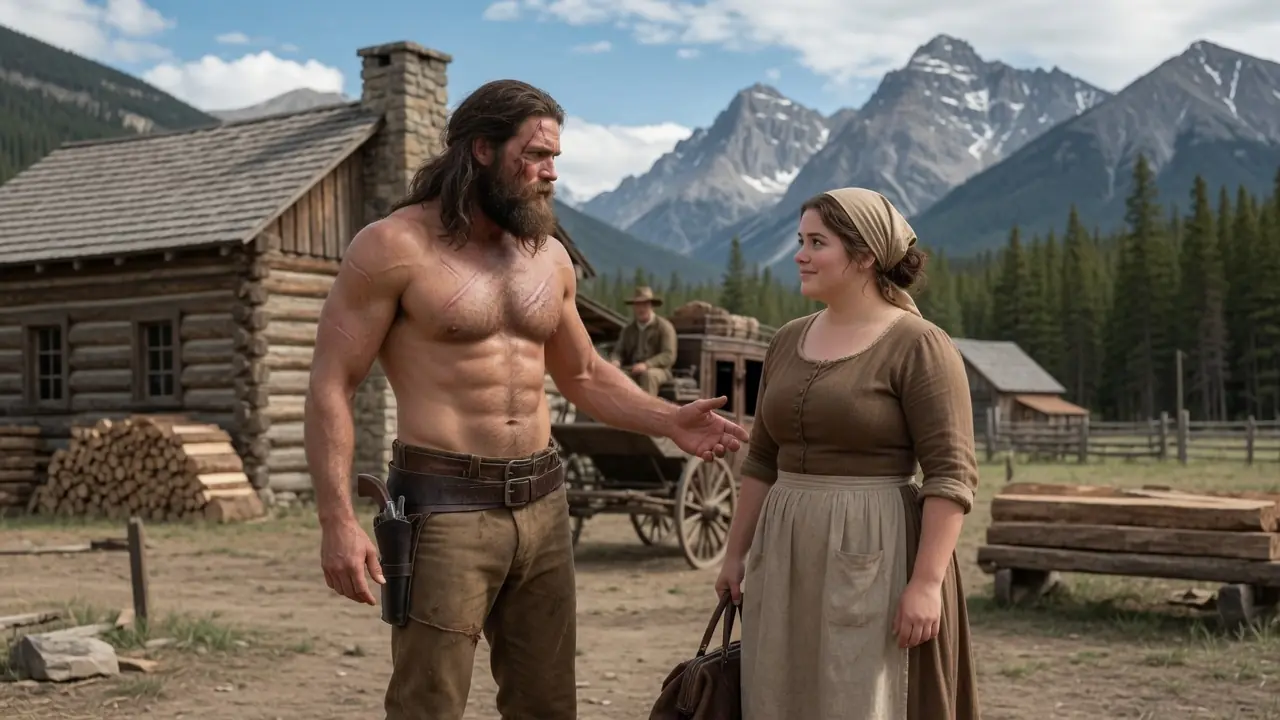
At forty-three, he looked as if the mountain had built him from whatever rough materials it had available. He stood well over six feet, with shoulders broad enough to fill a doorway and hands large enough to make an ordinary coffee cup look like a child’s toy.
A horse had broken his nose years earlier.
A falling branch had opened his left eyebrow.
A lifetime of wind, cold, and outdoor labor had cut deep lines into his face.
Children sometimes hid when he entered the trading post.
Strangers watched him carefully.
Dogs approached with caution.
But Callum’s eyes betrayed the rest of him.
They were warm brown, steady and patient, the kind of eyes that noticed when a horse favored one leg or when an exhausted traveler had not eaten.
Most people never looked long enough to see them.
Callum lived on a ridge above the Flathead Valley in a cabin he had built with his own hands. It began as one room and became three over sixteen years. A stone fireplace heated it through winter. A deep porch faced west toward a valley where the sunset arrived each evening in copper, violet, and gold.
Callum watched it alone.
That was the part of solitude he hated most.
Beauty experienced alone eventually became another form of grief.
He did not want a servant.
He did not want someone merely to cook, clean, or bear children.
He wanted a voice in the cabin besides his own. Someone who might sit beside him while the light faded and say what she noticed.
The marriage correspondence service had seemed practical.
There were no eligible women living within easy riding distance. The women who saw him in town rarely looked twice unless they were making certain he was not following them.
A newspaper advertisement allowed people to meet through words before appearances interfered.
At least, that was the hope.
Callum wrote honestly.
He owned land, livestock, and a well-built cabin.
He did not drink heavily.
He had no debts.
He could provide food, shelter, and protection.
He was quiet, hardworking, and not handsome.
The advertisement received more replies than he expected.
The women wrote about wanting adventure, fresh beginnings, and dependable husbands.
Then they arrived.
Adventure looked different when it required carrying water uphill.
A fresh beginning felt less romantic when snow blocked the road.
A dependable husband was difficult to appreciate when he looked capable of wrestling a bear and spoke only when he believed words were necessary.
After the fifth woman left, Callum packed the correspondence letters into a wooden box and pushed it beneath his bed.
Winter came early.
Snow sealed the mountain road.
For four months, he saw no one except a timber hauler who passed twice and a trapper who stayed one night during a storm.
The cabin felt larger after disappointment.
Every empty chair seemed to accuse him.
By February, Callum accepted what the five women had taught him.
Some men were built for company.
Others were built to endure its absence.
Then, in March of 1873, the owner of the valley trading post sent a letter up the mountain with a freight driver.
Callum turned the envelope over several times before opening it.
The handwriting was direct and heavy, each line pressed firmly into the paper.
The letter came from a woman named Ruth Fairchild in Iowa.
She had seen his old advertisement reprinted in a newspaper humor column. The editor apparently found the story of five departed brides amusing.
Ruth did not.
Her letter contained none of the careful charm Callum had learned to distrust.
She wrote that she was thirty-seven years old.
She was not beautiful.
She was large.
Not tall, she explained. Broad, heavy, and strong.
People had called her “too much” since girlhood.
Too loud when she laughed.
Too large for fashionable dresses.
Too opinionated for polite conversation.
Too capable for men who preferred women to appear helpless.
Her father died when she was fifteen. She helped her mother manage a boardinghouse for twenty-two years. She cooked for as many as thirty people a day, kept accounts, repaired clothes, preserved food, treated minor injuries, and removed drunken men when they forgot how to behave.
She could chop wood.
Carry water.
Dress game.
Set a broken finger.
Bake bread worth traveling for.
She did not expect poetry, compliments, or delicate courtship.
She expected honest work, a secure home, and the basic dignity of being treated as a person rather than an apology.
The final lines made Callum read the letter three times.
I understand that you have difficulty keeping wives.
I have difficulty being wanted.
Perhaps our difficulties are compatible.
Callum sat at his table long after the fire burned low.
Then he took out a clean sheet of paper.
He considered writing about the mountain, the winters, and his failures with the previous women.
Instead, he wrote one word.
Come.
Ruth arrived on a Tuesday afternoon in April.
Callum waited beside the trading post while the stagecoach descended through the valley.
He had not polished his boots.
He had not trimmed his beard.
He had not borrowed a better coat.
He had done those things five times before and learned that preparation did not change a person’s first reaction to him.
The stage stopped in a cloud of dust.
A man climbed down first.
Then a woman appeared in the doorway.
Ruth Fairchild was exactly as she had described herself.
She was broad through the shoulders and hips, with a body built for labor rather than display. Her brown dress was plain, sturdy, and properly fitted instead of being designed to hide her. Her round face was reddened from travel. Brown hair was pinned away from her eyes with practical care.
She carried one leather bag.
The driver attempted to lift it.
Ruth took it from him without effort.
Then she saw Callum.
She stopped.
Callum had witnessed that pause before.
It was the moment when expectation became regret.
Ruth studied his height.
His beard.
His scars.
His hands.
Finally, she looked directly into his eyes.
“You are larger than I expected,” she said.
“So are you.”
The answer escaped before Callum could stop it.
He waited for offense.
Ruth stared at him.
Then she laughed.
Not a polite, controlled laugh.
A full, deep sound that rolled across the trading post yard and startled two horses.
Callum had never heard a woman laugh that way in his presence.
“Well,” she said, still smiling, “at least neither of us can accuse the other of false advertising.”
He took her bag.
She allowed it, though he suspected she did not need the help.
They traveled up the mountain in Callum’s wagon.
Ruth spent the first mile studying the valley.
Pines climbed the slopes. Meltwater flashed between rocks. The late-afternoon sun touched the distant snowfields.
“It is beautiful,” she said.
“It is isolated.”
“I know.”
“The town is two hours in good weather.”
“I read your letter.”
“The road closes during winter.”
“I can count snow.”
“You will hear wind, animals, and me. I do not speak much.”
Ruth looked toward him.
“I have spent thirty-seven years surrounded by people who spoke over me, around me, and about me. Silence may be an improvement.”
Callum almost smiled.
Almost.
The cabin appeared near sunset.
Ruth climbed down from the wagon and studied it.
Callum watched her face.
The others had seen poverty, distance, or imprisonment.
Ruth saw the roofline.
The chimney.
The root cellar.
The barn.
“Does the chimney draw properly?”
“Yes.”
“The roof leak?”
“Only over the rear room during heavy rain.”
“The cellar flood?”
“Sometimes in spring.”
“You have a stove?”
“Cast iron.”
She nodded.
Then she walked inside.
Callum followed.
Ruth stood in the kitchen with both hands on her hips.
The room was functional but disordered. Iron pans hung without pattern. Flour was stored beside lamp oil. Dried beans occupied three separate shelves. A sack of potatoes had begun growing pale roots beneath the table.
Ruth opened the pantry.
Then the cupboards.
Then the stove.
Callum waited for judgment.
She turned toward him.
“The cabin needs work.”
He nodded.
“The kitchen needs a system.”
Another nod.
“The pantry appears to have survived a small war.”
“That may be accurate.”
She looked him over.
“And you need a proper meal.”
“I ate this morning.”
“What?”
“Coffee.”
“That is a drink.”
“Bread.”
“What kind?”
Callum pointed toward a hard loaf near the stove.
Ruth picked it up and struck it against the table.
The loaf made a sound like timber.
She looked at him.
“Sit down.”
“This is my house.”
“Yes.”
“My table.”
“Yes.”
“My chair.”
“Then you should be familiar with sitting in it.”
Callum sat.
Ruth began cooking.
She moved through the kitchen with the authority of a general entering a badly managed campaign.
She found onions, dried meat, beans, potatoes, and herbs Callum had been walking past for years without recognizing as food.
Within an hour, the cabin smelled different.
Warm.
Rich.
Alive.
Ruth placed a bowl of stew before him.
“This will not be my best work,” she said. “I have not yet determined the full extent of your supplies.”
Callum took one bite.
Then stopped.
Ruth watched him.
“Is something wrong?”
“No.”
“Then continue.”
He did.
The stew was the finest meal he had ever eaten.
Not because the ingredients were rare.
Because each one tasted as though someone had paid attention to it.
Ruth knew exactly what his silence meant.
She did not ask for praise again.
That night, Callum gave her the bedroom.
He prepared to sleep near the fireplace.
Ruth stood in the doorway holding a folded blanket.
“We have not discussed terms.”
Callum looked up.
“Terms?”
“I did not travel this distance to become a temporary housekeeper while you decide whether I am suitable.”
“I would not do that.”
“Five women left.”
“They chose to.”
“And if I choose to stay?”
Callum rose.
He did not know how to answer without revealing too much hope.
“You may stay as long as you wish.”
“That is not a proposal.”
“No.”
“Do you intend to make one?”
“If you still want one after you understand this life.”
Ruth considered him.
“How long will that take?”
“A season.”
“Too long.”
“A month.”
“Two weeks.”
Callum blinked.
Ruth continued.
“In two weeks, I will know whether the cabin is survivable, whether you are honest, whether you become cruel when angry, and whether your habits can be corrected.”
“My habits?”
“We will address those tomorrow.”
“And what will I learn?”
“Whether I am useful, tolerable, and willing to remain.”
Callum shook his head.
“I already know you are useful.”
Ruth narrowed her eyes.
“That is not the same as being wanted.”
The truth of it struck him.
He lowered his gaze.
“No.”
“Two weeks,” she repeated.
“Two weeks.”
The first days found their rhythm quickly.
Ruth reorganized the kitchen.
Callum repaired the cellar drainage.
She baked bread.
He built shelves.
She cleaned sixteen years of soot from the rear wall.
He replaced the leaking roof boards.
They worked separately but within sight of each other, learning through observation.
Ruth discovered Callum was gentle with animals.
One morning, a young mare kicked him while he treated a hoof injury. The blow sent him against the stable wall.
Ruth expected anger.
Callum only waited for the horse to calm before trying again.
“She is frightened,” he explained.
“She nearly broke your ribs.”
“That would not make her less frightened.”
Callum discovered Ruth’s confidence had limits.
She could manage a kitchen, negotiate prices, and carry a flour sack without help.
But the mountain’s steep paths unsettled her.
On the fourth day, she slipped near the creek.
Callum caught her arm.
Ruth pulled away immediately.
“I can manage.”
“I know.”
“You do not need to drag me like cargo.”
“I wasn’t.”
Her face reddened.
Callum understood too late.
Ruth had spent her life hearing jokes about her size. Help often arrived wrapped in humiliation.
He released her.
“The ground is loose near the water,” he said. “It took me three falls to learn that.”
“You fell?”
“Frequently.”
She looked at him.
“A man your size?”
“Gravity respects no one.”
Ruth laughed.
The tension passed.
On the seventh night, snow began falling unexpectedly.
By midnight, the wind was strong enough to shake the shutters.
Callum secured the barn while Ruth covered food and filled every available container with water.
The temperature dropped.
A section of chimney mortar cracked.
Smoke entered the cabin.
Callum climbed onto the roof with a rope around his waist.
Ruth held the other end from below.
“You will fall,” she shouted.
“Not if you hold.”
“That is a great deal of confidence in a woman you met one week ago.”
“I have seen you carry flour.”
He repaired the chimney in darkness while snow struck his face.
When he returned inside, his hands were blue with cold.
Ruth dragged him toward the fire.
She removed his wet coat, wrapped his fingers in warm cloth, and scolded him continuously.
“You could have waited until morning.”
“We would have breathed smoke all night.”
“We could have opened a window.”
“Then we would freeze.”
“Freezing is slower than falling from a roof.”
Callum looked at her.
Ruth’s hands trembled.
Not from cold.
From fear.
“You thought I would die.”
“Do not sound pleased.”
“I’m not.”
He studied her face.
“No one has worried about me in a long time.”
Ruth stopped moving.
The anger left her.
“Well,” she said quietly, “someone does now.”
Neither spoke after that.
The storm lasted two days.
They spent the second evening near the fire.
Ruth repaired a shirt.
Callum sharpened tools.
The silence between them did not feel empty.
That surprised them both.
“What happened to the other women?” Ruth asked.
Callum continued working.
“You know.”
“I know why they claimed to leave.”
He looked toward her.
“What does that mean?”
“People rarely tell the full truth when leaving. They tell the version that allows them to feel reasonable.”
Callum set down the sharpening stone.
“Helen wanted a town.”
“Reasonable.”
“Margaret feared the silence.”
“Also reasonable.”
“Dorothy said living with me felt like living inside a bear.”
Ruth’s mouth twitched.
“I understand the comparison.”
“Catherine cried.”
“And Sarah?”
“She saw me and left.”
Ruth placed the shirt in her lap.
“That one was about you.”
“Yes.”
“Did it hurt more because she did not bother pretending otherwise?”
Callum stared into the fire.
“Yes.”
Ruth waited.
“I frightened her.”
“You frighten many people.”
“I know.”
“You frightened me.”
He turned sharply.
“When?”
“At the trading post.”
“You laughed.”
“Fear and laughter can occupy the same body.”
Callum looked away.
“Then why did you come?”
“Because fear is not always instruction.”
Ruth’s voice softened.
“Sometimes it is merely unfamiliarity wearing a loud coat.”
She picked up the shirt again.
“I watched how you held my bag. You carried it without taking it from me until I allowed you. I watched how you drove. You slowed for every hole before the wagon struck it. I watched your horses. Animals do not relax around cruel men.”
Callum said nothing.
“You look dangerous,” Ruth continued. “That is not the same as being dangerous.”
“What do I look like to you now?”
She considered him carefully.
“Tired.”
He laughed once.
“And kind.”
The word unsettled him more than insult ever had.
At the end of two weeks, Callum woke before dawn.
Ruth was already in the kitchen.
A loaf cooled near the window.
Her bag sat beside the door.
Callum stopped.
The sight opened something cold inside his chest.
“You packed.”
“Yes.”
He forced himself to breathe normally.
“The stage comes Friday.”
“I know.”
“I can take you down tomorrow.”
Ruth turned.
“Do you want me to leave?”
“No.”
The answer came immediately.
Ruth waited.
Callum’s hands opened and closed at his sides.
“I do not know how to ask properly.”
“Try badly.”
He looked at the woman who had filled his kitchen, challenged his habits, worried over his hands, and made the silence comfortable.
“Stay.”
“For how long?”
“As long as either of us lives.”
Ruth’s expression remained still, but her eyes changed.
“That sounds almost like a proposal.”
“It is the best one I have.”
“What are you offering?”
“The cabin.”
“I have improved it considerably.”
“The land.”
“I cannot eat land.”
“My work.”
“I have seen it.”
“My loyalty.”
She became quiet.
Callum continued.
“I cannot promise comfort. Winter is difficult. Crops fail. Animals die. I am silent too often and stubborn almost always.”
“Accurate.”
“I have no fine words.”
“Also accurate.”
“But I will not shame you.”
Ruth looked down.
“I will not ask you to become smaller,” he said. “I will not treat you as though your strength makes you less of a woman. I will listen when you speak, even when I disagree.”
“Especially then.”
“Especially then.”
He stepped closer.
“And I want you here.”
Ruth’s eyes filled.
She looked toward the bag.
“I packed because I decided I would not remain as a guest.”
Callum frowned.
She opened it.
Inside were folded cloth, sewing tools, and a small wooden box.
“I intended to move my things into your room after you proposed.”
Callum stared at her.
“You knew?”
“I suspected.”
“What if I had not asked?”
“I would have unpacked anyway and forced the conversation by supper.”
He laughed.
Ruth smiled through her tears.
“Well?”
Callum took her hands.
They nearly matched his in strength, though not size.
“Ruth Fairchild, will you marry me?”
“Yes.”
They married in May.
The ceremony took place on the porch.
The trading post owner came as witness. A traveling preacher read the scripture. Two timber workers brought whiskey and wildflowers.
Ruth wore the same brown dress she had arrived in.
Callum wore a clean shirt and trimmed his beard enough to reveal part of his face.
The ring was made from polished copper.
Callum had shaped it three times before achieving the correct size.
Ruth slid it onto her finger.
“It fits,” she said.
“It does.”
They both understood she meant more than the ring.
Marriage did not turn their life into a frontier romance free of hardship.
The first year tested them repeatedly.
A late frost killed much of the vegetable garden.
A bear entered the smokehouse.
One horse broke through a fence.
Callum injured his shoulder while cutting timber and could not lift his left arm for six weeks.
Ruth managed the animals, hauled water, cooked, and threatened him with bodily harm each time he tried to work before healing.
They argued.
Ruth thought Callum took unnecessary risks.
Callum believed Ruth tried to control every problem personally.
Neither was entirely wrong.
Their arguments were loud enough to alarm passing travelers.
But neither used cruelty as a weapon.
Callum never insulted Ruth’s body.
Ruth never used his loneliness against him.
They learned that respect was not the absence of anger.
It was the refusal to destroy something valuable merely because anger was present.
During their second winter, a rider arrived from the valley during a blizzard.
His horse collapsed near the barn.
Callum carried the unconscious man inside.
Ruth treated his frostbitten hands and fed him broth through the night.
The rider survived.
Word spread that the Breck cabin offered shelter to travelers trapped by weather.
Over the next several years, their porch became known throughout the valley.
Miners stopped for food.
Families moving west rested their animals.
Lost hunters found warmth.
Ruth never turned away anyone hungry, though she charged rude men twice the normal amount for a meal.
Callum built an additional room.
Then another.
“What are we becoming?” he asked one evening.
“A proper household,” Ruth replied.
“This resembles an inn.”
“Then build more beds.”
He did.
Ruth’s cooking became famous before either of them realized it.
Travelers altered routes to reach the mountain kitchen.
Her bread became the subject of exaggerated stories. One man claimed it had cured his grief. Another said it persuaded him not to return to his wife.
Ruth informed him that any bread powerful enough to destroy a marriage would cost extra.
Callum watched people gather around their table.
The cabin he once believed was too remote slowly became a destination.
Not because the mountain changed.
Because Ruth made it feel possible to arrive.
Three years after their marriage, Ruth became pregnant.
At forty, she knew the risks.
She did not speak of them often.
Callum worried enough for both of them.
He hovered until Ruth threatened to make him sleep in the barn.
Their daughter was born during a summer thunderstorm.
A midwife came from the valley and remained two days.
The labor lasted through the night.
Callum sat outside the bedroom door, helpless and pale.
When the baby finally cried, the sound filled every room.
The midwife opened the door.
“You have a daughter.”
Callum entered slowly.
Ruth looked exhausted, angry, and more beautiful than anyone he had ever seen.
A large, healthy infant rested against her chest.
“She is loud,” Callum whispered.
“She is ours.”
They named her Hope.
Not because their lives had suddenly become easy.
Because hope had arrived before proof.
It came in a letter from Iowa.
In a one-word reply.
In a woman stepping from a stagecoach and laughing instead of turning away.
Years passed.
Hope grew up between the cabin, barn, and valley.
She inherited Callum’s height, Ruth’s voice, and the stubbornness of both.
By ten, she could ride better than most grown men.
By twelve, she could prepare bread and repair a broken harness.
By fourteen, she informed her parents that she intended to become a doctor.
Ruth asked where she would obtain training.
Hope said she would find a way.
Callum believed her.
Travelers continued telling the story of the five women who left the mountain man.
The tale changed depending on the speaker.
Some said Callum was so ugly horses refused to look at him.
Others claimed Ruth was the only woman in three territories strong enough to survive his cooking.
The Brecks laughed whenever they heard a new version.
Ruth never spoke badly of the women who left.
“They were not weak,” she told Hope. “They simply wanted another life.”
“Then why did you stay?”
Ruth looked toward Callum repairing a fence.
“Because I did not need him to become smaller.”
Hope considered that.
“And he did not need you to become smaller?”
“Exactly.”
Many years later, when Callum’s beard had turned completely white and Ruth’s knees no longer tolerated mountain paths, they still sat together on the porch each evening.
The valley had changed.
More houses stood below.
The road improved.
The nearest town grew larger.
The mountain remained.
One evening, the sunset arrived in bands of red and gold.
Callum watched quietly.
Ruth sat beside him beneath a heavy blanket.
“You still stare at it as though it owes you money,” she said.
He smiled.
“It took a long time to pay.”
Ruth rested her head against his shoulder.
“Was it worth waiting?”
“For the sunset?”
“For me.”
Callum turned toward her.
The woman who once believed she would never be wanted had become the center of everything he considered home.
“You did not make the loneliness disappear,” he said.
Ruth lifted her head.
“That is not a very romantic answer.”
“You made me understand why it hurt.”
She waited.
“Because I had been saving room for you.”
Ruth became quiet.
Then she took his hand.
Callum had spent much of his life believing he was too large, too rough, and too difficult to fit anywhere another person might remain.
Ruth had spent hers being told she occupied more space than a woman deserved.
The world tried to reduce them both.
The mountain did not.
It had room for Callum’s silence.
Ruth’s laughter.
Their arguments.
Their work.
A daughter named Hope.
A kitchen filled with travelers.
And two old chairs on a porch facing a sunset that was no longer wasted on one pair of eyes.
The five women who left had not failed.
Neither had Callum.
They had simply reached a life that did not fit them and possessed the courage to admit it.
Ruth fit differently.
Not neatly.
Not quietly.
Not by changing herself into the woman Callum thought a wife should be.
She fit the way a foundation fits beneath a house—broad, strong, largely unseen by outsiders, and essential to everything built above it.
Callum fit beside her not because he became polished or handsome.
He remained rough.
Scarred.
Silent.
He simply stopped mistaking roughness for unworthiness.
Their love was not proof that there was a perfect person waiting for everyone.
It was proof that sometimes two people rejected for taking up too much space can build a life large enough to hold them both.
Five women came to Callum Breck’s mountain and left before the week was over.
The sixth arrived, looked at his cabin, looked at him, and said they both had work to do.
She stayed because the work was real.
Because the respect was real.
And because, for the first time in either of their lives, neither person was required to become less in order to be loved.
The mountain held them.
But more importantly, they held each other.