The North Fork Gas and Market looked like a place forgotten by every map except the ones used by exhausted truckers.
It stood beside a narrow highway in western Montana, surrounded by dark pine forests and low mountains that disappeared whenever the weather turned bad. The parking lot was cracked, the fuel pumps were older than some of the customers, and the fluorescent lights inside gave everything a pale, sleepless glow.
At 2:17 on a rainy Thursday morning, Mara Vance stood behind the counter arranging energy drinks into perfectly even rows.
Labels forward.
Equal spacing.
No gaps.
She worked the night shift because almost no one came in after midnight. Fewer customers meant fewer conversations, fewer questions, and fewer chances for anyone to remember her face.
For eleven months, Mara had lived in the nearby town of Red Hollow without attracting attention.
To the people there, she was simply the quiet woman who worked nights at the gas station.
She wore plain jeans, dark hooded jackets, and inexpensive boots. She paid cash whenever possible. She owned no social media accounts and never volunteered personal information.
People believed she was shy.
Mara preferred that explanation.
Rain whispered against the wide front windows. Beyond the glass, the empty parking lot shimmered beneath the canopy lights.
The bell above the door chimed.
Deputy Owen Mercer entered, removing his wet campaign hat and shaking droplets from the brim.
“Evening,” he said.
Mara glanced at the clock.
“Morning.”
Owen smiled and walked toward the coffee machine.
He was one of the few people in Red Hollow who had tried more than once to learn something about her. He asked about her childhood, whether she had family nearby, and why she had chosen a dying town in Montana.
Mara always answered without truly answering.
Coffee was easier.
“Fresh pot,” she said.
Owen filled a paper cup and leaned against the counter.
His elbow brushed a cardboard display.
Three cans tipped forward.
Mara’s hand moved.
She caught all three before they fell.
The movement was too fast.
Too controlled.
The cans landed silently in her palm.
Owen raised his eyebrows.
For half a second, Mara saw the question forming.
She deliberately loosened her grip.
One can slipped and struck the floor.
“Butterfingers,” she said.
Owen watched her bend down and retrieve it.
“You ever play softball?”
“No.”
“We could use someone with reflexes like that.”
“I’m not much of a joiner.”
“That much I figured out.”
He drank his coffee, still studying her.
Then his expression became more serious.
“Heard something on the county channel tonight. Motorcycle crew caused trouble near Elk Ridge.”
Mara returned the can to the display.
“What kind of trouble?”
“Assaulted a bartender. Tore up a motel room. Calls themselves the Jackals.”
Her fingers paused briefly.
Owen did not notice.
“The leader goes by Rourke,” he continued. “Most of them have military backgrounds. Dishonorable discharges, weapons charges, that sort of thing.”
“They coming this way?”
“Maybe. Highway patrol thinks they’re moving west.”
Mara looked toward the security monitors mounted beneath the counter.
Four camera views displayed the pumps, rear delivery entrance, storage room, and parking lot.
“They’ll probably pass through,” she said.
“I hope so.”
Owen set several dollars beside the register.
“Keep the doors locked.”
“I always do.”
He placed his hat back on his head.
“Softball registration closes Friday.”
Mara almost smiled.
“Good night, Deputy.”
When he left, she watched his cruiser disappear into the rain.
Then she remained at the window for another thirty seconds, listening.
No other engines.
No movement among the trees.
Only rain.
At seven that morning, Mara locked the store and began the three-mile walk to her trailer.
She owned an old pickup, but walking allowed her to notice changes along the road. Tire tracks. Broken branches. Vehicles that appeared too often.
Her trailer sat alone near the edge of an abandoned lumber yard.
Inside, it looked less like a home than a temporary command post.
One table.
One chair.
A narrow bed.
No framed photographs.
No decorations.
Nothing she could not abandon in less than five minutes.
Three canvas bags rested beneath the bed. One contained cash and clothing. The second held medical supplies and several unregistered phones. The third was locked.
Mara checked the front door, rear door, and loose kitchen panel leading beneath the trailer.
Only after confirming all three exits did she remove her boots.
The single personal object in the room was a worn collection of poems by W. H. Auden. Notes filled the margins in tight handwriting.
Mara placed it beside the bed.
Then she swallowed one tablet from an orange prescription bottle and lay down.
Sleep came quickly.
Peace did not.
She smelled smoke before the dream fully formed.
A village beneath a gray foreign sky.
Children running between stone houses.
A radio operator shouting that the coordinates were wrong.
Then aircraft passing overhead.
The first explosion.
Windows becoming white fire.
Mara woke before the alarm, one hand reaching beneath the mattress.
Her breathing was controlled, but sweat dampened the back of her neck.
For several seconds, she did not know where she was.
Then the Montana wind pushed against the trailer wall.
The village vanished.
Three uneventful days followed.
No bikers.
No unfamiliar vehicles.
Routine returned, and Mara allowed herself to believe that Owen had been right.
Perhaps the Jackals were moving west.
Perhaps Red Hollow would remain too small and unimportant for anyone to search.
On the fourth night, Mara finished her shift shortly after two.
The rain had returned, lighter now, floating through the fuel-station lights as silver mist.
She bought eggs, bread, instant coffee, and another prescription refill.
The small grocery bag rested against her hip as she crossed the parking lot.
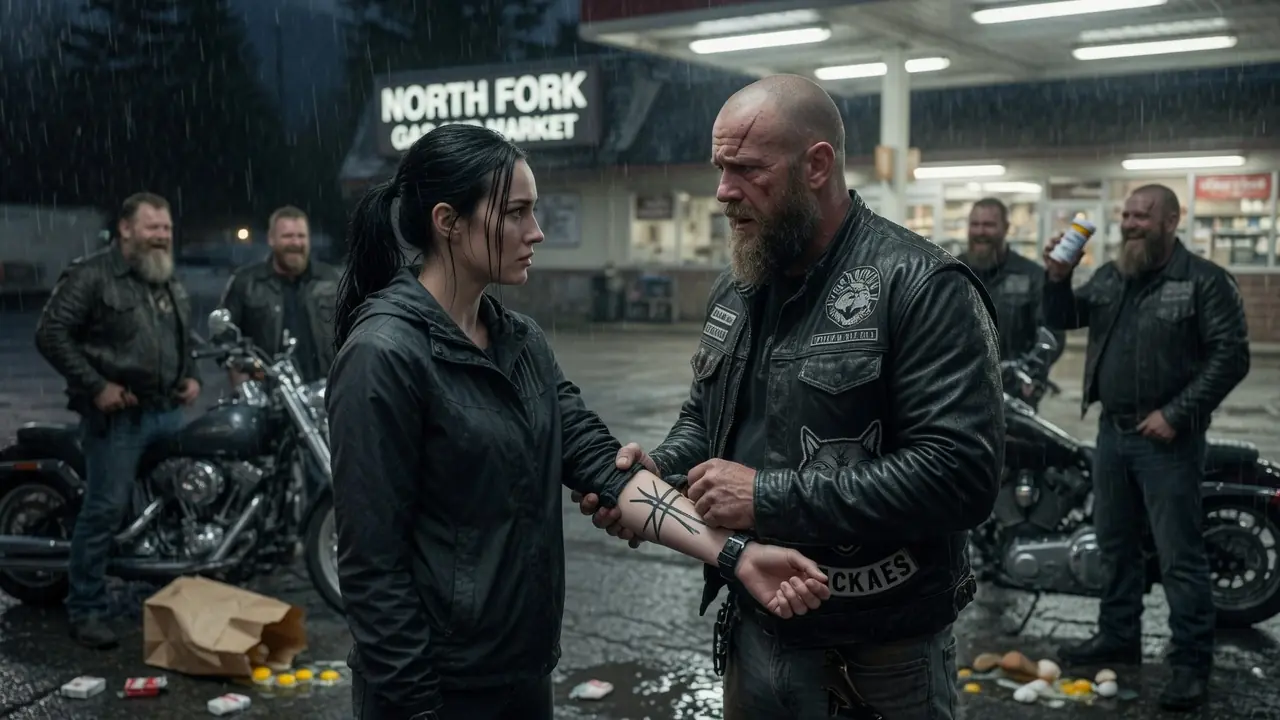
Halfway to the road, the darkness changed.
Engines growled beyond the edge of the light.
Five motorcycles emerged from the rain.
They entered the lot in a wide formation and surrounded her before she could reach the store.
The riders revved their engines once.
Then all five shut them down.
The resulting silence felt staged.
Mara stood still.
Her eyes measured the distances automatically.
Twenty feet to the entrance.
Fourteen to the nearest pump.
A propane cage behind her.
Wet pavement.
Five men.
At least three visible weapons.
The rider in front removed his helmet.
He had a shaved head, a thick beard, and a jagged scar passing through his right eyebrow. His leather jacket displayed a wolf devouring a bleeding heart.
Rourke.
Mara recognized him from a classified personnel photograph taken nearly seven years earlier.
His real name was Carter Wynn.
Former infantry sergeant.
Expelled after weapons disappeared from a coalition supply depot.
The official record described him as unstable and violent.
The unofficial record was worse.
“Well,” Rourke said. “Look what we found.”
The other riders dismounted.
They spread into a loose crescent, cutting off the road and the store.
Mara kept her voice even.
“I’m going home.”
“You work here?”
“Yes.”
“Place open?”
“Not until six.”
Rourke stepped closer.
“Then maybe you can make an exception.”
“I can’t.”
He smiled.
“Can’t or won’t?”
Mara looked at the space between his boots.
His balance favored the left leg.
Old knee injury.
His right hand remained near the inside of his jacket.
“Move your motorcycles,” she said.
The men laughed.
Rourke circled her slowly.
“You’re polite. I like that.”
He struck the grocery bag from her hand.
Eggs, bread, and the orange medicine bottle scattered across the wet pavement.
One rider bent down and picked up the bottle.
He read the label.
“Paroxetine.”
Another laughed.
“What’s that for?”
“Depression,” the man said. “Anxiety. Post-traumatic stress.”
Rourke’s expression sharpened.
“Military?”
Mara said nothing.
He seized her left wrist.
His grip was deliberate, testing rather than restraining.
Mara allowed him to pull her sleeve upward.
A faded tattoo appeared beneath her watch.
Three black lines intersecting a broken circle.
Rourke stopped smiling.
The other men watched him.
“What is it?” one asked.
Rourke turned Mara’s wrist toward the light.
“Special Activities Division.”
He looked into her face.
For the first time, the drunken amusement vanished from his eyes.
“Lieutenant Mara Vance.”
Her breathing remained unchanged.
Rourke leaned closer.
“Back from the dead.”
The helmet camera attached to another biker’s motorcycle blinked red.
Mara noticed it immediately.
Someone wanted a record.
Not for social media.
For confirmation.
Rourke tightened his hand around her wrist.
“He’s been searching for you.”
Mara’s expression hardened.
“Who?”
“You know who.”
“Say the name.”
“Commander Adrian Vale.”
The rain tapped softly against their jackets.
Operation Nightglass returned to her in fragments.
A falsified intelligence report.
A village identified as a weapons compound.
Forty civilians.
A team that discovered the truth too late.
Then an ambush three days later.
The official report declared every member of Mara’s unit dead.
Mara had spent five years ensuring the world continued to believe it.
Rourke smiled again.
“Vale thought you might crawl out eventually.”
“Tell him he should have left the grave closed.”
“We’re taking you with us.”
“No.”
The word was almost gentle.
Rourke tilted his head.
“You think you have a choice?”
Mara loosened her fingers.
Her weight shifted slightly onto the balls of her feet.
“I’m giving all five of you one chance to leave.”
The bikers laughed.
Rourke pulled her closer.
“Do you still move like the woman in the reports?”
Mara looked toward the blinking helmet camera.
Then back at him.
“You are about to find out.”
Rourke’s grin widened.
That was his last mistake.
Mara did not attempt to pull her wrist away.
She moved toward him.
The sudden change collapsed the tension in his grip. Her free hand struck beneath his throat with controlled precision.
Rourke released her and stumbled backward, choking.
The largest biker charged from the left.
Mara stepped outside his path and redirected his momentum into his own motorcycle. His knee struck the frame, and both man and machine crashed onto the pavement.
A third biker produced a knife.
Mara closed the distance before he could extend his arm. She struck the wrist, turned his shoulder, and sent the weapon sliding beneath a parked truck.
The fourth man grabbed her from behind.
She lowered her center of gravity and twisted out of his hold, dropping him hard enough to end the attempt without breaking his neck.
The fifth rider remained still longer than the others.
That made him the most dangerous.
His hand moved smoothly into his jacket.
Mara crossed the space between them before he completed the draw. She disabled his wrist and drove the air from his lungs. A compact pistol fell onto the wet ground.
She kicked it away.
The fight lasted only seconds.
When it ended, five men lay across the parking lot in various stages of shock, pain, and disbelief.
Mara remained standing.
Her breathing was steady.
She felt no triumph.
Only calculation.
No broken necks.
No fatal strikes.
No unnecessary damage.
The outcome was controlled.
Rourke remained on his knees, struggling to breathe.
Mara crouched before him and placed two fingers beside his windpipe.
“Slow breath through the nose.”
He tried to push her hand away.
She increased the pressure slightly.
“Do what I’m telling you.”
His body obeyed even while his eyes burned with hatred.
Air gradually returned.
“You’re dead,” he rasped.
“I’ve heard that before.”
“He won’t stop.”
“Neither will I.”
Mara turned toward the helmet camera.
The red light continued blinking.
She walked directly in front of it.
For almost a year, she had hidden beneath a cashier’s uniform, avoided photographs, and lowered her eyes whenever strangers stared too long.
That protection was gone now.
If Vale had sent the Jackals, disappearing again would only postpone the attack.
Mara looked into the lens.
“Commander Vale,” she said, “you are not hunting a ghost.”
She paused.
“You are pulling on a trip wire.”
Rourke coughed behind her.
Mara continued.
“Send anyone else, and the Nightglass files go to every major news organization in the country.”
One biker began crawling toward a phone.
Mara placed her boot over it and slid it away.
“The original files,” she added. “Not the versions you altered.”
The helmet camera emitted a soft electronic chirp.
Upload complete.
Mara retrieved her medicine bottle and undamaged groceries.
Sirens rose in the distance.
Someone nearby had reported the motorcycles.
Rourke managed to stand against one of the fuel pumps.
“You think the police will believe you?”
Mara glanced at the station cameras.
“They don’t need to.”
She entered the store through the employee door.
At the back-office monitor, she confirmed that the external cameras had captured the encounter. The angle was wide and imperfect, but enough to show who had surrounded whom.
She removed the local memory card.
The footage from the helmet camera would provide Vale with her face.
The missing store card would tell him she still understood counterintelligence.
She left the drawer open deliberately.
Then Mara walked out through the delivery entrance.
Red and blue lights reflected across the low clouds.
Deputies entered the parking lot from the opposite side.
Mara could have remained and given a statement.
She could have trusted Owen Mercer.
But once her name entered an official report, every system Vale controlled would locate her within minutes.
She crossed the road and entered the darkness beyond the fluorescent lights.
Behind her, officers shouted commands.
One of the Jackals attempted to explain what had happened.
Another groaned.
Rourke called through the rain.
“He’s coming for you!”
Mara did not turn around.
“Then he knows where to look.”
Five miles from the gas station, she stopped beneath a dripping pine tree.
The adrenaline finally reached her hands.
A small tremor began.
She closed her fingers until it passed.
North meant snow.
West meant mountains.
East meant open country.
South meant memories she had spent years avoiding.
For the moment, she chose motion.
By dawn, Mara had returned to her trailer.
She entered through the loose panel beneath the kitchen and climbed into the living area.
The evacuation took four minutes.
Cash.
Weapons.
Three encrypted drives.
Medical supplies.
False documents.
The sealed Nightglass archive.
She placed everything inside one duffel.
Her burner phone rang.
An unknown number.
Mara answered after the second ring.
“They found you.”
The voice was male and familiar.
“Ethan?”
Sergeant Ethan Cole had been part of her unit.
She had watched him disappear beneath smoke during the ambush. For years, she believed he had died with the others.
“Ghost Protocol is active,” he said. “You have hours, not days.”
“Vale?”
“He’s running the operation personally.”
“Where are you?”
“Not safe enough to answer.”
Mara zipped the duffel.
“The files are ready.”
“Once you release them, you can’t undo it.”
“There has been nothing to return to since Kazakhstan.”
A vehicle passed along the nearby road.
Mara watched its headlights through the blinds.
“They are tracking every known identity,” Ethan said. “You need to erase this one.”
“I already planned to.”
She ended the call.
Before leaving, Mara carried the poetry book to the neighboring trailer.
Mrs. Abernathy, a seventy-nine-year-old widow, had left soup outside Mara’s door during her first winter in town and never asked why she was alone.
Mara placed the book on her porch.
Inside it was a short note.
Some fights are worth being seen for. Thank you for treating me like I belonged here.
Mara walked two hundred yards into the trees.
Then she activated the device inside her trailer.
The explosion turned the building into a brief orange sun.
Windows rattled across the old lumber yard.
Mara kept walking.
The fire would suggest panic, death, or destroyed evidence.
She wanted Vale to believe whichever possibility delayed him longest.
Seven time zones away, helmet-camera footage from the Montana gas station played across multiple screens inside a restricted conference room near Washington.
Five bikers surrounded a lone woman.
Twelve seconds later, all five were on the ground.
General Robert Halvorsen paused the recording.
“Run facial recognition again.”
A junior officer swallowed.
“It has already confirmed twice.”
“Name.”
“Lieutenant Mara Vance. Special Activities Division.”
“That is impossible.”
“She was declared killed in action in 2019.”
The conference-room door opened.
Commander Adrian Vale entered.
His silver hair was cut close to the scalp. He wore no uniform, only a dark suit with a small defense-department pin.
Everyone stood.
Vale watched the footage once.
He paused at the moment Mara looked directly into the camera.
“Leave us,” he said.
Only intelligence officer Cassandra Price remained.
When the door closed, she opened a classified database.
“She downloaded the complete Nightglass archive before disappearing.”
Vale watched Mara’s face on the frozen screen.
“What does she have?”
“Original intelligence assessments, target changes, internal messages, casualty records, and authorization logs.”
“Does she know the village was deliberately misidentified?”
“Yes.”
“And the ambush?”
“She knows her team was sent into it after they attempted to report what happened.”
Vale’s jaw tightened.
“Who else survived?”
“We believed none.”
“Belief is no longer sufficient.”
Cassandra studied him.
“The parking-lot footage is spreading. Seventeen million views in six hours.”
“Then we have less time.”
“Sir, if we move openly against her now, people will ask questions.”
Vale turned away from the screen.
“Activate Ghost Protocol.”
Cassandra did not move.
“That authorizes capture or lethal force.”
“I know what it authorizes.”
“She is an American officer.”
“She is a national-security threat carrying classified material.”
“She is a witness.”
Vale faced her.
“Find her before she speaks.”
Thirty-six hours later, Mara sat inside a roadside motel three states away.
The curtains remained closed.
The television volume was low.
Her own face appeared beside the helmet-camera footage.
The headline beneath it read:
THE PARKING LOT GHOST — WHO IS SHE?
A news presenter described the unknown woman’s military-level fighting ability. Online speculation identified her as everything from a federal agent to a fugitive assassin.
Then the story changed.
A second headline crossed the screen.
LEAKED FILES RAISE QUESTIONS ABOUT 2019 CIVILIAN DEATHS IN KAZAKHSTAN.
Mara leaned forward.
Ethan had released the first package.
The anchor continued.
“Documents provided to several international news organizations suggest that intelligence used to authorize Operation Nightglass may have been knowingly falsified. More than forty civilians were reportedly killed.”
Mara’s secure phone rang.
“They issued a capture-or-kill order,” Ethan said.
“Through which authority?”
“Vale convinced senior command that you are attempting to compromise ongoing operations.”
“Have they read the files?”
“They don’t need to. You made them public. That was enough.”
Mara moved toward the window.
Across the street, a black SUV sat near a closed diner.
A man inside held a newspaper he had not turned for ten minutes.
Her phone vibrated with a message.
ALLEY BEHIND MOTEL. FIVE MINUTES. FRIENDLY.
“Ethan, did you send someone?”
“No.”
Mara ended the call.
A trap was likely.
Remaining inside was worse.
She removed the bathroom screen, lowered herself into the alley, and landed without sound.
A woman stood beneath a broken light.
Military posture.
Hands visible.
Eyes scanning the rooftops without turning her head.
“Cassandra Price,” Mara said from the shadows.
Cassandra looked toward her.
“We have two minutes.”
“Why are you helping me?”
“Because I read the Nightglass files.”
“All of them?”
“Including the sections you never received.”
Mara stepped closer.
“Vale ordered the ambush.”
“He transmitted the order.”
“That is the same thing.”
“No.”
Cassandra shook her head.
“He was following instructions from higher in the chain.”
“Who?”
“Secretary Raymond Carlisle.”
Mara felt no surprise.
Only confirmation.
“He authorized the false intelligence?”
“And the cleanup.”
Sirens sounded several blocks away.
Cassandra pointed down the alley.
“Blue Ford. Keys inside. Drive north.”
“They’ll know you helped.”
“They probably already do.”
“Come with me.”
“I need to slow them down.”
Mara studied her face.
Cassandra smiled faintly.
“Some fights are worth being seen for.”
Mara reached the Ford as tactical vehicles entered the motel parking lot.
She drove away without headlights until she reached the next road.
By sunrise, she abandoned the car behind a church and continued on foot.
Cassandra’s information changed everything.
Vale was not the top of the chain.
Exposing him alone would allow the people above him to survive.
Mara needed a platform they could not silence.
Two days later, she entered an old brick house in Georgetown.
Three United States senators waited inside without staff or cameras.
Senator Elena Delgado.
Senator Thomas Finch.
Senator Robert Winters.
Ethan stood beside the fireplace.
He was thinner than Mara remembered. A scar ran along his jaw, and he carried his left arm stiffly.
For several seconds, neither moved.
“They told me you were dead,” Mara said.
“They told me the same about you.”
“How did you survive?”
“I stopped breathing whenever they checked.”
He attempted a smile.
“Then I spent five years becoming useful enough for them not to notice me.”
“You sent the anonymous information.”
“Yes.”
Mara looked at the senators.
“Why are we here?”
Delgado answered.
“Because your scheduled classified testimony will disappear inside a secure archive.”
Finch pushed a folder across the table.
“Several witnesses connected to Nightglass have died during the last week.”
“Director Malcolm Kerr?” Mara asked.
“Found dead in federal custody,” Winters said. “Officially suicide.”
“Not likely.”
“We agree.”
Delgado opened the folder.
Inside were signed immunity agreements from the attorney general and protective orders covering Mara and Ethan.
“We are proposing a live press conference tonight,” she said. “Documents released simultaneously to the media, inspectors general, federal prosecutors, and international investigators.”
“No single agency can bury it,” Finch added.
Mara reviewed the signatures.
“What about Cassandra Price?”
No one answered immediately.
Then Ethan spoke.
“She was detained after you escaped.”
“Alive?”
“As of six hours ago.”
“Her protection is part of the agreement.”
Delgado nodded.
“We can add it.”
Mara closed the folder.
“One hour. Then we go live.”
The press conference began at midnight inside a hotel ballroom filled with cameras.
News networks from across the country carried it live.
Mara stood behind the podium wearing a dark suit. Ethan remained several feet behind her. The three senators stood to either side.
Microphones crowded the space before her.
Flashbulbs began.
Mara waited until the room quieted.
“My name is Lieutenant Mara Vance,” she said. “I served in the United States Special Activities Division.”
Pens stopped moving.
“In 2019, my team was ordered into a village in Kazakhstan under intelligence identifying it as a terrorist command center.”
She looked into the cameras.
“The intelligence was false.”
The room shifted.
“The location was a civilian village. Families lived there. Children lived there. More than forty people died.”
A reporter attempted to interrupt.
Mara continued.
“When my team discovered the target had been deliberately misidentified, we attempted to report the facts through official channels.”
Ethan lowered his eyes.
“Three days later, our unit was sent into an ambush using compromised coordinates. The attack was intended to eliminate every surviving witness.”
Mara held up a small encrypted drive.
“This contains the original intelligence, the altered documents, internal communications, and authorization records.”
“Who authorized the operation?” someone shouted.
“Commander Adrian Vale transmitted the order to silence my team.”
Camera shutters filled the room.
“He acted under the authority of Secretary of Defense Raymond Carlisle.”
The ballroom erupted.
Mara waited.
When the noise settled, she continued.
“Director Malcolm Kerr attempted to preserve evidence. He died in custody before he could testify.”
Another reporter shouted.
“Are you claiming the secretary ordered the killing of American soldiers?”
“I am not making a claim.”
Mara looked directly into the nearest camera.
“I am presenting records.”
Copies of the archive were released simultaneously.
Within minutes, news organizations began authenticating signatures and communication logs.
Federal agents arrested Carlisle before dawn.
Vale was detained several hours later.
Cassandra Price entered protective custody and agreed to testify.
Six months afterward, Mara appeared before a congressional committee.
For the first time in years, she wore her service uniform.
The ribbons on her chest had been hidden inside the locked bag beneath her bed in Montana. Now they rested openly beneath the bright hearing-room lights.
The gallery was full.
Families of the Nightglass team sat behind her.
Across the aisle were human-rights observers and representatives of the villagers’ surviving relatives.
Chairman Walter Wexler adjusted his microphone.
“Lieutenant Vance, why did you retain classified material rather than surrendering it through official channels?”
“Because every official channel I used led to another witness disappearing.”
“When did you decide to release it?”
“When I understood that silence was not protecting national security. It was protecting the people who committed the crimes.”
The rear doors opened.
Adrian Vale entered in restraints.
He looked older than he had on the Montana security footage.
His eyes found Mara.
There was no anger in them now.
Only exhaustion.
Wexler turned toward her.
“Do you have anything you wish to say to Commander Vale?”
Mara considered the question.
“No, sir.”
“Nothing?”
“The evidence has already spoken.”
Vale was led away.
The hearings resulted in criminal charges, resignations, military-review reforms, and new protections for whistleblowers who reported unlawful targeting.
No law could restore the dead.
No hearing could rebuild the village.
Mara understood that justice was not the same as repair.
It was simply the refusal to allow the lie to become permanent.
Six weeks after her final testimony, she arrived early at a community center in Virginia.
She arranged twelve folding chairs into a circle.
Equal spacing.
Clear access to the door.
A coffee pot stood on a side table.
The sign outside read:
VETERAN SUPPORT GROUP
ALL SERVICES — ALL ERAS — ALL WELCOME
Ethan entered while she was adjusting the final chair.
“You still line everything up like a briefing room.”
“People deserve equal access to the coffee.”
“That sounds official.”
He sat beside her.
More veterans arrived.
Some were young.
Others carried canes or wore faded unit caps.
All of them glanced toward the exits when they entered.
Mara recognized the habit.
A former Marine sat across from her, hands clasped between his knees.
When introductions began, Mara did not hide behind a false name.
“My name is Mara.”
She took a breath.
“I served in special activities. For years, I believed disappearing was the same as surviving.”
The group remained quiet.
“It wasn’t.”
A young veteran near the window looked at her.
“How do you stop seeing the people who didn’t come home?”
Mara thought of the village.
Her team.
The faces that appeared every time she slept.
“You don’t,” she said.
His shoulders dropped.
“That doesn’t sound hopeful.”
“It can be.”
She leaned forward.
“You cannot erase them. But you can choose what their memory asks you to do.”
“What does yours ask?”
“To speak when silence protects the wrong people.”
Rain began against the community-center windows.
The sound carried Mara back to the Montana gas station.
The humming lights.
Rourke’s hand around her wrist.
The moment the old tattoo appeared.
For eleven months, Mara had believed safety required invisibility.
Then five men arrived and tore away the disguise.
They thought they had exposed a frightened woman hiding from her past.
Instead, they revealed a witness who had finally become more dangerous to the guilty than any soldier carrying a weapon.
Ethan poured himself coffee.
“Good turnout,” he said quietly.
“They need this.”
“So do we.”
Mara looked around the circle.
Different wars.
Different losses.
The same haunted distance behind their eyes.
Outside, rain washed the pavement clean.
Inside the dark window, Mara saw her own reflection.
Not the quiet night clerk.
Not the dead lieutenant whose name remained buried in a classified report.
Not a ghost.
A woman sitting among other survivors, allowing herself to be seen.
For years, she had believed the most difficult part was staying alive.
She finally understood that survival had only been the beginning.
The harder question was what she would do with the life that remained.
Mara looked at the men and women waiting in the circle.
“This,” she said, “is what I’m doing with mine.”