“Take off that hat, old man.”
The voice carried across the roadside gas station beneath the hard afternoon sun.
Walter Mercer stopped beside Pump Four.
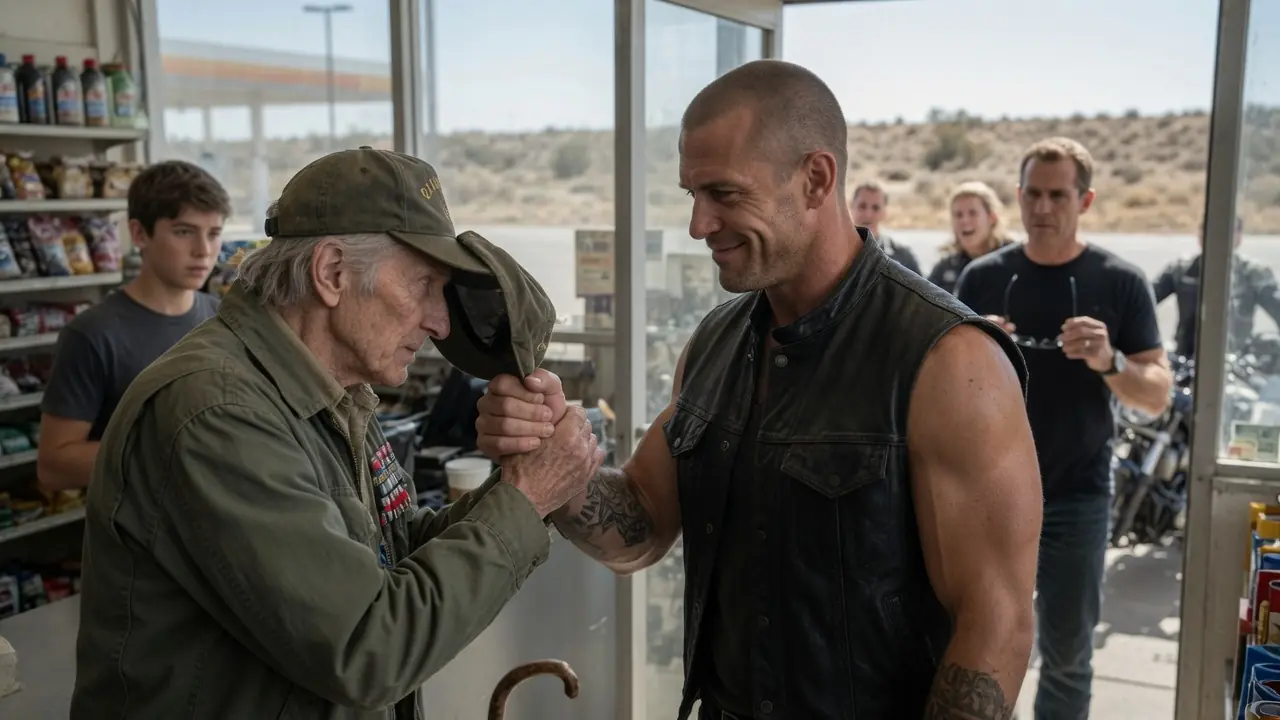
At seventy-seven, he moved carefully, placing most of his weight on a polished wooden cane. Silver hair showed beneath a faded green cap bearing the nearly worn-away emblem of the United States Marine Corps.
His dark field jacket was older than most of the men surrounding him. Several small service ribbons and two weathered medals remained pinned above the left pocket.
The five bikers had noticed him as soon as he arrived.
They sat astride polished motorcycles beside the convenience store, drinking from paper bags and filling the parking lot with loud voices. Their leather vests displayed the name Road Vultures across the back.
The largest of them, Cole Maddox, stepped away from his motorcycle.
He was in his early thirties, broad through the shoulders, with tattoos climbing both arms. He wore mirrored sunglasses and carried himself with the confidence of a man who had spent years choosing victims unlikely to fight back.
Walter continued toward the store.
Cole moved into his path.
“I said take it off.”
Walter looked at him.
“Why?”
“Because you don’t deserve to wear it.”
The other bikers laughed.
One of them pointed at the medals on Walter’s jacket.
“Those real, Grandpa? Or did you buy them online?”
Another reached for the brim of Walter’s cap.
The old Marine caught the younger man’s wrist.
The movement was not fast.
It was simply precise.
Walter’s hand trembled slightly from age, but his grip did not.
The biker’s grin disappeared.
For one quiet second, Walter stared into his eyes.
There was no rage in the old man’s face.
That would have been easier to understand.
Instead, there was something colder—the calm of a person who had experienced real danger and no longer confused noise with courage.
Walter released the wrist.
“Don’t touch the hat.”
Cole stepped closer.
The laughter behind him became louder.
“You threatening us?”
“No.”
Walter adjusted his cap.
“I’m asking you to behave like men.”
The laughter stopped for half a second before returning with greater force.
One of the bikers kicked Walter’s cane.
It spun across the oil-stained concrete and struck the base of a trash can.
Without the support, Walter staggered.
His shoulder hit the side of a newspaper box, and a sharp pain traveled through his left hip.
The men laughed again.
Inside the store, nineteen-year-old cashier Noah Briggs stood frozen behind the register.
He had seen the bikers arrive twenty minutes earlier. They had purchased beer, insulted a truck driver, and complained about fuel prices as if the boy behind the counter controlled them.
Noah had considered calling the sheriff then.
Now he reached beneath the counter for his phone.
Walter slowly crossed the distance to his cane.
Each step awakened an old wound buried beneath his trouser leg. A piece of metal had entered his hip in 1968 and remained there because the surgeons believed removing it would cause more damage than leaving it behind.
Most days, he barely noticed it.
That afternoon, the pain returned like a memory.
He bent down, picked up the cane, and wiped dust from its handle.
The bikers watched him.
Walter did not complain.
He did not ask anyone for help.
His silence gradually changed the atmosphere around them.
It was no longer the silence of an elderly man too frightened to defend himself.
It became an accusation.
Cole’s smile tightened.
He had expected Walter to shout, beg, or leave.
Instead, the veteran merely straightened his jacket.
Sunlight touched the ribbons on his chest.
They were old and faded, but carefully maintained.
Walter entered the store.
The five bikers followed.
The bell above the glass door gave a cheerful ring that felt strangely out of place.
Noah placed his phone beside the register.
“Afternoon, sir,” he said to Walter.
“Pump Four,” Walter replied. “Thirty-seven dollars.”
His voice was low and rough, but steady.
Noah glanced at the bikers gathering behind him.
“Are you all right?”
“I’m fine.”
Cole leaned against a display of potato chips.
“Look at him. Still pretending to be some war hero.”
Walter removed his wallet.
The leather was cracked and softened from decades of use. Inside was a photograph of a young woman standing beside a 1967 Ford truck, smiling beneath a summer sky.
Cole saw the picture.
“That your nurse from the retirement home?”
Walter ignored him and counted his money.
One of the bikers reached forward and flicked a finger against the medals.
The faint metallic sound carried through the store.
Walter’s hand stopped above the counter.
The sound returned him to another place.
For a moment, there was no store.
No fuel pumps.
No fluorescent lighting.
There was only red earth, wet heat, and the thick smell of burned vegetation.
Men shouted through gunfire.
A radio crackled somewhere behind him.
Someone screamed for ammunition.
Twenty-year-old Walter Mercer lay against a broken ridge while bullets struck the dirt above his helmet. Private Thomas Maddox was beside the radio, refusing to abandon the damaged equipment even after blood covered his sleeve.
“Keep the line open!” Walter had shouted.
Thomas had nodded.
He had kept transmitting until the position was overrun.
Walter returned to the present.
The biker’s finger still rested against the medal.
Walter raised his eyes.
“Remove your hand.”
The biker withdrew it without understanding why.
Cole pushed away from the display.
“What are you going to do if he doesn’t?”
Walter turned toward him.
“I’ve met louder men than you.”
Cole smiled.
“And?”
Walter looked through the glass windows toward the highway.
“They stayed behind.”
The words were not delivered as a threat.
They sounded like grief.
That made them heavier.
Noah watched the five bikers exchange uncertain glances.
Cole removed his sunglasses.
His pride had been wounded in front of his men. He needed to restore the balance he believed existed between them.
He stepped close enough for Walter to smell beer and cigarettes on his breath.
“Maybe we should take the hat ourselves.”
Walter’s grip tightened around the cane.
“You don’t know what you’re doing.”
“Then teach me.”
Cole grabbed the brim of the Marine cap.
The bell above the door rang again.
A man entered from the afternoon heat.
He was tall, perhaps in his late fifties, wearing a black T-shirt, faded jeans, and dusty boots. Dark sunglasses covered his eyes. A pale scar ran from his right temple toward his ear.
He stopped just inside the door.
Cole released the cap and looked toward him.
“This is private.”
The stranger removed his sunglasses.
He did not answer.
His eyes moved through the room once.
Five men.
One older veteran.
A frightened cashier.
A chain hanging from one biker’s belt.
A folding knife clipped inside another man’s pocket.
The stranger observed everything without appearing hurried.
The bikers felt the shift before they understood it.
He had entered the store with empty hands, yet every one of them became more aware of his own hands.
Cole forced a laugh.
“Something you want?”
The man looked at Walter’s ribbons.
Then he looked at the faded Marine cap.
His attention settled on a small red-and-yellow ribbon near Walter’s heart.
“That ribbon is real,” the stranger said.
His voice was quiet, but every person in the store heard it.
Walter turned.
The man nodded toward his chest.
“Third Marine Division.”
Walter studied him.
“Afghanistan?” he asked.
“And Iraq.”
The stranger held his gaze.
“Seventy-Fifth Ranger Regiment.”
Nothing more was necessary.
The two men recognized the language in each other’s posture.
Cole looked between them.
“So what? You two going to trade war stories?”
The stranger faced him.
“No.”
He placed the sunglasses in his pocket.
“You’re going to apologize.”
Cole laughed, but none of his friends joined him.
“To him?”
“Yes.”
“And if I don’t?”
The stranger took one step closer.
He did not puff his chest or raise his fists.
He simply reduced the distance between them.
“You should.”
Cole looked toward the other bikers.
There were five of them.
The stranger was alone.
The old Marine could barely walk.
Numbers should have restored Cole’s confidence.
They did not.
“Who are you supposed to be?” he demanded.
“Daniel Cross.”
The name did not mean anything to Cole.
But Noah recognized it.
He had seen the man on television months earlier during a ceremony at Fort Branson. Colonel Daniel Cross had commanded a Ranger task force overseas before retiring from active duty.
Noah’s eyes widened.
Cole’s younger companion leaned closer to him.
“He said Ranger.”
Cole ignored the warning.
“There are five of us, Daniel.”
Cross’s expression remained unchanged.
“One is enough.”
The words were neither boastful nor theatrical.
They sounded like a simple calculation.
Cole reached for the chain hanging from his belt.
Walter planted his cane firmly against the floor.
“Don’t.”
For the first time, Cole looked directly at the old veteran rather than at his age, his clothes, or his cane.
Something in Walter’s face stopped him.
The old man was not preparing to attack.
He was trying to prevent Cole from making a decision that could not be taken back.
Cross looked toward the medals again.
“Where did you serve?”
Walter hesitated.
“Vietnam.”
“Where?”
“Near Da Nang. Summer of 1968.”
Cross’s eyes narrowed slightly.
“What unit?”
Walter gave him the designation.
Cross stood straighter.
He had read the account.
Most career officers knew the battle, though the names of the men had faded from public memory. A small Marine position had held against a much larger force long enough for wounded soldiers to be evacuated.
Nearly half the unit had never returned.
“Staff Sergeant Walter Mercer,” Cross said.
The room went still.
Walter lowered his eyes.
Cole’s hand moved away from the chain.
Cross continued.
“Bronze Star. Purple Heart. Two commendations for valor.”
“How do you know that?” Noah asked.
Cross did not take his eyes from Walter.
“My father was one of the wounded men evacuated from that ridge.”
Walter looked up sharply.
“Who was he?”
“Lieutenant Samuel Cross.”
Recognition moved through Walter’s expression.
“He had a chest wound.”
“Yes.”
Walter nodded slowly.
“He kept trying to go back for his radio operator.”
“My father said a young Marine carried him downhill under fire.”
Walter looked away.
“There were several of us.”
“My father remembered only one.”
Cross stepped toward him.
“He said that Marine wore a broken watch and kept telling him not to close his eyes.”
Walter’s hand moved unconsciously toward his left wrist, where no watch had rested for many years.
“He lived a long life,” Cross said. “Because of you.”
Walter’s face changed.
The hard, distant calm remained, but something vulnerable moved behind it.
“When did he pass?”
“Four years ago.”
“I’m sorry.”
“He spoke about you until the end.”
Cross extended his hand.
Walter accepted it.
The old Marine’s fingers trembled now.
Not from fear.
From memory.
Outside, a low rumble began along the highway.
At first, it sounded like distant thunder.
Then it grew deeper.
Steadier.
The windows of the gas station vibrated.
The bikers turned toward the parking lot.
Motorcycles appeared at the far end of the road.
Not five.
Fifteen.
They traveled in two disciplined lines, maintaining equal distance as they approached the station. Their black machines moved with practiced unity, sunlight reflecting from chrome and windshields.
Each rider wore a leather vest bearing a silver shield and the words:
VETERANS ROAD ASSOCIATION
BROTHERS THEN — BROTHERS NOW
The motorcycles entered the lot and stopped in formation.
Every engine shut down within seconds of the others.
The resulting silence was more powerful than the noise.
A woman dismounted from the lead motorcycle.
She was in her early fifties, with short dark hair threaded with gray. A Navy insignia was pinned to the front of her jacket. She walked toward the store while the others remained beside their motorcycles.
The bell rang again.
She entered, took in the scene, and looked at Cross.
“Colonel.”
Her hand rose in a clean salute.
Cross returned it.
“At ease, Commander.”
The woman lowered her hand and faced Walter.
For several seconds, she simply stared.
Then recognition reached her.
“Staff Sergeant Mercer?”
Walter looked confused.
“I’m sorry. Have we met?”
“No, sir.”
Her voice softened.
“My name is Elena Reyes. I’ve read the battle report from your unit.”
Walter glanced at Cross.
“What is this?”
Cross stepped aside.
“The Veterans Road Association was holding a charity ride nearby. I was meeting them here.”
Reyes looked at Walter’s medals.
“Your position held for more than three hours after communications failed. You and fourteen Marines protected the evacuation route.”
Walter shook his head.
“There were more men than that.”
“The official record names you.”
“The record doesn’t name enough of them.”
The answer silenced Reyes.
Walter looked down at the medals.
“I didn’t earn these alone.”
Cole and his men stood near the drink coolers, no longer laughing.
The biker who had touched Walter’s medals now stared at the floor.
Reyes turned toward them.
“Did one of you knock away his cane?”
No one answered.
Cross pointed toward Cole.
“He was leading the conversation.”
Reyes looked at Cole’s vest.
“Road Vultures.”
Cole’s voice had lost its earlier strength.
“We were joking.”
Cross glanced at Walter’s cheek, his displaced cap, and the dust still visible on the cane.
“He wasn’t.”
Cole swallowed.
Noah watched him struggle to decide which performance would save him. Defiance had failed. Humor had failed. Numbers had failed.
Finally, he removed his sunglasses.
“My grandfather served in Vietnam.”
Walter looked at him.
“What was his name?”
Cole hesitated.
“Thomas Maddox.”
The store became completely still.
Walter’s fingers tightened around his cane.
“Thomas Maddox?”
“Yes.”
“Radio operator?”
Cole’s face changed.
“You knew him?”
Walter closed his eyes.
The red earth returned.
The broken radio.
Thomas pressing one hand against his bleeding arm while calling coordinates through static.
The twenty-three-year-old refusing evacuation because someone had to maintain contact with the supporting unit.
Walter opened his eyes.
“He stayed at the radio when he could have left.”
Cole’s breathing became shallow.
“My father never talked about him. He only said he died over there.”
“He died helping thirty-seven men get home.”
Cole looked down at the floor.
The arrogance drained from his posture.
For the first time, he appeared young.
“I didn’t know.”
“Most families weren’t told enough,” Walter said. “Sometimes the truth was too painful. Sometimes the men who came home didn’t know how to speak about the ones who didn’t.”
Cole’s eyes reddened.
“My father said the war destroyed my grandfather before he ever met him. He hated everything military.”
Walter nodded.
“Pain moves through families when no one gives it a name.”
Cole looked at the Marine cap he had attempted to remove.
“I’m sorry.”
Walter remained silent.
Cole’s voice broke.
“I mean it.”
The other Road Vultures lowered their eyes.
Walter stepped toward Cole.
He moved slowly, using the cane for support.
When he reached the younger man, he rested one hand against his shoulder.
“Regret isn’t proven by saying it.”
Cole looked up.
“How do I prove it?”
“You live differently after today.”
Reyes removed her riding cap.
“This Sunday, we’re holding a memorial service at the county veterans center. Thomas Maddox’s name is on the wall.”
Cole stared at her.
“No one told us.”
“You’re invited.”
He nodded slowly.
Cross looked toward the other bikers.
“So are they.”
The men stood awkwardly beneath the fluorescent lights.
They had entered the afternoon believing cruelty made them strong.
Now they stood before people who had lived through war without needing to humiliate anyone.
One by one, they removed their sunglasses.
Then their caps.
Cole faced Walter.
He held the faded Marine cap carefully and returned it with both hands.
Walter placed it on his head.
Outside, the flag above the station stretched in the wind.
Reyes opened the door and signaled to the veterans waiting beside their motorcycles.
They removed their helmets.
Together, they raised their hands in salute.
Walter froze.
His eyes moved across the line of veterans.
Men and women from different branches.
Different wars.
Different generations.
Some carried visible scars.
Others carried wounds hidden behind ordinary faces.
Walter’s hand rose slowly to the brim of his cap.
For one long moment, the gas station became completely silent.
The salute was not for one man alone.
It was for Thomas Maddox.
For Samuel Cross.
For the Marines who had remained on the ridge.
For every person whose name survived only inside another veteran’s memory.
Walter lowered his hand.
“Thank you,” he said.
His voice nearly failed him.
Cross stepped beside him.
“You deserved to hear it sooner.”
Walter looked toward Cole.
“No. We all needed to hear it today.”
The memorial service took place the following Sunday.
Cole arrived without his gang vest.
He wore a plain white shirt and carried a small photograph of Thomas Maddox that his father had kept hidden in a drawer for decades.
In the photograph, Thomas was twenty-one years old.
He stood beside a military radio with one hand raised against the sun. He was smiling as though life had not yet taught him what it intended to take.
Walter stood before the memorial wall and told Cole the parts of the story his family had never known.
Thomas had been funny.
He had hated canned peaches.
He had written letters to a woman named Linda every Thursday.
During the final hour of the battle, he had continued transmitting even after being ordered to withdraw.
“He was afraid,” Walter said.
Cole looked surprised.
“I thought soldiers like him weren’t afraid.”
“Every brave man is afraid.”
Walter placed one finger beside Thomas’s name.
“Courage is deciding something else matters more.”
Cole remained at the wall long after the service ended.
In the following weeks, the Road Vultures changed.
Not immediately.
Not perfectly.
Some members left because they had joined for intimidation rather than brotherhood. Those who remained volunteered to repair the veterans center roof. They transported older veterans to medical appointments. They helped clean neglected graves at the county cemetery.
Cole attended every project.
He stopped drinking before rides.
He removed the Road Vultures patch from his vest and replaced it with a small emblem honoring the Twenty-Fifth Infantry Division, Thomas’s unit before he transferred to support the Marines near Da Nang.
He never called himself a hero.
He had finally learned what the word required.
The gas station changed too.
Noah spoke with the owner about creating a small veterans display near the entrance. What began as a single photograph became an entire memorial wall.
Families donated pictures.
A black-and-white portrait of Thomas Maddox appeared beside photographs of Marines, soldiers, sailors, airmen, and nurses from the area.
At the center was a picture taken outside the station on the day everything changed.
Walter stood with his cane.
Daniel Cross stood beside him.
Commander Reyes stood on the other side.
Cole remained several feet away, his head lowered.
Beneath the photograph, a bronze plaque carried six words:
THE CHAIN OF SERVICE NEVER BREAKS.
People began stopping at the station for more than fuel.
Travelers left flowers.
Children asked about the uniforms in the photographs.
Veterans who had not spoken about their service in years brought old pictures and finally told someone the names of the people beside them.
Noah cleaned the glass every morning.
Sometimes Walter visited and sat on a small bench beside the wall.
He never asked for special treatment.
He purchased a cup of coffee, greeted whoever was working, and watched people pause before the photographs.
One afternoon in late autumn, Cole found Walter there alone.
The young biker carried no sunglasses and wore no leather vest.
He sat beside the old Marine.
For several minutes, neither spoke.
Then Cole opened his hand.
Inside was a small metal radio operator’s badge that had belonged to Thomas Maddox.
“My father gave it to me,” Cole said. “He said he should have brought it here years ago.”
Walter examined the badge.
“It belongs with your family.”
“I thought maybe it belonged on the wall.”
Walter closed Cole’s fingers around it.
“The wall is for memory. That is for responsibility.”
Cole looked at him.
“I don’t understand.”
Walter tapped the badge gently.
“You carry it. When you feel yourself becoming the man you were that afternoon, remember who carried this before you.”
Cole looked down at the metal.
“The best way to honor the dead,” Walter continued, “is to live a life worthy of what they lost.”
Cole nodded.
Commander Reyes arrived several minutes later carrying three cups of coffee.
She handed one to each man.
“We’re holding another service next month,” she told Walter. “We want you to speak.”
Walter smiled.
“I’ve spoken enough.”
“You told Cole a story his family needed.”
“That was different.”
Reyes sat on his other side.
“Then tell the town what you told him.”
Walter looked at the photographs along the wall.
“So many faces.”
“So many stories,” she replied.
He took a drink of coffee.
“Maybe it’s time someone else told them.”
Cross could not attend that afternoon, but a letter from him had been framed beside the memorial.
The message was brief.
Some battles never end. They only change shape. Honor survives when one generation teaches the next what must never be forgotten.
Visitors often stopped to read it.
That evening, the three sat beside the memorial as sunlight turned the highway bronze.
Motorcycles passed in the distance, their engines blending into a single low rhythm.
Cole studied the photograph of his grandfather.
“I spent most of my life believing nobody remembered him.”
Walter rested both hands on his cane.
“Someone always remembers.”
“What if they never say it?”
“Then the next generation has to ask.”
The final sunlight touched the bronze plaque.
For a moment, every engraved letter seemed to glow.
The chain of service never breaks.
Walter looked at the faces behind the glass.
Some had lived long lives.
Others had remained forever young.
He thought of the ridge, the radio, and the men who had carried one another through smoke and fear.
“They aren’t gone,” he said quietly.
Cole turned toward him.
Walter smiled faintly.
“They simply went home before we did.”
The wind moved through the station lot.
A dry leaf crossed the concrete where Walter’s cane had once been kicked aside.
This time, no one laughed.
People standing near the pumps lowered their voices as they passed the memorial. A father lifted his young son so the boy could see the photographs more clearly. A truck driver removed his cap.
Cole remained beside Walter, holding his grandfather’s badge.
The old Marine had arrived that summer afternoon intending only to purchase fuel.
He left behind something the entire town had forgotten it needed.
Not fear.
Not punishment.
Remembrance.
Because courage did not always announce itself through noise, anger, or force.
Sometimes it appeared as an elderly man bending to retrieve his cane without surrendering his dignity.
Sometimes it entered quietly through a glass door.
And sometimes it began when a man who had chosen cruelty finally lowered his head and learned how to remember.