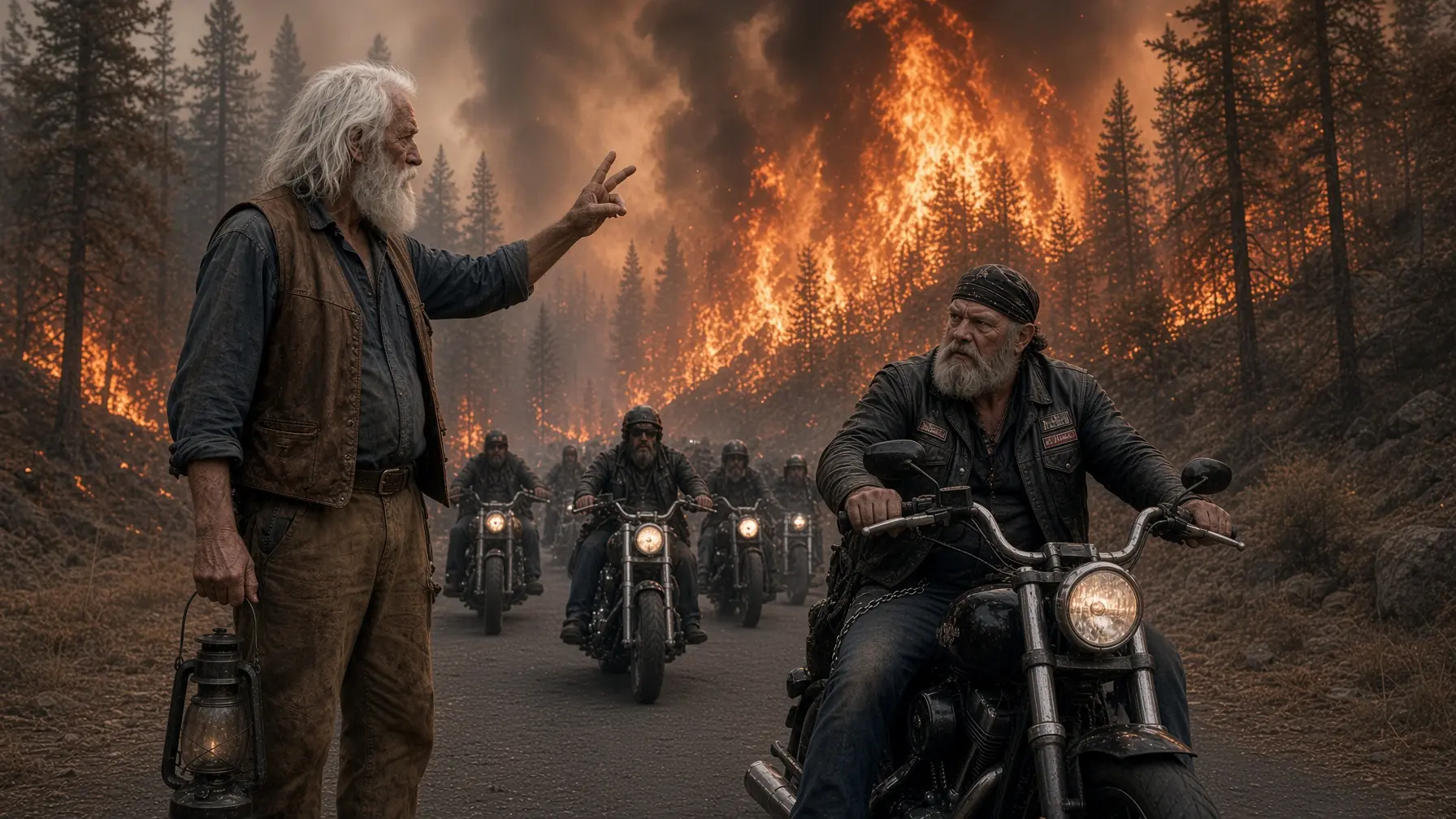
By the time the first motorcycle slid into the ditch, the mountain was already burning on both sides of the road.
Not somewhere distant.
Not a thin orange glow across another ridge.
The fire was there.
In the grass.
In the lower branches.
Moving through dead needles beneath the pines faster than a man could comfortably walk.
Smoke rolled across the two-lane mountain road until riders twenty feet apart could see little more than a red taillight appearing and disappearing in gray-black waves.
The convoy had started with fifty-seven motorcycles.
By the time they reached the upper section of Calder Ridge, two had gone down on loose gravel, one rider was coughing so hard he could barely remain upright, and nobody knew whether the road ahead still existed.
Their northern exit had been closed by fallen timber.
The forest-service route behind them was already under evacuation order.
Cell service vanished ten miles back.
The chapter president, Wade Tanner, had been trying to keep everybody moving toward lower ground.
Then he saw the old woman standing in the road.
She held a battery lantern in one hand.
No shotgun.
No heroic pose.
Just a faded denim jacket, work boots, gray hair tied tightly behind her head, and an expression that suggested the fifty-seven motorcycles coming toward her were considerably less frightening than what she could hear in the trees.
She raised one hand.
Wade braked.
The motorcycles behind him compressed dangerously.
“What the hell are you doing?” somebody shouted.
The woman pointed toward the ridge behind them.
“Kill the engines.”
Nobody moved.
Wade stared through smoke.
“Lady, we need to get off this mountain.”
“You do.”
“Then get out of the road.”
She looked at the treetops.
Not at him.
“Three seconds.”
Wade frowned.
“What?”
“Three.”
One of the riders laughed.
The woman kept watching the ridge.
“Two.”
Then:
“One.”
The upper crowns behind the convoy ignited.
Not because the trees exploded like bombs.
Because wind pushed flame into connected dry canopy all at once, and a section of ridge that had been dark thirty seconds earlier suddenly became a continuous orange line.
Heat pressed down the road.
Smoke thickened.
The laughter stopped.
The woman pointed toward a narrow break in the roadside brush.
“Engines off.”
“Walk the bikes.”
“Single file.”
“If somebody falls, two men help him and the rest keep moving.”
Wade looked at the opening.
It barely resembled a trail.
“Where does that go?”
“My house.”
“And your house is safe?”
“No place up here is safe.”
She finally looked him directly in the eyes.
“But it is better prepared than this road.”
Wade Tanner had spent twenty years riding with men who did not enjoy taking orders.
He did not enjoy it either.
But he understood competence when he saw it.
“Who are you?”
“Ruth Calder.”
Another gust bent smoke sideways through the trees.
Ruth turned.
“If you want introductions, we can have them when the fire isn’t trying to cut us off.”
Wade shut down his motorcycle.
Then shouted over his shoulder:
“Engines off!”
The line began going quiet.
One by one.
Fifty-seven engines died until the only sound left was men coughing, metal ticking from heat, and the terrible rushing noise of fire moving through timber.
Ruth raised the lantern.
“Follow me.”
And they did.
Ruth Calder was seventy-nine years old.
She had lived on that mountain for fifty-two of them.
Her property sat inside a natural bench below a granite shoulder, surrounded by land she and her late husband had spent decades thinning, clearing, grazing, and maintaining.
That did not make it fireproof.
Nothing in those mountains was.
It made it defensible.
There was a wide gravel break around the house.
A buried concrete cistern fed from a spring when conditions were good.
A root cellar cut deeply into the hillside.
A separate stone livestock shelter farther uphill.
Metal screens covered the vents.
Wood piles sat away from the buildings rather than against them.
Brush had been cleared back.
Dead limbs removed.
Ruth had been called obsessive for most of her adult life.
She preferred alive.
Her husband, Samuel, had died in the Granger Fire of 1978.
He had been helping evacuate two neighboring families when wind shifted across a canyon road.
His truck was found three days later.
After that, Ruth learned everything she could about wildfire.
Not because she imagined herself a firefighter.
She did not.
She respected firefighters too much for that.
She learned because professional crews could not always reach isolated mountain properties in time.
Her responsibility was to prepare the property, evacuate early when possible, and understand when leaving became more dangerous than sheltering.
Tonight, the fire had arrived faster than anyone expected.
And now fifty-seven strangers had arrived with it.
The trail descended behind a granite outcrop and into a shallow drainage.
The riders pushed their motorcycles.
Nobody rode.
Visibility came and went.
Ruth moved carefully rather than quickly.
“Stay out of the bottom when the smoke settles,” she warned.
“Higher edge where you can.”
A younger rider named Eric “Finch” Nolan was breathing too fast.
Ruth noticed before anyone else.
He was thirty.
Broad-shouldered.
Tattooed from wrist to neck.
And terrified.
Not of the fire exactly.
Of the way his chest had begun refusing to behave.
His breath came in short bursts.
Hands trembling.
Vision narrowing.
He gripped his handlebars as if the motorcycle were the only solid thing left in the world.
Ruth stopped beside him.
“You have asthma?”
He shook his head.
“Heart problem?”
“No.”
“Panic attacks?”
Finch looked humiliated.
Wade answered for him.
“Sometimes.”
Ruth nodded.
“Then he stays where he can see open sky.”
She looked at Finch.
“Don’t fight for a huge breath.”
“Slow what you can.”
“Count your exhale.”
He tried.
Failed.
Ruth did not tell him he was fine.
He clearly was not.
She gave him something better.
“You’re rear count.”
He looked up.
“What?”
“You count people past every bend.”
“You lose one, you tell Wade immediately.”
“Why me?”
“Because panic likes having nothing to do.”
She pointed downhill.
“Now it has a job.”
Finch swallowed.
Then nodded.
“One.”
The next rider passed.
“Two.”
Another.
By the time he reached twelve, his hands were still shaking.
But he was moving.
The most serious problem was Jax Monroe.
Smoke had been bothering him since the road.
Halfway down the drainage, his coughing became violent.
He dropped to one knee.
Wade and another rider caught him.
Ruth came back.
“Can he talk?”
Jax managed:
“Yeah.”
“Good.”
She looked at Wade.
“He needs cleaner air, not a crowd around him.”
“Get him downhill.”
“Keep him upright if he tolerates it.”
“Somebody with medical training?”
A hand rose three riders back.
“EMT ten years.”
Ruth pointed.
“You’re with him.”
She did not pretend to diagnose smoke inhalation on a mountain trail.
She did not offer miracle remedies.
She simply moved the sickest man toward the best air and the fastest route to shelter.
That distinction saved time.
The property appeared through smoke twenty minutes later.
Small two-story house.
Weathered gray siding.
Metal roof.
Low porch.
Barn to the east.
Root cellar door set into the hillside.
Farther uphill, the stone livestock shelter.
Several men stopped when they saw it.
One rider laughed weakly.
“This is what we’re trusting?”
Ruth pointed at the cleared ground surrounding the buildings.
“This is what you’re working with.”
She turned toward Wade.
“How many can still move well?”
“Most.”
“Good.”
“Then nobody crowds the house.”
She pointed.
“Jax and anybody with breathing trouble goes to the porch first for evaluation.”
“Cellar is for people who can tolerate enclosed space and need protection if the heat front reaches us.”
“Stone shelter is stronger but smaller.”
“Everyone else stays outside only while conditions allow and works on ember patrol.”
Wade glanced toward the forest.
“You’ve done this before.”
“I’ve prepared for it.”
“That isn’t the same thing.”
“No.”
She looked toward the orange glow strengthening beyond the trees.
“And I’d prefer we keep it that way.”
Then Wade made his mistake.
He looked at her.
Looked at the small house.
Looked at fifty-seven men.
And said:
“We’re not hiding underground because one old woman says so.”
Silence fell.
Ruth stared at him.
Not offended.
Tired.
“I don’t care what patch is on your back.”
Several riders stiffened.
Wade’s vest carried the insignia of the Red River Riders, one of the largest motorcycle clubs in the region.
Their reputation traveled farther than they did.
Ruth continued.
“Your men are exhausted.”
“One is having a panic attack.”
“One is breathing smoke.”
“Your road is blocked.”
“And the fire behind you is moving with the wind.”
“If you know more about this ridge than I do, speak now.”
Wade said nothing.
Ruth stepped closer.
“I buried my husband because wildfire moved faster than the evacuation plan.”
“I have spent fifty years making sure I never again confuse pride with preparation.”
She pointed toward the root cellar.
“So you can help me keep these men alive.”
“Or you can stand there explaining why your title matters.”
Wade held her gaze.
Then looked away first.
“You heard her.”
The yard moved.
The motorcycles were pushed onto the widest patch of bare gravel away from the house.
Fuel containers were separated from structures.
Nobody smoked.
The injured were assessed.
Water was inventoried rather than passed around without control.
Ruth had bottled drinking water, but not enough for fifty-seven men to waste.
The cistern held utility water.
A spring line still produced a slow flow.
Men with burns from embers were cooled with clean water when possible and covered loosely with clean material while they waited for professional care.
No salves.
No kitchen remedies.
No theatrical frontier medicine.
Ruth had learned that lesson years ago too.
A burn could be made worse by someone desperate to “treat” it.
Sometimes the smartest thing was to protect it and stop interfering.
The Red River Riders had two current EMTs and one retired firefighter among them.
Ruth put those men in charge of medical decisions.
Wade noticed.
“You’re giving orders away.”
“I’m giving jobs to people who know more than I do.”
That answer stayed with him.
The first ember shower reached the property after dark.
It came in waves.
Burning needles.
Small pieces of bark.
Light debris carried ahead of the main flame front.
Ruth had the men watching roof edges, gutters, wooden steps, and dry corners.
When somebody yelled that the old feed shed was burning, half a dozen riders instinctively rushed toward it.
Ruth stopped them.
“Leave it.”
A young man stared.
“It’ll burn down.”
“Yes.”
“There are tools inside.”
“Then the tools are gone.”
She pointed toward the barn twenty feet away.
“Keep that wall from catching.”
The men changed direction.
That was Ruth’s way of thinking.
Not save everything.
Save what mattered most.
Feed shed.
Barn.
House.
Shelter.
People.
There was an order.
Fire punished people who forgot it.
The shed collapsed twenty minutes later.
Nobody was inside.
The barn took heat along one wall but did not ignite.
A rider named Dalton took several embers to the neck while moving equipment away.
The EMT cooled the area and sent him to the treatment porch.
Dalton protested.
“I’m fine.”
Ruth looked at him.
“You can be fine while sitting down.”
He sat.
That was when several men began calling her Ruth instead of “lady.”
Wade noticed that too.
Authority had moved without anyone voting on it.
Near midnight, something changed.
The fire’s sound grew deeper.
Not louder exactly.
More continuous.
Ruth walked to the edge of the yard.
Wade followed.
Beyond the cleared area, orange light moved through the timber.
“How long?” he asked.
Ruth watched the smoke.
Then the wind.
Then checked the portable weather meter she kept in an emergency box.
“I’m not guessing minutes.”
Wade looked at her.
“That bad?”
“That unpredictable.”
She pointed uphill.
“We move the most vulnerable to stone shelter now.”
“Then the rest rotate between the cellar and the protected side of the property until we know what the fire does.”
“What about the house?”
“Last resort.”
Wade frowned.
“Most people would go inside.”
“Most houses burn from embers entering places people didn’t know were open.”
She looked toward the roof.
“My house has been prepared.”
“That does not make it immortal.”
That was when Brennan arrived.
Nobody knew he was coming.
A motorcycle engine screamed somewhere above them.
Ruth’s head snapped toward the sound.
“One of yours?”
Wade started counting faces.
Then:
“Brennan.”
The motorcycle appeared through smoke with one headlight.
It crossed the broken fence line too fast.
Hit a shallow rut.
Slid sideways.
Brennan separated from the motorcycle and rolled across bare soil.
Men ran.
Ruth shouted:
“Watch the bike!”
Fuel began leaking.
Two riders dragged Brennan away by his jacket.
Another man reached for the motorcycle.
“Don’t touch it if fuel’s spreading!”
They backed off.
A small flame appeared beneath the machine.
Then grew.
Because the motorcycle sat on bare gravel separated from the house, the fire did not immediately spread.
Men used extinguishers from Ruth’s workshop and dirt where appropriate to contain burning fuel around the machine.
Nobody tried to save the motorcycle.
Brennan mattered.
The machine did not.
Brennan had burns on one forearm and signs of heavy smoke exposure.
He was conscious.
Barely.
He looked at Wade.
“West road’s gone.”
Wade crouched beside him.
“We know.”
Brennan’s eyes moved across the yard.
“How many?”
“All of us.”
His face folded for half a second.
Not pain.
Relief.
He had believed he was the last one alive.
The Red River Riders had built their reputation around toughness.
That night toughness changed meaning.
It became carrying a wounded man without making him feel weak.
Passing water without arguing.
Following instructions from someone they would have ignored at a gas station.
Moving an injured rider before saving a motorcycle.
Sitting beside Finch while he counted his breathing.
Nobody announced that change.
Nobody needed to.
Then someone disappeared.
The count came up one short.
Wade counted again.
Fifty-seven, including Brennan.
Then again.
Still one missing.
“Kip.”
Nobody answered.
Finch looked sick.
“He was behind me when we came from the lower water line.”
Ruth had sent a small team with Wade to open an old gravity-fed storage tank farther up the drainage.
They had returned carrying portable containers.
Kip had been rear position.
Somewhere in the smoke and confusion, he had stopped.
Wade immediately turned toward the drainage.
Ruth grabbed his sleeve.
“You take three.”
“I’m taking everybody.”
“No.”
“He’s one of mine.”
“And if twenty men go into zero visibility searching one drainage, I get more missing men.”
Wade’s face hardened.
Then softened.
Because he knew she was right.
“Who?”
“Me.”
“You.”
“Sully.”
“And Finch.”
Finch froze.
Wade stared at her.
“Finch?”
“He counted him last.”
Ruth looked at Finch.
“You know exactly where you stopped seeing him.”
Finch swallowed.
Then nodded.
They went.
They found Kip less than a quarter mile away.
A section of loose soil had slumped from the drainage wall.
Not a dramatic landslide.
Enough to pin one leg beneath dirt, roots, and a fallen branch.
He was conscious.
Terrified.
Smoke moved above him.
When Ruth reached him, he said:
“Thought everybody left.”
Ruth knelt.
“You’re loud enough to be difficult to leave.”
He laughed.
Then coughed.
They cleared dirt from his leg.
Sully cut away a root.
Wade moved the branch.
Finch kept talking to Kip.
Anything.
Weather.
Motorcycles.
Bad beer.
Anything to keep him focused.
They freed him after several minutes.
His ankle could bear some weight.
With help, he walked.
Back in the yard, the men saw Kip return.
Something changed in the group.
Ruth had told them earlier:
Nobody gets forgotten.
Now they believed her.
The firefighter appeared an hour later.
Not riding.
Walking.
Or trying to.
A reflective stripe moved beyond the western edge of the clearing.
One rider shouted.
Ruth ran toward it.
A county wildland firefighter stumbled into view.
His name was Daniel Holt.
His crew had been scouting a route along the western spur when wind pushed fire across the access road.
He and another firefighter, Wes Parker, were cut off.
Holt had found the clearing by following the sound of men shouting.
Parker was farther downslope.
Injured.
Wade asked:
“How far?”
Holt pointed.
“Maybe two hundred yards.”
Ruth looked toward the smoke.
Then at Wade.
This was no longer her decision alone.
There were trained firefighters on scene now.
Holt, despite exhaustion, still had radio contact intermittently.
He told them what the fire was doing.
Ruth told him what the property offered.
Together they made the decision.
Four riders with protective clothing.
Holt.
Wade.
No one else.
Ruth wanted to go.
Holt stopped her.
“You know the ground?”
“Yes.”
“Then you lead us to the drainage edge and stop.”
Ruth looked offended.
Holt said:
“You’re the only person here who knows the property.”
“If something happens to you, everybody loses that.”
For once, someone else gave Ruth an order.
She considered.
Then nodded.
“Fine.”
Wade almost smiled.
They brought Wes Parker back alive.
Bruised ribs.
Possible arm fracture.
Heavy smoke exposure.
No heroic speeches.
No one lifting burning trees with bare hands.
Just six exhausted people working together with leverage, ropes, and Holt’s instructions to free a trapped man without creating another casualty.
When Parker reached the property, the radio on Holt’s vest finally caught a stronger signal.
County command answered.
The voice on the radio sounded stunned.
Holt gave the location.
Number of civilians.
Number injured.
Shelter condition.
Then:
“Repeat, approximately sixty civilians alive at Calder property.”
Static.
Then:
“Copy.”
Holt looked at Ruth.
“They had this ridge marked non-survivable.”
Ruth stared toward the black sky.
“Ridges don’t read maps.”
The worst fire front reached them before dawn.
By then everyone had been moved into the stone livestock shelter and the root cellar according to capacity.
The house was emptied except for emergency supplies.
Nobody stood in the yard.
Nobody fought the fire.
Nobody tried to save fences.
The people mattered.
That was all.
Inside the larger stone shelter, men sat shoulder to shoulder.
No engines.
No bravado.
No room for it.
Heat pressed outside.
Embers hissed against the metal door.
Smoke seeped in small amounts despite the seals.
The retired firefighter among the riders monitored conditions.
Holt listened to the radio.
Finch counted breaths.
Other men counted people.
Again.
Again.
Nobody laughed at him for it.
At some point, a young rider named Rigby began talking about his daughter.
Seven years old.
Ellie.
He had not seen her in eleven months.
Nobody asked why.
Another rider admitted he had a twelve-year-old son who barely answered his calls anymore.
The conversation passed quietly through the dark.
The kind of things men told each other only when they no longer had energy to pretend their lives were simple.
Ruth sat near the wall.
Wade beside her.
“You got children?” he asked.
“No.”
“Family?”
“Had a husband.”
“The fire?”
She nodded.
“Samuel.”
“Good man?”
“The best.”
Wade waited.
Ruth surprised herself by continuing.
“He stopped on a frozen bridge once.”
“Before we were married.”
“Two motorcycle riders had gone through a guardrail into the river.”
“He pulled both of them out.”
“Ruined his shoulder.”
Wade looked at her.
“Club riders?”
“I never knew much about clubs.”
“They wore patches.”
“Used to visit for years afterward.”
“Helped with fences.”
“Brought parts.”
“Then life moved.”
“People died.”
“People moved away.”
“That was fifty years ago.”
Wade looked at the dark.
“You remember the club?”
Ruth shook her head.
“Some bird on the back.”
Wade turned toward her.
“What kind of bird?”
“Red wings.”
He said nothing after that.
Ruth did not notice his expression.
The worst of the fire moved past.
Not cleanly.
Not suddenly.
The sound outside slowly broke apart.
One long roar became smaller separate fires.
Then crackling.
Then wind.
Then silence that was not really silence.
At dawn, Holt opened the shelter only after checking exterior conditions.
Gray light entered.
The mountain looked erased.
Trees blackened.
Ground smoking.
Fence gone in places.
The feed shed destroyed.
One side of the barn scorched.
Ruth’s house still standing.
Part of the porch roof damaged.
One window gone.
But standing.
Men emerged one at a time.
Brennan cried when cold morning air hit his face.
He blamed the smoke.
Nobody challenged him.
Wade counted.
Every rider present.
Both firefighters.
Ruth.
Alive.
That was enough.
Rescue crews reached the property later that morning.
Medical teams transported the most seriously injured.
Jax.
Brennan.
Wes Parker.
Two others with respiratory concerns.
Nobody had died.
The incident would later be described in official reports using less dramatic language than anyone expected.
Entrapment.
Shelter-in-place.
Civilians assisted by prepared resident.
Multiple smoke exposures.
Structure damage.
Successful extraction.
Ruth preferred the official wording.
It made survival sound like work rather than legend.
That was closer to the truth.
Three days later, the county placed a temporary unsafe-occupancy notice on the damaged house.
That part was not sinister.
Ruth understood why.
The roof needed evaluation.
Electrical service had been exposed to heat.
One wall had visible damage.
County building officials told her she could remain temporarily in a trailer provided by emergency management while a structural engineer assessed the house.
Ruth hated it.
But she understood it.
The problem came with the second envelope.
Inside was correspondence regarding a preexisting transportation project.
For years the county had discussed widening the lower ridge road and securing an easement across part of Ruth’s land to create a safer turnaround and emergency access point.
Ruth had refused several offers.
Now the disaster had revived the proposal.
A planning memo suggested that if damage made rebuilding financially impractical, the county might explore voluntary acquisition of part or all of the property using hazard-mitigation funding.
Voluntary.
The word did not comfort her.
A planner named Martin Loomis came with the inspection team.
Ruth watched him stand at the edge of her clearing.
Look toward the road.
Then toward her blackened pasture.
She had seen that look before.
Not greed exactly.
Possibility.
The kind of possibility planners saw on paper before landowners saw what would disappear.
Loomis said:
“Mrs. Calder, nobody is forcing a sale.”
“Good.”
“But you may want to consider whether rebuilding at your age makes sense.”
Ruth looked at him.
“At my age?”
He immediately regretted the phrasing.
“I mean given the scale of the loss.”
“The house is standing.”
“It needs major inspection.”
“Then inspect it.”
Loomis nodded.
“We will.”
Ruth looked toward the burned ridge.
Then back at him.
“I stayed here fifty-two years because this is my home.”
“I didn’t survive the fire to surrender because rebuilding looks inconvenient from a desk.”
He had no answer.
That evening, Ruth sat beside an emergency trailer drinking coffee from a metal cup.
The property smelled of wet ash.
Her hands finally shook now that there was no emergency demanding they stop.
On the table beside her lay a small steel box recovered from a damaged section of the barn.
She had not seen it in decades.
Samuel’s box.
She opened it.
Letters.
An old silver lighter.
Two faded motorcycle-club patches.
And a photograph.
Samuel stood beside two younger men near a frozen river.
All three looked impossibly young.
On the back, in Samuel’s handwriting:
Boulder Gap. January 1969. Everybody went past except us.
Below that, another hand had added:
Debt remembered.
Ruth stared at the photograph for a long time.
Then closed the box.
The next afternoon Wade Tanner returned.
Borrowed pickup.
Bruised hip.
Red eyes.
No motorcycle.
He sat beside Ruth.
She gave him coffee.
“You look terrible,” she said.
“So do you.”
“Good.”
They drank.
Wade saw the county paperwork.
“What’s that?”
“Road easement.”
“Old fight?”
“Fifteen years old.”
“County wants access.”
“Partly.”
“And you don’t.”
“Not the way they’ve proposed it.”
Wade nodded.
Then noticed the steel box.
Ruth opened it.
Handed him the photograph.
He turned it over.
Read the writing.
Then stared at the patches.
His expression changed.
“Where did Samuel get these?”
“Those two men.”
“The ones he pulled out?”
“Yes.”
Wade looked almost amused.
“Ruth.”
“What?”
“That club still exists.”
She frowned.
“What club?”
He held up one patch.
“The Red Hawks.”
“One of the oldest riding clubs in the region.”
She looked at him.
“So?”
“So old riders tell stories.”
“Especially rescue stories.”
Ruth sighed.
“Wade, I’m tired.”
“I know.”
He stood.
“What are you doing?”
“Making a phone call.”
“To who?”
He looked toward the road.
“People who remember debts.”
The sound arrived the following afternoon.
Not thousands of motorcycles.
That would have been absurd.
And dangerous on a road still serving emergency vehicles.
What came instead was several organized groups totaling a few hundred riders over the course of the day.
Red River Riders.
Red Hawks.
Veterans’ motorcycle associations.
Independent clubs.
Friends and families of the men Ruth had sheltered.
They arrived in scheduled groups coordinated with county emergency management so they did not block access.
More importantly, they brought trucks.
Flatbeds.
Water.
Lumber.
Fencing.
Tools.
Work gloves.
Portable toilets.
Food.
And licensed people who knew what they were doing.
A roofing contractor whose brother had been in Ruth’s cellar.
An electrician who rode with the Red Hawks.
A structural engineer whose father had known Samuel.
A retired attorney from Helena.
A volunteer disaster-recovery coordinator.
Ruth stood beside the trailer staring at all of them.
Wade came up beside her.
“You called all these people?”
“No.”
“I called six.”
“Apparently six called six.”
An enormous older rider named Magnus Bell removed his helmet and approached Ruth.
White beard.
Hands like fence posts.
He stopped several feet away.
“Mrs. Calder?”
“Yes.”
“My father was one of the men Samuel pulled from Boulder Gap.”
Ruth stopped breathing for a second.
Magnus held out an old photograph.
Same bridge.
Same winter.
Different angle.
“My father told that story until the year he died.”
Ruth looked at the picture.
“He remembered?”
Magnus smiled.
“Ma’am, some debts aren’t bills.”
“They’re stories.”
“And stories can outlive the people who owe them.”
Ruth looked away.
For the first time since the fire, her eyes filled.
Magnus pretended not to notice.
That kindness mattered too.
Nobody began rebuilding the house illegally.
That was Wade’s first lesson in how different real help was from dramatic help.
The structural engineer inspected it.
The electrician assessed the service.
County inspectors returned.
Temporary shoring was authorized.
Damaged areas documented.
Permits filed.
The riders worked where they legally could.
Clearing debris.
Replacing fencing.
Moving salvage.
Rebuilding livestock pens.
Repairing the access trail.
Delivering supplies.
The more complicated house repairs waited for approval.
Ruth complained constantly.
The attorney, Claire Mercer, finally said:
“Ruth, if you want to keep the property, do not hand the county an easy code case because two hundred bikers ignored a stop-work notice.”
Ruth glared.
Claire smiled.
“You can glare after you sign this.”
Ruth signed.
The road proposal became public.
That changed things.
Not because the county was exposed as secretly corrupt.
There was no grand conspiracy.
There was something more ordinary.
For years, planners had wanted better emergency access through the area.
Ruth had resisted because early designs took too much of her pasture and placed a public turnaround close to the house.
The wildfire proved the road needed improvement.
It also proved Ruth’s property had value as a defensible refuge point.
Instead of reducing the argument to “county versus widow,” the lawyer pushed for a new design.
Smaller easement.
Emergency access without full acquisition.
Compensation based on updated appraisal.
Protection for Ruth’s house site.
And formal recognition of the stone shelter as private infrastructure that emergency responders could coordinate with only under agreed conditions.
Ruth did not win everything.
Neither did the county.
That was how real land disputes usually ended.
Negotiation.
Maps.
Surveys.
Too many meetings.
Some anger.
Some compromise.
A better road eventually came through.
Ruth kept her house.
Her pasture remained mostly intact.
The county gained an emergency turnaround farther downslope.
And nobody had to become a cartoon villain for the outcome to matter.
The story spread anyway.
Not the paperwork.
The night.
Fifty-seven motorcycles disappearing into smoke.
An old woman blocking the road.
“Kill the engines.”
The hidden trail.
The cellar.
The stone shelter.
The missing rider recovered.
Two firefighters brought in.
No one left behind.
Reporters wanted Ruth to call herself a hero.
She refused.
One asked:
“How did you save fifty-nine people?”
Ruth corrected him.
“I didn’t.”
The reporter looked confused.
“You directed the evacuation.”
“I knew the property.”
“The riders carried each other.”
“The medically trained people handled injuries.”
“The firefighters helped us understand conditions.”
“The shelters were built over fifty years.”
“My husband helped plan the first one.”
“That is not one person.”
The reporter tried again.
“But without you—”
Ruth interrupted.
“Without preparation.”
“That is the phrase you want.”
The clip became the part people remembered.
Not heroism.
Preparation.
Finch returned six months later.
Alone.
No club.
No convoy.
He sat on Ruth’s rebuilt porch.
“You gave me a job.”
Ruth looked at him.
“I gave you counting.”
“You know what I mean.”
He stared at the mountains.
“I started therapy.”
Ruth nodded.
“You want congratulations?”
“No.”
“Good.”
He smiled.
Then:
“I called my son.”
Ruth turned.
“You have a son?”
“Eight.”
“Lives with his mother.”
“I hadn’t seen him in a year.”
“How’d it go?”
“He asked why motorcycles are so loud.”
“Reasonable question.”
Finch laughed.
Then became quiet.
“I’m seeing him next weekend.”
Ruth looked toward the ridge.
“Good.”
That was all she said.
It was enough.
Rigby went home to Ellie.
Brennan stopped riding alone on mountain roads.
Wade changed the club’s emergency procedures.
Every large ride began carrying better first-aid equipment, satellite communicators, route checks, and wildfire closures during fire season.
Not because motorcycle riders suddenly became timid.
Because surviving taught them the difference between caution and fear.
The Red River Riders also began raising money every spring for rural volunteer fire departments.
Ruth hated speeches about it.
So Wade stopped inviting her.
Instead, every year, a truck arrived with something her property needed.
Hose.
Water tank fittings.
Roof screening.
A new generator.
Once, a completely unnecessary commercial coffee machine.
Ruth called Wade.
“What am I supposed to do with this?”
“Make coffee.”
“It makes fifty cups.”
“You complain when people visit.”
“You complain when they don’t.”
She hung up.
Kept the machine.
The old house survived another fire seven years later.
That time Ruth evacuated two days early.
When Wade heard, he called immediately.
“You left?”
“Yes.”
“Voluntarily?”
“Don’t sound surprised.”
“I am surprised.”
“I’m old, not stupid.”
The fire never reached the house.
Ruth returned three days later.
Found nothing damaged.
She complained she had wasted a hotel room.
Wade reminded her that wasted money was cheaper than wasted funerals.
She admitted he had finally learned something.
Ruth lived on Calder Ridge until eighty-seven.
When climbing the cellar steps became difficult, she moved voluntarily to a smaller house near town.
She did not sell the mountain property to developers.
She placed most of it into a conservation agreement with provisions allowing managed emergency access.
The house became a seasonal training site for rural fire-preparedness workshops.
Not because Ruth wanted a monument.
Because, as she said:
“Buildings are more useful when people use them.”
The old stone shelter remained.
So did Samuel’s photograph.
Ruth hung it inside.
Beneath it, someone eventually placed another photograph.
Fifty-seven soot-covered motorcycle riders standing in a burned yard at sunrise.
Ruth in front.
Small.
Dirty.
Unimpressed.
Wade beside her.
Finch behind him.
Brennan with one arm wrapped.
Holt and Parker in yellow fire gear.
Everyone alive.
Underneath, Wade had written:
Calder Ridge. Everybody came out.
Years later, visitors often asked whether the story had been exaggerated.
Did an eighty-year-old woman really command dozens of bikers?
Did she really know exactly when the ridge would ignite?
Did hundreds of riders really return afterward?
The truth was less theatrical.
Ruth did not command the fire.
She understood enough to respect it.
She did not single-handedly rescue anyone.
She knew the land and put competent people to work.
She did not defeat the county.
She fought for a fairer agreement.
She did not magically turn violent men into saints.
The riders were complicated people before the fire and complicated people afterward.
What changed was what they owed one another.
And what they understood about strength.
The hardest man on the road was not necessarily the one who refused help.
Sometimes it was the one who accepted an order from somebody who knew more.
Sometimes courage looked like carrying an injured friend.
Sometimes it looked like counting breaths through a panic attack.
Sometimes it meant leaving a motorcycle to burn.
Sometimes it meant admitting the house could be rebuilt but a human being could not.
Ruth Calder had learned that lesson in 1978 when Samuel never came home.
She spent the rest of her life preparing for a night she hoped would never arrive.
When it finally did, fifty-seven strangers happened to be standing on her mountain.
That was why Wade remembered her first sentence more than anything else.
Not the speeches later.
Not the convoy.
Not the fire front.
The road.
The smoke.
The old woman standing where no one expected her to be.
Wade yelling for her to get out of the way.
Ruth looking beyond him toward the trees.
Then calmly saying:
“Three seconds.”
And being right.
Years afterward, when young riders asked Wade why the Red River Riders now stopped every summer to check fire maps, weather alerts, alternate routes, medical kits, and communication equipment before crossing mountain country, he never gave them a lecture.
He simply told them:
“Because once, fifty-seven of us thought toughness meant we didn’t need anybody.”
He would pause.
Then smile.
“And an old woman on a burning mountain cured us of that in about three seconds.”