On the fourth morning after the stagecoach disappeared, the Denver newspapers printed Clara Whitmore’s obituary.
There was no body.
No grave.
Only a blurred portrait of a twenty-four-year-old woman beneath a black headline:
BANKER’S DAUGHTER LOST TO THE GREAT WHITE SILENCE
The article described her as beautiful, educated, and beloved. It spoke of the Christmas gala she had been traveling home to attend and the fifty riders who had searched the Colorado high country before returning with frostbitten hands and empty saddles.
No living person, the lead scout had said, could survive three nights above timberline in such cold.
By noon, Denver had accepted her death.
Her father had not.
Inside the offices of the Western Continental Bank, Harrison Whitmore stood beside a tall window while snow struck the glass.
He had not changed clothes in three days.
His black waistcoat was wrinkled. Gray stubble covered his jaw. The untouched food on his desk had gone hard.
Harrison was one of the wealthiest men in Colorado.
Railroad companies borrowed from him.
Mine owners waited outside his office.
Politicians remembered his birthday.
Yet all his influence had produced nothing but exhausted riders and careful condolences.
“Send them back,” he said.
The lead scout stood near the door with ice still melting from his coat.
“Mr. Whitmore, there is another storm moving across the divide.”
“Double their pay.”
“It is not a matter of money.”
“Everything is a matter of money.”
The scout looked toward the newspaper on Harrison’s desk.
“Not the mountain.”
Harrison turned.
For a moment, grief stripped away the banker and left only a frightened father.
“You are telling me to stop looking for my child.”
“I am telling you the men cannot see the trail. Snow has covered the road, the ravines, and half the timber. Another day up there may cost more lives.”
“How many?”
The scout hesitated.
Harrison stepped closer.
“How many lives before you stop measuring them against hers?”
No answer could satisfy him.
The scout lowered his head and left.
Fifty miles west, where Denver’s brick buildings gave way to pine forest and stone, nobody had read the newspaper.
Gabriel Mercer lived with his eight-year-old daughter in a cedar cabin beneath Grayson Ridge.
The house contained two rooms, an iron stove, a pine table, and little else.
Gabriel owned no bank account.
He possessed three traps, one old rifle, a mule named Amos, and enough stored food to survive an ordinary winter.
This was not an ordinary winter.
Snow had buried the lower fence and reached the windowsill along the north wall. The wind found every gap in the cabin boards.
Gabriel’s wife, Rebecca, had died four winters earlier.
A fever began with coughing and ended before the doctor arrived from town.
Since then, Gabriel had raised Rose alone.
She had her mother’s copper-colored hair and her father’s habit of watching carefully before speaking.
That morning, Gabriel wrapped a wool scarf around her neck.
“You will stay with Mrs. Calder until I return.”
Rose looked toward the white world beyond the door.
“How long?”
“One night, perhaps two.”
“You said the traps could wait.”
“They can.”
“Then why are you going?”
Gabriel tightened the strap on his snowshoes.
“Because the storm moved things.”
“What things?”
“Trees. Snow. Maybe something else.”
He had noticed crows circling above the western ridge the previous afternoon.
In winter, crows rarely wasted energy.
Something had drawn them.
Gabriel had also found a strip of leather frozen beside the creek, too finely worked to belong to a local trapper.
Rose caught his sleeve.
“What if the wind comes back?”
“It will.”
“That is not an answer.”
“It is the only honest one.”
He knelt and placed both hands around hers.
“I know these mountains.”
“So did Mama.”
The words struck quietly.
Rose immediately lowered her eyes.
Gabriel did not rebuke her.
Rebecca had known the mountains well. Knowledge had not protected her from fever.
He kissed Rose’s forehead.
“I will come home.”
“You always say that.”
“Because I always intend to.”
Mrs. Calder lived in a neighboring cabin half a mile down the slope. She was nearly seventy and had delivered half the children born in the valley.
Gabriel left Rose with her, then climbed west carrying rope, blankets, dried venison, matches sealed in wax, and a small medical kit Rebecca once used.
The sky was clear but mercilessly cold.
Every breath crystallized in his beard.
The snow reflected so much light that he wrapped a narrow strip of dark cloth across his eyes.
Near the ridge, he found the first unmistakable sign.
A broken harness lay half-buried beneath a drift.
The leather had frozen stiff.
Farther uphill, something flashed beneath the sun.
Gabriel dug with one glove and uncovered the brass frame of a stagecoach lantern.
He looked toward the cliffs.
The road curved along the ridge above him, but no tracks remained. Wind had erased everything.
A paid searcher might have followed the road.
Gabriel studied the slope instead.
Snow below one section had settled differently. The surface appeared smooth, but beneath it lay a faint diagonal depression.
Something heavy had passed through before the storm covered it.
He began climbing.
The slope steepened.
Snow reached his thighs. Each step required him to lift his leg, press forward, and fight for breath.
Twice, he stopped beneath the trees and listened.
No voices.
No bells.
Only wind moving across the stone.
Near noon, he reached the base of the cliffs.
The stagecoach lay shattered among the rocks.
One wheel remained upright.
The red body had split open. Splintered wood protruded through the snow, and a passenger trunk had burst against a boulder.
Gabriel found the driver first.
The man was frozen beside the harness, one arm extended toward the horses that had vanished into the storm.
Two passengers remained inside the wreckage.
Neither had survived the first night.
Gabriel removed his hat.
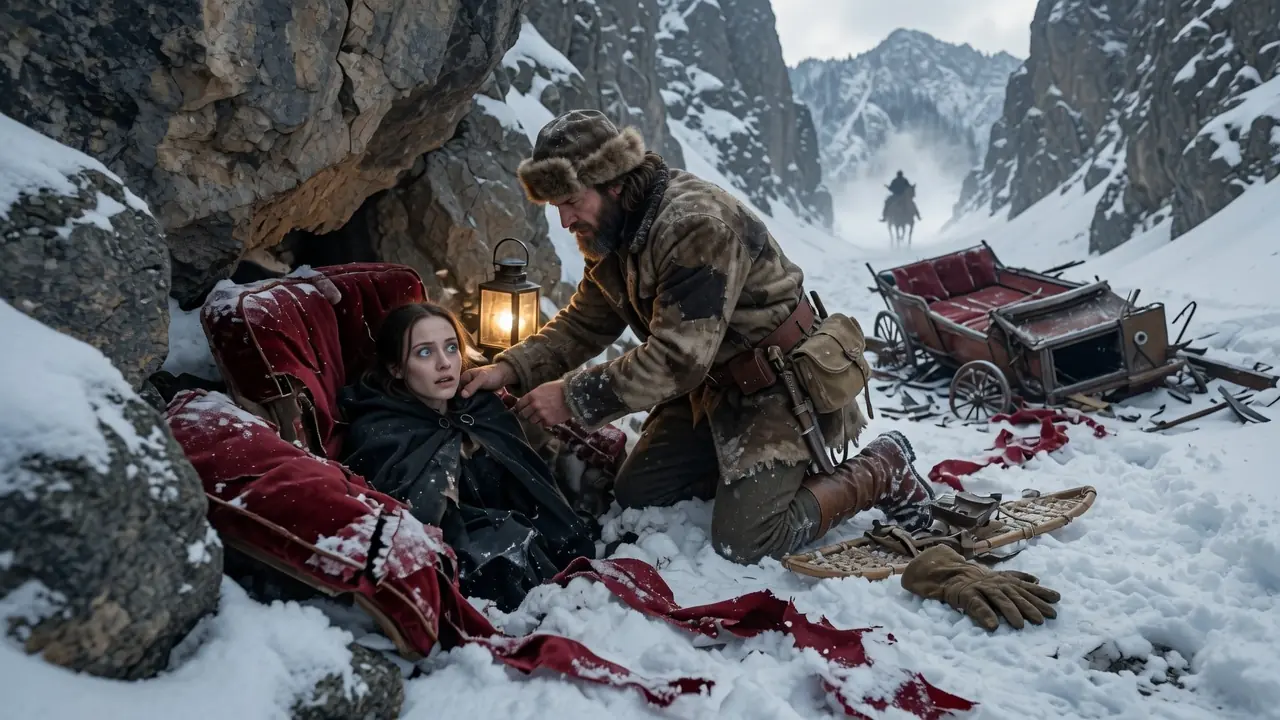
He stood for a moment in silence, then searched the surrounding snow.
There were marks near the rear door.
Not tracks exactly.
Drag lines.
Someone had crawled from the coach.
The wind had nearly erased them, but small fibers clung to a broken branch.
Red thread.
Gabriel followed.
Fifty yards from the wreckage, a shallow opening appeared in the granite wall.
A torn section of coach canvas had been fastened across it with pieces of harness.
Behind it, someone had built a shelter.
Seat cushions covered the stone floor.
A tin cup rested beside a hollow where snow had been collected.
A woman lay wrapped in a dark shawl, her crimson dress torn at the hem.
Her face was pale.
Frost clung to her eyelashes.
Gabriel knelt and pressed two fingers to her neck.
Nothing.
He waited.
Then felt a pulse.
Slow.
Weak.
Present.
He whispered a prayer he had not spoken since Rebecca died.
The woman had survived by refusing to remain helpless.
She had torn fabric from her dress to secure the canvas. She had packed cushions around her body for insulation and melted snow against her skin inside the tin cup.
Her hands were cut.
One fingernail had broken away.
She had fought the storm hour by hour.
Gabriel lifted her carefully.
She weighed almost nothing.
The wind shifted as he carried her toward a cave hidden farther along the cliff.
Years earlier, he had stored dry cedar, blankets, and trapping supplies there for emergencies.
He laid her near the back wall and built a fire.
Warming her too quickly could kill her.
Rebecca had taught him that.
He removed the woman’s wet outer layers, wrapped her in dry wool, and placed heated stones nearby without touching her skin.
He rubbed her hands gently.
Hours passed.
Outside, snow began falling again.
The woman moved shortly after dark.
Her eyes opened suddenly.
She tried to rise.
Gabriel stepped backward.
“Do not move quickly.”
She stared around the cave.
“Where am I?”
“Near Grayson Ridge.”
Her lips trembled.
“The coach.”
“I found it.”
“The others?”
Gabriel did not answer immediately.
She understood.
Her eyes closed.
“No one?”
“You are the only living person I found.”
Her face tightened, but she did not cry.
Perhaps she had no strength left for tears.
“My name is Gabriel Mercer.”
She looked toward him.
“Clara Whitmore.”
Gabriel recognized the surname.
Even mountain families knew Harrison Whitmore’s bank.
He handed her warm broth.
She could not hold the cup.
He supported it while she drank.
“My father will be searching.”
“He was.”
“Was?”
“Search parties may have turned back.”
Clara’s gaze sharpened.
“He would not stop.”
“Men stop. Storms decide when.”
She looked toward the cave entrance.
“How long have I been here?”
“Near the wreck?”
“Yes.”
“Perhaps three nights.”
Clara swallowed.
“I counted them.”
“How?”
“Christmas mornings.”
Gabriel waited.
“My mother died when I was fifteen. I remembered every Christmas before that. Each room. Each dress. Every song she played.”
Her voice weakened.
“When I reached the last memory, I began again.”
Gabriel looked toward the fire.
He understood the usefulness of memory when survival depended upon remaining awake.
“You should sleep now.”
“I was afraid to.”
“You do not need to be.”
She studied him.
“Why did you come this far?”
“I was checking the ridge.”
“That is not what I asked.”
Gabriel added wood to the fire.
“My daughter is waiting below.”
Clara looked confused.
“And you still came?”
“I thought of her.”
“Would that not make you turn back?”
“It made me continue.”
He looked toward the snow beyond the cave.
“Somewhere, another father was waiting for his daughter.”
Clara turned her face away.
This time, tears came.
The second storm trapped them for three more days.
Clara developed a fever during the first night.
Gabriel remained beside her.
He cooled her forehead with melted snow and measured time by feeding the fire.
In her fever, Clara spoke of Denver.
Chandeliers.
Music.
A house with more rooms than people.
She spoke of her father’s annual gala and the men he wished her to meet.
One name returned several times.
Charles Pembroke.
Gabriel assumed he was a suitor.
Clara did not speak of him with affection.
When the fever broke, she woke to find Gabriel carving a small bird from pine.
“For your daughter?” she asked.
“Yes.”
“What kind?”
“A mountain bluebird.”
“It resembles a potato.”
Gabriel looked at the carving.
“You are recovering.”
She smiled for the first time.
It changed her face.
Recovery came slowly.
One cup of broth.
Ten steps across the cave.
A full night without trembling.
Gabriel never hurried her.
Clara had spent her life surrounded by servants who anticipated every need. Yet nobody had ever cared for her with such quiet attention.
He did not flatter her.
He did not ask about her father’s wealth.
He did not behave as though rescuing a banker’s daughter entitled him to anything.
In the cave, their worlds lost their usual meaning.
Her education could not produce firewood.
His poverty did not prevent him from saving her life.
They were simply two people inside the cold.
One evening, Clara noticed Gabriel repairing a tear in his buffalo coat.
His large hands struggled with the needle.
“You are making it worse.”
“It only needs to hold.”
“It will not.”
Gabriel looked toward her.
Clara held out her hand.
“Give it to me.”
He hesitated before removing a small leather sewing case from his pack.
The leather had softened with age.
A faded flower had been painted on the lid.
“My wife’s,” he said.
Clara’s hand stopped.
“You do not have to lend it to me.”
Gabriel rested his thumb across the case.
He had not opened it since Rebecca died.
“She believed broken things should be repaired before they were discarded.”
Clara looked toward the coat.
“Are you speaking about cloth?”
“I have not decided.”
He handed her the case.
The needles were slightly rusted.
Clara had learned decorative needlework at school, but the buffalo hide resisted her soft fingers.
Gabriel showed her the mountain stitch Rebecca had used.
Their shoulders nearly touched beside the fire.
Clara pricked her thumb.
She gasped.
Gabriel looked at the small bead of blood.
“Dangerous work.”
She laughed.
The sound surprised them both.
It echoed around the cave, clear and warm.
Gabriel felt something tighten in his chest.
Not grief.
Not fear.
Something he had not allowed himself to name in four years.
When the weather cleared, he took Clara down the mountain.
She wore his spare wool coat and rabbit-fur boots that were too large. He tied a rope around both their waists for the steep sections.
At every icy ledge, Gabriel moved first.
Clara followed his footprints.
Near the lower valley, they heard bells.
A search party approached through the trees.
Harrison Whitmore led it himself.
He looked nothing like the man whose portrait appeared in the newspapers.
His face was hollow.
His expensive coat was torn.
His horse staggered from exhaustion.
Then he saw Clara.
The banker fell from the saddle into knee-deep snow.
“Clara!”
She tried to run but nearly collapsed.
Gabriel caught her arm and guided her forward.
Harrison reached her and pulled her against him.
He held her so tightly she could barely breathe.
“My girl,” he whispered. “My girl.”
The remaining riders surrounded them.
Men shouted.
Someone laughed.
Another removed his hat and began praying.
Gabriel stepped back toward the trees.
Harrison finally noticed him.
“You found her?”
“Yes.”
“You kept her alive?”
“She kept herself alive. I helped afterward.”
Harrison removed a leather purse from his coat.
Gold coins pressed against its sides.
“I promised a reward.”
Gabriel looked at it.
“No.”
Harrison believed he had misheard.
“There is enough here to purchase land.”
“I have land.”
“Then a house. Livestock. Whatever you need.”
“My answer remains no.”
Harrison’s grief turned briefly into insult.
“You risked your life and expect nothing?”
“I expect to go home to my daughter.”
“A man does not refuse this much money.”
Gabriel’s expression did not change.
“A life is not a debt that can be settled with coins.”
Clara stepped between them and lowered her father’s hand.
“Please.”
Harrison looked toward her.
“Some things cannot be purchased,” she said.
The riders prepared for the journey to Denver.
Before leaving, Clara approached Gabriel near the timber.
She removed a small silver locket from her neck.
“My mother gave me this.”
Gabriel shook his head.
“I cannot take it.”
“It is not payment.”
She pressed it into his palm.
“My mother told me to give it someday to someone who made me feel safe.”
Her eyes moved toward the mountain.
“Give it to Rose. Tell her it came from a woman who owes her father more than she can repay.”
Gabriel closed his fingers around the locket.
Clara looked as though she wanted to say something else.
Instead, she whispered, “Will I see you again?”
“The mountains are not moving.”
“That was not an answer.”
“It is the only one I have.”
Harrison took Clara back to Denver.
The city celebrated her return.
Newspapers called it a miracle.
Guests filled the Whitmore mansion.
Doctors examined her.
Tailors replaced the clothes destroyed in the crash.
Her father postponed the Christmas gala, then arranged another reception in spring.
Clara attended in a silver gown.
She danced once with Charles Pembroke and refused a second dance.
The ballroom felt colder than the cave.
Everyone wanted to hear how she had survived.
Few wanted to hear about Gabriel.
They preferred a story in which courage belonged to the missing heiress, not the poor widower whose name they struggled to remember.
Clara began writing letters.
The first went unanswered for nearly a month.
Then a folded page arrived from the mountain.
Rose liked the locket. She says the woman who owned it must have been very brave.
Gabriel wrote little about himself.
Clara wrote enough for both of them.
She sent books for Rose.
Medical supplies for Mrs. Calder.
Blankets and flour for isolated families along the pass.
Harrison believed the generosity was temporary gratitude.
It was not.
Clara used part of her inheritance from her mother to establish emergency shelters along dangerous routes.
Each contained dry wood, food, blankets, and lanterns.
She funded a small school near Grayson Ridge.
When the building opened, Clara traveled there.
Gabriel stood outside with Rose.
The girl wore the silver locket.
“You came,” Rose said.
“I promised to try.”
“Papa said city promises are weak.”
Gabriel looked toward his daughter.
“I said no such thing.”
“You said city wheels break on mountain roads.”
“That is different.”
Clara smiled.
The first visit lasted six days.
The second lasted two weeks.
By the third year, Rose saved a place beside the stove whenever Clara was expected.
She and Clara read books together in the evenings.
Gabriel repaired fences while pretending not to listen.
One night, Rose fell asleep with her head in Clara’s lap.
Gabriel covered them with the quilt Clara had sent.
It contained a bluebird stitched into the center, modeled after the clumsy carving from the cave.
“Rose believes you will stay eventually,” he said.
Clara looked toward the sleeping child.
“What do you believe?”
Gabriel sat opposite her.
“That your life is in Denver.”
“That is where my father’s life is.”
“And yours?”
Clara did not answer.
The fire settled.
Gabriel looked toward Rebecca’s sewing case resting beside Clara’s hand.
He had begun allowing her to use it during each visit.
Neither spoke of what that trust meant.
In 1893, the silver market collapsed.
Mines closed across Colorado.
Banks failed.
Depositors gathered in angry crowds.
Harrison Whitmore had invested too heavily in silver and extended loans against property whose value disappeared within weeks.
Western Continental Bank suspended payments.
Families lost savings.
Businesses closed.
Harrison became the public face of the disaster.
Men threw stones through the mansion windows.
Threatening letters arrived.
Clara sent a message to Gabriel.
She asked for shelter.
He met them outside Denver after midnight.
Harrison wore city shoes on the mountain trail.
Mud destroyed them within an hour.
Briars tore his coat. His breathing became labored.
He resented needing help from a man who had once refused his gold.
At the cabin, Harrison felt stripped of everything that had defined him.
The walls were small.
Meals were plain.
Nobody stood when he entered.
Gabriel spoke to him as an equal.
This should have comforted Harrison.
Instead, it frightened him.
One evening, he saw Gabriel holding Rose’s silver locket.
Harrison’s fear and humiliation hardened into suspicion.
“Where did you get that?”
Gabriel looked toward him.
“Clara gave it to Rose.”
Harrison stood.
“That belonged to her mother.”
“I know.”
“She would never give that away.”
Clara entered from the other room.
“Father.”
Harrison ignored her.
“You found her unconscious. You had her possessions.”
The cabin became silent.
Gabriel opened his hand and placed the locket on the table.
The silver struck the wood.
“You believe I stole it.”
“I believe poor men sometimes mistake opportunity for providence.”
Clara’s face changed.
“That is enough.”
Harrison turned.
“You do not understand what men will do for wealth.”
“No, Father. You do.”
She stepped between them.
“He saved my life. He refused your gold. He has asked nothing from us in five years.”
“That proves nothing.”
“It proves everything you refuse to see.”
Harrison pointed toward Gabriel.
“You defend him as though—”
“As though I love him?”
The words stopped him.
Clara’s voice trembled, but she did not retreat.
“Yes. I love him.”
Gabriel looked toward her.
She had never said it aloud.
Clara faced her father.
“Your money was your god for fifty years. Now silver has taken it from you, and you still cannot imagine a man acting without greed.”
Harrison stared at his daughter.
“If you cannot find gratitude in this house, then leave it.”
Outside, the wind pressed snow against the windows.
Harrison had nowhere to go.
That night, he remained beside the dying fire.
Rose slept beneath the bluebird quilt.
Clara rested in the next room.
Gabriel had gone to the barn.
Harrison picked up the locket.
He remembered offering Gabriel enough gold to transform his life.
He had interpreted the refusal as pride.
Now he understood.
Gabriel did not need money to know who he was.
At dawn, Harrison found him splitting wood.
He stood nearby for several minutes.
Then he lifted the second axe.
Gabriel did not stop him.
Harrison swung poorly.
The blade struck at an angle and bounced.
He tried again.
Within minutes, blisters formed across his palms.
Still, he continued.
Neither man spoke until a log finally split.
Harrison rested both hands on the axe handle.
“I was wrong about you.”
The sentence seemed to cost him more than his lost fortune.
Gabriel nodded once.
For men unused to apology, it was enough to begin.
In the weeks that followed, Harrison changed slowly.
He listened when Gabriel explained the forest.
He carried water.
He repaired a section of fence badly and returned the next day to repair it properly.
Most importantly, he began speaking with Clara.
Not about marriage arrangements.
Not about bank recovery.
About her.
He asked what she remembered from the crash.
What she wanted.
What years of his ambition had taught her to hide.
One evening, Clara held his blistered hand while they spoke until the fire faded.
When the violence in Denver subsided, a letter arrived informing Harrison that he could return.
A smaller bank offered him work managing recoveries.
He would never regain his former empire.
He could build something more honest.
Harrison prepared to leave.
He expected Clara to travel with him.
She stood beside Gabriel on the cabin porch.
Rose held both their hands.
“I am staying,” Clara said.
Harrison looked toward the mountains.
“This is not the life you were raised for.”
“No.”
She smiled.
“It is the life I choose.”
Gabriel’s voice was quiet.
“You owe me nothing.”
“I know.”
Clara turned toward him.
“That is why I can give you everything freely.”
Gabriel looked at Rose.
The child tightened her grip on Clara’s hand.
For several seconds, none of them spoke.
Then Harrison approached Gabriel.
Years earlier, he had offered gold.
This time, he offered only his hand.
Gabriel accepted it.
“Take care of her.”
“I will stand beside her.”
Harrison nodded.
He finally understood the difference.
Clara and Gabriel married the following spring near the mountain school.
There were no chandeliers.
No champagne.
Rose carried wildflowers.
Mrs. Calder cried through the entire ceremony and denied it afterward.
Harrison attended in a plain dark coat.
He gave Clara Rebecca’s restored sewing case, which Gabriel had quietly asked him to carry.
Clara held it against her heart.
She and Gabriel expanded the cabin.
They had two more children.
Rose became a teacher and later managed the mountain shelters her stepmother had established.
Harrison rebuilt a modest life in Denver.
He visited each summer.
He never recovered all his wealth.
He recovered his daughter.
In time, that became enough.
The story of Clara Whitmore’s rescue survived in newspapers and local histories.
Most versions emphasized the storm, the ruined stagecoach, and the banker’s reward.
They missed the more important part.
Fifty riders searched the road and returned when the mountain erased it.
Gabriel Mercer looked beneath the surface.
He noticed a broken harness.
A glint of brass.
A red thread caught on a branch.
He found a woman whom the world had already begun mourning.
But rescue did not end when he carried her from the snow.
Clara survived the mountain only to discover that the life waiting below no longer fit her.
Gabriel did not demand gratitude.
He offered safety without ownership.
Space without abandonment.
Love without turning it into another debt.
The blizzard of 1888 buried roads, shattered a coach, and nearly took Clara’s life.
It also stripped away wealth, title, expectation, and pride until two people from different worlds could finally see one another clearly.
Years later, when winter storms crossed the ridge, Clara sometimes stood outside the cabin and watched snow gather beneath the pines.
Gabriel would join her.
Neither needed to speak about the cave.
They remembered.
The cold.
The fire.
The sewing lesson.
The first laughter against the stone walls.
Everyone in Denver believed Clara Whitmore had been rescued when she returned from the mountain alive.
Only Clara understood that another rescue came later.
It happened when a poor widowed father looked at a banker’s daughter and saw neither fortune nor obligation.
He saw a human being in the dark.
And he stayed until morning.