There were more than three hundred people inside the grand ballroom of the Grand Harrington Hotel that night, and every one of them would remember the exact second the music stopped. Crystal chandeliers glittered above polished marble floors, white roses filled the center of every table, and champagne glasses caught the soft ballroom light like tiny stars. The pre-wedding dinner had been planned to look flawless from every angle, the kind of luxury evening rich families used to prove that nothing in their world could ever crack. But by the end of the night, everyone in that room would understand that money could buy silence for a while, but it could not bury the truth forever.
Clara Bennett had been working since five in the afternoon, moving quietly between tables with a tray balanced in one steady hand. She was twenty-eight years old, a Black woman with deep brown skin, soft brown eyes, and dark natural hair pulled into a neat low bun beneath the hotel’s strict service standards. Her white banquet uniform had been pressed that morning, her black work shoes polished, and her small name tag pinned perfectly above her heart. Most guests looked past her as if she were part of the furniture, but Clara had learned long ago that being unseen did not mean being unaware.
She had worked at the Grand Harrington for almost four years, first in housekeeping, then on the premium banquet floor after her supervisors noticed how careful she was under pressure. The hotel hosted celebrities, executives, foreign investors, and families whose last names appeared on buildings and museum wings. Clara knew how to refill a glass without interrupting a conversation, how to clear plates without drawing attention, and how to stand still when people with money spoke sharply. She did not mistake quietness for weakness; quietness had carried her farther than pride ever could.
The evening belonged to Daniel Whitmore and Vanessa Cole, at least on paper. Daniel was twenty-eight, the youngest son of the Whitmore family, and already a billionaire after selling the technology company he had built in college. Vanessa was his fiancée, also twenty-eight, elegant and beautiful in the controlled way of women raised around wealth. Their wedding was nine days away, and that dinner was supposed to be the final public celebration before their families joined in front of photographers, guests, and old society acquaintances.
Daniel was not like most men Clara had served in rooms like that. He remembered names, looked people in the eye, and thanked staff without sounding like he was performing kindness for an audience. Earlier that evening, when Clara refilled his water, he glanced at her name tag and said, “Thank you, Clara,” as if saying her name properly mattered. It was a small thing, but small things are often where a person’s character reveals itself. Clara nodded politely and stepped back, but she noticed Vanessa watching the exchange with a cold, measuring stillness.
Vanessa had been watching Clara all evening. Not the way guests watched staff when they needed another drink or a missing fork, but the way someone watched a closed door they feared might open. Every time Clara approached the head table, Vanessa’s smile tightened. Every time Daniel spoke kindly to a server, Vanessa’s eyes flickered with irritation. Clara told herself to ignore it, because people like Vanessa often disliked anyone who reminded them that the world did not actually revolve around them.
During the third course, Clara began to sense that something beneath the elegant dinner was wrong. The speeches were warm, the string quartet played softly, and laughter moved across the tables in polished waves, but tension clung to the head table like perfume sprayed too heavily. Vanessa smiled at Daniel’s friends, touched his arm at the right moments, and leaned close whenever cameras turned their way. But when nobody important was looking, her expression became hard and restless.
Clara was clearing salad plates near the service corridor when she overheard two of Vanessa’s friends speaking too carelessly beside a floral arrangement. One of them said Vanessa had found out about the trust the previous week. The other whispered something about the clause and whether Daniel knew she knew. Clara kept walking, her face neutral, because hotel work trained a person to hear everything and react to nothing. But the words stayed with her, pressing against the back of her mind.
Two nights earlier, Clara had learned something she wished she had not seen. Her neighbor, a paralegal who worked for a private attorney’s office, had needed help carrying groceries upstairs after a long day. Clara had helped without thinking twice, the way she always helped when someone needed an extra hand. While setting a paper bag on the kitchen counter, she had accidentally seen Daniel Whitmore’s name on the woman’s open laptop, alongside Vanessa Cole’s initials and a message about postnuptial timing. Clara had looked away immediately, but not before reading enough to understand that something was being planned behind Daniel’s back.
She had spent two days arguing with herself about what to do. It was not her business, she told herself again and again. Wealthy people had attorneys, trusts, agreements, and arrangements she did not understand. But the message she had seen did not feel like normal planning; it felt like a strategy built before vows were even spoken. By the night of the dinner, Clara had folded a printed copy of what she had seen into the pocket of her service apron, not because she wanted drama, but because she could not shake one thought: if it were her life, she would want to know.
The dessert course had just begun when the room’s mood shifted. Vanessa leaned toward an older woman named Eleanor, a family friend seated two chairs away, and listened to something whispered in her ear. Clara could not hear the words, but she saw Vanessa’s face change. It was not fear exactly, and not guilt either. It was calculation, quick and cold, followed by anger so controlled it seemed almost calm.
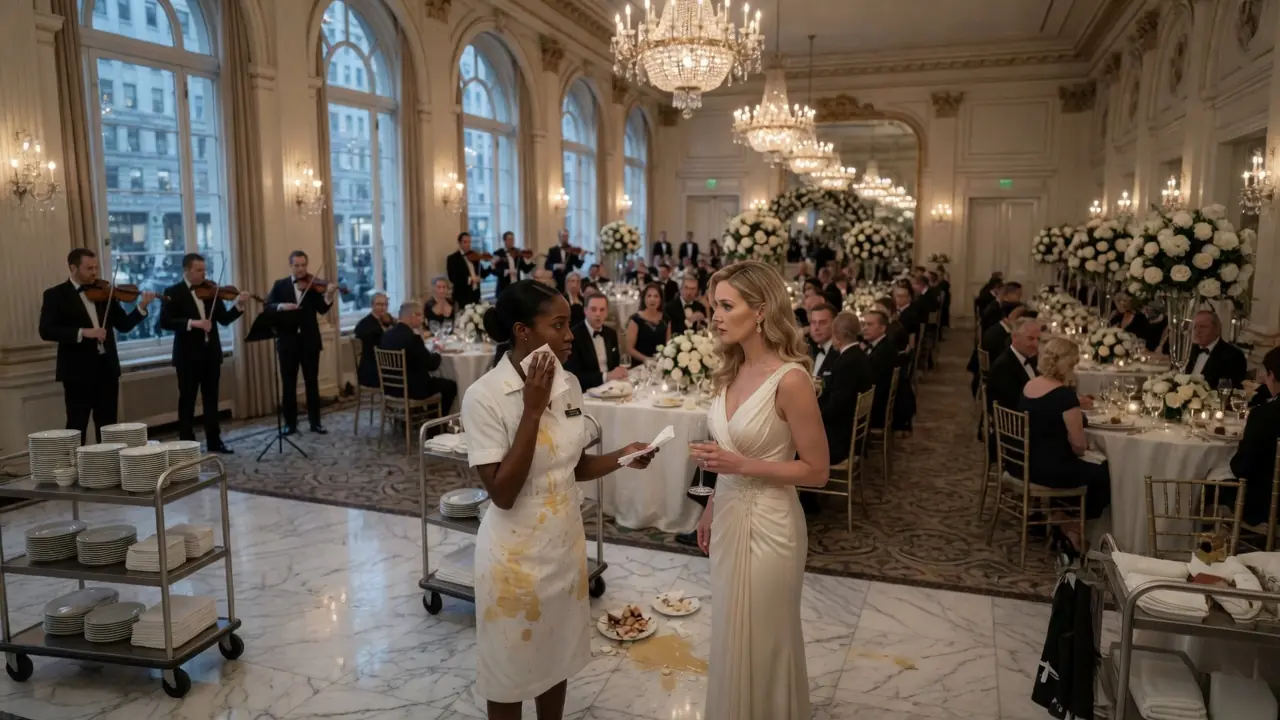
Clara stepped beside Vanessa’s chair to clear a dessert plate. She kept her eyes lowered, one hand steady beneath the plate, the other guiding the tray close to her waist. Vanessa turned her head slowly and looked straight at her. For one sharp second, the noise of the room seemed to fade, leaving only Vanessa’s stare and Clara’s own heartbeat. Then Vanessa reached for her glass of pale golden white wine.
The movement happened fast, but everyone nearby saw it. Vanessa stood so quickly that her chair scraped against the floor, lifted the glass, and snapped her arm forward in one angry motion. The pale golden wine arced through the chandelier light, bright and unmistakable, before splashing across Clara’s face, cheek, neck, and white service uniform. The dessert plate slipped from Clara’s hand and struck the floor with a sharp crack. A gasp moved through the head table before the entire ballroom fell silent.
The string quartet stopped playing. A waiter near the service doors froze with a tray in both hands. Guests turned in their chairs, some with forks still lifted halfway to their mouths. Daniel Whitmore rose from his seat so suddenly that his napkin fell to the floor beside him. Vanessa still held the empty glass, her arm slightly extended, her face full of fury she had not managed to hide.
For one second, everyone expected Clara to break. They expected tears, an apology, a rush toward the exit, or the frantic embarrassment of a worker desperate not to lose her job. But Clara did not run. She did not scream. She stood completely still with pale golden wine dripping from her chin onto her uniform, her breathing steady, her eyes lifted now. And then, in a voice quiet enough to be controlled but clear enough for the head table to hear, she said, “I know everything.”
Those three words changed the temperature of the room. Vanessa’s expression flickered, and for the first time all evening, her confidence cracked. Daniel turned from Vanessa to Clara, his face pale with shock. “What did you just say?” he asked. Clara reached for a folded cloth napkin from the table and gently pressed it against her cheek, still standing straight despite the humiliation.
Vanessa recovered first because women like Vanessa were trained to recover quickly. “Daniel, she is staff,” she said sharply, her voice shaking beneath the polished surface. “She is trying to create a scene.” Clara did not respond to the insult. She looked only at Daniel, because he was the one who needed the truth, and she had already decided that whatever happened to her job afterward would be easier to live with than silence.
“Mr. Whitmore,” Clara said, “I am sorry to do this here, but I do not think there will be a better place.” Ms. Patterson, the hotel’s event director, appeared beside her with a face tight from professional panic. She whispered Clara’s name, warning her without quite saying the warning aloud. Clara turned slightly and said, “Please,” not as a demand, but as a request from someone who understood the risk. Then she reached into the pocket of her apron and pulled out the folded paper.
Daniel looked at the paper as if it might burn him. Vanessa stepped forward, but he lifted one hand without looking at her. “Sit down, Vanessa,” he said. His voice was quiet, but something in it made the entire head table obey the silence around him. Vanessa sat slowly, her jaw tight, her empty glass now trembling slightly between her fingers.
Clara held the paper out to Daniel. He took it, unfolded it, and began to read. The first lines were enough to change his expression completely. It was a printed screenshot of messages between Vanessa and an attorney, discussing the Whitmore family trust and a clause that protected Daniel’s inherited assets if the marriage ended within five years. The messages also discussed ways to redirect separate liquid assets soon after the ceremony, before any future separation became public.
Daniel read the page once, then again. The color seemed to leave his face slowly, like water draining from a glass. Someone at a nearby table whispered, “Oh my God,” but nobody told them to be quiet. Vanessa shot to her feet again, this time with panic instead of anger. “That is private correspondence,” she snapped. “She had no right to see that.”
Daniel did not answer her immediately. His eyes remained on the paper, and Clara saw something in him collapse inward. It was not the look of a man angry about money; it was the look of a man realizing love had been treated like a transaction. When he finally lifted his eyes, he did not look at Vanessa first. He looked at Clara.
“Where did you get this?” he asked. Clara swallowed once, feeling the weight of three hundred silent guests pressing against her back. She explained that the attorney’s paralegal was her neighbor, that she had accidentally seen the message while helping carry groceries, and that she had not known what to do. “I almost stayed quiet,” Clara said. “But I kept thinking that if someone were planning my future without my knowledge, I would want someone to tell me.”
Vanessa laughed once, a short cold sound that did not reach her eyes. “So now the maid is a moral authority?” she said. The words cut across the ballroom, ugly in their polished cruelty. Daniel turned toward her then, and whatever remained of his public softness disappeared. “Do not speak to her like that,” he said.
The command landed harder than a shout. Vanessa blinked, stunned that he had defended Clara in front of everyone. Daniel folded the paper carefully, almost too carefully, and placed it on the table beside his untouched dessert. He looked at Vanessa with a grief so quiet it made the room feel smaller. “Is this real?” he asked.
Vanessa’s mouth opened, then closed. She glanced at the guests, at Daniel’s family, at the wedding planner, at the white roses and the expensive dinner she had expected to control. For a moment, Clara saw the calculation return to her face. Vanessa began with denial, then shifted quickly into explanation, saying attorneys discussed many possibilities, wealthy marriages required protection, and Daniel could not possibly understand the pressure placed on women entering powerful families. But every sentence sounded less like innocence and more like strategy.
Daniel listened without interrupting. That was what made it worse. He did not rage or accuse her wildly. He simply stood there, hearing each word and letting it reveal more than Vanessa intended. When she finally said she had only been protecting herself, Daniel looked at her and asked, “From what? From the marriage we had not even begun yet?”
Vanessa’s face changed. She looked suddenly younger, but not softer. “You have everything,” she said, her voice low and tight. “You have money, lawyers, family protection, an entire structure built to keep you safe.” Daniel nodded once, slowly. “And your answer was to marry me while preparing your exit?” he asked. Vanessa had no clean answer for that.
The ballroom remained frozen in a strange half-silence. No one was eating now. The string quartet stood with instruments lowered, and even the staff seemed unable to move. Clara was still standing beside the head table, her uniform damp with pale golden wine, the cloth napkin pressed lightly to her cheek. She wanted to disappear, but she knew the moment had moved beyond her.
Daniel turned to Ms. Patterson and asked for a private room. His voice was steady, but his eyes were bright in a way that revealed how close he was to breaking. Two of his closest friends stood without being asked, and his mother pressed a hand to her mouth. Vanessa looked at the paper on the table as if it had betrayed her personally. Then Daniel said, “We need to talk upstairs.”
Before leaving, he turned back to Clara. “Please wait,” he said quietly. Clara nodded. Vanessa’s eyes flashed at the exchange, but she said nothing this time. She had already lost the right to control the room, and everyone knew it.
Ms. Patterson guided Clara toward the staff break room while another server hurried to bring her a clean uniform. The moment the door closed behind them, Clara finally exhaled. Her hands began to tremble now that the room could no longer see her. Ms. Patterson stood in front of her, torn between hotel procedure and human concern. “Are you hurt?” she asked.
“No, ma’am,” Clara said. The answer was not completely true, but it was true enough. Ms. Patterson handed her a towel and then, after a pause, touched her shoulder gently. “You understand there will have to be a review,” she said. Clara nodded because she had expected that. Then Ms. Patterson added, very quietly, “But what you did took courage.”
Upstairs, in a private suite overlooking Manhattan, Daniel asked Vanessa one question after another. Was the document real? Had she spoken to the attorney? Had she planned to move assets after the wedding? Had she known about the trust clause before accepting his proposal? At first, Vanessa tried to control the conversation, but control was useless once the truth had already entered the room.
She admitted parts of it slowly. Yes, she knew about the clause. Yes, she had contacted the attorney. Yes, she had been afraid of entering a marriage where Daniel’s family wealth was protected and hers might not grow the way she expected. But she insisted that fear was not the same as betrayal. Daniel looked at her for a long time and asked whether love had ever been the center of her decision.
That question ended the engagement more completely than any accusation could have. Vanessa stared at him, her eyes wet but her silence honest. She said she thought she loved him. She said she wanted to love him. She said the life around him was so enormous that sometimes she could not tell where affection ended and ambition began. Daniel closed his eyes for a moment, and when he opened them, the decision was already there.
“I think you should go,” he said. Vanessa tried to protest, but he did not argue. He simply repeated it, quieter the second time. The wedding that had been nine days away ended in that suite without shouting, without broken glass, and without public spectacle. It ended because Daniel finally saw that a beautiful future built on hidden calculations was not a future at all.
Before Daniel returned to his family, he went down to the staff corridor. Clara had changed into a clean uniform, though her hair was still slightly damp and her eyes looked tired. When she saw him at the break room door, she stood quickly, unsure whether she was about to be thanked or blamed. Daniel stepped inside and looked at her with a seriousness that made her chest tighten. “You risked your job to tell me something I needed to know,” he said. “I will not forget that.”
Clara did not know what to say. She had imagined anger, suspicion, or legal questions, but not gratitude. “I just thought it was right,” she said softly. Daniel nodded. Then he extended his hand, and Clara shook it. In the hallway of a luxury hotel, the billionaire groom and the Black maid everyone had ignored stood as equals for one honest moment.
The weeks after that night were not easy. The hotel launched a review because rules existed, even when truth made them complicated. Clara answered questions about what she had seen, how she had obtained the printed message, and why she had waited until the dinner to speak. She told the same story every time because the truth did not need decoration. Still, every day she came to work wondering whether it would be her last.
Her neighbor lost her job at the attorney’s office, though the mistake was judged accidental and no legal action was taken against Clara. Clara felt guilty about that, even though her neighbor told her not to. For three nights in a row, Clara brought her dinner and helped her rewrite her résumé. That was the part of Clara most people never saw. Even when she was carrying her own fear, she still noticed who else was struggling.
Three weeks later, Ms. Patterson called Clara into her office. Clara sat with her hands folded tightly in her lap while Ms. Patterson opened a folder. The review had concluded that Clara would not be disciplined. Her actions, while unusual, had been taken in good faith under extraordinary circumstances, and several senior staff members had spoken strongly on her behalf. Clara nodded carefully, afraid that if she reacted too quickly, she might cry.
Then Ms. Patterson slid a second envelope across the desk. It was from Daniel Whitmore’s family office. Inside was a handwritten letter and a certified check large enough to cover the rest of Clara’s hospitality management degree, her parents’ remaining mortgage in Ohio, and several months of breathing room. The note was simple: For your education, your future, and the courage to do the right thing when silence would have been easier.
Clara read the note three times before the tears came. She cried in Ms. Patterson’s office, not from embarrassment, but from the sudden release of years spent holding herself together. That evening, she called her mother from the bench outside the employee entrance. She told her everything, from the pale golden wine to Daniel’s letter. Her mother listened quietly, then said, “Baby, I raised you to stand straight when the world tries to bend you.”
Months passed, and the Grand Harrington returned to its usual rhythm of weddings, conferences, charity dinners, and private celebrations. People still whispered about the Whitmore dinner, but Clara no longer lowered her head when she walked through the ballroom. She finished her degree and was promoted to junior event coordinator, a job with a desk, a salary increase, and a future that finally felt wider than survival. She still worked hard, but now people learned to say her name before they needed something from her.
Daniel returned to the hotel once, nearly six months later, for a corporate event. He saw Clara near the banquet floor, wearing a black coordinator’s blazer instead of a service uniform. He stopped, smiled gently, and asked how she was. Clara smiled back and said, “Really good.” For the first time in a long time, she meant every word.
As for Vanessa, she disappeared from the public wedding pages almost overnight. The announcement said the wedding had been postponed indefinitely, polite language for a future that had already ended. Daniel never humiliated her publicly, even though many people believed he could have. He let silence do what revenge never could. Those who knew the truth understood enough.
But the story people remembered was not really about Vanessa, or even Daniel. It was about Clara Bennett standing in a ballroom with pale golden wine on her uniform while hundreds of powerful people watched. It was about a Black maid everyone had treated as invisible becoming the only person brave enough to speak. It was about the truth arriving through the hands of someone the room had underestimated. And it was about the unforgettable lesson that dignity does not depend on wealth, status, or a seat at the head table.
Clara did not become powerful that night because Daniel thanked her or because money came later. She had already been powerful when she chose not to stay silent. She had already been powerful when she stood still instead of running, when she held out the folded paper, when she spoke with a steady voice after being humiliated in front of strangers. The room froze because the truth had entered it. And truth, once spoken, has a way of making even the richest people listen.