"Please, Mrs. Harmon, can I have my lunch now?"
The question was barely louder than the scrape of plastic trays in Pinewood Elementary's cafeteria, but Aaron Williams heard every word from the doorway. He had come with a paper lunch bag in his hand, expecting to surprise his eight-year-old son with a turkey sandwich from the deli Isaiah loved. Instead, he stood beneath the humming fluorescent lights and watched his little boy sit alone at a small table in the farthest corner of the room, separated from two hundred other children by fifteen feet of empty floor and a laminated sign that read BEHAVIOR TABLE.
Patricia Harmon stood over him in a beige cardigan, her reading glasses pushed up into her hair and her mouth pulled into the patient, poisoned smile of someone who knew how to hurt quietly. "Lunch?" she said, bending close enough that Isaiah shrank back in his chair. "Little boys like you don't get to eat with the other children until you learn how to act civilized. Animals sit where they belong."
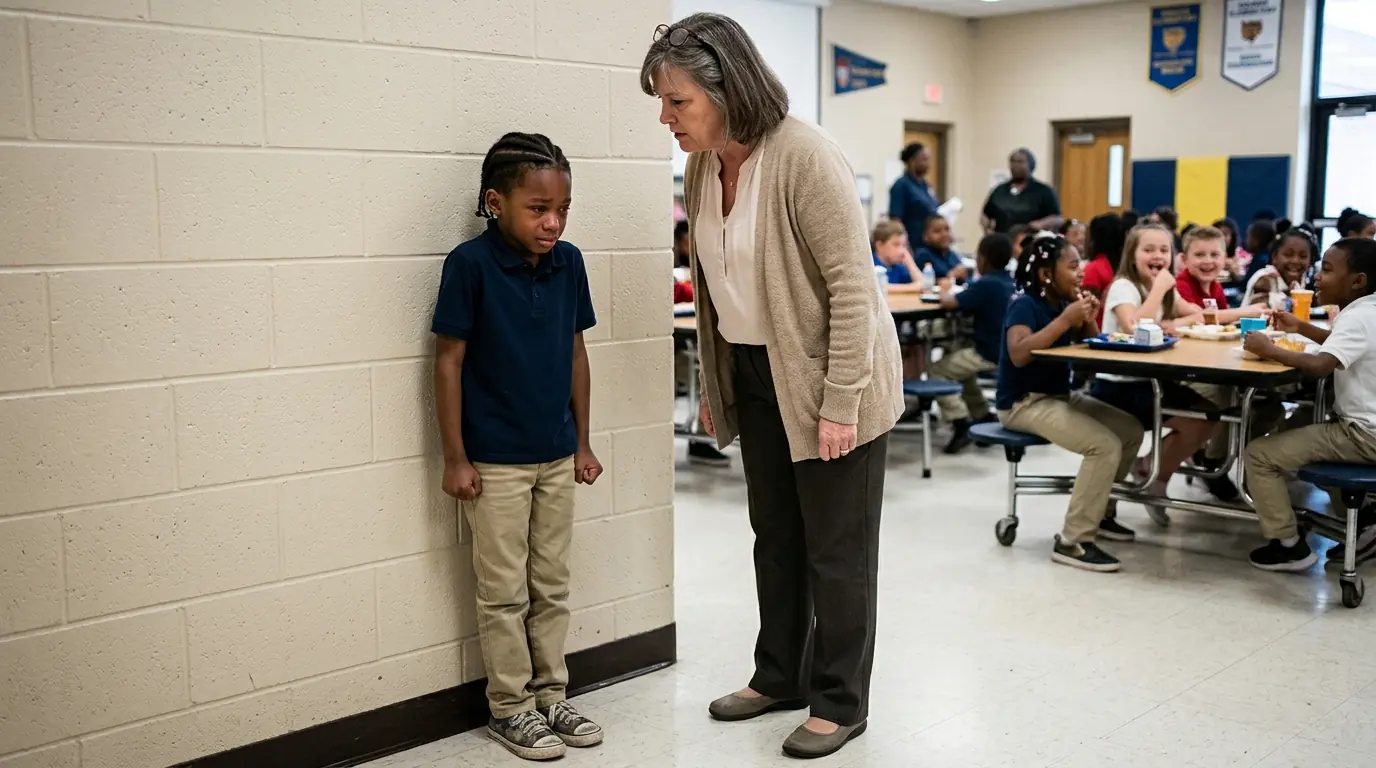
Aaron's fingers tightened around the lunch bag. He had spent eighteen years as a federal civil rights investigator, eighteen years interviewing witnesses who trembled, suspects who lied, and officials who hid cruelty behind paperwork. He knew how to keep his body still while rage moved through him. But nothing in those eighteen years had prepared him for the sight of his son sitting hungry and humiliated while a grown woman explained cruelty as discipline.
Isaiah's voice shook. "But I didn't do anything. I just asked if I could sit with Jayden."
Mrs. Harmon leaned lower. "And that mouth is exactly why you're here. Your father may let you talk any kind of way at home, but in my classroom, you learn respect. Maybe if your mama were still around, she would have taught you better. Oh, wait. She isn't, is she?"
The cafeteria kept roaring around them. Children laughed. Milk cartons opened. Forks tapped against trays. A playground argument broke out near the center table and an aide told two students to sit down, but nobody turned toward the corner where Isaiah Williams lowered his head and cried silently onto an empty table.
Aaron took one step forward.
Mrs. Harmon straightened and turned, noticing him for the first time. Her face changed in the smallest way, a flicker of irritation quickly covered by professional surprise. "Can I help you, sir?"
Aaron crossed the distance slowly. His voice, when it came, was lower than the cafeteria noise and sharper than shouting. "That's my son."
For one second, Mrs. Harmon said nothing. Then the machinery of excuse clicked into place behind her eyes. "Oh. Mr. Williams, Isaiah was being disruptive during lunch transition. We use the behavior table to help students reflect on their choices."
Aaron set the lunch bag on the table beside his son's empty hands. "He hasn't eaten."
"He was asked to wait until he was ready to rejoin the group appropriately."
"I heard what you said to him."
Mrs. Harmon's smile tightened. "Cafeterias are very loud. It's easy to misunderstand tone."
Aaron looked at her, then down at his son. Isaiah's shoulders were shaking. His small braids had slipped loose from the neat part Aaron had fixed that morning, and his eyes were red in a way no child's eyes should be during lunch.
Aaron knelt beside him. "Hey, champ. Daddy's here."
Isaiah looked up, and the effort he had been making to stay quiet broke all at once. "She said I was bad. She said boys like me act like animals. She said Mommy should have taught me."
Aaron pulled him close. The boy's body folded against him as if he had been holding himself up by will alone. Aaron pressed one hand to the back of his head and closed his eyes for half a second, long enough to bury the instinct to destroy everything in the room.
"You are not bad," Aaron whispered. "You hear me? You are not bad. Nothing she said is true."
Mrs. Harmon shifted behind them. "Mr. Williams, I think this conversation should continue with administration."
Aaron stood, keeping one hand on Isaiah's shoulder. "It will."
The teacher's confidence returned a little at the word administration. She seemed to believe the building itself would protect her, that the office, the principal, the language of procedure, and her eighteen years of service would make what Aaron heard less real. She did not know who he was. That did not matter to Aaron. In fact, it mattered more that she did not know, because she had shown him exactly how she treated a Black child when she believed no one powerful was watching.