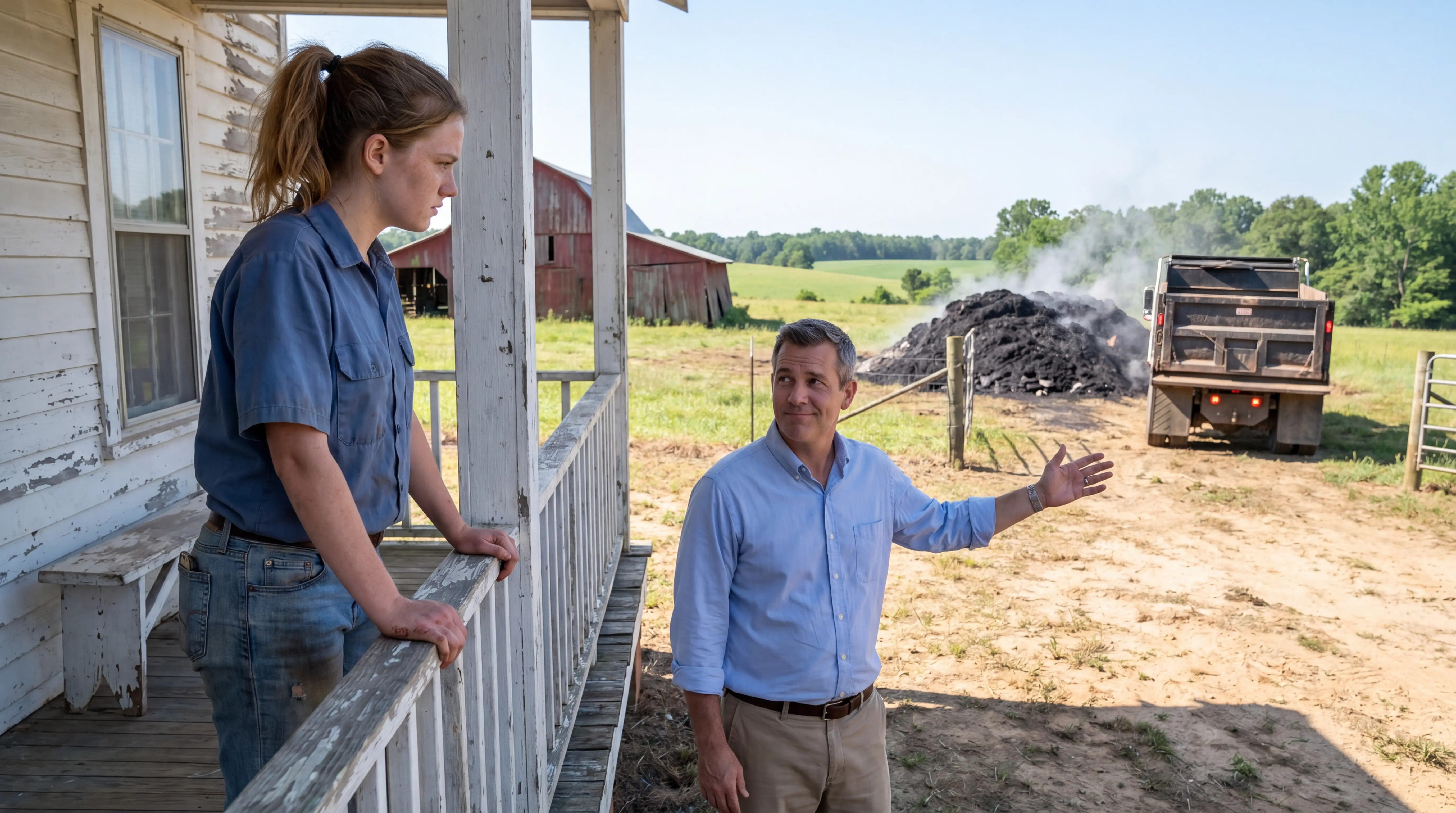
The smell came before the trucks did. It always did. By the time Elsie Wren stepped onto the back porch that summer morning, the air over the South pasture already carried it. That thick, fermented sweetness, half molasses and half rot, was the kind of smell that settled into your hair and the inside of your nose and refused to leave.
The grass near the fence line had turned the color of weak tea. Flies hung in slow, lazy spirals above the drainage ditch. And beyond the fence, in the low corner of land her grandfather had once called the good bottom, a fresh black mountain of crushed cane and mill sludge steamed quietly in the early heat. She was 16.
Her boots were taped at the toe. Her hands were already chapped from the morning's work. And she had been watching this pile grow in one form or another for nearly six years. The Callaway Sugar Refining Company had been dumping there since she was 10.
Quietly at first, then openly. Then with a kind of patient confidence that said no one was coming to stop them. Her father had written letters. Her mother had stopped reading them out loud. The county clerk had a folder somewhere with their name on it that, as far as anyone could tell, had never been opened twice.
Elsie stood on the porch and watched a fresh truck back up to the dumping ground, its tailgate yawning open like a tired mouth. The driver didn't look at the house. They never did. What none of them knew, what she didn't know yet that morning, was that the black mountain poisoning her family's land was about to become the most valuable fertilizer in the county.
And the quiet girl on the porch was the only person who would figure out how.
The Wren farm sat on the soft, rolling edge of a river valley in a county where the cane fields had once been the pride of three generations. Eighty acres. A red barn that leaned slightly east. A farmhouse painted the kind of white that had stopped being white sometime around 1994.
Elsie's grandfather had worked that soil for 41 years and used to say the bottom land was so rich you could push a fence post in by hand and watch a sprout climb it by Sunday. That was before the refinery expanded. Before a man in a tucked-in shirt arrived one autumn afternoon and explained that the back 40 of the Wren property happened to sit downwind, downhill, and conveniently adjacent to land the company had recently purchased. He used the word byproduct a great deal.
The drainage shifted. The bottom land that had once grown sweet corn waist-high by July began to grow thin, yellow stalks that snapped in the wind. The well water took on a faint sourness her mother refused to comment on. Her father went to the company offices three times.
The first time he came home angry. The second time he came home quiet. The third time he didn't talk about it at all. The manager, a man named Hal Brennan, was not cruel.
That was almost the worst part. He was tired in the way men become tired when they have learned that nothing they say will ever be questioned. He poured coffee. He spoke about regulatory timelines and operational realities and the unfortunate complexities of agricultural runoff.
Then he walked her father to the door and forgot him before the door had finished closing. The neighbors were not much better. Some of them worked at the refinery. Some of them simply did not want trouble.
When Elsie's mother brought it up at the feed store, a woman named Dorothy Halsey, who had known Elsie since she was small, looked at the floor and said, “Honey, that's just how things are now.” That, more than the smell, more than the trucks, more than the yellowing corn, was the moment Elsie understood that no one was coming. She was 16 the day she stopped waiting.
It began, like most real things begin, with something small and easy to miss. Late September, the kind of warm afternoon where the cicadas sound like a kettle that will not stop boiling. Elsie was walking the fence line, checking for breaks, when she stopped near the oldest part of the dumping ground, a section long abandoned by the trucks in favor of fresher corners.
The pile had collapsed in on itself, flattened by rain, eaten at by weather. Grass had crept across the edges. And on the south side, half hidden under a curl of decomposing bagasse, she saw something that made her stop walking. A volunteer tomato plant, not a sad, struggling one, but a thick, dark-leaved, almost arrogant tomato plant, taller than any in her mother's garden, hung with fruit so heavy the stems bowed.
Nothing else grew in that field. Nothing. She stood there for a long time, long enough for the sun to shift. And in that silence, for the first time in six years, she felt something other than helplessness.
She felt curious. She didn't tell anyone, not that night, not the next morning. She went to the small county library after school the following Tuesday and asked the librarian, a soft-spoken woman named Mrs. Penhalligan, for anything she had on composting. Mrs. Penhalligan brought her three books, then four more by the end of the week, then began quietly setting aside agricultural extension pamphlets she found in the recycle bin from the university up north.
What Elsie learned, slowly, over weeks of reading at the kitchen table after her chores were done, was that the black mountain behind her house was not garbage. It was unfinished. And buried inside that ugly word, waste, was the raw material of one of the oldest, most powerful organic fertilizers known to agriculture. Sugarcane bagasse, the crushed fiber left after the juice is pressed out, is one of the most carbon-rich agricultural residues on Earth.
Dumped raw, it is acidic, nitrogen-starved, and slow to break down. It robs the soil it touches, chokes drainage, and poisons the shallow root zone. That part, she had lived. But under the right conditions, the right balance of nitrogen, the right moisture, the right oxygen, and the right time, that same waste could become something else entirely.
Something her books called humus. A dark, crumbling, sweet-smelling substance that fed soil microbes, held water, released nutrients slowly, and built Earth the way coral builds reefs, one invisible layer at a time. Farmers had a simpler name for it: living fertilizer. The kind that didn't burn the soil out the way synthetic nitrogen did, but rebuilt it season by season, year by year.
Compost, she read, was not made by people. It was made by life, by billions of microorganisms, bacteria, fungi, actinomycetes, and protozoa, eating, breathing, dying, and being eaten. The compost pile was not a container. It was a body.
It had a temperature. It had a pulse. When it was working, you could feel the heat of it through your palm from a foot away. The cane waste had everything it needed except partnership.
Nitrogen. Air. Water in the right amount. She read about the carbon-to-nitrogen ratio.
The magic number was around 30 to 1. Thirty parts carbon to one part nitrogen. And the bagasse sitting in those piles was closer to 150 to 1. Starving.
She read about thermophilic bacteria that thrive above 130 degrees Fahrenheit and kill weed seeds and pathogens. She read about turning, about aeration, about the difference between anaerobic rot and aerobic decomposition, the difference between a swamp and a forest floor. And one night, sitting at the kitchen table while her father slept in the next room, she understood something her books had not quite said out loud.
The company hadn't been dumping waste behind her farm. They'd been dumping raw material. They simply didn't know it. Or they didn't care.
She did.
She started in October on a patch of ground behind the old equipment shed, out of view of the road. She didn't tell her father what she was doing. She wasn't sure yet that there was anything to tell. The first pile was small, maybe four feet across and three feet high.
She built it the way the extension pamphlets described. A base of coarse twigs for airflow, a layer of bagasse hauled in a wheelbarrow from the dump site, one painful load at a time. A thin layer of fresh chicken manure from the coop. A handful of soil from the woods behind the barn, alive with native microbes.
Another layer of bagasse. Another layer of manure. Water, but not too much. The pamphlet said the pile should feel like a wrung-out sponge.
She squeezed a handful. One drop fell. She moved on. For the first week, nothing happened.
She put her hand against the pile every morning and felt only cold, damp fiber, and began to wonder if she'd done it wrong. On the ninth day, the pile was warm. On the eleventh, it was hot. She pushed a long steel rod into the center, the way one of the pamphlets had described, left it there for a minute, and pulled it out.
The metal was almost too hot to touch. She stood in the cold morning air with the rod in her hand and laughed, a short, startled laugh she did not entirely mean to make. It was alive. But process is not progress.
The first real setback came in November, when a hard cold front dropped the temperature 30 degrees overnight and the outer layer of her pile froze solid. The core kept working, barely, but the cooling slowed everything down. She covered the pile with straw, then with an old tarp her father didn't know was missing, then with more straw. She turned it with a pitchfork every five days, lifting the cooler outside material into the hot core.
Her shoulders ached. Her hands cracked at the knuckles and bled into her gloves. The second setback was the smell. Done correctly, finished compost smells sweet, like forest floor after rain.
Done badly, it smells like a slaughterhouse. In December, after a heavy snow that soaked the pile too deep, the inside went anaerobic. The smell that rose off it when she turned it the following week made her stagger backward and cover her face with her sleeve. The microbes inside were drowning.
She had to rebuild. She rebuilt. The third setback was social. A boy from her class saw her pushing a wheelbarrow of manure across the yard one Saturday morning and told everyone at school on Monday.
For two weeks, she was the manure girl. Someone wrote it on her locker in marker. She walked past it every day. She didn't wipe it off.
She thought about the tomato plant. Mr. Halloran, the agriculture teacher, a quiet, gray-bearded man who had grown up on a dairy farm two counties over, noticed her reading a soil biology textbook during lunch one afternoon. The next day, he set a battered old paperback on her desk without a word. It was Sir Albert Howard's An Agricultural Testament, the founding text of organic composting, written in 1940.
The cover was held on with tape. “Read it when you can,” he said. And then, after a moment, “If you need help, my barn's got space.” She read it twice.
She did not ask for help. Not yet. By February, she had three piles working at different stages. By March, the oldest pile had cooled, darkened, and broken down into a substance she almost didn't recognize as the same material she had started with.
It was deep brown, almost black. It crumbled in her hand like rich coffee grounds. When she pressed her face close, she could smell it. Not bagasse, not manure, not waste.
Earth. The honest, ancient smell of healthy soil. She filled a coffee can with it and carried it inside and set it on the kitchen table in front of her father. “Fertilizer,” she said, “from the back lot.”
He looked at it for a long time. He picked up a small handful and let it fall through his fingers. He didn't say anything. He didn't need to.
Elsie saw something move across his face that she had not seen in six years. In April, she spread her first finished batch across a quarter-acre test plot near the house. Not the bottom land. She wasn't ready for that.
A smaller plot, sandy and tired, the kind of ground that had been growing nothing but weeds for two seasons. She worked the compost in by hand and by hoe. She planted sweet corn and pole beans and three kinds of tomatoes. She kept making more compost.
She had figured out by then how to scale, which corner of the dump site had the best aged bagasse, already partly broken down by years of weather. She had worked out a turning schedule. She had built a long, low windrow behind the equipment shed that she covered with a salvaged tarp and turned every Sunday afternoon alone in silence while the rest of the county went to church.
By June, the test plot did not look like the rest of the farm. It looked like something out of an old photograph from her grandfather's time. The corn was waist-high by the first week of June. The tomato plants were dark-leaved and heavy, the way the volunteer plant in the dump field had been.
With the beans, the vines had to be re-staked twice because they kept outgrowing the supports. The neighbors noticed in July. A man named Pete Doheny, who farmed the place across the road and had once told her mother that “that's just how things are now,” leaned on the fence one afternoon and watched her pick beans for nearly 20 minutes before he spoke.
“What are you putting on it?” he finally asked.
She straightened up. She looked at him. She thought about the years of silence.
“Fertilizer I made,” she said, “from the cane waste.”
“From where?”
She pointed across the field toward the black mountain behind the south fence. He didn't say anything for a long moment. Then he took off his cap, ran a hand through his hair, put the cap back on, and walked away across the road without another word.
By August, three other farmers had stopped by. By September 6th, Mr. Halloran came out one Saturday with a soil testing kit from the agriculture department and ran samples from her test plot, the bottom land, and the original dumping ground. He went home, ran the numbers, came back the next weekend, and sat at the kitchen table with her parents for nearly two hours.
“The soil in her test plot,” he told them quietly, “had nearly three times the organic matter of the surrounding fields.”
The microbial activity was higher than anything he had measured in 23 years of teaching. What she was producing back behind that equipment shed, he said, was a complete organic fertilizer: nitrogen, phosphorus, potassium, trace minerals, and living biology. All of it pulled from material the company had been paying to throw away. He looked at Elsie when he said it.
He did not look away. The man from the company came in October. Not Hal Brennan. A different man, younger, in a better suit, with a quieter voice.
He stood in the yard with a clipboard and asked, in a careful way, whether the Wrens would be open to a conversation about the materials on the back lot. Elsie was the one who answered the door. She did not gloat. She did not raise her voice.
She had thought, sometimes in the bad months, about what she might say if someone from the company ever came back. None of those imagined speeches felt right now that the moment had arrived. They felt small. She simply said, “You can talk to my father. He's in the barn.”
What followed, over the next two years, was not a courtroom victory. It was not a public reckoning. The company did not collapse. Hal Brennan did not lose his job.
The dumping site, by mutual quiet agreement, was cleared at the company's expense, not because they were forced to, but because they had finally understood, the way men like that always understand things, that the value had shifted. Elsie was paid modestly for a consulting role she did not ask for. The university up north sent a graduate student to study her windrows. A regional farming magazine ran a small article.
Her father framed it and hung it above the kitchen sink. The bottom land took four more years to fully recover. She worked it slowly, season by season, the way her grandfather would have. By the time she was 23, the soil in that field was darker and richer than anything within 50 miles.
People ask her sometimes what the lesson was. She doesn't have a clean answer. She is not the kind of person who likes clean answers. But on quiet evenings, when the light is going down behind the barn and the swallows are cutting low across the pasture, she will sometimes say something close to this.
The land does not lie. Patience is not the same as waiting. The people who shout the loudest are almost never the ones who change things. And anything called waste is usually only waste because no one has bothered to understand it yet.
She keeps a quote tacked to the inside of the equipment shed in handwriting that has faded over the years. It is from George Washington Carver, the agricultural scientist who built a career on the conviction that humble things contained extraordinary possibilities.
“Anything will give up its secrets if you love it enough.”
The cane waste did. It gave up everything it had, its nitrogen, its carbon, its silent biology, and became the richest fertilizer in the county. The land gave up its secrets, too. So did the girl, though she would never put it that way about herself.
She just kept turning the pile every Sunday, alone, in silence, until the world eventually came around to where she had been standing all along.