The tide came in slowly along that stretch of coast, sliding over gray sand, broken clam shells, and smooth stones before drawing back toward the Atlantic as it had done long before anyone named the roads nearby. Eighteen acres sat above the tide line, with a weathered farmhouse, an equipment shed leaning slightly east, a barn missing part of its roof, and fields that still looked healthy from a passing car because distance was kind to damaged things. Those acres had belonged to Thomas Brooks for forty years, and on a cold Tuesday morning in March he died from a heart attack at the kitchen table before the coffee beside his hand had gone cold. By the following Monday, his widow Eleanor had already been told three times that the sensible thing was to sell.
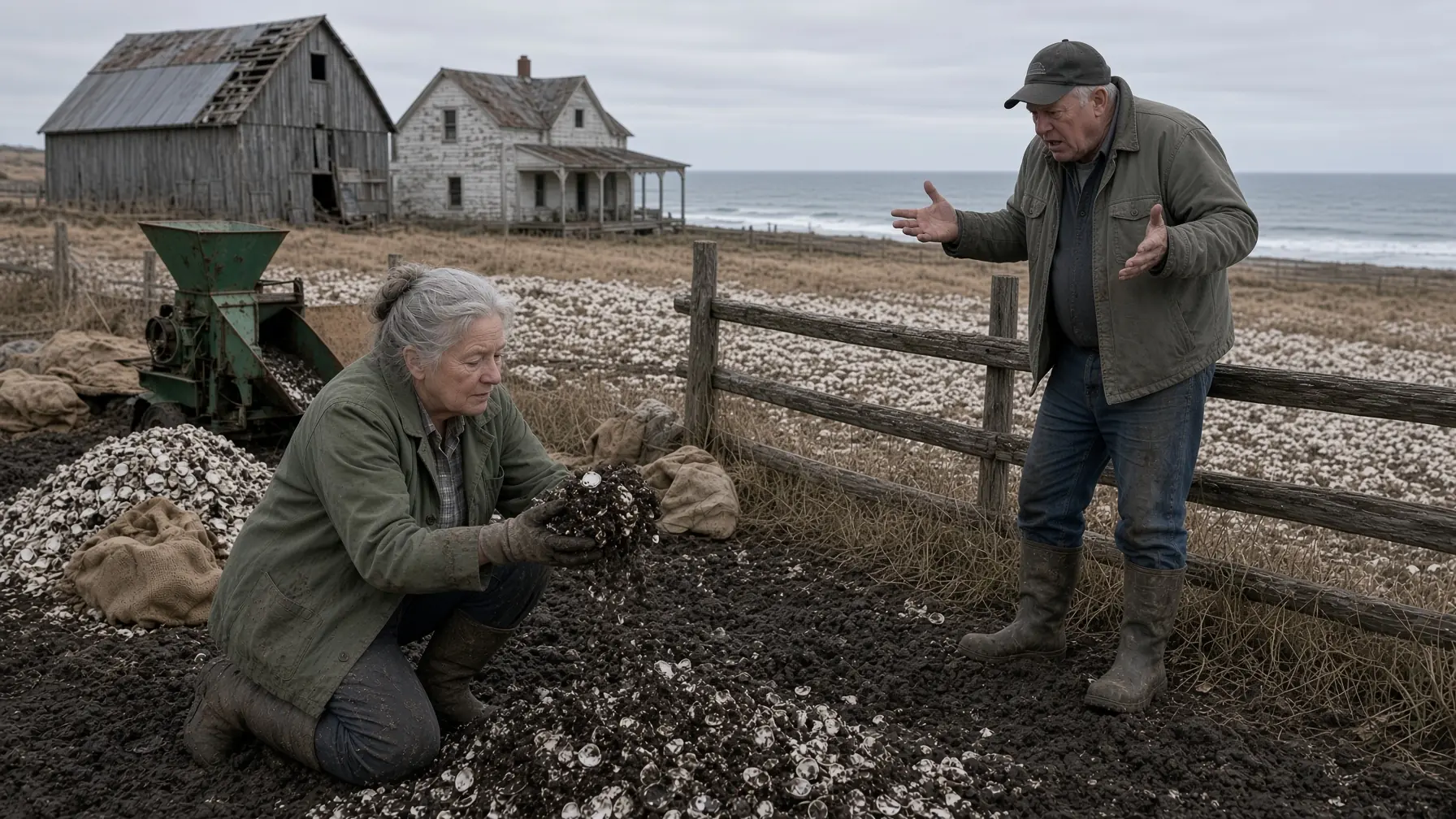
Eleanor Brooks was sixty-eight years old, five feet four inches tall, and accustomed to being underestimated because she spoke softly and rarely felt compelled to fill silence simply because other people found it uncomfortable. Her silver-gray hair stayed pinned at the back of her head, her hands carried small scars from decades of gardening, canning, mending fences, helping during harvest, and doing whatever else needed doing without ever describing herself as a farmer. Thomas had always been the farmer in public, while Eleanor managed household accounts, kept seed invoices organized, drove parts from town when machinery failed, helped in the fields when schedules collapsed, and remembered which neighbor had loaned them what fifteen years earlier. Marriage had divided their work without dividing the farm, which was why everyone calling the land “Thomas’s place” after his death sounded slightly wrong to her.
Thomas had collapsed just after seven in the morning while Eleanor was carrying laundry from the back room. She heard the chair scrape, found him on the kitchen floor, called emergency services, and began chest compressions with instructions coming through the phone until paramedics arrived twelve minutes later. They worked on him for almost forty minutes before a young medic with red cheeks and shaking hands finally looked at her in a way that told Eleanor the answer before he said it. Three days later she buried the man who had slept beside her for forty-six years.
The funeral filled the small white church near Harlow’s Point because Thomas had repaired enough tractors, loaned enough implements, delivered enough calves, and helped enough neighbors through bad seasons that people considered him part of the local landscape. Eleanor stood beside the grave while acquaintances told her he had been a good man, which was true, and then followed the words with advice about what she ought to do next, which she had not requested. Nobody was cruel, and that almost made the advice harder to reject because concern arrived disguised as certainty. “Eleanor, eighteen acres is too much now,” one neighbor told her, while another squeezed her hand and said, “There’s no shame in moving into town.”
They were not wrong about everything. The farmhouse needed foundation work, the barn roof leaked, the tractor had more repaired parts than original ones, and the farm had barely broken even during the final three years of Thomas’s life. Worse, the soil itself had been declining slowly enough that each season felt unfortunate rather than catastrophic until Eleanor compared old yield records with the newest ones and saw the direction plainly. The land people had begun calling “tired ground” was exactly that.
Repeated heavy rains had washed nutrients through sections of the fields and carried topsoil from the highest ground toward the drainage ditch. Thomas had compensated with purchased fertilizer, but input prices kept rising while his yields failed to recover proportionately, and by his final season even he had admitted that something deeper than simple nutrient shortage was happening. Some areas crusted hard after rain, others stayed waterlogged too long, and several fruit trees nearest the eastern field developed pale leaves despite regular feeding. Thomas had intended to order a more comprehensive soil analysis that spring.
He never got the chance. Eleanor found the soil-testing brochure beneath a stack of seed catalogs two weeks after the funeral, with Thomas’s handwriting across the top reading, Do this before planting anything expensive. She sat at the table holding that scrap of paper until afternoon light disappeared from the kitchen. Then she folded it once and put it in her coat pocket.
The first serious offer for the property arrived before April. Miles Landry, a land buyer working for a regional development company, came in a clean pickup wearing boots too spotless for a man who claimed to understand farms and offered Eleanor an amount large enough to erase every remaining farm debt. He explained that the road frontage made the property suitable for future residential lots, that the agricultural value was declining, and that she could purchase a comfortable condominium near town with money left over. “You wouldn’t have to worry about keeping this place alive anymore,” he said.
Eleanor looked past him toward the fields. Thomas had once stood near the western fence during a storm and said that land was not really owned by anyone because people merely borrowed it between generations, a statement Eleanor had mocked at the time because they still had a thirty-year mortgage. She thought about Miles’s offer, the leaking barn, the broken porch step, the silent bedroom upstairs, and how easy it would be to convert every problem into one check. Then she told him she was not ready.
Miles nodded politely. “Offer stays open for thirty days.” Eleanor thanked him.
That evening she walked all eighteen acres alone. The fields looked worse on foot than through the kitchen window, with compacted patches where water pooled, thin grass on the headlands, and sections where soil crumbled into pale dusty chunks after several dry days. She carried Thomas’s old soil probe and collected samples from different areas because remembering what he intended to do seemed easier than deciding what she wanted to do. By the time darkness reached the fence line, Eleanor had filled sixteen labeled bags.
She drove them to the county agricultural extension office the next morning. A soil specialist named Dr. Lena Ortiz accepted the samples, asked Eleanor about cropping history, drainage, fertilizer applications, organic matter, and whether livestock had occupied the property in earlier decades. Eleanor answered most questions and admitted what she did not know. Lena seemed to appreciate that more than false confidence.
The results arrived ten days later. Several fields were moderately acidic, available calcium was low in parts of the property, organic matter had declined, compaction was significant in heavily worked sections, and nutrient balance varied enough that blanket fertilizer applications had probably wasted money. Lena explained that no single amendment would solve everything because the farm needed a combination of improved drainage, added organic matter, reduced compaction, careful nutrient management, and time. Eleanor listened while disappointment and relief mixed strangely inside her because at least the problem now had names.
“So the land isn’t dead?” Eleanor asked. Lena shook her head. “Soil is rarely as simple as dead or alive, but yours is stressed, and stressed systems can recover if you change what is stressing them.” Eleanor took the report home.
For several weeks she did almost nothing dramatic. She repaired fence wire, sorted Thomas’s tools, paid bills, cancelled subscriptions in his name, and learned how many ordinary pieces of married life required one person to officially become absent before another could move forward. Grief did not resemble the dramatic collapse Eleanor had expected because most days it behaved more like an extra weight she carried while doing necessary work. Some mornings she woke believing Thomas was in the bathroom before remembering why the house was quiet.
The farm remained undecided around her. Neighbors continued suggesting a sale, though fewer mentioned it directly after Eleanor began responding with the same calm sentence, “I’m still thinking.” She did not tell anyone that her thinking increasingly sounded less like whether to stay and more like how staying might be possible. The distinction mattered.
The answer began three miles down the road on a morning Eleanor could not sleep. She left the farmhouse before four thirty, drove toward the coast without a destination, and passed Harlow’s Point Fish Market while loading trucks were already backed against the dock beneath harsh white lights. Eleanor had driven past the market thousands of times during daylight, but she had never seen what happened behind it before sunrise. Wheelbarrow after wheelbarrow of oyster, clam, and mussel shells was being dumped into industrial containers.
The pile caught her attention because of its scale. There were shells higher than a man’s waist, some clean and pale, others dark with bits of tissue, ice, seaweed, and packing debris, all of them treated as a disposal problem rather than a resource. Eleanor pulled over almost without deciding to. Five minutes later she stood on the dock in Thomas’s old barn coat while workers stared politely at the silver-haired woman who had appeared before dawn asking questions about garbage.
“What happens to all of that?” she asked a worker pushing a wheelbarrow. The man nodded toward the containers and said a waste hauler collected them twice weekly. Eleanor asked whether anyone recycled the shells, and he laughed before saying, “Not around here, unless somebody wants a million driveway decorations.” She asked how much the market paid to get rid of them.
That question brought the dock manager over. His name was Ben Carrow, a forty-nine-year-old man with a beard permanently scented by saltwater and twelve-hour workdays, and he initially assumed Eleanor represented some environmental program. When she explained that she owned a small farm and might want the shells, Ben looked suspicious. “All of them?”
“As many as I can use.”
“For what?”
“I don’t know yet.”
Ben stared at her, then laughed. “That may be the most honest business proposal I’ve heard all year.” He explained that landfill and hauling costs had been climbing steadily and told her she could take sorted shell waste for free if she removed it on a schedule that did not interfere with operations. Eleanor asked whether he would put that agreement in writing once she knew what she was doing.
Ben’s smile disappeared. “You’re serious.” Eleanor said she usually was.
She took only six buckets that first morning. On the drive home, oyster shells rattled behind her pickup like loose plates, and Eleanor felt almost embarrassed by the excitement rising in her because she still had no evidence the shells could solve anything. What she did have was a fragment of memory from decades earlier, when Thomas’s father had crushed old oyster shell around a vegetable garden and claimed it “sweetened sour ground.” Eleanor had never asked what that meant.
She started reading that afternoon. The local library carried old agricultural extension bulletins, and librarian Ruth Bell showed Eleanor how to access university databases through the county system. Eleanor learned that oyster and clam shells contained high concentrations of calcium carbonate, which could act similarly to agricultural lime when crushed finely enough, though reaction rates depended heavily on particle size, soil conditions, purity, and application rate. She also learned quickly that dumping raw seafood waste directly onto farmland was not an acceptable business plan.
Shells could carry organic residue, salts, odor, pathogens, and contaminants if handled badly. Some regions had established oyster-shell recycling programs for reef restoration, while agricultural reuse required attention to cleaning, drying, processing, product labeling, and local waste rules. Lena Ortiz warned Eleanor not to confuse “contains calcium carbonate” with “will magically fix soil.” Eleanor responded by bringing Lena coffee and asking more questions.
They designed a test instead of a miracle. Lena helped Eleanor divide half an acre of her worst field into several small sections, including untreated control areas, compost-only areas, and areas receiving carefully measured amounts of cleaned, aged, crushed shell blended with compost. The goal was not to prove Eleanor right. The goal was to discover whether she was wrong cheaply enough to survive it.
Processing six buckets was easy. Processing the first truckload was not.
Eleanor rinsed shells on a concrete pad beside the barn, screened out foreign material, spread them thinly to dry, and quickly discovered that even a small amount of remaining seafood tissue could transform warm air into something memorable. Her nearest neighbor, Walter Dean, appeared at the property line four days later with his nose wrinkled. “Eleanor, I can smell your experiment from my kitchen.”
“I know.”
“My wife thinks something died.”
“Several somethings did.”
Walter tried not to smile. “Can you fix it?”
“I’m working on it.”
She did not dismiss the complaint simply because she disliked hearing it. Eleanor called the county environmental health office, explained exactly what she was attempting, and invited an inspector to see the process before neighbors forced one to arrive under worse circumstances. The inspector told her the raw-shell handling area needed better drainage control and that any serious expansion would require a clearer plan for washing, aging, runoff, and storage. Eleanor wrote down everything.
She moved the shell work farther from houses. Ben agreed to have market workers rinse shells once before loading whenever operations allowed, and Eleanor built perforated drying racks from used lumber to reduce organic residue and improve airflow. Lena introduced her to a compost manager who explained carbon balance and warned her not to bury salty material into already stressed soil. Every useful answer produced three new problems.
Crushing was the worst one. Whole oyster shells resisted hammers, broke into sharp irregular pieces, and destroyed the patience of anyone attempting to process more than a few pounds manually. Eleanor experimented with an old wood chipper until a piece of shell damaged an internal blade and produced a repair bill she could not afford. She stood beside the silent machine afterward and told Thomas, who was obviously not there, “That was a stupid idea.”
The first season became an education in expensive mistakes. Eleanor applied one batch too coarsely and later found large shell fragments almost unchanged in the soil, proving that material could contain useful chemistry while being physically unavailable on any useful timetable. Another batch retained too much salt because she had shortened washing after several rainy days. A third developed odor strong enough to send Walter back to the fence.
“You’re improving,” he said. Eleanor looked at him.
“How?”
“The first batch smelled all day.”
“This one?”
“Only when the wind turns.”
Eleanor laughed despite herself. Walter brought her a box fan the next morning.
The farm’s tractor failed in June. Eleanor was pulling a small harrow across the test area when the engine coughed twice, lost power, and stopped beside the eastern fence. A mechanic found multiple issues and estimated repairs at nearly six thousand dollars, which might as well have been sixty thousand given Eleanor’s cash flow. Miles Landry returned three days later.
He had heard about the broken tractor because news traveled through Harlow’s Point faster than official mail. His second offer was slightly higher than the first, and this time he spoke less about development potential and more about the burden Eleanor carried. “You’ve already proved you tried,” he told her.
Eleanor looked at the tractor sitting near the barn. Thomas would have understood why the phrase bothered her because he had never considered effort proof of wisdom. Sometimes quitting was intelligent, and sometimes persistence was merely a person refusing to admit an idea had failed. Eleanor told Miles she needed one more season.
“That’s expensive time,” he warned. Eleanor nodded.
“I know.”
She rented tractor time from Walter instead of repairing her own. The arrangement embarrassed her until Walter reminded her that Thomas had loaned him a planter for almost an entire spring twenty years earlier and refused payment. “You people are exhausting with your pride,” Walter said. Eleanor used his tractor.
Then the rain came. Four consecutive days of coastal storms dropped enough water that a drainage channel formed through the shell-aging area and carried nearly half of Eleanor’s carefully processed material down the slope. She woke after the worst night, looked through the kitchen window, and knew from the pale streak across the field exactly what had happened. Eleanor stood in the mud for twenty minutes without moving.
The loss represented weeks of hauling, cleaning, turning, crushing, measuring, and blending. Worse, it proved the inspector’s warning about runoff had been more serious than Eleanor appreciated. She spent that afternoon shoveling shell fragments from the drainage channel and rebuilding containment rather than pretending bad weather excused bad preparation. By sunset, her hands hurt so badly she could barely close them.
That night Eleanor placed Miles Landry’s offer on the kitchen table. She calculated the farm debt, property taxes, projected repairs, household expenses, Thomas’s small life-insurance payment, and what remained of their retirement savings. Selling would eliminate almost every financial fear she currently possessed. Keeping the farm required money she did not have and knowledge she was still trying to acquire.
She went upstairs and opened Thomas’s dresser. His shirts remained where she left them, though enough months had passed that they no longer smelled like him. Eleanor sat on the edge of the bed holding one sleeve and finally said aloud what she had been too proud to admit to anyone else. “I don’t know what I’m doing.”
Nothing answered. That was grief’s least forgiving feature.
The next morning she called Lena Ortiz. “I think I’m done,” Eleanor said.
Lena did not tell her to believe in herself. She asked for the numbers.
They spent two hours reviewing expenses, test results, soil data, and what had actually been learned. Lena pointed out that the project had not proven large-scale viability, but it had also not yet failed scientifically because the first treated plots needed time before meaningful conclusions could be drawn. “If you stop, stop because you choose the life you want,” Lena said, “not because you think one rainy week has already answered the soil question.”
Eleanor kept Miles’s offer another three days. Then she returned it unsigned.
Winter came before the farm offered any encouraging result. Eleanor scaled the shell work almost completely down, covered the aging area properly, and spent cold evenings reading about liming value, particle-size distribution, compost maturity, soil biology, salinity, and amendment application rates. She learned more agriculture at sixty-eight than she had during four decades of standing beside a farmer. The realization made her wonder how much of Thomas’s knowledge she had mistaken for instinct when it had actually been years of accumulated mistakes.
She also discovered that Thomas had been keeping more detailed field notes than she realized. In a metal cabinet beneath old equipment manuals were notebooks going back twenty-six years, each containing planting dates, fertilizer applications, rainfall estimates, yields, pest problems, and comments written in his compressed handwriting. Eleanor spent evenings turning those pages. The last notebook included several entries criticizing his own reliance on fertilizer.
Need organic matter, not just more N. Another line read, Eastern field pH dropping again, stop treating every pale leaf as hunger. Near the end Thomas had written, Eleanor says soil looks tired, she’s right. She closed the notebook and cried for the first time in weeks.
Spring arrived wet and cold. Eleanor waited until the soil could be entered without compaction and then walked to the half-acre experiment carrying Lena’s latest test results. The treated sections showed measurable improvement in pH where shell had been applied at an appropriate rate, while organic matter improved most where shell was combined with mature compost. Electrical conductivity remained acceptable in the properly washed sections, and the poorly washed batch showed exactly why Lena had insisted on controls.
The soil itself felt different too. One treated strip broke into small aggregates between Eleanor’s fingers instead of forming the hard slabs she remembered from the previous year. She dug several inches and found earthworms, not hundreds of miraculous creatures appearing from nowhere, but enough to make her sit back on her heels. Walter found her that way.
“You fall?” he asked. Eleanor shook her head.
“Then why are you sitting in dirt?”
She held out one hand. An earthworm curled across her palm.
Walter stared. “You’ve officially become a strange woman.”
“That happened last summer.”
He crouched beside her.
The actual crop trial mattered more. Eleanor planted tomatoes, squash, beans, and several rows of leafy greens across treated and control sections, keeping planting dates and varieties consistent enough that she could compare them reasonably. She recorded germination, plant vigor, leaf color, fruit set, and harvest weight with more discipline than she had expected from herself. Thomas’s old notebooks had taught her that memory was a terrible research method.
By midsummer the differences were visible. The properly treated sections produced healthier plants than the untreated areas, although compost-only plots also improved considerably, reminding Eleanor again that crushed shell was one tool rather than the entire explanation. The best results came from a balanced blend tailored to the soil test. Eleanor liked that answer because it was less magical and therefore more useful.
Walter noticed before she invited him over. He stood at the fence one July morning comparing the darker leaves in Eleanor’s trial with tomatoes growing in his own garden. “What did you put there?” he asked.
“Compost, crushed shell, and a few other things based on the soil test.”
“How much shell?”
“That depends on your soil.”
Walter frowned. “Can’t you just give me whatever you used?”
“I can give you some after we test your garden.”
“You’re getting very bossy.”
Eleanor smiled. “That happens with scientific advancement.”
Lena helped them test Walter’s garden. His soil was already less acidic than Eleanor’s worst field, which meant copying Eleanor’s exact shell rate could have pushed the pH higher than his vegetables preferred. They adjusted the blend accordingly and treated one small section. Walter complained about waiting the entire time.
Three weeks later he stopped complaining. The difference was modest rather than spectacular, but the treated soil handled moisture better and plants remained stronger during a dry spell. Walter returned to Eleanor’s porch carrying two empty feed sacks. “I want more.”
“You just called this fish garbage three months ago.”
“I have evolved.”
“Apparently.”
He offered to pay.
Eleanor refused the first time because she wanted data more than income. Walter accepted that answer only after making her promise future batches would cost something because, as he put it, “Free products make people stupid.” Eleanor wrote the sentence in one of Thomas’s old notebooks.
The next customers came through Walter. Ruth Bell wanted material for raised beds behind the library, a retired science teacher named Grace Nolan wanted to test it on blueberries, and a small market gardener named Calvin Reese asked whether Eleanor could prepare enough for one-quarter acre. Eleanor said no to Calvin at first. She could not guarantee consistency yet.
That refusal improved her reputation more than an immediate sale might have. Calvin told Lena, who told another farmer, that the widow at Brookside would rather turn down money than sell something she could not defend. Eleanor heard the compliment indirectly and found it embarrassing. Thomas would have enjoyed it immensely.
She began sending samples of processed shell blends to an agricultural laboratory. Results varied enough that Eleanor realized hand crushing and approximate mixing would never support a legitimate business. Some batches had inconsistent particle size, while moisture and nutrient content shifted depending on the compost source. If she wanted other farmers relying on her product, she needed repeatability.
That required money. Eleanor had earned less than two thousand dollars from trial bags and had already spent more than that on testing, repairs, hauling, and process improvements. She approached a local bank with a small business plan requesting financing for a used hammer mill, covered storage, washing equipment, and basic screening machinery. The loan officer read the proposal twice.
“You want to borrow money to crush seafood shells.”
“Yes.”
“And sell them to farmers.”
“Among other ingredients, after testing.”
He removed his glasses. “Mrs. Brooks, I admire creativity.”
Eleanor knew where the sentence was going.
The bank declined.
She tried a farm-credit cooperative next. Their agricultural loan officer, Daniel Cho, did not laugh, but he wanted market evidence, supply agreements, production costs, regulatory requirements, and proof Eleanor could make enough consistent material to service debt. She had perhaps half of what he wanted. Daniel told her to return when she had the rest.
That answer motivated her because it contained a path. She went back to Ben Carrow at Harlow’s Point and asked whether the market would sign a nonexclusive shell-supply agreement guaranteeing Eleanor access to a defined amount of waste each month. Ben consulted the owner. They agreed because every ton Eleanor removed reduced their disposal expense.
Two neighboring seafood businesses eventually signed similar agreements. Eleanor met with county officials and clarified the permits, storage requirements, stormwater controls, and product rules that would apply if she moved beyond farm-scale reuse. Lena connected her with an agricultural attorney who helped make sure Eleanor did not casually label a soil amendment as fertilizer without meeting applicable requirements. Slowly, the ridiculous idea became a file of serious documents.
She returned to Daniel Cho seven months after the first meeting. This time Eleanor carried laboratory analyses, letters from potential customers, shell-supply agreements, cost estimates, trial data, environmental approvals, a five-year cash projection, and a purchase quote for used processing equipment from a landscape-material company closing across the state. Daniel spent almost two hours reading.
“You did all this yourself?”
“No.”
Eleanor thought of Lena, Ben, Ruth, Walter, and half the county.
“I did the part that was mine.”
The cooperative approved a modest equipment loan.
The used hammer mill arrived on a rainy Thursday. It was noisy, ugly, scratched across one side, and to Eleanor looked more impressive than any new car she had ever seen. Walter came over simply to watch it run. He brought ear protection without being asked.
The first properly processed batch emerged more uniformly than anything Eleanor had produced by hand. She screened it, blended it with measured compost and mineral components appropriate to the product formulation, sampled it, and waited for lab results before bagging a pound. When the report came back within target ranges, Eleanor drove into town and purchased one hundred plain paper bags.
Ruth Bell designed the first label. It read BROOKSIDE SOIL BLEND in simple black letters, followed by a description of the materials, application guidance, batch number, and a statement recommending customers test their soil before heavy use. Eleanor refused Ruth’s first design because it contained an illustration of an oyster smiling. “We’re not selling cartoons,” she said.
“You have no marketing instinct,” Ruth replied.
“Good.”
Ruth put a smaller oyster on the final label anyway.
The first official batch sold through a Saturday farm market. Eleanor brought forty bags and expected to return home with thirty-five. Walter purchased one despite already receiving free test material, then loudly told anyone within hearing distance that the product had saved his tomatoes, which Eleanor repeatedly corrected because nothing had “saved” anything. By noon she had sold all forty bags.
Customers returned the following week. Some reported better soil texture, others noticed little difference because their conditions did not require the amendment, and one gardener used far too much despite label instructions and raised the pH in a flower bed enough that Eleanor spent half an hour explaining how to correct it. She added clearer warnings to the next label. Every complaint became part of product development.
A small organic vegetable operation two towns inland became the first serious agricultural customer. The owners, Dana and Miguel Rivera, had acidic sections where they already used agricultural lime and compost, and they were curious whether Eleanor’s locally sourced blend fit their soil program. They did not buy because of sentimental community enthusiasm. They tested it against their existing practice.
The result did not revolutionize their farm. It performed well enough, cost competitively after delivery, and offered a slower-reacting calcium source combined with organic material they already valued. Miguel ordered more because, in his words, “It does what you say it does.” Eleanor considered that the best advertisement she had heard.
A nursery followed. Then a landscaping company. A small vineyard asked for samples after Lena mentioned Brookside during a soil-health workshop, though Eleanor insisted the vineyard’s agronomist determine whether the material actually fit their soil before ordering. The agronomist eventually placed a modest contract.
Demand became a problem before Eleanor had allowed herself to call Brookside a company. She could haul shell, manage aging, run the mill, blend batches, fill bags, answer customers, maintain records, make deliveries, and operate the farm, but not all of those things at once. One evening she fell asleep at the kitchen table with an invoice beneath her cheek. The following morning she found Thomas’s old note about soil testing still taped beside the refrigerator and started laughing at how far one unfinished chore had traveled.
Harlow’s Point had another problem at the same time. A seafood cannery outside town downsized, leaving several workers scrambling for steady employment. Ben mentioned three people he trusted: Tessa Neal, a forty-one-year-old single mother who had managed sanitation crews, Raymond Morales, fifty-four, who maintained processing equipment, and Leon Carter, thirty-three, whose shipping job disappeared during the downsizing. Eleanor interviewed all three around her kitchen table.
“I can’t promise this becomes a big company,” she told them. Tessa asked what Eleanor could promise.
“Regular hours if orders hold, honest books, and that nobody will be asked to do work I wouldn’t do.”
Ray looked toward the shell yard. “You still hauling that yourself?”
“For now.”
He smiled. “Then hire us before you hurt yourself.”
Brookside hired all three.
The change was immediate. Tessa redesigned the washing and handling schedule so shell arriving from seafood markets moved through cleaning, inspection, drying, and aging more efficiently while reducing odor dramatically. Ray built guards, repaired conveyors, improved the screening system, and constructed a simple covered storage area from salvaged framing that Eleanor could not believe she had tolerated without. Leon organized deliveries and inventory, revealing within two weeks that Eleanor’s handwritten tracking system was heroic but unsustainable.
They disagreed constantly. Eleanor believed every shell pile could be improved by another day of observation, while Tessa wanted written procedures that did not depend on Eleanor standing nearby. Ray thought Eleanor delayed equipment maintenance because spending money still frightened her, which was correct. Leon finally introduced a computer inventory system and endured Eleanor calling it “the blinking spreadsheet” for six months.
Brookside grew because everyone slowly became less indispensable. That was a lesson Eleanor had not learned during marriage because she and Thomas had built a life around knowing what the other person would automatically handle. His death exposed how much of that knowledge disappeared with one body. At Brookside, Eleanor began writing things down.
The company’s first full profitable year was not spectacular. After wages, loan payments, utilities, hauling, laboratory testing, packaging, insurance, maintenance, and farm expenses, Brookside produced a modest profit that would not impress anyone reading business magazines. It impressed Eleanor. The farm had stopped consuming savings.
More important, the fields were recovering. Eleanor did not dump unlimited Brookside material over all eighteen acres simply because she manufactured it; Lena continued testing soil and designing application plans based on actual deficiencies. Cover crops improved organic matter, reduced erosion, and fed soil biology, while drainage repairs addressed water movement and reduced tillage helped preserve structure. The shell blend was one piece of a larger system.
That distinction became central to Brookside’s reputation. Eleanor refused advertising language such as RESTORE DEAD SOIL or NATURE’S MIRACLE CALCIUM even when a marketing consultant said stronger claims would increase sales. “Soil isn’t a dead battery,” she told him. “You don’t pour something on it and restart it.”
The consultant did not return.
Ruth Bell became unofficial marketing instead. She photographed Eleanor’s field records, shell-recycling process, employees, and restored soil while telling customers the story without claiming magic. Brookside’s strongest message eventually became almost embarrassingly plain: Test first. Build slowly. Waste less.
Local opinion shifted gradually. The same people who once joked about Eleanor turning Brookside into a seafood dump began mentioning the business proudly when visitors came to town. Eleanor resisted enjoying their change of heart because she knew most of the earlier skepticism had been reasonable. If she had smelled the first shell piles from Walter’s porch, she would have complained too.
One afternoon, an old man named Frank Pell stopped her at the diner. Two years earlier he had told half the room the county would shut Eleanor down by Christmas. Now he asked if Brookside might treat compacted soil behind his daughter’s greenhouse.
Eleanor smiled. “I thought I was running a dump.”
Frank looked embarrassed.
“You were, for a while.”
That made her laugh.
He hired Brookside.
Miles Landry returned during the company’s third year. Development had expanded along the highway, making Eleanor’s acreage more valuable than when he first offered to buy it, and this time the number he presented would have allowed her to retire comfortably without touching Brookside’s business assets. “You proved everyone wrong,” he said.
Eleanor disliked the sentence. “I wasn’t trying to.”
Miles looked surprised.
“You kept the farm.”
“Yes.”
“You built a company.”
“Yes.”
“You’re telling me none of this was proving something?”
Eleanor thought about Thomas. “Mostly I was trying to keep one thing from becoming useless just because somebody said it was.”
Miles closed the folder. “Offer stands if you change your mind.”
She never did.
By the fourth year, Brookside employed seven people. Harlow’s Point and two neighboring processors diverted a significant portion of suitable shell material away from disposal, though Eleanor never claimed every shell could or should become agricultural product because quality and contamination still mattered. The company invested in better crushing, screening, covered storage, runoff controls, and laboratory testing. Expansion made Brookside cleaner rather than sloppier.
That growth attracted outside attention. A regional sustainable-agriculture conference invited Eleanor to speak about coastal waste reuse, and she almost refused because standing in front of hundreds of people frightened her more than the first equipment loan. Lena convinced her to accept. “You don’t need to sound like an expert,” Lena said.
“I’m not one.”
“You’re an expert on what you built.”
“That sounds suspiciously like public speaking.”
“It is.”
Eleanor spoke for eighteen minutes.
She told the audience the earliest shell pile smelled terrible. She told them her first crusher was a wood chipper she damaged through bad judgment, that rain carried away weeks of work because her runoff controls were inadequate, and that her most useful early decision was testing half an acre rather than treating eighteen. Nobody expected a business founder to spend so much of her presentation describing mistakes.
At the end, a young farmer asked what percentage of Brookside’s success came from oyster shell. Eleanor answered, “Less than people want the answer to be.” She explained soil testing, compost, drainage, cover crops, reduced disturbance, proper application rates, and the difference between selling an amendment and selling fantasy.