On an unusually cold morning in April, thirty-year-old Claire Rowan stepped out of a dust-covered pickup truck carrying a cashier’s check for five thousand five hundred dollars.
The wind came hard across western Kansas, sweeping pale soil from empty fields and throwing it against her boots.
Behind her stood a farmhouse that seemed to be leaning away from the prairie.
The porch sagged.
Two windows had been covered with plywood.
A length of gutter hung from the roof and struck the siding whenever the wind shifted.
Beyond the house, several hundred acres stretched toward a flat horizon.
Brown.
Pale.
Exhausted.
Nothing about the place suggested opportunity.
Which was why nearly everyone in Wallace County believed Claire Rowan had lost her mind.
The seller, Howard Maddox, stood beside her outside the county records office.
At sixty-eight, he looked older.
Not sick.
Used up.
There was a difference.
His shoulders curved slightly from decades spent repairing fence, lifting feed sacks, wrestling machinery, and walking fields that had returned less every year.
Howard barely looked at the cashier’s check.
He signed his papers quickly.
Too quickly.
The county clerk, Denise Palmer, paused with her stamp in one hand.
“You’re both certain about the amount?”
Howard nodded.
“That’s what we agreed.”
Denise looked at Claire.
“You understand this is an as-is sale?”
“Yes.”
“The house needs structural work.”
“I know.”
“Two wells are listed as unreliable.”
“I saw the reports.”
“The north eighty hasn’t produced a profitable wheat crop in nine years.”
“I saw that too.”
“The east field has alkali damage.”
Claire nodded.
Denise lowered her voice.
“There are easier ways to spend five thousand dollars.”
Howard gave a humorless laugh.
Claire did not.
“I’m not looking for easy.”
The clerk stared at her for another second.
Then stamped the deed.
No applause.
No congratulations.
The document changed hands with the quiet finality of a burial certificate.
Howard folded his copy.
“I left the keys on the kitchen counter.”
“Thank you.”
“South well will run after a wet spring.”
“How long?”
“Depends.”
“On what?”
“Whether God’s in a generous mood.”
Claire looked at him.
Howard seemed embarrassed by his own bitterness.
“The pump loses prime sometimes,” he added. “North one isn’t worth touching. We put money into it twice.”
Claire nodded.
Howard looked through the glass door toward his truck.
For several seconds, he said nothing.
Then:
“My father bought that ground in fifty-nine.”
Claire knew.
She had read the property history.
Howard continued anyway.
“Came home from Korea with bad lungs and good ideas.”
His eyes remained on the parking lot.
“Used to say one square mile of Kansas was enough to feed a family forever if a man respected it.”
“What happened?”
Howard smiled faintly.
“The land disagreed.”
Claire said nothing.
“I loved that place,” he said.
This time his voice nearly broke.
“That’s the stupid part.”
“No.”
He looked at her.
“That’s usually the part that keeps people too long.”
Howard considered that.
Then nodded.
“I hope it treats you better.”
Claire watched him leave.
She did not tell him what she was thinking.
Land did not treat people well or badly.
People liked language like that because it gave disappointment a personality.
The land was soil.
Stone.
Water.
Slope.
Wind.
History.
The question was whether anyone had understood what those things were doing together.
The former Maddox farm lay eleven miles outside the small town of Redfield.
Pavement became gravel.
Gravel became packed dirt.
The farther Claire drove, the emptier the landscape became.
Fence posts leaned.
A rusted windmill stood motionless near the north field.
Several pieces of old farm machinery rested beside a collapsing shed as though someone had walked away from them mid-repair decades earlier.
Claire stopped near the farmhouse.
She left the engine running.
For nearly five minutes, she simply looked.
Most buyers toured a property before closing.
Claire had.
Three times.
But ownership changed vision.
Yesterday, every problem belonged to Howard Maddox.
Today, each one belonged to her.
Roof.
Foundation.
Wells.
Soil.
Taxes.
Equipment.
Water.
She could feel the five thousand five hundred dollars leaving her bank account in a dozen new directions.
Then she noticed the hill again.
It rose gently along the eastern edge of the property.
Most of it was the same tired brown as everything else.
But one narrow strip of grass ran across the lower slope.
Green.
Not bright.
Not lush.
Just noticeably more alive.
Claire turned off the truck.
She walked toward it.
The wind pushed against her coat.
Near the hill, the ground changed.
Not dramatically.
That mattered.
Dramatic differences were easy.
Small differences asked whether you were paying attention.
Claire crouched.
She pressed two fingers into the soil.
Cooler.
She moved ten feet away.
Warmer.
Back to the green strip.
Cool again.
No meaningful rain had fallen for nearly three weeks.
She looked uphill.
A shallow depression crossed the slope.
Years of cultivation had nearly erased it.
Along the lower edge grew several cottonwoods and a few scrubby willows.
Claire stood slowly.
Cottonwoods did not prove groundwater.
Neither did greener grass.
Neither did cooler soil.
One clue meant almost nothing.
Three clues deserved a notebook.
She returned to the truck.
That evening, Claire carried a mattress, a camping stove, two cardboard boxes, a kettle, work clothes, and a brown field journal into the farmhouse.
The electricity had not yet been restored.
She lit a kerosene lamp.
The kitchen smelled like dust, old wood, and mouse droppings.
She opened the journal to a blank page.
For six years, the book had traveled with her through other people’s fields.
She had worked as a conservation technician for the state, helping farmers map erosion, improve drainage, reduce soil loss, and understand groundwater limitations.
Most people expected someone in her job to arrive with answers.
Claire learned quickly that the best work usually began with questions.
She wrote one now.
What is this farm actually doing?
Then below it:
Not what people say it does. What does it do?
She underlined the second sentence.
Claire grew up eighty miles east on her grandparents’ farm.
Her parents divorced when she was six.
Her mother worked as a nurse.
Her father moved to Oklahoma.
So much of Claire’s childhood belonged to her grandparents.
Her grandfather, Henry, could judge soil moisture by squeezing a handful and watching how it broke apart.
Her grandmother, June, kept rain records in spiral notebooks going back twenty-seven years.
Neither had attended college.
Both understood things Claire later learned universities had technical names for.
Capillary movement.
Infiltration.
Evapotranspiration.
Soil aggregation.
Recharge.
Henry simply called it:
“Watching what happens long enough.”
When Claire was ten, he took her to a field after a thunderstorm.
“Tell me where the water went.”
She pointed toward the ditch.
“There.”
“That’s where some went.”
He crouched.
“Where did the rest go?”
She shrugged.
Henry smiled.
“Exactly.”
That question stayed with her.
Where did the rest go?
Years later, Claire studied soil science and natural-resource management.
She liked maps.
Measurements.
Patterns.
She disliked certainty offered too quickly.
The Maddox property interested her long before it went up for sale because its history made little sense.
The failures were too consistent.
Wheat failed.
Sorghum underperformed.
Shallow wells weakened.
Deeper wells were disappointing.
Certain low areas suffered salt accumulation.
Rainwater left the farm quickly during storms.
Howard had tried nearly everything available to a farmer without unlimited money.
If one factor were responsible, something should have worked better.
Instead, every solution improved one problem and worsened another.
Claire suspected the farm was not dealing with one problem.
It was dealing with several systems layered on top of each other.
She just did not yet know what they were.
Her first spring as owner confused everyone.
Claire planted nothing.
Neighboring fields greened with wheat.
Planters rolled.
Fertilizer trucks moved.
Claire walked.
Every morning.
Sometimes before sunrise.
Sometimes after sunset.
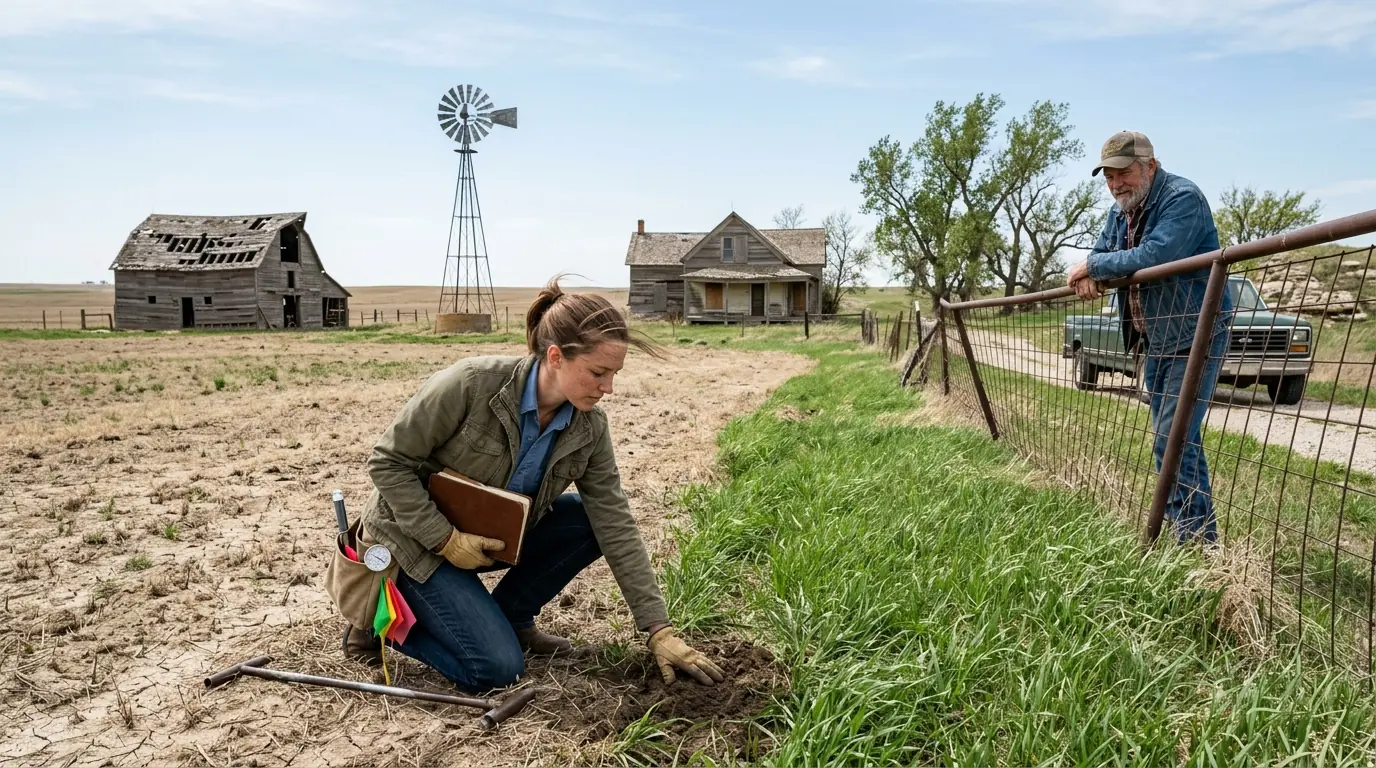
She carried flags, a soil probe, a thermometer, a hand auger, a compass, and the field journal.
She divided the farm into rough zones.
Upper west.
North flats.
Old creek bottom.
East rise.
Lower south.
She took soil samples.
Measured crusting.
Recorded organic matter.
Mapped wind erosion.
After rain, she followed runoff.
During dry periods, she tracked which vegetation wilted first.
A farmer named Raymond Keller watched from across the road.
Raymond was sixty-three and owned land touching Claire’s northern boundary.
His family had farmed the area since before Howard’s father arrived.
One evening, he drove over.
Claire was standing near the eastern hill holding a soil thermometer.
Raymond leaned against his pickup.
“You lose something?”
“No.”
“What’re you doing?”
“Taking temperatures.”
“Of dirt.”
“Yes.”
He waited.
Claire continued writing.
Raymond looked toward her empty fields.
“You planning to farm any of this?”
“Eventually.”
“When?”
“When I know what it can support.”
He chuckled.
“Howard spent forty years finding that out.”
“What did he decide?”
“That it supports disappointment.”
Claire smiled faintly.
Raymond nodded toward the green strip.
“You interested in that?”
“Yes.”
“Been there forever.”
“How green does it stay in August?”
“Greener than the rest.”
“Why?”
He shrugged.
“Different dirt.”
“Maybe.”
“What else would it be?”
Claire closed the journal.
“That’s what I’m trying to learn.”
Raymond shook his head.
“That property has been dying since before you were born.”
Claire looked across the hillside.
“Maybe.”
“You don’t believe me.”
“I believe crops failed.”
“Same thing.”
“No.”
Raymond waited.
Claire pointed toward the green strip.
“Dead things usually don’t keep doing that.”
By June, she had a pattern.
The green strip remained cool.
Cottonwoods along the lower slope showed stronger growth than expected.
Bird activity increased around the same zone during dry periods.
Certain wildflowers bloomed longer there.
After a light rain, water disappeared faster uphill but lingered beneath the grass strip.
Claire recorded everything.
June 4 — meadowlarks congregating near east draw.
June 11 — soil 4.8°F cooler than control point at 3:15 p.m.
June 17 — no rain seven days. Wild bergamot still flowering.
June 23 — willow growth concentrated near limestone exposure.
June 29 — faint moisture smell after probing 18 inches.
None of it proved water.
But observations were becoming repeatable.
She studied well records.
Howard’s father drilled near the house.
Howard later drilled north.
Both assumed groundwater would sit beneath low ground.
Reasonable.
Common.
And perhaps wrong.
Claire hired a small drilling company.
The owner, Ben Ortiz, walked the flagged area.
“You sure here?”
“No.”
He laughed.
“That’s reassuring.”
“I’m sure enough to test.”
The first borehole went down thirty feet.
Then fifty.
Seventy.
Damp material appeared.
Then dry limestone.
At ninety-two feet, the crew encountered a weak seep.
Ben measured it.
“Less than half a gallon a minute.”
Claire looked into the casing.
“Could it increase?”
“Maybe after rain.”
“For agriculture?”
“No.”
“Household?”
“Wouldn’t trust it.”
The drill had cost thousands.
Money Claire did not have much of.
Ben waited for her to say something.
Claire stared at the hill.
“Cap it.”
Raymond saw the equipment leave.
He drove over later.
He did not say, I told you so.
That almost made Claire wish he would.
“Bad?”
“Not useful.”
“Sorry.”
“Me too.”
“You done?”
“No.”
Raymond sighed.
“Claire.”
She looked at him.
“Land can bankrupt a person while they’re proving a point.”
“I’m not proving a point.”
“What are you doing?”
“Trying to understand why the observations don’t match the well.”
Raymond shook his head.
“Sometimes the explanation is simple.”
“Sometimes.”
“Dry ground.”
“Yes.”
He looked toward the green strip.
“And sometimes green grass is just grass.”
Claire nodded.
“Maybe.”
That answer bothered Raymond more than argument would have.
She marked a second location farther uphill.
The rock appeared more fractured.
Temperature measurements were lower.
Vegetation stronger.
The second well went down seventy feet.
Nothing.
Eighty.
Nothing.
One hundred and six.
Barely damp.
Ben removed his gloves.
“I wouldn’t keep spending.”
Claire knew.
She knew before he said it.
The second dry hole hurt worse.
Not because she had been more certain.
Because she was running out of ways to afford uncertainty.
The farmhouse roof leaked.
The south pump needed replacement.
Property taxes would come again.
Her savings had dropped below the number she promised herself she would never cross.
The day after the drilling crew left, Dr. Catherine Lowe from the county extension service drove out.
Catherine had spent thirty years studying groundwater.
She did not waste words.
She sat at Claire’s kitchen table and turned through the field journal.
“You’re thorough.”
Claire waited.
“That usually means there’s a but.”
“There is.”
Catherine pointed to several pages.
“Vegetation anomalies are useful.”
“Okay.”
“Temperature differences are useful.”
“Okay.”
“Cottonwoods can be useful.”
Claire nodded.
“But two failed wells are also data.”
“I know.”
“Stronger data than meadowlarks.”
“I know that too.”
Catherine closed the journal.
“What exactly do you believe?”
Claire looked toward the window.
“I believe water is influencing that hillside.”
“That’s broader than saying there’s an aquifer.”
“Yes.”
“Good.”
Claire looked back.
Catherine continued.
“Because right now, your original theory is losing.”
Claire appreciated the wording.
Not dead.
Losing.
“What would you do?”
“Stop drilling.”
“For how long?”
“Until you know why the first two missed.”
Claire nodded.
Catherine pointed toward the journal.
“You’ve been asking where the water is.”
“Yes.”
“Maybe ask where it came from.”
That question kept Claire awake.
Where did it come from?
At midnight she sat at the kitchen table surrounded by paper.
Old soil maps.
Topo sheets.
Well logs.
Historic photographs.
She opened a county archive box she had purchased at an estate sale months earlier.
Inside were black-and-white aerial photographs.
Claire spread them across the floor.
She aligned field boundaries.
Roads.
Fence corners.
The farm looked different in each decade.
Fields expanded.
Trees disappeared.
Drainage shifted.
Then she saw it.
A pale curved line across the 1961 image.
An old seasonal drainage route.
It began beyond the northeastern property line.
Crossed the hill.
Then bent sharply toward the cottonwoods.
Claire leaned closer.
In 1974, the channel remained.
But part had been plowed.
By 1988, field grading had almost erased it.
By 1996, surface evidence had largely disappeared.
Except vegetation still followed the original curve.
Claire placed transparent tracing paper over the photographs.
She marked the channel.
Then marked her two failed wells.
Both sat near the visible green strip.
Neither sat directly over the old drainage path’s projected intersection with the fractured limestone.
She froze.
She had assumed the vegetation sat above the water.
What if it sat downhill from it?
Water could enter fractures higher up.
Move laterally.
Hit a less permeable layer.
Then emerge elsewhere.
Not deep regional groundwater.
A perched system.
Local.
Confined by geology.
She called Catherine at 6:42 the next morning.
“I think I was drilling in the wrong direction.”
A pause.
“Good morning to you too.”
Catherine arrived before lunch.
The maps covered half the kitchen.
Claire explained.
Historic drainage.
Fractured limestone.
Vegetation offset.
Failed wells.
Catherine listened.
Then began rearranging the photographs herself.
She took out a pencil.
“Elevation?”
Claire handed over the survey.
“Recharge from northeast?”
“Possibly.”
“Any shale layer?”
“County geology map shows one approximately forty feet below the limestone section.”
Catherine stopped.
Then looked toward Claire.
“That’s interesting.”
Claire waited.
“If water enters fractured limestone uphill…”
“And meets shale.”
“It could perch.”
“Then travel laterally.”
“Yes.”
Claire pointed toward the two failed wells.
“We drilled too far west.”
“Maybe.”
“Again.”
Catherine looked at her.
“You’ve learned nothing about caution.”
“I learned to say maybe.”
“That’s progress.”
For the first time, Catherine smiled.
“Don’t drill yet.”
Claire groaned.
“We survey.”
A university geology department brought electrical resistivity equipment three weeks later.
Long cables crossed the eastern field.
Electrodes were driven into the ground.
Students walked transects.
Raymond watched from his truck.
By now he had stopped laughing.
On the second day, Howard Maddox appeared.
He parked near the road.
Did not come closer.
Claire saw him.
Said nothing.
The first survey showed a fractured zone beneath the old drainage corridor.
The second showed a more resistant layer beneath it.
Catherine studied the results.
“Possible perched water.”
Claire’s pulse increased.
“Possible.”
“Say it again.”
“Possible.”
“Good.”
They mapped a third site.
Not directly beneath the green grass.
One hundred and forty yards above it.
Between two exposed limestone shelves.
Ben Ortiz returned with the drill.
He looked at Claire.
“Third time.”
“Third time.”
“You rich?”
“No.”
“Good. Rich people don’t worry enough.”
The drill started.
Twenty feet.
Dry.
Twenty-eight.
Cool material.
Thirty-two.
Damp.
Claire felt every person stop talking.
Thirty-five.
The bit dropped slightly.
Ben looked toward his assistant.
“Fracture.”
They continued.
Thirty-nine feet.
Water entered.
Not a seep.
Flow.
Ben stopped drilling.
“Hold.”
They pulled the bit.
Water rose inside the borehole.
One foot.
Two.
Then another.
Claire stared.
Ben lowered a measuring tape.
“Standing level’s climbing.”
Catherine approached slowly.
“How fast?”
Ben checked.
“Faster than I expected.”
Water continued rising.
Finally it stopped several feet below ground level.
Ben looked at Claire.
“Natural pressure.”
Nobody cheered.
Not yet.
Experienced people knew one flowing hole could still disappoint.
They tested.
Measured.
Pumped.
Waited.
The supply recovered.
Again.
Again.
Flow remained steady.
Catherine finally removed her hat.
“Well.”
Claire looked at her.
Catherine smiled.
“You found water.”
Claire crouched beside the casing.
For months she had imagined feeling triumphant.
Instead, she felt frightened.
Because finding water changed the question.
Now it was no longer:
Is it there?
It became:
How much can this land afford to give?
Howard walked over after the drilling crew left.
He stood beside the temporary discharge pipe.
Clear water ran into a metal tank.
He watched for a long time.
“Forty years.”
Claire stood beside him.
Howard shook his head.
“I walked that hill forty years.”
“I know.”
“My father did too.”
“I know.”
“We drilled three wells.”
“Yes.”
“One over there.”
He pointed.
“Another by the north fence.”
Claire nodded.
Howard’s face tightened.
“I buried my wife while we still owed money on the second one.”
Claire said nothing.
“I sold cattle.”
Silence.
“Borrowed against equipment.”
His voice became rough.
“Watched my son leave because he said he wasn’t going to spend his life fighting dirt.”
Claire looked toward the water.
Howard laughed bitterly.
“And it was sitting forty feet down.”
“No.”
He turned.
“It wasn’t sitting there.”
Claire pointed uphill.
“It enters farther northeast.”
She traced the invisible path with her hand.
“Moves through fractured limestone.”
“Hits a shale layer.”
“Travels sideways.”
“Then pressure pushes part toward the lower slope.”
Howard stared at the hill.
“The wells?”
“Wrong geometry.”
He looked at her.
“All those years…”
“You weren’t stupid.”
“I sure feel it.”
“Howard.”
He looked at her.
“You drilled where the science and experience available to you said to drill.”
“That didn’t make water appear.”
“No.”
Claire watched the stream.
“But your failed wells gave me data.”
Howard’s face changed.
“You’re trying to make an old man feel useful.”
“I’m telling you the truth.”
She pointed toward the north field.
“If those records weren’t there, I might have drilled another deep well.”
Then toward the first two test sites.
“And if I hadn’t failed twice myself, I might not have questioned the direction.”
Howard lowered his eyes.
The water entered the tank steadily.
“My father called this place cursed.”
Claire smiled faintly.
“People use that word when they’re tired of saying they don’t understand something.”
Howard almost laughed.
Then, unexpectedly, tears appeared.
He turned away.
Claire let him.
After several minutes, he said:
“Five thousand five hundred dollars.”
“Yes.”
“You robbed me.”
Claire looked shocked.
Howard finally laughed.
A genuine laugh this time.
Then shook his head.
“No.”
He wiped his eyes.
“No, you didn’t.”
He looked toward the spring.
“You listened longer.”
The offers started almost immediately.
A land company offered Claire four hundred thousand dollars.
A bottled-water company offered a lease.
An irrigation partnership proposed production wells large enough to supply nearby acreage.
A developer suggested using the discovery to build a residential project around “natural prairie water.”
Claire sat at her kitchen table reading numbers that could erase every financial problem she had.
Repair the house.
Replace the truck.
Pay every debt.
Invest.
Leave.
Nobody would blame her.
Then Catherine arrived with preliminary recharge estimates.
“How much can I pump?” Claire asked.
Catherine sat down.
“That is not the first question.”
“What is?”
“How much recharges.”
Claire nodded.
The numbers were encouraging.
But not enormous.
The system was substantial enough for careful farm use.
Possibly enough to support limited neighboring use.
Not enough to sustain industrial extraction without risk.
“What happens if they put four production wells in?”
“Pressure drops.”
“And?”
“Could dry the surface expression.”
“The cottonwoods?”
“Eventually.”
“Wetland?”
“Likely.”
“Could the perched zone collapse?”
“Not physically collapse like a cave, but hydraulic connectivity could change.”
“Contamination?”
“If development disturbs recharge areas, yes.”
Claire looked toward the expensive offers.
Catherine followed her eyes.
“I’m not telling you what to do.”
“I know.”
“You paid five thousand five hundred dollars.”
“I remember.”
“You could sell tomorrow and never worry about money again.”
Claire opened her journal.
First page.
What is this farm actually doing?
She looked at the words.
The farm had answered.
Now she had to decide whether she was willing to listen when the answer cost money.
Claire rejected the commercial offers.
Everyone in Redfield thought she had lost her mind a second time.
Raymond Keller came over after hearing.
“You turned down how much?”
“Enough.”
“How much is enough?”
“Enough that I don’t want to say it again.”
He stared at her.
“You bought dead ground for five thousand dollars.”
“Yes.”
“Found water.”
“Yes.”
“Then refused half a million.”
“Approximately.”
Raymond removed his cap.
“I take back everything.”
“About me?”
“No.”
He scratched his head.
“You’re crazier than I thought.”
Claire laughed.
“Probably.”
“What are you doing instead?”
“Testing sustainable withdrawal.”
“Meaning?”
“Using less than replenishes.”
“For what?”
“Repairing the farm.”
Raymond looked across the barren fields.
“That could take years.”
“Yes.”
“You’re thirty.”
“Yes.”
“You ever plan to have fun?”
Claire considered.
“This is fun.”
Raymond stared.
“That may be the saddest thing you’ve ever said.”
She began small.
Native grasses first.
Deep-rooted species across the worst erosion zones.
Buffer vegetation near the spring.
A small wetland restoration below the limestone exposure.
The drainage channels Howard’s father had straightened were partially reshaped to slow runoff.
Instead of forcing stormwater from the property, Claire built shallow structures that encouraged infiltration.
She did not irrigate every acre.
Only test plots.
Sorghum.
Alfalfa.
A small wheat section.
She measured flow constantly.
Every gallon mattered.
The first year was ugly.
One test field failed.
Alfalfa establishment was uneven.
A storm washed out part of a newly shaped channel.
The temporary pipeline froze in January.
Claire spent two nights repairing it.
Raymond found her one morning covered in mud.
“How’s paradise?”
“Leaking.”
“Good.”
She looked at him.
“Why good?”
“Means it isn’t boring.”
She threw a glove at him.
Three years after purchase, the farm no longer looked dead.
Not transformed.
Recovering.
That difference mattered.
Native grasses held the upper fields.
Soil organic matter increased slowly.
Alkaline crusting declined in several areas where drainage improved.
The wetland supported frogs, insects, birds, and sedges that had not appeared in decades.
Cottonwoods thickened.
Claire finally planted a larger wheat field.
The yield was not extraordinary.
It did not need to be.
It was profitable.
Howard came for harvest.
He stood beside the combine watching grain move into the truck.
“Your first decent wheat.”
“Our first.”
Claire corrected him.
Howard looked at her.
“Still doing that?”
“What?”
“Trying to include dead men and tired old farmers in your success.”
“Yes.”
“Why?”
“Because the farm didn’t begin the day I signed the deed.”
Howard watched the wheat.
“My father would have liked you.”
“He might have thought I was reckless.”
“He definitely would’ve thought that.”
They laughed.
Then came the drought.
It began quietly.
A dry winter.
Weak spring rain.
By June, ponds shrank.
By July, corn rolled its leaves before noon.
Shallow domestic wells weakened.
Raymond’s cattle pond lost half its water.
County restrictions began.
Claire’s spring continued flowing.
Less than average.
Still steady.
She reduced her own irrigation immediately.
One evening Raymond arrived.
He looked embarrassed.
That told Claire everything.
“My cattle pond’s got maybe ten days.”
“How many head?”
“One hundred twelve.”
Claire did the math.
“We can run a temporary line.”
“I’m not asking.”
“Yes, you are.”
“No.”
“Raymond.”
He looked toward the spring.
“You built this place from nothing.”
“No.”
“Close enough.”
“I’m not taking your water.”
“It isn’t mine.”
He frowned.
Claire continued.
“I own the land above part of it.”
“Different thing.”
“That sounds philosophical.”
“It’s hydrology.”
Raymond almost smiled.
“How much can you spare?”
Claire opened the flow records.
“We do it carefully.”
Within a week, temporary lines crossed three property boundaries.
Claire did not save every crop.
That would have been impossible.
Instead, she prioritized.
Livestock water.
Seed production.
Small orchards.
Household use.
High-value acreage requiring relatively little water.
People argued.
Claire said no often.
A farmer named Mitchell Cross demanded enough water for his entire corn field.
“No.”
“You gave Raymond water.”
“For cattle.”
“My crop’s worth more than his cows.”
“That isn’t how allocation works.”
“Who made you queen of groundwater?”
“No one.”
She looked at him.
“That’s why we have withdrawal limits and records.”
He left angry.
Two months later, his field failed.
He blamed Claire publicly.
Claire said nothing.
People expected generosity to feel noble.
Often it felt like choosing which person you would disappoint.
By September, the spring had dropped but remained stable.
The surrounding farms survived better than expected.
Raymond lost no cattle.
Two orchards made it through.
Several families preserved enough seed for the following season.
At a county meeting, someone praised Claire for “saving the valley.”
She stood.
“No.”
The room quieted.
“We had limited water.”
She looked toward the farmers.
“We measured it.”
“We prioritized.”
“We wasted less.”
“We also lost crops.”
She pointed toward Mitchell.
“Some people lost more than others.”
Mitchell stared at the floor.
Claire continued.
“The lesson isn’t that a hidden spring saved us.”
She paused.
“The lesson is that even good water becomes useless if we pretend it has no limit.”
Over the next decade, the former Maddox property became a field-study site.
University students visited.
County conservation teams brought young farmers.
Claire never began tours at the flowing spring.
She began at the dry wells.
The first one.
Then the second.
A student once asked:
“Why show us failures first?”
“Because this spring didn’t appear on the third try.”
Claire pointed to the capped hole.
“The first two failures forced us to change the question.”
“What question?”
“Instead of asking where the water was, we asked where it came from.”
She looked toward the hillside.
“That changed everything.”
Another student asked:
“So persistence was the key?”
Claire shook her head.
“No.”
The group looked surprised.
“Persistence without correction is just expensive stubbornness.”
Catherine Lowe, now retired, stood nearby and smiled.
Claire continued.
“The key was being willing to abandon the explanation I wanted when the evidence stopped supporting it.”
Catherine murmured:
“Finally learned something.”
Claire looked at her.
“Eventually.”
Howard grew older.
He visited less often.
One spring evening, almost fifteen years after the sale, Claire found him sitting in a chair beside the restored wetland.
She brought him coffee.
He accepted it.
“Remember closing day?”
“Yes.”
“I thought you were desperate.”
Claire smiled.
“I was.”
“For land?”
“For something that belonged to me.”
Howard nodded.
“Did it work?”
Claire looked toward the fields.
The house had been repaired.
The barn rebuilt.
Windbreaks protected sections of soil.
Native grass moved like water beneath the breeze.
Birds called from the wetland.
The spring flowed quietly over limestone.
“Mostly.”
Howard sipped his coffee.
“I used to hate this place.”
Claire looked at him.
“After I sold.”
He continued.
“I’d drive past and feel relieved.”
“Then guilty for feeling relieved.”
“Yes.”
“I hated my father for buying it.”
He looked toward the hill.
“Hated myself for not making it work.”
Claire waited.
“Then you found water and I hated you a little.”
“That seems fair.”
Howard laughed.
“You know what changed?”
“What?”
“You never acted like you beat me.”
Claire looked confused.
“Why would I?”
“Because people like winning.”
“This wasn’t a contest.”
“It felt like one for a while.”
He stared across the land.
“Then I realized you didn’t solve the farm because you were smarter.”
Claire raised an eyebrow.
“I’m choosing not to be offended.”
“You were willing to admit you were wrong more often.”
She considered that.
“Probably.”
Howard nodded.
“My father never was.”
“Neither was I for most of my life.”
He smiled.
Then his expression became serious.
“I’m glad I sold it to you.”
Claire looked toward him.
Howard’s eyes filled.
“I mean that.”
“I know.”
A few months later, Howard died in his sleep.
His son asked whether part of his ashes could be scattered near the east hill.
Claire said yes.
Years later, a young woman named Hannah Pierce arrived at the farm.
Twenty-four.
Fresh out of college.
Carrying a new field journal.
She followed Claire across the property asking questions quickly.
Too quickly.
“What made you know?”
“I didn’t.”
“But the green strip.”
“I noticed it.”
“You must have known.”
“No.”
Claire stopped walking.
Hannah stopped too.
“You want the story to have a moment where I looked at one patch of grass and understood everything.”
Hannah smiled sheepishly.
“That would be a good story.”
“Yes.”
Claire pointed toward the first dry well.
“It would also be false.”
They walked toward it.
“I guessed wrong.”
Then the second.
“Wrong again.”
Then toward the survey line.
“I almost quit.”
Hannah looked surprised.
“Really?”
“Yes.”
“What kept you going?”
Claire considered.
“Not belief.”
“What then?”
“The observations were still unexplained.”
She looked toward the hillside.
“If the water theory had been completely wrong, I could have accepted that.”
“But something was still causing the vegetation pattern.”
“So I kept asking what.”
Hannah wrote that down.
Claire smiled.
“Another mistake.”
“What?”
“You don’t need to write down everything I say.”
“I want to remember.”
“Remember the land.”
Claire pointed toward the grass.
“People become confident after the outcome is known.”
“Fields don’t.”
On a cold April evening, twenty years after she paid five thousand five hundred dollars for a farm almost everyone had abandoned, Claire stood on the eastern hillside.
The same wind moved across the prairie.
The same cottonwoods grew below.
Older now.
Thicker.
The narrow green strip was harder to distinguish because much of the surrounding land had recovered.
That made Claire strangely happy.
The clue that changed her life was disappearing into healthier ground.
Hannah stood beside her.
“Where exactly was it?”
Claire pointed.
“There.”
“I can barely see it.”
“I know.”
“Does that bother you?”
“No.”
Claire smiled.
“It means the rest finally caught up.”
Below them, water moved through the protected wetland.
Some continued into storage.
Some remained in the soil.
Some evaporated.
Some infiltrated again.
Water did what water had always done.
Moved.
Changed.
Connected places that property lines pretended were separate.
The farm had never contained a magical underground river.
There had been no secret lake waiting beneath the farmhouse.
No fortune hidden underground.
The truth was quieter.
Water entered fractured limestone miles away.
Moved slowly through stone.
Met a layer it could not pass.
Turned sideways.
Rose where pressure and geology allowed.
Enough to matter.
Not enough to waste.
That was the lesson Claire eventually understood.
The important discoveries were not always valuable because they were large.
Sometimes they mattered because someone respected their limits.
She had bought a failed farm.
Found water.
Then discovered that finding something and understanding what to do with it were completely different accomplishments.
The spring could have made her rich quickly.
Instead, it made the farm healthy slowly.
Claire preferred that.
Hannah opened her field journal.
“Can I ask you one last question?”
“Of course.”
“If you could go back to closing day, knowing everything you know now, what would you tell yourself?”
Claire looked toward the farmhouse.
She remembered the sagging porch.
The broken gutter.
Howard walking away without looking back.
The first night beneath a kerosene lamp.
The sentence at the top of the journal.
She thought for a long time.
Then:
“I’d tell her not to fall in love with her first explanation.”
Hannah waited.
Claire continued.
“Fall in love with the question.”
The younger woman smiled.
“That’s it?”
Claire looked toward the hill.
“That’s enough.”
They walked down toward the house.
Behind them, evening light spread across the prairie.
Water moved silently beneath their feet.
It had been there before Howard.
Before Howard’s father.
Before Claire.
Before any fence marked the farm.
People had spent decades calling the place dry.
Then cursed.
Then worthless.
The land had never argued.
It simply kept behaving according to rules no one had fully understood.
Claire did not save it.
She would have rejected that version of the story.
She observed it.
Failed on it.
Changed her mind because of it.
Protected what it revealed.
And listened long enough to understand that the green line across the hill had never been promising her a fortune.
It had only been asking one question.
Are you paying attention?