The morning Cole Bridger first spoke to Maggie Calloway outside Red Bluff Train Station, the whole town had already decided what she was. Too tall, too strong, too sharp with her tongue, too capable with her hands, too much for any man who wanted peace in his house. That was the phrase they used most often, usually with a pitying shake of the head, as if Maggie were a fine horse nobody could saddle. They said it in the feed store, at the livery, outside the church, and beside the train platform whenever they thought she was not close enough to hear.
Maggie always heard. A woman like her learned early that people’s whispers travel farther than their courage. She was twenty-eight years old, five feet ten inches tall, and strong from years of lifting feed sacks her father could no longer carry. Her dark red hair was usually pinned up in a practical knot, her brown eyes looked straight through foolishness, and her laugh came loud when something was truly funny.
Red Bluff, Texas, had never known what to do with a woman who refused to shrink. Maggie ran the Calloway Feed Store with ledgers so clean they made bankers jealous and shelves so well-stocked that ranchers from ten miles away came to buy from her. She knew prices, grain quality, delivery schedules, horse feed, cattle supplements, and the habits of every customer who tried to delay payment. If a man came into the store expecting softness, Maggie gave him accuracy instead.
Her father, Amos Calloway, had built the store thirty years earlier with a wagon, a borrowed scale, and more stubbornness than money. For most of Maggie’s childhood, he had been broad-shouldered and unstoppable, the kind of man who could lift a barrel and laugh while doing it. But time had narrowed him. By the time Maggie turned twenty-four, his hands had begun to stiffen, and the store slowly became hers before anyone officially said so.
She took over the lifting, the ordering, the accounts, and the arguments. She taught herself bookkeeping from a manual ordered out of Chicago because Red Bluff had never considered such knowledge necessary for women. At night, after the lamps were low and the last customer had gone home, she sat behind the counter and worked numbers until they balanced to the penny. It gave her satisfaction, that order, because the town might be unfair, but a ledger could still be made honest.
Men had proposed to her twice. The first was Grady Miller, a farmer who wanted a wife with strong arms and no opinions about how to spend harvest money. The second was a shopkeeper from Abilene who told her a woman her size must get lonely, as though loneliness could make insult sound like romance. Maggie declined both men with the same clear voice she used when correcting an overcharge.
After that, Red Bluff’s opinion hardened. Maggie Calloway was too much. Too tall to look delicate, too clever to flatter, too strong to need carrying, and too honest to pretend small men were larger than they were. Maggie’s private opinion was that the men who found her too much had never been enough, but she mostly kept that conclusion to herself.
Not because she was ashamed.
Because she was tired of explaining the obvious.
Cole Bridger arrived in Red Bluff on a Wednesday in October of 1877. He came by train from the north, stepping down onto the platform with a bedroll, a saddlebag, a worn tan Stetson, and the quiet look of a man who had spent too many years moving. He was thirty-five, sun-weathered, strong in the shoulders, and steady in the eyes. The McCreedy ranch had hired him as foreman, which meant he had earned a reputation before he ever set foot on Red Bluff dirt.
He noticed Maggie before he knew her name. She stood near the station road with a folded feed order slip in one hand, speaking to the station clerk about a delayed shipment. A pair of men nearby were making comments under their breath, not quite low enough to hide, not quite loud enough to answer. Cole watched Maggie hear them and refuse to give them the satisfaction of turning around.
One man said, “There she goes. Too much woman for any man in Texas.”
The other laughed. “Any man with sense, anyway.”
Cole’s eyes moved from them to Maggie. She stood tall, not stiff, not proud in the fragile way of people desperate to seem untouched, but grounded. Her chin lifted slightly, her shoulders squared, and the men’s laughter passed around her like dust around a stone. Cole had known brave men who could not have endured mockery with that much control.
He crossed the road before he had fully decided to do it.
Maggie saw him coming and turned. Her eyes took him in quickly: hat, boots, shirt, hands, posture, the way a feed store owner measures a man by whether he is about to buy, lie, or waste her time. Cole removed his hat respectfully. That small gesture made her pause because many men tipped their hats to pretty women and forgot respect when a woman unsettled them.
“Miss Calloway,” he said.
“You know my name?”
“I asked at the station.”
“That usually means someone has already warned you.”
He looked at her, then glanced briefly toward the men near the platform. “They said several things.”
Maggie’s mouth curved without becoming a smile. “And did you come to confirm them, correct them, or add your own?”
Cole held his hat in both hands. “I came because I heard enough nonsense in one minute to know this town talks too freely.”
Her eyes narrowed, not in anger but assessment. “You must be new. Red Bluff has turned free talk into a civic duty.”
“I am Cole Bridger. New foreman at McCreedy’s.”
That name changed the shape of the moment. Maggie knew the McCreedy ranch, knew its size, its account history, and the fact that the previous foreman had been careless with delivery schedules. A new foreman meant new orders, new terms, and possibly new headaches. Business steadied her.
“Then you will be needing a feed account,” she said.
“I will.”
“The store is two streets over.”
“I know.”
“But you stopped me here.”
“Yes.”
“Why?”
Cole looked at her directly. “Because I heard them say you were too much for any man, and I wanted to see whether you believed it.”
For the first time that morning, Maggie had no immediate answer.
The train behind the station fence gave a low hiss. A horse shifted near the hitching post. Somewhere down the road, a shopkeeper opened shutters with a wooden clap. The moment stretched between them, clean and sharp in the morning light.
“What I believe is not usually a concern to men who repeat gossip,” Maggie said.
“I am not repeating it.”
“Then what are you doing?”
“Questioning the men who started it.”
A real smile almost reached her face, but she stopped it before it got comfortable. “You have been in Red Bluff less than an hour, Mr. Bridger.”
“Long enough to hear foolishness.”
“It gets worse if you stay.”
“I have heard worse in Kansas, Colorado, and Wyoming.”
“And what made you leave those places?”
“Work. Weather. Bad bosses. A few mistakes. Eventually, the desire to stop moving.”
That answer surprised her. It was plain, without flourish. Most men either inflated their past or buried it beneath swagger. Cole Bridger spoke like a man willing to tell the truth if asked properly, and Maggie had always respected that quality.
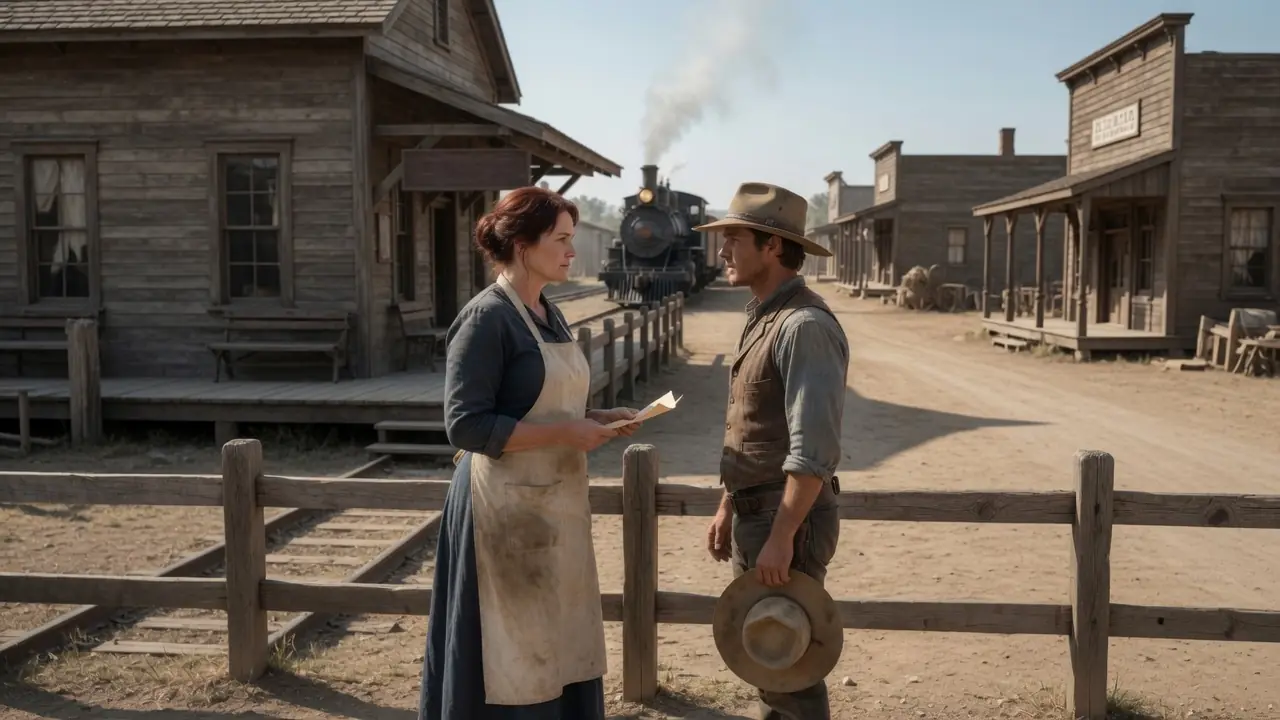
She gestured toward the road. “If you want your account opened, the store is this way.”
They walked together from the station. Not side by side exactly, not at first. Maggie kept half a step ahead, partly because she knew the way and partly because she did not yet know what to do with him. Cole did not hurry to overtake her. That, too, counted in his favor.
The Calloway Feed Store stood with a clean wooden front, two wide windows, and a sign that had weathered twenty Texas summers. Inside, feed sacks were stacked along the wall in straight rows. The counter held an open ledger, a brass scale, a small ink bottle, and a sharpened pencil. The place smelled of grain, wood, leather, and work.
Cole looked around with genuine attention.
“Good store,” he said.
“It is.”
“Organized.”
“It has to be.”
“Yours?”
“My father’s name is on the sign. My hands keep it open.”
He nodded, as if that made perfect sense. Maggie felt herself waiting for the comment that usually came next. Something about women and heavy work, or fathers needing sons, or whether she had a brother. Cole said none of it.
She stepped behind the counter and opened the ledger to a clean page. “McCreedy ranch account. Name?”
“Cole Bridger, foreman.”
“Quantities?”
He gave them clearly. Barley, oats, corn, salt blocks, winter feed estimates, delivery timing. Maggie wrote quickly, asking two questions about storage capacity and herd size that made Cole look up with interest.
“You know your business,” he said.
“I run my business.”
“That was what I meant.”
“A lot of men say that and mean something smaller.”
“I try not to say things smaller than I mean.”
She looked at him then. A long direct look. Cole met it without flinching, without turning it into a challenge, without trying to soften it. Maggie found that unsettling in a way she did not dislike.
When the account was finished, he paid a small deposit and asked when delivery could begin.
“Monday,” she said. “If McCreedy’s men are ready to receive it.”
“They will be.”
“I do not chase ranch hands who forget their own orders.”
“You will not have to.”
“We will see.”
He put his hat back on. “Yes, ma’am. I expect we will.”
For the rest of the day, Maggie worked as she always did, but the rhythm of the store seemed slightly altered. She lifted sacks, counted change, corrected a delivery receipt, and told a customer twice that credit did not mean charity. Yet now and then, she thought of Cole Bridger standing outside the train station, asking whether she believed what men said about her.
By evening, she was irritated at herself for thinking about him at all.
By Thursday morning, he came back.
“I do not need feed,” he said as soon as he stepped through the door.
“I assumed as much. The first delivery is Monday.”
“I was passing.”
Maggie glanced through the window. “The general store is in the other direction.”
Cole paused. “I took a longer route.”
“That happens to men who do not know town streets.”
“I know where the general store is.”
“Then you came here on purpose.”
“Yes.”
The honesty of it struck her harder than a clever excuse would have.
“What do you want, Mr. Bridger?”
“Recommendations.”
“For feed?”
“For Red Bluff.”
Maggie leaned her elbows lightly on the counter. “Mrs. Porto’s has the best food. The barber on Main Street is honest, the one on Second Street is not. The Harmon brothers at the livery will overcharge you until they understand you know horses. The sheriff is competent. The town council is mostly noise in coats.”
Cole’s eyes warmed. “Anything else?”
“Do not trust anyone who says this is a simple town.”
“No town is simple.”
“That is the first sensible thing you have said.”
“I was hoping it was not the first.”
This time, Maggie did smile. Just a little.
By the end of the second week, Red Bluff had noticed. Small towns notice the pattern of footsteps before the people walking them understand where they are going. Cole came by the feed store more often than business required. Maggie was seen speaking to him on the porch after closing. Once, Mrs. Porto saw him carry a crate into the store and Maggie let him, which caused more discussion than it should have.
The town warned him in stages.
Bill Harmon at the livery did it kindly. “Maggie is a fine woman, Bridger, but she is a lot.”
Cole was checking his horse’s hoof at the time. “A lot of what?”
Bill blinked. “Opinions. Strength. Height. She runs that store like a general.”
“Good. Generals tend to know where things are.”
“She turned down two men.”
“Good.”
“Good?”
“That tells me she knows how to say no.”
Bill scratched his chin. “You are a strange man.”
“Likely.”
The warnings continued. A ranch hand said Maggie would never let a husband lead. A church woman said Maggie needed a man with patience. The barber on Second Street, proving Maggie’s judgment correct, told Cole a woman like that would wear a man down. Cole listened less each time.
What interested him was not what Red Bluff said about Maggie.
It was how carefully the town avoided admitting why she frightened them.
A woman who knew her worth left less room for other people’s measurements.
One Friday in November, Cole rode to the feed store at closing time without even pretending to have a reason. Maggie was locking the door, her apron folded over one arm. She turned when he dismounted.
“I do not have an excuse,” he said.
“I know.”
“I wondered if you would walk with me.”
“Where?”
“The river.”
She looked at him for a long moment. “Give me a minute.”
They walked along the Red Bluff River as the evening settled blue over the land. Cottonwoods stood bare along the bank, and the water ran low and cold over smooth stones. Maggie wore a dark green coat that suited her without trying to flatter anyone’s expectations. Cole walked beside her, careful to match her stride without making a show of it.
They spoke without performance. She told him about teaching herself bookkeeping at nineteen, about her father’s hands failing, about how everyone had advice when she took over the store but no one had labor to offer. He told her about leaving Kansas after a winter that killed half a herd, about Colorado bosses who cheated hands out of wages, about Wyoming loneliness and the strange relief of being tired enough to finally stop.
“Why Red Bluff?” Maggie asked.
“McCreedy’s offered good pay.”
“That is the reason you accepted. Not the reason you stayed interested.”
Cole looked at the river. “I had not been here two days before I wondered if the land was not the only thing worth staying for.”
“You are not subtle.”
“No. I never saw the point.”
They walked in silence for a while.
Then Maggie said, “People have been telling you things about me.”
“Yes.”
“What things?”
“That you are too much for any man.”
She kept her eyes on the river. “And?”
“And I think they have been measuring you against men who were too little for the work.”
Maggie stopped.
Cole turned toward her. The last light caught the edge of his hat and the line of his face. He did not look amused. He did not look flattering. He looked certain, and certainty without possession was something Maggie had rarely seen in a man.
“That is not your failing,” he said. “It is theirs.”
“You do not know me that well.”
“I know enough. I know you run the store better than most men in this town run their own lives. I know you taught yourself because no one bothered to teach you. I know you refused men who were wrong for you and did not apologize for having standards. I know your laugh is honest.”
Her throat tightened, which annoyed her.
“Cole,” she said.
“Yes.”
“What exactly are you doing?”
He took a breath. “I am telling you I would like the chance to be right about you, if you will let me.”
The river moved beside them. The Texas night opened overhead. Maggie had been called many things in her life, but she had rarely been seen. Not admired for usefulness, not judged for size, not desired as a challenge, but seen.
“All right,” she said.
Just that.
It was enough.
December brought gray mornings and cold evenings. Cole and Maggie settled into the kind of courtship that gave Red Bluff something to discuss and very little to criticize. He called at proper times. He walked her home. He sat in the feed store after closing while she balanced accounts, sometimes speaking, sometimes only keeping company.
One Saturday morning, Cole arrived outside the store with two horses. One was his. The other was a beautiful gray mare, tall, deep-chested, and calm-eyed.
Maggie stepped onto the porch. “What is this?”
“Her name is Silver.”
“I can see she has a name.”
“She is sixteen hands. Steady. Good back. I checked the saddle myself.”
Maggie’s expression changed. Cole saw the memory before she spoke. Three years earlier, she had tried to borrow a horse from the livery. The animal had been too small, and four men had laughed when someone said Maggie needed a plow horse instead. She had not ridden since.
“I heard about the livery,” Cole said.
Her face closed. “Most of the town did.”
“This is different.”
“Is it?”
“Yes.”
She looked at Silver. The mare stood patient, unbothered, strong enough for the truth of Maggie without requiring apology.
Cole held the reins out. “Sit down and let me show you.”
Maggie stared at him. “That is a bold way to speak to a woman.”
“Only if I meant to command.”
“And do you?”
“No. I mean to prove.”
She studied him, then took the reins.
Maggie Calloway was not a woman who let old humiliation make new decisions for her. She put one boot in the stirrup, gripped the saddle, and swung up. Silver stood solid beneath her, steady as earth. The saddle held. The mare did not shift, stumble, or complain. Nothing broke. No one laughed.
For one breath, Maggie sat above the street and felt a piece of herself return.
Cole looked up at her, and his face held satisfaction, warmth, and something very close to tenderness.
“Well?” he asked.
“Well,” she said.
“She fits.”
Maggie smiled fully then. “She does.”
They rode north that morning toward McCreedy’s pasture. The winter field was silvered with frost, each blade of grass shining in the low sun. A creek ran along the edge, frozen at the banks and moving at the center. It was beautiful in a clean, hard, honest way.
At the fence line, Maggie looked across the pasture. “You were right. This was worth seeing.”
“I am often right about that.”
“That quality will not endear you to people.”
“I am not trying to endear myself to people. Just to you.”
She looked at him sideways. “How is that going?”
“You tell me.”
The frost glittered. Silver shifted beneath her, calm and steady.
“Better than I expected,” she said.
“What did you expect?”
“Another man who would discover I was too much and leave.”
Cole turned his horse toward her. “Maggie, I have been looking for someone who was enough for most of my life. You are the first person I have met who is.”
She looked at him, and all the years of comments seemed suddenly smaller. Too tall. Too loud. Too strong. Too capable. Maybe none of those had ever been faults. Maybe they had only been descriptions spoken by people who wanted them to sound like warnings.
“Cole,” she said softly.
“Yes.”
“Ask me.”
He did.
Not for marriage, not yet, but for the promise of it. For a future. For the right to stand beside her openly and make Red Bluff adjust its opinion to the truth. Maggie said yes before doubt had a chance to dress itself as caution.
They married in February. The ceremony was simple because Maggie disliked fuss and Cole had no use for unnecessary decoration. Red Bluff attended because Red Bluff attended everything, especially when it had previously declared something impossible. Mrs. Porto made the cake and told everyone she had known from the beginning.
Bill Harmon told Cole he had concluded he was both brave and smart.
Maggie’s father sat in the front row and cried without shame.
The two men who had once proposed to Maggie were not there, which everyone silently agreed was best.
Marriage did not make Maggie smaller. That was what surprised Red Bluff most. She still ran the feed store. She still kept Calloway on the sign because it was her father’s name and because she saw no reason to erase history for the comfort of anyone’s expectations. She handled McCreedy’s accounts as well, because competence has a way of expanding when given room.
Cole continued as foreman. He rode out before dawn, came home tired, and listened with genuine interest when Maggie explained supply costs or argued about grain quality. On Saturdays, Maggie rode Silver. At first, people watched. Then they nodded. Then they stopped noticing, which was the final stage of acceptance in a small town.
The town’s opinion changed without ever admitting it had been wrong.
“She is too much,” became “She is strong.”
“Too capable,” became “She knows her business.”
“Too tall,” became “She sits a horse well.”
And finally, as if they had invented kindness themselves, people began to say Maggie Bridger was exactly right.
She had always been exactly right.
It had simply taken one man brave enough to stand beside her and say what everyone else had been too small to see.
Years later, when Maggie and Cole were older and Red Bluff had grown around the railroad, people still told the story of the day he brought her Silver. Some said he tamed her pride, which made Maggie laugh so hard she nearly spilled her coffee. Cole always corrected that version.
“I never tamed a thing,” he would say. “I just brought her a horse that fit.”
Maggie would look at him with the same direct brown eyes he had seen outside the train station.
“And a man who did,” she would add.
That was the truth of it. Cole had not made Maggie less. He had made room for all of her. And Maggie, who had spent years being called too much, finally discovered that love was not the place where a woman became smaller.
Love, real love, was the place where she could sit tall in the saddle and ride.