In the spring of 1976, in Kingfisher County, Oklahoma, a forty-year-old farmer named Howard Jessup made a decision that his neighbors would laugh about for years. He planted sorghum, not wheat like every other farmer in the county, not corn or soybeans, and not any of the profitable crops that filled the grain elevators every harvest. Sorghum was a tall, sturdy grain that most Oklahoma farmers considered cattle feed at best and a waste of good land at worst. Howard planted two hundred acres of it.
Word spread through the county like wildfire. At the feed store, at the diner, and at church on Sunday morning, everyone was talking about Howard Jessup and his crazy decision. “Did you hear? Howard is planting sorghum. All two hundred acres.” “Sorghum? What is he thinking? You cannot make money on sorghum. Maybe he has lost his mind.”
“Should we say something?” someone asked. “I tried,” another replied. “He just smiled and kept planting.” The John Deere dealer in Kingfisher, a man named Virgil Tate, drove out to Howard’s farm in early May to see it for himself. He found Howard on his tractor, pulling a planter through the red Oklahoma dirt, dropping sorghum seeds into the ground.
Virgil flagged him down. “Howard.” Virgil walked to the edge of the field, shaking his head. “I had to see it with my own eyes. You are really doing this.” Howard climbed down from the tractor and wiped the dust from his face. “Morning, Virgil.”
“Morning nothing,” Virgil said. “What are you doing? Sorghum? Every farmer in this county plants wheat. Wheat prices are through the roof. The export market is booming. Why would you plant sorghum?” Howard looked out at his field, at the neat rows of freshly planted earth and the promise of something growing where nothing had grown before.
“You want the short answer or the long answer?” Howard asked. “I want any answer that makes sense.” Howard smiled slightly. “The short answer is, my grandfather told me to.” Virgil stared at him. “Your grandfather has been dead for thirty years.”
“I know,” Howard said. “But he left something behind.” Virgil waited for more, but Howard simply climbed back onto his tractor. “Wrong crop, Howard,” Virgil called after him. “Wheat is gold out here. Sorghum is what you plant when you have given up. Everyone is going to think you have lost your mind.”
Howard started the engine. “Maybe so,” he said. “We will see who is right.” Then he drove on down the row, leaving Virgil standing at the edge of a field that did not make sense to anyone but Howard. To understand why Howard made that choice, you have to understand the journal.
Howard Jessup’s grandfather, Elmer Jessup, had been a farmer in Kingfisher County since the early 1900s. He had survived the land rush, the First World War, the boom times of the 1920s, and then something that nearly destroyed him: the Dust Bowl. The 1930s were apocalyptic in Oklahoma. Drought, wind, and decades of poor farming practices combined to create the worst environmental disaster in American history.
The topsoil, the precious layer of earth that made farming possible, simply blew away, leaving behind hardpan and despair. Elmer Jessup lost almost everything. His wheat crop failed in 1931, 1932, 1934, and 1935. Five years of almost nothing. Five years of watching the sky for rain that never came and watching the wind carry his future to Kansas.
But Elmer did not leave. Unlike thousands of Okies who packed their cars and headed for California, Elmer stayed. In 1936, when the drought was at its worst, he did something unexpected. He planted sorghum. Not much, just twenty acres. It was an experiment born of desperation.
He had read about sorghum in a government pamphlet. He learned that it could survive on less water than wheat and that its deep roots could find moisture where other crops could not. That year, while every wheat field in the county lay dead and brown, Elmer’s sorghum stood green. It was not much of a crop. The yields were low, and the price was poor. But it was something.
And in 1936, something was everything. Elmer kept planting sorghum through the rest of the Dust Bowl years, mixing it with whatever wheat he could manage. He survived when others did not. When the rains finally came back and wheat became profitable again, Elmer went back to planting wheat like everyone else. But he never forgot.
In 1945, the year before he died, Elmer Jessup sat down and wrote a journal. It was not about his life and not about his family. It was about farming, about what he had learned in fifty years of working Oklahoma soil, and about the mistakes he had made and the lessons he had paid for in sweat and tears. The journal ended with a warning.
The drought would come again. It always did. Maybe not that year, maybe not that decade, but it would come. When it did, Elmer wrote, remember what I learned. Wheat dies in the dry years. Sorghum survives. Plant sorghum before the drought comes, not after. After is too late.
Elmer died in 1946. The journal went into a trunk in the attic of the farmhouse, and there it stayed for thirty years until Howard found it. That moment came in February 1976. Howard had been farming the family land for fifteen years after his father passed. That winter, a storm damaged the farmhouse roof, and Howard went into the attic to check for leaks.
That was when he found the trunk. He had known it was there, vaguely. His mother had mentioned it once as his grandfather’s old things, but Howard had never bothered to look. Farming did not leave much time for nostalgia. Now, stuck in the attic waiting out the storm, he opened it.
Inside was a collection of artifacts from a life he had never known. There were old photographs of people he did not recognize, a pocket watch that did not work, a Bible with names and dates written inside the cover, and at the bottom, wrapped in oilcloth to protect it from moisture, a leather-bound journal. Howard opened it and started reading. Three hours later, when Dorothy came looking for him, she found her husband sitting in the cold attic with tears on his face, holding a book written before he was born.
“Howard, what is it?” she asked. “What is wrong?” Howard looked up at her. “My grandfather. He knew. He knew what was coming, and he wrote it all down, and we never…” He stopped and wiped his eyes. “We never even looked.”
“Knew what?” Dorothy asked. Howard handed her the journal. “Read the last page.” Dorothy read it. When she finished, she looked at her husband with confusion. “He is talking about drought. So what? We have droughts every few years. It is Oklahoma.”
“Not like the one he is describing,” Howard said. “Not like the thirties.” He stood up, his mind racing. “Dorothy, do you know what I have been reading for the last three hours? How to survive a disaster I never believed could happen. Crop rotation patterns, water conservation, which varieties survive dry years and which do not.”
“Howard, that was forty years ago,” Dorothy said. “Farming is different now.” “The weather is not different,” Howard replied. “The rain does not know what year it is.” He picked up the journal. “My grandfather watched his neighbors pack up and leave for California. He watched families that had been here for generations just disappear, and he swore he would never let that happen to us.”
Howard looked at his wife with an intensity she had rarely seen. “He planted sorghum, Dorothy. When everyone else was losing everything, he planted sorghum, and it saved him. He wrote it all down so someone would know what to do when it happened again.” “If it happens again,” Dorothy said. “When,” Howard answered firmly. “The drought always comes back. He said so, and I believe him.”
That night, Howard Jessup made a decision that would define the rest of his life. In three hours of reading, he went from a man who farmed the way his neighbors farmed to a man who understood that he was part of something larger. He had found a chain of knowledge stretching back generations, preserved in a journal nobody had bothered to read. His grandfather had seen the worst, survived it, and written down how. Now Howard had to decide whether to trust the old man’s words or trust the neighbors who said wheat was gold.
He chose his grandfather. In the spring of 1976, Howard planted two hundred acres of sorghum. His neighbors laughed. “Wrong crop, Howard.” “You will regret that come harvest.” “What are you, a cattle rancher now?” The harvest came. Wheat prices were high, over four dollars a bushel. Howard’s neighbors made money hand over fist.
Howard’s sorghum sold for less than two dollars, barely covering his costs. “Told you so,” Virgil Tate said at the feed store. “Wheat is gold. Sorghum is for fools.” Howard just smiled. “We will see.” In the spring of 1977, Howard planted sorghum again.
There was more laughter. “You did not learn your lesson.” “Maybe he likes losing money.” “Some people just cannot be helped.” It was another good year for wheat and another mediocre year for Howard’s sorghum. His neighbors were starting to look at him with something between pity and contempt.
At church one Sunday, Dorothy overheard two women talking. “I feel sorry for Dorothy Jessup,” one said. “Married to a man who cannot admit when he is wrong.” Dorothy wanted to say something, but what could she say? Her husband was planting the wrong crop year after year, based on a journal written by a man who had been dead for thirty years. She was starting to wonder if the women were right.
In the spring of 1978, Howard planted sorghum again. By then, the jokes had become routine. People did not even bother hiding their amusement. “Wrong Crop Howard,” they called him. It was not quite an insult anymore, more like a nickname for the town eccentric, the man who did not know any better.
Howard’s son, Tommy, came home from school one day with a black eye. “What happened?” Dorothy demanded. “Billy Tate said Dad was an idiot,” Tommy said. “He said his dad says we are going to lose the farm because Dad does not know how to be a real farmer.” Howard put down his newspaper and looked at his son. “What did you do?” “I punched him.”
Howard was quiet for a moment. Then he stood up and walked to the bookshelf where he kept Elmer’s journal. He brought it back to the table and opened it. “Sit down, Tommy. I want to show you something.” For the next hour, Howard read passages from his grandfather’s journal.
He explained about the Dust Bowl, about the neighbors who left, and about the sorghum that survived when nothing else did. “Your great-grandfather wrote this years ago,” Howard said. “He said the drought would come back. He said to plant sorghum before it comes, not after. After is too late.” Tommy looked at the old handwriting and faded pages. “But, Dad, everyone says wheat is better.”
“Everyone said that in 1930 too,” Howard replied. “And in 1931, 1934, and 1935. Five years of everyone being wrong.” Howard closed the journal. “Sometimes the crowd is not right, son. Sometimes the old ways know things the new ways have forgotten.”
“But what if Grandpa Elmer was wrong?” Tommy asked. “What if the drought does not come?” Howard put his hand on his son’s shoulder. “Then I will be the fool everyone says I am. But if he was right, if the drought comes and we are ready, we will be the only family in this county that survives.”
He looked at his son with steady eyes. “I would rather be wrong and safe than right and destroyed. Wouldn’t you?” In the spring of 1979, Howard planted sorghum again. Four years now. Four years of being laughed at. Four years of lower profits. Four years of being Wrong Crop Howard. Then the weather changed.
The winter of 1979 was dry. Not unusually dry, just dry. The spring rains came late, and when they came, they were sparse. By May, farmers were starting to worry. By June, they were praying. July was brutal, day after day of one-hundred-degree heat, day after day of cloudless skies, and day after day of watching the wheat begin to wither.
Wheat is a thirsty crop. It needs regular rain, especially during the growing season. When the rain does not come, the wheat does not grow. And when heat comes on top of drought, the wheat dies. By the end of July 1980, every wheat field in Kingfisher County was in crisis.
Howard drove through the county one afternoon, looking at his neighbors’ fields. What he saw reminded him of the photographs in his grandfather’s journal: black-and-white images of the Dust Bowl, dead crops, and cracked earth. The wheat was brown and brittle. In some fields, it had stopped growing entirely. In others, the stalks had fallen over, too weak to stand, and the heads that should have been full of grain were shriveled and empty.
“It is happening,” Howard said to himself. “Just like he said.” He drove home and walked out to his own fields, his two hundred acres of sorghum. The plants were stressed. You could see it in the curled leaves and slowed growth. Sorghum was drought resistant, not drought proof, but the plants were alive. They were standing. They were going to produce a crop, not a great crop and not a record-breaking crop, but a crop.
Dorothy found him standing at the edge of the sorghum field, looking out at the rows of surviving plants. “Howard,” she said. He turned to her, and she was surprised to see tears in his eyes. “He was right,” Howard said. “Forty years ago, he wrote it down, and he was right.” Dorothy stood beside her husband and looked at the sorghum, the wrong crop that everyone had laughed at.
“What happens now?” she asked. “Now?” Howard wiped his eyes. “Now we harvest whatever we can. And then we see how bad it gets for everyone else.” It got very bad.
By September 1980, the numbers were in. Kingfisher County’s wheat crop was down sixty percent from the previous year. Some farms were worse. Some had lost everything, their fields nothing but stubble and dust. The grain elevator in Kingfisher, which usually hummed with activity during harvest season, was half empty.
Farmers who normally brought in thousands of bushels were bringing in hundreds. Some brought nothing at all. Then Howard Jessup drove up with his sorghum. The elevator operator, a man named Glenn Mueller, watched Howard’s truck pull onto the scale with something like disbelief. “Sorghum?” Glenn said. “I’ll be damned.”
“Morning, Glenn,” Howard said. “Howard, I have to be honest with you,” Glenn replied. “I do not remember the last time someone brought sorghum to this elevator. We might have to look up the price.” “Take your time,” Howard said. Glenn disappeared into his office.
When Glenn came back, he was shaking his head. “You are not going to believe this. Sorghum prices are up. Way up. The feedlots in Texas are desperate for anything they can get. The hay crop failed too. They are paying three dollars and twenty cents a bushel.” Howard nodded. “I heard it might go higher.”
“It might,” Glenn said. “Would not surprise me.” He looked at Howard’s truck, then at the empty elevator around them. “How much do you have?” “About six thousand bushels, give or take.” Glenn did the math in his head. “That is nearly twenty thousand dollars, Howard.”
“I know,” Howard said. “From sorghum?” “From sorghum.” Glenn was quiet for a moment. Then he started to laugh. Not the mocking laugh Howard had heard for four years, but something else. Something like wonder. “Wrong crop, Howard,” Glenn said. “Turns out you were the right crop Howard all along.”
The news spread faster than the drought had. Howard Jessup harvested six thousand bushels of sorghum. Howard Jessup made nearly twenty thousand dollars when his neighbors made nothing. Howard Jessup had planted the wrong crop for four years, and now he was the only farmer in the county with money in his pocket. At the feed store, at the diner, at church on Sunday, and everywhere Howard went, people stared at him differently.
“How did you know?” they asked. “How did you know to plant sorghum?” Howard gave the same answer every time. “My grandfather told me.” But the drought was not finished. If 1980 was bad, 1981 was worse.
The winter brought almost no snow. The spring brought almost no rain. By June, the county was in the grip of the worst drought since the 1930s, since the years Howard’s grandfather had written about in his journal. This time, some farmers tried to switch to sorghum, but it was too late. They did not have the seeds, the knowledge, or the equipment properly set up.
Some planted anyway and got poor results. Most just watched their wheat die for the second year in a row. Howard’s sorghum survived again, though not as well as the year before. The drought was deeper now, testing even the tough grain’s limits, but it survived well enough. Four thousand bushels sold at prices that had climbed to nearly four dollars a bushel.
That meant sixteen thousand dollars for Howard while his neighbors made nothing. By the fall of 1981, the first foreclosures began. Dale Watkins, who had farmed four hundred acres north of town, could not make his payments. The bank took his land. The Mitchell brothers, who had expanded aggressively in the late 1970s, could not service their debt. They lost everything.
Virgil Tate’s dealership, which had sold all those shiny new John Deeres on credit, started repossessing tractors from farmers who could not pay. Half of them sat on his lot for months because nobody was buying. Howard watched it all happen with a mixture of sadness and grim validation. These were his neighbors, his friends, people he had known his whole life. He did not want to see them suffer.
But he had tried to warn them by example. Not directly, because nobody would have listened. For four years, he had planted the wrong crop and shown them a different way. They had laughed instead of learned. Now they were paying the price.
In the spring of 1982, Howard went to see Virgil Tate at the John Deere dealership. Virgil looked different than he had in 1976. The confidence was gone, replaced by the hollow look of a man watching his world collapse. His lot was full of repossessed equipment. His showroom was empty of customers.
“Howard,” Virgil said, managing a weak smile. “Come to gloat?” “No,” Howard said, sitting down across from the dealer’s desk. “I came to make you an offer.” “An offer? For what?” “The Watkins place. I heard the bank is looking to sell.”
Virgil’s eyebrows rose. “You want to buy Dale’s farm?” “If the price is right.” “Howard, that is four hundred acres. Even at distressed prices, you are talking serious money.” “I have serious money,” Howard said.
He pulled out a bank statement and slid it across the desk. “Three years of sorghum. Three years of being laughed at. Turns out laughing at people is not a great investment strategy.” Virgil looked at the statement, and his face went pale. “Sixty-two thousand dollars.” “Plus what I will make this year if the sorghum comes in,” Howard said.
Howard leaned back in his chair. “I figure I can offer the bank a fair price, more than they would get at auction. And I can pay cash.” Virgil was quiet for a long moment. When he finally spoke, his voice was thick. “You know, Howard, I owe you an apology.”
“You do not owe me anything,” Howard said. “Yes, I do,” Virgil replied. “I called you a fool for four years. Wrong Crop Howard. I said it to your face, behind your back, and to anyone who would listen.” Virgil shook his head. “And you were right. The whole time, you were right.”
“I was not right,” Howard said. “My grandfather was right. I just listened.” “Same thing, is it not?” Virgil asked. Howard considered that. “Maybe. Maybe that is all wisdom is. Listening to people who came before. They made the mistakes so we would not have to. We just have to be smart enough to learn from them.”
Howard stood and extended his hand. “Help me buy that land, Virgil, and then maybe help me find some more. The way things are going, there will be a lot of farms for sale.” Virgil shook his hand. “What are you going to plant?” Howard smiled. “What do you think?”
By 1985, Howard Jessup owned eight hundred acres. He had bought the Watkins place, the Mitchell brothers’ land, and two other farms from families who could not hold on. He paid fair prices, more than the banks were asking, because he knew what it meant to lose your land. He did not want to be the kind of man who profited from his neighbors’ despair, but profit he did. With eight hundred acres of sorghum, diversified now with some drought-resistant wheat varieties and a small herd of cattle, Howard Jessup had become the largest farmer in Kingfisher County.
More than that, he had become a teacher. Starting in 1982, when it became clear the drought was not ending anytime soon, farmers started coming to Howard for advice. They no longer came to mock him. They came to learn from him. They came to his kitchen table, his fields, and his equipment shed to see how he had modified his planters for sorghum seed.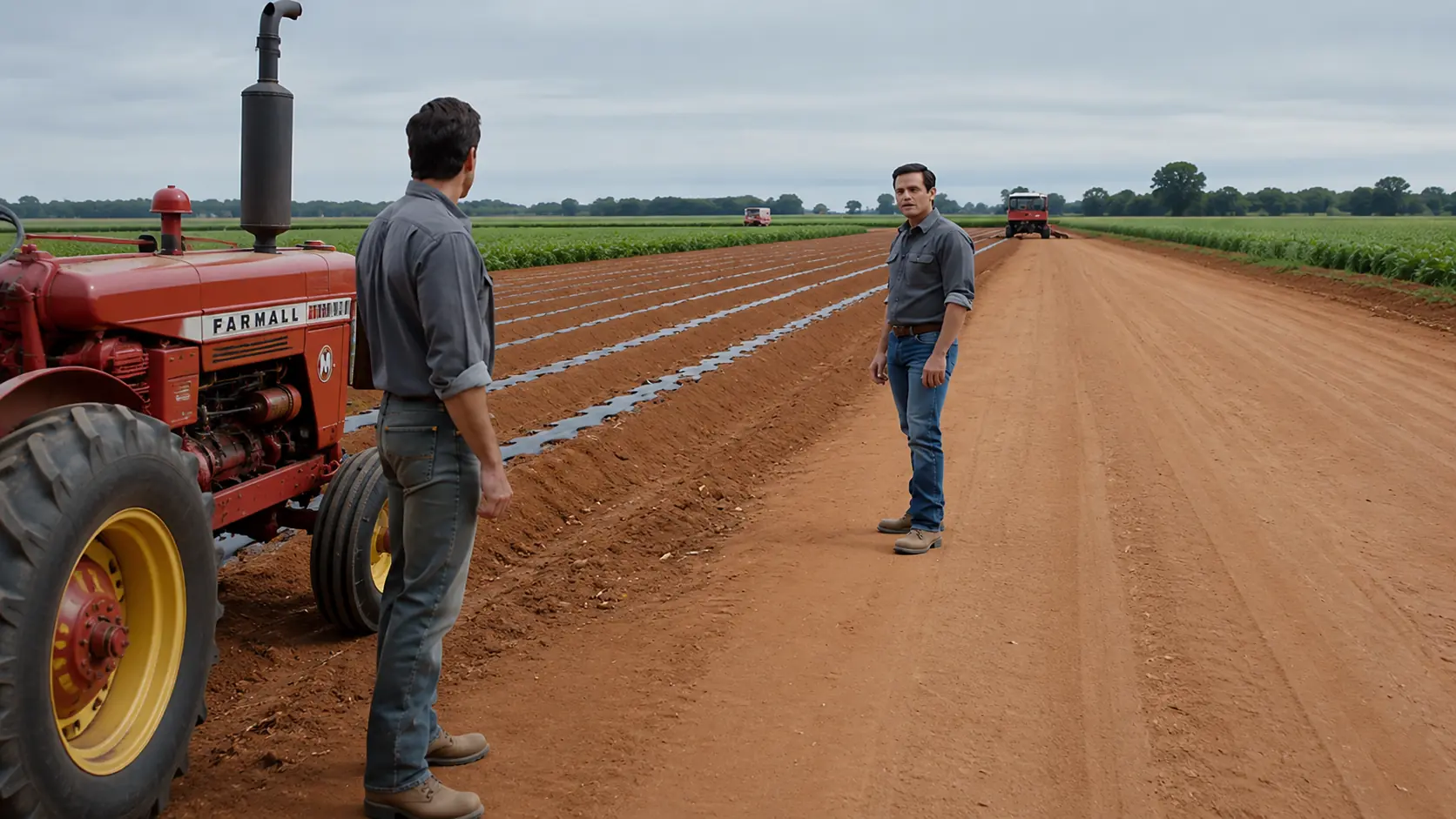
Howard taught them everything he knew. He shared his grandfather’s journal and made copies of the key pages so others could read them. He explained drought-resistant crops, crop rotation, and the cycles of wet years and dry years that had shaped Oklahoma farming for generations. “My grandfather learned this the hard way,” Howard told them. “In the thirties, when people were loading up their cars and driving to California, he stayed. He survived. He wrote it all down so someone would remember.”
“Why did you not tell us before?” one farmer asked. “Back in 1976, when you first planted sorghum, why did you not warn us?” Howard sighed. “Would you have listened?” The farmer was quiet for a moment. “No, probably not.”
“That is why I did not tell you,” Howard said. “I showed you instead. Four years of showing you, and even then, you did not see.” Howard’s voice was not angry, only sad. “People do not listen to warnings. They do not believe something can happen until it happens. My grandfather knew that.”
“That is why he said to plant sorghum before the drought comes, not after,” Howard continued. “Because after is when people finally believe, and after is too late.” In 1992, the Kingfisher County Historical Society asked Howard if they could display his grandfather’s journal in their museum. Howard agreed. But first, he did something he had been thinking about for years. He sat down and added his own chapter.
“This journal was written by my grandfather, Elmer Jessup, in 1945,” Howard wrote. “He meant it for his children and grandchildren, but it sat unread in an attic for thirty years until I found it. What I read in these pages changed my life. My grandfather survived the Dust Bowl by planting sorghum when everyone else planted wheat. He saved his family, his farm, and his future, and then he wrote it all down so someone would remember.”
“I read his words in February 1976,” Howard continued. “That spring, I planted sorghum for the first time. My neighbors laughed at me. They called me Wrong Crop Howard. They said I was throwing money away. In 1980, the drought came, just like my grandfather said it would.”
“The wheat died,” he wrote. “The sorghum survived. I made money when others made nothing. I bought land when others lost everything. I am writing this in 1992, sixteen years after I found this journal. I am seventy-six years old. I own eight hundred acres, all paid for, all productive. I have three children and seven grandchildren. None of this would exist without my grandfather’s words.”
“To whoever reads this next, the drought will come again,” Howard wrote. “It always does. Remember what Elmer Jessup learned. Plant sorghum before the drought comes, not after. Learn from the past before you have to learn from your own mistakes. The old ways are not always wrong. Sometimes the old ways are the only ways that work.”
The journal sits in the Kingfisher County Historical Society to this day. Visitors can see both entries, Elmer’s original warning and Howard’s confirmation, side by side on facing pages. The museum calls it the Jessup Journal, two generations of Oklahoma wisdom. But the story ends where it began, in a field of sorghum with a man who listened.
Howard Jessup died in 2001 at the age of sixty-five. He worked his farm until the last month of his life, finally slowing down when his heart would not let him do otherwise. His funeral was the largest in Kingfisher County history. Farmers came from three states to pay their respects, men and women who had learned from Howard, who had been saved by his teaching, and who owed their farms to a piece of advice about sorghum.
His son Tommy, the boy who came home with a black eye in 1978, gave the eulogy. “My father taught me many things,” Tommy said. “How to work the land, how to fix a tractor, and how to tell when rain was coming. But the most important thing he taught me was this: listen to the people who came before you. They paid for their knowledge with sweat and tears. We get it for free if we are wise enough to pay attention.”
Tommy held up his great-grandfather’s journal, the leather-bound book that had traveled from Elmer’s hands to Howard’s and then to his. “This journal saved our family, not once but twice,” he said. “In the 1930s, when my great-grandfather wrote it, and in the 1980s, when my father read it. Both times, the men in this family were called fools. Both times, they were proven right.”
He looked out at the crowd, at the farmers and their families, and at the people who had once laughed at Wrong Crop Howard and were now there to honor him. “My father could have kept this journal secret,” Tommy said. “He could have let his neighbors fail and bought their land for pennies. Instead, he taught everyone who would listen. He shared the wisdom that saved him because he believed that helping your neighbor was more important than getting ahead.”
Tommy closed the journal. “My father planted the wrong crop for four years while everyone laughed. He did it because he trusted his grandfather’s words more than the crowd’s opinion. And he was right. The drought came. The sorghum survived. Howard Jessup became the richest farmer in Kingfisher County, not in money, but in something more valuable: trust, respect, and the knowledge that he had done the right thing when doing the wrong thing would have been so much easier.”
Tommy looked at the coffin, then back at the crowd. “Dad always said the same thing when people asked how he knew to plant sorghum. ‘My grandfather told me.’ Well, now I am telling you. Listen to the old ones. Learn from their mistakes. And when everyone else is planting wheat, have the courage to plant sorghum.”
He smiled his father’s smile, quiet and knowing. “Because the drought always comes. And when it does, you had better be ready.” The Jessup farm is still operating today. Tommy’s son, Michael, runs it now, the fourth generation of Jessups on that Oklahoma land.
They grow sorghum, drought-resistant wheat, and raise cattle. They have never taken on debt they could not pay in a single season. They have never planted a crop without checking the journal first. Every spring before planting begins, Michael Jessup sits down with his own children and reads them the words Elmer wrote decades earlier. “The drought will come again. It always does. Plant sorghum before the drought comes, not after. After is too late.”
Four generations of Jessups. Four generations of listening. Four generations of surviving while others failed. That is the power of wisdom passed down. That is the legacy of the wrong crop. That is what happens when you trust your grandfather.