For twenty-three years, people in Mason Ridge called Walter Hayes’s barn the ugliest building in the county.
They were not entirely wrong.
The roof sagged in the middle like the back of an exhausted horse. Several boards along the western wall had turned silver with age, and one corner leaned far enough that people slowed their trucks to see whether it had finally fallen.
Three different colors of tin covered the roof.
None matched.
A faded tobacco advertisement remained visible beneath the peeling red paint on the southern wall, though no one could remember tobacco ever being grown on the Hayes farm.
The doors were worse.
They hung from heavy iron hinges blackened by rust. A split ran through the lower half of the left door, and daylight showed between nearly every board.
To anyone driving along County Road 14, the barn looked abandoned.
But it was not.
Every evening, shortly after sunset, Walter crossed the yard carrying a lantern and a ring of old keys.
He entered the barn alone.
Then he locked the doors behind him.
That habit created rumors.
Children said he kept a wild animal inside.
Teenagers claimed the barn contained stolen machinery.
Some older farmers believed Walter had become confused after his wife died and spent his nights talking to equipment that no longer ran.
Walter never corrected them.
He had stopped caring what Mason Ridge thought a long time ago.
At seventy-eight, he lived alone in a modest farmhouse surrounded by two hundred acres of pasture, hay ground, and scattered oak trees. His cattle herd had been reduced to twelve gentle Herefords. He no longer planted row crops, and he rented most of his best ground to a young neighbor named Caleb Morris.
Walter’s clothes always carried dust.
His truck was older than many of the people who laughed at it.
He wore the same green work jacket from October through April and repaired his boots until the leather could no longer hold another stitch.
Across the road stood the Caldwell estate.
Harrison Caldwell had inherited three hundred acres from his father, then turned them into something designed to be admired rather than farmed.
The original farmhouse had been demolished.
In its place stood a three-story stone mansion with white columns, copper gutters, and a circular driveway wide enough for a hotel.
Decorative fencing followed the road.
Landscaped ponds reflected imported trees.
A climate-controlled equipment building held new tractors polished more often than they were used.
Harrison owned only sixty cattle, but his barn had chandeliers.
People joked about Walter’s collapsing barn while attending charity dinners inside Harrison’s.
Harrison encouraged the comparison.
Whenever visitors admired his estate, he gestured across the road toward Walter’s property.
“Every neighborhood needs one place to remind us what happens when people refuse progress.”
The line usually earned a laugh.
Walter sometimes heard it.
He never responded.
The two men had known each other since childhood.
They had once attended the same school, worked harvests together, and played baseball in the same dusty field behind the church.
Then Harrison’s father became wealthy through land development.
Walter’s family remained farmers.
The difference widened over the years until friendship became politeness and politeness became contempt.
Harrison first offered to buy Walter’s farm in 1998.
Walter refused.
He offered again in 2005, then 2012, then every year after Walter’s wife, Margaret, died.
Each offer included the same argument.
Walter was getting older.
The house needed repairs.
The barn was dangerous.
The land would eventually be sold anyway.
Why not leave with money while he could still enjoy it?
Walter always gave the same answer.
“No.”
Harrison eventually stopped pretending the offers were generous.
One autumn afternoon, he stood at Walter’s fence in a tailored jacket and pointed toward the barn.
“That building will come down whether you sell to me or not.”
Walter rested both hands on the fence post.
“Probably.”
“The county can condemn it.”
“Maybe.”
“It’s a hazard.”
“To whom?”
“To property values.”
Walter looked across the road at Harrison’s mansion.
“Your property seems to have survived.”
Harrison smiled without humor.
“You think people admire that old place?”
“No.”
“Then why keep it?”
Walter looked toward the sagging roof.
“Because not everything important needs to impress someone driving past.”
Harrison shook his head.
“That is what poor men say when they cannot afford better.”
Walter turned away.
“Then you should be grateful. I make your place look expensive.”
The next week, Harrison complained to the county.
An inspector visited Walter’s farm.
He walked around the barn, photographed the leaning corner, and tested several boards with the handle of a screwdriver.
“This structure needs work,” he said.
“I know.”
“The western wall is failing.”
“Only the outer boards.”
“The roofline suggests movement.”
“The center beam has looked that way since 1974.”
“You may need an engineer.”
Walter nodded.
The inspector looked toward the locked doors.
“What is inside?”
“Farm equipment.”
“Any fuel?”
“No.”
“Chemicals?”
“No.”
“Livestock?”
“No.”
The inspector wrote something on his clipboard.
“I need access.”
Walter’s expression changed.
“No.”
The inspector looked up.
“If the county is evaluating a possible hazard—”
“You can evaluate the exterior.”
“I need to see the structural supports.”
Walter stood between him and the doors.
“Come back with a warrant or an engineer who understands post-and-beam construction.”
The inspector had not expected resistance.
He left irritated.
By evening, half the county knew Walter had refused to let officials inside.
The rumors multiplied.
At Rusty’s Diner, one farmer said Walter was hiding illegal whiskey.
Another claimed the barn floor covered an old family grave.
Dennis Croft, who sold machinery at Mason Ridge Equipment, suggested Walter had stolen tractor parts during the 1960s and kept them hidden.
Harrison sat at the counter listening.
“What do you think is inside?” the waitress asked him.
“Nothing valuable,” Harrison said. “If it were valuable, he wouldn’t keep it in a building ready to collapse.”
That answer sounded reasonable.
It was also completely wrong.
The first person to understand that was a twelve-year-old boy named Noah Bennett.
Noah lived two miles from Walter and delivered groceries for his mother on Saturdays. He had an unusual interest in old machinery.
Not restored machines at shows.
The forgotten ones.
He collected rusted nameplates, broken gauges, and old advertising booklets from farm auctions. He could identify many tractor models by grille shape alone.
One rainy afternoon, Noah arrived at Walter’s house carrying groceries.
Walter paid him, then looked toward the darkening sky.
“Storm’s coming.”
“My mom said it would pass north.”
“Your mom listens to the television.”
Walter pointed toward the cattle.
“They’re standing with their backs west. Storm’s coming here.”
Rain began before Noah reached his bicycle.
Walter told him to wait inside.
Then wind tore a sheet of loose tin from the barn roof.
The metal struck the ground hard enough to frighten the cattle.
Walter pulled on his jacket.
“Stay in the house.”
“I can help.”
“You can help by staying dry.”
Walter crossed the yard carrying rope and a ladder.
Noah watched through the kitchen window until the old man disappeared behind the barn.
Then another sheet of tin lifted.
Noah ignored the instruction and ran outside.
He found Walter struggling to secure a tarp over the damaged section.
“Hold the ladder,” Walter shouted.
Noah did.
For twenty minutes, rain soaked them while Walter tied the tarp beneath the eaves.
When they finished, both were covered in mud.
Walter looked at the boy.
“I told you to stay inside.”
“You would have fallen without someone holding the ladder.”
Walter considered that.
“Maybe.”
They walked toward the front doors.
Walter removed the keys.
Noah expected him to return to the house.
Instead, Walter unlocked three separate padlocks.
“We need to check for water.”
The doors opened.
Noah stepped forward.
Then stopped.
The barn everyone mocked did not exist inside.
Behind the weathered exterior was another structure entirely.
Massive oak posts rose from a dry concrete floor. Steel braces reinforced the frame. Hidden support beams carried the sagging outer roof while a newer inner roof protected everything below.
Rows of machines filled the building.
Not broken implements.
Tractors.
Dozens of them.
Some were small and narrow, with steel wheels and exposed engines.
Others had smooth rounded hoods, tall exhaust stacks, and paint so clean it reflected the lantern light.
Red.
Green.
Orange.
Gray.
Yellow.
Blue.
Every major American farm-machinery color appeared beneath the timber beams.
Noah forgot the rain.
He walked slowly between the first two rows.
A 1918 Waterloo Boy stood beside an early Fordson.
Farther back sat a Hart-Parr with steel wheels taller than Noah’s shoulders.
There were Rumely OilPulls, Minneapolis-Molines, Farmalls, Cases, Allis-Chalmers, Olivers, Massey-Harrises, and John Deeres.
Some looked restored.
Others remained exactly as they had been found, with worn paint and field repairs still visible.
Small signs hung from each steering wheel.
They listed model, year, serial number, original owner, and acquisition history.
Noah turned toward Walter.
“How many are there?”
“Seventy-three complete tractors.”
“You have seventy-three tractors?”
“Seventy-four if you count the one behind the shop waiting on a magneto.”
Noah moved toward a low green machine near the center.
“Is that a John Deere D?”
“First production year.”
The boy stared at the serial plate.
His mouth opened.
“This number…”
Walter watched him.
“It is earlier than the one in the state museum.”
Noah turned.
“How?”
“Because the museum has number 386.”
He pointed.
“That one is 312.”
Noah looked around again.
The collection was not random.
It traced the development of American farming through machinery.
Early steam-era transition tractors.
First successful gasoline machines.
Row-crop designs.
Diesel breakthroughs.
Experimental models.
Machines from companies that disappeared before most people in Mason Ridge were born.
At the back stood several tractors beneath gray cloth covers.
“What are those?”
Walter’s voice became firmer.
“Not for touching.”
“I wasn’t going to.”
“Good.”
Water began dripping near the western wall.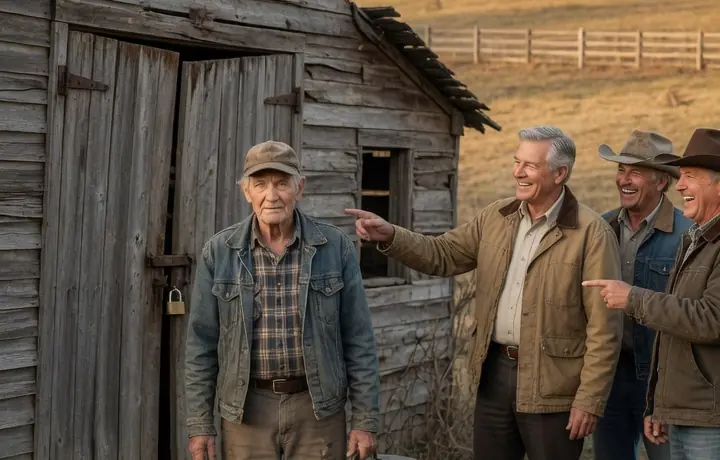
Walter placed buckets beneath it.
The inner structure remained dry.
Noah looked toward the outside boards.
“You made the barn look worse than it is.”
Walter did not answer.
“The inside is reinforced.”
“Yes.”
“Why hide it?”
Walter adjusted one bucket.
“People protect what they believe is valuable.”
“That sounds normal.”
“People also take what they believe they deserve.”
Noah waited.
Walter looked down the rows.
“My father began this collection.”
Walter Hayes Sr. purchased his first unusual tractor during the Depression.
It was a 1916 Mogul left behind when a nearby farm was repossessed. The bank considered it scrap. Walter’s father traded two hogs for it.
He did not intend to create a museum.
He simply hated seeing useful machines destroyed.
During the 1940s and 1950s, farms modernized quickly. Steel-wheeled tractors were abandoned. Small manufacturers disappeared. Dealers cut old machines apart for metal.
Walter’s father bought what he could.
Often for less than twenty dollars.
Sometimes for nothing.
“He said tractors were working history,” Walter explained. “Not because they were beautiful. Because each one replaced something people had depended on before.”
Walter continued collecting after returning from military service in 1967.
He traveled to farm auctions, scrapyards, estate sales, and closed dealerships. He kept records of every purchase.
Margaret helped.
She researched the owners and wrote down the stories.
One tractor had broken ground for a school built in 1923.
Another had powered a sawmill during the Second World War.
A small gray Ferguson had belonged to a widow who farmed eighty acres alone after her husband was killed in Korea.
“Why didn’t you show people?” Noah asked.
Walter looked toward the barn doors.
“I did once.”
In 1981, Walter loaned three rare tractors to a regional exhibition.
One was damaged during transport.
A second returned missing its original carburetor.
The third was listed in a dealer’s sales catalog without Walter’s permission.
Collectors began visiting.
Some offered money.
Others entered the property when Walter was away.
One man tried to remove a serial plate from a rare prototype.
After that, Walter stopped displaying the collection publicly.
He reinforced the barn from inside.
Kept the exterior unchanged.
And allowed people to believe there was nothing worth seeing.
“Does anyone else know?” Noah asked.
“Margaret knew.”
“Anyone alive?”
“An attorney in Lincoln has the inventory.”
Noah looked toward the covered tractors.
“What is under those?”
Walter gave him a long look.
Then he removed one cloth.
Beneath it stood a compact tractor painted deep green with yellow wheels.
It resembled a familiar John Deere model, but the hood shape was wrong.
The logo was smaller.
Several components appeared handmade.
Noah walked around it.
“What model?”
“It never received one.”
Walter pointed toward a brass plate.
EXPERIMENTAL UNIT 3
DEERE & COMPANY
1946
Noah looked at him.
“Is this real?”
“Yes.”
“What was it testing?”
“Early three-point hitch adaptation and a compact diesel arrangement.”
“John Deere didn’t release a compact diesel like this in 1946.”
“No.”
“Then this could be—”
“Rare.”
Noah almost laughed.
“Rare? Mr. Hayes, this might be the only one.”
Walter covered it again.
“That is why you will not tell anyone.”
Noah looked disappointed.
“You should let historians see this.”
“Historians talk to museums. Museums talk to donors. Donors talk to collectors.”
“But this is important.”
“So is keeping it here.”
“Why?”
Walter looked toward the rows.
“Because this is where the stories stayed together.”
Noah promised silence.
For nearly a year, he kept it.
He began visiting Walter after school.
At first, he swept floors and cleaned tools.
Later, Walter taught him how to remove rust without destroying original paint, how to rebuild a magneto, and how to preserve leather seats with the correct oils.
Noah learned that restoration did not always mean making a machine look new.
Sometimes restoration meant preserving wear.
A polished tractor could erase the farmer who used it.
Walter showed him hand-welded repairs, carved initials, modified controls, and homemade parts built during years when replacements were unavailable.
“Every imperfection tells you what someone needed,” Walter said.
The county continued laughing.
Harrison Caldwell complained twice more about the barn.
He offered Walter nearly two million dollars for the farm.
Walter refused.
Then Harrison proposed purchasing only the barn site.
“I’ll build a guesthouse there,” he said.
Walter looked at the sagging roof.
“You want guests sleeping under that?”
“I’ll demolish it.”
“No.”
“What could possibly be worth protecting in there?”
Walter smiled faintly.
“Nothing you would understand.”
The answer angered Harrison.
He filed another complaint.
This time, the county scheduled a formal condemnation hearing.
Walter received the notice in March.
He placed it on the kitchen table and read it twice.
The county intended to order demolition unless he produced an engineering report proving the structure was safe.
The engineer’s fee alone would cost several thousand dollars.
Repair orders could cost far more.
Noah found him inside the barn that evening.
“What are you going to do?”
“Nothing tonight.”
“They can’t tear this down.”
“They can tear down the outer structure.”
“What about the tractors?”
“I’ll move them.”
“Where?”
Walter did not answer.
Noah understood.
There was nowhere.
Most museums lacked space.
Private collectors would separate the machines.
Auction houses would sell them one by one.
The collection’s meaning came from remaining complete.
Noah looked at the rows.
“You need someone important.”
Walter smiled.
“Harrison would agree with you.”
“I mean a historian.”
“No.”
“Someone who can prove this barn matters.”
“The county is concerned with safety, not history.”
“Then prove both.”
Walter shook his head.
Noah went home angry.
That night, he searched agricultural-history journals online.
He found the name Dr. Evelyn Carter.
She was an agricultural historian at Iowa State University and had written several books about early American tractor development. She had authenticated machinery for the Smithsonian and consulted on national collections.
Noah sent her an email.
He did not reveal the experimental tractor.
He wrote only that an elderly farmer in Nebraska possessed a private collection that might contain machines of national importance and that the building housing them faced demolition.
He attached one photograph.
The image showed the serial plate on the early John Deere D.
Evelyn replied the next morning.
Where did you photograph this?
Noah lied.
At a private collection.
She wrote again.
Is the tractor complete?
Yes.
Original engine?
Yes.
Original wheels?
Yes.
Within two days, she requested a phone call.
Noah told Walter after everything was arranged.
The old man’s face hardened.
“You broke your word.”
“Yes.”
“Why?”
“Because the county is going to destroy the barn.”
“That was my decision.”
“No. It was Harrison’s decision. You’re just letting him make it.”
Walter stared at the boy.
Noah’s voice shook, but he continued.
“You told me every machine remembers someone who needed it. What happens when no one remembers them?”
Walter looked toward Margaret’s handwritten records.
For a long time, he said nothing.
Then he asked, “When is she coming?”
“Tomorrow.”
Dr. Evelyn Carter arrived in a rented car carrying a camera, notebooks, cotton gloves, and the controlled skepticism of someone accustomed to exaggerated claims.
She was sixty-two, with short gray hair and a direct manner.
From the road, she saw the barn and frowned.
“This is the collection site?”
Noah nodded.
Walter waited near the doors.
Evelyn introduced herself.
Walter did not shake her hand immediately.
“You came because a boy broke a promise.”
“I came because the serial number in his photograph should not exist in private hands without documentation.”
“That sounds like judgment.”
“It is concern.”
“For whom?”
“For the machine.”
Walter unlocked the doors.
When they opened, Evelyn stepped inside.
She stopped after three steps.
Noah watched her face.
The skepticism disappeared first.
Then professional control.
She turned slowly, taking in the rows.
“My God.”
Walter closed the doors behind them.
Evelyn walked toward the Waterloo Boy.
She examined the engine casting and serial plate.
Then the Hart-Parr.
Then a rare Case crossmotor model.
Her questions became faster.
“Original magneto?”
“Yes.”
“Factory wheels?”
“Yes.”
“Do you have acquisition records?”
“For every machine.”
“Ownership history?”
“Most.”
“Restoration notes?”
“In the cabinet.”
She reached the early John Deere D.
Her hands began to tremble slightly.
“This serial number has been listed as destroyed.”
“It wasn’t.”
“Where did your father find it?”
“Inside a collapsed dealership warehouse in 1949.”
Evelyn looked at Walter.
“Do you understand what this is worth?”
“Yes.”
“How long have you had it?”
“Seventy-five years.”
“And no one knows?”
“You know now.”
Then Walter uncovered Experimental Unit 3.
Evelyn did not speak.
She walked around the tractor twice.
Kneeling near the rear housing, she examined casting marks through a magnifying lens.
“Where did this come from?”
“A former Deere engineer named Harold Vance.”
“Harold Vance worked on experimental postwar systems.”
“I know.”
“His prototypes were ordered destroyed.”
“Most were.”
Evelyn looked up.
“You have documentation?”
Walter opened a steel cabinet.
Inside were letters, engineering sketches, and a transfer document signed by Vance in 1958.
Evelyn read the first page.
Then the second.
She sat down on an overturned crate.
Noah waited.
Finally, she said, “This could change parts of the accepted development history.”
Walter leaned against the cabinet.
“That sounds dramatic.”
“It is.”
The prototype showed Deere engineers experimenting with systems historians believed the company had not seriously explored until years later.
Its engineering value was immense.
As a unique surviving machine with documented provenance, its monetary value could reach several million dollars by itself.
But Evelyn was more interested in the collection as a whole.
The tractors represented nearly every major stage in mechanized American agriculture from 1910 through the early 1960s.
Many retained original components usually replaced during restoration.
Margaret’s records connected the machines to farms, families, wartime production, droughts, foreclosures, and changes in rural life.
“This is not simply a tractor collection,” Evelyn said.
Walter looked down the rows.
“No.”
“It is an archive.”
“That is what Margaret called it.”
“Who was Margaret?”
“My wife.”
Evelyn spent two full days documenting the barn.
She slept at the only motel in Mason Ridge and returned before sunrise.
On the third day, she attended the county hearing.
The room was full.
Harrison sat in the front row wearing a dark suit.
Walter sat near the back with Noah.
Several people whispered when Evelyn entered carrying binders and photographs.
The county commissioner began with the structural complaint.
Harrison’s attorney presented exterior photographs showing the sagging roof and weathered siding.
“This structure is clearly neglected,” he said. “It threatens nearby property values and may present a public hazard.”
Walter almost laughed at the phrase nearby property values.
The nearest occupied building was his own farmhouse.
The commissioner turned toward him.
“Mr. Hayes, do you have an engineering report?”
Evelyn stood.
“He does now.”
A structural engineer she contacted had inspected the barn the previous afternoon.
His report confirmed that the outer siding and roofline appeared poor, but the internal post-and-beam frame had been reinforced with concealed steel supports. The foundation was stable. The inner roof system carried the actual load.
The barn required repairs.
It was not in danger of collapse.
Harrison’s attorney objected.
Evelyn placed photographs on the display table.
Then she explained what the barn contained.
The room became silent.
Seventy-four historically significant tractors.
Several examples believed lost.
One unique experimental John Deere unit.
Acquisition records spanning three generations.
An archive containing thousands of pages of agricultural history.
The commissioner stared at Walter.
“You have all of that in the barn?”
“Yes.”
“Why did no one know?”
Walter looked toward Harrison.
“Apparently, I lacked chandeliers.”
Someone laughed.
Harrison did not.
Evelyn continued.
“In my professional opinion, the Hayes collection is one of the most complete privately held records of early American tractor development I have ever examined.”
She paused.
“The building and its contents should be evaluated for historic designation.”
Harrison’s attorney stood.
“Historical importance does not excuse code violations.”
“No,” Evelyn said. “But fabricated claims of imminent collapse should not be used to force demolition.”
The commissioner looked toward the engineer’s report.
The condemnation request was denied.
Walter received twelve months to complete exterior repairs.
Then Evelyn revealed the estimated value.
She refused to assign a precise figure without formal appraisal, but based on rarity, provenance, and completeness, the collection could be worth between twelve and eighteen million dollars.
People in the room turned toward Walter.
The old man still wore dusty boots and a patched green jacket.
The barn everyone mocked was worth more than Harrison Caldwell’s mansion.
Possibly several times more.
Harrison’s expression changed.
Not to admiration.
Calculation.
He approached Walter after the hearing.
“You should sell the collection.”
“No.”
“You cannot maintain it forever.”
“No.”
“I know collectors who would pay immediately.”
“That is exactly why you will never enter the barn.”
Harrison lowered his voice.
“You were sitting on millions while pretending you couldn’t afford a roof.”
“I could afford a roof.”
“Then why let the building look like that?”
Walter glanced toward the crowd.
“Because men like you look through anything that doesn’t shine.”
The story spread across the country.
Agricultural magazines requested access.
Television crews arrived.
Collectors sent letters and offers.
One offered four million dollars for the experimental Deere alone.
Walter refused every offer.
But the attention created another problem.
People began driving onto the property.
One night, someone cut the western fence.
Another person attempted to enter the barn through a side window.
Walter finally accepted that secrecy could no longer protect the collection.
Evelyn proposed creating a nonprofit trust.
The barn would be restored without changing its original appearance more than necessary. The collection would remain together. Researchers could study it by appointment. Limited public tours would fund preservation.
Walter resisted.
Noah argued with him.
“Your father saved the machines.”
Walter looked at him.
“You saved the records.”
“Yes.”
“Then what am I supposed to save?”
“The chance for someone after us to understand them.”
That sentence belonged to Margaret.
Walter had written it on a card after her funeral.
He kept it inside the archive cabinet.
He stared at Noah for a long time.
Then he agreed.
The Walter and Margaret Hayes Agricultural Heritage Trust was established that summer.
Evelyn became its first historical adviser.
Noah’s mother joined the board.
Caleb Morris oversaw the land.
Walter retained ownership and control during his lifetime, but the collection could never be separated or sold for private profit.
Restoration work began.
Carpenters removed the worst exterior boards one at a time. Each was numbered, repaired when possible, and returned to its original position.
The sagging roofline was preserved visually while hidden structural supports were strengthened.
The mismatched tin remained.
Walter insisted.
“That roof kept rain out for eighty years.”
The opening day was scheduled for the following spring.
People arrived from twenty-seven states.
Retired farmers stood beside tractors they remembered from childhood. Engineers examined forgotten systems. Families found photographs of grandparents in Margaret’s records.
One elderly woman recognized the gray Ferguson her mother used after her father died in Korea.
She touched the worn steering wheel and began crying.
“My mother’s hands made that smooth,” she said.
Walter stood nearby.
That was why he had kept the machine unrestored.
A polished wheel would have erased her.
Harrison Caldwell attended the opening.
He arrived late and parked his luxury truck near the road.
People recognized him.
Some whispered.
Walter met him at the door.
“I’d like to see the prototype,” Harrison said.
“The tour begins with the Waterloo Boy.”
“I don’t need the public tour.”
“That is the only tour.”
Harrison’s face tightened.
“I offered to help you for years.”
“You offered to buy the building so you could tear it down.”
“You could have told me what was inside.”
Walter smiled.
“You already told me what you thought anything inside would be worth.”
Harrison entered with the next group.
For the first time in his life, he followed Walter’s rules.
Noah became the collection’s youngest guide.
He explained the transition from steam power to gasoline tractors. He showed visitors factory castings, original repairs, and experimental systems.
When he reached Unit 3, he never began with its estimated value.
He told them about Harold Vance.
The engineer ordered to destroy the prototype.
The decision to hide it.
Walter’s father agreeing to preserve it without displaying it.
The decades it spent beneath a gray cloth while accepted history developed without it.
Only after telling that story did Noah mention that collectors had offered millions.
“Why didn’t Mr. Hayes sell?” visitors often asked.
Noah gave the answer Walter taught him.
“Because price is what someone offers to separate a thing from its story.”
Walter died three years after the museum opened.
He was eighty-one.
On the evening before his death, Noah found him sitting inside the barn beside the early John Deere D.
“You should be in the house,” Noah said.
Walter rested one hand on the steel wheel.
“So should this tractor, according to a museum catalog.”
“You’re tired.”
“Yes.”
Noah sat beside him.
For several minutes, neither spoke.
Then Walter handed him the ring of keys.
“They’re the trust’s now.”
Noah did not take them immediately.
“I’m not ready.”
“Good.”
“How is that good?”
“People who feel ready around valuable things usually become dangerous.”
Noah accepted the keys.
Walter looked down the rows.
“Your job is not to make these machines famous.”
“I know.”
“What is it?”
“To keep their stories together.”
Walter nodded.
“And?”
“To let the next person understand what they changed.”
“Good.”
The following morning, Walter died peacefully in his bed.
His funeral procession passed the barn.
Tractors from the collection were not driven.
Walter had forbidden unnecessary operation of the rarest machines.
Instead, farmers from across Mason Ridge brought their own tractors.
Old and new.
Red, green, orange, and blue.
They lined County Road 14 from the church to the farm.
Harrison Caldwell stood near his mansion and watched the procession pass the building he once called an eyesore.
He removed his hat.
No one asked him to.
Years later, the Hayes barn became one of the most respected agricultural-history sites in the Midwest.
Its exterior still looked old.
Visitors often questioned whether they had arrived at the correct place.
The paint continued peeling.
The roof remained mismatched.
The tobacco advertisement was preserved beneath a protective coating.
The trust could have made the building look new.
It chose not to.
A polished exterior would have changed the lesson.
Everyone in Mason Ridge had looked at the barn for decades.
They had seen loose boards, rusted tin, and a man too poor or stubborn to improve them.
What they had not seen were reinforced beams.
Carefully controlled humidity.
Handwritten records.
Machines rescued from destruction.
A history worth millions protected by an appearance no thief, developer, or wealthy neighbor considered valuable.
The barn had never been neglected.
Its ugliness was partly camouflage.
Partly practicality.
And partly Walter’s refusal to prove anything to people who valued surfaces more than substance.
At the entrance, visitors now passed a small plaque written by Noah.
It did not list the collection’s estimated value.
It did not mention the famous prototype first.
It carried one sentence Walter had spoken to Harrison decades earlier:
NOT EVERYTHING IMPORTANT NEEDS TO IMPRESS SOMEONE DRIVING PAST.
Inside, seventy-four tractors remained in their rows.
The early Deere stood beside the Waterloo Boy.
The experimental unit remained beneath controlled light.
Margaret’s handwritten histories filled the archive room.
And the worn gray Ferguson still carried the smooth steering wheel shaped by a widow’s hands.
People entered expecting rare machinery.
They found something larger.
They found evidence that progress always leaves something behind.
A method.
A machine.
A family.
A way of life.
And sometimes, one stubborn old farmer is the only person standing between that history and the scrapyard.
For years, everyone laughed at Walter Hayes’s falling barn.
They believed it lowered the value of the county.
Then the doors opened.
The historian stopped speaking.
The collectors began making offers.
The county withdrew its demolition order.
And the mansion across the road became merely the second-most talked-about building in Mason Ridge.
The difference was simple.
Harrison Caldwell had built something designed to look valuable from the road.
Walter Hayes had protected something that remained valuable after the doors were opened.