The first time Clare Bennett agreed to let two beavers move onto her ranch, half the county decided the drought had finally gotten to her. She was standing beside a creek that barely deserved the name anymore, watching a wildlife technician unload two heavy wooden crates from the back of a truck while July heat pressed against the valley like an open furnace. Across the fence, her neighbor Roy Mercer leaned on his gate, listened to the scratching coming from one of the crates, and called out, “Please tell me those are not what I think they are.” Clare wiped sweat from her forehead and answered, “That depends on whether you think I just hired two giant river rats.”
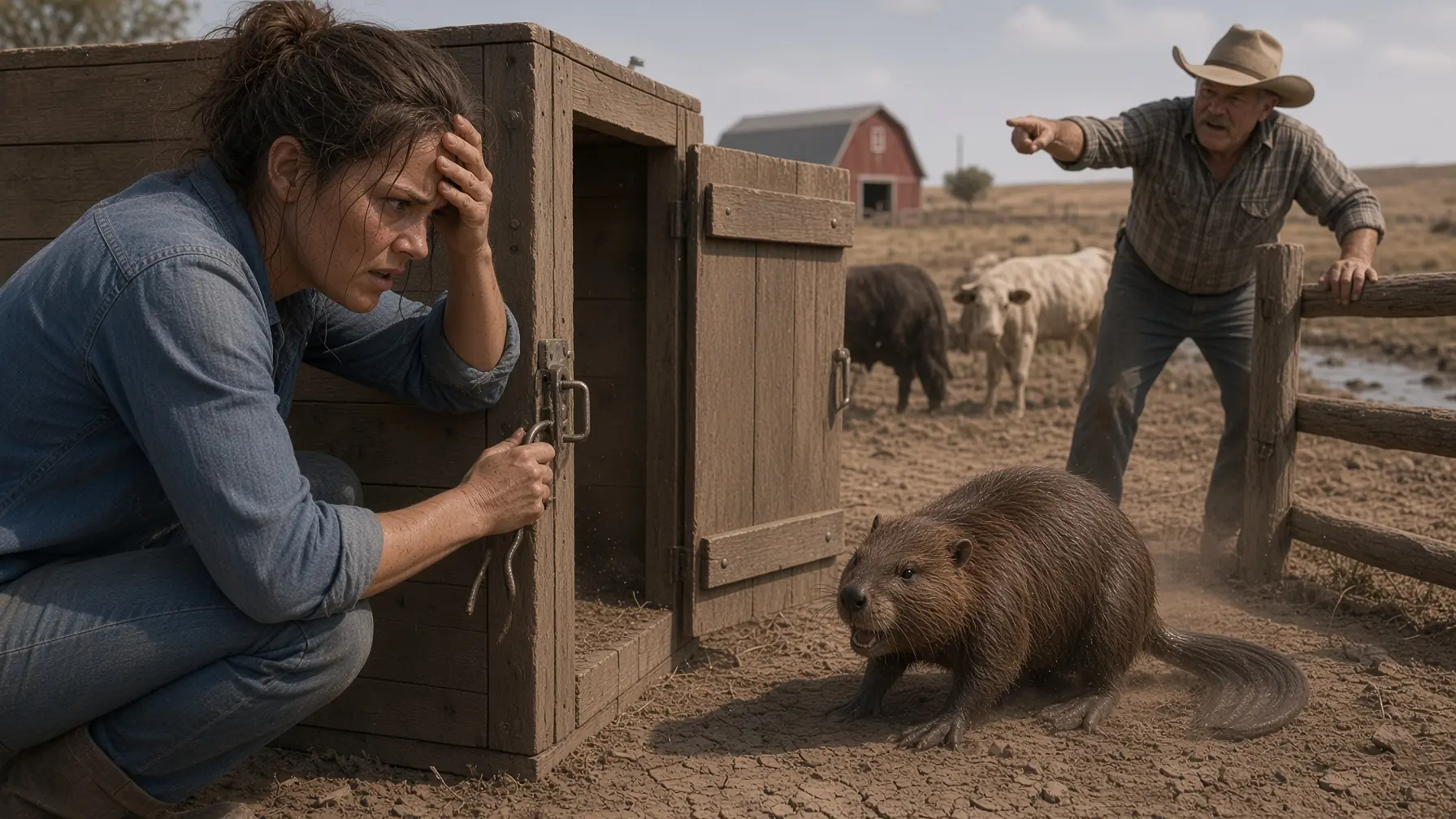
Roy laughed so hard he had to grab the fence. Clare did not. Behind her, Bennett Creek had shrunk into a tired brown ribbon interrupted by shallow pools, while the hills above the ranch had turned the color of old straw. Two cows stood beneath a cottonwood tree that had already begun dropping leaves, and the rest of Clare’s remaining herd crowded the only pasture where grass still carried a little green.
“At this point,” she told Roy, “I’ll take help from anybody with teeth and a work ethic.” Roy shook his head and muttered something about putting the animals on payroll. Clare looked toward the crates again and wondered whether everyone laughing at her might eventually turn out to be right.
Bennett Creek Ranch had been in her family for three generations. Her grandfather ran cattle there when children could still swim in the creek during July, and her father cut hay from fields that now struggled to produce one usable cutting in a good year. Clare had grown up riding horses along the banks, catching frogs near the reeds, and hearing her father repeat the same sentence so often that she eventually stopped listening to it.
“Water is the first crop, Clare.” Everything else, he always said, came after.
She understood it now. Water had not disappeared from the ranch in one dramatic catastrophe, because something that obvious might have been easier to fight. Instead, each spring brought slightly less flow, each summer turned brown sooner, and every storm seemed to race through the narrow creek channel before the soil could hold any of it.
The hay field that once produced two cuttings barely produced one. The shallow stock well took longer to recover after pumping, and the pasture near the creek turned dusty by August instead of late September. The previous year Clare sold twenty cows simply to reduce the feed bill, telling herself she could rebuild the herd when conditions improved.
Conditions did not improve. By the summer the beavers arrived, she had only a small group left, and selling them would mean more than losing livestock. Without cattle, she was not sure what remained of Bennett Creek Ranch besides a mortgage, a barn, and several hundred acres of dry memories.
Clare had tried almost everything she could afford. She repaired old irrigation ditches, paid for water deliveries during the worst weeks, reseeded grass along the creek, and planted young willows only to watch most die before their roots reached moisture. A drilling company estimated nearly sixty thousand dollars for a deeper well with a larger pump and associated work.
The estimate came from Wade Harper. Wade owned Harper Waterworks, the biggest drilling and ditch-clearing company in the county, and his polished blue trucks appeared anywhere farmers were desperate enough to need something large and expensive placed underground. He was not dishonest about what he offered, and Clare had seen his crews save more than one operation by finding deeper water, but sixty thousand dollars might as well have been six hundred thousand to her.
“You have to stop thinking small,” Wade told her when he inspected the property. “A ranch this size needs dependable water, not temporary fixes.” He recommended a deeper well, some channel reshaping, and possibly a new storage tank.
Clare asked what dependable water cost. Wade handed her the estimate.
She laughed once, looked at the number again, and asked whether his financing department accepted livestock and kitchen appliances. Wade smiled because he knew she was joking, though not by much. Before leaving, he told her, “You can’t afford to be wrong about water.”
That sentence stayed with her. Two weeks later, Dr. Hannah Ortiz called.
Hannah worked with a regional watershed conservation group that partnered with ranchers, wildlife agencies, and landowners trying to restore damaged streams. Clare had heard enough environmental presentations to expect someone who spoke romantically about ecosystems while ignoring feed bills, property taxes, and cows that needed water immediately. Hannah arrived wearing dusty boots, carrying a clipboard with mud on it, and asked more questions about Clare’s operating costs than about endangered plants.
They walked the creek in silence for almost twenty minutes. Hannah studied the steep banks, the exposed gravel, the dead willow roots, and the narrow channel cutting deeper through the pasture. Eventually she said, “Your problem may not be only how much water arrives.”
Clare looked at the nearly dry creek. “It seems pretty relevant.”
“It is.” Hannah pointed toward the channel. “But when storms do come, the water runs through here too fast.”
Clare stared at her. “Right now it barely moves.”
“Exactly.” Hannah crouched beside the bank. “Then a thunderstorm hits and suddenly you get a hard pulse of water in a narrow channel. It cuts deeper, carries soil downstream, and leaves before much spreads into the floodplain.”
Clare understood erosion. What she did not understand was where beavers entered the conversation.
Hannah explained it without promising miracles. Beaver dams could slow water, spread it across a wider area, trap sediment, raise local groundwater levels, and help wetland plants establish along degraded creek systems. In the right setting, the ponds and side channels could keep portions of a creek wet longer into the dry season, though results depended on terrain, flow, beaver behavior, and careful management.
“So I release two beavers,” Clare said, “and suddenly I have water?” Hannah shook her head.
“No.” That answer made Clare trust her more.
“You release beavers into suitable habitat, protect the things you cannot afford to lose, monitor them, manage conflicts, and see whether their behavior helps the creek recover.” Hannah pointed toward several cottonwoods. “They may chew trees you like, dam places you dislike, flood areas you wanted dry, or decide to move somewhere completely different.”
Clare looked toward the creek. “Still sounds cheaper than sixty thousand dollars.”
“It is cheaper.” Hannah smiled. “That does not mean it is free.”
The pair eventually released on Bennett Creek had been relocated from a drainage ditch near a county road where their dams repeatedly flooded infrastructure. Hannah’s group handled permits, site assessment, and the relocation. Clare built protective wire around several important trees, changed fencing around a low pasture, and agreed to monitor water levels.
The wildlife truck arrived on a hot July morning. Roy watched from his fence like a man who had been given free theater tickets.
“You got workers’ compensation for those things?” he called. Clare ignored him.
The first beaver stayed inside its crate several minutes after the door opened. The second waddled out, sniffed the air, slapped its tail against the ground with startling force, and headed toward the deepest remaining pool. Clare watched it slide into muddy water and disappear.
There was no music, no transformation, no sign that the ranch had just entered a better future. Just a ripple and two animals that seemed completely indifferent to the hopes Clare had attached to them. For a moment she felt ridiculous.
The first week did not help. One beaver chewed through three of the young willows Clare had planted at considerable effort, while the other investigated a stack of wooden fence posts beside the barn as though Clare had conveniently organized building materials for it. Their first attempts at dam construction appeared in a bend Clare had not expected them to choose.
Hannah told her not to interfere unless the location threatened infrastructure. Clare wrapped more trees in wire and spent several mornings standing in mud trying to understand why an animal with an entire creek full of fallen branches seemed obsessed with the one cottonwood she wanted alive.
Roy discovered the project provided unlimited entertainment. By the second week, somebody had photographed Clare knee-deep in mud wrapping wire around a tree while one beaver floated behind her like a supervisor. The picture reached the local ranching Facebook page with the caption BEAVER SWAMP RANCH NOW HIRING.
People loved it, though not always kindly. Two men at the feed store made tail-slapping noises when Clare walked past. Someone at the diner asked whether she planned to sell beaver milk.
Another rancher said, “You’ve been spending too much time around conservation people.” Clare smiled through most of it because defending herself made the joke last longer.
Then something changed. Small enough that Clare almost missed it.
A puddle behind the first rough dam remained after several hot days when similar pools farther downstream had disappeared. The dam looked terrible, just sticks, mud, grass, stones, and whatever else the beavers dragged into it, but the water behind it had widened by several feet.
Then a brief thunderstorm crossed the valley. Normally the creek surged brown for several hours before dropping almost immediately.
The next morning Clare walked down expecting another empty channel. Instead, water still sat behind the dam.
Quiet. Brown. Almost motionless.
She crouched beside it and touched the surface with two fingers. “No way.”
Within another week, damp ground extended farther from the creek. A few green shoots appeared where the bank had been dusty, and the mud stayed soft under Clare’s boots through the hottest part of the afternoon. Red-winged blackbirds returned.
A heron landed badly enough to make Clare laugh. The cows began spending more time near the recovering creek corridor, though Clare kept them fenced away from the most fragile banks.
Clare recorded a short video on her phone. She showed the dead pasture above the creek, then turned toward the pond forming behind the beaver dam.
“I know everybody thinks I’ve lost my mind,” she said into the camera, feeling ridiculous. “Some days I agree, but this bend was almost dry three weeks ago.”
She pointed toward the water. “The beavers built that.”
“The banks are staying wet longer.” “Grass is coming back.”
She smiled. “So maybe my weird little engineers know something.”
She posted the video expecting friends to tease her. By the following afternoon it had been shared by a local farm page.
Messages started arriving. Some people still mocked the project, but others asked real questions.
A rancher thirty miles away wanted to know whether beavers would flood hay ground. A woman managing cattle on a smaller property asked for Hannah’s number. A high-school science teacher wondered whether students could visit later in the year.
For the first time since spring, Clare slept an entire night without calculating feed costs in her head. The improvement was not enough to save the ranch yet, but it had created something almost as valuable.
Possibility. Then Wade Harper drove through her gate.
His blue truck looked strangely clean beside Clare’s mud-covered pickup. Wade climbed out wearing pressed jeans and a white shirt, glanced toward the new pond, and smiled.
“Heard you’ve got a science project.” Clare was repairing a section of fence.
“Morning, Wade.” He walked closer to the creek.
“I’ll admit, I’ve seen desperate ranchers try some interesting things.” Clare tightened a wire clip.
“They’re helping.”
“For now.” Wade nodded toward the cottonwoods. “Until they chew trees, flood the pasture, block something, or decide your driveway needs a lake.”
“Hannah already explained the risks.” Wade nodded.
“I’m sure she did.”
Clare stood. “You came out here to check on me?”
Wade smiled. “I was nearby.”
He looked at the pond again. “Water is serious business, Clare.”
“I know.”
“You don’t build a ranch water plan around wild animals.” Clare looked at him.
“I’m not.” Wade pointed toward the hills.
“You still need a well.”
“I still don’t have sixty thousand dollars.” His expression softened.
“You can’t afford to be wrong either.”