The tax auction lasted eleven minutes, mostly because nobody wanted Lot 17. The clerk described sixty-three acres of abandoned pasture outside Cedar Hollow, Missouri, with collapsed fencing, no usable structures, poor road access, and nearly four decades of unmanaged brush. When the auctioneer asked for the minimum opening bid, the room stayed silent long enough for somebody in the back to cough and another man to laugh. Then forty-six-year-old Elena Brody raised one hand and said, “I’ll take it.”
The auctioneer looked at her as though he wanted to make sure she understood which parcel he had just described. He repeated the minimum bid, Elena nodded, and nobody countered. Three taps of the gavel ended a tax-sale process that had already spent years moving through notices, delinquency procedures, and the required period for heirs to respond. The paperwork would take several more weeks to finalize, but for practical purposes the ugliest property in the room had just found an owner.
Outside the courthouse, Curtis Nolan caught up with her beside the steps. Curtis ran cattle on two hundred acres west of Elena’s place and had known her since high school, which meant he considered himself authorized to question almost any decision she made. “You actually bought the Carson parcel?” he asked, and Elena smiled. “I did.”
“There’s nothing there.”
“There are sixty-three acres there.”
“You know what I mean.”
Elena looked toward the low Ozark hills beyond town. “We’ll see.”
The property lay four miles from the Brody family ranch, separated from Elena’s main grazing ground by a county road and two smaller farms. Old maps showed cattle on the Carson place as late as the 1970s, but the last owner died without children nearby, the remaining heirs scattered across several states, and eventually nobody cared enough to keep paying taxes on land they had not seen in years. Fences collapsed, the old lane disappeared, and vegetation reclaimed everything that had once been pasture.
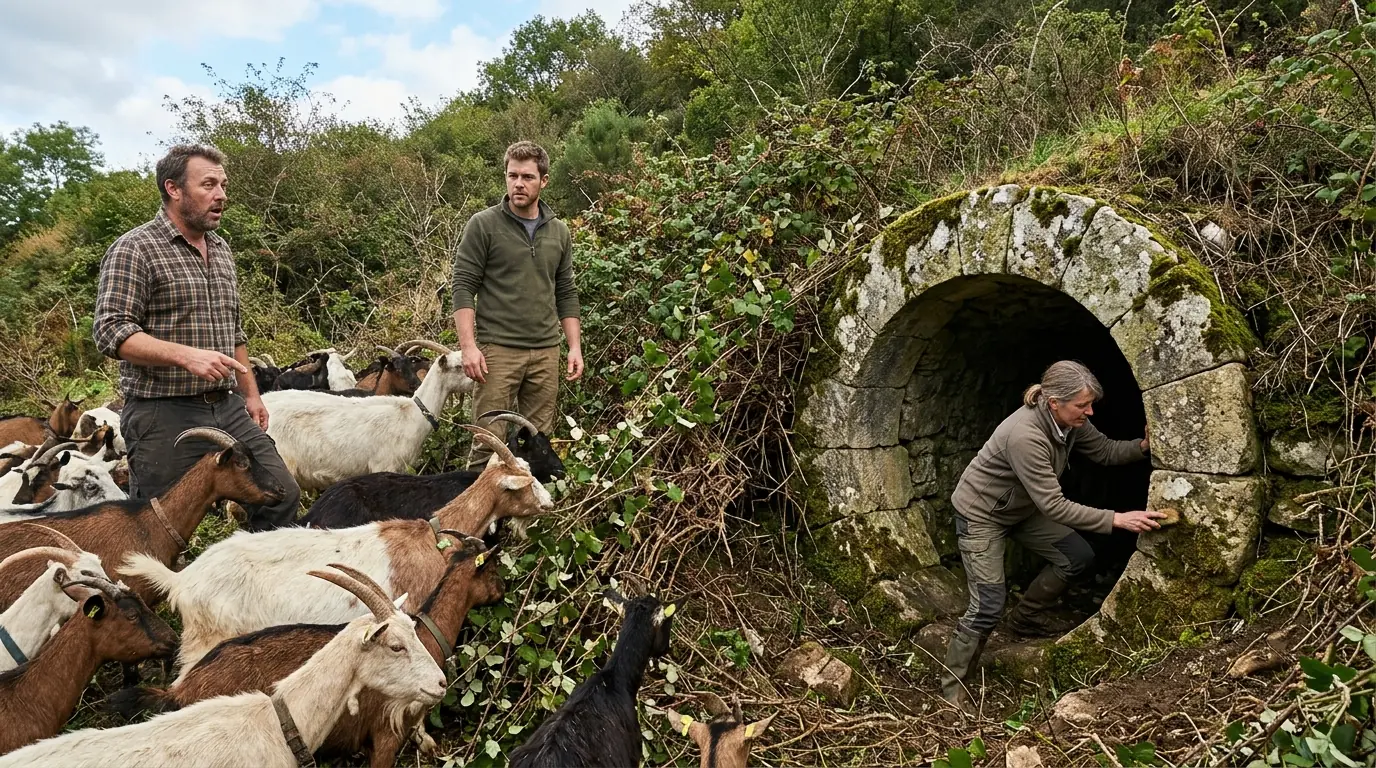
Eastern red cedar crowded the ridges. Blackberry and multiflora rose formed thorn walls along the lower ground, wild grape climbed young elm, honey locust filled open spaces with thorns, and poison ivy seemed to have volunteered for every job left over. From the road, the place looked less like abandoned farmland than a green wall with a gate somewhere inside it.
Elena drove through that gate on the first morning after the sale was finalized. Her nephew Tyler Quinn followed in the ranch truck and immediately lost sight of her bumper when brush slapped across both sides of the narrow lane. After two hundred yards they stopped because a young cedar leaned so far into the road that passing it without scratching every panel would have required removing the truck’s mirrors.
Tyler climbed out and stared around. “You bought a forest.”
“Not exactly.”
He looked toward the bed of Elena’s truck. “Where’s the saw?”
“At home.”
“Brush cutter?”
“Home.”
“Tractor?”
“Home.”
Tyler crossed his arms. “Then what exactly did we bring?”
Elena pointed toward the livestock trailer.
Inside stood one hundred twenty Spanish-Kiko cross goats.
They were part of a browsing herd Elena had spent several years developing on difficult corners of her existing ranch. They were not magical weed-eating machines, and she knew better than to pretend they could turn mature cedar trunks into grass, but goats naturally preferred many woody leaves, vines, and broadleaf plants that cattle ignored. With repeated, controlled browsing, they could weaken dense brush enough to reveal the ground underneath and reduce how much mechanical work would eventually be needed.
Tyler walked to the trailer and stared at the goats chewing calmly on whatever pieces of vegetation they could reach through the slats. “You’re going to clear sixty-three acres with goats?”
“I’m going to start sixty-three acres with goats.”
“That sounds like a careful way of not answering.”
“It’s the accurate way.”
Their first job was fencing. Elena used portable electrified netting and polywire inside the old boundary, dividing a manageable section near the entrance into small paddocks and powering the system with a solar energizer. She checked voltage twice, flagged areas where fallen metal fencing could create problems, and left enough room around dangerous tangles that goats could browse without becoming trapped.
When the trailer opened, the herd entered the paddock with the enthusiasm of diners arriving at a buffet nobody else wanted. They sampled grass briefly, then moved toward blackberry leaves, wild grape, young woody shoots, and the lower branches of cedar. Tyler watched one doe stand on her hind legs to reach a vine above her head and shook his head.
“They really do want the brush.”
“They’re browsers,” Elena said. “Grass isn’t always first choice when this is available.”
By sunset the paddock still looked terrible. That pleased Elena because anyone expecting transformation after eight hours was not managing land; they were watching a trick. She wanted repeated pressure on targeted plants, followed by enough recovery time for grasses and desirable vegetation to respond.
The goats moved again two days later. Elena did not leave them in one section until everything was eaten to bare soil, because overuse would simply trade a brush problem for erosion and damaged forage. Each rotation was short, concentrated, and followed by rest.
Cedar trunks remained. Mature thorn stems remained. But leaves disappeared, vines were stripped, and young woody growth lost the photosynthetic machinery it depended on to keep expanding.
Naturally, Cedar Hollow heard about it before Elena completed the second rotation.
Saturday morning at Miller’s Coffee Shop, Curtis folded his newspaper and announced, “Elena bought the Carson jungle.” Several farmers looked up, though at least two of them had attended the auction and already knew. “She turned goats loose on it,” he added.
Rick Sanders laughed. “Good. Maybe they’ll eat until they vanish and save her the trouble of fencing.”
Another rancher asked, “How many acres?”
“Sixty-three.”
“With goats?”
Curtis nodded.
The table erupted.
Elena entered while they were still enjoying the joke. She was carrying two mineral tubs and wanted coffee before driving back to the property, but Curtis waved her over. “How’s the logging operation?”
“Busy.”
“You seriously think those goats are clearing sixty-three acres?”
Elena took the cup the waitress handed her. “No.”
Curtis grinned as though she had surrendered.
“I think they’re browsing sixty-three acres,” Elena continued. “Clearing is what happens after I see what they uncover.”
The grin weakened.
Rick asked, “Difference?”
“A large one.”
Elena carried her coffee out.
By the third week, the difference became visible.
Blackberry walls that had looked impenetrable from the road now stood nearly leafless in several paddocks. Wild grape had been stripped down to tough stems, multiflora rose showed heavy browse damage, and young cedar branches within reach had been chewed enough that some plants would require follow-up cutting rather than merely continuing unchecked. For the first time in years, sunlight reached patches of ground beneath the thickets.
Tyler walked through a rested paddock one evening and stopped. “There’s grass under here.”
Elena crouched.
Some of it was old pasture fescue and orchardgrass that had survived in thin patches. Other areas contained broomsedge, clover, native forbs, and small stands of warm-season grasses that had apparently persisted despite the shade. Elena did not assume every green plant was desirable; she flagged several invasive species for later control and began photographing fixed monitoring points so memory would not become her measurement system.
Tyler turned slowly. “So this was here the whole time?”
“Some of it.”
“Waiting?”
Elena smiled. “Surviving.”
That distinction mattered to her.
Her father, Henry Brody, had taught her about brush years earlier. When Elena was fourteen, she followed him across a neglected pasture where blackberry had overtaken half the south slope and announced confidently that they needed to bulldoze everything. Henry knelt beside a browsed twig and asked whether she knew why brush kept winning.
“Nobody cuts it,” Elena answered.
Henry shook his head. “Sometimes. But we also took most of the browsing animals out of these systems and then acted surprised when plants cattle won’t touch took over.”
“What animals?”
“Goats, mostly, if you manage them right.”
Elena had remembered the conversation without understanding how useful it might become. Decades later, facing a property everyone else viewed as a mechanical clearing job, she decided to let animals perform the first examination. The goats would not finish the work, but they could show her where finishing work was actually necessary.
A county extension grazing specialist named Dr. Aaron Whitely visited in June. He had seen enough poorly planned goat projects to approach the property cautiously, because targeted grazing worked only when stocking pressure, timing, animal health, fencing, water, recovery, and plant response were actually managed. He walked three completed rotations, looked at Elena’s photographs, then knelt in a patch where light had reached the soil again.
“I expected more bare ground.”
“So did Tyler.”
Tyler raised both hands. “I’ve been corrected repeatedly.”
Aaron smiled. “You’re rotating quickly enough that they’re hitting the woody material without hammering everything underneath.”
“That’s the idea.”
He stood and looked across the slope. “You’re still going to need mechanical follow-up on the bigger cedar.”
“I know.”
“And some of this multiflora will resprout aggressively.”
“I know.”
Aaron looked at her. “You’re less fun than most people I visit.”
“I’ll try to become irresponsible before your next trip.”
The first mechanical work began only after the goats revealed enough ground to make it safe. Elena and Tyler cut mature cedar selectively, removed dangerous honey-locust stems near access routes, repaired old boundary fence where it could be located, and left useful oaks, hickories, and scattered shade trees standing. The goal was not to turn sixty-three acres into a golf course.
By midsummer, the Carson place began looking like land again.
Old fence posts emerged from blackberry. Flat limestone markers appeared along a boundary line Elena had previously known only from survey documents. A shallow wagon track became visible beneath years of leaves, winding from the old entrance toward a low ridge.
One afternoon Tyler stopped beside an almost perfectly straight line of moss-covered stones.
“Elena.”
She walked back.
“What?”
He pointed.
The stones were too regular to be natural. Hand-shaped limestone blocks continued downhill beneath thin vegetation, each roughly aligned with the next. Elena brushed leaves from one and found a flattened upper face.
“Foundation?” Tyler asked.
“Maybe.”
“Fence?”
“Maybe.”
“You don’t know?”
“No.”
Tyler smiled. “I’m enjoying this.”
They marked the location and left it alone.
Two weeks later another paddock produced something stranger.
When the goats stripped blackberry from a south-facing hill, crooked trunks appeared underneath. At first Elena assumed they were volunteer trees, but then she noticed the spacing: irregular after decades of loss, yet too deliberate to be natural.
Apple trees.
Old ones.
Some were hollow at the center, several were dying, but nearly twenty still carried leaves. Six held small green fruit despite years without pruning.
Tyler picked one in late summer and bit into it.
His face collapsed.
“That is terrible.”
Elena laughed. “It’s not ripe.”
“I don’t think time is fixing that.”
The apple was sharp, tannic, and fragrant. It was not a modern dessert variety anybody at the supermarket would have recognized immediately. Elena saved several rather than assuming the orchard had no value because the fruit offended Tyler’s mouth.
News of the trees reached Calvin Mercer, president of the county historical society. Calvin arrived carrying aerial photographs, plat maps, and the peculiar excitement of a man who had spent thirty years waiting for somebody to become interested in forgotten foundations. He walked among the old apples, unfolded a copy of a photograph taken from an aircraft in 1941, and pointed toward a dark cluster on the same ridge.
“This was the Carson homestead.”
“There was a house here?” Tyler asked.
Calvin nodded. “House, barn, smokehouse, probably a springhouse. Earlier county records show settlement on this parcel before the Carson family bought it.”
“How much earlier?”
“Possibly before the Civil War.”
Elena looked toward the stone line.
Calvin became more interested when she showed him.
“That could be part of the house foundation or a retaining wall.”
“Anything else we should be looking for?”
Calvin smiled. “A well.”
Tyler looked around. “Where?”
“That’s the problem.”
The later maps showed a well symbol near the homestead but were not precise enough to locate it beneath decades of regrowth. Calvin warned them not to go poking through heavy brush looking for an uncovered shaft because an old hand-dug well could be one of the most dangerous objects on the property. Elena immediately added the suspected area to her exclusion map.
From then on, goats entered those paddocks only behind interior fencing that kept them away from depressions or stone features until each site could be inspected. History was interesting. A goat disappearing into a nineteenth-century hole was not.
Autumn arrived with almost forty acres having received at least one controlled browsing pass and roughly twenty-five acres showing enough improvement for detailed follow-up. Elena deliberately described the numbers that way because claiming forty acres “cleared” would have been dishonest. Some paddocks needed another year of browsing, and others still contained mature cedar too large for goats to affect meaningfully.
The visual change remained extraordinary.
Open strips of pasture connected areas that had been isolated by thorn thickets. Quail began appearing along the edges, turkey scratched where blackberry had opened, and deer used recovering forbs in rested paddocks. Elena kept enough brush and woodland cover to prevent the property from becoming ecologically uniform.
Then Tyler found the circle.
It was an October morning cold enough that his coffee steamed visibly while he walked a newly exposed slope below the orchard. Something pale appeared beneath flattened briars, curving in a way no fence line should. Tyler set down his cup.
“Elena!”
She reached him several minutes later.
Only six inches of stone showed above the ground, but the arc continued beneath leaves until it formed most of a circle roughly five feet across. The masonry was carefully fitted limestone, green with moss and darkened by age. Elena did not step onto it.
“I think we found Calvin’s well.”
Tyler leaned forward.
“Don’t.”
“I wasn’t going to—”
“You were absolutely going to.”
He stepped backward.
They fenced the area before doing anything else.
Calvin arrived that afternoon and stopped several yards away when he saw the circle. “Well,” he said quietly. “That answers one question.”
“How old?”
He shook his head. “Stonework alone won’t give me a clean date.”
“You told us it could predate the Carsons.”
“It could.”
“That’s different from does.”
Calvin grinned. “You’re irritatingly teachable.”
Two days later, Mason Tate, a licensed well contractor experienced with old farm wells, inspected the structure. Nobody climbed into it; Mason used remote lighting and a camera because old stone linings could fail without warning and confined spaces had hazards that nostalgia did not remove. The shaft extended a little over fifty feet before reaching water.
Tyler watched the camera monitor. “There’s a lot.”
Mason nodded. “About eighteen feet of water today.”
“So it never went dry?”
Mason looked at him. “We know it has water today. That is all we know.”
Elena smiled.
Tyler pointed at her. “You’ve infected everybody.”
Before anyone discussed using the water, Mason recommended stabilizing the upper masonry, installing a secure temporary cover, and testing water chemistry and bacteria. The county environmental health office sampled it, and the first result showed bacterial contamination common in old open wells. Elena was not disappointed.
“Can it be cleaned?”
“Possibly,” Mason said. “But first we stop surface runoff from entering it.”
That took weeks.
Workers reset only loose upper stones, documented their positions, stabilized the rim, and installed a protective structure that prevented animals or people from falling into the shaft. Elena resisted suggestions to rebuild the entire stone wall until it looked new.
“I don’t want a decorative imitation of what was here,” she told Calvin.
He nodded. “Good.”
They repaired what required repair.
Winter slowed the project but did not end it.
Calvin spent cold months searching courthouse records, newspaper archives, family collections, and old survey notes. In February he arrived at Elena’s kitchen carrying a copy of an 1872 property description that referenced “the stone spring well above the orchard.”
Elena read the line twice.
“Spring well?”
Calvin nodded. “That explains something I’ve been wondering about.”
He pointed toward the topographic map.
The well sat on a slope rather than the lowest point of the property. Earlier settlers may have dug into a perched spring or seep, lining the excavation with stone so groundwater collected inside while excess water escaped through a side channel downhill. If the description was accurate, the structure was partly a well and partly a spring collection system.
“What side channel?” Tyler asked.
Calvin smiled. “The one we haven’t found yet.”
Spring uncovered it.
After several rainless weeks, Tyler noticed a strip of grass downhill from the well remained greener than everything around it. He followed the line nearly three hundred yards until it vanished beneath another dense blackberry patch. Elena fenced the section and moved goats through it for a short browsing pass.
Within days, stones appeared.
Not a pipe.
A channel.
It was shallow, narrow, and built from small limestone pieces set along a gentle grade. Parts had collapsed, but the line continued toward the old orchard.
Calvin nearly laughed when he saw it.
“That’s your water race.”
Tyler frowned. “From the well?”
“Probably from an overflow point near the upper water level, not from the bottom of the shaft. Gravity can’t pull water uphill, no matter how old the system is.”
Elena followed the channel with her eyes.
“So when the spring filled the well above the outlet elevation—”
“Excess water moved downhill.”
“To the orchard.”
Calvin nodded.
Suddenly the location of the old apple trees made much more sense.
Elena brought in a water-resources specialist before restoring anything. Measurements showed slow but steady recharge associated with the hillside seep, and the historic side outlet appeared to sit below the normal high-water level during wetter months. Rather than forcing the system to produce continuously, they restored only enough of the stone race to observe natural overflow and protect the archaeological feature.
A separate modern trough system for goats used a small solar pump and storage tank.
Tyler complained.
“The old gravity system was more interesting.”
“It also doesn’t produce enough water reliably in August.”
“That ruins the story.”
“It improves the ranch.”
By the second summer, the property had changed enough that Curtis Nolan stopped joking.
He drove through the gate one evening and parked beside a paddock where goats were entering a fresh section of brush. Open pasture now rolled across several hillsides, while patches of woodland remained along creeks and steeper ground. The old orchard had been lightly pruned by an arborist rather than butchered into modern shapes, and several trees responded with stronger growth.
Curtis stood beside the truck.
“I would’ve sworn this place was finished.”
Elena joined him.
“So would half the county.”
“I told people you bought a jungle.”
“You did.”
He looked toward the stone shelter protecting the old well. “Nobody knew that was there.”
“No.”
“Not even you.”
“No.”
Curtis frowned. “You’re supposed to pretend you knew.”
“Why?”
“Makes a better story.”
Elena smiled. “Land doesn’t care about stories.”
The restored acreage also began producing measurable economic value.
Elena tracked forage availability rather than simply judging by appearance. In the best recovered paddocks, usable grazing days per acre more than doubled compared with her initial conservative estimates, though performance varied widely depending on soil depth, shade, and how much woody competition remained. She used the property primarily for goats and limited cattle grazing rather than pushing every acre toward maximum stocking.
Goat browse paid indirectly too.
Mechanical clearing costs were far lower than they would have been if Elena had hired heavy equipment to attack the entire property at once. The animals produced kids, meat animals, and breeding stock while doing vegetation work, though fencing labor, parasite management, minerals, predator protection, and winter feed made the system far from free. Elena kept all those costs in the ledger because she refused to turn a useful method into a miracle.
Aaron Whitely from extension returned every few months.
On his third visit, he found Elena photographing a paddock.
“What’s wrong?”
“Nothing.”
“You look suspicious.”
“I’m trying to figure out why little bluestem is increasing here but barely moving on the west slope.”
Aaron crouched beside her.
“Soil.”
“Probably.”
“Shade.”
“Maybe.”
“Grazing history.”
“Also maybe.”
Tyler, standing nearby, sighed. “You two are terrible at certainty.”
Aaron smiled. “Certainty is expensive.”
The county conservation district organized a field day that autumn.
Elena expected perhaps forty ranchers.
More than two hundred people arrived.
Some came for the goats, others for the historic site, and a surprising number came because Curtis Nolan had apparently spent months telling everyone the property needed to be seen before they would believe what happened. Elena made him direct parking as punishment.
The tour began with the least impressive paddock.
Visitors seemed confused.
Brush still stood there.
Elena explained that it was only in its second browsing cycle and that repeated defoliation required time. She showed photographs from the previous year, pointed out which stems would eventually require cutting, and discussed why the goats left some plants untouched.
“You mean they don’t eat everything?” a farmer asked.
“No animal should.”
That produced a few laughs.
She showed them recovery periods, mineral stations, portable fencing, water systems, and the records she kept for parasite load and body condition. The point was not that goats solved brush problems automatically. The point was that properly managed browsing could become one tool inside a larger restoration plan.
They reached the orchard next.
Visitors sampled apples from several surviving trees, though Elena warned them about one variety Tyler had nicknamed Regret. A fruit specialist had identified two trees as old regional cultivars and taken scionwood for preservation, while several others remained unidentified seedlings.
Then the group arrived at the well.
The restored limestone ring sat beneath a simple protective roof inspired by historical photographs without pretending to be an exact reconstruction. A secure cover protected the shaft, and a small viewing panel allowed visitors to look down safely. Nearby, part of the old stone water race remained visible beneath grass.
A young rancher raised his hand.
“What was the biggest thing you found?”
Several people looked at the well.
Elena smiled.
“The grass.”
The group went quiet.
She pointed across the hills.
“The well is wonderful. The orchard matters. The old foundation and wagon road tell us something about the people who lived here before us.”
Then she looked toward a rested paddock where seed heads moved in the wind.
“But I bought this place because I thought the land underneath the brush might still function.”
She paused.
“It did.”
That became the sentence people remembered.
Not that goats had defeated a forest.
Not that Elena had discovered buried treasure.
The real surprise was less dramatic: after decades of neglect, enough soil structure, seedbank, root systems, water movement, and surviving vegetation remained that careful management could help productive ground reappear. Recovery had been hiding beneath shade and competition, not waiting for somebody to manufacture a new landscape from nothing.
The project drew more attention than Elena wanted.
A state agriculture program recognized the work for innovative targeted grazing and historic-land stewardship. University classes visited to monitor vegetation changes, pollinator habitat, soil cover, and browsing effects. Elena accepted the attention as long as nobody described the property as restored after a single season.
“It’s never finished,” she told one reporter.
“When will it be?”
Elena looked toward the hillside.
“When land stops changing.”
The reporter waited.
“That was a joke.”
By the third year, erosion on several formerly bare livestock trails had decreased after vegetation recovered and runoff was redirected. Bird surveys recorded more quail and grassland species in the open areas, though woodland birds remained important in the patches Elena deliberately retained. The orchard produced enough fruit for Elena to sell cider apples locally and provide scionwood for heritage-fruit enthusiasts.
Then Calvin arrived with the photograph.
It was black and white, faded at the edges, and showed four children beside a stone well with wooden buckets at their feet. Behind them stood apple trees much smaller than the ones surviving on Elena’s hillside. Handwriting on the back read, Carson Place, Summer 1894.
Elena stared at it.
“That’s the well.”
Calvin nodded.
“And those are the apples.”
“Some of them, probably.”
She looked at the children.
“Names?”
“Two identified. Still working on the others.”
Elena had the photograph copied.
The original returned to the family collection it came from. A framed reproduction went into the small interpretive shelter near the old foundation along with maps explaining the homestead, because Elena believed history should remain honest about what was known and what remained uncertain.
One cool October evening, she stood beside the well after everyone else had gone home.
Goats browsed quietly inside a paddock on the northern slope. The orchard leaves had begun turning, and beyond them rested sixty-three acres that no longer looked abandoned yet did not look artificially polished either. There were rough patches, cedar pockets, imperfect fences, bramble edges, and areas still waiting for another year of work.
Tyler walked up carrying two cups of coffee.
“You remember auction day?”
“Yes.”
“Curtis said there was nothing here.”
“He wasn’t entirely wrong.”
Tyler handed her a cup.
Elena looked at him.
“He was wrong about one thing,” Tyler said.
“What?”
“He thought nothing meant nothing worth finding.”
Elena smiled.
By then, the Carson parcel had become one of the most useful pieces of the Brody operation.
Not because every acre carried livestock.
Some did not.
The rocky ridge remained mostly timber.
The historic area stayed protected.
The steepest ground held permanent vegetation rather than being forced into production.
But the property now provided seasonal goat browse, cattle grazing in suitable paddocks, orchard fruit, wildlife habitat, educational value, and a reliable landscape connection between other parts of Elena’s ranch.
The numbers worked.
That mattered because beautiful restoration that bankrupts its owner rarely survives long enough to become permanent.
Years after the auction, people still asked Elena whether she had somehow known the well was there.
She always told them no.
They asked whether she expected the orchard.
No.
Had she predicted the water race?
Absolutely not.
Did she know goats would uncover old foundations and wagon trails?
Of course not.
She knew only that the property had once supported agriculture and that much of what people called useless was hidden beneath woody competition rather than destroyed beyond recovery. She believed the cheapest first question was not How fast can I clear this? but What is still alive underneath it?
The goats helped answer.
So did maps.
So did soil.
So did patient observation.
On the tenth anniversary of the auction, Curtis joined Elena beside the courthouse after another county land sale.
A neglected forty-acre parcel received no bids.
Curtis watched the auctioneer lower the gavel.
“You interested?”
Elena shook her head.
“Why not?”
“Wrong soil, poor water access, bad location for my operation.”
Curtis looked surprised.
“I thought you were the woman who buys worthless land.”
Elena smiled.
“No.”
She looked toward the door where another young farmer was studying the unsold parcel list.
“I buy land when I think I understand why everybody else thinks it’s worthless.”
Curtis considered that.
“Different thing.”
“Very.”
They walked outside.
Back at the Carson place, the stone well remained under its simple roof. Water still entered from the hillside spring, rising and falling with season and rainfall as it probably had long before anybody alive could remember. During wet periods, a small amount again found its way into the restored section of the old gravity race before disappearing into modern grass.
Visitors usually stopped there longest.
They admired the hand-cut limestone.
They photographed the 1894 picture.
They listened to Calvin’s recorded history of the homestead.
Elena always enjoyed that.
But when somebody asked what mattered most, she still pointed away from the stone.
Toward the pasture.
Because the well had been forgotten.
The orchard had been buried.
The wagon trail had disappeared.
Yet none of those things changed Elena’s understanding of what happened on those sixty-three acres.
The greatest discovery was not something humans had built.
It was what the land had continued doing after humans stopped paying attention.
Roots remained.
Seeds waited.
Water moved.
Soil held more memory than anyone at the auction gave it credit for.
And sunlight, once it reached the ground again, did the quiet work sunlight had always done.
On the morning Elena bought the property, everyone in the courthouse saw briars, cedar, thorns, and neglect.
They saw sixty-three acres nobody wanted.
Elena saw something less romantic and more useful.
A question.
She spent the next ten years answering it one paddock at a time.