The auctioneer had already dropped the price twice, and still nobody wanted the rusted grain dryer sitting at the far end of Roger Lane’s equipment lot outside Clarion, Iowa. It was a Tuesday morning in September 1990, the kind of cool, bright day when farmers studied the sky as often as they studied machinery, and the old 1968 batch dryer looked as though both weather and time had already made their decision about it. Rust covered most of the lower panels, the belt guard hung crooked, one fan bearing had seized years earlier, and two cracked tires leaned against the frame because nobody had bothered removing them. When the auctioneer called, “Hundred dollars,” not a single hand moved.
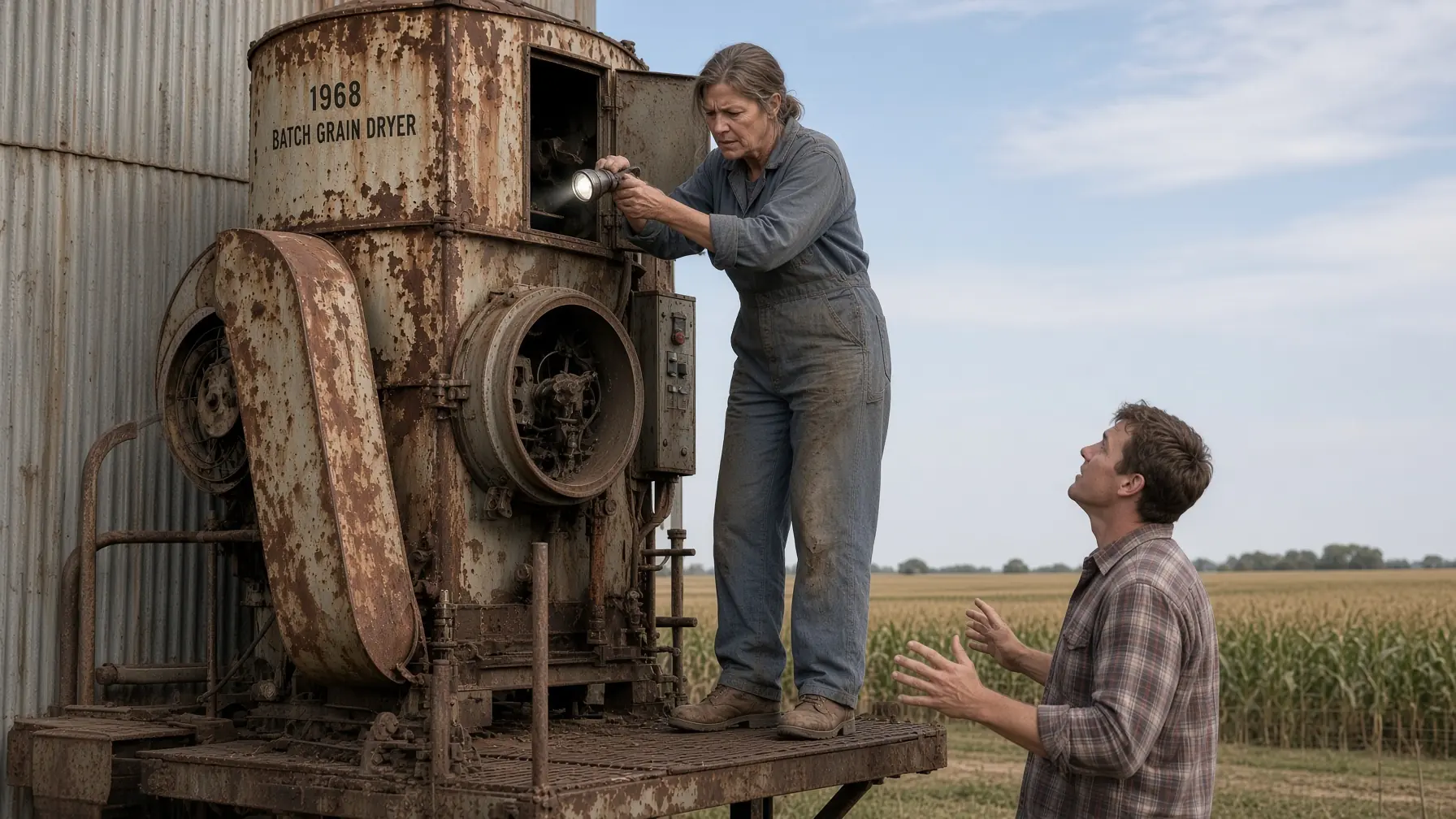
He tried fifty. Men shifted their boots in the gravel and looked toward newer augers, wagons, and tractors waiting farther down the row, but nobody even pretended to consider the dryer. Then a woman near the back raised one hand and said, “Eighty,” loudly enough that the auctioneer stared at her as though she had misunderstood the bidding process. Fifty-three-year-old Maggie Turner did not smile.
Cal Barnes, who farmed nine hundred acres east of town, looked at the machine and then at Maggie. “You know he said eighty dollars, not eight,” he called, and several men laughed. Maggie answered, “I heard him,” without looking away from the dryer. The auctioneer hesitated, realized nobody intended to rescue him from the bid, and finally dropped his hand with, “Sold, eighty dollars.”
Roger Lane walked over while Maggie signed the purchase slip. He had owned the equipment lot for thirty-one years and had learned that the fastest way to lose money was to argue with someone determined to buy something nobody else wanted. “That thing hasn’t run since Carter was president,” he said, and Maggie tucked the receipt into the pocket of her faded denim jacket. Roger added, “Parts are going to be close to impossible.”
“I know,” Maggie said. Roger waited for an explanation, but none came. She walked toward the dryer, placed one palm against a rusted side panel, and studied the machine the way another person might study an animal that had been injured too long for anyone to remember how it moved. Then she asked Roger whether the loading auger lying beside it was included.
By late afternoon, the dryer was chained to a flatbed behind Ethan Turner’s truck. Ethan was twenty-four, broad-shouldered, recently married, and still young enough to believe some problems could be prevented by telling his mother they were bad ideas before she had already purchased them. He walked around the machine twice, looked underneath it, then stared at Maggie. “Mom, you actually gave somebody money for this?”
“Eighty dollars,” Maggie said. Ethan pointed toward the fan housing and asked whether the collection of rust, weeds, and mouse nests attached to the frame came free. Maggie looked at him and replied, “You’re sarcastic when you’re nervous.” Ethan answered, “I’m nervous because we’re towing a tetanus exhibit down a county road.”
They hauled it six miles to Turner Farm, where Maggie owned six hundred and forty acres of corn and soybeans along with several grain bins, a machine shed, and the white farmhouse where she had raised Ethan. Her husband, Dale, had died from colon cancer four years earlier, leaving behind a farm that was financially stable but heavily dependent on Maggie learning quickly which decisions had belonged to Dale and which ones had simply looked as though they did. Many neighbors expected Ethan to take over immediately. Maggie disappointed them by continuing to make most of the decisions herself.
The dryer arrived just before sunset. Ethan backed the trailer beside the machine shed while Maggie stood near the grain bins guiding him into position, and by the time the chains came off, their hired hand, seventeen-year-old Lucas Webb, had arrived solely because he heard something ridiculous was being delivered. Lucas walked around the dryer and said, “Mrs. Turner, this thing looks older than my dad.” Maggie answered, “It probably works harder too.”
Ethan laughed despite himself. He asked what exactly his mother intended to do with a machine built before he was born when they already contracted most of their grain drying through the cooperative elevator in town. Maggie said she had not decided everything yet. “First I want to know why it stopped,” she told him.
That distinction mattered to Maggie because of Harold Benton, her father. Harold had spent thirty-seven years maintaining grain handling equipment at elevators across north-central Iowa, beginning when most controls were switches, relays, belts, chains, bearings, and valves rather than computer boards. Maggie had followed him through machine rooms from the time she was eleven, carrying tools, cleaning screens, and learning the language of equipment adults assumed girls would never need. Harold rarely explained machinery by saying a machine was broken; he said something inside it had stopped doing its job.
“Broken is lazy thinking,” he used to tell her. “Find the part that quit cooperating.” Maggie heard his voice while looking at the dryer. Harold had been dead fourteen years, but some of his phrases lived in her mind with more clarity than conversations from the previous week.
The next morning she began with no intention of starting the machine. The electrical system was too old, the burner too questionable, the fan too stiff, and the entire unit had sat outside long enough that attempting to energize anything before inspection would have been irresponsible. Maggie spent the first day simply opening access panels, photographing what she found with Ethan’s borrowed camera, labeling wires, and making lists. By evening, her notebook contained three pages of problems.
The fan bearing was seized, but the fan blades themselves were not badly damaged. Several drive belts had deteriorated into hard black loops, the burner assembly needed professional inspection, and parts of the wiring insulation had cracked. One internal sheet-metal diverter had sagged away from its original position, while decades of grain fines, mouse nests, and compacted debris had reduced several airflow passages to narrow openings. Maggie sat on the platform and stared into the plenum for almost ten minutes.
Ethan climbed up beside her. “Bad?” he asked, and Maggie answered, “Actually, interesting.” She pointed toward the collapsed internal panel and the packed material around it, explaining that somebody had kept running the dryer while airflow gradually became worse. The machine may have overheated, dried unevenly, performed terribly, and eventually gained a reputation for being useless even though the burner and fan had not necessarily been the original problem.
“So everyone quit using it because it was dirty?” Ethan asked. Maggie shook her head and said it was more than dirt, because the damaged airflow path had probably made every other component appear weaker than it was. “A dryer can have plenty of heat,” she said, “but if the air can’t move through the grain correctly, all you’ve built is an expensive hot box.” Ethan looked inside again with more interest than before.
By Friday, half the county knew what Maggie had bought. At Denny’s Cafe, Cal Barnes told a table of farmers that Maggie Turner was rebuilding museum equipment because apparently grief had finally convinced her to start collecting antiques. Nobody said the comment directly to Maggie, but Lucas heard it from his father and repeated it while cleaning soybean dust from a wagon. Maggie told him, “Cal has been wrong before and survived.”
The loudest skeptic was Tom Willis, manager of the Clarion Cooperative Elevator. Tom was not cruel, and he respected Maggie more than she realized, but he had spent twenty-five years watching farmers waste money trying to make obsolete equipment perform jobs modern systems handled more efficiently. When Maggie stopped by the elevator for moisture-testing supplies, he said, “Tell me you didn’t actually buy Roger’s old batch dryer.” Maggie replied, “I would, but then I’d be lying.”
Tom leaned against the counter. “We retired our last batch unit fifteen years ago because continuous-flow equipment can move a lot more grain with less labor.” Maggie agreed completely, which seemed to irritate him because he had prepared an argument. She told him she was not planning to compete with his commercial system.
“Then why rebuild it?” Tom asked. Maggie looked toward the grain trucks moving across the scale outside and said, “Because I paid eighty dollars for something I understand, and I want to see what it can still do.” Tom shook his head but smiled slightly. “When you set it on fire, call the fire department before you call me.”
Maggie answered, “If I set it on fire, I won’t need your advice.” Tom laughed. The conversation ended without either changing the other’s mind.
The first real obstacle came when Maggie searched for the fan bearing. The original manufacturer had changed ownership twice, the model number barely appeared in available catalogs, and two dealers told her they could not source a direct replacement. Ethan expected that to end the project. Instead, Maggie removed the assembly and carried it to Warren Machine Works in Webster City.
Warren Cross, the owner, measured the old bearing arrangement and said the exact part was obsolete. He also said the shaft could be inspected and the housing adapted professionally for a currently available equivalent without changing how the machine fundamentally operated. Maggie asked for a price. Warren quoted more than the dryer itself had cost by almost ten times.
Ethan heard the number and said, “Congratulations, Mom, your eighty-dollar dryer is now an eight-hundred-dollar dryer.” Maggie corrected him because the welding, wiring, belts, inspection, and other components would make it considerably more than that. Ethan stared at her. Maggie smiled and said, “You wanted honesty.”
They did not repair everything blindly. Maggie asked an electrician to inspect the control wiring and replace deteriorated components that could not be trusted, and she paid a licensed propane technician familiar with older agricultural equipment to inspect the burner, valves, safety devices, and fuel connections before anything involving heat was attempted. Those two invoices erased any fantasy that the dryer would become a bargain simply because the auction price had been low. Maggie had expected that.
What she was buying was not cheap capacity. She was buying optional capacity. Harold had taught her there was a difference.
The modern drying arrangements on Turner Farm depended on the cooperative accepting wet grain and processing it fast enough to prevent trucks from becoming mobile storage. Most years, that worked beautifully. Maggie hauled grain to town, paid drying charges, and avoided owning another machine that needed maintenance eleven months of the year.
But 1990 was beginning to look strange. September rain had been persistent, nights cooled early, and local extension reports suggested large amounts of corn might reach harvest at higher moisture than many farms preferred. Everyone could dry wet corn eventually. The question was how much could move through limited systems at the same time.
Maggie remembered 1972. She had been thirty-five years younger, riding with Harold between elevators during a season when wet grain arrived faster than local drying capacity could process it. Trucks waited for hours, temporary piles grew, equipment ran continuously, and minor breakdowns became major logistical problems because nothing had room to stop. Harold came home one night and said, “Bad harvests aren’t always about how much grain you grow; sometimes they’re about where you put it while you wait.”
That sentence returned while Maggie studied weather forecasts. She did not know whether 1990 would become another bottleneck year. She only knew a functioning dryer on her farm would turn one dependency into two options.
Ethan began taking the project seriously after the fan returned from Warren Machine Works. He spent an evening removing old belt fragments and cleaning surfaces while Maggie repaired exterior panels with help from a local sheet-metal shop. They did not attempt to restore the dryer cosmetically. Rust remained on the frame, paint mismatched, and one replacement panel came from galvanized sheet metal that looked almost offensive beside the faded original finish.
Lucas called it Frankenstein. Maggie told him Frankenstein was the doctor, not the creature. Lucas said that made the dryer even better because they could call it Doctor Turner.
The name lasted. Within a week everyone on the farm referred to the dryer as Doc.
Harold’s old toolbox came out of storage for the first time in years. Maggie found his brass moisture scoop, a collection of handwritten conversion notes, and a small spiral notebook containing sketches from jobs he had worked in the 1960s and 1970s. None matched the exact dryer, but several notes discussed uneven airflow, overloaded grain columns, and the importance of cooling and cleaning.
Ethan found her reading the notebook at midnight. “You miss Grandpa?” he asked. Maggie closed the cover and said, “Every day I have to make a decision he would have enjoyed arguing about.”
“He’d think this machine was a good idea?” Ethan asked. Maggie smiled. “He’d tell me I paid sixty dollars too much.”
By early October, the dryer could rotate, move air, and complete dry tests without heat. Maggie insisted on testing every repaired system separately rather than rushing toward the satisfaction of hearing everything operate together. Ethan complained that his mother had become more cautious with age.
“No,” Maggie said. “I became more expensive to replace.”
The burner inspection uncovered another problem. The old system had several worn components that the technician refused to approve until replacements and updated safety devices were installed. Maggie accepted the delay. She had watched enough grain-dryer fires with Harold to know that impatience around heat and dust could turn an old machine into exactly the disaster Tom Willis predicted.
The additional work added almost two thousand dollars to the project. Ethan stopped making jokes about the original eighty-dollar purchase because the total had become too serious. Maggie kept every invoice in a folder labeled DOC.
By October 8, the machine completed its first controlled heated test under professional supervision. The burner lit, the fan moved air through the empty chamber, and nothing made a sound Maggie considered alarming. She stood ten feet away with her arms folded while Ethan grinned like they had restored a locomotive.
“Don’t celebrate yet,” Maggie said. “It hasn’t seen grain.”
Ethan answered, “You are exhausting.”
Maggie smiled. “That’s why I’m still farming.”
Harvest began slowly. The first corn fields sampled wetter than many growers hoped, but not enough to create panic. Tom Willis told members the cooperative had room and drying capacity, though he encouraged anyone with on-farm storage to spread deliveries instead of waiting until every field was ready at once.
Then rain returned. Three days became five, five became seven, and combines sat under sheds while corn remained standing beneath gray skies. When fields finally dried enough to support equipment again, nearly every farmer in the county wanted to harvest at the same time.
Corn began arriving at the Clarion elevator with moisture levels high enough to slow throughput dramatically. The commercial dryer could handle enormous volume compared with Maggie’s batch unit, but enormous volume still had a ceiling. By noon on the second heavy harvest day, trucks were lined along the access road.
Tom added an evening shift. The dryer ran almost continuously. A maintenance crew cleaned screens, monitored bearings, adjusted flow, and tried to keep grain moving without sacrificing quality or safety.
The third day brought colder weather. Producers who had waited hoped field drying would help, but progress was slow. Meanwhile forecasts showed another storm system approaching in less than a week.
Maggie harvested forty acres of corn and sent the first loads to the cooperative. Ethan waited almost two hours in line before reaching the scale. When he returned home, he said, “Maybe your ugly machine gets a chance.”
Maggie already had the drying area prepared. She did not intend to place the entire farm’s harvest through Doc because the machine’s capacity was far too limited. Instead, she wanted enough on-farm flexibility to keep the combine moving when the elevator line became the bottleneck.
The first batch went in that afternoon. Maggie checked the grain carefully, verified that the dryer remained within its operating limits, and refused Ethan’s suggestion that they push more volume through simply because the chamber had extra physical space. “A machine doesn’t know you’re in a hurry,” she said.
Heat came up gradually. Air moved through grain where twenty years of dirt and a collapsed internal panel had once restricted it. Maggie walked around the dryer listening, touching only safe exterior surfaces, checking readings, and comparing what she heard with memories from childhood.
Ethan watched her. “What are you listening for?” he asked.
“Anything that changes.”
“That’s vague.”
“Machinery usually tells you before it embarrasses you.”
Hours later, they discharged the first batch. The result was not perfect. Moisture varied more than Maggie wanted, and part of the batch needed additional handling before it could safely enter longer-term storage.
Ethan looked disappointed. Maggie did not. “Good,” she said, which made him stare at her.
“What’s good about uneven grain?”
“It means we learned something without breaking anything.”
They adjusted how they loaded the chamber and corrected a remaining airflow imbalance after identifying debris trapped behind one section they had not been able to see during earlier cleaning. The next batch performed better. The third was better again.
By the end of the day, Maggie had enough confidence to say Doc was functional. Not efficient by modern standards, not fast, and certainly not a replacement for the cooperative. Functional was enough.
Word traveled. Cal Barnes drove into Turner Farm the next morning supposedly to return a chain he had borrowed months earlier. He spent fifteen minutes staring at the dryer before saying, “Heard that junk pile actually ran.”
Maggie answered, “Your information is excellent.”
Cal walked around the machine. “How much can she do?”
“Not enough for you.”
Cal laughed. “Wasn’t asking.”
“You were thinking.”
His smile disappeared slightly. Cal’s own dryer was modern but undersized for the acres he had added over the previous five years, and the wet crop was forcing him to harvest slower than he wanted. He asked whether Maggie would consider drying grain for neighbors after finishing her own.
Maggie said no.
Cal looked offended.
She explained she had no insurance, contracts, grain-handling procedures, or pricing structure for custom drying, and she was not going to become responsible for someone else’s crop simply because an old machine worked three times. Cal nodded reluctantly. “That’s probably smarter than what I was about to ask.”
Two days later the cooperative announced temporary delivery restrictions during overnight hours. Nothing catastrophic had happened. The commercial dryer simply could not process incoming wet grain at the rate trucks were arriving, and storage space for wet corn was tightening.
Tom Willis posted updated receiving windows. Farmers complained immediately.
Someone at Denny’s Cafe said Tom should have bought a bigger dryer. Another farmer pointed out that doubling capacity for one unusually wet harvest would be difficult to justify during ten normal years.
Tom heard both arguments and ignored them. His responsibility was preventing spoiled grain, mechanical overload, and unsafe storage conditions, not winning popularity at breakfast.
Maggie’s advantage became obvious that afternoon. Ethan combined while Lucas hauled grain directly to Doc, allowing the operation to continue without sending every load to town. When the batch dryer filled, they diverted later loads to temporary holding and timed deliveries around the cooperative’s less crowded periods.
The system was slower than Ethan preferred. It was also moving.
Across the road, another farm stopped harvesting for six hours because both trucks were waiting near the elevator. Ethan looked toward their silent combine and then at Doc.
“Okay,” he said. “I officially apologize for making fun of the eighty dollars.”
Maggie asked, “Just the eighty dollars?”
“I reserve judgment on the other four thousand.”
She laughed.
The first real breakdown came the next night. A drive belt began slipping, forcing Maggie to shut the machine down. Ethan wanted to replace it immediately and continue, but Maggie noticed the pulley alignment had shifted enough that another belt might fail too.
They stopped for three hours. Rain was two days away, and every lost hour felt enormous.
Ethan became impatient. “If this were newer, we wouldn’t be doing this.”
Maggie looked at him. “If it were newer, something else could break.”
“That doesn’t make this less annoying.”
“No.”
She smiled faintly.
“That’s the first intelligent thing you’ve said about equipment all week.”
The repair was straightforward for a local mechanic, but the pause taught Ethan another lesson. Owning backup capacity did not eliminate dependence; it simply changed where dependence lived. Maggie needed parts, fuel, technicians, time, grain storage, and people who knew what they were doing.
Doc was not independence. It was another path.
The next morning Cal Barnes returned, this time without pretending he needed to return anything. His modern on-farm dryer had shut down after an electrical control failed, and the dealer believed a replacement component could arrive within two days. Cal had almost two hundred acres ready before the storm.
“I know you said no custom drying,” he told Maggie.
“I did.”
“I’m asking again.”
Maggie crossed her arms.
Cal added, “And I’m willing to pay whatever makes it legitimate.”
Maggie called Andrea Schultz, her insurance agent. Andrea told her not to accept one kernel until they discussed liability, ownership of grain while on her property, fire coverage, and whether her existing farm policy permitted the activity.
Cal groaned when Maggie relayed the answer.
“I just need corn dried.”
“And I need to still own my farm afterward.”
By afternoon Andrea had arranged a short-term endorsement appropriate for limited custom work, while a local attorney provided a simple written agreement covering rates, responsibility, sampling, and handling. Maggie agreed to process only a limited quantity after her own critical needs were met. Cal signed without complaint.
The arrangement looked almost comically formal beside a fifty-three-year-old woman running a rusted batch dryer. Maggie did not care. Harold used to say the farmers most likely to call contracts unnecessary were often the first people to remember exactly what everyone supposedly promised after something went wrong.
Cal’s first load arrived before dark. Maggie sampled it, recorded the moisture reading, and had him sign the ticket. He watched her write everything down.
“You turning into the government?”
“No.”
“Bank?”
“Worse.”
Cal waited.
“Woman who intends to get paid.”
He laughed.
Doc dried Cal’s first batch overnight. It took longer than his newer equipment normally would, and Maggie refused to promise a precise completion time because the machine responded differently as outdoor temperature changed. By morning the grain was in acceptable condition for the storage plan Cal had prepared.
He loaded it and stared at the old dryer.
“I hate this thing.”
Maggie asked why.
“Because I laughed at it.”
“That sounds like a you problem.”
Cal smiled.
He paid the invoice.
By the end of that day, two more farmers called. Maggie declined both because she lacked capacity. The rumors nevertheless grew.
According to one version told at the cafe, Maggie Turner’s eighty-dollar dryer was outperforming the cooperative. According to another, she had discovered some forgotten fuel-saving design modern manufacturers had suppressed. One man claimed she was drying grain for half the county.
All of it was nonsense. Doc processed a tiny fraction of what the Clarion elevator moved every hour when its system was running normally. Maggie corrected anyone who asked.
The value was not scale. It was location.
Every bushel Maggie could handle at home was one less wet bushel waiting for the elevator’s dryer at the worst possible time. For a farm whose combine would otherwise stop because trucks had nowhere to unload, small capacity could have large operational value.
Tom Willis understood that before most people did. He drove to Turner Farm during lunch on October 22 and stood watching the batch dryer empty into a wagon.
“Looks less dead than I expected,” he said.
Maggie answered, “High praise.”
Tom examined the patched panels and newer electrical work. “You put some money into it.”
“More than eighty dollars.”
“I figured.”
They watched grain move.
Tom finally said, “How much of your own are you keeping home?”
Maggie explained the plan. Some would be dried sufficiently for their aerated storage system, while other grain would still move through the cooperative when receiving lines improved.
Tom nodded.
“You’re doing us a favor.”
“I’m doing me a favor.”
“Same result.”
Maggie looked at him.
He continued, “Every farmer who can take pressure off our wet holding space helps right now.”
That surprised her. She had expected Tom to defend the superiority of commercial drying.
Instead he said, “I was wrong about one thing.”
“Only one?”
“I said there was no reason to use a batch dryer anymore.”
Maggie waited.
Tom looked toward Doc.
“There are reasons.”
He did not say it was better. Maggie respected him for that.
The storm arrived the following night. Wind pushed rain sideways against the farmhouse windows, and temperatures fell enough that remaining corn would lose field moisture slowly. Some areas received more than two inches.
Combines stopped again.
For three days, the county waited.
Maggie used the pause to perform maintenance instead of forcing Doc to run continuously. She cleaned accumulated fines, inspected moving parts, checked areas prone to heat buildup, and had the propane system rechecked after a burner irregularity appeared. Ethan complained that shutting down a working machine during a weather delay felt overly cautious.
Maggie answered, “The best time to repair something is when the crop won’t let you use it anyway.”
Ethan admitted that sounded like Harold.
“Everything smart I know does.”
“That’s depressing.”
“For you maybe.”
They returned to the field on the fourth day. Corn moisture remained stubbornly high. The cooperative line formed before sunrise.
At ten in the morning, Tom announced another limitation. One of the elevator’s conveying systems needed repair, reducing the rate at which wet grain could move into the drying process.
Nothing about the failure made the commercial dryer obsolete. A separate piece of equipment upstream had become the constraint. Farmers who had spent years discussing dryer horsepower suddenly learned that capacity meant little if grain could not reach it.
Maggie smiled when Ethan told her.
“What?”
“Your grandfather used to say every system is only as fast as the narrowest door.”
“So now we’re smug?”
“No.”
Maggie pulled on her gloves.
“We’re harvesting.”
The Turners ran long days. Ethan combined until conditions forced him to stop, Lucas hauled and cleaned equipment, while Maggie divided her attention between grain movement, storage, moisture checks, and Doc.
Nobody on the farm slept enough.
Maggie began leaving a pot of soup on the stove because people ate whenever they happened to pass through the kitchen. Dishes accumulated beside the sink until she finally announced that anyone old enough to operate a tractor was old enough to wash a bowl.
Lucas claimed that policy was unconstitutional. Maggie told him to call the Supreme Court after finishing the spoons.
Despite exhaustion, Maggie felt something she had not experienced since Dale’s final harvest. The farm was operating as a coordinated organism rather than a collection of individual tasks.
Dale had loved harvest. Cancer took enough strength from him during his last year that he could not climb into the combine, so he sat in the pickup with a radio and coordinated trucks because being useful mattered almost as much as being present.
Maggie remembered his voice every evening.
She wished he could see Doc.
He would have hated it.
Dale believed old machinery developed personality only after it had already consumed enough repair money to qualify as a dependent.
He would have teased Maggie for months.
She missed that too.
The season became more difficult when propane deliveries tightened temporarily across several farms. Wet harvest conditions increased demand, and suppliers began asking customers to schedule carefully rather than assuming immediate refill availability.
Maggie had fuel contracted, but Doc’s appetite reminded her that having a dryer did not guarantee unlimited drying.
She adjusted the farm plan rather than pretending capacity was infinite.