In 1982, the entire town of Hollister Gap, Tennessee, laughed at Earl Renfroe. At the feed store on Monday mornings, men leaned against the counter and shook their heads when his name came up. At the diner on Route 11, waitresses poured coffee and rolled their eyes. In the church parking lot after Sunday service, the whispers followed him all the way to his pickup truck.
And at the Tuesday cattle auction in Greene County, grown men actually stopped bidding to watch him walk past, just so they could nudge each other and grin. Because Earl Renfroe had done something no cattle farmer in that valley had ever done. He had taken 83 acres of good open pasture, the kind of land his father had cleared with a mule and a chain back in 1946, and he had planted pine trees in it.
Not a windbreak, not a property line, not a little decorative cluster near the house. He planted them in rows, straight through the middle of his grazing land, 2,400 saplings, in the pasture where his cattle were supposed to eat. The men at the feed store called it the dumbest thing they had ever seen a farmer do. His own brother told him he had lost his mind.
The county extension agent drove out, looked at the rows of foot-tall seedlings poking up through the grass, and drove away without saying a word. For 6 years, they laughed at Earl Renfroe.
Let me take you back 6 years. Back to a cold February morning in 1982, when Earl Renfroe was 47 years old, and the whole valley still thought he was a sensible man. Earl had grown up on that land. His father, Walter Renfroe, had run about 60 head of Hereford on those 83 acres, same as every other cattleman in the hollow.
Earl had taken over in 1971, when Walter’s heart gave out during hay season. For the first 11 years, Earl did what his father had done. He ran cattle. He cut hay. He fixed fence. He paid the bank.
But Earl had one thing the other farmers in Hollister Gap did not have. In the winter of 1978, Earl had gone down to Athens, Georgia, for a 2-week short course at the university. His wife, Marlene, had won the trip in a Farm Bureau raffle, and Earl almost didn’t go. He almost gave the ticket to his cousin, but he went.
And in a cold lecture hall that smelled like old coffee, he sat and listened to a quiet man from Missouri named Dr. Howard Pilsner talk for 3 hours about something called silvopasture, trees and cattle on the same ground at the same time. Dr. Pilsner had shown slides from Argentina, from Spain, from a little farm in Virginia, where a man had been doing it for 20 years.
The cattle grew faster in the shade. The grass grew longer into the summer. The soil held water like a sponge. And when the trees got big enough, you could sell the timber, too. Earl did not speak during the lecture. He did not raise his hand.
He went back to his motel room, and he wrote four pages of notes in a spiral notebook by the lamp. He asked Dr. Pilsner one question after in the hallway. He asked him what kind of tree worked best on thin, acid soil in the Appalachian foothills. Dr. Pilsner said, “Loblolly pine, widely spaced, and you have to wait.”
Earl went home and did not tell anybody. Not Marlene, not his brother Dale, not his neighbor Curtis Whaley, who shared a fence line with him on the east side. For 4 years, Earl just thought about it.
Then, in January of 1982, he drove down to a forestry nursery outside of Chattanooga, and he put down $480 for 2,400 loblolly pine seedlings. The woman at the counter asked him if he was planting a Christmas tree farm. Earl said, “No.” She asked him if it was a timber plantation. Earl said, “No.”
The seedlings came wrapped in wet burlap, in plastic crates, each one no bigger than a pencil. You could hold a hundred of them in one hand. They looked like nothing, like green twigs with a little white root at the bottom.
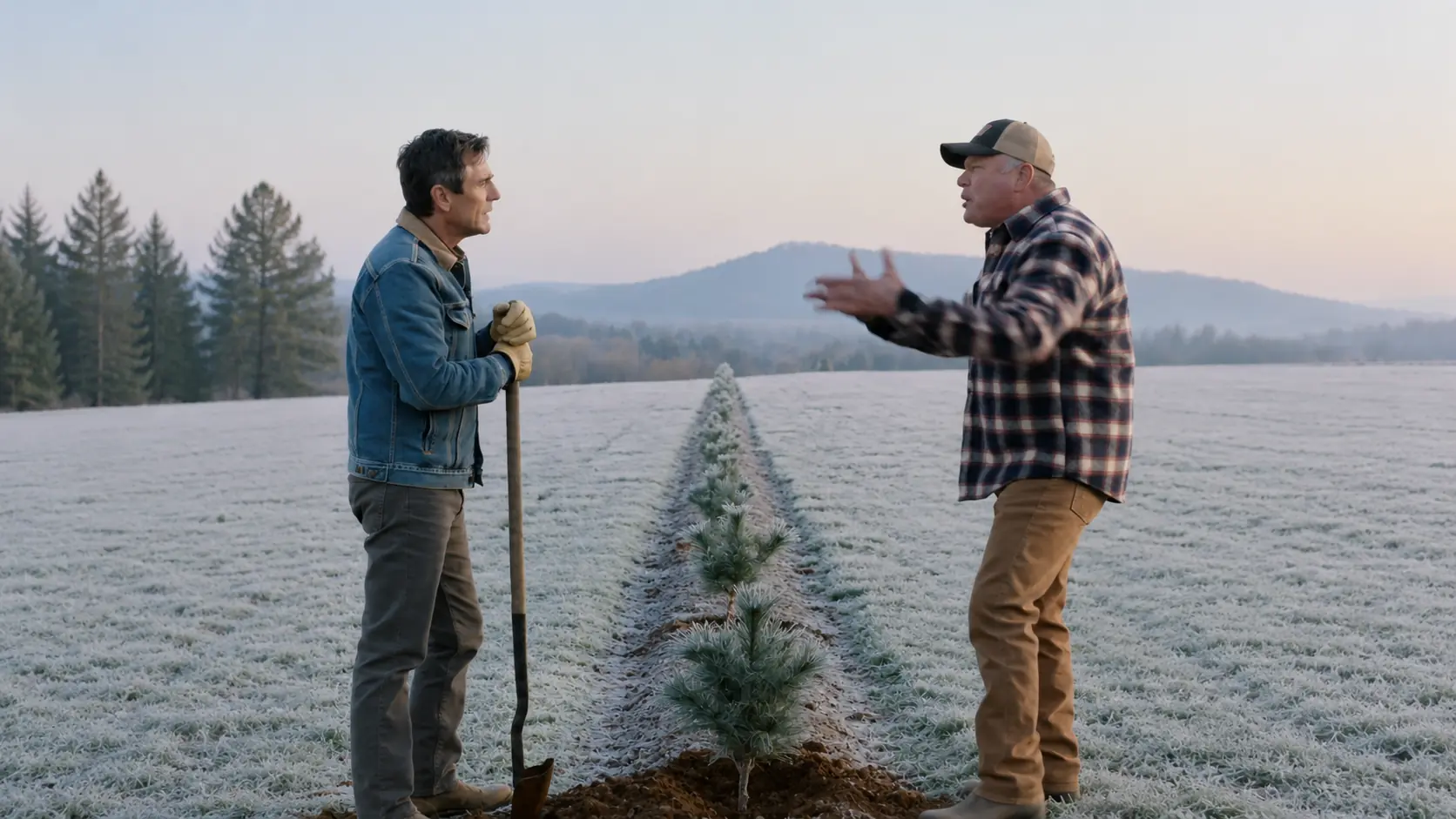
Earl planted them himself, him and his 13-year-old son, Wyatt. They used a dibble bar, a long steel rod with a foot peg, and they worked from sunup to full dark, row after row, for 11 straight days. Earl’s back seized up so bad on the fifth day that Marlene found him crying in the barn, leaning against a post, unable to straighten up. He took two aspirin and went back out.
The spacing was the part nobody understood. 40 feet between rows, 12 feet between trees, wide open, enough room for a tractor to drive down the middle, enough room for cattle to walk through. “Enough room,” Earl said, “for grass to still grow everywhere.”
When Curtis Whaley came over on the eighth day to borrow a posthole digger, he stood at the edge of the pasture and stared. Then he said, “Earl, what in the name of God are you doing?” Earl leaned on the dibble bar and wiped the sweat off his forehead with his sleeve. “I’ll tell you in 6 years, Curtis.”
Curtis laughed. He actually laughed out loud. Then he took the posthole digger and drove home. And by suppertime, everybody in Hollister Gap knew that Earl Renfroe had gone crazy.
The mockery came fast. At the feed store, Mel Buckner started calling him the lumberjack. At the diner, somebody drew a cartoon on a napkin of Earl riding a cow through a forest, and it got pinned up behind the register for 2 years.
His brother Dale came out to the farm in March, stood at the fence, and said, “You’re going to lose the place, Earl. You know that, right? You can’t graze 60 head on scrub pine.” Even Marlene, who had stood beside him at the bank and the auction and the hospital, sat him down one night at the kitchen table and asked him, very quietly, if he was feeling all right.
Not angry, just scared. She asked him if he had talked to anybody, a doctor, a pastor, anybody. Earl took her hand and said, “Marlene, I am not sick. I am not losing my mind. I just know something they don’t know, and I need you to trust me for 6 years.” She did not answer, but she did not leave, either.
The first summer, 412 of the seedlings died. The ground was too dry in August. Earl walked the rows with a bucket in each hand and watered them one by one, 2 gallons per tree, for 6 weeks. He lost 12 lb. His hands split open and bled into the bucket handles.
Wyatt helped on weekends, but Wyatt was starting high school and had football practice, and Earl told him to go be a boy while he still could. By October, Earl had replanted every dead one.
The second year, the trees were maybe 2 feet tall. You could barely see them in the summer grass. The cattle ignored them. Earl had been worried the cows would eat the tops, but loblolly pine, it turns out, tastes terrible to a Hereford. They walked around them.
The third year, the trees were chest high. Dale stopped coming by. The fourth year, they were over Earl’s head. Curtis Whaley, on the other side of the fence, told his wife at dinner one night that Earl’s pasture was starting to look like a Christmas tree lot, and what a damn shame it was.
But something else was happening, too. Something quiet. Something Earl watched without ever bragging about. The grass under the young pines was staying greener later into the summer than the grass in the open part of the pasture, by an inch, by 2 inches, by the fifth year, by 4 inches.
The cattle started bedding down in the shade at midday, instead of standing panting by the pond. Earl weighed his calves at weaning in the fall of 1986, and they came off 21 lb heavier, on average, than they had in 1981. 21 lb per calf. At auction prices, that was almost $13 a head times 60 head, almost $800 a year just showing up in the ledger, quiet as a mouse.
Earl didn’t tell anybody. Who would he tell? They were all still laughing. The soil was changing, too. Earl dug a shovel into a spot under the pines in the spring of 1987, and the dirt came up dark and crumbly, full of old needles breaking down, soft enough to squeeze in his fist and hold a shape.
Five years before, that same dirt had been red clay so hard you could barely get a shovel into it. But nobody walked Earl’s pasture with him. Nobody knew. He was in year five of a six-year plan.
Then year six. Marlene started sleeping on her side of the bed without asking questions anymore. Wyatt graduated and went to work at the lumber mill in Morristown. The bank note came due every January, and every January Earl paid it on time from a cattle operation that should, by everyone’s math, have been failing.
And then came 1988. The rain stopped in late April. By the first week of June, the creeks were low. By the end of June, the ponds were rings of cracked mud. By the middle of July, the grass in every open pasture in Greene County had gone the color of a paper bag.
You could walk across a hay field and hear it crunch under your boots like broken glass. The extension office declared a level three agricultural emergency. The governor came on the radio. Farmers started hauling water in from municipal hydrants 40 miles away, paying by the gallon.
Curtis Whaley sold 22 head of cattle in the third week of July at a loss of almost $400 a head because he could not feed them and could not water them and could not watch them starve. Dale Renfro sold his entire herd in August, stood at the auction ring with his hat in his hand, and watched 30 years of breeding walk away for 70 cents on the dollar.
Men in Hollister Gap were crying in their trucks, grown men with kids in school and notes at the bank, and fathers buried in the local cemetery who had held that land through the depression and the war. They were watching it end.
And then, one Thursday afternoon in the first week of August, a cattle buyer from Knoxville named Raymond Hess pulled off Route 11 because he had missed a turn. He drove 2 miles down a gravel road looking for a place to turn around, and he came up over a rise, and he stopped his truck in the middle of the road, and he got out.
Because in front of him, stretching across 83 acres, was green pasture. Green in August, in the worst drought anybody could remember. Long rows of pine trees, 30 ft tall now, casting long afternoon shadows across grass that was still, somehow, growing. And under those trees, maybe 60 head of Hereford cattle, fat and calm, chewing cud in the shade.
Raymond Hess stood at the fence for a long time. He had been a cattle buyer for 26 years. He had driven every back road in East Tennessee. He had never seen anything like it. He drove up to the house. Earl was out on the porch drinking iced tea, which he had been doing most afternoons.
Raymond introduced himself and asked if he could walk the pasture. Earl said, “Yes.” They walked for almost 2 hours. Raymond asked questions. Earl answered them, plain and slow, no bragging, no victory lap. He showed him the soil. He showed him the old weaning weights written in the spiral notebook he had kept since 1982.
Halfway across the pasture, Raymond Hess stopped walking. He took off his cap. He looked at the rows of pines and at the grass and at the cattle and at the quiet old man beside him, and he said, “Mr. Renfro, you didn’t just survive this drought. You solved it 6 years ago.” Earl didn’t say anything. He just nodded.
Raymond Hess went back to Knoxville, and he told people. The story traveled the way stories travel in cattle country, slowly and then all at once. By September, there were trucks parked along the gravel road in front of Earl’s farm every weekend. Farmers from three counties standing at the fence, not laughing now, just looking.
In October, a researcher from the University of Tennessee named Dr. Althea Mooring drove out with a graduate student and a clipboard. She spent 3 days on the farm. She measured soil moisture. She measured canopy cover. She measured grass height at 14 different points. She weighed six calves.
She asked Earl if she could publish what she found. Earl said, “Tell it however you need to tell it. Just tell it right.” The paper came out in the spring of 1989. It was 31 pages long. It used words Earl did not know, like evapotranspiration and microclimate buffering.
But the last page had a chart on it that Earl understood just fine. It showed that his pasture had retained 43% more soil moisture during the 1988 drought than any comparable open pasture in the region. 43%.
That winter, Curtis Whaley came up the driveway in his old truck. He had not set foot on Earl’s property in 4 years. He stood on the porch with his hat in his hand, and he would not look Earl in the eye. He said, “Earl, I’ve been a fool.” Earl said, “Come on in, Curtis.”
Marlene made coffee. They sat at the kitchen table for 2 hours. Curtis asked questions. Earl answered them. Before Curtis left, he asked where Earl had bought his seedlings. Earl wrote the nursery’s name and number on the back of a feed receipt and handed it to him.
Curtis planted 600 loblolly pines in his south pasture the next spring. Dale Renfro planted 400 the year after that. By 1993, there were 11 silvopasture operations in Greene County. By 1997, there were more than 40.
Earl Renfro did not become a rich man. He did not go on television. He did not write a book. He kept running cattle on those 83 acres until his hips gave out in 2004, and then he sat on the porch and watched Wyatt run them. Wyatt runs them still.
The pines are 60 ft tall now. The soil under them is black and deep. The cattle still bed down in the shade at midday. And when the drought of 2007 came worse in some ways than 1988, the Renfro pasture stayed green, the way it always does.
In the feed store in Hollister Gap, nobody laughs anymore when a young farmer says he is thinking about planting trees in his pasture. They just nod. And sometimes, one of the older men will lean over and say, quiet, like he is telling a secret. “You ought to drive out past the Renfro place. Take a look at what Earl did back in ’82.”
Earl Renfro died in the winter of 2019. Wyatt had his father’s ashes scattered among the oldest row of pines, the ones he and his daddy had planted with a dibble bar when he was 13 years old.
At the funeral, Dr. Althea Mooring, who was old herself by then, stood up and said something that a lot of people wrote down. She said, “Earl Renfro was not a genius. He was not a scientist. He was a cattleman who was willing to be laughed at for 6 years because he could see 1 year further down the road than anybody else in the valley. And that, maybe, is the whole story.”
Everyone in Hollister Gap saw trees. Earl Renfroe saw survival.