For as long as anyone in Mason County could remember, nobody touched the old pond behind Samuel Rourke’s hay barn.
Not Samuel.
Not his father.
Not his grandfather before him.
Three acres of dark water sat in a shallow bowl between the south field and a line of cottonwoods, fed by rain, runoff, and apparently whatever mysterious arrangement had kept it from drying completely even during the worst summers.
The pond held bluegill.
Cattle drank from one side.
Grandchildren swam there when the water was clean enough.
Geese stopped every spring.
In a farming county where people argued about almost everything, there was one opinion nearly everyone shared.
A good farm pond was worth protecting.
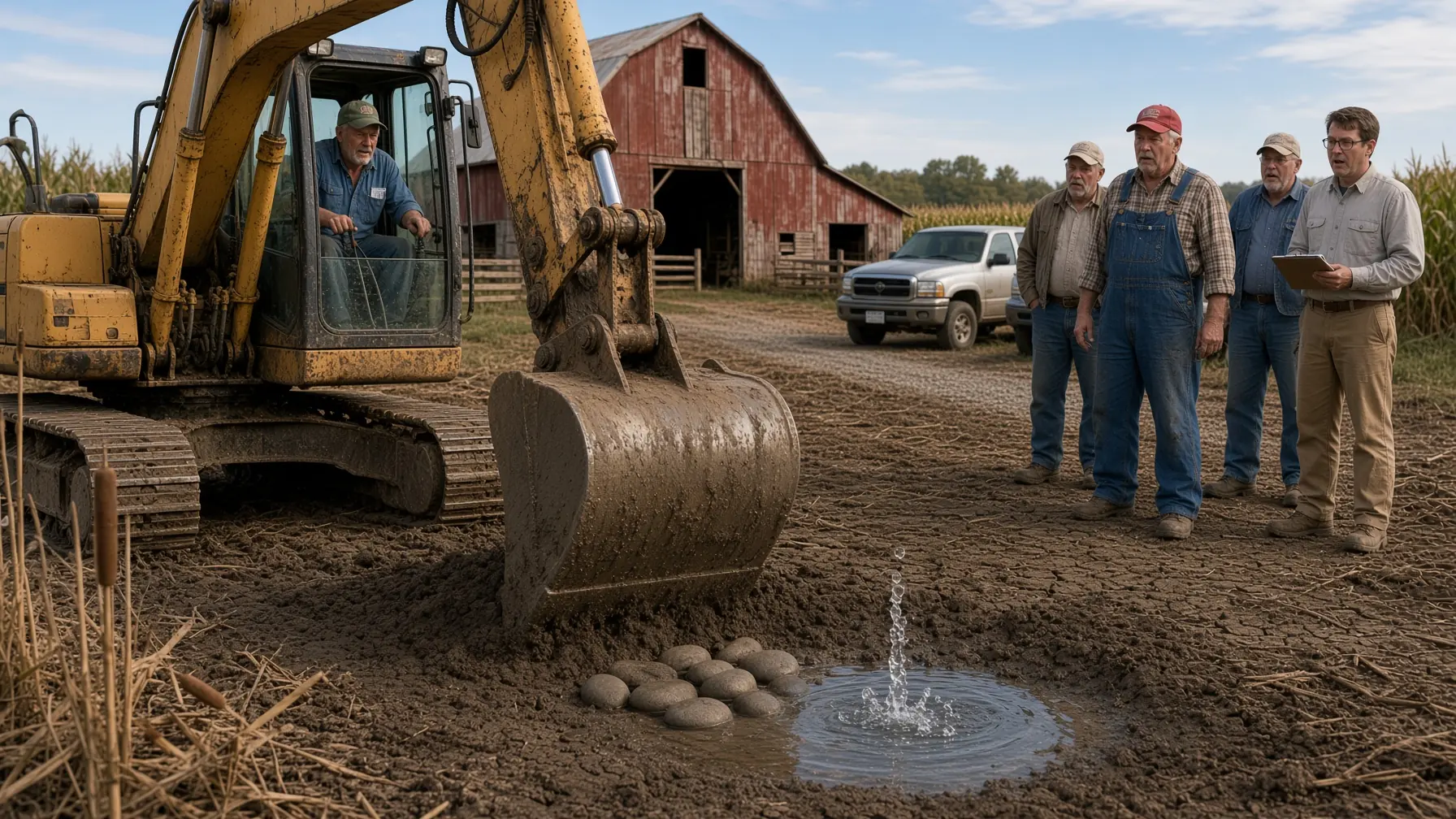
So when sixty-two-year-old Samuel backed a rented excavator down his gravel lane one September morning and told his neighbor he intended to drain it completely, Amos Pritchard laughed right in his face.
“You’re joking.”
Samuel climbed down from the cab.
“No.”
“You’re draining that pond?”
“Yes.”
“Why?”
Samuel looked toward the water.
“Need to see what’s underneath.”
Amos stared at him.
“There’s mud underneath.”
“Probably.”
“Then what are you expecting?”
Samuel adjusted his cap.
“I’ll tell you when I know.”
That answer guaranteed the entire county would hear about it by lunchtime.
Samuel Rourke was not known for foolish decisions.
That was what made the story irresistible.
He had farmed the same 118 acres outside a small Nebraska town for almost forty years.
Corn.
Soybeans.
Hay.
A modest cattle herd.
Nothing glamorous.
Nothing large enough to attract investors.
It was the kind of farm where equipment lasted until repairing it cost more than pride could justify.
Samuel’s grandfather, Walter Rourke, bought the original parcel in 1934.
Samuel’s father added thirty acres after the war.
Samuel inherited both the land and the family habit of keeping everything.
Receipts.
Weather notes.
Seed records.
Old aerial photographs.
Hand-drawn drainage maps.
Even notebooks full of observations nobody else would have thought worth writing down.
Samuel liked records.
His late wife, Ellen, used to tease him.
“If the barn cat sneezes twice in one morning, Sam will put it in a ledger.”
He always answered:
“Then if she sneezes three times next Tuesday, I’ll know something changed.”
Ellen had been dead two winters when Samuel decided to drain the pond.
People noticed that too.
They were careful around him for the first year after the funeral.
Then less careful.
Grief had an expiration date in other people’s minds.
By September, the gossip sounded different.
Maybe Samuel was lonely.
Maybe he needed someone watching him.
Maybe operating an excavator alone at sixty-two was a bad idea.
One man at the diner said:
“He’s been strange since Ellen died.”
Samuel heard about that.
His sister told him.
He said nothing.
But that one stayed with him.
Not because he worried people thought him strange.
Because Ellen would have understood exactly why he was draining the pond.
She had watched him study it for nine years.
The first thing Samuel noticed was the water level.
It behaved wrong.
During dry summers, when neighboring stock ponds dropped eighteen inches or more, Samuel’s pond barely moved.
That could have been groundwater.
Nothing remarkable.
But during wet springs, the pond behaved strangely too.
After heavy rainfall, instead of remaining high for weeks, it often returned to nearly the same level within days.
Samuel began measuring.
He hammered a marked steel post near the bank.
Every Sunday morning before church, he recorded the depth.
Rainfall.
Temperature.
Whether the neighboring creek was running.
Whether the low pasture was wet.
Nine years of numbers accumulated in a pocket notebook and later in a kitchen drawer.
Then he noticed the grass.
Northeast corner.
A narrow strip near the cattails remained green longer than anything else around it.
In October frost, that patch sometimes thawed first.
In August, cattle preferred standing there even when the rest of the bank offered easier footing.
Samuel pushed a soil thermometer into the ground one winter.
The soil there was several degrees warmer.
He repeated the measurement.
Same result.
Ellen once stood beside him while he crouched in frozen grass with the thermometer.
“You know normal men our age go fishing at the pond.”
“I’m doing science.”
“You’re poking dirt.”
“Science involves dirt.”
She laughed.
“You think there’s a spring.”
Samuel looked toward the water.
“Maybe.”
“Then why not say so?”
“Because maybe is not the same as yes.”
That was Samuel.
Never in love with his first explanation.
After Ellen died, Samuel finally sorted boxes from the attic.
That was when he found his grandfather’s ledger.
Most entries were ordinary.
Seed prices.
Calf births.
Fence repairs.
Rainfall.
Then one line from 1957:
Spring still runs hard beneath south ground. Never plug stone throat.
Samuel read it repeatedly.
Stone throat.
Not pond.
Not well.
Not ditch.
A second notebook contained a rough map drawn in pencil.
No pond appeared.
Instead, near the south field, his grandfather had marked a small square.
Beside it:
spring box
Farther east, a straight line crossed the low ground.
tile
Samuel sat at the kitchen table for nearly an hour.
The pond everyone treated as permanent had not existed when his grandfather first farmed the place.
Old county aerial photographs confirmed it.
No pond.
Still no pond, only wet ground.
A small dark depression appeared.
By the 1970s, the pond resembled its modern shape.
Something had changed.
Either the drainage failed and water backed up.
Or a spring had gradually flooded an old low area.
Or both.
Samuel needed to know.
Not because he wanted a better fishing story.
Because his south field was becoming expensive to irrigate.
His shallow well had weakened.
Electricity costs had climbed.
If the old notes were right and a reliable spring still existed beneath the pond, it might offer an alternative.
Not unlimited water.
Not free water forever.
But enough to matter.
The only way to find out was to see it.
So Samuel rented an excavator.
The work went badly almost immediately.
The old outlet pipe had collapsed.
Samuel spent the first two days clearing brush and locating the original drainage route.
On day six, a hydraulic hose burst on the excavator.
Oil sprayed across the machine.
Four days lost.
Repair bill higher than expected.
Then the mud started.
Samuel had anticipated mud.
He had not anticipated ground that seemed capable of swallowing objects out of spite.
One boot disappeared entirely.
A shovel vanished to the handle.
His dog, Jake, stepped into one patch and had to be pulled out by the collar.
When the water dropped below waist depth, neighbors began driving past slowly.
Nobody admitted why.
They were sightseeing.
Amos Pritchard stopped one afternoon.
“You found your treasure yet?”
Samuel leaned on the excavator.
“No.”
“Just mud?”
“Mostly.”
“How much this costing?”
“Enough.”
Amos smiled.
“You could’ve bought water for less.”
“Maybe.”
“You going to quit?”
Samuel looked at the pond.
“No.”
Amos shook his head.
“Stubborn old fool.”
Samuel smiled slightly.
“Could be.”
The first strange thing appeared during the second week.
Gravel.
Not random fieldstone.
Rounded pea-sized rock.
Clean beneath the mud.
Samuel scraped around it with a shovel.
The gravel formed a narrow strip, nearly straight.
A buried path?
Drainage bed?
He did not know.
He photographed it.
Marked the location.
Kept draining.
Three days later, rain nearly destroyed everything.
Two inches overnight.
The emptying pond refilled halfway.
The exposed basin became soup.
The excavator sank almost to the frame.
A tow truck had to pull it out while eleven spectators watched from the county road.
Samuel heard about the diner conversations later.
Best one:
“Rourke drained a pond so the rain could put it back.”
His nephew Luke came by that evening.
Thirty-two years old.
Helped on weekends.
Inherited Samuel’s work ethic but not his tolerance for public embarrassment.
“Uncle Sam.”
Samuel was washing mud from his boots.
“What?”
“Maybe we stop.”
“Why?”
Luke pointed toward the basin.
“Look at it.”
Samuel did.
It looked terrible.
“No pond.”
“No spring.”
“No irrigation.”
“Just a hole costing money.”
Samuel did not answer.
Luke softened.
“I know what Grandpa’s notes said.”
“Great-grandpa.”
“Whatever.”
He sighed.
“I’m not saying you were wrong to look.”
“I’m saying maybe we’ve looked.”
That evening Samuel almost agreed.
He sat alone at the kitchen table.
Ellen’s chair opposite him.
The notebook open.
Never plug stone throat.
He could hear her voice.
Maybe is not yes.
But no evidence was not the same thing as evidence of no.
He closed the notebook.
Waited three days for the mud to firm.
Then went back.
The next discovery was old clay tile.
Hand-fired.
Approximately four inches wide.
Running in a straight line beneath the eastern edge of the pond.
Samuel recognized the type.
Farmers installed miles of clay drainage tile before modern plastic pipe existed.
The line was old.
Older than Samuel.
Several sections had collapsed.
That explained part of the pond’s strange history.
Water that once drained away had gradually backed up.
But the tile alone did not explain why the pond remained full during drought.
Samuel followed the gravel.
Luke returned despite his doubts.
Together they uncovered a rectangle of fitted stone.
No mortar.
About four feet by six.
The top had collapsed inward.
Luke climbed down beside it.
“What is that?”
Samuel crouched.
“Spring box.”
“You sure?”
“No.”
Luke laughed.
“Good. Thought the whole experience changed you.”
They cleared more mud.
The old stones formed a shallow chamber.
At first, nothing happened.
Then Samuel noticed water.
Clear water.
Not muddy seepage.
It was gathering inside the stone box even while the surrounding basin dried.
He removed another layer of silt by hand.
Cold water pushed between two stones near the bottom.
Luke touched it.
“That is freezing.”
Samuel said nothing.
He cleared more.
Water strengthened.
Within fifteen minutes, the box contained several inches.
Luke stared.
“You knew.”
“No.”
“You absolutely knew.”
Samuel shook his head.
“I suspected.”
“That’s the same thing.”
“No.”
Samuel smiled.
“It’s the difference between farming and gambling.”
He did not start digging channels immediately.
That surprised everyone.
After weeks of refusing advice, Samuel suddenly stopped work.
He called the county extension office.
Then a groundwater specialist.
Then the state natural resources district.
The young extension agent who had warned him against draining the pond returned.
His name was Adam Fletcher.
Adam climbed into the basin wearing rubber boots.
He looked at the stone structure.
Then the clay tile.
Then Samuel.
“I owe you an apology.”
“For what?”
“I assumed you were destroying something before understanding it.”
Samuel shrugged.
“You weren’t entirely wrong.”
Adam blinked.
Samuel continued.
“Draining still creates erosion risk.”
“You said so.”
“So why do it?”
“Because sometimes you accept one risk to understand another.”
Adam nodded.
“I should’ve asked what you were studying.”
“Yes.”
“You could’ve told me.”
“Yes.”
They looked at each other.
Then both smiled.
Progress.
The hydrologist was a woman named Dr. Nora Bennett.
She did not make dramatic promises.
Samuel liked her immediately.
She measured temperature.
Flow.
Water chemistry.
Elevation.
Nearby wells.
Historic aerials.
The spring output changed slightly over several weeks but remained steady enough to be meaningful.
Not forty gallons per minute forever.
Not magical.
Initial dry-season measurements averaged closer to twenty-four to twenty-eight gallons per minute.
Still significant.
More important, records and geological mapping suggested the spring was fed by a shallow limestone and gravel system extending beneath higher land to the west.
Nora explained:
“It may be reliable.”
Samuel nodded.
“But?”
“Reliable is not infinite.”
“Good.”
She looked surprised.
“Most landowners dislike that sentence.”
“Most landowners dislike arithmetic too.”
Nora smiled.
She continued.
“Using the spring could reduce pumping.”
“But if you overdraw or reroute too aggressively, you could affect the wetland area and possibly nearby shallow wells.”
Samuel nodded.
“So we measure.”
“Yes.”
“And limit.”
“Yes.”
“And monitor.”
“Yes.”
Nora looked at him.
“You’ve been waiting nine years to say that, haven’t you?”
“Longer.”
The final solution was less dramatic than county gossip expected.
Samuel did not convert the pond into forty acres of miracle irrigation.
He preserved part of the wetland.
Rebuilt the spring box.
Restored controlled drainage.
Created a small lined holding basin downslope.
Installed gravity-fed pipe to approximately eighteen acres of high-value hay and vegetable ground.
For corn acreage farther away, he used the spring only as supplemental water.
The system reduced electric pumping significantly.
It did not eliminate wells.
It did not make Samuel drought-proof.
Nothing made a farmer drought-proof.
But it changed the economics of the south field.
Water reached it without running a pump every hour.
The soil stayed more consistent.
During dry weeks, Samuel had reserve capacity.
During wet periods, overflow returned through a managed channel rather than backing up into the pond uncontrollably.
The old pond became smaller.
Cleaner.
More deliberate.
Part pond.
Part spring-fed wetland.
Part irrigation storage.
What everyone had considered one simple thing turned out to be three systems accidentally layered together over decades.
The following summer was dry.
Not historic.
Bad enough.
Amos Pritchard’s pond fell nearly two feet.
Samuel’s spring kept running.
Twenty-one gallons per minute by late August.
Lower than spring measurement.
Still useful.
The south field stayed green longer than anything around it.
Amos drove over.
No laughter this time.
He stood beside Samuel watching water enter the holding basin.
“I owe you something.”
Samuel looked at him.
“Money?”
“No.”
“Then I’m less interested.”
Amos laughed.
“I called you crazy.”
“A lot of people did.”
“I said Ellen dying had messed with your head.”
Samuel’s face changed.
Amos looked down.
“That one was low.”
“Yes.”
“I’m sorry.”
Samuel stared toward the field.
After a moment:
“She would’ve told you herself.”
“I know.”
They stood quietly.
Then Amos said:
“Would you walk my lower pasture sometime?”
Samuel glanced over.
“Why?”
“Grass stays green along one fence line.”
Amos seemed embarrassed.
“Always thought it was shade.”
Samuel smiled.
“What side?”
“Northwest.”
“Any frost difference?”
Amos looked surprised.
“Actually…”
Samuel grabbed his hat.
“Let’s go look.”
They did not discover another major spring on Amos’s farm.
That would have made the story too neat.
They found a small seep.
Useful for livestock.
Not enough for irrigation.
Samuel considered that an important outcome.
A good observation did not owe anyone a spectacular result.
Sometimes the answer was simply:
Interesting.
Not valuable.
Farmers began asking Samuel questions anyway.
What should they watch?
Green grass during drought.
Unexpected frost melt.
Consistent wet spots.
Old tile.
Historical aerials.
Changes in plant species.
Differences in soil temperature.
But Samuel always added the part people liked least.
“Don’t dig because one patch is green.”
“Measure first.”
“How long?”
“As long as it takes.”
“Get records.”
“Check drainage.”
“Talk to people who know groundwater.”
“Test your idea.”
“Then try to prove yourself wrong.”
A young farmer once asked:
“Why would I try to prove myself wrong?”
Samuel replied:
“Because the land doesn’t care how much you like your theory.”
That sentence spread faster than the pond story.
Luke eventually took over more of the farm.
He became the one tracking spring flow.
Weekly in irrigation season.
Monthly through winter.
If flow dropped below their agreed threshold, they reduced use.
If the wetland plants showed stress, they adjusted.
If neighboring shallow wells changed significantly, they would investigate.
Samuel insisted those rules be written down.
Luke teased him.
“You think I’m going to forget?”
“Yes.”
“Thanks.”
“Everybody forgets what inconvenience taught them once the inconvenience disappears.”
Luke wrote the rules.
Five years after Samuel drained the pond, he walked the south field with Luke’s eleven-year-old daughter, Emma.
She stopped near a fence.
“Grandpa Sam.”
Samuel hated the name.
He had surrendered.
“What?”
She crouched.
“This grass is greener.”
Samuel looked.
Small patch.
Nothing dramatic.
“What do you think it means?”
“Spring?”
“Maybe.”
Emma smiled.
He pointed.
“What else?”
“Shade?”
“Good.”
“Pipe leak?”
“Better.”
“Different soil?”
“Yes.”
She looked at him.
“How do we know?”
Samuel smiled.
“We don’t.”
“That’s annoying.”
“That’s science.”
She rolled her eyes.
He handed her a small notebook.
“What’s this?”
“Yours.”
She opened it.
Blank pages.
Samuel nodded toward the grass.
“Write the date.”
“Why?”
“Because if it’s still green next August, that means more than if it’s green today.”
Emma wrote.
Then:
“What if it means nothing?”
Samuel smiled.
“Then you learned that too.”
People around Mason County still told the story as though Samuel Rourke had known a hidden spring existed all along.
He corrected them whenever he heard it.
“I didn’t know.”
“You drained three acres on a guess.”
“A hypothesis.”
“That’s a fancy word for guess.”
“No.”
“What’s the difference?”
Samuel would smile.
“A guess is what you make before looking.”
“A hypothesis is what you make after looking and before proving.”
Most people stopped arguing because Samuel had the patience to continue indefinitely.
The real story was not that one old farmer trusted himself while everyone else was wrong.
That version was too easy.
Samuel had been wrong about parts of it too.
He expected the spring to be stronger.
It wasn’t.
He underestimated erosion.
He misjudged drainage time.
He almost ruined a rented excavator.
His first irrigation plan would have taken too much water from the wetland.
Experts stopped him.
That mattered.
He succeeded because he trusted observation enough to investigate—and evidence enough to change his plan.
Not because instinct was always right.
Instinct had only pointed toward a question.
The work answered it.
Years later, the original stone spring box remained near the smaller pond.
Samuel refused to remove it.
The rebuilt structure sat beside it.
Old stones.
New pipe.
Two generations of water management visible at once.
A small metal marker stood nearby.
Luke had installed it without asking.
It contained one line from Samuel’s grandfather’s ledger:
DON’T CAP THE SPRING.
Below it, Luke added another:
DON’T ASSUME YOU KNOW WHAT YOU’RE LOOKING AT.
Samuel complained about the second sentence.
Emma liked it.
So it stayed.
Most mornings, Samuel still walked there.
His second dog followed.
He would look at the water.
Then the field.
Then the patch of grass where the whole investigation began.
People often asked what he considered the most important discovery.
The spring?
The clay tile?
The old records?
Samuel always shook his head.
“The important thing was noticing the pond didn’t behave like everybody said a pond should.”
That was all.
For nine years, the land had been giving him little contradictions.
Water staying high when it should fall.
Water disappearing when it should remain.
Grass staying green.
Frost melting early.
Old maps disagreeing with modern assumptions.
None of those observations proved anything alone.
Together, they formed a question Samuel could no longer ignore.
So he drained the pond.
People laughed.
Equipment broke.
Mud swallowed his boots.
Rain filled the hole again.
He spent more money than he planned.
And underneath decades of dark water, he found something his grandfather had known almost seventy years earlier.
Not treasure.
Not oil.
Not a miracle.
Water.
Moving quietly through stone.
Doing what it had been doing long before anyone in Mason County bothered to understand it.
Samuel never told the story as proof that crowds were foolish.
Crowds were sometimes right.
Experts were sometimes right.
Old farmers were sometimes wrong.
The lesson was smaller.
And harder.
Pay attention long enough to notice when reality does not match the explanation everyone has accepted.
Then do not stop at noticing.
Measure.
Question.
Test.
Invite people who know more than you.
Change your theory when the facts demand it.
And when the ground finally tells you what it has been trying to say—
listen.
Because sometimes what looks like a perfectly good pond is really a seventy-year-old plumbing problem sitting on top of the most useful spring on your farm.