The auctioneer thought he knew exactly how the morning would end.
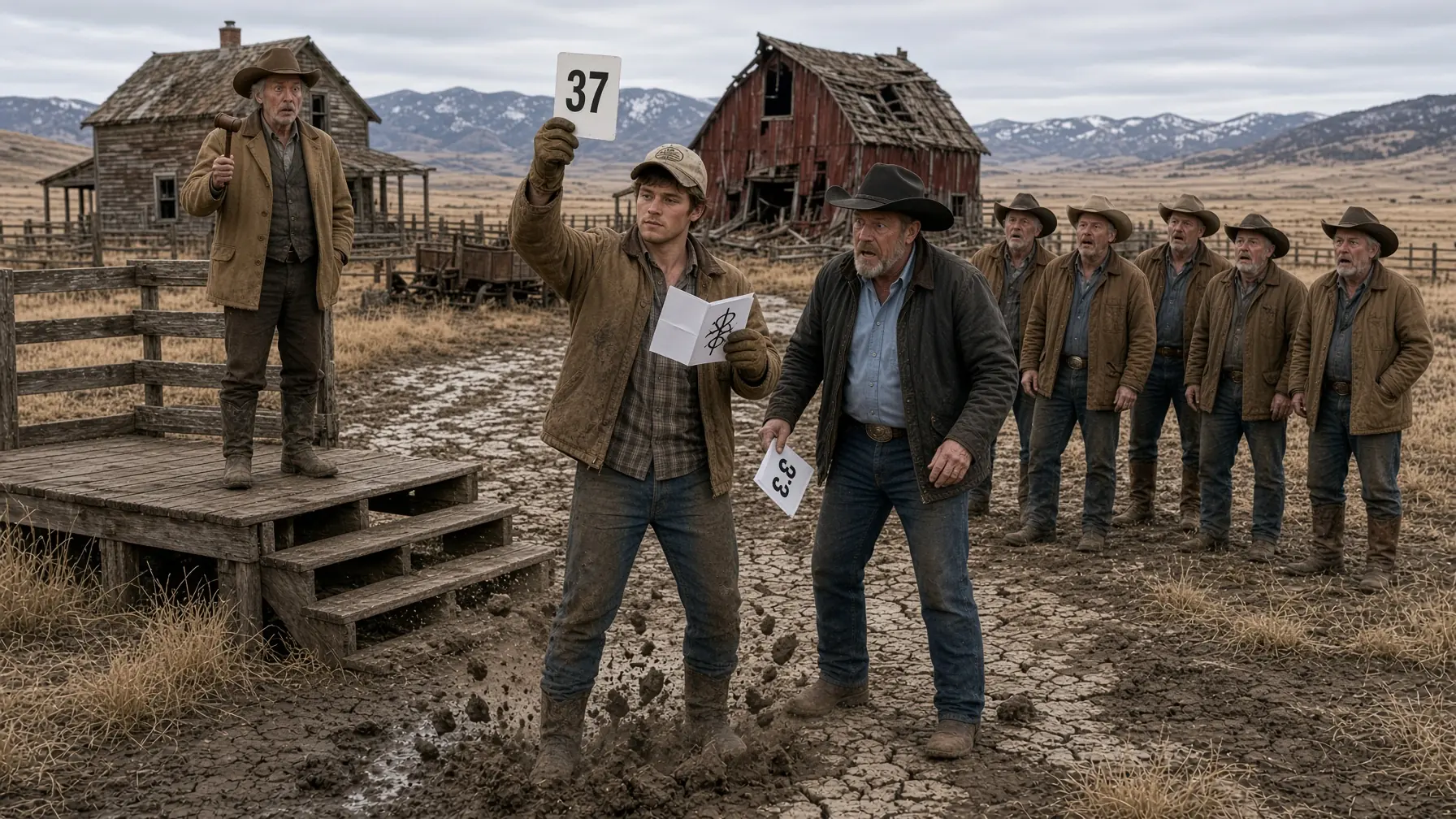
Red Creek Ranch would sell cheaply.
Some desperate buyer would regret it.
And by sunset, everyone in the valley would forget the place existed.
Then a twenty-four-year-old farmhand raised his bidding card.
Someone laughed.
Another rancher turned in his chair.
“Does that boy even know what he’s bidding on?”
Caleb Miller heard him.
He said nothing.
The auctioneer called forty thousand.
Caleb raised his card.
Fifty.
Again.
Sixty.
Again.
By ninety thousand dollars, the laughter had disappeared.
By one hundred twenty, people were staring.
At one hundred forty thousand, the last serious bidder finally lowered his card.
The gavel came down.
“Sold.”
Caleb had just spent nearly everything he could borrow, save, or sell on eight hundred acres everyone else called dead land.
Three days later, the elderly auctioneer opened the original ranch deed.
He read one paragraph.
Then read it again.
The color slowly disappeared from his face.
He looked across the desk at Caleb.
“Where did you hear about this property?”
Caleb frowned.
“I didn’t.”
The auctioneer looked back at the deed.
Then toward the small brass marker Caleb had placed beside it.
For several seconds, he said nothing.
Finally, he whispered:
“Then you may have just bought something nobody realized was still attached to the land.”
Red Creek Ranch sat at the edge of a wide Montana valley where the mountains looked close enough to touch and the wind could cross twenty miles without finding a tree large enough to stop it.
Eight hundred acres.
Once, it had been respectable cattle ground.
Old photographs hanging in the county records office showed grass reaching nearly to a horse’s belly.
Red Creek itself had once run across the eastern pasture, fed by snowmelt and several springs that emerged near the foothills.
There had been cattle.
Hay.
A working barn.
A farmhouse painted white.
By October of 1986, nearly all of it was gone.
The creek had been dry for almost eleven years.
The barn roof sagged.
Windows in the farmhouse had cracked.
The corrals leaned outward.
Half the boundary fencing needed replacement.
Thistles occupied entire fields.
The previous owner, Harold Jensen, had spent years borrowing against machinery and future cattle sales while drought slowly destroyed the operation.
Eventually, the cattle were sold.
Then the equipment.
Then the remaining machinery.
When the unpaid property taxes finally exceeded what Jensen could cover, the county took the ranch.
Locals stopped calling it Red Creek.
They called it the Jensen Desert.
One wealthy rancher inspected the eastern field before the auction, kicked the powdery soil with his boot, and laughed.
“You couldn’t grow weeds here if you planted them yourself.”
Another looked inside the old barn.
“Roof falls next winter.”
A third said:
“Only thing that property produces is taxes.”
Samuel Pierce heard all of it.
At sixty-seven, Samuel had conducted farm and estate auctions across the county for more than thirty years.
He knew land.
Or believed he did.
Red Creek Ranch, in his opinion, was eight hundred acres of expensive problems.
So when Caleb Miller registered to bid, Samuel assumed the young man was curious.
Not serious.
Caleb was not a rancher.
Not technically.
He worked as a farmhand for the Harlan Cattle Company thirty miles west.
Fence repair.
Calving.
Feed.
Welding.
Tractor maintenance.
Whatever needed doing.
He owned an eleven-year-old Ford pickup, a toolbox, two rifles inherited from his father, and approximately eighteen thousand dollars in savings.
He rented a small trailer behind his employer’s machine shed.
Nothing about him suggested eight hundred acres.
Yet three weeks before the auction, Caleb had been repairing fence near Red Creek’s eastern boundary when his shovel struck metal.
The sound was wrong for rock.
He dug.
Six inches below the soil was a small brass survey marker.
It was green with age.
Three groups of numbers remained visible.
14 - 6 - 82
Beneath them was a strange symbol.
A circle crossed by two short horizontal lines.
Caleb had never seen it.
He assumed it marked an old survey point.
Then he noticed something odd.
The marker was not positioned at a fence corner.
Not at a property boundary.
Not beside a road.
It stood twenty yards from the bed of the dead creek.
Caleb looked toward the ranch.
Then toward the mountains.
He dug farther.
A narrow strip of old concrete appeared beneath the marker.
Something had once been built there.
Or marked deliberately.
He cleaned the brass.
Copied the symbol onto a piece of paper.
And put the marker back exactly where he had found it.
He did not tell anyone.
Mostly because he did not know what he had found.
But the question stayed with him.
Why had someone put a permanent survey marker beside a creek that had been dry for eleven years?
And what did 14-6-82 mean?
Caleb spent the next two weeks looking.
Libraries first.
Then county plat books.
Old agricultural bulletins.
He found almost nothing.
One 1951 newspaper mentioned “experimental irrigation works near Red Creek.”
No details.
A 1953 article referred to an “abandoned valley water improvement project.”
Again, no details.
The symbol did not appear on modern county maps.
Caleb showed the drawing to an elderly surveyor named Hank Blevins without saying where he found it.
Hank adjusted his glasses.
“Haven’t seen that in years.”
“What is it?”
“Old hydraulic survey mark.”
“Water?”
“Usually.”
Hank tapped the symbol.
“Could be a test point. Could be a conduit marker. Those old reclamation crews used different stamps depending on who funded the work.”
“What about the numbers?”
Hank shrugged.
“Could be coordinates. Could be a date.”
Caleb looked down.
June 14, 1982.
Four years before the county seized the ranch.
He still knew almost nothing.
But he knew enough to attend the auction.
More than forty people gathered outside Red Creek’s old barn that Saturday morning.
Pickup trucks lined the road.
Steam rose from paper coffee cups.
Men in work jackets stood in clusters discussing fencing costs, grazing capacity, and how many years of rain it might take before the eastern pasture recovered.
Caleb stood near the back.
Walter Briggs noticed him.
Walter owned more than four thousand acres in the valley.
At fifty-eight, he was the kind of rancher whose name appeared on feed-store calendars and livestock-association boards.
He knew Caleb from Harlan Cattle.
“You buying furniture today?”
Caleb looked at him.
“What?”
Walter nodded toward the farmhouse.
“Only thing out here you can probably afford.”
A few men nearby laughed.
Caleb smiled slightly.
“Maybe.”
Walter looked him over.
“You thinking about bidding?”
Caleb did not answer.
That answer was enough.
Walter laughed.
“Son, there’s a difference between working cattle and owning ground.”
“I know.”
“You know what it costs to fix eight hundred acres of fence?”
“No.”
“At least you’re honest.”
Samuel Pierce climbed onto a small platform.
“All right, gentlemen. Let’s begin.”
He read the legal description.
Eight hundred and twelve acres, more or less.
Farmhouse.
Barn.
Outbuildings.
Existing improvements.
And then a phrase Caleb had already noticed in the auction packet:
together with all appurtenant rights, easements, and property interests described in the official record of title.
Most people ignored it.