The morning Leah Dunlap left one of the richest strips on her family farm completely unplowed, three men stopped their trucks along County Road 7 to watch. It was the middle of March in the lowlands of western Tennessee, and nearly every field within sight was being turned dark beneath spring tractors. Diesel hung in the damp air, clay stuck to tires in heavy ribbons, and nobody with bills due in the fall willingly gave up productive ground.
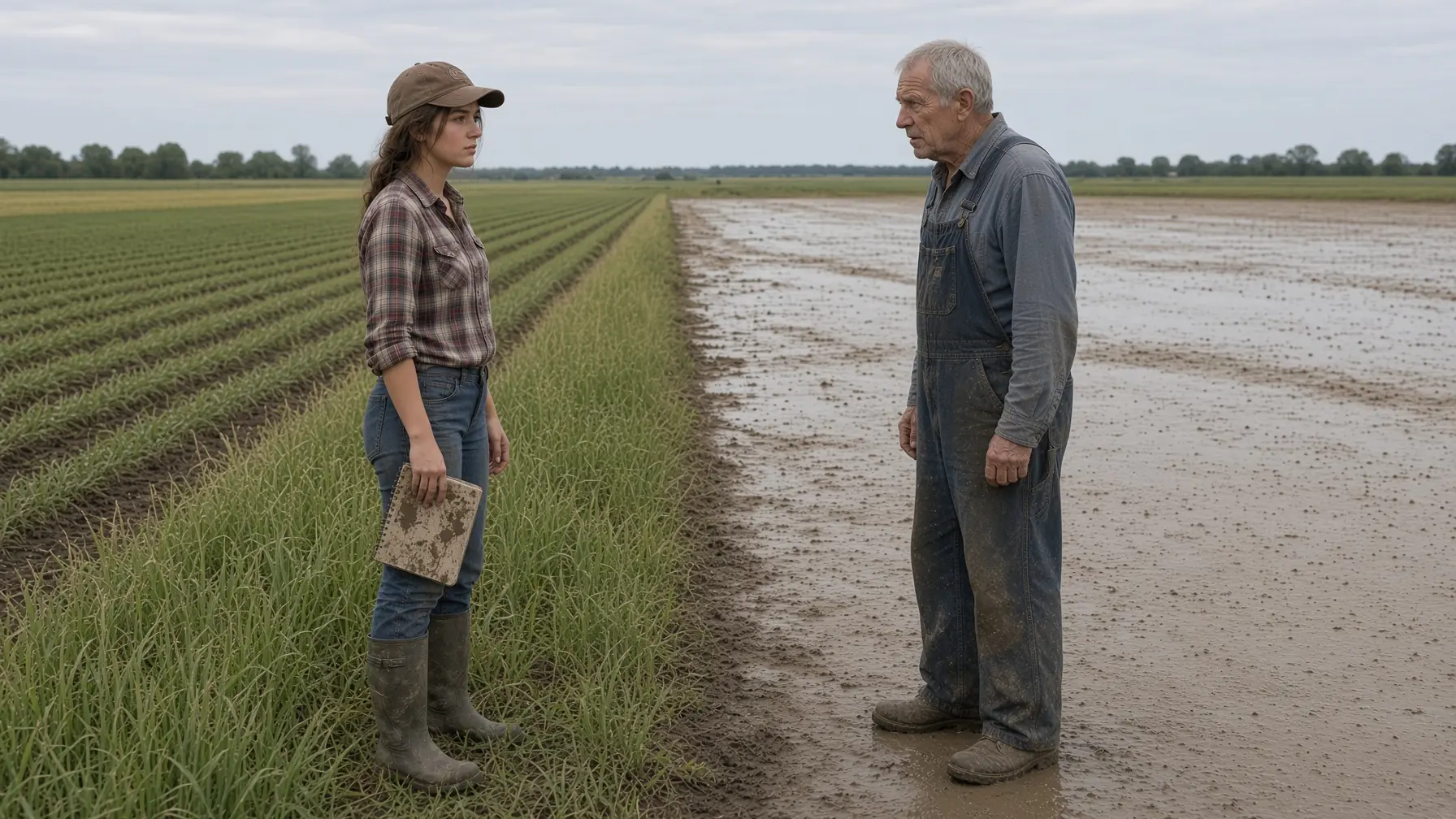
Leah was twenty years old, barely five foot four, with brown hair twisted beneath a faded green cap and work gloves too large for her hands. She drove her father’s old John Deere down the eastern field, reached the long strip beside Cane Branch Creek, and turned deliberately around it. Sixty feet of matted sedge, switchgrass, volunteer bluestem, and weeds remained untouched while fresh furrows opened everywhere else.
Vernon Pike removed his cap beside the road. “What in the world is she doing?”
Edwin Rusk shook his head. “Leaving money in the ground.”
The oldest man among them, Lonnie Givens, looked across the fence toward Leah’s tractor and laughed once. “Her daddy never would’ve skipped that strip when he was healthy.”
Leah heard none of it over the engine. Even if she had, she probably would not have stopped. She finished the eastern section, parked beneath the equipment shed, shut down the tractor, and walked toward the house without once looking toward the road.
The men watched her go. The Dunlap farm had never been large, only forty-three acres of bottomland and slightly higher pasture scattered along a bend of Cane Branch, and everyone knew Henry Dunlap’s health had declined sharply during the previous two winters. His only daughter was now making most of the daily farming decisions, and to the men along County Road 7, the first major decision she had made looked like wasting some of the best soil she owned.
What none of them knew was that Leah had spent most of January trying to answer a question her grandfather had written in pencil nearly sixty years earlier. She had found the question in a water-stained notebook inside an old cardboard box behind three rusted cultivator blades and a broken fence charger. By March, she had begun to suspect that the dead man whose handwriting filled those pages understood something about the farm that the living had forgotten.
The Hatchie River lowlands had always collected water. Heavy spring rain filled the tributaries, pushed creeks beyond their ordinary banks, and turned the lowest fields into shallow brown lakes that could remain for hours or days. It was rarely the kind of disaster that put houses on television, but it could destroy a farmer slowly through drowned seedlings, erosion, sediment deposits, delayed planting, and expensive reworking of ground that had been productive a week earlier.
Farmers adapted because they had to. They installed drainage where they could afford it, moved equipment early, avoided planting the wettest corners, and replanted when the season left enough time. Most accepted that water was simply another expense of farming low ground.
Henry Dunlap had spent thirty-two years making that arrangement work. He knew which rows dried first, where the tractor would sink after two inches of rain, which section should be planted late, and which creek bank needed checking after every storm. He had never become rich, but until his heart began failing, he had kept the mortgage paid, the barn standing, and his daughter convinced that a life measured in seasons could still be a good one.
Leah’s mother had died from ovarian cancer when Leah was ten. From then on, father and daughter moved through farm life together with very little ceremony. Henry taught her to change oil before he taught her to drive on the highway, and by fourteen she could back a trailer more accurately than most grown men who visited the farm.
When Henry began suffering shortness of breath and chest pain during Leah’s senior year of high school, she quietly took over more work. There was no family meeting in which responsibility changed hands. One morning Henry simply stayed inside while Leah started the tractor, and after that the balance never completely shifted back.
He hated it.
Not because he doubted her.
Because a father notices every burden his child begins carrying on his behalf.
That winter, while searching the equipment shed for spare parts, Leah found the cardboard box. It contained tax receipts, seed invoices, old photographs, and seven small notebooks belonging to her grandfather, Caleb Dunlap, who had farmed the property from the late 1940s through the early 1970s. The notebooks were not diaries; Caleb had apparently considered his feelings far less worth recording than rainfall, planting dates, cattle prices, creek levels, and the behavior of dirt.
Leah took them to the kitchen. For several nights she sat beside Henry after supper and read while the television played quietly in another room. Her grandfather had sketched field boundaries, marked places where water crossed after storms, and written observations that sounded almost embarrassingly simple until Leah compared them with what she herself had seen.
One page from 1966 caught her attention. The writing had faded, but the words remained legible: Creek strip stayed rough again. Grass slowed the muddy sheet coming off the bend. More dirt caught there, less over the beans. Don’t plow every wet foot just because the tractor can reach it.
Leah read the entry twice. Then five times.
She brought the notebook to Henry. “Did Grandpa always leave grass along the creek?”
Henry took his glasses from the table and read the page. “When I was little, yes.”
“Why did you stop?”
He thought about it. “Equipment got better. We could work closer to the bank.”
“That’s not what I asked.”
Henry smiled faintly. “No, it isn’t.”
Leah waited.
“Land was expensive,” he finally said. “Corn was expensive. Soybeans were expensive. Everybody wanted every acre producing something they could sell.”
“And did flooding get worse?”
Henry looked toward the dark kitchen window. “Some years.”
“Because you plowed the strip?”
“I don’t know.”
That answer interested Leah more than certainty would have.
She started researching.
The county library in town had six public computers, two of which seemed permanently occupied by men playing online card games. Leah spent several afternoons there reading university extension publications and conservation material about riparian vegetation, grassed filter strips, field borders, and erosion control. She learned enough to know that her grandfather had not discovered anything magical; farmers, soil conservationists, and watershed specialists had understood for generations that dense vegetation near drainage paths could slow shallow surface flow, trap sediment, reinforce soil with root systems, and reduce erosion under the right conditions.
She also learned what it could not do. A sixty-foot strip of grass would not stop the Hatchie River from flooding if the entire bottomland went underwater. It would not function like a levee, and it could not protect crops from prolonged submersion. Anyone claiming otherwise was selling hope instead of agronomy.
But Cane Branch did not usually bury the whole farm. Its worst damage came from fast muddy water spreading across the lower field during heavy rainfall, cutting shallow channels, stripping topsoil from some areas, and leaving thick sediment over others. Leah began wondering whether the strip her grandfather had once protected could reduce that particular kind of damage even when it could not prevent flooding itself.
She walked the low field repeatedly that winter. She compared Caleb’s sketches with present fence lines and marked where stormwater entered from the creek bend. The old vegetated strip had narrowed over the decades, but sections of sedge and native grasses had returned during years when Henry lacked time or energy to cultivate every edge.
By February, Leah had a plan.
She would leave a strip roughly sixty feet wide running along the most vulnerable creekside section. It would cost them nearly an acre of potential crop production, which mattered badly on a forty-three-acre farm. In return, she hoped the existing roots and dense surface vegetation would reduce erosion and sediment movement where floodwater usually entered the field.
Henry listened from his recliner while she explained it. His hands had become thinner during the winter, and medications sat in a plastic organizer on the table beside him. When Leah finished, he asked only one question.
“How much does that acre usually make us?”
She told him.
Henry nodded slowly. “So this isn’t free.”
“No.”
“And you might be wrong.”
“Yes.”
“Good.”
Leah frowned. “Good?”
“If you thought you couldn’t be wrong, I’d tell you not to do it.”
He handed the old notebook back. “Try it.”
So she did.
And on the morning everyone else was turning every reachable acre, Leah steered around the creekside strip.
For the first several weeks, nothing happened to prove anything. Grass grew taller. Soybeans emerged in the rows above it. Neighbors passed the farm and occasionally made jokes about Leah’s wildlife preserve.
Lonnie Givens once slowed his tractor beside her while she was measuring the strip. “You planning to bale those weeds?”
Leah smiled. “Maybe I’ll sell them to you.”
He laughed. “I already own weeds.”
“Then you’re ahead of me.”
There was no hostility in most of the teasing. That almost made it harder. The men did not hate Leah; they simply believed she was young, experimenting with land her father had spent decades learning to manage, and likely to discover why older farmers did things the way they did.
Leah did not argue.
After each substantial rain, she walked the eastern field carrying a spiral notebook. She noted where shallow water entered, where it spread, where soil remained exposed, and where sediment collected. She pushed thin stakes into several points so she could compare later storms.
By early May, she noticed something.
Water still reached the field.
It still crossed parts of the vegetated strip.
But the fastest muddy flow appeared to lose energy as it moved through dense grass. Small deposits of sediment accumulated among the stems rather than extending as far into the cultivated rows as Leah remembered from previous springs.
It was promising.
It was not proof.
Leah wrote both observations in the notebook.
May 6 — heavy rain overnight. Creek rose but stayed mostly inside bank. Surface water through strip slower than bare north corner. Sediment collecting inside first 20–30 feet. Need larger event before conclusions.
Her grandfather had written like that too.
No triumph.
Just weather and dirt.
By June, a larger event was coming.
A slow-moving weather system settled over the region and began drawing moisture northward from the Gulf. Forecasts shifted from scattered storms to repeated heavy rainfall over several days. The river and tributary gauges were already high from earlier rain, and county extension alerts warned farmers in low areas to secure equipment and prepare for flooding.
Nobody needed convincing.
Farmers along County Road 7 moved tractors uphill, checked drainage outlets, secured chemical containers, and watched radar maps that seemed to grow darker each hour. Henry sat at the kitchen table while Leah carried boxes from the lower shed to the barn loft.
“You ready?” he asked.
“No.”
He smiled. “Better answer.”
Leah stopped.
“I’ve done everything I can think of.”
“That’s different from being ready.”
“Yes.”
Henry looked toward the rain beginning against the window. “Nobody is ever ready for water.”
By Friday afternoon, the rain became steady.
It continued through Friday night.
Saturday.
Sunday.
Sometimes hard enough to roar against the metal barn roof, sometimes soft enough that everyone briefly imagined it was ending. It never really ended.
Cane Branch rose first.
The water turned brown, then climbed across the lower bank.
By Sunday evening, shallow water had entered the low fields on both sides of County Road 7.
Leah did not walk into it.
That had been one of the first things the extension material taught her not to romanticize. Moving floodwater did not care whether someone was dedicated, brave, or trying to save a crop.
She watched from safe ground.
By Monday morning, parts of the lower basin were underwater. Vernon Pike lost young corn in several depressions where water remained too long. Edwin Rusk’s lowest soybean rows disappeared beneath muddy flow, and Lonnie Givens lost a section of creek bank where water cut hard around an exposed bend.
The Dunlap farm flooded too.
That mattered.
Anyone telling the story later as though Leah’s grass strip created an invisible wall misunderstood what happened.
Water entered the lowest portion of her field.
Some soybeans went underwater.
Several rows yellowed afterward.
A corner near the southern fence eroded.
But where broad, shallow flow crossed the creekside boundary, the undisturbed vegetation changed how the water moved. Stems bent under the current, roots held the surface together, and suspended soil settled among the grass rather than traveling as far into the planted rows.
The difference became easiest to see after the water receded.
A pale band of deposited silt covered much of the neighboring cultivated ground.
On Leah’s side, a thicker deposit sat inside and along the edge of the vegetated strip. Above it, the planted rows were dirty, flattened in places, and stressed—but substantially less buried.
She stood there Tuesday morning after the rain stopped.
Rubber boots.
Mud to her calves.
Notebook in hand.
The sight did not make her feel victorious.
It made her nervous.
Because now she had to decide whether she was seeing what she hoped to see.
Confirmation bias was something the extension agent at the county office had mentioned once during a workshop.
People were very good at finding evidence for ideas they already loved.
Leah did not want that.
So she called the county extension office.
“I think the strip helped,” she told agronomy agent Nathan Cole.
“You think?”
“Yes.”
“That’s a useful word.”
Leah smiled. “Can you come look?”
Nathan arrived two days later carrying a measuring wheel, soil probe, camera, and more skepticism than Leah expected. She liked him immediately for that.
They walked the strip together.
He measured sediment depth at multiple points inside the vegetation.
Then beyond it.
Then in a cultivated comparison area where the strip ended.
He photographed erosion channels and noted crop condition.
Leah followed with her notebook.
After nearly two hours, Nathan stood near the creek and looked across the field.
“You want the good news or the annoying news?”
“Annoying.”
“One storm does not prove your system.”
“I know.”
“This field isn’t identical to the neighboring fields.”
“I know.”
“Elevation varies.”
“Yes.”
“Soil structure varies.”
“Yes.”
“Drainage histories vary.”
“I know.”
Nathan smiled. “You’re taking the fun out of this.”
“What’s the good news?”
He looked down at the dense grass.
“Everything I’m seeing is consistent with the strip doing what vegetative buffers are supposed to do.”
Leah said nothing.
Nathan continued. “It appears to have trapped sediment and reduced erosive surface flow across this section. It did not prevent flooding.”
“No.”
“But it probably reduced damage from the water that crossed here.”
Leah finally exhaled.
“How much?”
“I’m not giving you a number after one event.”
“That annoying news again?”
“Yes.”
She smiled.
“Fair.”
That afternoon, Lonnie Givens arrived.
He came alone.
No truck full of neighbors.
No apology prepared.
He walked from the road to the eastern field and stopped where the silt line met the grass.
For nearly a minute, he said nothing.
Leah waited.
Lonnie looked toward his own property. The creek had eaten several feet from one section of his bank, and a lower soybean patch now wore a pale crust of deposited sediment.
Finally he asked, “How wide is it?”
“About sixty feet here.”
“Why sixty?”
“My grandfather wrote that he used forty in some places.”
“But?”
“I went wider because this is the worst section.”
Lonnie stepped into the grass.
“What is all this?”
“Sedge mostly.”
She pointed.
“Switchgrass.”
“Some bluestem.”
“Other things I probably can’t name.”
“You planted it?”
“No.”
“Most was already trying to come back.”
“I stopped killing it.”
Lonnie rubbed his chin.
“That simple?”
“No.”
Leah looked toward the creek.
“The simple part is leaving it alone.”
“The hard part is deciding whether giving up crop ground is worth what it protects.”
Lonnie nodded.
That was a farmer’s answer.
Not conservation as virtue.
Tradeoffs.
Two days later Vernon came.
Then Edwin.
Neither mentioned the jokes from March.
Leah did not mention them either.
They walked.
Asked questions.
Bent down to examine sediment caught among stems.
Looked at the cleaner rows above.
Vernon eventually said, “I thought you were wasting an acre.”
Leah answered, “I might still be.”
He looked confused.
“One good flood doesn’t tell me what it costs over ten years.”
Vernon stared at her.
Then laughed.
“That sounds like something your daddy would say.”
“It’s something the extension guy said.”
“Don’t ruin it.”
Nathan Cole returned the following week with another extension specialist.
This time Henry came out to the porch.
He could no longer walk comfortably across the entire field, so Leah brought them notebooks instead.
Caleb Dunlap’s original pages.
Her own spring notes.
Rainfall measurements.
Photographs from April, May, and June.
Nathan read quietly.
The specialist, a woman named Dr. Marianne Ellis, compared Caleb’s hand-drawn creek map to the current aerial image on her tablet.
“Your grandfather was observant.”
Henry smiled.
“He was stubborn.”
“Those traits overlap more than people admit.”
Leah sat on the porch rail.
Marianne explained that the strip was not a new invention. Conservation programs had encouraged similar practices for years under different names and designs, sometimes for water quality, sometimes erosion control, sometimes habitat, and often for several reasons at once.
Henry looked toward his daughter.
“So she rediscovered something everybody already knew?”
Marianne smiled.
“Somebody knowing something somewhere is not the same as a farmer knowing how it applies to this field.”
Leah liked that sentence.
Marianne continued. “Your father’s notes matter because they describe this exact creek bend across decades.”
Henry corrected her.
“Grandfather.”
She nodded toward Leah. “Her grandfather.”
Then she looked at the old notebooks again.
“Local observation and formal research work best when they speak to each other.”
Leah looked down at Caleb’s handwriting.
For months she had imagined the notebooks as a message sent forward specifically to her.
Now she saw something different.
Caleb had not known who would read them.
Maybe he had not expected anyone to.
He had simply paid attention.
That was enough.
The county extension office organized a field day that autumn.
Leah hated the idea.
Nathan insisted.
“We’re not calling it the Leah Dunlap Flood Miracle.”
“Good.”
“We’re calling it a demonstration of vegetated creek buffers under bottomland conditions.”
“That sounds terrible.”
“Exactly.”
“Only farmers will come.”
Twenty-seven people showed up.
Most were older than Leah.
Some had farmed longer than she had been alive three times over.
Nathan spoke first.
Then Marianne.
They discussed erosion, sediment transport, buffer width, slope, maintenance, government conservation programs, invasive species, and the fact that local conditions mattered.
Then Nathan handed Leah the microphone.
She stared at it.
“I don’t need that.”
“There are twenty-seven people.”
“They’re standing ten feet away.”
He took it back.
Leah walked them to the field.
“This is what I did.”
She pointed toward the creek.
“I stopped plowing here.”
A few men smiled.
Leah continued. “I did not stop the flood.”
“Some crop was damaged.”
“I gave up production on almost an acre.”
“I don’t know yet whether sixty feet is the best width.”
“I don’t know whether the same result happens every year.”
“What I do know is that during the June event, this area collected a lot of sediment that otherwise would have moved farther into my planted rows.”
She showed them measurements.
Photographs.
Comparison points.
Then Caleb’s notebook.
Lonnie stood near the back.
Someone asked: “Whose idea was it?”
Leah held up the old notebook.
“My grandfather noticed it before I was born.”
Another farmer asked: “Then why’d everybody stop doing it?”
Henry answered from a folding chair near the shade tent.
“Because corn pays better than grass.”
Everyone laughed.
Then Henry added, “Until the grass saves some corn.”
That became the sentence people remembered.
The following spring, three farms along County Road 7 established wider vegetated borders along their most erosion-prone creek sections.
Not every farmer joined.
Some could not justify losing crop acreage.
Others had land where the approach made little sense.
A few preferred different erosion-control methods.
Leah considered that normal.
She had never wanted the whole county copying her field as though one solution fit every farm.
What changed was the conversation.
People who once asked, “Why would you leave good dirt unplowed?” began asking, “What is that acre doing for the other thirty-nine?”
Those were different questions.
Better questions.
The county extension office returned over several seasons and gathered more measurements.
Some years were dry.
Some floods came from different directions.
One year the buffer made little visible difference because the creek stayed well inside its banks.
Another year, during a series of hard storms, it again trapped substantial sediment and reduced visible erosion along the field edge.
The strip changed too.
Leah selectively managed woody growth where it interfered with access.
Native grasses thickened.
Birds nested there.
Deer used it, which created an entirely different argument because Leah did not enjoy watching deer eat soybeans.
Farming did not reward purity.
Every solution created another problem to manage.
She liked that honesty.
Henry lived long enough to see four more spring plantings.
His heart never improved much.
Some days he could walk to the barn.
Other days the porch was as far as he went.
He became Leah’s unofficial weather station, accountant, critic, and keeper of unnecessary opinions.
One May morning he watched her from the porch as she again turned the tractor before reaching the creek strip.
When she came in for lunch, he said, “Still leaving that acre?”
“Yes.”
“Could plant corn there.”
“You say that every year.”
“I like making sure you remember the cost.”
“I remember.”
He smiled.
“Then you’re doing fine.”
Henry died the following winter in his own bedroom with Leah beside him.
The farm felt enormous afterward.
Forty-three acres had never seemed so large.
For several weeks, Leah found herself walking into the kitchen expecting him at the table.
His coffee mug remained in the cabinet.
His boots stayed near the back door until March.
The first morning she climbed onto the tractor without him anywhere in the world, she sat behind the wheel longer than necessary.
Then she started the engine.
At the eastern field, she reached the creek strip.
Turned.
Left it untouched.
Kept going.
From County Road 7, Lonnie Givens watched.
This time he did not laugh.
Years passed.
Leah never became famous.
There was no national agricultural revolution named after her.
Nobody built a museum around Caleb Dunlap’s notebooks.
That would have made the story simpler than farming deserved.
She expanded slowly.
Leased another twenty acres from a retiring neighbor.
Changed rotations.
Improved soil testing.
Used cover crops in several fields.
Put another grassed waterway through a problem section where runoff repeatedly cut a shallow ditch.
Sometimes experiments worked.
Sometimes they did not.
Once she spent two years trying a management practice that produced so little benefit she abandoned it and wrote across the notebook page:
Grandpa would’ve told me this was foolish by week three.
She kept the notebooks anyway.
Failures belonged in records too.
Especially failures.
By the time Leah was thirty, younger farmers occasionally called her for advice.
That amused her.
One afternoon, a nineteen-year-old neighbor named Caleb Morris came over after his first independent planting season.
He stood near the creek buffer.
“My dad says I’m wasting time trying cover crops on our hill field.”
Leah smiled.
“Maybe you are.”
He looked disappointed.
“That’s not what I thought you’d say.”
“What did you want?”
“That everybody called you crazy and you proved them wrong.”
Leah laughed.
“People exaggerated that part.”
“They laughed.”
“Some did.”
“You were right.”
“One year.”
She pointed toward the strip.
“This did what I hoped during one flood.”
“Then we watched it for more years.”
“We measured.”
“We changed parts.”
“That isn’t the same as being right because everybody else is old and stupid.”
Caleb looked toward the creek.
“So what should I do?”
“Ask what problem you’re solving.”
“Figure out how you’ll know whether the change helped.”
“Know what it costs.”
“Then try something small enough that being wrong doesn’t ruin you.”
He nodded.
Leah added, “And write it down.”
That was the part Caleb Dunlap would have understood immediately.
The original cardboard box eventually fell apart.
Leah transferred her grandfather’s notebooks into an archival storage box and kept them in the farmhouse instead of the equipment shed. Her own spiral notebooks filled another shelf beside them.
Caleb’s handwriting ended in 1971.
Leah’s began in 2026.
Between those dates sat decades during which the farm changed machinery, seeds, markets, chemical programs, drainage, ownership responsibilities, and nearly everything else.
Water still moved downhill.
Roots still held soil.
Mud still told the truth about where it had traveled.
Some knowledge became old-fashioned because it was wrong.
Other knowledge merely became unfashionable because people had stopped needing to remember it for a while.
Leah learned not to confuse the two.
When the extension office eventually asked permission to digitize Caleb’s field notes for a local agricultural-history project, Leah agreed.
One scanned page became unexpectedly popular among conservation groups.
It was not the famous buffer-strip entry.
It was a shorter line Caleb had written after a spring storm in 1963:
Watch where the water wants to go before deciding where you want it to go.
Leah had never paid much attention to that sentence as a teenager.
At thirty-five, she thought it might have been the best thing he wrote.
Farming had taught her that land rarely cared about certainty.
You could shape it.
Drain it.
Plant it.
Protect it.
But eventually weather arrived and exposed the difference between planning with a place and planning against it.
Lonnie Givens retired before Leah turned thirty-two.
His son took over the farm.
On Lonnie’s last planting season, he stopped his truck beside Leah’s eastern field.
She walked over.
He nodded toward the buffer.
“You know what I thought that first morning?”
“That I was wasting land.”
“I thought worse than that.”
Leah smiled. “I assumed.”
“I thought your daddy was sick, your mother was gone, and some twenty-year-old girl was about to lose the farm because nobody had the nerve to tell her she didn’t know enough yet.”
Leah leaned on the fence.
“And?”
Lonnie looked across the rows.
“I was partly right.”
She raised an eyebrow.
“You didn’t know enough.”
Leah laughed.
“Nobody does.”
“That was the part I had forgotten.”
He looked toward Cane Branch.
“I’d been farming forty-five years and thought forty-five years meant the land had finished teaching me.”
They stood quietly for a moment.
Then Lonnie said, “I owe you an apology.”
Leah shook her head.
“No.”
“I laughed.”
“That didn’t hurt anything.”
“I was sure.”
“That’s more dangerous.”
Lonnie smiled.
“Your daddy used to talk like that.”
“Unfortunately.”
The Dunlap farm never became the richest farm in Hardeman County.
Some seasons barely worked.
A drought hurt yields one year.
Fertilizer prices climbed another.
A tractor transmission failed two weeks before planting and consumed money Leah had intended to use replacing part of the barn roof.
She had crop insurance.
Debt.
Good years.
Bad years.
The normal mathematics of a small farm.
The creek buffer did not save her from economics.
It solved one specific problem well enough to justify its place.
That was enough.
People who heard the story later often wanted the ending to be bigger.
They wanted the June flood to destroy every neighboring farm while Leah’s stood untouched.
That did not happen.
They wanted hundreds of farmers to copy her immediately.
They did not.
They wanted the old men who laughed at her to gather on the porch and admit she was wiser than all of them.
Nobody said anything so dramatic.
Real change usually arrived wearing muddy boots and asking practical questions.
“How wide?”
“What grass?”
“How much ground did you give up?”
“How bad was the sediment?”
“Would it work on my place?”
Leah preferred those questions to applause.
Applause ended.
Questions built things.
On a cool March morning many years after the first experiment, Leah drove the same eastern field in a newer tractor.
The old John Deere sat restored beneath the equipment shed.
Her father’s cap hung from a nail near the workbench.
Caleb’s notebooks were safe inside the house.
When Leah reached the creekside strip, she turned around it exactly as she had at twenty.
The grass was taller now.
Thicker.
The boundary unmistakable.
A pickup slowed along County Road 7.
Inside sat a young farm couple Leah barely knew.
The driver pointed toward the unplowed ground.
Leah could imagine the conversation.
Why is she leaving that?
Isn’t that good soil?
What does she know that we don’t?
She smiled.
Not because she knew everything.
Because she remembered being twenty and realizing that she knew almost nothing.
Then opening a dead man’s notebook anyway.
The first lesson Caleb Dunlap gave his granddaughter had not really been about grass.
It had been about attention.
Look before changing something.
Record before forgetting.
Compare instead of assuming.
Respect old knowledge without worshipping it.
Use new knowledge without believing it makes observation obsolete.
And never confuse the amount of ground you cultivate with the amount of ground that is working for you.
Leah turned the tractor toward the next row.
Behind her, sixty feet of creekside vegetation remained untouched.
Not wasted.
Not miraculous.
Working quietly.
Exactly as it had all along.