Lot seven sat at the far end of the county auction barn beneath a layer of red Oklahoma dust, dead grass, and twenty years of neglect. The 1967 John Deere 4020 had two collapsed rear tires, a rusted exhaust stack, faded green paint, and an engine tag marked SEIZED — PARTS ONLY, which was enough to make most farmers walk past without slowing down. Auctioneer Gary Sims began at two hundred dollars and joked that whoever bought it ought to own a very strong trailer and a very understanding wife. Then a twelve-year-old boy standing beside his grandmother quietly raised the bidder card in his right hand.
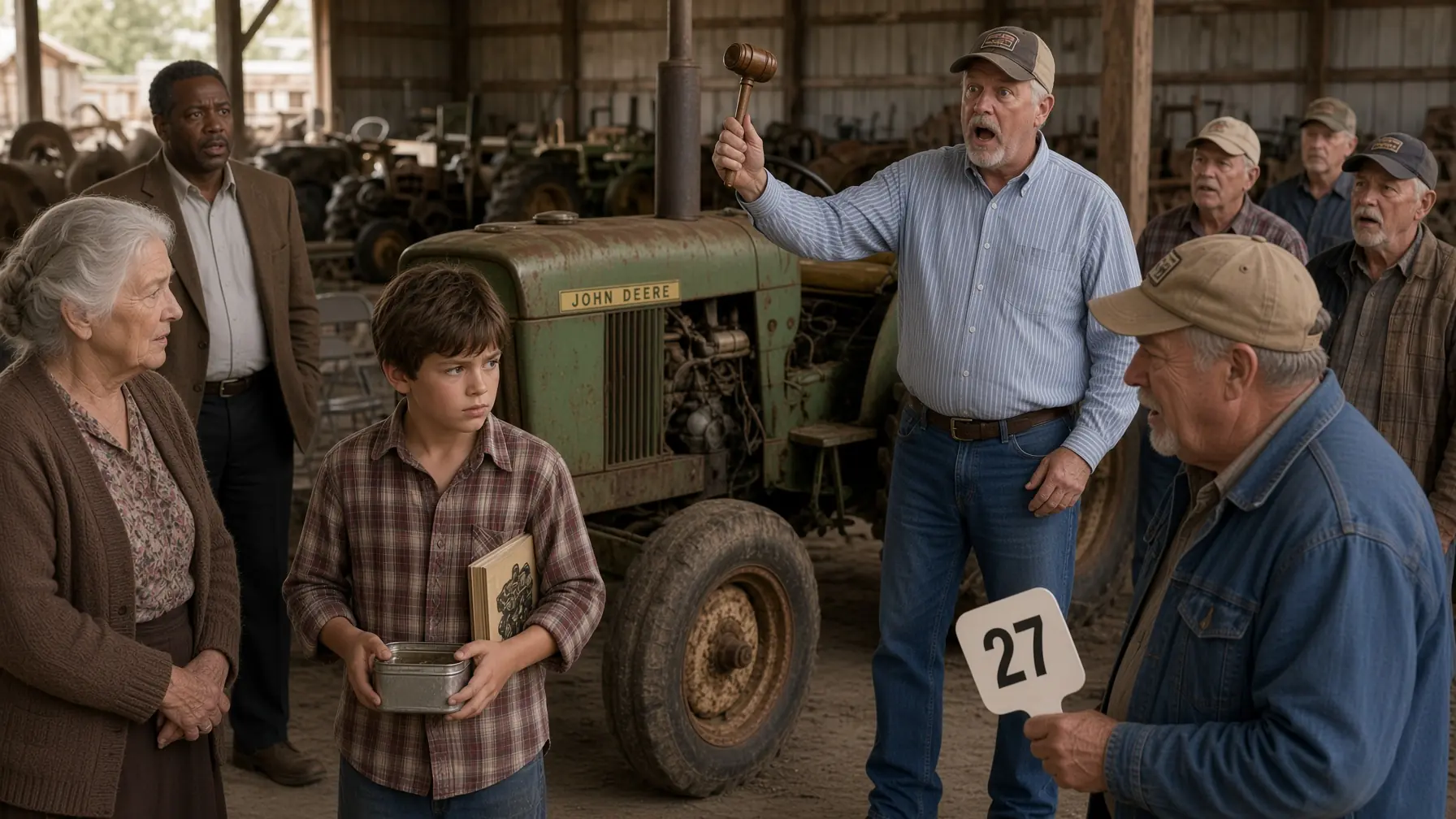
The laughter started before Gary could even recognize the bid. Floyd Meeker, a sixty-one-year-old cattleman who had been attending Harmon County equipment auctions since before the boy was born, turned in his folding chair and asked whether somebody had accidentally given a child permission to buy scrap iron. Several men laughed with him, while the boy’s grandmother stood motionless beside the aisle and allowed her grandson to answer for himself. Noah Price looked toward Floyd and said, “I know the tractor hasn’t run in twenty years, but I also know why it stopped, and I think I know what it will take to make it run again.”
The laughter weakened. Gary lowered his auction card, looked over the top of his glasses, and asked Noah whether he had actually inspected the machine or was simply repeating something he had read online. Noah answered that he had spent forty-five minutes with the tractor before the auction, had checked the oil, fuel system, injection lines, accessible engine components, and flywheel resistance, and believed moisture had seized two cylinders while old fuel had damaged the injection pump. At the back wall, Harmon County Farm Bureau director James Okafor stopped drinking his coffee and began watching the boy very carefully.
Noah did not know James was watching. He was thinking about the folded service manual inside his jacket, the two hundred sixty-three dollars he had saved from mowing yards, repairing lawn mowers, helping neighbors stack hay, and doing chores around the farm, and the additional one hundred eighty-seven dollars his grandmother had reluctantly agreed to risk if the bidding went higher than his savings. Together they had set a hard limit of four hundred fifty dollars, not because they believed the tractor was worth exactly that amount, but because Ruth Price refused to bet the following month’s feed, taxes, groceries, and electricity on a twelve-year-old’s confidence. Noah had promised her he would lower the bidder card the instant Gary Sims said four hundred seventy-five.
Four months earlier, Noah’s grandfather Earl Price had been alive. Earl had farmed ninety-five acres in Harmon County for nearly forty-six years, first with his father, then with Ruth, and finally with Noah following behind him whenever school, weather, and his mother’s work schedule allowed. He grew wheat on part of the place, cut hay from the lower ground, rented another small field for sorghum in good years, and kept a modest herd of cattle whose numbers rose and fell according to rainfall and feed prices. The farm had never made the Prices wealthy, but it had paid its taxes, covered much of its own operating expense, and held four generations of family memory inside fences Earl repaired more times than anyone could count.
Earl died in June 2023 after a heart attack so sudden that Noah spent weeks believing every truck approaching the driveway might somehow bring him back. The morning before his death, Earl had complained about a leaking stock tank valve, asked Ruth what she wanted for supper, and told Noah they would finish rebuilding a carburetor that weekend. By lunchtime he was gone, leaving Ruth at sixty-eight with paid-off land, a small cattle herd, two aging machines, and enough cash to continue only if nothing major broke. Something major broke seven days later.
Their 1982 Case tractor had been the farm’s main machine for years. It was not beautiful, modern, or especially comfortable, but Earl knew every noise it made, and Noah had spent enough time in the passenger corner of the cab to know which rattle belonged to the door latch and which one meant his grandfather was about to stop immediately. One afternoon Ruth tried using it to move a hay wagon, heard a grinding noise from the transmission, and shut the tractor down before metal turned an expensive problem into an impossible one. The repair estimate came back at approximately thirty-four hundred dollars after parts and labor, while the farm checking account held just over four hundred.
Ruth did not tell Noah they were going to lose the farm. She told him they would make decisions one at a time, beginning with borrowing a neighbor’s tractor long enough to finish necessary summer chores and postponing everything that could safely wait. Noah nevertheless heard conversations adults thought he was not listening to, including Ruth discussing property taxes with his mother, feed costs with the cooperative, and whether leasing the crop ground the following year might be smarter than trying to operate it herself. He also saw her standing in Earl’s workshop after dark with one hand resting on his empty stool.
Noah’s mother, Rebecca Price, lived thirty-five miles away and worked as a respiratory therapist at a regional hospital. She had grown up on the farm but never wanted farming to become her occupation, and Earl had supported that choice even when neighbors assumed his daughter would eventually return to take over. Rebecca wanted Ruth to lease the fields, reduce the cattle herd, and stop trying to prove she could replace her husband at sixty-eight. Ruth replied that she was not trying to replace Earl, only trying to decide what the farm still made sense doing without him.
Noah spent most weekends with Ruth after the funeral. Sometimes he helped with fences or feed, sometimes he sat in Earl’s workshop and opened drawers simply because the tools smelled like his grandfather’s hands, and sometimes he studied old service manuals while pretending he had a practical reason. Earl had begun teaching him small-engine repair when Noah was nine because the boy asked questions faster than adults could answer them. By twelve, Noah could rebuild a simple carburetor, diagnose basic ignition problems, service a lawn mower, repair a generator under supervision, sharpen chains, use a multimeter safely, and identify enough tractor components to know exactly how much he did not yet understand.
Earl never called him gifted. He called him interested, which Noah later came to appreciate because interest implied responsibility while gifted sounded like permission to skip work. Whenever Noah guessed instead of measuring, Earl made him start over, and whenever he tried remembering torque specifications rather than checking the manual, Earl tapped the book with one finger and said, “Memory is free, but mistakes send invoices.” Noah could still hear that sentence whenever he reached automatically for a wrench before checking a number.
The summer before Earl died, they spent six weeks studying a 4020 service manual Earl had purchased at an estate sale. He did not own a 4020, but he had repaired several during his younger years and considered the tractor one of the best platforms for teaching mechanical diesel systems because so much information existed about how the engine, fuel system, hydraulics, power takeoff, transmission, and controls worked together. Every evening after chores, Earl chose one section, made Noah explain it back to him, and then corrected whatever the boy oversimplified. By August, Noah could not rebuild a 4020 independently, but he understood its systems far better than most twelve-year-olds had any reason to.
Earl’s favorite phrase during those lessons was, “These engines don’t really die; people just stop giving them reasons to live.” The statement was not technically true, and Earl knew it, because broken crankshafts, cracked blocks, catastrophic overheating, ruined bearings, and a thousand other failures could absolutely end an engine economically. What he meant was that many machines labeled dead had never been diagnosed beyond the symptom that made somebody park them. Noah absorbed the distinction.
After the Case transmission failed, he began searching local listings every evening. Most tractors were far beyond the farm’s means, including battered thirty-year-old machines selling for several thousand dollars because anything capable of pulling implements had value when planting season approached. Noah checked marketplace listings, estate notices, dealer back rows, county auction announcements, and every bulletin board Ruth allowed him to photograph. Three months passed without a realistic option.
Then, on a Thursday evening in October, Noah opened the Harmon County surplus and impound auction listing. Lot seven was described in eleven words: 1967 John Deere 4020, diesel, nonrunning, seized engine, abandoned approximately twenty years, parts only. The listing showed three photographs, one of which revealed the exhaust cap missing entirely while rust stained the manifold below it. Noah enlarged that photograph until individual pixels blurred across his screen.
He called Ruth from the workshop. “Grandma, I need to show you something,” he said, trying to sound calmer than he felt, and she came outside carrying a dish towel because she had been cleaning the kitchen. Noah showed her the listing, explained the missing exhaust cap, pointed toward where rainwater likely entered, and described why a locked engine did not automatically mean a ruined crankshaft. Ruth listened, then asked the question Earl would have asked first: “What else could be wrong?”
Noah listed everything he could imagine. Tires could be unusable, brakes might be unsafe, hydraulics could be contaminated, the injection pump might need rebuilding, injectors could be stuck, the clutch might be frozen, wiring might be destroyed by rodents, seals could leak everywhere, and the transmission could contain damage nobody could detect without opening it. Ruth nodded after each problem until Noah finally said, “I’m not saying it’s good; I’m saying it might be fixable for less than the Case.” She asked what his confidence was worth in actual dollars.
That night they counted Noah’s savings on the kitchen table. He had two hundred sixty-three dollars in a coffee tin, mostly tens and fives, plus a collection of ones earned from small repair jobs and chores. Ruth had more money in the farm account, but much of it already belonged to feed, insurance, utilities, and winter costs even if the bank balance did not label the dollars individually. After forty minutes of arithmetic, they decided Ruth would risk no more than one hundred eighty-seven dollars from farm cash, creating a combined auction ceiling of four hundred fifty.
“If it goes to four fifty, you stop,” Ruth told him. Noah nodded. “If it goes to four fifty-five, you stop; if somebody laughs, you stop; if they tell you you’re almost there, you stop; and if Grandpa himself comes down from heaven and tells you to bid five hundred, you ask him why he left us with only four fifty.” Noah laughed for the first time that evening and promised.
Rebecca hated the idea when Ruth called her. She did not believe Noah’s mechanical knowledge was imaginary, but she understood how quickly adults turn an unusually capable child into a story about genius and then place unsafe expectations on small shoulders. She told Ruth that Noah could not sign a purchase contract, assume liability, arrange transport, or perform heavy engine work alone. Ruth agreed to register as the legal bidder, hold the card, complete the paperwork, and allow Noah to make technical decisions only within adult supervision.
Noah initially objected to Ruth holding the card. He wanted to raise his own hand if the moment came, partly because he had imagined doing exactly that since seeing the listing. Ruth considered, then agreed he could physically signal the bids with her registered bidder number while she remained beside him and retained the authority to stop at any amount. “You can make the bid,” she said, “but I’m the adult buying the tractor, and those are different things.”
Saturday morning they arrived two hours before the auction. The temperature hovered near fifty degrees, a north wind carried dust across the equipment rows, and old men in insulated jackets stood beside machinery discussing weather, prices, and one another’s mistakes with equal seriousness. Noah carried the 4020 manual inside a plastic grocery bag beneath his coat. Ruth carried the bidder card.
They found lot seven behind an old county grader. Up close, the tractor looked worse than the photographs because both rear tires had split deeply along the sidewalls, one front rim was nearly buried in dirt, the seat cushion had disappeared, and mice had packed material beneath the dash. Noah did not touch anything until Ruth asked the auction attendant whether inspection was permitted. The man shrugged, said they could examine without dismantling, and warned them that the tractor was sold exactly as it sat.
Noah began with the dipstick. The oil level was high enough to concern him, but it showed no obvious milky emulsification suggesting a crankcase full of coolant or rainwater, although decades of settling made any visual diagnosis uncertain. He loosened the fuel cap and smelled varnished diesel strong enough that Ruth stepped backward. Then he inspected the injection pump and found heavy corrosion around linkages and evidence that somebody had attempted repairs long ago.
The flywheel access became more important. With the attendant’s permission, Noah removed a small cover using a screwdriver from his pocket, then used the appropriate bar to test whether the engine would rotate even slightly by hand. It moved only a fraction before meeting firm resistance, which matched his suspicion of localized cylinder rust better than the completely immovable feel he expected from some forms of catastrophic mechanical damage. He replaced the cover exactly as he found it.
A man standing nearby watched. “You know what you’re doing, kid?” he asked. Noah answered, “Some of it,” because Earl had taught him that anyone saying they knew everything about a machine had probably stopped learning. The man introduced himself as Earl Pittman, a retired John Deere mechanic from Elk City who had driven to the auction looking for a mower. Noah blinked at the first name because hearing Earl from a stranger still felt like a hand touching a bruise.
Pittman asked what Noah thought was wrong. Noah explained the missing exhaust protection, likely moisture intrusion, the limited flywheel movement, the condition of the injection pump, and his suspicion that at least two cylinders had rusted badly enough to lock pistons or rings. Pittman did not praise him. He asked what would prove him wrong.
Noah thought before answering. “If the crankshaft is damaged, a rod is bent, the block is cracked, the head is ruined, or the transmission has major damage, the engine work might not make sense.” Pittman nodded. “And what can you know without opening it?”
“Not enough.” Pittman smiled slightly.
That exchange gave Noah more confidence than applause would have. A retired mechanic had not told him he was brilliant, but he had listened, challenged him, and found his reasoning serious enough to continue. Ruth thanked Pittman before they moved toward the auction barn. Pittman stayed near lot seven.
The first six lots sold slowly. A utility trailer brought eight hundred dollars, two old mowers sold together, a county pickup with transmission trouble attracted several bidders, and an irrigation pump went to a farmer Noah recognized from church. Ruth kept the card on her lap until Gary Sims announced lot seven. Then she handed it to Noah.
Gary described the tractor honestly. He reminded everyone the engine was seized, the county offered no guarantee of title beyond the legal disposal documents provided, transport was the buyer’s responsibility, and the machine had been abandoned long enough that no one could verify when it last ran. “Two hundred dollars,” Gary called, then added that the scrap yard might pay nearly enough to forgive a buyer for making the mistake. Floyd Meeker laughed and raised his paddle.
Gary acknowledged two hundred. Noah looked toward Ruth. She nodded once.
He raised their card. “Two fifty.”
The auction barn went quiet slowly rather than instantly. A few people continued talking until they realized the bid had come from a child, then heads turned row by row. Gary looked toward Ruth to confirm, and she said, “He’s bidding for me.”
Floyd twisted around. “Boy, that tractor hasn’t run in twenty years,” he said loudly. Noah felt blood reach his face but remembered Earl telling him that embarrassment becomes expensive when it starts making decisions. “I know,” he answered, “and I think I know why.”
Someone asked him to explain. Gary could have stopped the conversation and continued bidding, but curiosity had already taken control of the room. Noah described the probable cylinder corrosion, wet-sleeve replacement, fuel-system cleaning, injector-pump work, and the need to measure the crankshaft before deciding anything about a rebuild. He added, “I have the service manual, but I won’t know if I’m right until the head comes off.”
Floyd laughed again, louder this time. “You going to rebuild a six-cylinder diesel after school?” he asked. Noah answered that he would work with adult supervision and that his grandfather had taught him enough to know he would need help for the things he had not done before. That answer quieted several older farmers who had been waiting for childish bravado.
Gary resumed. Floyd bid three hundred. Noah answered three twenty-five.
Floyd moved to three fifty. Noah looked toward Ruth. She nodded.
Noah bid three seventy-five. Floyd immediately said four hundred.
This time Noah hesitated. Four hundred meant only fifty dollars remained before the line Ruth had drawn, and the certainty he had carried while studying the listing began colliding with all the unknown failures still hiding inside the machine. He could feel the bidder card becoming heavy in his fingers. Ruth whispered, “You don’t owe anybody another bid.”
Floyd noticed the hesitation and smiled. “That’s what I thought.” Noah looked toward him, then toward Gary. Pride tried to raise the card before reason did.
He closed his eyes for one second and imagined Earl tapping the service manual. Memory is free, mistakes send invoices. Noah opened his eyes and asked Gary whether bids had to move by twenty-five.
Gary said, “I’ll take ten.” Noah raised the card. “Four ten.”
The crowd murmured. Floyd’s smile disappeared.
“Four twenty,” Floyd said. Noah answered four thirty.
Floyd looked at the tractor through the barn doors as though remembering that he did not actually want it. He said four forty. Noah glanced toward Ruth.
She held his gaze. The maximum was four hundred fifty, and both understood what the next bid meant. Noah raised the card one last time. “Four fifty.”
Gary asked for four sixty. No one answered.
Floyd lifted his paddle halfway. For several seconds Noah could not breathe. Then Floyd lowered it.
Gary waited. “Four fifty once, four fifty twice, sold at four hundred fifty dollars to bidder seventy-one.” The gavel struck wood.
Someone clapped near the back wall. Earl Pittman joined. Then several others did too.
Noah did not feel victorious. His first emotion was panic because he had just spent every dollar Ruth authorized on a tractor that still did not run. He handed the card back to her and whispered, “I hope I’m right.”
Ruth squeezed his shoulder. “Now we find out.”
Floyd passed them on the way outside. He did not insult Noah again, but he said, “Hope that manual has a chapter on miracles.” Ruth answered before Noah could. “If it did, we couldn’t afford the parts.”
Several men laughed. Floyd kept walking.
James Okafor had watched the entire exchange. He was fifty-six, had served as Harmon County Farm Bureau director for eleven years, and had grown increasingly frustrated by agricultural youth programs that looked impressive in brochures but reached fewer rural children every year as farms consolidated and school schedules changed. He had spent months trying to convince local businesses to sponsor practical agricultural-mechanics projects rather than only livestock shows and leadership banquets. Most applications he received involved students already connected to well-funded programs.
James followed Noah and Ruth toward the parking lot. “Mrs. Price?” he called, and Ruth turned cautiously because people approaching immediately after an auction sometimes wanted something. James introduced himself, showed his county identification, and asked whether he could speak with both of them for a few minutes. Noah assumed he was in trouble for bidding.
James asked him to explain the tractor again. Noah started with the engine, but James interrupted and asked why he wanted it. The question changed Noah’s answer.
“Our tractor broke after Grandpa died,” he said. “Grandma can lease the crop ground if we have to, but I want to see whether we can keep farming it ourselves.” James asked how many acres.
“Ninety-five total, less cropped.” James asked whether Noah believed one repaired tractor guaranteed the farm would survive.
“No.” James nodded.
That was the second answer that impressed him. Noah explained they still needed seed, fuel, fertilizer, cattle feed, custom harvest, insurance, taxes, and weather that cooperated at least enough to grow something. The tractor could reduce custom-hire costs and give Ruth the ability to handle ordinary fieldwork, hay, feeding, mowing, and wagon work without borrowing machinery constantly. James listened without interrupting.
“Who is helping you rebuild it?” he asked. Noah looked toward Ruth. “We haven’t gotten that far.”
James smiled. “Then that is what we should talk about.”
He explained that the county supported several youth agricultural projects through a partnership involving local Farm Bureau members, 4-H volunteers, vocational instructors, and private sponsors. The program did not simply hand children money, and Noah would need a project plan, budget, safety agreement, adult mentor, recordkeeping, and approval before any parts could be funded. James also made clear that a twelve-year-old would not be allowed to perform dangerous lifting, unsupported heavy assembly, fuel-system pressure testing, or tractor operation beyond age-appropriate supervised work. Noah said he understood.
James asked whether they could meet Monday. Ruth answered that they would first need to explain everything to Noah’s mother. James said that sounded like the correct order.
Then Earl Pittman walked into the parking lot carrying a box from the mower he had purchased. James knew him immediately. “Pitt, you still pretending you retired?” he asked.
Pittman looked toward Noah. “Apparently somebody needs supervision.” Noah’s eyes widened.
Pittman had worked thirty-eight years repairing agricultural equipment before retiring six years earlier. He did not want a full-time project, but he missed teaching younger mechanics and had already decided during the auction that he wanted to know whether Noah’s diagnosis survived disassembly. When James mentioned needing an adult mentor, Pittman said, “I’ll give him Saturdays if the family wants me and if he agrees I get to tell him he’s wrong.”
Noah smiled. “Grandpa did that for free.” Pittman answered, “Then I can probably match the rate.”
Transport became the first immediate problem. The auction required removal within five days, and Ruth’s pickup could not safely haul a 4020. James called a Farm Bureau member with a heavy equipment trailer, but the man could not donate a commercial haul without covering fuel and time. Ruth agreed to pay one hundred twenty dollars from the remaining farm account, which meant the tractor had already cost five hundred seventy before anyone purchased a part.
Noah looked guilty when she wrote the check. Ruth told him, “If we are doing this, we are going to count the real cost, not the number that makes the story sound better.” She explained that someday people might say he bought a working tractor for four hundred fifty dollars, and if they did, he should correct them. Buying and rebuilding were different numbers.
Rebecca arrived Sunday afternoon with enough anger for everyone. She hugged Noah first, checked Ruth second, and then stood in front of the rusted 4020 as though it had personally created the situation. “You spent how much?” she asked.
“Four fifty purchase, one twenty hauling,” Ruth answered. Rebecca looked at her mother. “You are not helping.”
“I’m accounting.”
They sat at the kitchen table for two hours. James had emailed program forms, Pittman had written a short mentor agreement, and Ruth had already listed known expenses in Earl’s old farm notebook. Rebecca read every page.
Her concern centered on safety and expectation. “Noah is twelve,” she said, looking toward James, who had come by to explain the program. “I do not want the county turning my son into some little internet mechanic and pretending talent means he can do adult work without adult protection.” James agreed immediately.
“We support a project,” he said. “We do not hand him a tractor and walk away.” Rebecca asked who carried liability.
James explained the county’s program coverage, required volunteer agreements, workshop rules, supervision standards, and the fact that Ruth remained the tractor’s legal owner. Heavy components would be lifted by adults using proper equipment, fuel and electrical systems would be handled under direct supervision, and Noah would not drive on public roads or perform fieldwork beyond what state law, insurance, and the family considered safe. Rebecca continued asking questions until Noah became impatient.
Pittman finally leaned toward him. “You annoyed?” Noah nodded.
“Good. Your mother is doing her job.” Noah looked down.
Pittman said, “Machines punish impatience faster than mothers do.” That sounded enough like Earl that Noah stopped arguing.
The program approved a preliminary inspection grant of six hundred dollars, not a complete restoration budget. Additional funding would depend on whether the engine block, crankshaft, transmission, and major castings proved worth saving after disassembly. James insisted on that condition because he did not want sponsors pouring money into a project only because a crowd had applauded a child at an auction. Noah understood.
Monday after school, the real diagnosis began. Pittman made him clean the tractor before removing major parts, which Noah considered wasted time until the mechanic explained that dirt hides cracks, contaminates open systems, and turns organized work into guesswork. They pressure-washed decades of grime, vacuumed rodent nests, labeled wires, photographed hose routing, and placed every removed fastener into marked containers. Ruth sat at a folding table near the shop door recording hours and costs.
The first surprise was good. When they drained the engine oil, no large metal fragments appeared. Pittman cut open the filter and showed Noah what bearing material would look like if catastrophic internal damage had been circulating through the engine.
The second surprise was bad. The cooling system contained heavy corrosion, and the radiator would need professional cleaning or replacement. Noah added another uncertain expense to the ledger.
They removed the valve cover, rocker assembly, manifolds, fuel lines, and cylinder head over several supervised sessions. Noah could handle many smaller fasteners himself, but the head weighed far too much for a child, so Pittman used a shop crane while Noah guided from a safe position. When the head lifted, two cylinders showed deep orange corrosion exactly where Noah had predicted moisture damage. Another cylinder contained lighter rust that had not appeared in his original theory.
“You were right about two,” Pittman said. Noah smiled.
“Mostly.” Pittman pointed toward the third.
“Mostly costs money too.”
The pistons in the two worst cylinders were frozen by rust and ring corrosion rather than a destroyed crankshaft. That was encouraging, but the only responsible repair still required complete inspection rather than freeing them and pretending the problem ended. They removed the oil pan, disconnected rods, checked bearing surfaces, and measured the crankshaft journals with instruments Noah had practiced using on scrap components. Pittman performed every measurement again independently.
The crankshaft remained within serviceable limits after polishing. One connecting rod bearing showed wear that justified replacement, but nothing suggested the engine had suffered a catastrophic seizure under power. The block showed no obvious freeze crack, although Pittman insisted on cleaning and further inspection before declaring it sound. Noah’s original diagnosis had moved from guess to plausible repair.
The injection pump was worse than expected. Old diesel had degraded into sticky residue, internal components were corroded, and the governor mechanism could not be trusted without professional rebuilding. Noah had imagined cleaning it himself after watching educational videos, but Pittman said no. Injection equipment required specialized knowledge and test equipment if they wanted the engine to run correctly rather than merely run.
That decision disappointed Noah. He wanted to do every repair himself because the auction story already seemed to expect that from him. Pittman noticed.
“Who told you a mechanic proves himself by doing everything alone?” he asked. Noah said nobody.
“Then stop inventing rules.” Pittman explained that expertise includes knowing when a component belongs in another specialist’s hands. They sent the pump to a diesel shop.
The tires created the largest expense. New rear tires could consume more money than the entire project budget, and the existing ones were unsafe even for yard testing. James contacted local dealers not to request free equipment but to ask whether anyone had serviceable takeoff tires from customers who had upgraded.
A dealer forty miles away had two used rear tires with substantial remaining life but cosmetic cracking too minor to make them attractive retail inventory. He offered the pair at a deeply reduced price if the program covered mounting. James accepted only after Ruth confirmed the tires’ condition independently with Pittman.
“No pity parts,” Ruth said. James smiled.