I don't care what you say. I don't care what it costs. I don't care if every mechanic in Arizona tells me it's dead. Tyler Callahan's voice cracked like dry desert earth. My uncle is dying. He has three days, maybe four. And the last thing he asked for, the only thing he asked for, was to hear that motorcycle run one more time.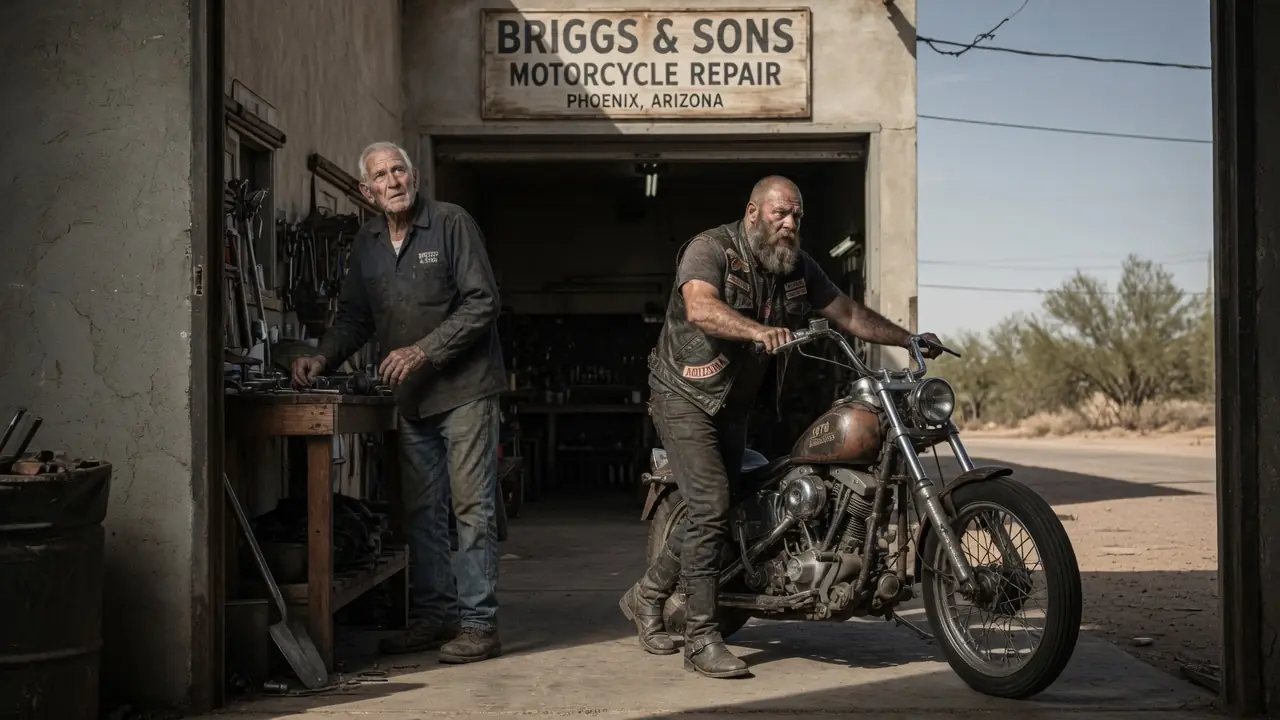
Nobody spoke. Nobody moved. The old Shovelhead sat there rusted and silent like a gravestone that hadn't been engraved yet. And then the door opened. The summer heat outside Phoenix hit like a furnace door swung open, but inside Briggs and Son's motorcycle repair the air was cool and smelled of old grease, rubber, and decades of work done with careful hands.
The shop had been at the same corner of Route nine for thirty-one years. Three bays, a parts wall covered floor to ceiling, a coffee machine that nobody had cleaned since two thousand nineteen. It wasn't a fancy operation. It was the kind of place where people brought bikes that mattered to them, not because it was the closest, but because the work got done right.
Marcus Webb had been the head mechanic there for eleven years. He was forty-three, built like someone who had grown up lifting engines, and proud in the quiet way of a man who didn't need to say much because the work spoke for him. He'd rebuilt carburetors from the nineteen sixties. He'd sourced impossible parts from three continents. He'd kept machines running that most people would have parted out and sold for scrap.
So when Tyler Callahan rolled a nineteen seventy-eight Harley-Davidson Shovelhead through the bay door that Tuesday morning in July, Marcus didn't panic. He walked around it once, crouched down, and looked at the engine case, stood back up, and wiped his hands on a rag. Then he said nothing for a long time. Darnell Cruz was the youngest mechanic in the shop, twenty-six, three years on the job.
He came around the bench to look and whistled low through his teeth. Man, what happened to this thing? Time, Marcus said. How long? Fifteen years minimum, maybe more.
Tyler had been standing near the door, watching them with his arms crossed and his jaw tight. He was mid-thirties, lean, with the kind of tired that isn't about sleep, the kind that lives behind the eyes. Closer to seventeen, he said. Since my uncle last rode it.
Marcus looked up. Your uncle Roy Callahan. Tyler said the name like he expected it to land somewhere. And from the flicker that moved across Marcus' face, it did.
Roy Callahan was not a small name in the Arizona motorcycle world. He had ridden with the Hell's Angels chapter out of Phoenix since nineteen seventy-one. Vietnam veteran, two tours, came back with a Purple Heart and a taste for the open road that never left him. In the nineteen seventies and eighties, Roy Callahan was one of the most recognizable riders in the Southwest.
Not just for the patch on his back, but for who he was. The man who organized fuel runs for stranded riders. The man who showed up when a brother needed bail. The man who didn't talk much, but whose silence carried more weight than most people's speeches.
He was seventy-one years old now, and he was in Desert Springs Hospital. And the doctors were saying the numbers in a way that doctors say numbers when the conversation is about time remaining rather than recovery. Tyler uncrossed his arms. He doesn't know I brought it here.
He thinks it's still in storage at the old garage. I drove down this morning to check on him and he, Tyler stopped, pressed his lips together. He grabbed my hand like really grabbed it. He hasn't had much strength the last couple weeks.
And he looked at me and he said. He said, Tyler, I need one more thing from you. Just one. I need to hear the Shovelhead run.
The shop was quiet. He said, I don't need anything else. I'm not scared. I've had a good life, but I need to hear that sound one more time before I go.
That engine, that particular engine, because that sound, that's where I lived, son. That's where I was free. Marcus looked at the motorcycle again. He walked to the engine and laid his hand on the cases.
The metal was cold despite the heat outside. He tilted the bike slightly and listened to nothing. Not a sound, not a drip, just the weight of seventeen years of stillness. Leave it with me, Marcus said.
Give me a day to assess. Tyler nodded. He took a card from his wallet and put it on the workbench. That's my cell.
Call me when you know something. He started toward the door, then stopped. He's got maybe three days, the doctors are saying. Maybe four.
He turned his head slightly but didn't fully look back. I know that's not a lot of time. He walked out. Darnell waited until the truck was gone from the lot.
Then he said, Marcus, you see the crack in the left case? I saw it. And the carburetor is seized, like fully seized, and the oil pump. I know.
So, what are we doing? Marcus pulled a shop stool to the side of the Shovelhead and sat down. He looked at the bike the way a doctor looks at an X-ray, not with urgency, but with the careful patience of someone reading a language written in damage and time. We're going to figure out what we're dealing with, he said.
And then we're going to figure out if it's possible. And if it is possible, we're going to do it. Darnell looked at the motorcycle, then at Marcus.
What if it's not possible? Marcus didn't answer right away. He picked up a flashlight and shone it down into the engine cases, tilting it until the beam caught the seam of the old crack running along the lower left. Then we'll deal with that answer when we get to it, he said.
But we don't decide that today. Today we start. That day turned into an education that neither Darnell nor the third mechanic, Ethan Parker, had expected. Ethan was thirty-one, the middle one in terms of age and tenure.
He'd been at the shop five years. He was meticulous, patient, and had an almost surgical way of disassembling things. Careful to the point where Darnell sometimes called him the surgeon, not always as a compliment. Ethan didn't mind.
He believed that understanding how something came apart was the only honest way to understand how it went back together. The nineteen seventy-eight Shovelhead was unlike anything either of them had worked on recently. Modern bikes, even bikes that people call classic now from the nineties or two thousands, had a logic that connected to contemporary tools, contemporary diagnostics.
You could plug something in. You could read a code. There was a conversation happening between machine and computer that gave you a starting point. The Shovelhead didn't do that.
The Shovelhead wasn't having a conversation with anything. It was a thing built entirely by hand, calibrated by ear and feel, and the knowledge of a specific generation of mechanics who understood these engines the way you understand a language you grew up speaking, not by rules but by instinct. Marcus had grown up speaking that language.
By noon on the first day, he had the carburetor removed and on the bench, and he was explaining to Darnell exactly what each component was doing and why it had failed and what would have to happen to fix it. This float needle, Marcus said, holding the tiny component up to the light. This is supposed to seat right here. When fuel comes in, the float rises.
We'll try. But if the needle seat is scored, we're fabricating and we're not finding a replacement on any shelf in the country. Darnell watched him work. How do you know all this stuff?
Marcus kept his eyes on the carburetor. Because when I was nineteen, a man named Gerald Oaks let me work in his shop for nothing. He'd been repairing Shovelheads since nineteen sixty-eight. He didn't have a curriculum.
He didn't have a manual. He just talked while he worked. And if you were listening, you learned. What happened to him?
He died in two thousand nine. But before he did, he made sure someone was still carrying what he knew. Marcus set the carburetor body in a parts washer and switched it on. That's the only way anything real gets passed down, one person at a time.
By the end of the first day, Marcus had a list, not a short list. The carburetor needed complete rebuilding with possible fabrication of the float needle seat. The oil pump was mechanically seized and would need to be disassembled and either rehabilitated or replaced. And replacement meant finding a nineteen seventy-eight spec pump, which meant searching a market that was older than Darnell's parents.
The ignition points had corroded beyond use. The primary chain was so brittle it would snap under load. The battery obviously was dead and gone. The electrical system, wiring, connections, switches had suffered seventeen years of heat cycling and rodent damage, and sections of it would need to be traced by hand and rebuilt from scratch.
And then there was the crack. The crack in the lower left engine case was the kind of problem that could make a restoration project suddenly and permanently into a decoration project. Engine cases for nineteen seventy-eight Shovelheads were not manufactured anymore. They hadn't been for decades.
The aftermarket produced some cases but not identical. And fitting a different case would mean machining and modification that would either work perfectly or introduce new problems that couldn't be predicted until the engine was running, which might be never. If the crack could be repaired, the original case could stay. If it couldn't be repaired reliably, the entire premise was in question.
Marcus sat in the shop alone that night after Darnell and Ethan went home. He'd sent Tyler a text. First assessment done. A lot to address, working on a plan, no promises yet.
Tyler had replied with just thank you. He had a rough afternoon, still asking about the bike. Marcus read that text three times. Then he picked up his phone and called a number he hadn't dialed in a long time.
Walter Briggs answered on the second ring. Marcus Webb, Walter said in a voice that sounded like gravel run through a filter of genuine pleasure. Don't tell me you've found a Shovelhead. Nineteen seventy-eight, Marcus said.
A pause. Then Roy Callahan's. Marcus blinked. You know it.
I saw Roy ride that machine in nineteen eighty-three at a rally outside Tucson. Walter's voice shifted into something quieter. I heard about Roy last week. Bad news travels in this community.
What are you dealing with? Marcus ran through the list. Walter listened without interrupting. When Marcus finished, there was a silence that lasted long enough to be meaningful.
The crack, Walter said finally. What does it look like? Left case, lower section, runs maybe two inches. It's been there a while.
I can see old seepage around it. Propagated some. It's not through the case completely but under the stress of running it would go. Another silence.
I can come look at it. Walter, you've been retired four years. I know how long I've been retired. I'm not, Marcus.
Walter's voice was patient but firm. Roy Callahan is dying and his last wish is to hear that engine run. Are you going to tell me this is a time to worry about whose shop it is? Marcus was quiet for a moment.
I'll see you tomorrow morning. I'll be there at seven, Walter said. And I'm bringing my own tools. Walter Briggs arrived at six fifty-two the next morning, which was exactly like him.
He was seventy-two years old, though he moved in a way that made you have to think twice about that number. Six feet tall, still carrying the shoulders of the Marine he'd been from nineteen seventy-one to nineteen seventy-five. His hair was whitewashed short. His hands were the hands of a man who had spent fifty years working with them, thick-fingered, scarred at the knuckles, with a permanent geography of grease lines that no amount of washing ever fully removed.
He walked into the shop with a metal toolbox that looked like it had been purchased in nineteen sixty-eight and maintained with obsessive care ever since. He set it on the bench without a word, walked to the Shovelhead and stood looking at it. Darnell and Ethan were already there. They watched Walter the way you watch someone who's been introduced to you with a reputation you are not sure you entirely believe.
Walter crouched beside the engine. He ran his fingers along the case seam, found the crack and traced it without a flashlight. He closed his eyes for a moment, actually closed them, and stayed like that for what felt like a full minute. Then he stood up, rolled his neck, and looked at Marcus.
It can be done, Walter said. Darnell couldn't help himself. The whole bike or just the crack? Walter looked at him, not unkindly.
The whole bike. The crack is the hardest part, but it's not impossible. The rest is just work. He looked back at the Shovelhead.
Who taught you carburetors? Marcus. Then you've got a foundation. Walter crouched again, this time at the front of the engine.
The timing case cover is warped. See that? He pointed. Darnell leaned in.
He hadn't seen it. That has to come off, be straightened and reworked, or you'll never get a reliable seal, and the oil will find the crack before the engine gets to temperature. He stood again. How much time do we have?
Tyler says three days, maybe four. Walter didn't react to that in any visible way. He just picked up his toolbox, set it next to the Shovelhead, and opened it. Then let's stop talking, he said.
And let's start. What happened over the next eighteen hours was something that Darnell and Ethan would describe differently for years afterward because they had experienced it differently. For Ethan, it was technical. It was watching a man who understood machines with an intimacy that bordered on something spiritual demonstrate step by step the logic behind every decision.
Walter didn't just fix things. He explained why they had failed. He explained what the original engineers had been thinking. He explained the relationship between components.
How a decision made in one part of the engine sent consequences rippling into every other part. The way a wrong word in a sentence changes the meaning of the whole paragraph. This is an engine that was built before anyone knew it was going to last fifty years, Walter told them, holding the timing case cover up to the light to check its warp. The people who made this thought it would run hard for a decade, maybe two, and then be replaced.
They were building for the rider who had it, not for the riders who'd have it after him. But Roy kept it. He cared for it. And now it's our job to honor that care by finishing what he started.
For Darnell, it was something else entirely. It was less about the mechanics and more about the man. About watching someone who had retired, who had every reason to say this wasn't his problem, who was seventy-two years old with bad knees that he never mentioned but that were clearly making every hour on the concrete floor a curse, watching that man show up with his old toolbox and his white-haired certainty and just work without complaint, without ego, without any visible need for recognition. At one point around hour eleven, Darnell brought Walter a cup of coffee.
Walter took it, drank half, set it down, and kept working without looking up. Can I ask you something? Darnell said. Asking is free.
Why does it matter to you? You never met Roy Callahan. Walter sat down the part he was working on and looked at Darnell with an expression that wasn't quite a smile and wasn't quite serious, but something in between. My best friend in the Marines was a man named Carl Drier.
We served together for two years. He was from Birmingham. Funniest man I ever knew. Brave as anything.
What happened to him? He came home fine, lived a good long life, died at sixty-eight of a heart attack. Walter picked his part back up. But before he died, he called me and he said, Walter, the one thing I regret is I never got back to Birmingham to see the house I grew up in.
I kept saying I'd go back. Never did. Walter's hands moved with steady, unhurried precision.
I'm not going to let Roy Callahan have that regret. If there's anything in this world I can do about it, that man is going to hear his engine run. Darnell didn't say anything.
He went back to his bench and worked harder than he had all day. Tyler called at nine p.m. Marcus took it in the office, standing by the window that looked out over the dark lot. How is he?
He's awake, which is good. He was sleeping most of the day. Tyler's voice was doing the thing it had been doing since the first day where the steadiness in it kept threatening to break and he kept pulling it back. He asked me again about the bike.
I told him we were working on it. He asked who we was. What did you tell him? I said there was a man working on it who knew what he was doing.
And Roy, he got quiet for a second and then he said, Tell me about him. Tyler paused. So I told him about Walter. And Roy just, he got this look on his face like something settled, like he'd been holding a breath for a long time and he let part of it go.
Marcus leaned against the wall. We're making progress, Tyler. Do you think, honestly, Marcus? Do you think it'll run?
Marcus looked through the window toward the shop where Walter was still bent over the engine, the work light throwing a white circle around him. Yeah, Marcus said. I think it'll run. He said it because he believed it and because the alternative wasn't something he was willing to consider yet.
Not tonight. Not while Walter Briggs was still standing at that bench carrying something heavier than a wrench and older than any of them, working in the particular silence of a man who has decided that this is exactly what he's supposed to be doing. Not tonight. The next morning, everything changed.
Ethan arrived first at six forty. He started where he left off the night before, tracing the electrical system, mapping each wire against an original schematic that Walter had produced from somewhere, a photocopy of a photocopy of a document that looked older than some of the men in the room. He worked methodically in pencil on a notepad, drawing what he found and noting what didn't match. Walter arrived at seven, Darnell at seven fifteen.
By eight, the carburetor had been fully cleaned. The float needle seat had been determined miraculously to be salvageable with careful polishing and a new needle that Walter had sourced with two phone calls the previous afternoon. The oil pump was disassembled on a clean cloth on the bench, its individual components cleaned and examined with two parts identified as needing replacement, and Walter already on the phone with a retired Hell's Angels member in Albuquerque who had in his personal collection an untouched nineteen seventy-eight oil pump still in its original packaging. He's driving it down today, Walter said, hanging up.
He'll be here by three. Marcus stared at him. He's driving from Albuquerque. Four hours.
He said when I told him what it was for, he didn't want to trust it to a courier. Walter said it matter-of-factly, the way you might mention that the weather was warm. His name is Guillermo. He rode with Roy in the late seventies.
He hasn't seen him in twelve years. Nobody spoke for a moment. He's going to want to come to the hospital, Tyler said. He had arrived that morning without calling ahead, unwilling to stay away any longer, and had been sitting on a stool in the corner since seven thirty, watching everything.
Walter nodded. That's between them. It was at ten forty-seven in the morning, according to the timestamp on Ethan's phone, that Walter made the discovery that stopped everything cold.
He had been doing a final examination of the engine case, assessing the crack repair options, running his fingertip along its length, and he stopped. Everybody noticed the stillness before he said anything. Darnell looked up from the bench. What?
Walter didn't answer immediately. He brought his flashlight close and held it steady. His face was unreadable. It's propagated, he said quietly.
Marcus crossed the shop in four strides. He crouched beside Walter and looked where the flashlight pointed. The crack that had been two inches yesterday was two and three-quarters inches this morning. And at the far end where the casting was thinnest, there was a hairline branch running upward at an angle, the beginning of a spread.
Moving fast, Marcus said. The cleaning yesterday, the vibration from the parts washer. Walter's voice was flat, not self-accusatory, but honest. I didn't think about the case proximity to the vibration surface.
Neither did I. Tyler stood up slowly from his stool. What does that mean?
Walter was quiet for a moment. When he spoke, he didn't try to soften it. It means the repair just got significantly harder. A propagating crack in a case this old, in aluminum that's been through this many heat cycles, welding it is a risk.
It can go one of two ways. Either the repair holds or the heat from the weld travels the grain of the metal and the crack spreads further and faster than before. What happens if it spreads further? The case fails when the engine starts.
The shop went quiet enough that you could hear the parts washer cycling in the back room. Tyler sat back down. He pressed his hands flat on his knees and stared at the floor. When he looked up, his eyes were wet.
So that's it. No, Walter said. Tyler looked at him. It's not it, Walter said.
He stood up, both knees protesting audibly, and he looked at the crack with a specific expression of a man who has faced things considerably harder than a crack in a metal engine case and has not been beaten by them. It means we have to be better than we planned to be. It means the margin for error just went to zero. He turned and looked at Ethan.
You've done aluminum TIG work before. Ethan blinked. Some. What's the most difficult weld you've ever completed?
Ethan thought about it. A cracked frame on a thirty-seven Knucklehead. The metal was original, really thin. Client wanted it structurally sound and invisible.
Did it hold? It's still holding three years later. Walter studied him for a moment. Then he walked to his toolbox and began laying out specific tools on the bench with quiet deliberation.
I'll guide you through every step, Walter said. But your hands have to do this. Mine shake now. He said it without embarrassment, just as a statement of fact.
They don't shake enough to affect most work. But for this weld, on this material, with this much at stake, the tremor in my hands is too much risk. He turned to Ethan. This is your work, Walter said.
And if you do it right, if you hold your nerves and your hand and everything I'm going to tell you, then that engine is going to run. And Roy Callahan is going to hear it. Ethan stood very still.
You ready? Walter said. Ethan looked at the crack. He looked at Tyler sitting in the corner, pressing his palms on his knees. He looked at Marcus, who gave him nothing except a steady, even gaze that said I know you can do this.
Yeah, Ethan said. I'm ready. Nobody moved for a long time after Ethan said he was ready. The word hung in the air between all of them.
Walter, Marcus, Darnell, Tyler, and each man processed it differently. Tyler pressed his hands harder into his knees until his knuckles went white. Marcus exhaled slowly through his nose and turned back to the workbench. Darnell picked up a wrench he didn't need and set it back down.
And Walter just nodded once the way a man nods when he's already done the calculation and accepted the result. Good, Walter said. Then we don't rush. We prepare.
Ethan looked at the crack one more time, two and three-quarters inches of old aluminum fatigue with that hairline branch reaching upward like a question nobody wanted to answer. He had welded harder things than this in terms of geometry. He had welded thinner material on more fragile pieces, but he had never welded anything where the consequence of failure was this specific, this human, and this close to its deadline. Before we touch anything, Walter said, pulling a stool to the side of the engine.
Sit down, both of you, he gestured to Ethan and Darnell. Marcus already knew to listen when Walter used that particular tone. I'm going to tell you something about aluminum that nobody writes in any manual, because the people who wrote the manuals learned it the same way I'm telling you, the hard way. Ethan pulled a stool over.
Darnell leaned against the bench. Old aluminum is not the same material as new aluminum, Walter said. Technically, they share a chemistry. In practice, they are completely different animals.
New aluminum is predictable. It responds to heat in a way you can model, calculate, anticipate. Old aluminum, aluminum that has been through thirty, forty, nearly fifty years of thermal cycling, expansion and contraction, heat and cold stress and vibration. It has a memory, and that memory doesn't always agree with what your torch wants to do.
He paused to let that settle. The grain structure of this case has been microscopically altered by decades of use. Which means when you introduce heat, the way that heat travels through the material is not uniform. It follows the path of least resistance through that grain, and the path of least resistance in an old casting often runs directly alongside an existing crack.
He looked at Ethan. So what does that mean for your approach? Ethan thought about it. Preheat the whole case, not just the area around the crack.
Get the entire piece to a uniform temperature before I introduce the weld heat. Walter nodded. And how long does that preheat take? On a mass this size, forty minutes minimum.
Probably closer to an hour. Fifty-five minutes, Walter said. And you monitor it with a contact thermometer every five minutes. You don't guess.
You don't feel it with your hand. You read it. He looked at Marcus. Do we have a contact thermometer?
I'll get one, Marcus said, and was already moving. Second point, Walter continued, turning back to Ethan. The filler rod. What's your instinct?
Four oh four three, Ethan said immediately. Low silicon, good flow on old castings. The corner of Walter's mouth moved, the closest thing to a smile Ethan had seen from him yet. Good.
Don't let anyone talk you into ER five three five six. No matter what they tell you about strength, the five three five six is harder and the hardness will work against you on a casting this old. You want a rod that flows into the existing grain, not one that sits on top of it. Understood.
Third point, Walter leaned forward. Your arc length. You're going to want to tighten it instinctively because the material is thin at the branch. Resist that.
Keep it consistent. The moment you tighten your arc because you're nervous, your heat input spikes and that branch propagates regardless of everything else we've done. Ethan nodded slowly. Are you nervous? Walter asked.
The question came out direct and without any trap in it. Walter wasn't testing him. He genuinely wanted to know. Yes, Ethan said.
Good, Walter said. Nervous means you understand what this is. A man who isn't nervous doing this weld either hasn't thought about it enough or doesn't care about the outcome. You've thought about it and you care about it.
Use the nerves. Don't fight them. Let them slow you down, not speed you up. While the case was being prepared for preheat, the shop kept moving on every other front because there was no time to let any single task idle.
Marcus had the primary chain on the bench and was measuring its stretch against the spec in the manual, a manual that was itself a forty-year-old Xerox copy. The pages soft with handling and annotated in three different colors of pen by Gerald Oaks, the man who had taught Marcus everything foundational about these engines. Reading those handwritten notes in Gerald's cramped, deliberate handwriting, Marcus felt something shift in his chest that he didn't name out loud. He called the only supplier he knew who still stocked primary chain for late seventies Shovelheads, a man named Pete Garvey, who ran an online parts operation out of his garage in Nebraska and had been doing it since two thousand two out of what he described as pure stubbornness and a refusal to let these bikes disappear.
Pete answered on the first ring. I've got two, Pete said when Marcus described the need. One is new old stock still in the original packaging. The other is a pull from a parts bike I bought last year.
Low mileage but not untouched. The new old stock, Marcus said immediately. What do you need for it? For Roy Callahan's Shovelhead.
I heard about it from Guillermo this morning. Ship it for free. You'll have it tomorrow. Marcus stopped.
How did you already hear about it? Word gets around in this community, Marcus. You should know that by now. There was something warm in Pete's voice.
It already got around. Marcus hung up and looked at Darnell. How many people has Walter called about this bike? Darnell thought about it.
The oil pump guy in Albuquerque. Somebody in El Paso about the ignition points. Somebody in Flagstaff about the wiring harness. And I heard him on the phone this morning early when I was unlocking, but I don't know who that was.
Marcus looked at the shop door as though he could see through it to the community assembling somewhere out there beyond his sight. He's been working the phones since before he got here, he said. Darnell shook his head slowly.
Man's been retired four years. No, Marcus said. He's been off the clock four years. That's different.
Guillermo Reyes arrived at two forty-seven in the afternoon. He was sixty-eight years old, compact and solid with a gray-white mustache and the kind of eyes that had seen a lot of road. He drove a truck that had at least two hundred thousand miles of desert on it and carried the oil pump in a cigar box that he'd been keeping in his glove box for the drive down as though the vibration of a cardboard shipping container was somehow insufficient for the significance of what was inside. He walked into the shop and looked immediately at the Shovelhead.
He stopped. He stood there a long time without speaking. You okay? Darnell asked.
Guillermo didn't answer right away. He walked to the bike slowly like you walked toward a grave. He put his hand on the fuel tank, the same place Walter had put his hand the first morning. The same place Roy's hand had rested ten thousand times across fifty years of riding.
He closed his eyes. The last time I saw this bike, Guillermo said, was a rally outside Tucson, summer of nineteen eighty-three. Roy won the distance run. Came in an hour ahead of the next rider.
Cool as anything, like he'd been out for a Sunday drive. He opened his eyes. He was something else on this machine.
Tyler had been in the corner again. He stood up. You're Guillermo. The older man looked at him.
Tyler, you look like him. Around the eyes. Tyler swallowed. He'd want to know you're here.
I know. Guillermo reached into the cigar box and withdrew the oil pump, still in its original clear plastic packaging. The Harley-Davidson logo on the box yellowed with age but intact. He set it on Marcus's workbench with a care you might use for something fragile and irreplaceable.
That's why I drove. He turned to Walter who had come in from the back bay where the case was finishing its preheat. The two old men looked at each other. Walter Briggs, Guillermo said.
Guillermo Reyes, Walter said. I remember you from the run in Sedona, nineteen eighty-eight. You were already retired from bikes by then. I came to watch.
Roy was riding. Walter extended his hand. Guillermo took it, and the handshake lasted longer than handshakes usually do. Thank you for the pump.
Roy would have driven to Alaska if I'd needed something, Guillermo said simply. The least I can do is drive four hours. The preheat finished at exactly fifty-five minutes.
The contact thermometer confirmed uniform temperature across the case within the acceptable range. Marcus set it down and looked at Ethan. Ethan had been at the bench for the past hour doing nothing except sitting with his hands flat on his knees, controlling his breathing, thinking through the weld in a sequence he had run mentally no fewer than a dozen times.
This was something Ethan did. He rehearsed with his mind before he acted with his hands. It was a habit he developed in his first year at the shop when Marcus had told him, The best work starts before you pick up the tool. You should already have done it in your head three times before you do it in real life once.
He had taken that literally and it had never failed him. But he had also never needed it as badly as he needed it now. Case is ready, Marcus said quietly. Ethan stood up.
He pulled on his gloves, adjusted his helmet, and walked to the engine. He looked at the crack one final time without the torch in his hand. Looked at it the way you look at a problem you have prepared for to confirm that the preparation matches the reality. It did.
He could see the line clearly. He could see the branch. He knew exactly where he was starting, exactly how he was moving, exactly what his arc length was going to be, and exactly how the rod was going to feed. I'm ready, he said.
The shop went completely quiet. Tyler stood against the wall with his arms crossed over his chest and his chin down. Guillermo stood beside Marcus. Darnell moved to a position where he could see without being in the way.
Walter pulled his stool to a spot just behind Ethan's right shoulder, close enough to speak quietly directly into his ear without raising his voice. Start at the base of the crack, not the tip, Walter said, his voice level and low. The base is the oldest part of the fracture, and it's already fully opened. You can establish your puddle there with confidence.
Work toward the branch. Ethan struck the arc. The blue-white light filled the bay. His first pass was establishment, getting the puddle started, reading how the material was responding, confirming that the preheat had done what it was supposed to do.
The aluminum moved correctly in the first inch. He could feel it in the rod, in the small adjustments his wrist made automatically in response to the changing surface. Good start, Walter said. Not flattery.
Confirmation. Ethan kept moving, slow, steady, his arc length holding exactly where he'd set it mentally. Three inches into the weld, he reached the point where the main crack intersected the branch. And this was the moment he had been rehearsing most intensely because this was where the geometry changed and where the heat path had the most unpredictable choices to make in the grain of the old metal.
His wrist made a small adjustment. Walter didn't say anything. He'd seen it and understood it. Ethan had read the puddle and compensated instinctively before being told to.
Good, Walter thought. The kid trusts himself when it counts. The second pass came thirty seconds after the first, following the branch up its short length to the casting surface. The filler rod fed smoothly.
The bead built evenly and then Ethan killed the arc, straightened up and took three slow breaths before he did anything else. Nobody spoke for a moment. Walter leaned forward and looked at the weld with his flashlight. He ran the beam slowly from the base all the way to the end of the branch.
His face gave nothing away while he looked. Ethan pulled his helmet up. He was sweating. His hands were completely steady, which was either remarkable or the specific calm that comes after extreme focus releases.
He looked at Walter and waited. Walter stood up. Hand me the magnifying glass, he said to Marcus. Marcus put it in his hand.
Walter held it over the weld and moved it inch by inch, the way you read text in a foreign language. You know well, but have to concentrate on the shop was so quiet that the traffic on Route nine outside was audible. Walter straightened up. No voids, he said.
No inclusion. Penetration looks complete from this angle. He handed the magnifying glass back to Marcus and looked at Ethan. That is a clean weld.
Darnell made a sound that he immediately converted into clearing his throat. Tyler dropped his chin to his chest and pressed the back of his hand to his mouth. Guillermo, who had been standing completely still since the arc struck, put his hand on Tyler's shoulder without saying anything. Marcus crossed the shop floor and clapped Ethan on the back once, hard, the kind of physical acknowledgement men give each other when words aren't the right instrument.
Good work, Marcus said. The same two words Walter had used, but in Marcus' voice in this moment they carried everything that had happened in the last two days inside them. Ethan nodded. His eyes were bright.
He turned back to the engine and said, All right, what's next? What was next was everything else simultaneously. The oil pump from Guillermo was installed through the afternoon, Walter talking Ethan through the torque sequence and the prelubing procedure that was specific to these early design pumps and that was nowhere in any manual currently in print. The ignition points that had arrived that morning from El Paso, sourced by a retired mechanic named Torres, who Walter had apparently been friends with for thirty years and who had driven them to a courier himself, were cleaned, gapped, and installed while Marcus worked the primary case. The new old stock primary chain from Pete in Nebraska wouldn't arrive until the next morning, but Marcus had confirmed it was on a truck and tracking showed six a.m. delivery.
That left the wiring. The wiring was Darnell's assignment and he had been working it steadily for two days. With Walter's annotated schematic and his own growing confidence in following the logic of the original design, he had identified eleven distinct problem points in the harness, corroded connectors, two sections of wire where the insulation had cracked completely and the copper had oxidized, a main ground that had been eaten through by what appeared to be decades of battery acid weeping. He had been sourcing wire gauge by gauge, connector by connector from Marcus' parts stock and two hardware runs.
And by six in the evening, he was eighty percent through the harness with the work holding clean. You know, Darnell said to nobody in particular, stretching his neck, I've been doing this three years, and I have never in three years traced a complete original harness on a bike this old. You've been doing it for two days, Marcus said. Yeah.
Darnell looked at the wiring in front of him. I know it now though, like I could draw this whole system from memory. That's the point, Walter said from the next bench without looking up. When you've worked through a problem that hard, the answer becomes part of you.
You don't need to look it up again. Darnell was quiet for a second. Gerald Oaks teach you that too? Walter paused then.
No. That one I figured out myself. Tyler had left at four to go to the hospital, promising to return.
He came back at eight thirty and when he walked through the door, everyone in the shop looked at his face before he said anything. His face said still here, still holding. He had a better afternoon, Tyler said.
He was awake for three hours, ate something. The nurse said that sometimes happens, the body has a rally. He looked at the Shovelhead. He asked me again.
He said, Is it running yet? And I told him we were close. Tyler looked at Walter. Are we close?
Walter considered the question honestly the way he did everything. The weld needs to set completely twenty-four hours before we put it under stress. The chain arrives at six in the morning. The wiring is almost complete.
The carburetor is rebuilt and ready to install. The oil pump is in. He paused. If everything goes as it should, we attempt to start tomorrow afternoon.
Tyler did the math that everyone in the room had already done and nobody had said out loud. Tomorrow afternoon. Roy's doctors had said three days, maybe four, from Tuesday morning. This was Wednesday evening.
Okay, Tyler said. He didn't say anything else. He sat down on his stool and pulled out his phone and texted his uncle something that nobody else could see. And when he put the phone back in his pocket, his expression was the expression of a man who has placed everything he has in one place and is now simply waiting to see what the world does with it.
Guillermo, who had stayed all day without anyone asking him to, poured two cups of coffee from the machine and handed one to Tyler without speaking. Tyler took it. He talks about you, Tyler said after a while. My uncle, he used to say that the Hell's Angels wasn't about the patch.
It was about the people who showed up. Guillermo stared into his cup. He was always right about things like that. He still is, Tyler said.
The chain arrived at five fifty-eight a.m. The delivery driver, an older man who had clearly been awake all night on a long road, set the package on the step without ringing the bell. But Marcus was already there. He'd slept on the cot in the back office.
He heard the truck. He brought the package inside and set it on the bench and opened it. The chain was perfect. New old stock meant exactly what it said.
It had never been installed, never been tensioned, never been stretched. It was manufactured in the same era as the engine it was about to live inside. In some strange material way, it belonged there. Walter arrived at seven.
He looked at the chain on the bench and nodded once. By eight, Ethan had inspected the weld with fresh eyes in the morning light, and it looked exactly as it had the night before, tight, complete, with none of the discoloration around the edges that would indicate the heat had traveled badly through the grain. He pressed the area around it gently with his thumb, feeling for any give, and found none. It's solid, he told Walter.
I know, Walter said. But he went and looked himself anyway. The carburetor went on at nine fifteen. Marcus installed it with Walter beside him.
Both of them working in a rhythm that felt like two musicians who'd never played together but somehow knew the same song. The fuel lines, the throttle cable, the choke mechanism, each connection made cleanly and checked twice. The primary case went back on at ten. The new chain running smooth and correctly tensioned.
The primary cover sealed and torqued in a pattern that Walter recited from memory. The numbers having apparently never left him despite four years of not needing them. Darnell finished the last wiring connection at ten forty. He had redone three sections entirely, fabricated two connectors from raw materials, and replaced the main ground with a cable run that was, as Marcus told him, cleaner than the original.
He crimped the final connector, wrapped it, and sat back. Done, he said. He hadn't said it dramatically, just stated it as a fact, but the word carried.
Marcus did a complete walk around of the entire machine, checking every connection, every component, every seal. He did it twice. Then he looked at Walter. I think we're ready, Marcus said.
Walter was standing at the front of the Shovelhead. His hand was on the headlight nacelle, not the fuel tank this time. Something different. Something like a first formal introduction rather than a reunion.
Not yet, Walter said. He looked at Tyler. Call your uncle. Tyler's hands were shaking when he dialed.
He didn't try to hide it. He sat on the stool in the corner where he'd been sitting for two days and he dialed Roy's hospital room. And when the nurse answered, he asked if Roy was awake and she said yes. And he said he needed to video call in about five minutes.
Could someone set that up on the tablet at Roy's bedside? There was a pause. Then she said, He's been asking about this call all morning. We've had the tablet ready since eight. Tyler looked up at the ceiling for a second.
Then down at the floor, then across at the Shovelhead, standing there in the bay with every part of it either original or sourced from brothers who had loved the man who owned it. Okay, Tyler said. We'll call in five minutes.
He hung up. He looked at Walter. He's been waiting since eight. Walter just nodded.
Can I ask you something? Tyler said. Go ahead. Why didn't you quit when the crack propagated? When the timeline got tighter? You're seventy-two.
You've got no obligation to any of this. Why didn't you just tell us it wasn't possible and go home? The shop was quiet. Walter looked at the Shovelhead.
Because I've been on the other side of that question, he said. I've been the man in the hospital bed, not dying. I was sick for a while three years ago, enough that it felt like it could go either way for a few months. He didn't dramatize it, just stated it the same way he stated everything.
And I remember what it felt like to want one more time. One more thing that meant you'd really been alive. One more sound or smell or feeling that said yes. You were here.
You mattered. The things you loved were real. He looked at Tyler. I didn't get to that place.
I recovered. But I remember the wanting. He turned back to the bike. Roy doesn't have my luck, but he has this.
He put his hand back on the fuel tank. He has brothers who showed up and a motorcycle that his brother's nephew refused to give up on. Tyler was crying silently.
He didn't try to stop it. He just let it happen and breathed through it. Okay, Tyler said after a moment. He wiped his face with the back of his hand.
Let's call him. The video call connected on the second ring. The tablet screen showed Roy Callahan's hospital room. And the first thing Tyler saw was his uncle's face.
And the first thing everyone else in the shop saw, crowding in behind Tyler's shoulder, was that Roy was awake. More than awake. He was sitting up at an angle which the nurse had clearly arranged in the last few minutes. And his eyes were open and fixed on the screen with an alertness that hadn't been there two days ago when Tyler had last seen him in person.
Roy was thin. He had always been a big man, broad through the chest, with the physical authority that comes from decades of hard riding and harder living. And the thinness was the kind that happened fast, the way a candle burns down in the last hours. But his eyes were the same.
Dark and steady and completely present, the eyes of a man who had ridden through two tours of Vietnam and forty years of American highway and come out the other side with the particular clarity of someone who had never once looked away from the truth of a thing. Tyler, Roy said. His voice was rough, lower than usual, but it carried. I'm here, Uncle Roy, and I've got some people I want you to meet.
Tyler turned the phone slowly so that the camera swept the shop. Marcus standing with his arms crossed in a look of quiet pride on his face. Darnell who lifted his chin in a respectful nod. Ethan who raised one hand in a small wave.
Guillermo whose face when it came into Roy's view produced a reaction that nobody in the shop had anticipated. Roy went completely still. Guillermo, Roy said. Guillermo stepped closer to the phone.
His jaw was tight and his eyes were wet. And he was clearly not a man who cried easily, which made what was happening on his face more significant, not less. Hey, brother, he said.
Just that, two words. Roy made a sound that wasn't quite a laugh and wasn't quite entirely Roy Callahan, rough and real and unashamed. You old dog! Where did you come from? Albuquerque, four-hour drive.
Guillermo cleared his throat. Brought the pump. Roy's expression shifted into something that was complicated, recognition, gratitude, the specific emotion of a man who understands that people have gone to great lengths for him and is simultaneously humbled by it and trying not to be overwhelmed by it. You still have that pump, he said.
Had it twenty years, waiting for the right reason to use it. Roy was quiet for a moment. Then, how's Rosario? She sends her love.
She said to tell you she still makes the best enchiladas in New Mexico and she's saving a plate. Roy smiled. It transformed his face. You tell her I said I'm holding her to that.
Guillermo pressed his lips together and nodded and stepped back, and Tyler noticed that he turned slightly away from the camera for a moment to collect himself before turning back. Then Tyler moved the camera to Walter. Roy looked at the old man on the screen for a long time. Walter looked back.
They had never met. They both knew it. And they both knew somehow that it didn't matter. You're Walter Briggs, Roy said.
Yes, sir, Walter said. Tyler told me about you. Roy's voice had a quality in it that Tyler hadn't heard in weeks. Not just alertness, but weight.
The kind of weight that a person's voice gets when they're saying something they really mean. He said you came in with your own tools and you didn't ask anyone's permission. I didn't think permission was the point, Walter said.
Roy made that sound again, rough laugh, rough gratitude, all mixed. Marines, first battalion, seventh Marines, seventy-one to seventy-five. Army, twenty-fifth Infantry, two tours. Roy looked at Walter through the screen with the recognition that veterans carry for each other.
The recognition that isn't about branch or unit or even war, but about something underneath all of that which doesn't have a clean name. Thank you, Roy said, not casually, completely. Walter nodded once.
We're not done yet, he said. Roy looked past Walter toward the bay. He was trying to see the bike. Is she there?
Tyler turned the camera. The nineteen seventy-eight Shovelhead stood in the bay, fully assembled, fully rebuilt, looking like not what it had looked like when it rolled in four days ago. Not a ruin, not a restoration project, like a motorcycle, like Roy Callahan's motorcycle. Roy didn't say anything for a long moment.
There she is, he finally said, and his voice was almost inaudible, just breath wrapped around the words. Walter looked at Marcus. Marcus looked at Ethan. Ethan looked at Darnell.
And in that circuit of glances, something passed between them that didn't need to be spoken. They had all heard Roy's voice just now, and they all understood with absolute clarity what the next twenty minutes meant. Roy, Walter said, turning back to the screen. We're going to try to start her.
Might take a few kicks. She's been sleeping a long time. I know how that feels, Roy said. Walter almost smiled.
Yeah, I imagine you do. She'll start, Roy said. Not a prediction, a declaration. The certainty of a man who knew his machine.
I believe you, Walter said. Ethan checked everything one final time. This was not obsessive. This was correct.
And Walter had told him so before he started. Before any engine runs for the first time after a rebuild, Walter had said, you check everything, every connection, every drain plug, every fluid level. Not because you don't trust the work, because you respect it. Ethan worked from front to back systematically.
The fuel petcock was open. The fuel level was correct. They'd run a measured amount of fresh ninety-three octane through the lines to confirm no blockages before closing everything up. The oil was at level, fresh twenty W fifty, pre-warmed slightly with a heat gun to help it circulate immediately on first crank.
The battery, a fresh one, correct spec, fully charged, was connected and secured. He checked the throttle cable movement from full close to full open and back. He checked the choke position. He checked the ignition switch position.
Primary chain tension, Walter asked. Correct. Checked it twice. Kill switch off.
Kill switch off means the ignition is live. Good. Walter stepped back. He looked at the bike the way a person looks at something they have put enormous effort into and are about to either see justified or defeated.
His face was composed. His hands were steady. The slight tremor that he described to Ethan invisible now, suppressed by whatever it is in a person that rises to a moment. Who kicks it? Darnell asked.
Ethan kicks it, Walter said without hesitation. Ethan looked at him. You did the weld that made this possible, Walter said. You kick it.
The shop was arranged around the bike now. Marcus on the left, Walter directly behind, Darnell and Guillermo at the back of the bay, and Tyler standing near the workbench with his phone propped against the parts wall so that Roy's face on the screen was visible to everyone. And the camera on Tyler's phone was capturing both the motorcycle and the room. Roy's voice came through the phone speaker.
Whenever you're ready, son. He was talking to Ethan. He didn't know Ethan's full story. He didn't need to.
He'd seen the young man's face on the screen for thirty seconds, and he'd read it the way he'd read people his whole life, honestly and without prejudice. Ethan swung his leg over the Shovelhead and settled his weight on it. The bike leaned slightly under him, finding its balance with a new rider, a new presence. He set his right foot on the kickstarter, felt the resistance in it.
The engine was tight, freshly assembled, with the particular stiffness of a machine that has been fully rebuilt and not yet run. His left hand found the choke, his right hand rested on the throttle. Choke full on, Walter said quietly. Full on, Ethan confirmed.
Bring it through compression slowly. Find top dead center. Ethan pressed down carefully, feeling the kickstarter travel, feeling the resistance build as the engine came up on compression, feeling the specific spot where the piston was at the top of its stroke. He backed off slightly, just past it.
There, Walter said. Ethan took a breath. He brought his full weight down on the kickstarter in one clean, committed stroke. The engine turned over.
Made a sound. Not a start, but the sound of an engine that was turning for the first time in seventeen years. Metal moving through oil, compression building and releasing, the mechanical voice of something waking up. No fire.
Again, soon, Walter said immediately. Don't pause. Ethan kicked again. The engine turned.
A brief cough, a single sharp bark from the exhaust, and then silence. Darnell made a sound. Guillermo's hands tightened on the workbench behind him. Roy's voice from the phone.
She's thinking about it. Again, Walter said. Third kick. The engine caught.
It didn't just catch, it erupted. The Shovelhead found its voice in a single violent instant. The exhaust cracking like a gunshot in the enclosed bay. The engine note settling in the next half second from chaos into the particular deep, lopey, uneven idle that was specific to Shovelhead engines and to no other motorcycle engine ever made, a sound like a giant clearing its throat.
Powerful and raw and entirely alive. The walls of the shop vibrated. The parts on the workbench rattled. Darnell shouted something wordless and pure.
Marcus pressed his fist to his mouth and turned his head away for exactly three seconds before turning back, his eyes wet and his jaw set. Guillermo stood completely still with tears running freely down his face, not making any effort to stop them, like a man who had decided that some moments simply require whatever they require, and there's no point in arguing with it. Walter stood behind the running motorcycle with his hand resting lightly on the rear fender, and his expression was not triumph.
It was something quieter and deeper, something that looked like completion, like a man who had been carrying a purpose and had just set it down in exactly the right place. And Tyler, Tyler had grabbed his phone and turned the camera toward the running motorcycle and then turned it back toward his own face and then held it so that Roy could see both the shop, the running engine, the men standing around it. And in doing so, he caught his own reflection in the dark screen for a single second and almost didn't recognize himself.
Uncle Roy, Tyler said. His voice was completely gone. Just the structure of words without the usual sound. Can you hear it?
Roy Callahan heard it. He heard it through a phone speaker in a hospital room in Phoenix, which was not the way he would have chosen to hear it and was also somehow exactly sufficient. The tiny reproduction of a phone speaker couldn't contain a Shovelhead's voice entirely, the bass frequencies, the physical vibration, the way the sound moved through a room and into your chest. But it carried enough.
It carried the rhythm. It carried the note. It carried the undeniable, irreducible fact that the engine was running. Roy closed his eyes.
The nurse who had been standing near the door, her name was Sandra. She'd been his primary nurse for the past week. A woman in her fifties who had seen a great deal of end-of-life care and thought she had seen most of what it looked like, watched Roy Callahan's face and understood that she was watching something she hadn't seen before. Not grief, not relief, not the complicated peace that sometimes came at the end of long suffering.
She was watching a man go somewhere, not away, somewhere interior and specific, somewhere that the sound of an engine had opened a door to and he had walked through it without hesitation. Roy's lips moved. Sandra leaned in slightly. He said very quietly, There you are.
He wasn't talking to Tyler. He wasn't talking to anyone in the room. He was talking to himself at twenty-three years old, coming back from Vietnam with a Purple Heart and a hunger for open road that would never leave him, throwing his leg over a brand new nineteen seventy-eight Harley-Davidson Shovelhead for the first time and hearing that engine come to life under him and knowing, knowing with the bone-deep certainty of a young man who has survived things he shouldn't have survived and come out the other side with the fierce, grateful knowledge of what it means to be alive, knowing that this was his, this sound, this machine, this freedom. There you are.
He kept his eyes closed and let the sound come through the phone. And he was twenty-three and forty and fifty-five. And he was on Route eighty-nine north of Phoenix with the sun going down and the desert air clean and cold and his brothers riding beside him and behind him, the sound of five Harleys running together making a kind of music that no instrument was designed to make and that no recording could fully capture, the music of men who had chosen the road and the brotherhood and the particular American freedom of a motorcycle and an open highway and the absolute refusal to be smaller than life demanded you be. Sandra didn't say anything.
She just let him have it. He had it for about ninety seconds before he opened his eyes. He looked at the phone screen. The engine was still running.
Ethan had kept it at a steady fast idle, exactly right, letting it warm up properly, not blipping the throttle showy, but just letting it run the way it wanted to run. The sound coming through the speaker was steady and alive. Roy looked at the screen and found Walter.
How long did it take you? Roy asked. Walter, hearing his voice over the running engine, leaned toward Tyler's phone. Four days, he said. Roy shook his head slowly.
Four days for seventeen years of sitting. He paused. You know what that tells me? What's that? That she wanted to run, Roy said it simply.
She was waiting for the right people. Walter looked at the engine. Or the right reason, he said. Roy was quiet for a moment.
Let her run a little while, he said. Don't turn her off yet. A pause. I just want to listen.
Take all the time you need, Walter said. They let it run for eleven minutes. Nobody tracked the time consciously. It was Darnell who checked his phone afterward and said eleven minutes, and the number felt both too short and exactly right.
The way certain things are exactly as long as they need to be and no longer. During those eleven minutes, various things happened. Marcus walked to the back of the shop and stood near the parts wall and looked at his hands for a while, the hands that had learned from Gerald Oaks and had carried that learning for twenty years and had just used it for something that mattered more than any job he'd ever been paid for. He thought about Gerald.
He thought about what it meant to learn something from someone who was gone and carry it forward to a moment the original teacher never knew was coming. He didn't have clean words for what he was thinking. He didn't need them. Guillermo called Rosario.
He stepped outside to do it and through the bay door, Marcus could see him standing in the lot with his phone to his ear, talking quietly. And at one point he held the phone up in the direction of the shop for a moment so that Rosario in Albuquerque could hear the sound of Roy's engine running. Even from twenty feet away, even with the shop door between them, Marcus could hear it clearly enough to know what Guillermo was doing. And he turned away to give the moment its privacy.
Darnell sat on his stool and looked at the Shovelhead running and thought about his grandfather, who had been a mechanic in Georgia for forty years and had died when Darnell was twelve, and how he had never really understood until this moment what his grandfather had meant when he said that working on machines was a way of taking care of people. He'd heard the words. He'd nodded at the words. He'd never felt them until now, sitting in the shop with this engine running for a dying man two miles away and everything clicking into alignment with a clarity that felt almost physical.
Ethan sat on the motorcycle. He wasn't riding it anywhere. He just sat on it with his feet on the ground and his hands at his sides and felt the engine running beneath him, felt the vibration through the frame and the seat, the living, rhythmic pulse of something that had been silent for seventeen years and was now running because of a weld he had made with his own hands under conditions that had frightened him more than he'd admitted to anyone. He thought about what Walter had said.
When you've worked through a problem that hard, the answer becomes part of you. He understood it now in a way he hadn't understood it when Walter said it. And Walter stood where he'd been standing for most of the last four days, close to the motorcycle, present, purposeful, and listened to it run with the particular satisfaction of someone who heard in that engine note not just the sound of a machine but the sound of a decision justified. He had decided to come.
He had decided to stay. He had decided that his hand still mattered. That his knowledge still had somewhere to go.
That retirement was a change of location and not a change of identity. And the Shovelhead running in front of him was the answer to every question he'd been quietly asking himself for four years. On the phone screen, Roy listened.
His eyes were closed again for most of it. Sandra stood near him and monitored, ready to intervene if he showed any signs of distress, but what she saw was the opposite of distress. His heart rate on the monitor behind him was steady. His breathing was slow and even.
He looked, she would tell her colleague later, like someone sleeping peacefully except that he wasn't sleeping. His face was too alive for sleep. He was somewhere else entirely, somewhere the monitor couldn't measure. At the ten-minute mark, Roy opened his eyes.
Tyler, he said. Tyler leaned close to the screen. I'm here. Come see me tonight.
I'll be there in an hour. Roy looked at the running engine on the screen one more time. Then he looked at the assembled men, Marcus, Walter, Darnell, Ethan, Guillermo, and his expression was the expression of a man who is not the sentimental type and knows it and is being sentimental anyway because the situation has simply exceeded his defenses. Tell them, Roy said to Tyler.
Tell them what? Tell them what this meant. A pause. They know, but tell them. Tyler looked at the men around him.
He opened his mouth and closed it. He tried again. He says. His voice failed completely.
He pressed his hand to his forehead. Walter stepped forward and looked directly at the phone screen. Directly at Roy. We know, Walter said.
Roy held his gaze through the screen for a long moment, then with the particular dignity of a man who has nothing left to prove and knows it, Semper Fi, Roy said. Walter straightened slightly. Semper Fi, he said back. Roy reached over and ended the call.
The screen went dark and the Shovelhead kept running, steady and alive, filling the shop with a sound that none of the men standing around it would ever fully stop hearing for the rest of their lives. The silence after Ethan cut the engine was its own kind of sound, not emptiness. The opposite, space so full of what had just happened that it had physical weight. Nobody spoke for almost a minute.
The echo of the exhaust note faded from the walls and left something behind it that didn't have a name, but that everyone in the shop could feel pressing against the insides of their ribs. Darnell was the first one to speak. So, he said, then he stopped because there was nothing to add to that. Marcus nodded.
So, he said back. Walter set his hand on the fuel tank one last time. He held it there for a moment, not dramatically, just contact, acknowledgement. Then he lifted it and began collecting his tools from the bench, placing each one back into his battered toolbox in the specific order he had carried them for fifty years.
Ethan watched him. What do we do with the bike now? Walter latched the toolbox and straightened up. That's for Roy's family to decide.
He looked at Tyler, who had set his phone down and was standing very still. But she runs. Whatever they decide, she runs. Tyler nodded.
He picked up his keys from the bench. He looked at the Shovelhead one more time. Not the ruin it had been, not the impossible project, but the running machine it now was, Roy Callahan's machine, alive again in the particular way that things come back to life when enough people refused to let them go. He looked at Walter, at Marcus, at Ethan and Darnell, at Guillermo, who had come back in from the lot and was standing at the bay door with his hands in his pockets and the look of a man who is grateful for exactly where he is.
I'm going to go see my uncle, Tyler said. Go, Marcus said. Tyler walked toward the door, then stopped, turned back. He looked like he was going to say something adequate to the last four days and then understood that nothing adequate existed.
Thank you, he said. He said it to all of them and to none of them specifically, and they all accepted it the same way. Tyler left. The shop stayed open a little while longer while they cleaned up, but the real work was done.
Walter closed his toolbox for the last time and looked around the space that had been his life for decades before it became someone else's. He nodded once, satisfied. Marcus walked him to his truck. The two men stood in the lot for a moment, the Arizona night cooling around them.
You coming back tomorrow? Marcus asked. Walter shook his head. No need. She's running.
The rest is maintenance. Marcus offered his hand. Walter took it. Thank you, Marcus said.
For everything. Walter's grip was firm. Thank you for calling. He got in his truck and drove away.
The next afternoon Tyler called the shop. Roy had passed peacefully that morning, a few hours after hearing the engine. He had been smiling. The family wanted the bike for the memorial ride.
Marcus said they would have it detailed and ready. The shop closed early that day. Marcus, Darnell, and Ethan sat in the office with the door open to the bay where the Shovelhead stood, quiet now but no longer silent in their memory. They didn't say much.
They didn't need to. Some things, once done right, stay done. And the sound of that engine running for Roy Callahan would echo in all of them for the rest of their lives, a reminder that sometimes the hardest work isn't about the machine. It's about the man who needs to hear it run one more time.