“I don’t want Eliza.”
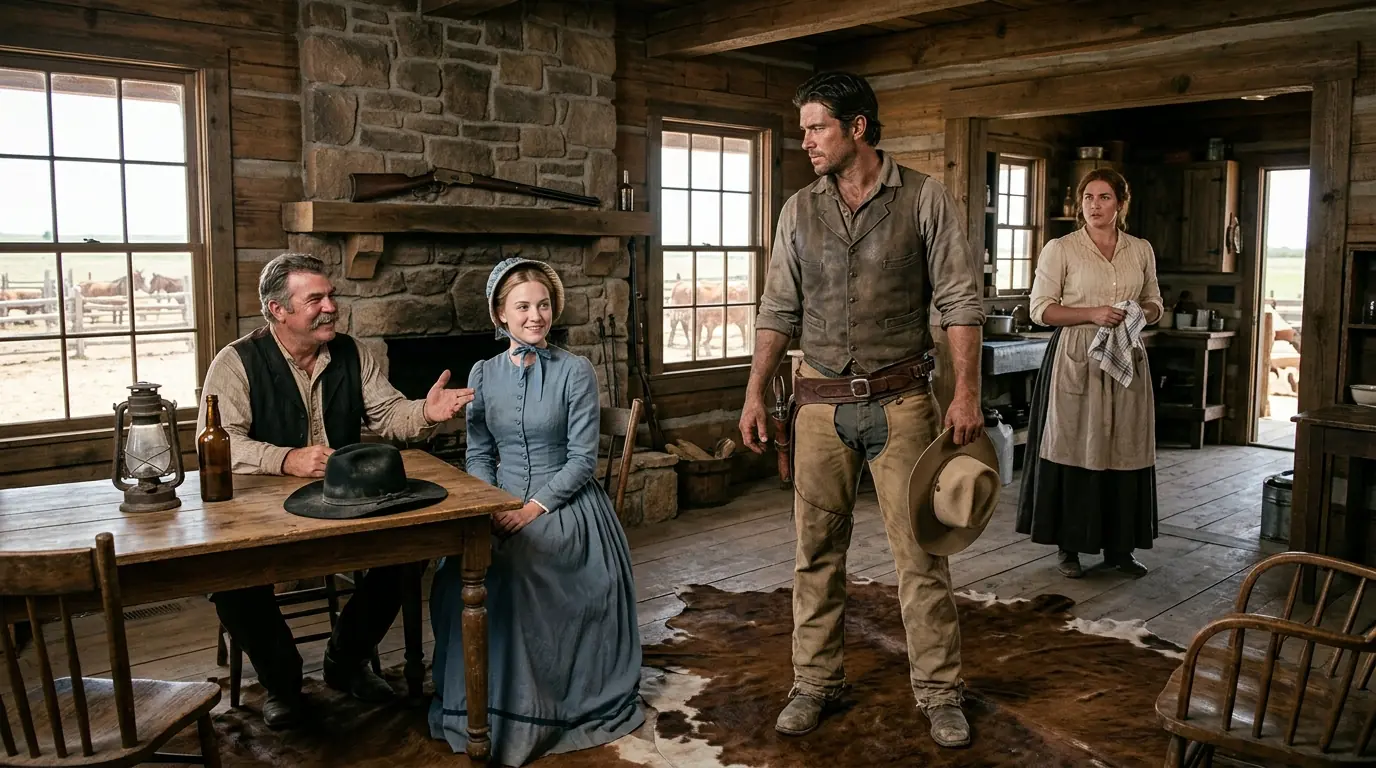
Dawson Mercer’s voice was not loud, but it stopped every sound in the Whitmore parlor. Harold Whitmore’s smile vanished. His wife froze with a teacup halfway to her lips. Eliza, twenty-two and beautiful enough that half the county had been predicting her marriage since she was sixteen, slowly turned toward the kitchen doorway. Standing there with a dish towel in her hands was her older sister, Lena, who had spent twenty-six years learning how to disappear inside her own family’s home. Dawson looked past everyone else and finished the sentence. “I came here to ask for Lena.”
For one strange second Lena wondered whether there might be another woman with her name standing somewhere behind her.
Nobody chose Lena first.
That was not self-pity. It was simply the architecture of the Whitmore household.
When visitors came, Harold introduced his daughters in the same order every time. “This is Eliza,” he would say with unmistakable pride. Then his hand would drift vaguely toward wherever Lena happened to be. “And Lena.”
Eliza had her mother’s pale gold hair, delicate features, and the instinctive ease of a person who had grown up knowing the room would notice when she entered. Lena was taller, broader through the shoulders, brown-haired, practical, and usually wearing something with a repaired seam because she considered replacing usable clothing a form of laziness. She had calluses from fencing, a pale scar along her forearm from barbed wire, and the strength to handle a difficult calving without waiting for a ranch hand to wake up. None of those things ever appeared in her father’s introductions.
That morning Dawson Mercer had arrived just after eight.
Lena had been kneading bread.
She saw him from the kitchen window before anyone else did: thirty-one years old, straight-backed on a gray roan, riding without hurry because Dawson Mercer was not a man who seemed to hurry toward anything. His ranch lay seven miles north and stretched across more land than Lena had ever walked in a day. He had started with forty cattle after his father died and, through a combination of judgment, stubbornness, and an almost irritating refusal to borrow beyond what he could repay, had turned the Mercer operation into one of the strongest ranches in three counties.
He also happened to be unmarried.
That fact interested almost everyone in Caldwell County except Dawson himself.
Lena heard her father before Dawson reached the porch.
“Eliza! Your dress. Margaret, where is she?”
Lena continued kneading.
Her mother hurried down the hallway. “Eliza, get up. Dawson Mercer is here.”
Lena almost smiled.
Of course he was here for Eliza.
Why else would a prosperous unmarried rancher visit a household with two daughters?
She shaped the dough, covered it, and started coffee.
Eight minutes later Harold entered with Dawson behind him.
“Finest summer we’ve had in years,” Harold was saying.
“Not on my north pasture,” Dawson replied.
Harold laughed too loudly.
Then he saw Lena.
“Ah. Dawson, you remember my daughter Lena. She helps around the house.”
Helps around the house.
Lena kept her face still.
Three days earlier she had found the south irrigation gate jammed, rebuilt the hinge, noticed early rot in two fence posts, and corrected a feed order her father had accidentally doubled.
Helps around the house.
Dawson removed his hat.
“Morning, Miss Whitmore.”
“Morning.”
He looked directly at her.
Not past her.
Not around her toward the hallway where Eliza would soon appear.
At her.
Lena felt something uncomfortable move beneath her ribs and retreated to the kitchen before it could become a thought.
Eliza appeared shortly afterward in a blue dress, her hair arranged quickly but beautifully.
Harold practically glowed.
Coffee was served. The conversation moved toward cattle prices, rail shipping, grass conditions, a county road proposal, and all the other topics men used when they wanted to conduct business while pretending they were not conducting business.
Eliza laughed politely.
Lena collected cups.
Then Dawson said, “Miss Whitmore.”
Both sisters looked up.
His eyes remained on Lena.
“Would you sit?”
Harold blinked. “Lena has things to do.”
“The coffee’s already poured.”
It was such a simple answer that Harold could not find a polite objection.
Lena sat.
For the next twenty minutes she mostly listened.
That was something she had become very good at.
Her father exaggerated the number of cattle he had successfully wintered the previous year. Dawson did not correct him, but Lena saw his eyes flick briefly toward her.
Later Harold claimed the west field had produced nearly twice its actual hay yield.
Again Dawson looked at Lena.
Not long.
Just enough.
As if her face were a second ledger he was checking against the first.
She gave him nothing.
After breakfast Margaret found an excuse to take Eliza into the garden.
Lena returned to the kitchen.
She was wiping cups when her father began the conversation he had obviously been waiting for.
“Well, Dawson. I imagine you’ve had enough opportunity to see the sort of girl Eliza is.”
Silence.
“Beautiful,” Harold continued. “Well raised. Knows how to keep a proper home. She would be a credit to any man’s household.”
Dawson set his cup down.
“I’m sure she would.”
Harold smiled.
“That’s why I came.”
Lena stopped moving.
Her father leaned forward eagerly.
Dawson continued. “But not for Eliza.”
Harold’s smile weakened.
“I’m sorry?”
“I want to speak with Lena.”
The dish towel slipped slightly in Lena’s hands.
Harold stared.
“You mean Lena?”
Dawson’s expression did not change.
“Yes, Harold. I know your daughters’ names.”
“Well, certainly, but—”
“But what?”
Harold looked toward the kitchen, realized Lena could hear every word, then lowered his voice as though that could undo what had already been said.
“Eliza is better suited.”
“For what?”
Harold had no answer ready.
Dawson waited.
Finally Harold said, “For your position.”
“What does my position require?”
“A wife who can represent you.”
“Represent me doing what?”
Harold’s irritation began showing.
“Dawson, don’t be difficult.”
“I’m trying not to be.”
That was when Lena walked into the parlor.
She had no plan.
She simply knew she could not remain behind a doorway while people discussed her future as though she were a fence post.
“What exactly are you asking?” she said.
Dawson stood.
That mattered to her.
Her father did not.
Dawson did.
“I’m asking whether you would consider marriage to me.”
Lena stared at him.
“Why?”
Harold made a sharp sound. “Lena.”
She ignored him.
Dawson almost smiled.
“Fair question.”
“It seems like the first question.”
“It probably is.”
He glanced toward Harold. “Could we have a few minutes?”
Harold objected for nearly a full minute before remembering that Dawson controlled grazing contracts Harold hoped to use next spring.
He eventually found urgent work outside.
The moment the door closed, Lena turned back to Dawson.
“You surprised him.”
“Yes.”
“You surprised me more.”
“I expected that.”
“Then answer me.”
He stood near the cold fireplace, hat held loosely in one hand.
“Last March there was a storm.”
Lena remembered immediately.
Everyone remembered that storm.
It had dropped out of the northwest after sunset with almost no warning, bringing freezing rain, wind, and enough lightning to spook every animal in the county.
Dawson continued. “One of my heifers got through the south fence. I went looking for her.”
Lena said nothing.
“I found her near your property.”
His gaze stayed on her.
“I also found you.”
Memory returned with uncomfortable clarity.
Mud to her knees.
Lantern swinging from a hook.
A cow bellowing in the barn.
The hired hand had gone to town. Harold had taken sleeping medicine for his back. A pregnant heifer had gone into labor wrong, one leg presented while the calf’s head was turned.
Lena had worked nearly two hours alone.
“You were on the barn floor,” Dawson said, “with one arm inside that cow trying to turn the calf.”
“The calf was breech.”
“I know.”
“You watched?”
“Long enough to understand you knew what you were doing.”
“You could have helped.”
“You already had it.”
That answer surprised her.
Most men would have invented a reason they had not stepped in.
Dawson simply acknowledged that she had not needed him.
“The calf lived,” he said.
“Yes.”
“So did the cow.”
“Yes.”
“And afterward you walked outside into freezing rain and repaired the gate because you knew if you left it broken, the rest of the cattle might get out before morning.”
Lena folded the dish towel once.
“You want to marry me because I fixed a gate?”
“No.”
“Because I pulled a calf?”
“No.”
“Then what?”
“Because nobody was watching.”
She went still.
Dawson continued.
“You didn’t do any of it to impress somebody. Nobody was going to praise you. Nobody even knew you were out there. Something went wrong, you understood it, and you handled it.”
“That’s not romantic.”
“No.”
His agreement came so quickly she nearly laughed.
Dawson said, “I don’t trust romance that requires ignorance. I’m sure it’s pleasant. But I have four thousand acres, two hundred cattle, eleven employees, debts that need managing, water agreements that need renegotiating, winter feed that has to be calculated correctly, and weather that doesn’t care whether anybody feels romantic.”
Lena stared at him.
“You make marriage sound like hiring a foreman.”
“I already have a foreman.”
For the first time she did laugh.
A small sound.
Dawson’s expression softened.
Then he said, “I want someone beside me who tells the truth when the truth is inconvenient. Someone who can make a decision when I’m twenty miles away. Someone who doesn’t fall apart because a plan fails. I’ve watched you since March, Lena.”
She disliked how that sentence sounded.
He saw it.
“Not from bushes.”
“That helps.”
“I mean I started paying attention.”
He named things she had forgotten.
The day she corrected a blacksmith who was about to put the wrong shoe on Harold’s mare.
The county fair when Lena had noticed a child wandering toward an agitated stallion and intercepted him before anyone else reacted.
The morning she argued with the feed merchant because the weight marked on six sacks did not match what had been delivered.
“You notice problems,” Dawson said. “Then you solve them.”
Lena looked away.
Nobody had ever described her that way.
Useful, yes.
Stubborn, certainly.
Difficult, sometimes.