In October of 1987, Hazel Morrow stood at the edge of her father’s farm and watched her husband leave.
Thomas’s pickup rolled slowly down the gravel lane, passed the old split-rail fence, and disappeared beneath a sky the color of cold steel. The red taillights flickered once between the maple trees, then vanished.
Hazel remained where she was long after the sound of the engine had faded.
The wind moved through the bare branches above her. Somewhere behind the barn, a loose sheet of tin lifted and struck the roof with a hollow bang.
That was what Thomas left her with.
A farmhouse growing colder by the hour.
A barn that would not survive many more winters without repairs.
A broken tractor.
Two equipment loans.
And three hundred acres of land that nearly everyone believed she would soon be forced to sell.
Thomas had not left in anger. Anger would almost have been easier.
He left with the calm certainty of a man who had decided that the future belonged somewhere else.
For months, he had called the farm a burden.
He said the cattle consumed more money than they returned. He said the maple bush belonged to another century. He said Hazel’s father had been too stubborn to sell when developers first approached them in 1984.
Most often, he said the same thing.
“This place is finished.”
Then he accepted a construction job in the city, packed two suitcases, removed his name from the operating loan, and drove away.
By the end of the week, Hazel had taken back her maiden name.
It did not reduce the debt.
It did not repair the tractor.
But it returned one small thing Thomas had no right to keep.
Her father’s name.
Remy Morrow had died seven months earlier.
Pancreatic cancer took him quickly, though not quickly enough to spare him the frustration of missing one final maple season. He had spent seventy-one years on that farm and died in the same upstairs room where he had been born.
Hazel had sat beside him during his final week.
Even then, when pain had reduced his world to the distance between the bed and the window, he asked about the land.
Had the south fence held after the thaw?
Was the loader cylinder still leaking?
Had Thomas checked the tension on the baler chain?
Remy did not leave behind a modern farm.
He never wanted one.
He left behind equipment that was old but understood, fields protected by cover crops, a sugar bush maintained one line at a time, and a record of nearly every dollar he had spent since 1971.
He also left very little debt.
At least, that had been true before Thomas began making plans.
Thomas believed the farm needed to grow if it was going to survive. He persuaded Remy to finance a secondhand loader and a newer hay baler. Neither purchase was foolish on its own, but both came with payments that changed the shape of the operation.
The baler broke down twice in its first season.
The loader worked well, but the interest rate was higher than Remy would ever have accepted when he was healthy.
By the time Hazel inherited the property, she also inherited the payments attached to those machines.
The farmhouse had its own complaints.
The hot-water tank rumbled as if stones were moving inside it. The kitchen window admitted a thin line of cold air. One section of the barn roof sagged whenever snow collected along the eastern side.
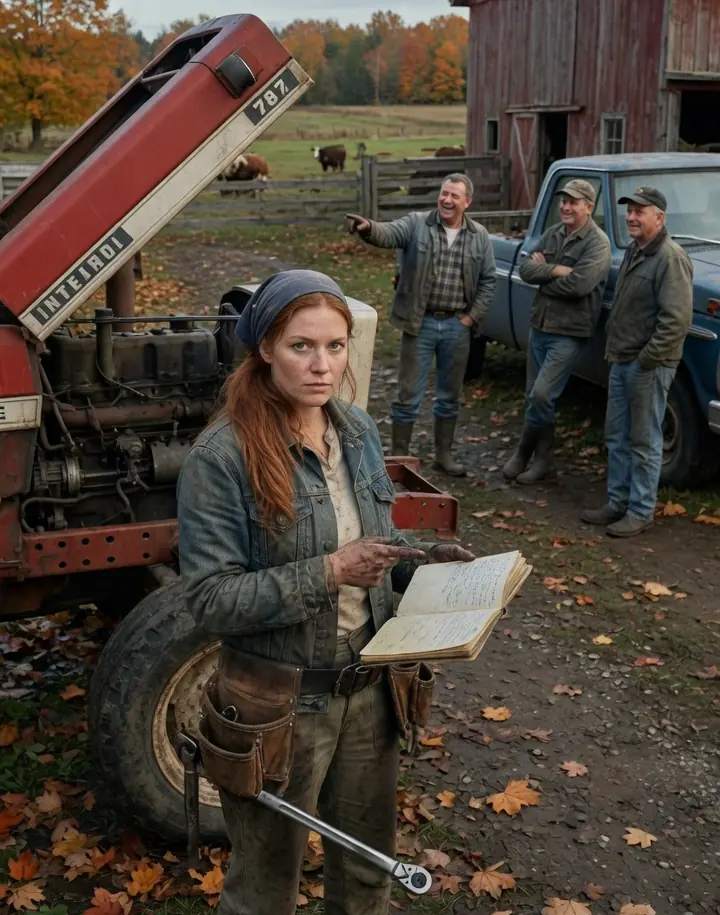
And in the machinery shed sat a 1979 International 784 that Thomas had declared ruined.
A mechanic he knew had looked at the engine for less than a minute and announced that the block was cracked.
Thomas accepted the diagnosis without question.
The repair, he said, would cost more than the tractor was worth.
So the machine remained in the shed for three weeks, surrounded by dust, old oil cans, and the smell of cold iron.
Its silence became part of the larger silence that settled over the farm after Thomas left.
Hazel’s neighbors did not speak unkindly about her.
They simply understood numbers.
A single woman of twenty-seven could not easily run three hundred acres, feed cattle through an Ontario winter, manage the maple season, repair machinery, and meet payments without off-farm income.
That was what people said in kitchens, feed stores, and parking lots.
Some believed Hazel would sell before Christmas.
Others thought she might last until spring.
Almost no one believed she could keep the place for long.
The surrounding farms were already disappearing.
Investment companies from Ottawa and Montreal had begun buying land throughout eastern Ontario. Their representatives arrived in clean coats and polished shoes, speaking of consolidation, efficiency, and future development.
They rarely spoke of soil.
They spoke of acreage.
They did not ask what had been planted.
They asked what the land could be converted into.
The Larue family had sold in the spring.
The old Beaumont cattle farm was being turned into storage buildings for a manufacturing company from Hawkesbury.
Every sale made the next one easier.
A farm ceased to be a farm, then became evidence that the neighboring farm should stop trying too.
One week after Thomas left, Hazel drove into town.
She parked Remy’s old Chevrolet outside the agricultural lending office and sat behind the wheel for a moment before going inside.
Richard Caldwell received her in a small office at the back of the building.
He had known her father for more than twenty years.
Caldwell respected Remy, though Hazel suspected he had never fully understood him. Bankers preferred decisions that could be explained in columns. Remy made many decisions based on weather, machinery sounds, and what he believed the soil would need five years later.
His methods did not always fit neatly on paper.
His results did.
Caldwell gestured toward the chair across from his desk.
“Hazel, I want to be honest with you.”
She sat without removing her work jacket.
He folded his hands.
“The operating account is heavier than I would like going into winter. With Thomas no longer attached to the loan, the bank has to reconsider the risk.”
“The payments are current.”
“At the moment.”
“They’ll remain current.”
Caldwell looked down at the file.
“The maple season does not begin until March. Hay income will be limited through winter, and the tractor requires a major engine replacement.”
“It has not been properly inspected.”
“I understand you want another opinion.”
“I intend to give it one.”
He lifted his eyes.
Caldwell was not an unkind man. That made what came next more difficult, because he spoke as though he were protecting her.
“There is another option.”
Hazel waited.
“A company from Ottawa is acquiring farms along your concession. They have already expressed interest in your property. They would assume the equipment debt, clear the operating balance, and pay market value for the land.”
He leaned forward slightly.
“You could leave without owing anyone.”
Hazel looked at him.
“Leave and go where?”
“That would be your decision. You are still young. You could start again.”
“I already have a place to start.”
Caldwell exhaled.
“Hazel, I knew your father. I know what this land meant to him.”
“That isn’t what I asked.”
He paused.
“No.”
“I’m not selling.”
The room seemed to become smaller.
Caldwell leaned back in his chair.
“You cannot run that operation alone.”
“I can run it through winter.”
“You have no hired help.”
“I have myself.”
“The tractor may be beyond repair.”
“It may not be.”
“You have no capital for a replacement.”
“Then I won’t replace it.”
Caldwell watched her with the weary expression of someone listening to determination he believed reality would soon correct.
“I need you to be practical.”
Hazel stood.
“I am being practical.”
She collected the folder she had brought with her.
“I’ll bring the loan current by May.”
Caldwell did not argue further.
But his silence said what nearly everyone else was thinking.
She would return.
Sooner or later, the winter would persuade her.
Hazel drove directly back to the farm.
She did not enter the farmhouse.
Instead, she crossed the yard to the machinery shed and pulled the cord hanging beneath the overhead light.
The bulb flickered once before coming alive.
Its weak glow left the corners of the building in shadow.
Remy’s toolbox stood against the wall.
It was a gray Mastercraft cabinet on wheels, dented at one corner and stained with years of grease. Every wrench, socket, puller, and gauge had a specific place inside it.
Remy believed disorder wasted time.
He also believed wasted time eventually became wasted money.
Above the toolbox was a shelf of service manuals. Some had been purchased with the equipment. Others were photocopies from books Remy borrowed from the library.
His pencil notes covered the margins.
Wrong bolt length in diagram.
Check seal before replacing pump.
Supplier in Cornwall cheaper after freight.
Beside the manuals sat a yellow legal pad with black electrical tape reinforcing its cover.
Hazel lifted it from the shelf.
Remy had begun the notebook in 1971.
Every major repair was recorded inside.
Date.
Problem.
Diagnosis.
Part number.
Supplier.
Cost.
Result.
He wrote in careful block letters because he had never been taught cursive.
The notebook contained no speeches and almost no emotion.
Yet as Hazel turned the pages, she heard his voice more clearly than she had since his funeral.
The International 784 had its own section.
Remy recorded an overheating problem in 1983, a water-pump replacement in 1985, and a minor coolant leak the previous winter.
He had also written a note beside the most recent entry.
CHECK HEAD GASKET IF COOLANT RETURNS TO OIL. BLOCK TESTED SOUND, 1986.
Hazel read the sentence twice.
Then she carried a flashlight to the tractor.
The mechanic who diagnosed a cracked block had pointed to coolant in the oil as proof.
It was serious evidence.
But it was not proof of the diagnosis he had given.
Hazel removed the side panels and began inspecting the engine.
She checked for exterior cracks.
Nothing.
She looked around the freeze plugs, the lower block, and the water jacket.
Nothing.
Then she studied the head and gasket line.
There were signs of leakage.
Small ones.
Easy to overlook if a person had already decided the engine was finished.
She returned to the workbench and opened the service manual.
For the next two hours, Hazel moved between the manual, her father’s notebook, and the tractor.
By midnight, she reached a conclusion.
The block was probably fine.
The head gasket had failed.
It was not a simple repair.
She had never removed a cylinder head before.
But the work was described clearly.
The machine was not mysterious.
Only unfamiliar.
The next morning, Hazel drove to an implement dealer in another county.
She did not want to hear the story of the abandoned farm repeated while she stood at the parts counter.
The dealer located the gasket set and new head bolts.
The total came to just under forty-seven dollars.
Hazel counted the money twice before handing it over.
The repair took four days.
On the first day, she drained the coolant and oil, removed the intake and exhaust connections, and labeled every wire and hose with masking tape.
She arranged each bolt on a piece of cardboard in the order it came out.
On the second day, she lifted the cylinder head with the loader hoist and examined the gasket.
The failure was visible immediately.
A narrow burned section had opened between a coolant passage and one cylinder.
Thomas’s mechanic had been wrong.
The tractor was not dead.
It had been misjudged.
Hazel cleaned the surfaces exactly as the manual instructed. She checked the head with a straightedge. She measured twice. She waited when uncertain.
Remy had often told her that impatience damaged more machinery than bad parts ever did.
By the fourth evening, the engine was reassembled.
Hazel did not attempt to start it immediately.
She went inside, ate a bowl of soup she barely tasted, and slept for six hours.
At dawn, she returned to the shed.
The air was cold enough to show her breath.
She climbed into the cab, turned the key halfway, and waited for the glow plug.
Then she started the engine.
The tractor turned over once.
Twice.
On the third attempt, it caught.
A cloud of gray exhaust moved toward the open shed door.
The engine settled into a steady idle.
Hazel climbed down and walked around the machine.
No coolant leaked.
The oil remained clean.
The temperature rose slowly, then held.
She checked every connection.
Then she checked them again.
When she finally returned to the cab, she rested both hands on the steering wheel.
She did not cry.
She did not laugh.
She simply listened to the engine and understood that the first impossible thing had been done.
Winter arrived early.
The cold came in layers.
First frost hardened the pasture grass. Then snow filled the fence corners. By January, the mornings were so severe that metal tools burned bare fingers.
Hazel fed the cattle before sunrise and again before dark.
She repaired gates by lantern light.
She split firewood until her shoulders ached.
Nothing on the farm failed at a convenient time.
A water line froze beneath the barn.
The loader lost pressure on a January morning.
A section of fence collapsed after cattle crowded against it during a storm.
Each problem took time from another problem.
Hazel kept a notebook in her coat pocket and wrote down what had to be done in order of consequence.
Animals first.
Water second.
Heat third.
Debt fourth.
Comfort only if time remained.
There was rarely time.
Walter Fenton became the closest thing she had to regular help.
He farmed two concessions north and had known Remy since they were boys. Walter was nearly seventy, narrow-faced, and uncomfortable with gratitude.
He never offered charity.
Instead, he offered trades.
Hazel helped him move cattle before a freeze. He lent her a post-hole auger.
She repaired a hydraulic hose on his loader. He brought her two jerry cans of diesel when prices rose.
No one kept a formal account.
Both of them remembered.
One February night, freezing rain covered the valley.
Ice pulled down a section of the hydro line near the barn, leaving the farm without power.
Hazel started the generator.
By eleven, the fuel gauge was nearly empty.
The roads were closed.
The temperature was falling.
The cattle had water, but the barn heaters and house furnace could not run through the night without more diesel.
For the first time since Thomas left, Hazel felt the full weight of being alone.
She sat at the kitchen table with a candle burning in an old saucer.
The farmhouse was quiet except for the wind pressing ice against the windows.
The bank loan.
The barn roof.
The maple season still weeks away.
The equipment payments.
Every burden seemed to arrive at once and sit beside her.
Hazel placed Remy’s notebook on the table.
She did not open it for technical advice.
She only wanted something that had belonged to him beneath her hands.
When she lifted the back cover, a folded piece of paper fell onto the table.
The paper had yellowed with age.
Remy’s block handwriting covered one side.
THE LAND KEEPS WHAT YOU GIVE IT.
BAD YEARS END.
THE ONES STILL HERE WHEN THEY DO ARE THE ONES WHO DIDN’T LET THE BAD YEARS MAKE THE DECISIONS.
Hazel read the words once.
Then again.
Her father had not written that note for her.
Perhaps he had written it during a season she was too young to remember. Perhaps it had been meant for himself.
It did not matter.
She stood, put on her coat, and went outside.
Behind empty feed sacks in the generator shed, she found a half-full fuel can she had forgotten.
It was enough to keep the generator running until morning.
Hazel refilled the tank, returned to the kitchen, and wrote a list for the next day.
The fear had not disappeared.
But it had stopped making decisions.
Spring came slowly.
The maple sap began running late, then surged when warm afternoons followed freezing nights.
Hazel worked from before sunrise until after dark.
She checked lines, hauled sap, watched the evaporator, and slept in short stretches.
The syrup that year was unusually clear.
Light amber.
It sold well at markets in Hawkesbury and Alexandria.
The income mattered.
But the greater proof appeared in the fields.
Remy had always planted fall rye and clover after harvest. Some neighboring farmers considered the practice unnecessary. Hazel continued it because the soil told her he had been right.
By the following spring, the lower fields absorbed rain differently.
Water no longer gathered in shallow pools.
The earth was darker.
Worms appeared wherever Hazel turned the soil.
Walter Fenton crouched in one field and lifted a handful.
He broke it apart between his fingers, examined the roots, then gave one slow nod.
From Walter, that was high praise.
Hazel’s yields were not the largest in the district.
They did not need to be.
Her fertilizer costs remained low. Her machinery was old but mostly paid for. She repaired rather than replaced.
She never made decisions based on the best possible year.
She made them based on whether the farm could survive the worst one.
That distinction saved her.
By 1990, interest rates had climbed high enough to turn ordinary farm loans into crushing obligations.
Beef prices weakened.
Large operators with new equipment and significant debt discovered that impressive production did not guarantee survival.
The land companies that had been buying farms became quiet.
They had borrowed too much too.
Properties changed hands through receivership instead of negotiation.
The Beaumont place failed under its second owner.
A young dairy couple east of Hazel lost their farm during a bank restructuring. The cattle were sold first. The equipment followed. Then the land.
Hazel watched trucks carry away machines she had seen working those fields for years.
Her own operation remained narrow but stable.
The loan on the loader and baler was nearly paid.
She had used income from maple syrup and hay to reduce the principal whenever possible.
She had not expanded the herd.
She had not purchased a new tractor.
She had not added buildings simply because a lender was willing to finance them.
She was not becoming wealthy.
She was becoming difficult to remove.
In May of 1991, Richard Caldwell returned to the farm.
He arrived in an unfamiliar sedan and parked beside the equipment shed.
Hazel was working on the baler’s slip clutch.
The parts lay on cardboard. The service manual was open. Her father’s torque wrench rested beside her knee.
Caldwell stood at the entrance for a moment before speaking.
“I bought some of your syrup last month.”
Hazel continued adjusting the clutch.
“At the Hawkesbury market,” he added. “Light amber.”
“It was a decent run.”
“It was excellent.”
Hazel looked up.
Caldwell removed his hat.
“I’ve driven past several times.”
She waited.
“I wasn’t certain I should stop.”
“You stopped today.”
“Yes.”
He looked beyond her toward the fields.
The fences were straight. Cattle grazed in the near pasture. The International 784 stood outside the barn with its paint faded but its engine sound.
“I came to tell you I was wrong.”
Hazel set down the wrench.
Caldwell continued.
“In 1987, I looked at the farm and saw debt, old machinery, and one person where I believed there needed to be three.”
“That was what was there.”
“No.”
He shook his head.
“That was what I knew how to measure.”
His eyes moved toward the yellow notebook on the bench.
“I saw a problem to resolve. I did not see Remy Morrow’s daughter.”
Hazel said nothing.
“How did you repair the tractor?”
“It was never the block.”
“What was it?”
“Head gasket.”
“You replaced it yourself?”
“My father’s records told me where to look. The manual told me how to do the work.”
Caldwell smiled faintly.
“You say that as though anyone could have done it.”
“Anyone patient enough could have tried.”
He held out his hand.
“I should have trusted you.”
Hazel wiped her palm on a shop cloth and shook his hand.
She did not need his apology.
But she accepted it because it was honestly given.
Three months later, Thomas returned.
His truck looked older. So did he.
The construction job had disappeared during the recession. The city had not rewarded him the way he expected.
He stood beside the truck and surveyed the farm.
The repaired fences.
The healthy cattle.
The mowed hayfields.
The tractor he had called worthless.
Hazel came onto the porch.
Thomas did not walk toward her.
“I heard you’re the only place on this concession that stayed out of the bank.”
Hazel leaned against the porch post.
“I heard a lot of things too.”
He lowered his eyes.
“I called this farm a losing proposition.”
“You did.”
“I called your father a fool.”
“You did that too.”
Thomas looked toward the maple bush.
“I was wrong about him.”
Hazel waited.
“I was wrong about the farm.”
His voice became quieter.
“And I was wrong about you.”
For a moment, neither spoke.
“I didn’t come to ask you to take me back,” Thomas said. “I know better than that.”
Hazel studied him.
“Then why did you come?”
“Because I wanted to say it where I said the other things.”
She understood.
Some apologies were not requests.
They were debts.
Thomas had finally come to pay his.
Hazel nodded once.
“I know.”
Then she returned inside.
Thomas drove away.
She did not remain on the porch to watch the truck disappear.
By 2009, Hazel Morrow had operated the farm alone for more than two decades.
The property remained three hundred acres.
She had never wanted more land.
More was not the same as better.
Instead of expanding outward, Hazel improved what she already possessed.
The soil deepened.
The maple bush became more reliable.
Her cattle developed a reputation at regional markets.
The loans disappeared one by one.
The hot-water tank finally failed in 1993. Hazel replaced it with money saved from a strong syrup season, using a plumbing manual and Walter Fenton’s assistance.
The old International remained in the shed.
Hazel paid to have the engine rebuilt properly in the late 1990s. She wrote a check for the work and recorded every part number in a new yellow notebook.
In 2001, she purchased a secondhand utility tractor.
The dealer spent twenty minutes explaining financing options.
Hazel allowed him to finish.
Then she paid the full amount.
Young farmers began visiting the property.
Many had agricultural degrees, satellite field maps, computerized yield records, and expensive equipment subscriptions.
Hazel had no objection to any of those things.
She simply understood that information was not the same as judgment.
They came to ask her how to read a field after rain.
How to recognize machinery problems before failure.
How to improve soil without doubling input costs.
How to build an operation that could endure a bad year without surrendering everything earned in a good one.
Hazel did not present herself as an expert.
She showed them records.
The original yellow pad was followed by another.
Then a third.
Each contained the history of the farm in the same plain block lettering Remy had used.
Repairs.
Costs.
Weather.
Yields.
Mistakes.
Observations.
No year was described as perfect.
No machine was treated as immortal.
Everything was watched.
Everything was maintained.
Everything was expected to speak before it failed.
One afternoon in October, Hazel stood inside the machinery shed with her twenty-two-year-old niece, Petra.
The maple leaves outside had turned red and orange.
Petra had been working at the farm every weekend since August. She did not talk constantly about farming. She simply arrived, listened, and returned the next week.
That was how Hazel knew she was serious.
They stood beside the old baler.
Almost every moving component had been replaced over the years. Only the frame remained original.
Remy would have approved.
Hazel pressed the drive chain sideways with two fingers.
“The manual gives you the measurement,” she said. “But measurements only tell you where to begin.”
She released the chain.
“Listen.”
Petra leaned closer.
Hazel pushed it again.
“Now try.”
Petra placed her fingers against the links.
“Too loose?”
“Not yet.”
“How can you tell?”
“The sound changes before the measurement does.”
Hazel adjusted the chain slightly and moved it again.
Petra listened.
“That’s different.”
“Yes.”
“Your father taught you that?”
“He taught me that machines rarely fail without warning. People simply become too busy, too proud, or too impatient to hear it.”
Hazel walked to the shelf above the gray toolbox.
Four yellow notebooks rested there now.
She took down the newest one.
Half its pages were still blank.
Hazel handed it to Petra.
“You’ll need this.”
Petra accepted it carefully.
“What should I write first?”
Hazel looked beyond the shed toward the fields.
“Everything you don’t want to learn twice.”
Outside, the wind moved through the sugar maples.
The old International sat beside the barn, its engine ticking softly as it cooled.
Another autumn had arrived.
Winter would follow.
Then spring.
The farm had never promised Hazel an easy life.
Her father had never promised that either.
What he left her was something more useful.
The knowledge that survival was rarely one heroic act.
It was attention.
Restraint.
Repair.
The decision not to let fear purchase an answer that patience might solve more cheaply.
The land had kept every season of work Hazel gave it.
The soil remembered the clover.
The machinery remembered maintenance.
The maple bush remembered each careful cut.
And Hazel carried forward the lesson that had saved the farm when nearly everyone expected it to disappear.
Bad years ended.
But only for those who refused to let the bad years decide what came next.