By noon, the line outside the Prairie Union elevator stretched past the sale barn, past the cemetery, and nearly to the old feed store with the broken Coca-Cola sign. Every wheat grower in Mercer County seemed to be sitting in that line, engines idling, grain trailers full, faces tight behind dusty windshields. The posted price on the electronic board blinked in red numbers: hard red winter wheat, $4.68 a bushel. Men who had spent eleven months praying over their fields were now praying the price would not fall before their truck reached the scale.
Nathan Bell stood on the shoulder of a gravel road with his cap pulled low and one hand resting on the radio clipped to his vest. He was fifty-nine years old, lean, quiet, and weathered into the color of old fence posts. His family had farmed outside Lawder, Kansas, for three generations, not rich, not corporate, not flashy, just steady enough to survive most years and humble enough to fear every year. Behind him, four brand-new steel grain bins stood beside his machine shed, shining like silver watchtowers in the harvest dust.
His foreman’s voice crackled through the radio. “Truck one is at the turnoff. Want me to get in line?”
Nathan looked at the elevator board again. Then he looked at the trucks coming off his fields, the amber wheat riding heavy in the trailers, the crop everyone said was adequate but that his hands told him was not. He had walked those fields himself. The stands looked pretty from the road, but the grain was light, the protein uneven, and the May wind had taken more yield than the county wanted to admit.
“No,” Nathan said into the radio. “Bring it home.”
There was a long pause. “Home? All of it?”
“All of it.”
By supper, the whole county knew Nathan Bell had refused to sell. By breakfast, most of them had decided he had lost his mind. At the diner, the talk moved from weather to Nathan before the first coffee refills. Men who had sold at $4.68 called him stubborn because calling him brave would have made them question themselves.
Nathan had built his answer four months earlier, when he signed a construction note that made his wife, Elise, stop speaking for almost an hour. He had not bought the new combine he needed. He had not replaced the grain cart that rattled like loose teeth over rough ground. He had not remodeled the farmhouse kitchen Elise had wanted fixed for ten years.
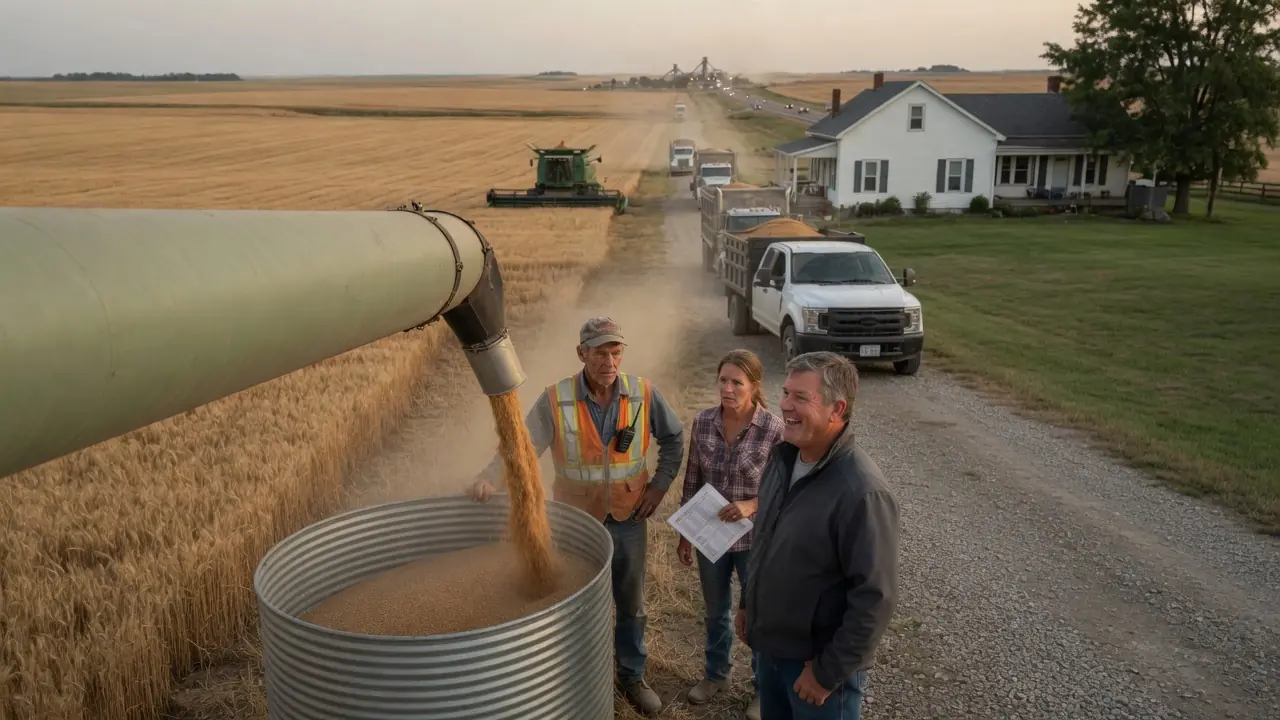
Instead, he poured concrete pads behind the barn and raised four steel bins big enough to hold nearly half a million bushels. He ran power, installed temperature cables, bought fans, added full-floor aeration, and put up a grain leg tall enough to be seen from the highway. Neighbors slowed down for weeks to stare at the project. Some admired it, but most laughed because new bins on a debt-heavy farm looked less like strategy than pride with bolts.
That evening, Wade Sutter’s white pickup came down Nathan’s lane fast enough to throw gravel. Wade was the largest farmer in three counties, with fifteen thousand acres, new equipment every two years, and his farm logo stitched over the heart of his softshell jacket. He farmed like a man trying to win a war no one else had agreed to fight. When he stepped out, his boots were cleaner than Nathan’s kitchen floor.
Nathan stood beneath the grain leg, watching wheat pour through the spout in a hard amber stream. Dust drifted around him, catching the evening light. Elise stood on the porch with a folded spreadsheet page in one hand, her face caught between loyalty and fear. She had run the numbers until the numbers seemed to look back at her.
Wade raised his voice over the machinery. “You building a museum for bad decisions, Nate?”
Nathan did not look away from the falling grain. “Something like that.”
“I dumped eighty thousand bushels this morning,” Wade said. “Four-sixty-eight is ugly, but ugly cash still spends. You store this crop, and you’re paying interest on hope.”
Nathan turned then, slow and calm. “I’m paying interest on control.”
Wade laughed and pointed toward the highway. “Control is a story farmers tell themselves before the bank reminds them who owns the note.”
Nathan shut off the auger. The sudden quiet made the yard feel larger, and the grain dust settled slowly between the three of them. Wade stepped closer, lowering his voice as if pretending concern made the insult less sharp. “I heard you pledged the west quarter to put these bins up. That true?”
“That’s between me and the bank,” Nathan said.
“It won’t be when the auction notice hits the paper.”
Elise’s hand tightened around the spreadsheet. Nathan saw it and hated that she had to stand there listening to another man name the fear already living in their house. Wade looked at her, then back at Nathan, with the smug patience of a man who believed time itself was on his side. “You’re a good grower, Nate, but this is not the old days. The market doesn’t care about your hunch.”
“The market has been wrong before,” Nathan said.
Wade smiled without warmth. “Then pray it is wrong fast.”
After Wade drove away, the farmyard seemed too quiet. The bins stood full of promise or ruin, depending on which part of Elise’s spreadsheet a person believed. Nathan restarted the auger and watched the wheat flow again. Elise stayed on the porch until the light went out of the sky.
Inside the farmhouse, the kitchen table had become a battlefield of paper. Elise had operating loan sheets, bin construction interest schedules, land rent notices, seed bills, and handwritten notes in columns so careful they looked almost cruel. One page showed what they could have brought in if Nathan had sold at harvest. It would have been painful, but survivable.
The next page showed the cash they actually had. That page looked like a floor giving way.
Glenn Mercer at Farmers State had already called twice that week. Glenn was not a cruel banker, which made it worse. Cruel men are easier to hate than decent men wearing bank coats. Glenn had known Elise since school, had eaten barbecue in Nathan’s yard, and still had a loan committee waiting behind him like weather no farmer could talk down.
“You know what we owe by February,” Elise said without looking up.
Nathan washed wheat dust from his hands at the sink. “I know.”
“Two hundred eighty thousand dollars.”
“I know.”
“You say that like knowing makes it smaller.”
Nathan dried his hands slowly. “Selling today makes it smaller for the bank, not for us.”
Elise looked at him then, her eyes tired and sharp. “And holding makes it what? A miracle?”
He pulled a folded report from his shirt pocket, the corners soft from too much handling. “Look at the protein surveys. Eastern Kansas is low. Oklahoma is worse than they’re saying. Nebraska’s test weights are down. The mills are pretending they have choices because everyone is hauling grain to town at once.”
“And if they keep pretending until after February?” Elise asked.
Nathan looked out the kitchen window, where the bins reflected the last purple of evening. “Then those bins are the most expensive tombstones in Mercer County.”
The first month nearly proved Wade right. Wheat crept from $4.68 to $4.79, then slid back down to $4.62. Freight rates jumped. Storage interest piled up. Every day Nathan did not sell, the farm borrowed a little more courage from a future that had not yet agreed to pay.
Nathan acted calm in town, but at night he walked the bins with a flashlight and notebook. Stored grain is not dead. It breathes, shifts, sweats, warms, cools, and lies to a man who forgets to listen. If one warm pocket forms deep in the core, a fortune can turn sour before the surface gives a warning.
In late November, bin three lied.
The alarm chirped at 1:18 in the morning, thin and digital from the monitor near the bedroom door. Nathan woke before the second chirp and was already pulling on jeans when Elise sat up. “What is it?” she asked. “Bin three,” he said.
The readout showed a temperature jump on cable six, thirty feet down. Grain that should have been cooling with the season had warmed to seventy-four degrees. In November, that number felt like a hand around Nathan’s throat. He drove the utility cart across frozen ruts while Elise watched from the back door in her robe.
At the bin, he started the fan and felt the motor shudder through the concrete. Then he climbed the icy ladder, seventy feet up, rung by rung, the flashlight beam shaking in his teeth. At the roof hatch, he lifted the lid against the wind. The smell came out immediately.
Not ruined, not yet, but sour enough to make his stomach turn. The wheat surface looked smooth and innocent under the flashlight beam. The danger was buried where he could not see it. That was always how trouble worked on a farm: it grew first in the places a man trusted too much.
For ten days, Nathan fought bin three like a field fire. He ran fans until the electric meter spun hard. He pulled grain from the center, hired a crew from Salina to core the bin, and wrote a check he could not afford because not writing it would cost more. They saved most of the wheat, but not all.
Twelve thousand bushels came out musty and heat-stained. Prairie Union took it at a discount so deep Nathan could barely sign the ticket. By the next morning, Wade was telling the story at the diner as if he had personally predicted the temperature on cable six. “He thought he was smarter than the market,” Wade said loudly. “Now he’s paying men to dig spoiled wheat out of his own monument.”
Men laughed into coffee cups because fear sounds better when someone else is wearing it.
December froze Mercer County solid. Wheat stubble disappeared under gray snow, stock ponds skinned over with ice, and the trains sounded louder at night as their horns dragged across the dark. The cash price improved to $4.91, then stopped. It was not enough to save anything.
Elise stopped leaving bank envelopes on the kitchen table. She stacked them in a drawer, as if hiding them could slow them down. Nathan noticed but said nothing. Marriage on a farm is often two people pretending not to see the other one trying not to break.
On January 14th, Glenn Mercer drove out himself. He found Nathan in the shop replacing worn bearings on an old drill, hands greasy, radio on low, bins standing silent outside the open door. Glenn did not smile when he stepped inside. That told Nathan more than any greeting could have.
“Nate,” Glenn said, “I have defended this file as long as I can.”
Nathan wiped grease off his fingers. “I need more time.”
“You don’t have more time. The committee wants a liquidation plan. Sell enough wheat to clean up the operating line.”
“At this price, that only saves the bank,” Nathan said. “It kills the farm.”
Glenn looked exhausted. “The bank is not here to prove you right.”
Nathan walked to the shop door and looked at the bins. “Flour mills are buying hand to mouth. They’re living off contracted wheat and assuming rail will fill the gaps. But the west crop is light. Protein is scarce.”
“I can’t take ifs into a loan committee,” Glenn said. His voice sharpened, then softened. “I am trying to keep you from losing the land. Don’t make me be the man who files on you.”
He put a folder on the workbench. February 20th. Two hundred eighty thousand dollars. After that, the bank would start action on the north quarter.
That evening, Wade came back with a purchase agreement in his hand. This time, he did not joke. He stood on the porch in the cold, his white pickup idling behind him. Nathan opened the door, and Elise appeared behind his shoulder.
“I’ll buy the north quarter,” Wade said. “Cash close in forty-eight hours.”
Nathan stared at the paper. The price was low, not accidentally low, but shaped to fit desperation. Wade knew exactly what kind of pain he was measuring. He held the agreement like a man offering mercy.
“That ground has been in my family since my grandfather first bought it,” Nathan said.
“And it’ll be in the county auction if you keep pretending pride is a plan.”
Elise’s face went pale. Wade lowered his voice, aiming the next words at both of them. “I’m giving you a clean exit. Pay Glenn, keep the house, keep some land, learn from it.”
Nathan took the agreement. For one second, Elise thought he might sign, and the hope that passed across her face nearly broke him. Then he folded the paper once, then again. He tore it clean down the middle.
Wade’s eyes hardened. “You’re going to drag your wife into ruin over a number on a screen.”
Nathan dropped the torn halves at Wade’s boots. “No. I’m not selling pain at a discount.”
After Wade left, Elise shut the door slowly. The house was silent except for the furnace kicking on beneath the floor. Then she turned on Nathan with tears in her eyes and anger in her voice. “Why?”
“Elise.”
“No. Tell me why. Not with protein levels or basis or freight or reports. Tell me why you tore up the only offer on the table.”
Nathan looked older than he had that morning. “Because it was not an offer. It was Wade measuring how much pain we could stand.”
“And what if he measured correctly?”
Nathan had no answer. That night, Elise slept in the spare room. Nathan stayed in the kitchen until nearly dawn, looking at the drawer where she had hidden the bank envelopes.
The last week before February 20th arrived with a low sky and a mean wind. Nathan checked cables, cleaned sensors, shoveled snow away from fan housings, and called two mills and three brokers. Each one said the same thing. Plenty of wheat on paper. Call back later.
On February 19th, Luis Ortega found Nathan in the machine shed. Luis was twenty-four, steady, and newly married, and he twisted his cap in both hands before speaking. “Mr. Bell, I hate asking, but my paycheck is late again.”
Nathan closed his eyes. The shame hit harder than Glenn’s folder or Wade’s offer. “I know.”
“My wife’s car payment is due.”
Nathan reached into his coat pocket and pulled out the keys to the old service pickup. “Take the truck tonight. If I don’t have your pay tomorrow, the title is yours until I do.”
Luis shook his head. “I don’t want your truck.”
“I know,” Nathan said. “But you deserve more than a promise.”
That evening, Nathan drove into Lawder. He did not go to the bank. He went to the diner, where the bell over the door rang and conversation faded just enough to be noticed. Wade sat in the back booth with two younger farmers and a plate of chicken-fried steak.
Nathan took a stool at the counter. Mara, the waitress, poured coffee without asking. “Rough weather coming,” she said.
“Seems like it,” Nathan replied.
On the television above the pie case, the farm news ran with the sound low. Commodity tickers crawled along the bottom of the screen. Wheat: $4.93. Nathan did not look at it long because he knew what failure looked like now. It was not lightning. It was math.
When he returned home, Elise was sitting in the living room with the lights off, watching the same farm news. Glenn had left a message: 9:00 tomorrow, bring payment or bring a signed sale plan. Nathan sat beside her. For a while, neither of them spoke.
Then Nathan said the words he had avoided for months. “I may have been wrong.”
Elise did not answer.
“I thought I could read the crop better than they could. I thought the shortage would surface before the note came due. I thought storage would turn time into leverage.” His voice cracked on the last word. “But time is only leverage if you survive long enough to use it.”
Elise reached for his hand in the dark.
The anchor’s voice changed before either of them could say more. The words were ordinary at first, then they were not. A winter storm system had stalled over the central plains. Ice had shut down switching yards across Kansas and Missouri. Two unit trains loaded with milling wheat were stranded outside Topeka, and a derailment near Emporia had closed a key rail corridor.
Nathan sat forward.
The anchor continued, reporting that drought in parts of the southern plains had reduced high-protein wheat availability more than early estimates suggested. Regional flour mills were warning customers of possible production delays. Some mills were seeking immediate truck-delivered wheat to maintain operations.
Elise turned up the volume.
The futures market was closed, but Nathan was no longer thinking about futures. He was thinking about basis, local premiums, truck distance, protein, delivery windows, and the price a desperate buyer pays when he does not need wheat someday. He needs it before his mill goes dark.
The phone rang at 5:06 the next morning. Nathan was standing beside it because he had not slept.
“Bell Farm,” he said.
The man on the other end wasted no time. “My name is Marcus Reed. I buy wheat for Central Crown Milling in Abilene. I’m told you have farm-stored hard red winter wheat.”
Nathan gripped the counter. “I do.”
“How much?”
“Roughly three hundred thousand bushels clean enough to mill. Protein runs stronger than the county average.”
A pause. Paper rustled. “I need two hundred forty thousand bushels trucked today and tomorrow.”
“That is a lot of truckloads.”
“I know what it is,” Reed said. “My railcars are iced in. I have bakery contracts that start penalizing me in thirty-six hours. If I shut a mill line down, restarting is not just expensive. It breaks supply commitments from Wichita to St. Louis.”
Elise came into the kitchen tying her robe, eyes fixed on Nathan’s face.
“What are you bidding?” Nathan asked.
“Board closed at $4.93. I can pay $6.20 cash.”
Elise covered her mouth. Nathan closed his eyes. Six-twenty would save them. Six-twenty would pay Glenn, catch up Luis, cover the interest, and make the bins look brave instead of foolish.
But Nathan heard Wade’s voice: ugly cash still spends. He heard Glenn’s voice: the bank is not here to prove you right. Then he heard his own voice from harvest evening: I’m paying interest on control.
Nathan opened his eyes. “Seven dollars even.”
Reed exhaled sharply. “That is not a bid. That is a hostage note.”
“No,” Nathan said. “It is loaded wheat, on-farm, aerated, truck-accessible inside your radius, with protein you can use on the morning your rail supply failed.”
Silence.
“Six-fifty,” Reed said.
“Seven.”
“I can source from Nebraska.”
“Then call Nebraska.”
“Nathan.”
“You have thirty-six hours,” Nathan said. “I have bins full of what your mill needs. Seven dollars. Wire on scale ticket. Trucks supplied by you. I start loading at six-thirty.”
Another silence stretched long enough for the old clock over the stove to tick five times.
Then Reed said, “Contracts in ten minutes. First trucks by seven.”
Nathan hung up. Elise stared at him as if afraid moving too quickly would wake them from the moment. Then she put both hands over her face and began to cry, not softly, not politely, but like a woman who had been holding up a wall for months and had finally been told she could set it down.
At 6:41, the first truck rolled into the yard. By seven, the gravel lane was a river of semis. By eight, half the county had heard. Nathan and Luis stood under a sky the color of tin, loading one truck after another while wheat thundered through the spout.
Drivers climbed down with clipboards. Dust rose in gold clouds. Diesel engines grumbled in line. The farm that had been called foolish in June had become the most important loading site in the region by breakfast.
At 8:25, Wade Sutter’s white pickup came fast down the road. He parked crooked, got out without shutting the door, and walked toward the bin stairs. Nathan stood by the control panel, wheat dust on his jacket and cap, one hand on the switch. Elise stood near the shop with Luis’s wife, holding a thermos of coffee and watching the trucks move.
Wade shouted over the auger. “Central Crown filled their emergency bid?”
Nathan looked down. “That’s what they told me.”
“They won’t take another bushel from me. Said your farm covered the slot.”
Nathan did not smile. That would have been too small. He only said, “You got cash when you wanted it.”
Wade stared at the grain stream, at the bins he had mocked when they were empty and feared when they mattered. For once, he had no clean answer. The largest farmer in three counties stood in Nathan Bell’s yard looking like a man who had sold certainty too early.
At 10:12, Nathan walked into Farmers State Bank wearing jeans stiff with wheat dust. Glenn Mercer was standing in his office with a folder open on the desk. The folder had Nathan’s name on it. Nathan placed his phone on top of the papers.
The wire confirmation filled the screen.
Glenn put on his glasses. Then he removed them. Then he put them on again. “Nate,” he whispered. “Is this real?”
“First installment from Central Crown,” Nathan said. “More coming when the afternoon loads scale.”
Glenn stared at the number. Then he leaned back in his chair and laughed once, not because it was funny, but because his body had run out of other ways to handle it. “You cut it close.”
Nathan picked up the folder and closed it. “No,” he said. “The mills did.”
By sunset, the yard was rutted, loud, and glowing gold under the bin lights. Luis had his paycheck and a bonus. Elise stood on the porch wrapped in Nathan’s old coat, watching the last truck pull away with red taillights fading down the lane. The bins that nearly ruined them were emptying fast, but Nathan did not feel like he had beaten the market.
He felt like he had finally understood the cruelest rule of it. A crop is not worth what it cost. It is not worth what a report says. It is not worth what the loudest man at the diner claims. It is worth what the hungriest buyer must pay when he has run out of time.
That night, after the last truck left, Nathan walked alone to the base of bin three. The same bin that had chirped him awake in November. The same bin that had gone sour in the center and nearly broken his faith. The same bin everyone said proved he was wrong before the mills proved he had only been early.
He placed his palm against the cold corrugated steel. For months, the county had seen those bins as a gamble, a monument, a mistake, or a prideful old farmer’s last bad idea. Nathan saw them differently now. Not storage. Not stubbornness. Not even victory.
They were a clock.
For once, that clock had belonged to him.