The trucks arrived on a Tuesday morning, three of them in a line, unmarked except for the wet streaks running down three of them in a line, un their stainless tanks. They backed slowly along the gravel road toward four old aquaculture ponds outside Willow Bend, Arkansas, a town small enough that strangers were noticed before they reached the gas station. By nine o’clock, half the county seemed to know something unusual was happening at the abandoned Mercer place.
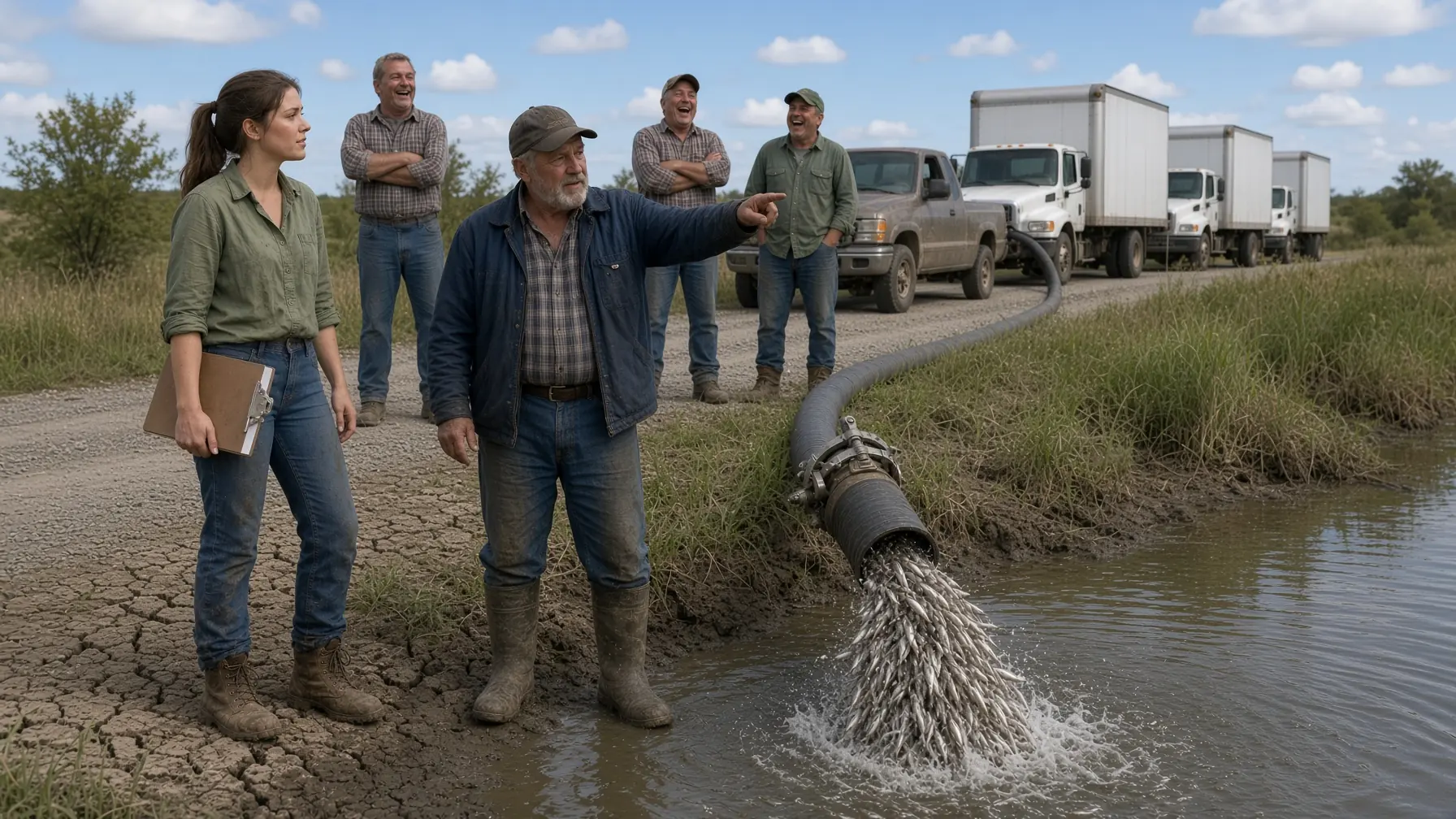
Neighbors slowed as they passed. Some rolled down their windows, others simply stared at the young woman standing beside the largest pond with mud around her work boots and a clipboard tucked beneath one arm. Everybody in Willow Bend knew those ponds had once belonged to a failed catfish farmer and had produced almost nothing useful in more than a decade.
Then the first tank opened.
Thousands of fingerlings spilled through the transfer hose into water that had only recently stopped smelling like stagnant leaves and rotten algae. Silver bodies flashed beneath the surface, disappeared, then returned in nervous waves along the bank. One farmer watching from the county road laughed and said, “That girl just stocked fish into a cemetery.”
The girl was twenty-six-year-old Cassidy Monroe, and one year earlier she could not have explained the difference between a fingerling and a minnow. She had never worked on a fish farm, never operated an aerator, and had no family history in aquaculture. What she did have was six acres of inherited land, four neglected ponds, and the stubborn habit of asking one more question after sensible people told her to stop.
The oldest hatchery driver approached before leaving. Earl Pritchard had hauled live fish for nearly thirty years, and the expression on his weathered face suggested he had watched many ambitious beginners spend money faster than fish could grow. “You understand this is reject stock?” he asked Cassidy.
“I understand it didn’t meet your regular contract specifications.”
“That’s a polite way of saying nobody wanted it.”
Cassidy looked toward the water. “When’s the next surplus batch?”
Earl stared at her. “You didn’t hear what I said.”
“I did.”
That conversation stayed with her, although not because Earl had intended it to. For years afterward, Cassidy remembered the phrase nobody wanted it, because it described almost everything that eventually mattered to her. The fish, the ponds, the land, and at one point Cassidy herself had all been evaluated by someone and quietly placed in the wrong column.
Her grandfather, Amos Monroe, had been the first person in her life who refused to think that way. Amos spent forty-one years running a small peach and apple orchard two counties east, an operation that rarely produced impressive profits but somehow survived drought, hail, late freezes, broken equipment, and prices low enough to make neighbors quit. He repaired machinery with mismatched parts, grafted damaged trees instead of replacing them, and kept boxes of hardware everyone else considered useless because, as he frequently told Cassidy, “Useless is usually just something nobody has needed correctly yet.”
Amos died during the previous winter. While sorting his papers, Cassidy discovered a deed to six acres she did not know he owned, including four rectangular aquaculture ponds left from the bankruptcy of a catfish operation twenty years earlier. He had purchased the property cheaply, paid taxes on it every year, and apparently done almost nothing else.
Attached to the deed was a handwritten note.
Some things aren’t broken. They’re waiting for the right person to notice them.
Cassidy read the sentence several times and assumed her grandfather meant the land. Much later, she would decide he had probably meant something more complicated. At the time, however, she was working an administrative job in Little Rock she disliked, renting an apartment that consumed too much of her paycheck, and wondering why a practical old orchard farmer had spent money maintaining four abandoned ponds.
Her first instinct was to sell. A local buyer offered four thousand dollars, explaining that the usable part of the property might make decent hay ground if someone filled the ponds and cleaned the drainage ditches. Cassidy nearly accepted.
Then she drove out alone.
The buyer had not exaggerated the condition. One pond was almost dry, two had eroded banks, the fourth held water the color of weak coffee, and the old electrical aeration equipment had rusted into something closer to sculpture than machinery. Brush grew through sections of pipe, turtles occupied one broken intake box, and the access road disappeared beneath weeds near the back boundary.
Cassidy stood there for an hour.
She did not suddenly see a thriving fish business.
She saw a question.
Forty minutes away, the county extension office employed a fisheries and pond-management specialist named Dr. Calvin Reese. Cassidy arrived with photographs on her phone and asked him, “Can these ever be productive again?” Calvin looked through the images twice before answering.
“Yes.”
Cassidy smiled.
Then he added, “Probably for more money and work than you expect.”
Her smile disappeared.
Calvin explained that old aquaculture ponds failed for reasons that were often invisible from the bank. Water chemistry mattered, drainage mattered, oxygen mattered, sediment mattered, and damaged levees could turn an apparently healthy pond into an expensive leak. Before stocking a single fish, Cassidy needed to understand what she actually had.
She paid for basic soil and water testing, hired a contractor to inspect the banks, and had the old inlet and outlet structures evaluated. One pond required more earthwork than she could afford immediately, but three could potentially be rehabilitated in stages. Calvin recommended that she begin smaller than her imagination wanted.
That advice lasted approximately three weeks.
Cassidy heard about a hatchery ninety miles north that had overproduced fingerlings after a restaurant supplier reduced an order. The surplus included channel catfish and hybrid sunfish that had become mixed during handling, making the batch unsuitable for customers expecting uniform, traceable stocking groups. The fish were healthy enough to live, but commercially awkward enough that keeping them cost the hatchery money every day.
Cassidy called the manager.
Her name was Marlene Vega, a blunt woman who had spent twenty-five years around hatcheries and had learned to distrust enthusiasm unsupported by infrastructure. “How many do you want?” she asked.
Cassidy gave her a number.
Marlene laughed.
“You have how many functioning ponds?”
“Three.”
“And you’ve raised how many fish?”
“None.”
“Then cut your number in half.”
Cassidy did not.
She negotiated instead.
They eventually agreed on roughly six thousand fingerlings spread across the three rehabilitated ponds, with stocking densities adjusted between species and pond condition rather than simply dumping everything together. Marlene made Cassidy sign paperwork acknowledging that the stock was mixed and could not be represented later as certified pure breeding stock.
Three trucks delivered the fish.
The county laughed.
Three nights later, nearly two thousand of them died.
Cassidy found them just before sunrise, floating near the shallow end of Pond Two. For several seconds she stood motionless, unable to understand how water that looked normal the previous evening could hold so much death by morning. Then she called Calvin.
He arrived with a dissolved-oxygen meter.
The reading told the story.
A combination of warm water, heavy biological demand, limited circulation, and inadequate overnight aeration had driven oxygen dangerously low before dawn. Cassidy had repaired one old aerator and assumed movement she could see from shore meant the pond was safe.
It did not.
“Fish don’t care what the pond looks like at five in the afternoon,” Calvin told her. “Your worst oxygen is often near dawn.”
Cassidy looked across the floating bodies. “I killed them.”
“You made a management mistake.”
“Same result.”
“For them, yes.”
He did not soften it further.
That helped.
Cassidy spent nearly all her remaining cash improving aeration and monitoring rather than purchasing more fish. She learned that dissolved oxygen could change quickly, that feeding influenced oxygen demand, and that a pond carrying growing fish had to be watched as a living system rather than treated like a container full of water. Every morning before work, she checked the ponds.
Then summer rain exposed the next weakness.
A violent storm dumped several inches overnight and overwhelmed a section of bank Cassidy had patched cheaply rather than rebuilding correctly. She arrived at two in the morning to find Pond One losing water through an expanding breach. With help from a neighbor and a contractor who answered his phone because Amos Monroe had once repaired his tractor for free, she stabilized the damaged area long enough for a proper repair the following day.
The bill hurt.
The lesson hurt more.
Cassidy stopped treating temporary fixes as invisible debt.
The herons came next. Two great blue herons discovered the ponds and began visiting with enough regularity that Cassidy joked bitterly that she had opened a breakfast restaurant for birds. Predation would always be part of outdoor aquaculture, but shallow edges and young fish made some areas particularly vulnerable.
She changed habitat around the most exposed sections and used lawful deterrent measures recommended by extension staff. The solution was not beautiful, and nothing about it made good photographs. It reduced losses.
By autumn, feed became the problem.
Prices rose sharply, pushing Cassidy’s largest recurring expense beyond the number in her original budget. For several days she considered feeding less and hoping slower growth would be tolerable until prices improved. Calvin discouraged the shortcut.
“Reduce waste, yes,” he told her. “Starve growth, no.”
Cassidy reviewed records instead.
She discovered she had been feeding too uniformly, treating fish of different sizes as though they had identical nutritional needs and feeding behavior. With help from Marlene, she adjusted schedules, monitored consumption more closely, and stopped throwing feed into water simply because a chart said it was feeding time.
That winter, Cassidy realized she was no longer guessing blindly.
She was still inexperienced, but her mistakes had begun producing knowledge instead of simply producing panic. She could recognize unusual surface behavior, knew which pond lost oxygen fastest, understood why water temperature at one depth could mislead her about conditions below, and had learned that fish gathered near fresh inflow for reasons worth investigating.
She also kept records obsessively.
Amos had done the same with trees.
Every feed purchase, mortality estimate, water reading, repair expense, and harvest weight went into spreadsheets. Cassidy originally believed records existed mainly for accountants, but she slowly understood that memory was an unreliable business partner.
The first sale happened almost accidentally.
Her neighbor, Warren Bell, had mocked the operation when the hatchery trucks arrived. One evening he stopped beside the pond and asked whether any of the surviving catfish were finally large enough to justify all the electricity Cassidy was paying for.
“Some.”
“You selling?”
“I can.”
Warren bought four.
The next week his brother called.
Then a woman from church.
Within a month, Cassidy was taking a small cooler to a Saturday farmers market under the name Monroe Pond Farm. The income was modest, but money mattered less than the repeated evidence that customers liked the fish enough to return.
The first serious buyer was Julian Webb, owner of a forty-seat restaurant in a nearby town. Julian cared about local sourcing but cared more about consistency, which became apparent during the first five minutes of their conversation. “I don’t need a story,” he told Cassidy. “I need fish approximately the same size every week, cleaned properly, handled safely, and delivered when you said they would be.”
Cassidy nodded.
She failed his second order.
The fish coming from her mixed original stock had grown unevenly. Some catfish reached market size quickly while others remained substantially smaller, and her sunfish varied even more.
Julian looked inside the delivery container and shook his head. “My kitchen cannot plan portions around this.”
Cassidy wanted to explain the hatchery mistake.
She stopped herself.
“You’re right.”
He looked surprised.
“I can replace this delivery.”
“That doesn’t solve next week.”
“No.”
She asked for one smaller standing order, one she knew she could grade reliably.
Julian gave her another chance.
Cassidy began learning what commercial producers already understood: grading was not merely sorting fish at the end. Size variation affected competition, feeding, harvest planning, inventory, and every promise she made to a buyer.
She reorganized the ponds.
Larger catfish moved into one group, slower growers into another, and the hybrid sunfish received separate management where practical. The system was imperfect because her facility had never been designed for sophisticated production, but consistency improved.
Julian’s small order became weekly.
Then another restaurant called.
A diner forty-five minutes away wanted catfish, but only if Cassidy could deliver before breakfast preparation began. That forced her to confront transportation and temperature control in a way farmers market sales had not.
Her first system was inadequate.
She lost one potential restaurant relationship after product temperature rose beyond the buyer’s acceptance standard during a hot-weather run. Nobody became sick, but the diner refused delivery and Cassidy absorbed the loss.
She upgraded insulated transport and monitoring.
She learned the boring part of food businesses.
Ice.
Sanitation.
Packaging.
Documentation.
Delivery windows.
Invoices.
The things nobody included when describing the romantic idea of raising fish on an inherited farm.
By the end of the first full production year, Cassidy had not become rich. She had lost more than a third of the original fish between early oxygen failures, predation, handling losses, uneven growth, and ordinary mortality. Some ponds produced well enough to encourage her, while others exposed problems she still did not fully understand.
But the business existed.
That alone surprised Willow Bend.
People stopped calling the ponds a graveyard.
They started calling them Cassidy’s place.
The fourth pond remained dry.
Calvin had mentioned during his first visit that its bottom soil appeared more suitable than Cassidy expected, but rehabilitation costs had placed it beyond her first-year budget. Now a regional distributor contacted her after tasting hybrid sunfish supplied through Julian’s restaurant and asked whether she could produce substantially more.
The volume terrified her.
If Cassidy accepted and failed, she could lose the buyer and damage relationships she had spent two years building. If she refused, somebody else might become the supplier.
She showed the contract to Calvin.
“Can I do it?”
He read it.
“Not with three ponds.”
“I know.”
“So your real question is whether Pond Four is worth rehabilitating.”
“Yes.”
Calvin handed the contract back. “That depends on whether you want to run a larger business or simply own more water.”
Cassidy understood.
Expansion was not automatically progress.
She spent two weeks building projections with an accountant and another week having the dry pond evaluated again. Only after the numbers remained plausible under less optimistic assumptions did she apply for a small agricultural loan.
She hated signing it.
Debt had destroyed the original catfish operation on the property, and Amos had raised Cassidy to distrust money borrowed against future optimism. But avoiding all debt could be as irrational as borrowing recklessly.
She rehabilitated Pond Four.
Then she hired her first employee.
His name was Leon Brooks, a forty-three-year-old hatchery technician who had been laid off after a consolidation. Leon knew more about fish health, handling, grading, and biosecurity than Cassidy had managed to learn in two years. Instead of pretending otherwise, she told him on his first day, “If you see me doing something stupid, tell me before the fish discover it.”
Leon smiled. “That arrangement usually costs extra.”
“I’m paying you.”
“Not enough for all the stupid things I may find.”
They worked well together.
Then disease arrived.
It did not announce itself with a pond full of dead fish.
Leon noticed first.
A small group of catfish near one bank moved differently during the morning walk, sluggish and separated from the rest. He and Cassidy isolated handling equipment between ponds, contacted aquatic animal health professionals, and followed diagnostic guidance instead of treating the water with whatever chemical somebody on the internet recommended.
The outbreak still caused losses.
But it remained largely contained.
Cassidy stood beside the affected pond after the worst week and realized something important. Her business had survived not because she had finally stopped encountering disasters, but because she had become better at noticing them while they were still small.
That changed her entire understanding of competence.
Experts were not people nothing went wrong for.
They were people who recognized wrong sooner.
By the second year, Cassidy added a small permitted processing space through partnerships and inspections appropriate for the products she intended to sell. She also began working with a commercial facility capable of producing smoked catfish under proper food-safety controls rather than trying to improvise the process in a backyard shed.
Smoked product opened different customers.
Specialty grocers could sell it at a higher margin than whole fish, and fish slightly outside restaurant portion specifications sometimes found a profitable alternative market. Cassidy learned that value could be created after harvest just as easily as it could be lost.
Revenue crossed six figures late in the second year.
Profit did not.
That distinction annoyed reporters when the local paper eventually wrote about her because “young farmer builds six-figure business from rejected fish” sounded much better than “young farmer reaches six figures in gross sales while still paying loans, feed, labor, utilities, repairs, processing, insurance, transport, and taxes.” Cassidy insisted on the distinction anyway.
She knew what happened when people confused money moving through a business with money belonging to the owner.
By the third year, the numbers finally became healthy.
Not spectacular.
Healthy.
The loan payments were current, Leon worked full-time, seasonal help joined during harvest periods, and Cassidy supplied several restaurants, two specialty markets, and a regional buyer without depending completely on any one account. Farmers market customers remained because Cassidy liked knowing the people who eventually put her fish on their kitchen tables.
Marlene Vega became one of her most reliable suppliers.
The woman who had once told Cassidy to cut her order in half now called when healthy surplus or off-spec stock became available. Cassidy did not automatically take everything.
That was another sign she had changed.
At the beginning, reject stock fascinated her because it was cheap.
Now she asked why it had been rejected, whether she had room, whether the species fit her production plan, whether biosecurity paperwork was adequate, and whether buying inexpensively would cost more later.
Sometimes she said no.
Opportunity, she learned, was not the same as leftovers.
One evening Cassidy stood beside Pond Two, the place where nearly two thousand fish had died during her first week. The surface moved gently beneath the aerators, and the water looked ordinary enough that a stranger would never understand how much fear that pond once caused her.
She carried Amos’s note in her wallet.
The paper had softened along the folds.
Some things aren’t broken. They’re waiting for the right person to notice them.
For years Cassidy believed he meant the ponds.
Standing there, she reconsidered.
When Amos died, Cassidy had thought of herself as ordinary. She had a job she disliked, bills she barely covered, and no obvious talent that separated her from thousands of other people trying to get through the week.
Amos had never told her she was destined for something grand.
He had taught her something quieter.
Look again.
Before throwing away a broken tool, look again.
Before cutting down a damaged tree, look again.
Before deciding poor land cannot improve, look again.
Before accepting somebody else’s judgment about what a thing is worth, understand why they reached it.
Cassidy finally realized those habits had become hers before the ponds ever did.
The inheritance was not six acres.
It was attention.
Years later, trucks still backed down the gravel road.
Some brought regular fingerlings purchased at full market price because Cassidy’s business no longer depended on rejected stock. Others occasionally carried mixed or surplus fish that fit a purpose she understood well enough to manage.
Neighbors still slowed.
But nobody laughed.
Sometimes farmers stopped to ask questions.
Cassidy usually warned them that the story people told about her was dangerously incomplete.
They wanted to hear that she received free fish, used abandoned ponds, and built a profitable operation out of what everybody else considered worthless.
She told them about the two thousand fish floating dead at sunrise.
She told them about the washed-out bank.
The rejected restaurant delivery.
The feed bill.
The disease outbreak.
The loan payment that came due during a terrible sales month.
Then she explained why those details mattered.
“There wasn’t one clever idea,” she told a group of high school agriculture students visiting the farm. “There were about a thousand small corrections.”
One student asked, “So was taking the rejected fish a good idea?”
Cassidy smiled.
“At the beginning?”
“Yes.”
“No.”
The students laughed.
“I stocked too aggressively because cheap fish made me think quantity was opportunity.”
She pointed toward the ponds.
“The opportunity was learning what these ponds could support and building customers willing to pay for what we could consistently produce.”
Another student asked, “Would you do it again?”
Cassidy looked toward Pond Two.
“Yes.”
She paused.
“Just with fewer fish.”
By then, the property looked nothing like the land she first inherited.
The pond banks were stable and mowed enough for inspection. Aeration equipment was maintained rather than rescued from rust, electrical systems were protected properly, and access roads allowed delivery trucks to reach the ponds without disappearing into vegetation.
Yet Cassidy kept one object untouched.
Near the back of the equipment shed sat the first rusted aerator she found when she inherited the property.
Leon repeatedly asked permission to haul it for scrap.
Cassidy always refused.
“Sentimental value?”
“No.”
“Then why keep it?”
“Because it reminds me equipment can look extremely useful right up until you actually need it.”
Leon considered that.
“That sounds like something your grandfather would say.”
Cassidy smiled.
“Probably why I kept it.”
The business grew, but Cassidy resisted becoming the success story strangers wanted to turn into a formula. She did not tell people to find abandoned ponds, collect unwanted fish, and expect wealth.
Most failed operations had failed for reasons.
Land could be genuinely unsuitable.
Water could be inadequate.
Markets could be too far away.
Fish could be diseased rather than merely off-spec.
Cheap inputs could become expensive mistakes.
Her lesson was not everything discarded is valuable.
That would have been foolish.
Her lesson was that other people’s lack of interest was information, not a verdict.
Sometimes they were right.
Sometimes they had simply been solving a different problem.
The hatchery did not want mixed fingerlings because commercial buyers needed uniform stock.
Cassidy wanted fish she could afford while learning.
Both judgments made sense.
The old owner failed because he tried to operate a large catfish business with debt, poor infrastructure, and commodity pricing.
Cassidy built slowly around multiple buyers, several products, and tighter control.
Different systems created different outcomes.
Even the ponds had not been waiting for a heroic person to rescue them.
They required money, science, labor, maintenance, patience, and a willingness to admit when something was not working.
That truth pleased Cassidy more than the legend.
It meant she had not succeeded because Amos left behind magical land.
She had succeeded because she kept learning long after the romantic part of inheriting something had disappeared.
One Tuesday morning, almost seven years after the first trucks arrived, Earl Pritchard returned with another delivery.
His hair had gone nearly white.
He climbed down from the cab and looked across the ponds.
“Still taking worthless fish?”
Cassidy smiled.
“Sometimes.”
Earl laughed.
“I remember telling you that first batch wasn’t worth anything.”
“I remember.”
“Guess I was wrong.”
Cassidy shook her head.
“No.”
He looked surprised.
“You were right about what they were worth to your usual buyers.”
Earl looked toward the water.
“And wrong about what they were worth to you?”
Cassidy considered it.
“They weren’t worth much to me either until I learned what to do with them.”
Earl nodded slowly.
“That’s probably a better answer.”
They unloaded the fish.
After the truck left, Cassidy walked the bank as she did almost every morning. She checked the water, watched how the fish moved, inspected equipment, and wrote down numbers that would look meaningless to anyone hoping for a dramatic secret.
Nothing extraordinary happened.
That was the point.
The business lived in ordinary mornings.
In equipment starting when it should.
In fish feeding normally.
In invoices paid.
In a delivery arriving at a restaurant before somebody had to call and ask where it was.
In Leon noticing something strange before it became expensive.
In Cassidy knowing enough to understand how much she still did not know.
Near sunrise, the water changed color as light crossed the surface.
Cassidy stopped beside the place where the first mass of dead fingerlings had washed against the bank years earlier. She could still picture them if she tried.
She rarely tried.
Failure had taught what it needed to teach.
It did not deserve permanent ownership of the ground where it happened.
Cassidy took Amos’s note from her wallet.
The writing had faded slightly.
She read it once and folded it again.
For years, people told her the old man must have known what those ponds could become.
Cassidy doubted it.
Amos Monroe had been an orchard farmer, not a prophet.
He probably had no idea whether the ponds would ever produce fish again.
What he understood was his granddaughter.
She would look twice.
Then three times.
She would ask somebody who knew more.
She would make a mistake.
She would hate making it.
Then she would return the next morning and learn why it happened.
That was the real inheritance.
The trucks still came down the gravel road.
The fish still entered the water.
And Cassidy still watched them disappear beneath the surface with the same thought she had learned to carry into almost everything else in her life.
Not What is this worth?
Not yet.
First came the better question.
What could this become if I understand it well enough?