The first piece of wood hit the floor before anyone in the room moved.
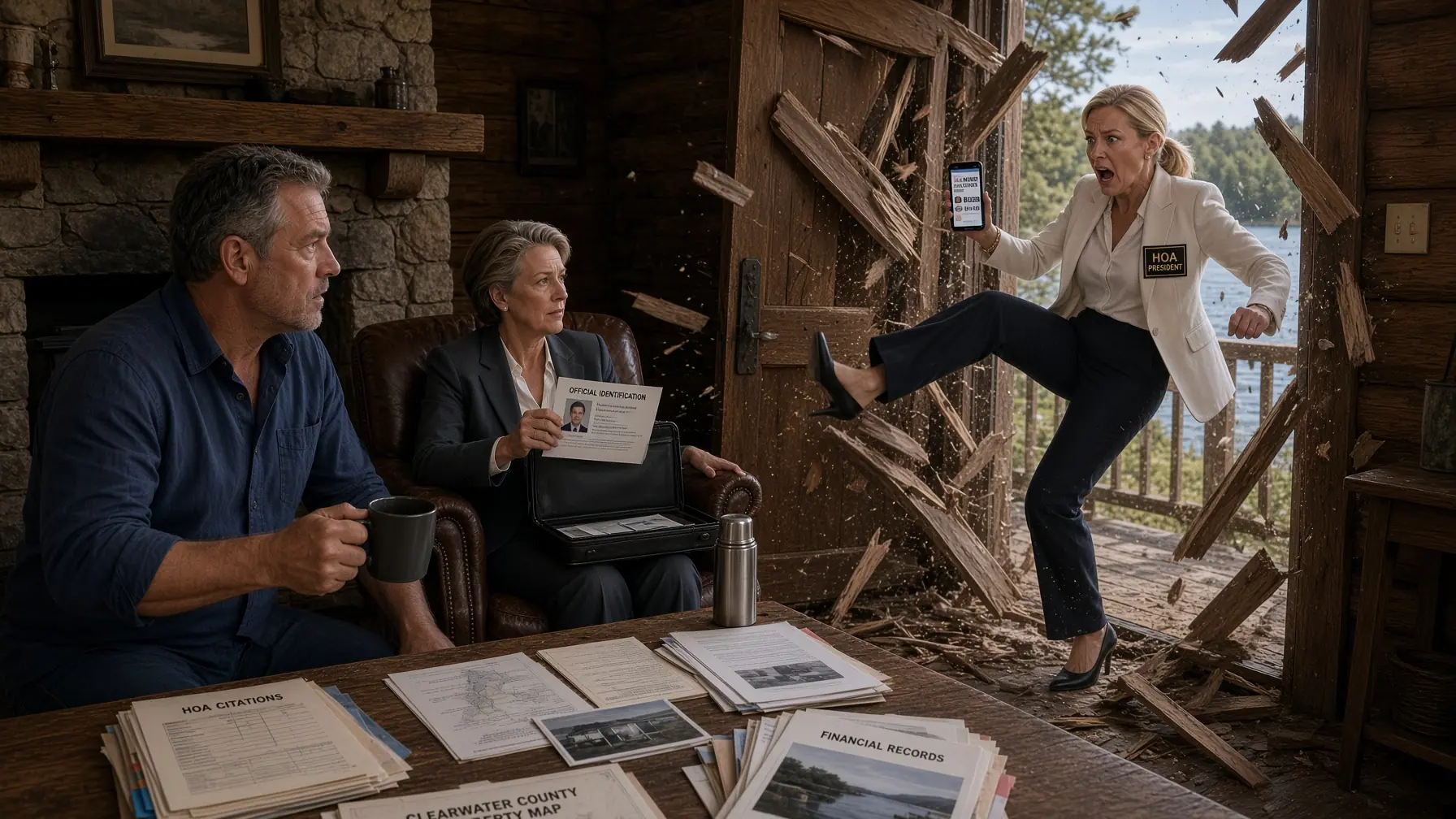
Thomas Whitaker heard the crack, saw the old cedar door burst inward, and watched sunlight flash across a woman’s raised phone.
For one strange second, nobody spoke.
Then Vivian Marlowe stepped through the broken doorway.
Cream blazer.
Designer boots.
Pearl earrings.
Phone held chest-high.
Live video running.
Behind her came a man carrying another camera and a younger woman whispering:
“We’re live. Three thousand watching.”
Vivian pointed directly at Thomas.
“There he is.”
Thomas sat at the dining table with three visitors.
One was his attorney.
One was a forensic accountant.
And the third was Deputy Attorney General Miriam Holt, who had spent the previous forty minutes reviewing financial records from the Clearwater Shores Homeowners Association.
Vivian did not know that.
She barely looked at them.
“This,” she announced into her phone, “is exactly what I’ve been warning everyone about. Secret meetings. Political interference. People conspiring against property owners who refuse to submit.”
Thomas slowly stood.
His grandfather’s door lay broken across the entryway.
A piece of the old brass latch rested near Miriam Holt’s shoe.
Vivian swung the phone toward her.
“And who exactly are you?”
Miriam looked at the phone.
Then at Vivian.
“My name is Miriam Holt.”
Vivian laughed.
“That doesn’t answer my question.”
Miriam reached into her jacket and placed her state credentials on the table.
“I’m a deputy attorney general assigned to the Financial Integrity Division.”
Silence.
The young woman holding the second camera stopped whispering.
Vivian’s expression changed.
Only for a moment.
Then pride rushed in to protect her from reality.
“This is an HOA enforcement matter.”
“No,” Miriam said.
Her voice was almost gentle.
“It isn’t.”
Vivian looked toward Thomas.
“You set this up.”
Thomas glanced at the broken door.
“No.”
He pointed toward the phone in her hand.
“You did.”
Six months earlier, Thomas Whitaker had believed retirement would be boring.
That had been the plan.
He was fifty-four.
Thirty-one years as an electrical contractor.
Substations.
Municipal grids.
Hospital backup systems.
Solar installations.
Enough emergency calls at two in the morning to permanently cure him of wanting excitement.
When he retired, he moved full-time into the cabin his grandfather had built on Clearwater Lake in 1966.
Two acres.
Hand-hewn logs.
Stone fireplace.
Screened porch.
A dock that extended into water Thomas had fished since childhood.
The cabin was not fancy.
That was exactly why he loved it.
He upgraded the electrical system himself.
Added solar.
Modernized the septic.
Reinforced the porch.
Kept the original railings where his grandfather’s knife marks still showed beneath the varnish.
Thomas’s grandfather, Lewis Whitaker, had two rules about land.
The first:
Never let maintenance become emergency.
The second:
If somebody wants your property badly enough to pressure you, find out what they know that you don’t.
Thomas remembered that second rule the morning Vivian Marlowe appeared on his dock.
Seven fifteen.
Perfect summer light.
Coffee in his hand.
A pair of loons working the shoreline.
Then the sound of heels against cedar.
Click.
Click.
Click.
Thomas turned.
A woman in white trousers and a fitted jacket was walking toward him carrying a clipboard.
“Mr. Whitaker?”
“Yes?”
“Vivian Marlowe.”
She smiled.
“President of Clearwater Shores.”
Thomas looked toward the road.
There was no election sign.
No county truck.
No reason she should be standing on his private dock at seven in the morning.
“Okay.”
She handed him a document.
NOTICE OF ARCHITECTURAL NONCOMPLIANCE
Thomas read it once.
Then again.
“Unsightly marine structure?”
“Your dock.”
“My dock?”
“Yes.”
“Damaging community property values.”
Thomas looked over the weathered cedar.
He and his grandfather had rebuilt that dock together when Thomas was thirteen.
“According to who?”
“The association.”
“I’m not in the association.”
Vivian smiled.
“That’s a common misunderstanding among legacy owners.”
“No.”
Thomas looked at her.
“It’s not a misunderstanding.”
He handed the notice back.
“My deed predates Clearwater Shores by three decades.”
“Everyone using the lake is subject to community standards.”
“My property is not part of your recorded covenant.”
Vivian crossed her arms.
“You might want to verify that.”
“I already have.”
She stared at him for several seconds.
Then smiled again.
Not pleasantly.
“There’s a five-hundred-dollar initial assessment.”
“No.”
“Daily penalties begin after seventy-two hours.”
“No.”
“Mr. Whitaker—”
“Vivian.”
He pointed toward the path.
“My coffee is getting cold.”
Her face stiffened.
Before leaving, she said:
“Ask the Harpers how fighting the association worked out.”
That was the first time Thomas heard the warning.
He did not understand it yet.
The Harpers had owned a cabin three lots east for twenty-six years.
Elderly couple.
Retired teachers.
Gone now.
Sold suddenly that spring.
Everyone said they wanted to be closer to their daughter.
Thomas had believed it.
Two weeks after Vivian’s first visit, he stopped believing much of anything she said.
Citation two arrived for his solar panels.
Citation three for vegetable beds visible from the water.
Citation four claimed his woodpile violated “resort aesthetic standards.”
Then came a certified letter from a law firm demanding more than three thousand dollars in accumulated association penalties.
Thomas called the law firm.
The junior attorney who answered repeated:
“Clearwater Shores has asserted jurisdiction.”
“Asserted?”
“Yes.”
“That doesn’t mean it has any.”
“I can’t give you legal advice.”
“You sent me the letter.”
“I represent the association.”
“Great.”
Thomas smiled.
“Then tell your client I’m checking the deed.”
He drove to the county recorder.
The clerk remembered his grandfather.
That helped.
Two hours later, Thomas sat beside a copy machine reading documents that made the entire dispute look absurd.
His lot existed before the development.
No later annexation.
No signed covenant.
No HOA membership agreement.
His deed included a narrow strip of lake bottom extending beyond the shoreline according to the original survey.
Clearwater Shores had no recorded authority to fine him.
None.
Thomas left with certified copies.
For a day, he felt victorious.
Then Vivian parked her SUV sideways across his driveway.
He found her sitting inside with the engine running.
“Move.”
She lowered the window three inches.
“I’m documenting parking conditions.”
“You’re blocking access to my property.”
“I’ll be finished shortly.”
Thomas took out his phone.
“Good.”
“What are you doing?”
“Documenting parking conditions.”
She moved the vehicle.
That was when Thomas understood the legal notices were not the real issue.
They were pressure.
Over the following month, Vivian became systematic.
Anonymous building complaint.
County inspection.
Everything passed.
Septic complaint.
Passed.
Solar safety complaint.
Passed.
Fire inspection.
Passed.
The inspectors were mostly apologetic.
They had jobs to do.
Someone submitted a complaint.
They had to follow up.
Thomas kept every report.
Date.
Time.
Allegation.
Result.
The stack grew.
Then the social media posts started.
Concerned about declining safety standards on the eastern shore.
Some owners believe rules shouldn’t apply to them.
Families deserve better.
No name.
Pictures of Thomas’s cabin taken from flattering angles if you loved rustic buildings and terrible angles if you wanted to make it look abandoned.
One photograph showed a broken wheelbarrow beside the barn.
The caption:
This is what unchecked neglect becomes.
Thomas laughed the first time.
Then three neighbors stopped waving.
That was less funny.
A week later, someone spray-painted his mailbox.
COMPLY OR SELL
His security camera captured Vivian’s SUV passing at 2:14 a.m.
It did not show who held the spray can.
Thomas filed a report anyway.
Deputy Nolan Marlowe arrived.
Vivian’s nephew.
That fact became obvious only when he said:
“My aunt says there’s been tension out here.”
Thomas stared.
“Your aunt.”
Nolan glanced at the mailbox.
“Could be kids.”
“Could be.”
“You got evidence?”
“Vehicle footage.”
“Does it show vandalism?”
“No.”
“Then not much I can do.”
Thomas studied him.
“Can you still take the report?”
Nolan sighed.
“Sure.”
The sigh told Thomas more than the paperwork.
Thomas’s lawyer was an old union friend named Daniel Price.
Daniel listened to the entire story over beer on the porch.
When Thomas finished, Daniel said:
“She doesn’t want compliance.”
“I figured that out.”
“She wants leverage.”
“For what?”
“Your land?”
Thomas looked toward the water.
Daniel continued.
“Harassment usually has a goal.”
“Some people just like power.”
“True.”
“But expensive lawyers, repeated inspections, social pressure, threats to lien property they don’t control?”
Daniel shook his head.
“That’s a lot of effort for a dock.”
Thomas remembered his grandfather.
Find out what they know that you don’t.
The answer began with the Harpers.
Thomas called them.
At first, Mrs. Harper said everything was fine.
Then her husband took the phone.
“Who’s asking?”
“Tom Whitaker.”
Silence.
Then:
“What has Vivian done?”
That opened the door.
The Harpers had received twenty-three violations in four months.
Roof color.
Dock spacing.
Garden shed.
Boat trailer.
Noise complaints when they were out of state.
Then an association-approved buyer offered cash.
Thirty percent below what a realtor had estimated.
The Harpers refused.
More violations.
More legal letters.
A threat that unresolved assessments could complicate title.
Eventually, exhausted, they sold.
“To the same buyer?”
Thomas asked.
“No.”
Mr. Harper gave the company name.
Thomas wrote it down.
Bluewater Holdings LLC.
Daniel searched public filings.
Bluewater had been created eighteen months earlier.
Its registered agent was a law office used by several local developers.
Three former Clearwater owners had sold to companies linked through the same network.
All after HOA pressure.
The pattern was not proof of a crime.
But it was enough to keep looking.
Then Thomas found the money.
One violation notice contained a footer:
Payments payable to Clearwater Shores Community Restoration Fund.
That name bothered him.
Why separate the fines from ordinary HOA dues?
Daniel helped obtain public corporate filings.
A retired accountant from the lake community named Martin Hale volunteered to examine annual statements available to members.
The numbers did not reconcile.
Large “emergency dock restoration” assessments.
No restoration.
Landscaping payments to a company owned by Vivian’s brother-in-law.
Management fees paid to an LLC registered to a post-office box.
Insurance reimbursements with supporting descriptions that did not match known weather events.
Martin sat at Thomas’s table surrounded by spreadsheets.
“Something’s wrong.”
“How wrong?”
“I can’t call it theft without bank records.”
“So what can you call it?”
“Enough smoke to ask for fire investigators.”
Daniel contacted the state attorney general’s consumer and financial fraud unit.
Not because the attorney general personally handled neighborhood disputes.
Because multiple homeowners appeared to have been pressured through questionable assessments and potentially fraudulent corporate structures.
Investigators listened.
Then asked for records.
Thomas had records.
Lots of them.
That became his advantage.
He did not have secret hacking skills.
No access to bank accounts.
No magical insider.
He had:
Certified deeds.
Inspection results.
Copies of violation notices.
Videos.
Emails.
Witnesses.
Recorded voicemail messages.
Property sale dates.
Public corporate registrations.
The Harpers’ documents.
Three other families joined.
Then six.
Then twelve.
Soon, the story was no longer:
Thomas Whitaker versus the HOA president.
It was:
Why had so many long-term owners been pressured to sell?
Vivian sensed resistance.
Her behavior changed.
A restraining-order petition claimed Thomas had threatened her.
A judge reviewed the supporting evidence and declined to issue a final order after a hearing.
Thomas had recordings of the conversations.
No threats.
Then came more police calls.
Suspicious activity.
Noise.
Possible illegal construction.
The more reports arrived, the more Thomas documented.
He stopped arguing with deputies.
“Here’s the inspection report.”
“Here’s the permit.”
“Here’s the camera.”
“Here’s the timeline.”
Facts became boring.
Boring was useful.
Then Vivian made her first undeniable mistake.
She entered his property at night.
Thomas had installed an additional camera near the solar equipment after noticing unexplained shutdowns.
At 2:48 one morning, it recorded Vivian walking behind the cabin with a flashlight.
She opened the exterior service enclosure.
Touched wiring.
Left.
The next morning, two connections had been loosened.
Thomas did not post the footage.
Did not confront her.
He gave it to Daniel.
Daniel gave it to investigators.
That decision mattered.
The story remained evidence instead of entertainment.
A week later, somebody cut the chain securing Thomas’s fishing boat.
The camera angle missed the person.
Then his septic system failed.
A technician found contamination inconsistent with ordinary household use.
Again, Thomas documented.
Again, he did not accuse publicly.
By then, state investigators had begun coordinating with county prosecutors because several allegations potentially involved property damage, fraudulent billing, coercive collection practices, and misuse of association funds.
Deputy Nolan Marlowe was reassigned from calls involving Clearwater Shores while his department reviewed whether he had handled complaints appropriately.
Thomas almost felt sorry for him.
Almost.
The financial investigation took months.
There was no dramatic moment where one spreadsheet proved everything.
Instead, pieces accumulated.
Subpoenaed bank records.
Vendor invoices.
Contracts.
Emails.
Insurance claims.
Property sale records.
Investigators found that several “community improvement” vendors had close ties to Vivian or other board members.
Some services were real but overpriced.
Others were difficult to verify.
Money had moved through multiple entities.
The property-acquisition angle was more complicated.
Investigators did not find evidence that every sale had been secretly arranged by Vivian.
But they found enough communications to show that certain owners had been targeted for pressure at the same time investors connected to a development group were seeking lakefront parcels.
That was far more serious than a petty HOA dispute.
Thomas’s cabin was especially valuable because it sat beside two parcels already acquired by a development company.
Three connected lakefront lots would create enough continuous shoreline for a small resort project.
That was why his grandfather’s land mattered.
Not because the cabin was ugly.
Because it was in the way.
Deputy Attorney General Miriam Holt visited Thomas’s cabin in October.
Not for a trap.
For an interview.
She brought a forensic accountant named Ellis Grant and a state investigator named Rosa Delgado.
Thomas’s attorney attended.
They sat at the dining table.
No hidden snipers.
No choreographed confrontation.
No plan for Vivian to appear.
Miriam was explaining that investigators believed the case could support search warrants and financial charges but that several facts still needed corroboration when tires sprayed gravel outside.
Thomas looked toward the window.
Pearl-white SUV.
Daniel whispered:
“You have got to be kidding.”
Miriam stood.
“Are you expecting someone?”
“No.”
Vivian climbed out.
Another car stopped behind her.
Two people with phones.
Thomas’s security camera showed the whole thing.
Vivian marched toward the porch already livestreaming.
Apparently she had learned from social media gossip that “state officials” were meeting at Thomas’s cabin and decided this proved a conspiracy against her.
She did not knock.
She tried the handle.
Locked.
Then shouted.
“Thomas Whitaker, open this door.”
Thomas looked at Miriam.
Miriam said:
“Don’t.”
Vivian struck the door with her shoulder.
Once.
Twice.
Old cedar cracked around the latch.
On the third hit, the frame failed.
That was the moment the story returned to where it began.
Vivian stood in the cabin with three thousand people watching.
“I have jurisdiction over this property.”
Miriam Holt looked at the broken doorway.
“No, you don’t.”
Vivian pointed toward Thomas.
“He’s been conducting an illegal harassment campaign against the association.”
Miriam said:
“Mrs. Marlowe, you need to leave.”
“This is community property.”
“No.”
“You don’t understand the covenants.”
“I’ve read them.”
That finally slowed Vivian down.
“Who are you again?”
Miriam placed her credentials on the table.
Vivian’s face changed.
Thomas would remember that expression for years.
Not guilt.
Not yet.
Recognition.
The sudden realization that the people she thought she had come to expose were exactly the people already examining her records.
She lowered the phone slightly.
Then raised it again.
“This is political retaliation.”
Miriam answered:
“You are free to make that allegation through counsel.”
“I have rights.”
“Yes.”
“You also need to leave private property.”
Vivian looked toward the broken door.
For the first time, she seemed to notice what she had done.
Outside, Investigator Rosa Delgado had already called local law enforcement.
Miriam did not announce six felonies.
Did not handcuff Vivian personally.
Did not perform for the livestream.
She simply said:
“Do not delete that video.”
Vivian stared.
“Why?”
“Because it may be evidence.”
The livestream comments were moving too fast to read.
Vivian ended the broadcast.
Too late.
Screen recordings existed.
So did Thomas’s exterior camera.
So did the state investigators sitting ten feet away.
Vivian was not arrested in the living room.
That disappointed half the people who later heard the story.
Reality took longer.
Deputies arrived.
Statements were taken.
The damaged door photographed.
Vivian was issued a trespass notice and left with her attorney after refusing further questions.
Three weeks later, state and county authorities executed search warrants on HOA offices, vendor records, and several electronic accounts.
The financial case expanded.
So did the list of defendants.
Vivian was eventually charged with a combination of fraud-related offenses, falsification of business records, conspiracy, and crimes connected to harassment and property damage.
Not every accusation Thomas suspected became a charge.
Some could not be proven.
Others turned out to be legal but unethical.
That mattered.
A strong case did not need exaggeration.
Deputy Nolan faced a separate administrative review.
Investigators found poor judgment and conflicts of interest.
They did not prove he was part of the financial scheme.
He was disciplined for handling complaints involving his aunt when he should have recused himself and for failing to document certain incidents properly.
Thomas accepted that.
Accountability did not require inventing guilt.
The HOA board collapsed within two months.
Two members resigned.
One cooperated with investigators.
Another claimed he had signed contracts without reading them.
Martin Hale, the retired accountant, said:
“That isn’t a defense. It’s an explanation for why boards need controls.”
Homeowners petitioned for a court-supervised financial review.
A temporary administrator took over essential operations while litigation continued.
The association was not magically dissolved overnight.
There were roads.
Shared shoreline maintenance.
Insurance.
Storm-water responsibilities.
Someone still had to manage real things.
Eventually residents rewrote the bylaws.
Independent annual financial review.
Competitive bidding.
Conflict disclosures.
Strict limits on fines.
No enforcement against properties outside recorded jurisdiction.
Formal appeal procedures.
Records accessible to members.
Boring reforms.
Thomas loved them.
Boring was what functioning governance looked like.
The criminal case took nearly a year.
At trial, the prosecution did not center the broken door.
The door was memorable.
The money mattered more.
Bank transfers.
Vendor relationships.
False or inflated invoices.
Communications regarding targeted owners.
Improper movement of association funds.
The livestream became useful because it showed Vivian’s continuing belief that HOA authority extended far beyond anything the documents supported.
But one viral moment did not prove a multi-year financial crime.
Records did.
Witnesses did.
Accountants did.
Emails did.
That distinction was repeated constantly.
Thomas testified for part of one day.
Vivian’s attorney asked:
“You disliked my client.”
“Yes.”
“You wanted her removed from the community.”
“I wanted her to stop coming onto my property.”
“You investigated her personally.”
“No.”
“You gathered documents.”
“Public documents.”
“You organized other homeowners.”
“We compared records.”
“You wanted revenge.”
Thomas looked at Vivian.
Then back at the attorney.
“No.”
“What did you want?”
“My door left on its hinges would’ve been a start.”
Several jurors smiled.
The judge did not.
Thomas continued.
“I wanted people to stop being pressured with rules that didn’t apply to them.”
“And after that?”
“I wanted to know where the money went.”
That was all.
Vivian was convicted on several major financial and fraud counts.
Acquitted on others.
The jury rejected one conspiracy theory prosecutors had not supported well enough.
Thomas considered that a good sign.
They were evaluating evidence.
Not punishing a disliked woman for everything anyone ever accused her of.
Sentencing included prison time, restitution, and financial penalties.
Assets traceable to unlawful proceeds were subject to recovery proceedings.
Her husband, who had held a politically connected administrative role, was investigated separately.
Prosecutors found he had improperly shared some nonpublic development information.
He pleaded to a narrower offense and resigned.
Not a grand statewide criminal empire.
Not dozens of secret politicians.
Just something more ordinary and therefore more disturbing.
People with access.
People with weak oversight.
People discovering they could turn small powers into money because nobody expected neighbors with bylaws to behave like organized fraudsters.
The Harpers never recovered their original cabin.
Another family owned it by then.
Thomas was glad nobody tried to solve one injustice by creating another.
But the Harpers received part of a civil settlement related to improper fees and documented pressure tactics.
Other homeowners received refunds or restitution where claims could be proven.
Mrs. Patterson returned to Clearwater Lake, though not to her old house.
She rented a cottage nearby every summer.
The first time Thomas saw her back on the water, she cried.
So did he.
Neither admitted it.
Thomas repaired his grandfather’s door.
He could have replaced it.
Instead he salvaged what he could.
A carpenter friend rebuilt the frame.
The original cedar boards remained visible from inside, including one long crack that could not be hidden.
Daniel asked:
“Why keep that?”
Thomas ran his hand along the split.
“Because I spent six months thinking the fight was about keeping things exactly the same.”
“And?”
“It wasn’t.”
He looked toward the lake.
“It was about keeping someone else from deciding what had to change.”
The cabin stayed off-grid.
Solar panels still hummed.
Vegetable beds still irritated people who preferred decorative landscaping.
The dock remained weathered.
Thomas repaired it, but refused to make it look new.
The Clearwater Shores board never cited it again.
In fact, they could not.
Thomas’s parcel was formally acknowledged in association records as outside covenant jurisdiction.
The county survey was added to the file.
No argument.
No interpretation.
Just a line on a map and a deed older than the HOA.
That was another lesson Thomas liked.
Sometimes freedom was less dramatic than people imagined.
Sometimes it looked like paperwork filed correctly in 1966.
The lake community changed.
Slowly.
Residents who had avoided Thomas started returning.
Some apologized.
Some did not.
One neighbor, Mark Ellison, admitted:
“I believed her posts.”
“Why?”
“She sounded certain.”
Thomas nodded.
“That’ll do it.”
“I should’ve asked you.”
“Yes.”
Mark waited.
“That all?”
“What do you want?”
“I don’t know. Anger?”
Thomas smiled.
“I’m retired.”
“That means?”
“I’m conserving energy.”
They laughed.
It was enough.
Miriam Holt visited once more after the case ended.
No cameras.
No investigators.
She brought coffee.
Thomas had finally replaced the mug Vivian’s entry knocked from the table.
Miriam sat on the porch.
“You know what everybody remembers?”
“The door.”
“The door.”
“Of course.”
“They think she got arrested five seconds after breaking it.”
Thomas laughed.
“People hate paperwork.”
“They also think you uncovered four million dollars by reading one HOA report.”
“I didn’t.”
“No.”
Miriam looked across the lake.
“You noticed something didn’t fit.”
“Then other people did their jobs.”
Thomas nodded.
“That’s less exciting.”
“Usually more accurate.”
They drank coffee.
After a while Miriam said:
“What did your grandfather actually tell you?”
Thomas smiled.
“He said if somebody wants your land badly, find out why.”
“And?”
“He was right.”
“You miss him?”
“Every day.”
Miriam looked toward the dock.
“He’d probably enjoy this.”
“The court case?”
“No.”
She smiled.
“The fact that the dock survived.”
Thomas laughed.
“That he would.”
Years later, newcomers still heard some version of the story.
The HOA president who kicked down a cabin door.
The state prosecutor sitting inside.
The livestream.
The fraud case.
The trial.
Every retelling became cleaner.
Bigger.
More satisfying.
Thomas corrected them when he could.
“No, the attorney general wasn’t hiding behind my sofa.”
“No, there weren’t federal agents waiting in the woods.”
“No, she didn’t confess to stealing millions on livestream.”
“No, the HOA badge was not admitted as evidence of insanity.”
People were always disappointed.
Then they asked:
“So what really brought her down?”
Thomas would point toward a small metal filing cabinet beside his desk.
“Paper.”
That usually got a laugh.
He meant it.
One deed.
Then another.
Inspection reports.
Invoices.
Bank records.
Emails.
Complaint logs.
Property transfers.
Vendor registrations.
Camera timestamps.
Copies kept after everyone assumed nobody would care enough to keep them.
Vivian had relied on exhaustion.
That was the center of it.
Not brilliance.
Not unstoppable power.
She had learned that most people eventually paid small fines rather than spend hours fighting them.
Most elderly owners would rather move than spend months with lawyers.
Most neighbors preferred silence over becoming targets.
Most board members signed documents because reading them was inconvenient.
Most officials saw one complaint at a time instead of twenty complaints as a pattern.
Her power lived in the gaps between those people.
Thomas did not defeat her because he was tougher.
He simply stopped treating each incident as separate.
He put them beside one another.
Then other people did too.
The pattern became visible.
Once visible, it became difficult to explain away.
Thomas eventually created a small binder he gave to anyone around the lake dealing with property disputes.
Nothing fancy.
Title:
START WITH THE DOCUMENTS
Inside:
Find your deed.
Find your survey.
Read the covenant.
Verify whether your property is actually subject to it.
Keep every notice.
Ask for authority in writing.
Do not threaten.
Do not trespass.
Do not retaliate.
Use official complaint channels.
Document dates.
Separate things that are irritating from things that are illegal.
Call qualified professionals when the problem exceeds what you know.
One young homeowner flipped through it.
“That’s it?”
Thomas nodded.
“I expected something more aggressive.”
“That’s why people get themselves in trouble.”
The young man laughed.
“No secret strategy?”
“Patience.”
“That’s not secret.”
“You’d be surprised.”
On summer evenings, Thomas still sat on his grandfather’s porch.
The loons returned.
The lake changed colors near sunset.
His solar batteries clicked softly inside the utility room.
The repaired door closed properly.
Most nights, nothing happened.
No citations.
No deputies.
No cameras.
No social-media wars.
That ordinary quiet became the best outcome of the entire case.
Thomas never became famous.
He did not receive a giant government reward.
No streaming company bought his story.
No law carried his name.
He was simply a retired electrician who kept his cabin.
That was enough.
The lake did not become paradise after Vivian left.
People still argued.
About docks.
Dogs.
Parking.
Noise.
Property lines.
Human beings remained human.
But the arguments changed.
Rules had to be shown.
Money had to be accounted for.
Authority had limits.
And neighbors who once stayed silent became slightly more willing to ask:
“Where is that written?”
Thomas liked that question.
It had saved his home.
Not because every authority figure was corrupt.
Not because every HOA was criminal.
Because power behaved better when people required it to explain itself.
One evening, Thomas’s grandson asked about the crack in the front door.
Thomas ran a thumb over the repaired cedar.
“A woman broke it.”
“Why?”
“She thought she had the right.”
“Did she?”
“No.”
“How did you know?”
Thomas smiled.
“I checked.”
The boy looked disappointed.
“That’s it?”
“That’s most of adulthood.”
Thomas pointed toward the lake.
“People tell you a lot of things confidently.”
“Doesn’t make them true.”
His grandson thought about that.
Then asked:
“What did Grandpa Lewis say?”
Thomas looked across the water.
The old advice returned exactly as he remembered it.
If somebody wants your land badly, find out why.
He smiled.
“He told me to pay attention.”
The boy nodded.
Thomas leaned back.
Behind him, the repaired door stood open.
Not because anyone had forced it.
Because Thomas had chosen to leave it that way.
And after everything that happened, that difference meant more to him than any verdict ever could.