Every Tuesday morning, just after sunrise, two flatbed trucks turned off County Road 18 and rolled through the open gate of the old Bennett farm.
Nobody came out to wave them in anymore.
The drivers knew where to go.
Past the farmhouse with the crooked porch.
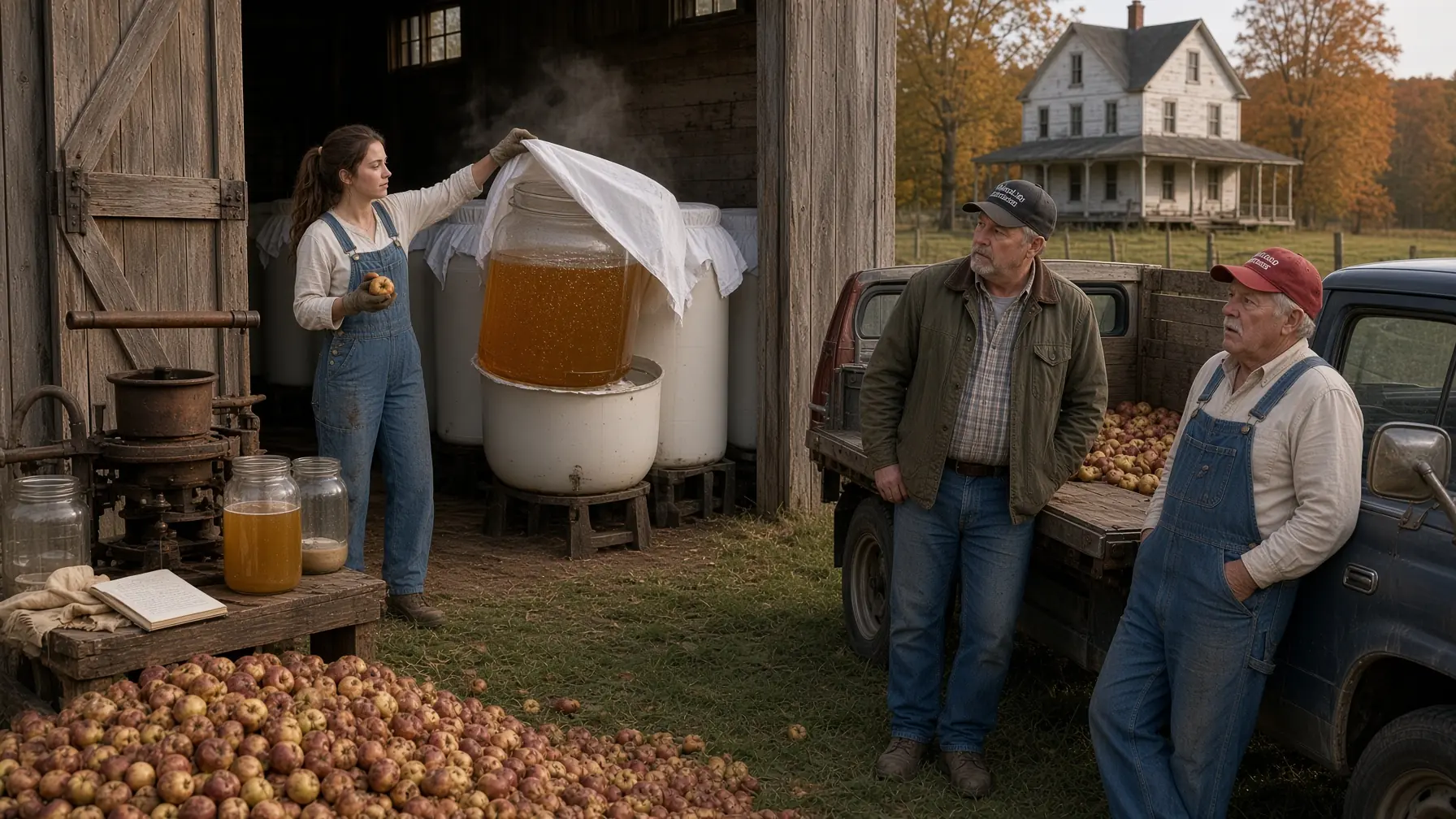
Past the rusted cider press beneath the lean-to.
Around the north side of the barn.
Then reverse until the rear tires touched a strip of packed gravel that twenty-four-year-old Nora Bennett had laid herself.
Tailgates opened.
Hydraulic beds rose.
And thousands of pounds of apples came sliding down.
Red.
Green.
Yellow.
Bruised.
Misshapen.
Split from hail.
Soft at the shoulder.
Too small for supermarket specifications.
Too ugly for gift boxes.
Too ripe to survive long-distance shipping.
The sound was extraordinary.
Thousands of apples knocking against one another like rain on a wooden roof.
Then silence.
Then the smell.
Sweet.
Sharp.
Fermenting at the edges.
Enough to make anyone passing the farm slow down.
And people did.
For months.
Pickup trucks rolled past at half speed.
Drivers turned their heads.
Some stopped.
One neighbor took a photograph and posted it online.
BENNETT GIRL BUILDING APPLE MOUNTAIN.
The caption received dozens of laughing reactions.
Another man asked Nora at the feed store:
“You planning to bury somebody under all that?”
“No.”
“You feeding deer?”
“No.”
“Making cider?”
“No.”
“Then what are you doing?”
Nora paid for her chicken feed.
“You’ll see.”
That answer annoyed people more than no answer at all.
By October, the pile behind her barn had become something of a local attraction.
By November, people had concluded Nora Bennett had made a terrible mistake.
By December, Nora was beginning to wonder whether they were right.
Because nine months after leaving a stable marketing job, moving into her dead grandmother’s farmhouse, and telling everyone she had “an idea,” she had exactly forty-three dollars in business revenue.
And enough failed vinegar in the barn to clean every window in western New York.
Nora had never intended to become a farmer.
Growing up, she considered the Bennett place something she visited.
Not something she would inherit.
Her grandmother, June Bennett, had eleven acres outside a small town south of Rochester.
Not enough land for a large commercial farm.
Enough for an old orchard.
A vegetable garden.
A few hens.
A barn.
An equipment shed.
And a house that always smelled like cinnamon in October.
June was not sentimental about food.
If an apple was beautiful, she sold it.
If it was ugly, she cooked it.
If it had one bruised side, she cut the bruise away.
If it had truly spoiled, she composted it.
Nothing became valuable merely because June wished it so.
She simply refused to confuse appearance with usefulness.
When Nora was nine, she once watched her grandmother buy an entire box of scarred apples from a farm stand for almost nothing.
“Why not get the good ones?”
June kept filling the box.
“These are good ones.”
“They look terrible.”
June held up an apple shaped almost like a fist.
“Fruit doesn’t know what price somebody put on it.”
Nora frowned.
June smiled.
“People decide what something is worth by what they need it for.”
At nine, Nora thought that was one of those sentences old people said because they enjoyed making simple things sound mysterious.
She forgot it.
For fifteen years.
By twenty-four, Nora lived in a one-bedroom apartment in Rochester and worked for a marketing agency that sold optimism to companies.
She wrote slogans for fitness products she never used.
Email campaigns for software she did not understand.
Social media copy for luxury kitchen appliances that cost more than her monthly rent.
She was good at it.
That made leaving harder.
Bad jobs are easy to quit in stories.
Real life is more complicated.
Nora had health insurance.
A predictable paycheck.
A manager who mostly left her alone.
She hated Mondays but paid her bills.
Then June died.
Stroke.
Seventy-eight.
Three days between hospital admission and funeral.
June left the farm to Nora.
Not because Nora was the most qualified.
There were other relatives.
June simply wrote in her will:
Nora notices things. The place needs someone who notices.
Nora read that sentence three times.
Then drove back to Rochester.
Worked nine more days.
Sat through a meeting about “consumer emotional conversion pathways.”
Went home.
Opened June’s will again.
The following morning she gave notice.
Everyone assumed grief had made her impulsive.
Maybe it had.
But not entirely.
Something about returning to the Bennett farm felt less like starting a new life than discovering she had been living in the wrong one.
The property was worse than memory.
The porch leaned.
Half the gutters were missing.
The orchard had gone wild.
Branches crossed one another.
Deadwood remained in the canopy.
Grass grew almost waist-high between rows.
The cider press in the barn had seized.
Mice had eaten part of an old grain sack beneath it.
Nora arrived with four boxes.
A laptop.
Eight thousand dollars in savings.
And no real plan.
The first month disappeared into repairs.
Roof patch.
Porch board.
Plumbing.
Brush clearing.
She sold June’s old utility trailer to pay property taxes.
Then began asking the dangerous question:
What could eleven neglected acres actually produce?
Three miles away sat Red Creek Orchards.
Hundreds of acres.
Packing lines.
Cold storage.
Seasonal workers.
Trucks leaving daily during harvest.
The orchard sold high-grade fruit into supermarkets and wholesalers.
Lower-grade fruit went to juice processors.
But even after that, there was waste.
Apples bruised badly during handling.
Fruit too soft for commercial shipping.
Small lots that failed cosmetic grading.
Windfalls that remained sound but unattractive.
And fruit that was truly spoiled and had to be composted or otherwise disposed of.
Nora learned all this from Red Creek’s operations manager, Sam Hollister.
He came to the Bennett farm after hearing Nora was looking for inexpensive feedstock for “some kind of food project.”
Sam was fifty-eight.
Windburned face.
Hands permanently stained with work.
He looked over the abandoned barn.
“What are you making?”
“I’m not sure yet.”
“That inspires confidence.”
Nora smiled.
“What do you pay to dispose of rejected fruit?”
He looked at her.
“Depends.”
“How much goes out?”
“In peak harvest?”
“Enough.”
“Could I take some?”
Sam laughed.
“For what?”
“Experiments.”
“With apples?”
“Yes.”
“What kind?”
“I’ll tell you when one works.”
Sam stared for several seconds.
Then said:
“If you’re accepting food-grade culls, you need to understand something.”
He pointed toward the orchard road.
“Ugly is one thing.”
“Rotten is another.”
Nora nodded.
“I know.”
“No, you probably don’t.”
His tone was not insulting.
Just experienced.
“Bruised fruit can sometimes be processed quickly.”
“Hail scars are fine if the flesh is sound.”
“Soft fruit may work depending on condition.”
“But mold?”
He shook his head.
“Decay?”
“No.”
“Anything contaminated?”
“Absolutely not.”
Nora listened.
Sam continued.
“If you’re making something people consume, you sort.”
“Hard.”
“And you follow food-safety rules.”
“I will.”
He looked toward the barn.
“What do I get?”
“Lower disposal cost.”
That got his attention.
Nora continued.
“You already pay to move some of this fruit off-site.”
“If I can legally take clean processing culls, you bring them here instead.”
Sam smiled.
“You’re asking me to give you apples and save me money.”
“Yes.”
“Not bad.”
“Marketing degree.”
“That explains the confidence.”
They shook hands.
The first truck arrived the following Tuesday.
Nora’s original idea was vinegar.
Not because vinegar was fashionable.
Because it made sense.
Apples contained sugar.
Yeast could convert sugar into alcohol.
Acetic acid bacteria could then convert alcohol into acetic acid under the right conditions.
Vinegar stored well.
It could be sold to restaurants.
Farm shops.
Home cooks.
Picklers.
Maybe even specialty retailers eventually.
And unlike fresh fruit, vinegar did not care whether an apple had been too small or ugly for a supermarket display.
Theory.
Beautiful theory.
Reality smelled terrible.
Batch One failed before Nora understood what she was doing.
She sorted several hundred pounds of apples.
Discarded everything moldy.
Washed the sound fruit.
Crushed it using June’s old press after spending two days freeing the mechanism.
Then she loaded juice and pulp into food-grade containers.
Covered them badly.
Waited.
Within days, a surface growth appeared that did not resemble anything in the photographs she had been studying.
The smell became worse.
Nora threw out the batch.
She hated doing it.
Not because of the apples.
Because dumping a failed experiment felt like admitting the people laughing on County Road 18 had been right.
Batch Two fermented.
That alone felt like victory.
Bubbles.
Yeasty smell.
Sugar disappearing.
She measured specific gravity with a hydrometer she barely understood.
Alcohol formed.
Then everything seemed to stop.
Weeks passed.
No real vinegar aroma.
Nora kept waiting.
Eventually she realized why.
She had transferred the liquid into sealed containers.
Acetic acid bacteria needed oxygen.
She had successfully created hard cider.
Then suffocated the organisms necessary for the next stage.
She laughed when she figured it out.
Then almost cried.
By Batch Three, Nora had notebooks.
Dates.
Temperatures.
Starting sugar levels.
Apple varieties when known.
Container size.
Cleaning procedure.
Smell.
Color.
pH.
She also had a bruise on her forehead after one improperly secured cap flew off a test container and hit the barn wall two feet from her head.
She sat on the floor afterward staring at it.
“Excellent.”
The barn offered no sympathy.
“Brilliant business.”
Outside, a truck slowed on the road.
Nora threw a rag at the wall.
The turning point came through a retired cidermaker named Elias Ward.
Nora found his name in an online fermentation forum after posting a question embarrassing enough that several people answered with variations of:
Please stop guessing before you make yourself sick.
Elias sent her a private message.
Call me.
He lived forty miles away.
Seventy-one.
Former winemaker.
Later specialized in cider and vinegar.
He spent forty minutes asking Nora questions.
Most answers were:
“I don’t know.”
Finally he said:
“That’s actually encouraging.”
“Why?”
“People who think they know everything are harder to teach.”
He drove to the Bennett farm the following Saturday.
Looked at the apple pile.
Looked at the barn.
Looked at Nora’s notes.
Then said:
“You’re trying to build a food business like somebody making soup in their kitchen.”
“I am making vinegar.”
“Commercially?”
“Eventually.”
“Then stop thinking like a hobbyist.”
He opened her notebook.
“Where’s your sanitation log?”
She pointed.
“Batch notes.”
“No.”
“Cleaning procedure?”
“No.”
“Traceability?”
She stared.
“What?”
“If Sam Hollister brings you fruit Tuesday and Wednesday and you discover a contamination issue Friday, can you tell which finished product contains which fruit?”
“No.”
“Then you don’t have a business.”
He flipped another page.
“Acidity verification?”
“pH.”
“That isn’t the same as titratable acidity.”
Nora sighed.
Elias smiled.
“Good.”
“What?”
“You’re annoyed.”
“Yes.”
“That means you’re ready to learn something.”
Over the next several months, Nora stopped trying to make perfect vinegar.
She started trying to make repeatable vinegar.
The difference changed everything.
Incoming apples were sorted immediately.
Food-grade culls went one direction.
Spoiled fruit went to compost.
She stopped combining random truckloads blindly.
She recorded source dates and dominant varieties.
Equipment was cleaned and sanitized consistently.
She learned controlled yeast fermentation rather than relying entirely on whatever happened to live on the apple skins.
She measured sugar.
Temperature.
Alcohol.
Acidity.
She learned that making something sour was easy.
Making something safe, balanced, consistent, and legally saleable was different.
She ruined more batches.
Batch Four was too harsh.
Batch Five tasted thin.
Batch Six developed an unpleasant solvent-like aroma because fermentation temperature climbed too high.
Batch Seven finally approached what Elias called “not embarrassing.”
Nora considered that a triumph.
Then Batch Eight made him stop talking.
They stood inside the barn on a cold February afternoon.
Elias poured a spoonful.
Smelled it.
Tasted.
Waited.
Nora stared.
“Well?”
He tasted again.
“Don’t ruin this one.”
Her heart began racing.
“That means it’s good?”
“It means if you start celebrating before you reproduce it, I will leave.”
She smiled.
“You like it.”
“I did not say that.”
“You took two tastes.”
“For science.”
“Elias.”
He finally smiled.
“Yes.”
Nora sat on an overturned bucket.
For nearly a minute she simply breathed.
Eleven months after the first apples arrived, she finally possessed something that tasted less like an experiment and more like a product.
Bright acidity.
Apple aroma.
A slight roundness at the finish.
Not luxury.
Not magical.
Good.
Repeatably good was the dream.
Her first finished bottles went to people who had nothing to gain by flattering her.
That was deliberate.
The owner of a farm shop.
A chef.
Two neighbors.
Her aunt.
Sam Hollister.
Elias.
She labeled them only:
BENNETT TEST BATCH 8
No price.
No branding.
No sentimental paragraph about June.
“Tell me what’s wrong with it.”
The chef called first.
His name was Malcolm Greene.
He ran a twenty-table restaurant in the next county.
“Where’d you get this?”
“Made it.”
“No.”
Nora smiled.
“Yes.”
“From those apples?”
“Some of them.”
“Can you make more?”
Nora froze.
“How much more?”
“Start with a case.”
She looked toward the barn.
A case.
Twelve bottles.
It might as well have been twelve thousand.
“Yes.”
“Price?”
“I’ll call you back.”
Malcolm laughed.
“That means you haven’t figured it out.”
“No.”
“Figure it out before you sell me anything.”
That became her next lesson.
A product that cost more to make than people paid for it was not a business.
It was an expensive hobby with labels.
Nora calculated everything.
Fruit was nearly free.
Everything else was not.
Bottles.
Caps.
Labels.
Cleaning chemicals.
Electricity.
Testing.
Insurance.
Licensing.
Equipment.
Her own labor.
Packaging.
Delivery.
Spoilage.
Failed batches.
The number shocked her.
She could not sell a twelve-ounce bottle for three dollars and survive.
Could she sell it for eight?
Ten?
Would anyone care?
That was where her old marketing job finally became useful.
Nora studied specialty vinegar shelves.
Talked to buyers.
Asked chefs what they paid.
Stopped treating “apple cider vinegar” as one commodity.
Her vinegar had character influenced by variety and harvest.
Some batches from tart older apples had more complexity.
Others were softer.
She began buying or contracting a few specific cull streams rather than accepting everything indiscriminately.
Sam noticed.
“You’ve become picky about free apples.”
“I have become expensive about bad inputs.”
He laughed.
“That sounds like a business owner.”
She named the company June Orchard Vinegar Works.
Not Bennett.
June.
Her grandmother’s first name.
The first commercial labels were simple.
Apple variety when known.
Harvest season.
Batch number.
Made from sound surplus and cosmetically rejected regional apples.
Nothing about “rotting fruit.”
Nora refused that language.
Ugly fruit was not rotten fruit.
Food waste reduction did not require pretending food safety did not exist.
She completed the inspections required for her production setup.
Worked with food-safety professionals.
Standardized acidity.
Documented processing.
Obtained product-liability insurance.
The paperwork took longer than fermenting some batches.
She complained constantly.
Elias never sympathized.
“Regulation exists because somewhere, sometime, somebody thought cleanliness was optional.”
Malcolm Greene became her first real customer.
Then a farm shop ordered six bottles.
Then eighteen.
A specialty grocer asked for twenty-four.
Then rejected her labels.
“They look homemade.”
“They are made locally.”
“That’s not the same thing.”
Nora redesigned them.
The grocer accepted the next version.
Then returned three bottles because caps leaked.
Nora changed suppliers.
Every solution created a new problem.
Every problem forced the company to become less imaginary.
The people along County Road 18 stopped laughing gradually.
There was no dramatic morning when the town suddenly respected Nora.
It happened one person at a time.
Mr. Sullivan, who once joked about bodies under the apple pile, came to the farm.
“My daughter’s getting married.”
“Congratulations.”
“She wants local favors.”
Nora waited.
He looked embarrassed.
“Little vinegar bottles.”
She smiled.
“How many?”
“Hundred twenty.”
“That’s a lot.”
“Can you do it?”
“Yes.”
He looked toward the barn.
“I suppose I owe you an apology.”
“For what?”
“Laughing.”
Nora shrugged.
“You weren’t wrong that it looked ridiculous.”
“That doesn’t excuse it.”
“No.”
He stood awkwardly.
Nora handed him a sample spoon.
“Try the fall blend.”
That was all.
She discovered revenge was less satisfying than invoices paid on time.
Sam Hollister visited the farm one Tuesday near the end of Nora’s second year.
The delivery trucks had changed.
Instead of dumping mixed fruit onto one huge pile, the orchard now separated several categories for her.
Sound cider-grade culls.
Specific tart varieties.
Soft but usable fruit destined for immediate processing.
True waste still went elsewhere.
Sam watched two employees sort bins.
Nora had employees now.
Only two.
But seeing other people working inside an idea that had once existed only in her head still felt strange.
Sam followed her into the renovated production shed.
Stainless fittings.
Fermentation tanks.
Wash station.
Batch charts.
Shelves of finished product.
He picked up a bottle.
“You sell all this?”
“Eventually.”
“How much did you do last year?”
Nora looked at him.
“Why?”
“Curious.”
“You laughed at me too.”
“I absolutely did.”
“Thought I’d quit.”
“By the second truck.”
“Third?”
“Honestly, first.”
She smiled.
“About one hundred and twenty thousand in gross sales.”
Sam’s eyebrows rose.
“Seriously?”
“Yes.”
“Profit?”
Nora gave him a look.
“Less impressive.”
He laughed.
“That’s the first honest thing any business owner says.”
Then he became serious.
“We spend real money handling culls.”
“I know.”
“You’re taking more every year.”
“Yes.”
“Other orchards have started asking what we do with ours.”
Nora leaned against the table.
“What are you thinking?”
“A supply agreement.”
She blinked.
“Formal.”
“Multi-year.”
“You guarantee volume.”
“We guarantee quality categories.”
Nora stared.
Two years earlier she had begged for rejected apples.
Now the orchard wanted paperwork to ensure she kept taking them.
Sam smiled.
“Funny.”
“What?”
“I came here originally because I thought you needed us.”
Nora looked around the production room.
“I did.”
“And now?”
She smiled.
“Now we need each other.”
That was better.
June Orchard Vinegar Works never became a billion-dollar company.
Nora was grateful.
She did not want investors telling her how to “disrupt the vinegar space.”
By year four, she employed six people.
Sold to restaurants and specialty shops across New York and parts of Pennsylvania and Massachusetts.
Produced several seasonal vinegars.
Supplied bulk vinegar to two pickling businesses.
Used apple pomace from pressing as compost feedstock when appropriate.
Worked with nearby orchards to identify higher-value uses for sound processing culls.
Annual revenue moved comfortably into six figures.
Not fortune.
A living.
Several livings, actually.
That mattered more.
The farmhouse porch no longer leaned.
The old cider barn still looked old from the outside.
Nora liked it that way.
She kept June’s rusted hand peeler mounted above the tasting table.
Beside it was a small card containing the sentence Nora had finally remembered correctly:
The fruit doesn’t know it’s supposed to be worth less. People decided that.
Customers loved it.
Nora occasionally worried it made the whole journey sound too easy.
A grandmother says something wise.
Granddaughter believes it.
Success.
That was not what happened.
So whenever young entrepreneurs visited and asked how she “saw the opportunity,” Nora showed them another object.
A stained spiral notebook.
Batch One through Batch Eight.
Mold.
Stalled fermentation.
Bad aroma.
Weak acidity.
Leaking cap.
Inconsistent flavor.
Batch Six:
AWFUL. DO NOT REPEAT.
Batch Seven:
Closer.
Batch Eight:
Elias drank twice.
People laughed.
Nora would tap the notebook.
“This is the business.”
Not the pretty bottle.
Not the orchard story.
Not the pile of apples.
This.
Observation.
Failure.
Record.
Adjustment.
Again.
Years later, Nora stood in the old orchard with her niece Sophie.
Ten years old.
Sophie held one ugly apple.
Half green.
Half red.
A scar crossed one side from hail damage.
“Can we make vinegar from this?”
Nora examined it.
“Maybe.”
“It’s ugly.”
“That doesn’t matter.”
She cut it open.
Inside, the flesh was clean.
“This one’s fine.”
Sophie picked up another.
Soft brown decay had entered around the stem.
“This one?”
“No.”
“Why?”
“Because there’s a difference between unwanted and unsafe.”
Sophie thought about that.
Nora smiled.
“Your great-grandmother hated waste.”
“But she wasn’t foolish about it.”
She dropped the spoiled apple into the compost bin.
“Seeing value doesn’t mean pretending everything can be saved.”
They carried the good fruit toward the barn.
Two trucks were arriving from Red Creek Orchards.
Same Tuesday route.
Same gravel lane.
But no mountain of uncontrolled fruit waited behind the barn anymore.
Bins were weighed.
Sorted.
Logged.
Processing schedules planned.
The thing that once looked like chaos had become a system.
Sophie watched.
“Aunt Nora?”
“Yes?”
“Did everybody really laugh at you?”
“Pretty much.”
“Were you mad?”
“Sometimes.”
“Did you know you were right?”
Nora stopped.
That question mattered.
“No.”
Sophie looked surprised.
“But it worked.”
“Eventually.”
“So you didn’t know?”
“I knew the apples might have value.”
“That’s different.”
“From what?”
“Knowing exactly how.”
Nora smiled.
“Exactly.”
She pointed toward the notebook shelf.
“I spent almost a year figuring out the how.”
Sophie nodded thoughtfully.
Then:
“What if it hadn’t worked?”
Nora looked across the property.
At the farmhouse.
At June’s old trees.
At the production building.
At the trucks.
“I would’ve learned enough to try something else.”
That was the answer she wished more people understood.
Nora had not succeeded because she believed hard enough.
Belief did not control microorganisms.
Stubbornness did not create safe acidity.
A grandmother’s wisdom did not substitute for sanitation, licensing, chemistry, accounting, or customers.
What belief had done was keep Nora interested long enough to investigate.
That was its proper job.
Curiosity opened the door.
Work decided whether anything useful stood behind it.
People still slowed occasionally on County Road 18.
Not to laugh now.
To look at the small sign near the gate.
JUNE ORCHARD VINEGAR WORKS
Some turned in.
Inside, they sampled vinegar made from apples that never would have survived supermarket grading.
They saw photographs from the early days.
The absurd pile behind the barn.
Nora waist-deep in apples wearing rubber boots.
Elias scowling beside a fermentation tank.
Sam Hollister unloading the first truck.
One picture showed June Bennett decades earlier.
Standing beside the same barn.
Apron on.
Holding a basket of scarred apples.
Nora kept that photograph near the register.
Whenever someone asked what had inspired the company, she pointed to it.
But the older she became, the less she described June’s lesson as being about trash becoming treasure.
That phrase bothered her.
Too simple.
Too sentimental.
Some trash was trash.
Some spoiled fruit belonged in compost.
Some experiments deserved to be abandoned.
Some business ideas failed because customers did not want them.
The lesson was not:
Everything has hidden value.
The lesson was:
Do not let somebody else’s category keep you from asking what something could still be useful for.
The supermarkets saw appearance.
Juice processors saw specification.
The orchard saw disposal cost.
Nora eventually saw fermentation feedstock.
None of them were necessarily wrong.
They simply needed different things.
That was the insight June had understood without ever using the language of markets or supply chains.
Value was often contextual.
An apple rejected from one system might still fit perfectly into another.
And maybe people were sometimes like that too.
Nora thought about the young woman who had sat beneath fluorescent office lights in Rochester believing she was ungrateful because she hated a job other people told her was good.
Good salary.
Good benefits.
Good future.
Nothing was wrong with the job.
It was simply wrong for her.
Like a scarred apple failing supermarket grade, she had spent too much time thinking rejection from one definition of success meant failure entirely.
June’s farm changed that.
So did the apples.
So did eight failed batches.
By the time Nora understood her grandmother’s sentence, she realized it had never really been about fruit.
Not completely.
The world was full of things people had labeled too quickly.
Worthless.
Unqualified.
Ugly.
Finished.
Too late.
Wrong shape.
Wrong background.
No market.
No use.
Most of those judgments were correct often enough to become habits.
But habits were not laws.
Sometimes the thing worth doing was stopping long enough to ask one more question.
Not:
What is this worth?
But:
Worth for what?
Every Tuesday, two trucks still turned through Nora Bennett’s gate.
Years earlier, they had delivered something an orchard wanted gone.
Now they delivered raw material covered by contracts, specifications, quality standards, and invoices.
The apples had not changed.
People had changed what they were looking for.
And somewhere above the tasting-room counter, June Bennett’s old sentence remained.
The fruit never knew it was supposed to be worth less.
It had only been waiting for someone to need it for something different.