For months, the mysterious sound had become something of a legend around Whitaker Farm. It was the kind of puzzle that mechanics talked about in hushed tones at the local diner and that kept Samuel Whitaker awake on quiet nights. No two people ever described the noise exactly the same way. Some called it a sharp metallic clank, like a loose wrench bouncing relentlessly inside an engine bay. Others swore it sounded more like the dull, resonant thud of a heavy tool striking thick steel. One senior mechanic insisted it had to be a cracked transmission gear grinding under load, while another was absolutely convinced the differential bearings were failing catastrophically. Every new theory sounded professional, logical, and thoroughly convincing—right up until the moment the old John Deere was painstakingly put back together, test-driven up the hill, and the exact same elusive clank returned, mocking every expert who had touched it.
One detail about the problem remained stubbornly consistent: the sound appeared only while climbing a hill. Never on flat ground. Never while idling in the yard. Never when backing up or coasting downhill. Only when the tractor was working against gravity, engine laboring and chassis flexing, did the mysterious metallic strike make itself known. That single, stubborn noise had already cost the Whitaker family thousands of dollars in parts and labor. It had bruised more than a few professional egos and left even the most confident mechanics scratching their heads in frustration.
The tractor itself was a battle-hardened John Deere 4020, a machine that had earned every one of its scars over nearly five decades of faithful service. Its once-vibrant green paint had faded to a soft, weathered sage under countless seasons of blazing sun, driving rain, and swirling dust. The hood bore deep scratches from low-hanging orchard branches and eager loader hooks. The driver’s seat, reupholstered twice over the years, still carried the faint outline of Samuel’s familiar shape. Every dent, every patch of rust, and every repaired weld seemed to tell its own story—of record harvests, muddy springs that tested even the strongest machines, dry autumns when water was scarce, and long, golden evenings when the work finally slowed.
To most people who drove past Whitaker Farm, it was just an old tractor slowly approaching the end of its working life. But to eighty-year-old Samuel Whitaker, it was far more than metal and rubber. It was family.
Samuel had bought the John Deere brand-new in the early 1970s after years of scrimping, saving, and working extra hours on neighboring farms. That machine had plowed every single acre of his land, pulled heavy hay wagons through thick spring mud that sucked at the tires like quicksand, hauled wagonloads of golden corn during crisp autumn harvests, and even carried his young children and grandchildren on slow, gentle evening rides around the property long before they could reach the pedals. His late wife Martha used to stand on the porch with her hands on her hips, smiling as she teased him that he polished the tractor more carefully and more often than he polished his Sunday shoes for church. She wasn’t entirely wrong. The tractor had been part of their love story—through good seasons and heartbreakingly lean ones, through the joy of watching their children grow and the sorrow of burying loved ones.
At first it was infrequent—once every few days. Then it happened every single time the tractor climbed the gentle but persistent hill behind the north pasture. Soon the clank became impossible to ignore, a constant companion that made Samuel’s heart tighten with worry. He finally admitted the tractor needed professional help.
His grandson Ethan, practical and energetic in his thirties, insisted they take it to Dawson’s Agricultural Repair—the largest and most respected shop in the county. “If anybody can fix it, Grandpa, it’s those guys,” Ethan said confidently as they loaded the tractor onto the flatbed. Samuel simply smiled and nodded. “We’ll see, son. We’ll see.”
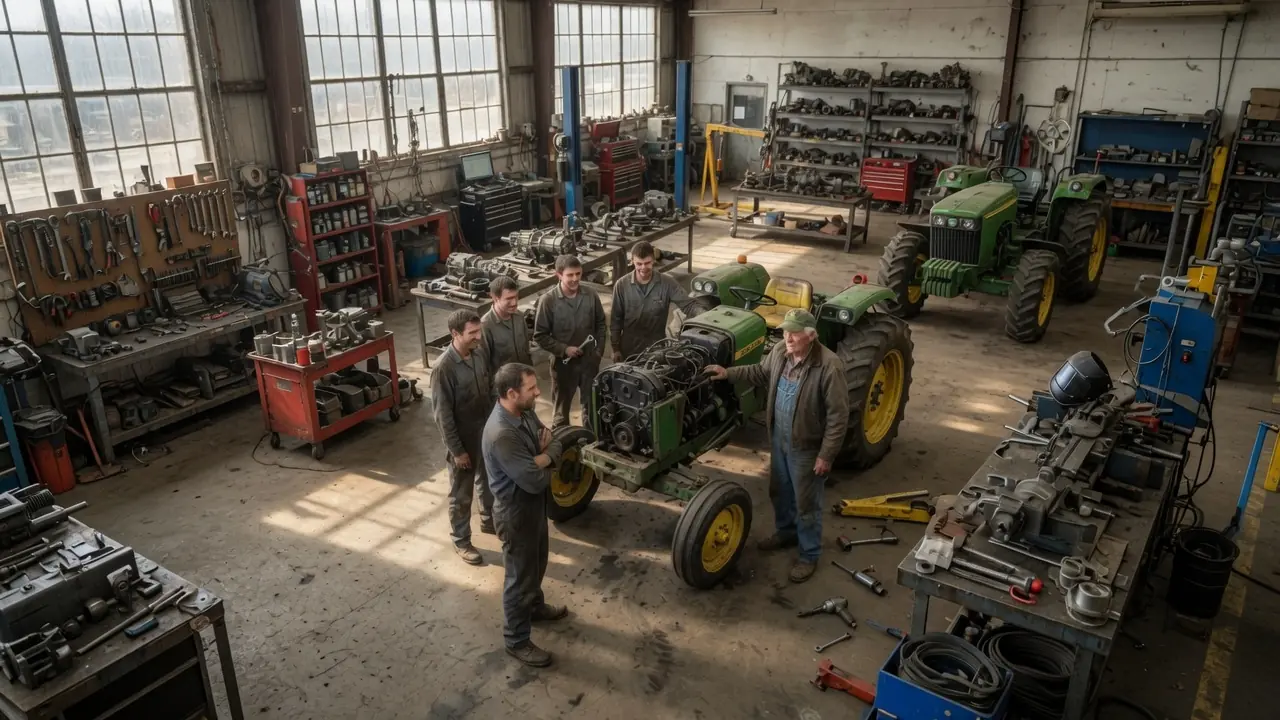
Dawson’s shop was an impressive facility filled with the smell of diesel, grease, and fresh coffee. It employed six certified mechanics, all younger than fifty, working under bright overhead lights with modern diagnostic tools. Owner Rick Dawson had built a strong reputation for solving the kinds of difficult mechanical mysteries that left other shops defeated. When the tractor arrived, Rick listened patiently while Samuel described the problem in his quiet, measured way, emphasizing that the noise only occurred under load while climbing hills.
Rick nodded with the easy confidence of a man who had seen nearly everything in his twenty-five years in the trade. “We’ll find it, Mr. Whitaker. Don’t you worry.”
He truly believed those words.
Three full days later, the John Deere’s transmission lay completely dismantled across three large workbenches. Every bearing was inspected under magnification. Every gear tooth was measured with precision calipers. Every shaft, seal, bushing, and gasket was examined and re-examined. They found nothing obviously broken. Still convinced the issue had to be inside the drivetrain, the team replaced several expensive components “just to be safe.” When the tractor was finally reassembled with new seals and bearings, Rick himself climbed into the seat for the test drive.
He headed straight for the same hill. Halfway up the incline… Clank. The exact same sound rang out clearly.
Rick stared straight ahead in stunned disbelief, his hands tightening on the wheel.
Back at the shop, frustration spread like wildfire. Over the following two weeks, the tractor was torn down again, even more aggressively. The rear axle was removed and inspected. The clutch assembly was completely rebuilt. The hydraulic pump was overhauled. Engine mounts were replaced. Thousands of dollars in parts and skilled labor vanished into the machine. Still, every test drive up that hill produced the same mocking clank.
Some of the younger mechanics began whispering privately that the old farmer might be imagining things or that the tractor had simply grown noisy with age. Samuel heard the murmurs but said nothing. He simply smiled politely and repeated with quiet conviction, “I’ve driven this machine for fifty years. It wasn’t born making that sound.”
One rainy Tuesday afternoon, Ethan drove his grandfather back to the shop. Rick met them outside, looking tired and defeated. “I’m running out of ideas, Mr. Whitaker,” he admitted honestly.
Samuel nodded with genuine kindness. “I know you’ve worked hard.”
Rick hesitated, then offered, “Would you mind if I showed you everything we’ve checked so far? Maybe you’ll see something we missed.”
The younger mechanics exchanged amused glances behind their boss’s back. One whispered, “Now the owner’s going to let the customer fix it?” Another chuckled softly. “He probably still thinks tractors don’t need computers.”
Samuel heard every word. He ignored them completely.
For nearly half an hour, Rick walked him slowly around the tractor, explaining in technical detail every inspection, every replacement, every diagnostic test they had performed. Samuel listened with full attention, his weathered hands clasped behind his back, nodding occasionally but never interrupting.
When the tour finally ended, Samuel asked quietly, “Can I drive her for a bit?”
Rick handed over the keys without hesitation.
The old farmer climbed into the familiar seat with surprising ease for a man of eighty. The big diesel engine roared to life instantly, its deep, throaty rumble filling the yard like an old friend greeting him warmly. Samuel closed his eyes for a long moment, head slightly tilted, just listening with the deep intuition that only five decades of daily companionship could create.
Then he eased the tractor out onto the test path and headed for the hill behind the shop. Halfway up… Clank. Sharp. Metallic. Unmistakable. Samuel didn’t stop. He drove back down, turned around, and climbed again. Clank—exactly the same spot. He repeated the climb three more times, carefully noting the precise location each time the sound appeared.
Finally, he parked the tractor, shut off the engine, and walked around to the left rear wheel. The younger mechanics watched with puzzled expressions. “What are you looking at?” one asked.
Samuel didn’t answer immediately. He knelt slowly, reached underneath the axle housing, and ran his calloused fingertips along an old steel support bracket that had been there since the tractor left the factory. A small, knowing smile crossed his face.
“There you are,” he whispered.
Rick stepped closer, crouching beside him. “What is it?”
Samuel tapped an old cast-iron toolbox that had been bolted to the bracket for decades. “This right here.”
Rick shook the toolbox firmly. “It doesn’t move at all when I shake it.”
Samuel nodded patiently. “Not when it’s sitting still on level ground.”
He removed two bolts with practiced, steady hands. Inside the toolbox lay several old hitch pins, a couple of large washers, and a short steel clevis pin. One of the washers had worn down over the decades until it was almost paper-thin. Samuel carefully placed everything back exactly as he had found it.
“Now tilt the toolbox the way it would tilt when climbing a hill,” he said.
Rick tilted the box. The worn washer slid slowly across the bottom of the metal container. Then… Clank. The exact same sound that had baffled them for weeks echoed clearly.
Every mechanic in the shop froze in stunned silence.
Samuel stood up slowly, brushing dirt from his knees. “Going uphill shifts the washer backward. It strikes the side once with each bounce. Going downhill, gravity holds it against the front edge. On flat ground, nothing moves enough to make noise.”
Rick stared at the tiny, insignificant washer in disbelief. “We tore apart the entire transmission… spent thousands… for a washer?”
Samuel chuckled softly, his eyes twinkling with gentle, hard-earned wisdom. “You were listening to the loudest parts of the machine. The answer was hiding in the quietest one all along.”
One young mechanic looked genuinely embarrassed. “We never even thought to check something as simple as an old toolbox.”
Samuel placed a reassuring hand on the young man’s shoulder. “Because you were trying to prove a complicated theory instead of simply understanding what the machine was actually telling you. Machines usually tell you exactly what’s wrong if you let them. The hard part is learning to listen without letting your assumptions get in the way first.”
A long, thoughtful silence settled over the entire shop. The younger mechanics no longer looked at the old farmer as just an elderly customer from a different era. They saw him for what he truly was: a master craftsman whose deep knowledge had been earned one season, one repair, one quiet observation, and one hard-won lesson at a time.
Rick insisted on refunding nearly the entire repair bill. Samuel refused. “You and your men worked hard and honestly,” he said. “Even if it was in the wrong direction at first. Hard work still deserves respect.” Instead, he asked Rick to buy lunch for everyone in the shop that day.
As hamburgers, fries, and cold drinks arrived later that afternoon, the conversation around the big table was completely different. No one joked about the old farmer anymore. Instead, they asked genuine questions—how he had known, how he had figured it out so quickly after weeks of professional troubleshooting, and what other lessons he had learned over fifty years of farming.
Samuel smiled warmly over his cup of strong black coffee. “I didn’t figure anything complicated out. I just started where the noise actually lived… instead of where everyone expected it to live.”
Years later, Rick Dawson still told the story to every new apprentice who walked through the doors of his shop. Before anyone was allowed to touch a wrench, he would point to an old, worn steel washer mounted inside a small wooden picture frame hanging proudly above the main workbench. Beneath it, a handwritten note in careful script read:
“Never let your experience become louder than the machine itself.”
Every new apprentice eventually asked why such an ordinary, seemingly insignificant washer had earned such a place of honor on the wall. Rick would always smile before answering the same way:
“Because one eighty-year-old farmer taught six professional mechanics—and everyone who has come after them—a lesson we’ll never forget: wisdom isn’t measured by the newest diagnostic tools you own, the certificates on your wall, or how many complicated repairs you’ve completed. It’s measured by how carefully, how humbly, and how patiently you’re willing to listen to what’s really there.”
And in the quiet moments after the story, more than one young mechanic would find themselves looking at their own tools with fresh eyes—and a deeper respect for the quiet wisdom that only time, patience, and true listening can bring.