On a frozen Thursday morning in January of 1998, Tom DelVecchio stood on the muddy bank of the Allegheny River and watched his career sink deeper into freezing water.
The bridge construction site, seven miles north of Pittsburgh, had been silent for four days. Heavy equipment sat idle beneath a gray winter sky, workers stood in small groups with their hands shoved into their jackets, and the river moved dark and cold beside the unfinished bridge supports. In the middle of that river, half-submerged in twelve feet of water, sat the problem that had stopped everything. An eighty-ton crane rested at an ugly angle, its counterweight barely above the surface and its boom buried deep in river mud.
Tom had barely slept since the accident.
Four days earlier, one of his operators had been positioning a sixty-foot steel girder near the riverbank. The soil engineers had promised the ground was stable enough. The pad had been checked, the plan had been signed, and the crew had moved forward because every bridge project lived under the pressure of deadlines. Then the crane’s outrigger punched through the bank like wet cardboard.
The crane tilted.
The boom swung toward the river.
Men shouted.
Steel groaned.
Before anyone could stop it, eighty tons of machinery slid over the edge and dropped into the Allegheny with a sound Tom still heard every time he closed his eyes.
Now the project was frozen.
The bridge contract was in danger. The insurance adjuster was coming Monday. If the crane was declared a total loss, Tom’s company would eat a ruinous cost, pay delay penalties, and probably lose the entire job. Tom had built his reputation on keeping projects moving, and now every hour that crane sat in the river made him feel like the water was pulling his name under with it.
The recovery company had tried.
They brought in a modern two-hundred-ton hydraulic recovery crane, a beautiful yellow machine that cost more than most houses in the county. It should have been the answer. But every time the operators tried to position it near the riverbank, the outriggers sank into the soft thawed ground. The more weight they brought in, the less the bank wanted to hold.
Divers went down into the freezing water.
They came back with bad news.
The crane’s boom was buried nearly four feet into the river bottom mud. The current was strong, the water was bitter cold, and the angle of the machine made a straight lift dangerous. It would take days just to rig properly, and even then, no one could guarantee the recovery crane could anchor safely enough to pull. Every expert answer sounded like a different way of saying the same thing.
Impossible.
Tom hated that word.
He stood beside Young Engineer Martin Hayes, a forty-year-old structural specialist with a hard hat, a clipboard, and the flat voice of a man who trusted numbers more than desperation. Martin had been right about almost everything so far, which only made Tom resent him more. The engineer had no cruelty in him, but his conclusions landed like nails in a coffin. Every time Tom asked for one more option, Martin pointed back to the same problem.
“The ground won’t hold,” Martin said that morning.
Tom gripped his hard hat in one gloved hand.
“Then move farther back.”
“We lose the angle.”
“Then build a platform.”
“That takes days, maybe a week.”
“We don’t have a week.”
Martin looked toward the river.
“I know.”
Tom stepped closer to him, his boots sinking slightly in the mud.
“Tell me there’s one more way to pull that crane out.”
“There isn’t. The ground won’t hold, the boom is buried, and the math is dead.”
Tom looked at the half-submerged crane and felt anger rise because fear had nowhere else to go.
“I don’t need math telling me my whole project is finished.”
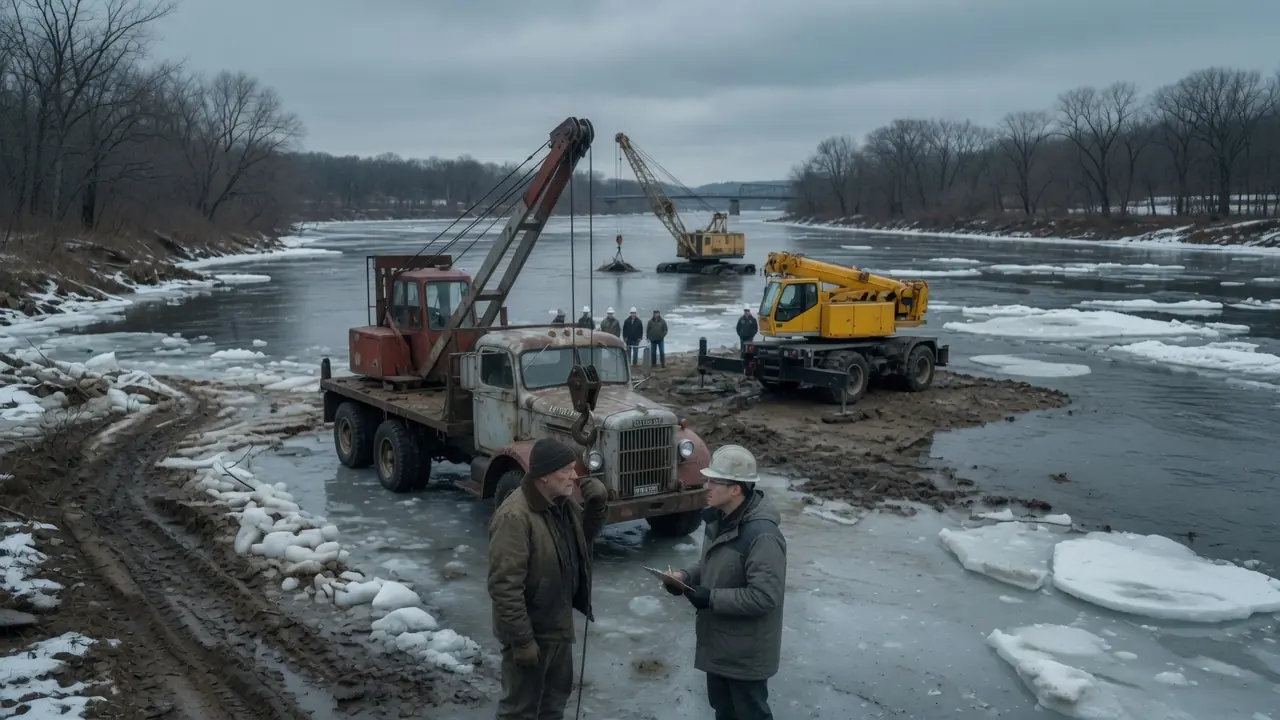
Martin lifted his clipboard and pointed toward the sinking bank where the modern recovery crane had already failed to anchor.
“Then look at the river, Tom. That machine is already gone.”
The words made Tom turn away.
He did not want the crew to see his face.
Behind him, workers whispered near the equipment trailers. The recovery crew stood by their expensive crane with the embarrassed stiffness of men who had the right tools for the wrong ground. The divers sat in a heated truck, exhausted and silent. Even the river sounded cruel, slapping against the steel supports like it knew it had won.
Then the security guard at the entrance radioed Tom.
“Tom, there’s an old pickup at the gate. Driver says he called earlier.”
Tom closed his eyes.
For one second, he had forgotten.
That morning, before sunrise, a man named Ed Kowalczyk had called the site office. He said he was seventy-three years old, retired from the steel mills, and had heard about the crane on his scanner. He said he had a wrecker, an old one, built by his father in 1948. He said he might be able to help.
Tom had nearly hung up.
A 1948 wrecker sounded like a joke.
But desperation made room for strange ideas.
“What have I got to lose?” Tom had muttered before telling the man he could come look.
Now the man had arrived.
Tom turned toward the construction gate.
Martin followed his gaze.
Through the muddy entrance road came a faded old machine that made every worker on the site stop moving.
It was not sleek, yellow, computerized, or modern.
It was a faded 1948 Autocar wrecker, boxy and heavy-looking, with a flat windshield, worn paint, and a hood that seemed to belong to another era of American industry. Behind the cab rose a homemade boom, tall and rough and unmistakably hand-built, welded from steel beams by someone who had trusted his own hands more than a factory catalog. The engine rumbled low as it crawled forward, slow but steady, like an old steel mill waking up after years of silence.
Men began to laugh.
Not loudly at first.
Just little bursts of disbelief.
One worker near the barrier shook his head.
“Is that thing safe to drive?”
Another muttered, “Tom’s calling museum pieces now.”
Tom heard them and said nothing.
Martin stood beside him with his clipboard pressed to his chest, staring at the Autocar as if it offended him professionally. His eyes moved from the old truck to the half-submerged crane in the river, then back again. A smug smile appeared at the corner of his mouth before he tried to hide it. The smile told Tom that Martin had already judged the machine before it even stopped.
The Autocar parked near the useless recovery crane.
The difference between the two machines was almost embarrassing.
The modern crane towered high, painted bright, equipped with hydraulics, computers, warning lights, load charts, and polished outriggers. The Autocar looked like it had been built in a garage because it had been. Its boom showed rough welds, its cable drum was exposed, and its whole frame seemed to speak a language older than the engineers on site.
Then the driver climbed down.
Ed Kowalczyk moved slowly, but not weakly.
He had the careful steps of a man whose back remembered hard labor and whose knees had earned every complaint they made. His face was lined, his hands thick, and his eyes were sharp under the brim of his old cap. He wore heavy gloves, a worn work coat, and the calm expression of a man who had seen too many dangerous jobs to be excited by one more.
Tom walked toward him.
“Mr. Kowalczyk?”
“Ed,” the old man said.
“I’m Tom DelVecchio. Thanks for coming out.”
Ed nodded toward the river.
“How long’s it been sitting like that?”
“Four days.”
“Boom buried?”
“Divers say about four feet into the mud.”
Ed looked toward the modern recovery crane.
“And that one can’t get close enough?”
Tom sighed.
“Ground won’t hold it.”
Ed did not answer immediately.
He looked at the river, then at the slope, then at the construction pads, the barriers, the bank, the crane’s angle, and the soft places where the mud had already collapsed under weight. His eyes did not move like a man admiring the problem. They moved like a man measuring it without needing a tape.
“Mind if I look?”
Tom gestured toward the river.
“Be careful near the bank. It’s unstable.”
Ed walked past him.
Martin watched him go.
For nearly twenty minutes, the old man moved along the riverbank. He knelt once, pushed a steel rod into the ground, pulled it out, rubbed the mud between his fingers, and walked farther back from the water. He looked at the crane’s counterweight, then the buried boom, then the angle from the higher ground beyond the construction ruts. He did not seem impressed by the expensive equipment sitting idle behind him.
Tom watched in silence.
Martin finally leaned toward him.
“Is this really the guy?”
Tom kept his eyes on Ed.
“Yes.”
“Tom, that truck looks like it belongs behind ropes at a history museum.”
“I know what it looks like.”
“That boom is homemade.”
Tom’s jaw tightened.
“His father built it for mill work.”
Martin let out a sharp little breath.
“With all respect, that doesn’t make it safe.”
Ed returned before Tom could answer.
He pointed toward a rise about eighty feet back from the river’s edge.
“Ground is stable there.”
Martin looked in that direction and frowned.
“That’s too far from the load.”
Ed glanced at him once, then back at Tom.
“Not for my boom.”
Martin’s eyebrows lifted.
Ed continued calmly.
“I can set the Autocar back there, run cable through blocks anchored to those concrete barriers, and pull from solid ground. I’m not lifting the crane. I’m going to shift it. Break the suction around the boom, change the angle, and let the river help instead of fighting it.”
Martin stepped forward.
“Sir, that crane weighs eighty tons.”
“I heard.”
“Your truck weighs maybe ten.”
“Closer to twelve with the boom.”
“That does not help your case.”
Some of the crew chuckled.
Ed did not look at them.
Martin lifted his clipboard, now fully confident again.
“Your plan ignores basic load force. You’re talking about dragging a crane eight times heavier than your truck through river mud with a homemade boom and mechanical winch.”
Ed pulled on his gloves, tightening each finger with slow patience.
“I’m not dragging it through anything.”
Martin pointed at the river.
“It’s buried.”
“I know.”
“It’s been underwater four days.”
“I know.”
“The current is working against you.”
Ed looked at the moving water.
“Not if you understand how to use it.”
Martin stared at him, disbelief hardening into arrogance.
Tom felt the whole crew watching.
This was the moment when Ed could have defended himself, listed his years in the mills, explained his father’s design, or told them about all the heavy loads he had moved long before computers told men what was possible. Instead, he only reached into the Autocar’s side box and pulled out a heavy steel hook. His hands were steady.
Martin shook his head.
“Tom, please tell me you didn’t call that thing our backup plan.”
Tom did not answer.
Ed stepped down beside the old wrecker, eyes still on the river.
“I didn’t come to impress anybody,” he said. “I came to look at the pull.”
Martin’s face tightened.
Then he said it.
“That museum truck can’t pull eighty tons out of river mud.”
The words hung over the site.
A few men laughed again, but the laughter sounded less certain now.
Ed slowly turned to face Martin.
The old man’s expression did not change much, but his eyes sharpened in a way that made the younger engineer lower his clipboard slightly.
“No,” Ed said. “It can’t pull your pride out of the way either.”
The crew went silent.
Martin’s face flushed.
“The math says your homemade boom snaps before that crane moves.”
Ed looked past him at the frozen river.
“Then stand back and watch old steel teach your math how weight really moves.”
Tom should have stopped it there.
The liability alone made his stomach twist.
But he looked at the river, the crane, the useless recovery equipment, and the men waiting for someone else to decide the project was finished. He thought of Monday’s insurance adjuster. He thought of the penalties. He thought of the phone call he would have to make to his boss if this failed.
Then he looked at Ed.
“Show me what you’ve got.”
Martin turned sharply.
“Tom, this is reckless.”
Tom’s voice was low.
“Reckless was trusting the bank after the first outrigger sank. This is one man trying something different.”
Ed nodded once.
He got to work.
The old man positioned the Autocar eighty feet from the riverbank on ground nobody had disturbed. He moved slowly, checking the soil, adjusting the angle, and setting the truck exactly where he wanted it. The crew watched, some still doubtful, some curious now. The modern recovery crew folded their arms and stood near their crane, no longer laughing.
Ed pulled heavy snatch blocks from the truck.
They looked old, scarred, and brutally strong.
He ran the cable through them, creating mechanical advantage one loop at a time. Every movement had purpose. No wasted effort. No hurry. He anchored the blocks to concrete Jersey barriers and reinforced the pull line with chains that looked heavy enough to hold a bridge in place.
Martin followed him, objecting quietly at first, then less quietly.
“You’re multiplying force, but you’re also multiplying failure points.”
Ed checked a shackle.
“Only if your gear is weak.”
“That cable is ancient.”
Ed looked at him.
“That cable has pulled more steel than you’ve ever calculated.”
Tom saw Martin’s mouth tighten.
The old man stepped into chest waders.
Tom moved toward him.
“You’re going in?”
“Cable has to be placed right.”
“We have divers.”
“They already looked. I need to feel the frame.”
Tom hesitated.
The water was thirty-four degrees.
The current moved fast enough to shove a grown man sideways.
Ed picked up the cable and walked toward the river.
Tom followed him to the edge.
“Ed, you don’t have to do this.”
Ed looked at him.
“My father built that truck to help working men when fancy outfits couldn’t or wouldn’t. If I drove it here and quit at the waterline, I’d have to explain that to him someday.”
Then he stepped into the river.
The cold hit him hard enough that his shoulders stiffened, but he kept moving.
The crew went silent again.
Every man on that bank watched the seventy-three-year-old steelworker wade into the Allegheny with a cable over his shoulder. The current pressed against him, pulling at his legs, but Ed moved with slow, stubborn control. He reached the submerged crane, disappeared waist-deep beside the frame, and worked by feel where the muddy water hid everything.
Martin lowered his clipboard.
For the first time, he looked worried instead of smug.
Tom held his breath.
Minutes passed.
Then Ed raised one gloved hand.
The cable was set.
He waded back to shore, breathing hard but steady, river water pouring from his waders. Tom offered a hand, and Ed took it without embarrassment. His face was pale from the cold, but his eyes were alive now. He looked like a man who had found the point where the problem could be touched.
Ed climbed into the Autocar’s cab.
The old truck’s engine changed tone as he engaged the winch.
A deep grinding sound came from the mechanical drum, slow and heavy, like gears waking from another century. The cable tightened. The snatch blocks creaked. Chains pulled straight against the concrete barriers. Everyone watched the river.
Nothing happened.
Ten seconds.
Twenty.
Thirty.
Martin exhaled.
“It’s not moving.”
Ed kept pressure steady.
The Autocar’s frame groaned.
The boom swayed slightly, but held.
The cable hummed under tension.
Then the water around the crane shifted.
Just a ripple at first.
A small movement near the counterweight.
Tom stepped forward.
“Wait.”
The crane tilted a fraction.
The boom, buried deep in mud, gave a faint shudder beneath the surface.
Ed did not force it.
He held the tension.
The old winch kept pulling at a walking pace.
The crane moved one inch.
A murmur ran through the crew.
Martin’s eyes widened.
Ed stopped the winch, let the load settle, adjusted the angle, and pulled again.
Another inch.
Then three.
The mud suction began to break slowly, not with a dramatic burst, but with a stubborn release. Ed worked the crane like an old mill man moving a heavy beam into place. Pull. Hold. Wait. Let the load shift. Pull again.
The modern recovery crew stopped pretending not to care.
Tom stood with his radio halfway to his mouth and forgot to speak.
Martin stared at the river as if the water had just contradicted his degree.
After twenty minutes, the buried boom broke loose from the mud with a deep, wet sound that rolled across the bank.
The crane lurched forward.
Workers shouted.
Tom flinched.
Ed held the brake, waited, then resumed pulling.
The crane began moving through the water.
Not fast.
Not gracefully.
But moving.
Forty-five minutes after Ed began the pull, the eighty-ton crane sat on the riverbank, dripping water and mud, damaged but recoverable. The project was not dead. The contract was not lost. Tom stood staring at the machine that everyone said could not be moved and then at the faded Autocar that had done it.
Ed shut down the winch.
He climbed out and began coiling cable like nothing remarkable had happened.
Tom walked over slowly.
For a long moment, he could not speak.
Finally, he said, “How much do I owe you?”
Ed did not look up.
“Nothing.”
Tom blinked.
“You just saved us half a million dollars and maybe the whole bridge contract.”
“Your crane’s out.”
“I have to pay you something.”
Ed finished coiling one loop before answering.
“My father built this truck to help people. Steelworkers mostly. Men who couldn’t afford the fancy recovery companies.” He looked toward the Autocar. “He said helping people was what the truck was for.”
Tom swallowed.
“And that’s still what it’s for?”
Ed nodded.
“That’s still what it’s for.”
Tom extended his hand.
Ed shook it with a grip that still carried decades of mill work.
Behind them, Martin Hayes stood near the riverbank, his clipboard lowered at his side. He looked at Ed differently now. Not with worship. Not even with full understanding. But with the quiet discomfort of a man whose certainty had been pulled out of the mud along with the crane.
Ed walked past him.
Martin cleared his throat.
“Mr. Kowalczyk.”
Ed stopped.
Martin’s face tightened as pride fought with honesty.
“I was wrong.”
Ed studied him.
Then he nodded toward the river.
“No shame in being wrong, son. Shame is when the load moves and you refuse to learn from it.”
Martin looked down.
Ed climbed back into the Autocar.
The engine coughed, caught, and settled into its rough idle.
He drove away at twenty-five miles an hour, the homemade boom swaying slightly above the truck bed while the entire construction crew stood on the frozen bank and watched him leave. No one laughed this time. No one called it a museum truck. No one looked at old steel the same way.
The bridge project finished on time.
Tom told the story for years.
He told it in offices, on job sites, at union halls, and anywhere young men thought expensive machines and printed calculations were the same thing as knowing how weight moved in the real world. He told them about the day modern equipment failed for four days and an old steelworker with a homemade 1948 Autocar wrecker solved the problem one inch at a time.
Ed Kowalczyk never advertised.
He never bragged.
But over the next few years, people called him when impossible jobs appeared in ugly places: soft ground, bad angles, unstable banks, frozen ponds, steep embankments, and spots where modern equipment was too heavy to get close. The Autocar became known around Pittsburgh as the last-resort wrecker. You did not call it first. You called it when everything else had failed.
Ed died in 2004.
His son later donated the Autocar to a Pittsburgh history museum, where it was restored and displayed as a piece of working-class history. Visitors saw the faded truck, the tall homemade boom, and the plaque describing the day it pulled an eighty-ton crane from the Allegheny River. Most people read it quickly and moved on. But those who understood heavy work stood a little longer.
Because the story was never only about a truck.
It was about a father who built something strong with his hands.
It was about a son who kept that machine alive for the day it was needed again.
It was about a frozen riverbank where pride, fear, engineering, and experience all stood facing the same impossible load.
And it was about an old man who did not fight the crane, did not bully the river, and did not pretend strength meant forcing something to move.
He simply found the angle.
Set the line.
Trusted old steel.
And pulled one inch at a time until the impossible came loose.