The first crack appeared at 6:18 on a Monday morning.
It ran through the concrete foundation beneath Turbine Hall Three with a sound like a rifle shot.
Workers stopped where they stood.
A steel wrench fell from someone’s hand and struck the floor. Forty feet above them, a crane operator leaned out of his cab as dust drifted from the eastern wall.
Then the floor moved.
Not much.
Less than an inch.
But everyone inside the unfinished building felt it.
Site superintendent Mark Delaney shouted for an evacuation before the emergency alarms began. Men in reflective vests ran toward the exits while engineers stared at laser levels whose readings had suddenly changed.
Outside, the eastern edge of the construction site had dropped nearly fourteen inches.
A row of newly installed support columns tilted toward the drainage basin. Fresh cracks spread through the access road, branching across the asphalt like black lightning.
Beyond the security fence, sixteen-year-old Eli Hargrove stood beside an old red pickup truck with a spiral notebook pressed against his chest.
He did not look surprised.
He looked sick.
Beside him, his father stared at the sinking ground.
“You said this would happen,” Thomas Hargrove whispered.
Eli watched a section of concrete collapse into the mud.
“No,” he said. “I said it might happen.”
Another crack tore through the access road.
This one opened wide enough to swallow a man’s boot.
Emergency sirens rose across the two-hundred-million-dollar project. Workers scrambled away from the damaged buildings while black SUVs carrying executives raced through the front gate.
Three months earlier, those same executives had laughed when Eli brought them his notebook.
Now every one of them wanted to know what else was written inside it.
The Hargrove farm sat along the Red Willow River in western Kansas, twelve miles outside the town of Bellweather. The land had been in the family since 1948, when Eli’s great-grandfather bought four hundred acres of wheat ground with money saved from repairing Army trucks after the war.
By the time Eli was born, the farm had grown to six hundred and eighty acres.
It was not rich land.
The western fields were dry and sandy. The low eastern ground near the river grew good sorghum when the spring floods behaved and nothing at all when they did not.
Thomas Hargrove knew every fence post, drainage cut, and shallow well on the property.
Eli knew something else.
He knew where the ground moved.
He had been recording it since he was eleven.
At first, the notebook had been part of a science assignment. His sixth-grade teacher asked the class to observe one natural change over a full season.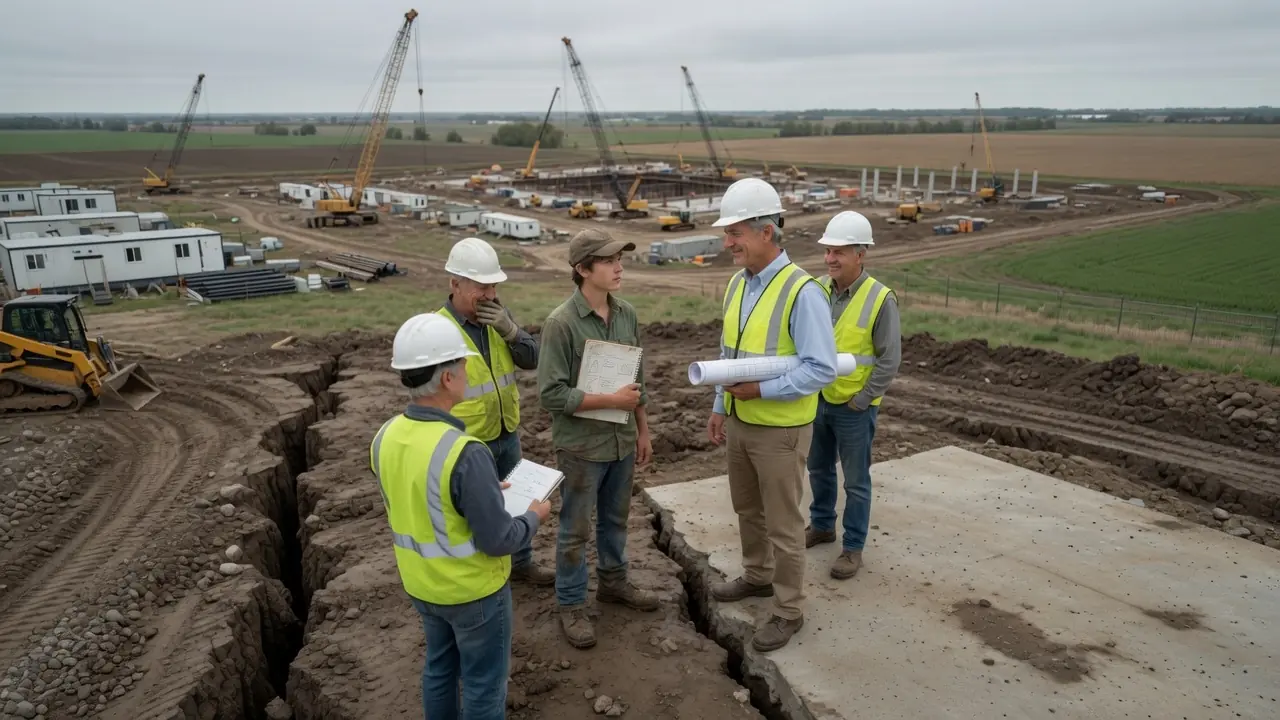
Most students chose birds, weather, or the height of garden plants.
Eli chose a depression in the south pasture where water collected after rain.
His grandfather, Samuel Hargrove, called it the sleeping bowl.
“Been there longer than I have,” Samuel once told him. “Some years it’s six feet across. Some years it’s twenty.”
Eli measured it every Saturday.
He drove a wooden stake into the center and recorded the distance to the edges. He noted rainfall, temperature, soil moisture, and the depth of standing water.
By autumn, the depression had widened nearly three feet.
His teacher gave him an A.
Eli did not stop.
He filled the remaining pages of the notebook, then started another.
He mapped fence posts that leaned for no visible reason. He recorded cracks opening in hard ground after heavy pumping from the irrigation wells. He marked places where puddles vanished faster than the soil could absorb them.
His mother called it his dirt diary.
His father called it useful, though he did not always understand what Eli was measuring.
His grandfather understood more.
Samuel had farmed the land for fifty-one years. He knew that portions of the southern pasture never behaved like the rest of the property.
Cattle avoided one strip of grass during wet springs. Wagon wheels had sunk there in 1976 even though the ground appeared dry. A storage shed built in 1989 developed a sloping floor within three years.
Samuel never used scientific language.
He simply said the land breathed.
Eli wanted to know why.
He borrowed geology books from the Bellweather library. He watched university lectures on an old laptop whose battery lasted eleven minutes. He learned about subsidence, groundwater movement, buried channels, dissolving rock, and abandoned mines.
The farm had no mines.
At least, none appeared on county maps.
But the Red Willow River had changed course many times over thousands of years. Beneath the visible soil lay layers of silt, sand, clay, and old river gravel.
Water could move through those layers without appearing on the surface.
Eli began adding colored marks to his maps.
Blue for standing water.
Red for cracks.
Green for unusual plant growth.
Black for sinking posts or structures.
By fifteen, he had filled seven notebooks.
His observations were not perfect. He had no surveying equipment beyond a homemade water level, a tape measure, and an old carpenter’s transit borrowed from his grandfather’s barn.
But he had time.
He had something the professional reports did not.
Years.
The energy project arrived in Bellweather in April.
Prairie Horizon Energy announced plans to build one of the largest green-hydrogen production facilities in the region. The company would use wind and solar power to separate hydrogen from water, store it, and ship it to industrial buyers across the Midwest.
The project promised three hundred construction jobs and eighty permanent positions.
It promised new roads, tax revenue, and contracts for local businesses.
It also needed land.
The company purchased nine hundred acres directly south of the Hargrove farm from a retired rancher named Dale Mercer. The site included the southern edge of the same low ground Eli had been studying.
At the town meeting, Prairie Horizon displayed bright architectural renderings.
White storage tanks.
Silver pipes.
Solar arrays stretching toward the horizon.
A row of enormous buildings set on concrete foundations.
The project director, Charles Voss, described it as a historic investment.
“This facility will place Bellweather at the center of America’s energy future,” he said.
Applause filled the high school auditorium.
Thomas clapped too.
The farm had struggled through three dry years. New construction might bring road improvements, better electrical service, and temporary work for neighbors who needed it.
Eli sat beside his father with one of his notebooks open on his lap.
On the screen, the proposed turbine hall rested directly above three clusters of red and black marks.
He raised his hand.
Voss continued speaking.
Eli kept his hand up.
Finally, a woman from the company noticed him.
“We’ll take questions at the end.”
When the microphone reached him, Eli stood.
His voice shook.
“Did your survey teams test below the clay layer on the east side?”
Voss smiled politely.
“We conducted extensive geotechnical analysis across the site.”
“How deep?”
A few people turned toward Eli.
Voss’s smile tightened.
“How deep were the cores?”
A man in the front row laughed softly.
Thomas touched Eli’s arm.
“Sit down,” he whispered.
Eli remained standing.
“The ground near the river has been sinking,” he said. “Not everywhere. Mostly in three lines running southwest.”
Voss looked toward the company’s lead civil engineer, Dr. Amelia Grant.
She was forty-one, with dark hair pulled back and a pair of reading glasses resting on top of her head.
Grant took the microphone.
“We drilled to depths appropriate for the planned foundations.”
“What does appropriate mean?”
This time, several people laughed openly.
Eli felt heat rise into his face.
Grant did not laugh.
“Between forty and sixty feet, depending on structure type.”
Eli looked down at his map.
“The movement might be deeper.”
“How much deeper?”
“I don’t know.”
Voss leaned toward the microphone.
“Then what exactly are you suggesting?”
Eli held up the notebook.
“I’ve measured the ground for five years. Fence posts moved nine inches near your eastern boundary. One well casing shifted. The old cattle pond drained underground after the flood two years ago.”
Voss glanced toward the audience.
The patience in his face began to look theatrical.
“Young man, our project has been reviewed by licensed geotechnical engineers, structural consultants, environmental specialists, and state regulators.”
“I know.”
“Do you have formal training?”
“No.”
“Are you a geologist?”
“No.”
“An engineer?”
“No.”
Voss spread his hands.
“Then I’m afraid we cannot redesign a two-hundred-million-dollar project based on a high school notebook.”
The room laughed.
Eli sat down.
Thomas stared at the floor.
On the drive home, neither spoke for several miles.
Finally, Thomas said, “You made your point.”
“They didn’t answer.”
“They answered enough.”
“No. They said they drilled to sixty feet.”
“That sounds deep.”
“It isn’t if the water is moving below it.”
Thomas tightened his hands around the steering wheel.
“You don’t know that.”
“No.”
“Then you can’t walk into a meeting and accuse professionals of missing something.”
“I didn’t accuse them.”
“You embarrassed them.”
Eli looked out the window.
Wheat fields passed beneath a red evening sky.
“What if I’m right?”
Thomas sighed.
“Then they’ll find it.”
Eli looked at him.
“What if they don’t?”
Construction began in June.
Earthmovers stripped the prairie grass. Graders leveled the site. Dump trucks carried thousands of tons of crushed rock through the new access road.
The sleeping bowl disappeared beneath fill.
Prairie Horizon installed drainage channels and temporary pumps. Concrete trucks arrived before sunrise. The main foundation pads were poured in sections large enough to resemble parking lots.
Eli watched from the edge of the farm.
At night, he copied details into his notebook.
He marked where water collected after storms.
He noted a row of survey stakes that had been reset twice.
He photographed cracks appearing along the northern drainage trench.
In July, he saw something that made him cross the fence.
A drilling rig stood near the future hydrogen storage area. Muddy water flowed from a pipe into a containment basin.
The water was gray and smelled faintly of sulfur.
Eli knelt beside the trench and watched tiny bubbles rise through the mud.
A security truck approached.
The driver was a young site engineer named Lena Ortiz.
She lowered the window.
“You can’t be in here.”
Eli stood.
“I’m on my side of the fence.”
“You crossed twenty yards.”
He looked back.
She was right.
The temporary boundary had shifted after roadwork.
“Sorry.”
Lena noticed the notebook.
“You’re the kid from the town meeting.”
“Eli.”
“I know.”
She stepped out.
At twenty-seven, Lena was younger than most engineers on the project. She wore steel-toed boots, a yellow vest, and a hard hat covered with inspection stickers.
“What are you looking at?” she asked.
“The bubbles.”
“Air escaping from disturbed soil.”
“It smells like sulfur.”
“That can happen with organic material.”
Eli pointed toward the muddy discharge.
“Did the drill hit water?”
“It hit several saturated zones.”
“How deep?”
She hesitated.
“Ninety-three feet.”
Eli’s attention sharpened.
“Your first survey only went to sixty.”
Lena looked toward the rig.
“This is a production well, not a foundation boring.”
“Did they test the water pressure?”
“That’s not public information.”
“Was it high?”
She closed her notebook.
“You need to leave.”
Eli did not move.
“The cattle pond drained after the 2022 flood. The water disappeared through cracks near here. I think it entered a buried channel.”
Lena studied him.
“You think there’s a cave?”
“Not exactly. Maybe old river gravel under clay. Or something dissolving.”
“The bedrock here isn’t known for karst.”
“I know.”
“Then what?”
Eli looked at the bubbling mud.
“I don’t know yet.”
She almost smiled.
“Engineers do not stop projects every time someone says they don’t know.”
“They should if the ground is moving.”
Lena’s smile vanished.
A horn sounded from the drilling rig.
She turned.
When she looked back, Eli had already crossed to the farm side of the fence.
Two days later, Lena found him repairing irrigation pipe with his father.
She parked along the county road and walked into the field.
Thomas straightened.
“Can we help you?”
“I need to see Eli’s records.”
Eli stopped tightening the pipe clamp.
Thomas looked at her vest.
“You’re with Prairie Horizon.”
“Yes.”
“What changed?”
Lena removed a folder from her bag.
“Settlement markers around the eastern turbine hall have moved.”
“How much?” Eli asked.
“Four millimeters.”
Thomas frowned.
“That doesn’t sound like much.”
“It isn’t. Not yet.”
Lena looked at Eli.
“But the movement follows the same line you drew on your map.”
Thomas slowly turned toward his son.
Eli wiped his hands on his jeans.
“I’ll get the notebooks.”
They spread the maps across the Hargrove kitchen table.
Lena examined every page.
At first, she moved quickly.
Then she began taking photographs.
She asked about dates, rainfall, wells, and field operations. Eli showed her the leaning fence posts, the old shed foundation, and the place where the cattle pond had emptied through a widening crack.
Samuel Hargrove watched from the porch.
At seventy-eight, his back had bent but his memory remained sharp.
“You folks finally notice the south ground won’t stay put?” he asked.
Lena looked at him.
“How long has it been happening?”
“Long as I remember.”
“Did anyone ever investigate?”
Samuel laughed.
“County sent a man in 1981. Said it was poor drainage.”
“What did you think?”
“I thought he wanted to leave before lunch.”
Eli brought out an old wooden box from Samuel’s closet.
Inside were farm documents dating back decades.
Tax maps.
Well records.
Receipts.
A folded hand-drawn map made by Eli’s great-grandfather in 1952.
Lena spread it flat.
A black line crossed the southern property and continued beneath the Prairie Horizon site.
Beside it, someone had written:
OLD WORKINGS — DO NOT PLOW DEEP.
Lena looked at Samuel.
“What does this mean?”
He shook his head.
“My father never explained.”
“Mine shaft?” Eli asked.
“There aren’t any registered mines here,” Lena said.
Samuel rubbed his chin.
“During the war, men dug something out there at night.”
“What men?”
“Government trucks. My father said not to ask.”
Thomas laughed nervously.
“Dad, you never told us that.”
“You never asked.”
Lena photographed the map.
That evening, she sent the information to Dr. Amelia Grant.
Grant replied within eleven minutes.
Historical agricultural markings are not sufficient evidence of underground voids. Continue monitoring.
Lena forwarded Eli’s settlement data.
Grant responded again.
Four millimeters remains within construction tolerance.
The project continued.
By August, the settlement reached eleven millimeters.
Then seventeen.
Grant approved additional fill and wider footings.
Eli wrote her a letter explaining why he believed adding weight could worsen the movement.
He included copies of his maps.
No one answered.
In September, Prairie Horizon held a public progress event.
Charles Voss stood before cameras beside the half-finished turbine hall. He praised the engineering team for keeping the project ahead of schedule.
Eli attended with Samuel.
When the presentation ended, Eli approached Amelia Grant.
She recognized him immediately.
“I read your letter.”
“Then why didn’t you respond?”
“I receive hundreds of communications.”
“The ground moved seventeen millimeters.”
Her expression tightened.
“You should not have access to internal measurements.”
“Lena told me.”
Grant glanced toward the young engineer standing near the stage.
“That was inappropriate.”
“Was I wrong?”
Grant lowered her voice.
“Settlement occurs on every large project. Engineers account for it.”
“Not in lines.”
“What?”
“The markers are sinking in lines. The same direction as the old map.”
Grant looked at the notebook beneath his arm.
“You are seeing patterns because you expect patterns.”
Eli opened to a marked page.
“The cracks open after pumping increases.”
“You cannot know site pumping volume.”
“I hear the pumps at night.”
“That is not data.”
“It is observation.”
“Observation without instrumentation is anecdote.”
Samuel stepped forward.
“Lady, that boy has watched this land longer than your company has owned a shovel here.”
Grant looked at the elderly farmer.
“And I respect that.”
“No, you don’t.”
Samuel’s voice remained calm.
“You respect credentials. That’s not the same thing.”
Voss approached before Grant could answer.
“Is there a problem?”
Grant closed Eli’s notebook.
“No.”
Eli took it back.
“Yes.”
Voss looked tired.
“Eli, this project employs people your family knows. It brings revenue to your county. Every time you spread unsupported concerns, you create fear.”
“I’m trying to prevent something.”
“What?”
“I don’t know.”
Voss gave a humorless smile.
“Exactly.”
Samuel placed one hand on Eli’s shoulder.
“Come on.”
As they walked away, Eli heard Voss tell Grant, “Keep the boy off the site.”
The first major warning came three weeks later.
A contractor operating a compactor near Turbine Hall Three felt the ground vibrate beneath him. He stopped the machine and reported a hollow sound.
The supervisor marked the area for inspection.
By the following morning, the report had been reclassified as equipment vibration.
Lena sent Eli a photograph.
A dark crack ran along the base of the eastern foundation.
Eli enlarged it on his phone.
Small grains of sand had accumulated along the edge.
Water was carrying material out from beneath the slab.
He called Lena.
“You need to stop pumping.”
“We need to keep the excavation dry.”
“The pumps may be pulling sand through the underground channel.”
“Our filters would catch it.”
“Are they?”
Lena was silent.
“Lena?”
“We found fine material in two discharge basins.”
“How much?”
“I don’t know.”
“Stop the pumps.”
“I can’t.”
“Tell Grant.”
“I did.”
“What did she say?”
“That the material came from construction disturbance.”
Eli looked toward the project lights glowing beyond the fields.
“They’re wrong.”
“I know.”
That was the first time an engineer said it.
Lena began collecting copies of reports.
Pump volumes.
Settlement readings.
Drill logs.
Photographs of discharge basins.
She discovered three boreholes where drilling pressure suddenly dropped below one hundred feet. The original contractors described the events as fluid loss into permeable gravel.
No deeper tests were ordered.
The final geotechnical report had reduced those notes to a single sentence:
Localized high-permeability zones encountered; no significant voids identified.
Lena searched the project archive.
The raw drilling logs were missing.
She contacted the subcontractor, but the firm said Prairie Horizon had all original files.
When she asked Grant, the lead engineer became defensive.
“You are spending too much time on a resolved issue.”
“It isn’t resolved.”
“Then write a formal technical challenge.”
“I did.”
“And it was reviewed.”
“By whom?”
“By me.”
Lena stared.
Grant removed her glasses.
“You are a junior field engineer. Your responsibility is to implement the approved design.”
“My responsibility is public safety.”
“Do not lecture me about safety.”
“Then stop construction until we know what is under Hall Three.”
Grant leaned back.
“Do you understand what a shutdown costs per day?”
“Do you understand what a collapse costs?”
Grant’s face went still.
“You are suspended from site access pending review.”
Lena left the office with her badge deactivated before she reached the parking lot.
That evening, she drove to the Hargrove farm.
Eli opened the door.
One look at her face told him what happened.
“They fired you?”
“Not officially.”
She placed a flash drive on the kitchen table.
“I copied everything I could.”
Thomas stood near the sink.
“Is that legal?”
“Probably not.”
Eli touched the drive.
“What did you find?”
“Pumping increased forty percent after July.”
He looked at her.
“They’re pulling more water.”
“And more sediment.”
Lena opened a laptop.
A chart showed pump discharge becoming cloudier over time.
“The settlement accelerates within twenty-four hours of high pumping.”
Eli pulled out his notebooks.
He compared dates.
Heavy pumping matched three new cracks on the farm.
Samuel entered carrying the 1952 map.
“Found something else.”
He had spent the afternoon searching through old county records stored in the church basement.
A newspaper clipping from 1944 described a federal minerals project near the Red Willow River. The article was vague, but it mentioned strategic salt extraction.
Lena read it twice.
“Salt?”
Eli looked toward the project.
“What kind?”
The answer came from a retired county surveyor named Harold Penn.
Penn was ninety-one and lived in an assisted-care facility in Bellweather. When Samuel showed him the map, the old man began shaking.
“My father worked there,” he said.
“Where?” Eli asked.
“The solution wells.”
Penn explained that during World War II, federal contractors drilled into a deep salt layer more than four hundred feet below the prairie. They injected water, dissolved the salt, and pumped brine to the surface for chemical processing.
The operation ended after one well collapsed.
Records were sealed because the facility produced material for military manufacturing.
“What happened to the wells?” Lena asked.
“Some were plugged.”
“Some?”
Penn looked at the map.
“One wasn’t.”
The black line marked an underground pipeline connecting the wells.
The unsealed shaft lay beneath what was now the Prairie Horizon site.
For eighty years, groundwater had slowly entered the old salt cavity.
The result was not a traditional cave.
It was a growing underground chamber whose roof consisted of unstable layers of shale, clay, and river sediment.
The Hargrove family had been observing its surface effects for generations.
Eli’s sleeping bowl was not poor drainage.
It was subsidence.
Lena sent the information to Prairie Horizon, the county commission, and the state environmental office.
Voss responded through an attorney.
The historical claims are unverified and potentially damaging. Unauthorized distribution of confidential project data may result in legal action.
The county administrator called Thomas.
“Your son needs to stop making public statements.”
“He hasn’t made any.”
“People are talking.”
“Maybe they should.”
“The project is too important to this county.”
Thomas looked toward Eli sitting at the kitchen table.
“What’s more important than the ground holding it up?”
The administrator lowered his voice.
“Thomas, your farm loan is held by Bellweather Community Bank.”
Thomas went still.
“So?”
“The bank has a substantial investment in project development.”
“Is that a threat?”
“It’s advice.”
The call ended.
Thomas did not tell Eli immediately.
For the first time, he understood why people with more authority had remained quiet.
The project was not only steel and concrete.
It was contracts, loans, careers, political promises, and reputations.
Stopping it would cost money.
Admitting the warnings had been ignored would cost more.
The next morning, Thomas found Eli packing his notebooks into a plastic storage box.
“What are you doing?”
“Moving them.”
“Where?”
“Grandpa’s safe.”
“Why?”
“In case someone comes for them.”
Thomas stared at his son.
Eli avoided his eyes.
“I heard your call.”
Thomas sat down.
“You shouldn’t have.”
“They can take the farm?”
“No.”
“But the bank can make things hard.”
“We’ve survived hard.”
Eli closed the box.
“I’m sorry.”
“For what?”
“If I had stayed quiet—”
Thomas stood so quickly the chair scraped backward.
“No.”
Eli looked up.
“I told you to stop embarrassing people because I was afraid they’d think we were ignorant farmers.”
Thomas’s voice roughened.
“I should have been more afraid they were ignoring you.”
He placed both hands on the box.
“You don’t apologize for seeing something.”
Two days later, Prairie Horizon announced that Turbine Hall Three had passed an independent safety review.
No review had actually occurred.
The announcement came from Voss’s office after Grant signed a statement saying observed settlement remained manageable.
Lena read the statement online.
“She knows better,” she said.
Eli looked at the signature.
“Why would she sign?”
“Because her name is already on the design.”
The project began installing major equipment.
Each turbine assembly weighed hundreds of tons.
The hydrogen compression units added more load to the eastern foundations.
Eli watched the cranes from his bedroom window.
His notebook entries became shorter.
October 11: New crack near south fence.
October 13: Pump discharge gray after midnight.
October 16: Field tile stopped flowing.
October 19: Sleeping bowl widened 14 inches.
October 22: Hall Three lights shifted relative to silo roof.
He used the farm silo as a fixed reference point.
At sunset, the line of the turbine hall roof had changed.
The structure was tilting.
He showed Thomas.
His father called the county sheriff.
The sheriff said it was a civil engineering matter.
Lena called the state.
The state referred her to federal energy regulators.
The federal office said the project remained under state jurisdiction during construction.
Everyone had a number to call.
No one had authority they wished to use.
On Sunday night, rain fell for six hours.
Not heavily.
Just enough to saturate the upper clay.
The project pumps ran continuously.
At 4:12 Monday morning, an automated settlement marker beneath Turbine Hall Three recorded a sudden downward movement of twenty-two millimeters.
The alert went to a monitoring server.
The notification list included Grant, Voss, Delaney, and a project geotechnical consultant.
Grant saw the warning at 4:19.
She marked it for review.
At 5:03, another marker dropped thirty-one millimeters.
At 5:17, the eastern drainage basin began losing water through its bottom.
A night worker reported hearing deep knocking beneath the ground.
Delaney called Grant.
She told him to restrict access to the eastern slab until daylight.
She did not order a full evacuation.
At 6:18, the crack opened.
The collapse did not happen all at once.
The first foundation section dropped fourteen inches.
Then underground water rushed into the newly opened fractures, carrying sand and silt into the old salt cavity.
The cavity roof failed in stages.
A circular section of ground nearly one hundred feet across sank beside Turbine Hall Three.
The access road broke.
Two empty equipment trailers slid into the depression.
A temporary electrical building tilted until cables tore from the walls.
Workers escaped because Delaney had reacted to the first crack instead of waiting for approval.
No one died.
Three men suffered injuries.
One broke an ankle.
Another was struck by falling pipe.
A crane operator remained trapped in his cab for forty minutes before rescuers reached him.
By 7:00, news helicopters circled above the facility.
By 7:30, Voss stood at the command trailer demanding answers.
Amelia Grant arrived in a black SUV.
She looked at the collapsed ground and said nothing.
Then she saw Eli and Thomas beyond the fence.
Voss followed her gaze.
“Get security.”
Grant stopped him.
“No.”
“He has no reason to be here.”
“He has every reason.”
She walked toward Eli.
Her boots sank into wet gravel.
When she reached the fence, she looked older than she had at the town meeting.
“How far does it go?” she asked.
Eli held the notebook tighter.
“What?”
“The unstable area.”
“I don’t know.”
“You mapped it.”
“I mapped surface changes.”
“Show me.”
Voss arrived behind her.
“We are not basing emergency decisions on a teenager’s drawings.”
Grant turned.
“We already based two hundred million dollars on incomplete drilling.”
His face hardened.
“Be careful.”
“No.”
She pointed toward the collapsed hall.
“I was careful for six months.”
Workers nearby began listening.
Grant looked back at Eli.
“Please.”
He opened the notebook.
The maps showed three lines of subsidence.
One passed beneath Turbine Hall Three.
The second crossed the hydrogen storage area.
The third ended near the main water-treatment building.
Voss stared at the page.
“This is speculation.”
A deep boom rolled across the site.
Everyone turned.
Two storage-tank foundations shifted.
One tank leaned less than a degree.
It was enough.
Grant seized the radio from Voss’s hand.
“Evacuate the entire eastern sector.”
He grabbed her wrist.
“You do not have command authority.”
She pulled free.
“Then fire me after we get everyone out.”
Delaney heard the transmission and ordered the evacuation.
Within twenty minutes, the eastern half of the project stood empty.
At 8:14, the second collapse began.
The ground beneath the hydrogen storage area settled three feet.
Pipes snapped.
A buried water line ruptured and poured thousands of gallons into the cavity.
The tanks had not yet been filled with hydrogen.
Had the collapse occurred six months later, the result could have been catastrophic.
The story spread nationally.
Headlines described the farmer’s son who predicted the sinking project.
Television crews gathered outside the Hargrove farm.
Reporters wanted Eli to hold up the spiral notebook.
They wanted a simple story.
Teenage genius defeats arrogant experts.
Eli refused every interview.
“It wasn’t genius,” he told Lena. “I just watched.”
“That’s what science starts with.”
“They’ll make it sound like nobody else could have known.”
“Someone else did.”
She looked toward Prairie Horizon.
“They chose not to.”
Investigators arrived from the state, the Department of Energy, and the National Transportation Safety Board because the planned hydrogen systems fell under multiple jurisdictions.
The site was sealed.
Raw drilling records were subpoenaed.
The missing logs reappeared on a consultant’s backup server.
They showed fluid losses at depths between ninety and one hundred thirty feet.
But the salt cavity lay more than four hundred feet down.
How had the surface connected to it?
The answer came from a borehole drilled after the collapse.
The original solution well had failed near the top of the salt layer. Over decades, its steel casing corroded.
Groundwater entered through the broken pipe.
As salt dissolved, the cavity expanded upward. Roof layers fractured one by one, creating a column of broken material known as a chimney.
The chimney reached into the old river gravels.
Project pumping lowered groundwater pressure around the site and accelerated the movement of sand into the fractures.
The heavy foundations added stress from above.
The site had not been stable.
It had been temporarily balanced.
Prairie Horizon disturbed every part of that balance at once.
Investigators also discovered that an early geotechnical subcontractor had recommended deep seismic testing after detecting abnormal drill-fluid losses.
The recommendation disappeared from the final report.
A project manager marked it:
Low probability. High schedule impact. No further action.
The manager reported directly to Charles Voss.
Voss denied ordering the note removed.
Emails showed otherwise.
Grant’s role was more complicated.
She had received the warning.
She had also signed the final report.
During a public hearing in Bellweather, hundreds of residents filled the high school auditorium.
The same room where Eli had first raised his hand.
Voss sat behind a long table with attorneys.
Grant sat separately.
Lena sat near the Hargrove family.
State investigators displayed Eli’s maps beside professional survey data.
The lines matched.
A senator asked Eli to explain how he identified them.
He stood at the microphone.
“I measured what changed.”
“That is all?”
“I wrote down where the ground opened after rain. I measured fence posts. I recorded when ponds drained and when wells pumped.”
“Why did professionals miss it?”
Eli looked toward Grant.
“They didn’t have enough time.”
Grant lowered her eyes.
He continued.
“And when they found things that didn’t fit, the project kept moving.”
The senator looked at Voss.
“Were you warned?”
Voss leaned toward his microphone.
“We received informal concerns from a minor without technical qualifications.”
Samuel Hargrove laughed from the audience.
The senator raised one eyebrow.
Voss continued.
“At no point were we provided verified evidence of a deep cavity.”
Lena stood.
“You were provided drilling logs showing unexplained fluid loss.”
His attorney objected.
The senator allowed her to continue.
“You were given settlement data, sediment discharge reports, and historical maps.”
Voss looked at her.
“You stole confidential information.”
“I preserved it.”
Grant finally spoke.
“Mr. Voss is correct about one thing.”
The room turned toward her.
“We did not have verified evidence of a deep cavity before construction.”
Eli’s face tightened.
Then Grant continued.
“We had evidence that our understanding of the site was incomplete.”
Silence settled over the auditorium.
“That should have been enough to stop,” she said.
Voss stared at her.
Grant placed a folder on the table.
“I signed the final safety statement after being told a shutdown would destroy the project and cost hundreds of jobs.”
“Were you threatened?” the senator asked.
“No.”
“Then why did you sign?”
Grant looked toward Eli.
“Because I wanted the uncertainty to be manageable.”
Her voice shook for the first time.
“I confused what I wanted with what the data showed.”
That statement ended her career with Prairie Horizon.
It also prevented Voss from placing all responsibility on junior staff.
The investigation expanded.
Bank records revealed that Bellweather Community Bank had extended unusually favorable financing to contractors connected to Voss.
The county administrator received consulting payments through a private company.
The project’s independent review had been conducted by a firm partly owned by Voss’s brother.
The collapse became more than an engineering failure.
It became a record of how uncertainty had been pushed downward until no one person appeared responsible.
Voss was indicted on fraud, conspiracy, falsification of safety records, and obstruction charges.
The county administrator resigned.
Prairie Horizon’s board removed its regional leadership.
The company announced it would abandon the Bellweather site.
That decision created a new problem.
Hundreds of workers lost jobs.
Local businesses lost contracts.
Some residents blamed Voss.
Others blamed regulators.
A few blamed Eli.
Someone spray-painted LIAR on the Hargrove barn.
Thomas found it before sunrise.
He tried to wash it away before Eli saw.
The red paint remained visible beneath the soap.
“I’m sorry,” Thomas said.
Eli stared at the word.
“For what?”
“For this town.”
“They’re scared.”
“That doesn’t make it right.”
“No.”
Eli touched the wet boards.
“But the project was supposed to help.”
Thomas looked toward the idle cranes.
“Bad foundations don’t become good because people need the building.”
The project site remained dangerous.
Engineers proposed filling the cavity with grout, but the underground chamber was too large and irregular to stabilize cheaply.
A federal team recommended converting the area into a monitored exclusion zone.
The western portion of the land remained stable.
Lena proposed a smaller project there.
Not hydrogen.
A research facility for subsidence monitoring, groundwater restoration, and safe renewable development.
Prairie Horizon rejected the idea.
The state university did not.
Dr. Amelia Grant, now working independently, helped secure funding.
She visited the Hargrove farm six months after the collapse.
Eli was repairing a fence post.
She stopped beside him.
“I owe you an apology.”
He kept working.
“You already apologized at the hearing.”
“That was public.”
“This is also outside.”
She almost smiled.
“I dismissed you because you could not explain the mechanism.”
“I couldn’t.”
“I treated that as proof there was no mechanism.”
Eli drove the post deeper.
“Why?”
Grant looked toward the site.
“Because experts are rewarded for answers.”
“And farmers?”
“For surviving wrong ones.”
He leaned on the post driver.
“You knew the ground was moving.”
“Yes.”
“Why didn’t you stop it?”
She answered without excuses.
“I was afraid of being the person who delayed everything over something I could not prove.”
Eli nodded.
“I was afraid too.”
“Of what?”
“Being wrong.”
Grant looked at him.
“What made you speak anyway?”
He glanced toward the sleeping bowl.
“If I was wrong, they’d laugh.”
He looked toward the collapsed turbine hall.
“If I was right and said nothing, people could die.”
Grant remained silent.
One year after the collapse, the Red Willow Ground Research Center opened on the stable western portion of the site.
Its first project installed monitoring wells across the Hargrove farm and former Prairie Horizon property.
Eli helped place the instruments.
He was seventeen by then and had been accepted into Kansas State University’s geology program.
The scholarship letter arrived with no dramatic ceremony.
Thomas found it in the mailbox between a seed catalog and the electric bill.
Eli read it twice at the kitchen table.
Samuel watched from the doorway.
“You going?”
“I don’t know.”
Thomas stared at him.
“What do you mean?”
“The farm needs help.”
“The farm needed help before you were born.”
“I can study here.”
“You can study dirt here,” Samuel said. “You need to study why it moves somewhere people know the words.”
Eli looked toward his grandfather.
Samuel pointed at the notebooks stacked on the shelf.
“Then bring the words back.”
At university, Eli discovered how much he did not know.
Calculus nearly defeated him.
Laboratory equipment intimidated him.
Students from wealthy schools had used software he had never seen.
During his first semester, he considered leaving.
Lena, now a graduate researcher at the Red Willow Center, called him.
“You were comfortable being the smartest person in a room that didn’t listen.”
“That isn’t true.”
“It is a little true.”
He said nothing.
“Now you’re in rooms where everyone knows things you don’t.”
“Yes.”
“That’s where you wanted to be.”
“I thought it would feel different.”
“It will.”
“When?”
“When you stop treating confusion like failure.”
Eli stayed.
He returned to the farm every summer.
The sleeping bowl remained, though sensors now measured its movement to fractions of an inch.
The old solution cavity continued changing slowly. Engineers learned that the collapse had not ended the underground process.
It had exposed it.
Researchers used Eli’s notebooks to compare modern readings with years of earlier observations.
His imperfect measurements became valuable because they provided something no instrument could recreate.
History.
Five years after the disaster, the state completed a memorial and observation center near the edge of the exclusion zone.
A section of the tilted turbine hall remained visible in the distance.
Visitors came to study engineering ethics, land history, and geologic risk.
One display case held Eli’s first spiral notebook.
He objected.
“It looks childish.”
“That is the point,” Grant said.
She now taught engineering safety.
“Why?”
“Because people assume useful knowledge must look professional before it can be useful.”
The display included the page from the town meeting.
Three red lines crossed the project footprint.
Beside it hung a copy of the final geotechnical report.
The contrast made Eli uncomfortable.
He did not want the engineers remembered as fools.
Grant understood.
“We missed it,” she said.
“You found some of it.”
“And chose not to follow it.”
“That isn’t the same as knowing.”
“No.”
She looked at the tilted building.
“But responsibility begins before certainty.”
Charles Voss was convicted on four federal charges and served six years in prison.
The fraud case focused on altered safety records and financial conflicts, not the collapse itself.
No law punished confidence.
No statute criminalized arrogance.
But the emails showed deliberate concealment of recommendations that might have delayed construction.
Prairie Horizon paid more than eighty million dollars in settlements.
The company survived.
Its Bellweather project did not.
Thomas used part of the family’s settlement to pay off the farm loan.
He refused to buy new equipment.
Instead, he repaired the old combine and replaced the barn roof.
Samuel died two winters later.
He was eighty-three.
At his funeral, Eli placed a copy of the 1952 map inside the casket.
The original remained at the research center.
After the service, Thomas and Eli stood near the farm gate.
“You were right,” Thomas said.
Eli shook his head.
“Grandpa was right first.”
“His father may have been right before him.”
They looked toward the southern fields.
Knowledge had moved through the family without titles.
A warning on a hand-drawn map.
A phrase about breathing land.
A boy measuring fence posts.
None of it was complete.
Together, it had been enough.
Ten years after the collapse, Dr. Eli Hargrove returned to Bellweather as a hydrogeologist.
He was twenty-six.
The town had changed.
Some of the temporary project housing had become apartments. The research center employed thirty people. Local schools brought students to measure groundwater and soil movement.
Eli still carried a notebook.
Not the old spiral kind.
A waterproof field book with gridded pages.
On his first morning back, he walked to the sleeping bowl.
It was wider than before.
A sensor post stood at its edge.
He crouched and pressed his hand against the soil.
Lena approached from behind.
“You know we have instruments for that.”
“I know.”
“What does your hand tell you?”
“It’s wet.”
She laughed.
Lena had become director of field operations at the center.
She wore the same kind of inspection vest she had worn when they met, though now her name appeared above the pocket.
Eli stood.
“The pumping test starts tomorrow?”
“Unless a teenage farmer stops us.”
“I’m too old now.”
“That is unfortunate. People listen less once you become a professional.”
They walked toward the observation building.
Inside, a group of high school students waited for a tour.
One boy lingered near the back holding a folded map.
He raised his hand before Eli began speaking.
“My family has cracks opening near our well.”
The teacher looked embarrassed.
“We can discuss personal questions afterward.”
Eli stopped her.
“What kind of cracks?”
The boy unfolded the map.
“They form after the dairy east of us pumps a lot of water.”
Eli walked down from the front.
He did not ask whether the boy had formal training.
He did not ask whether the drawing was verified.
He looked at the map.
“How long have you been watching them?”
“Two years.”
“Do you have dates?”
The boy opened a notebook.
Eli smiled.
“Show me everything.”
Outside, wind moved across the Kansas prairie.
Beyond the research center, rusted steel from the abandoned energy project still leaned above the exclusion zone.
It remained a monument to a failure larger than one company or one engineer.
The project had not sunk because nobody warned them.
It sank because the warning arrived in a form powerful people had decided not to respect.
A farmer’s memory.
A hand-drawn map.
A junior engineer’s concern.
A sixteen-year-old’s spiral notebook.
The ground had told the truth for years.
Eli had simply written it down.