On a Friday afternoon in April of 1996, a $450,000 excavator came out of a mud hole that four modern machines and three professional recovery crews couldn't budge. It came out in under 4 minutes. It was pulled by a steam traction engine built in 1909, operated by a 74-year-old farmer who hadn't asked for permission, hadn't asked for payment, and hadn't bothered explaining himself until the job was done. The construction crew stood in silence. The project supervisor stood in silence.
The county engineer who'd told the old man to go home stood in silence. The only sound was the steam whistle echoing across the Mississippi River bottoms. The same sound that had echoed across those fields when the old man's grandfather was alive. Let me take you back 4 days. On a Monday morning in April of 1996, Pike County, Missouri, had a problem.
Three weeks of spring rain had swollen the Mississippi to flood stage. A levee on the Sailor Bend, named for the family that had farmed the bottom land behind it since 1891, had breached overnight. Water was pouring through a 40-ft gap onto 8,000 acres of farmland. 12 families were behind that levee, 12 farms, generations of work. The county hired Prescott and Sons Construction out of Hannibal to make the emergency repair.
Jack Prescott ran the operation. 42 years old, lean, crew cut, wearing a hard hat and a company polo shirt. Jack had been building and repairing levees along the Mississippi for 18 years. He was good at it. He knew it. Everyone knew it.
Jack brought a Caterpillar 345 excavator, 62 tons of steel, a machine that could move 100 cubic yards of earth per hour. He brought two Caterpillar D7 bulldozers for pushing fill. He brought dump trucks loaded with rock and clay. He had the equipment, the crew, and the experience to close that breach. What he didn't have was solid ground.
The access road to the breach ran across bottom land that had been underwater for 2 weeks. The water had receded, leaving a surface that looked dry, hard-packed clay with cracks in it, the way bottom land looks after a flood dries. But underneath that crust, the soil was saturated, 4 ft of soup covered by an inch of shell. The Caterpillar 345 broke through on its third pass. One moment it was tracking toward the breach.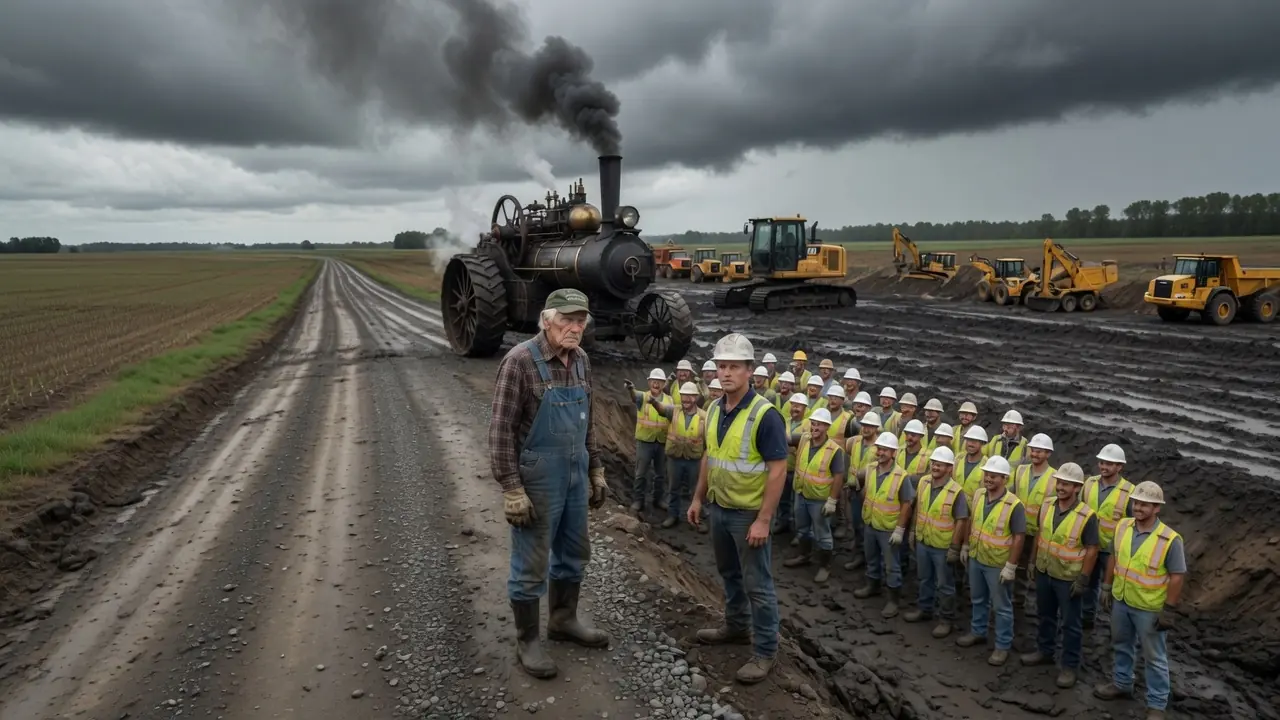
The next moment, the ground opened and 62 tons of excavator dropped like a trapdoor had been pulled. The machine sank to its cab floor in under a minute. The operator barely got out. By Tuesday, the excavator was buried to the top of its tracks. By Wednesday morning, only the cab and boom were visible.
Every hour it sank a little deeper, and every hour the breach in the levee stayed open, and every hour more water poured onto the farmland behind it. The weather forecast said more rain was coming Friday night, heavy rain. If the levee wasn't repaired before Friday, the flooding would double. 8,000 acres of winter wheat would be destroyed. 12 families would lose their spring crop, some of them their entire year's income.
Jack Prescott tried everything. Day one, he chained two D7 bulldozers to the excavator and pulled. The bulldozers spun on the saturated ground, couldn't get traction. The chains went taut and the bulldozers just sat there, tracks churning mud, going nowhere. The excavator didn't move.
The excavator sank another 4 in. Day three, he called a crane company. The crane operator drove to the site, looked at the ground, and said three words, "Not a chance." He wouldn't bring his crane within 200 ft of the soft ground. "You want two machines stuck?" he said.
"Because that's what you'll get." By Wednesday evening, Jack Prescott was standing at the edge of the breach, watching river water pour through the gap and a $450,000 machine disappear inch by inch into the earth. His foreman walked over. "Jack, what about draining the ground? Pump the water out, let it dry."
"That would take 2 weeks. The rain's coming Friday." "Helicopter? Military sky crane?" "Nearest one's at Fort Leonard Wood. Even if they'd do it, we couldn't get authorization before Friday." "Then what?" Jack didn't have an answer.
That's when a green John Deere 4020 pulled up on the county road above the levee. An old man climbed down, 74 years old, tall but stooped, white hair under a feed cap, wearing denim overalls and rubber boots. He walked down the slope to where Jack stood. "You're Prescott?" the old man said. "Yeah, site's closed. We've got a situation."
"I know what your situation is. I've been watching it for 3 days from my kitchen window. That's my wheat behind this levee." Jack looked at him. "You're Sailor?" "Emmett Sailor. My grandfather built that levee by hand in 1903. And right now, your machine is sitting in the same mud hole that swallowed a team of mules in 1911."
"I'm sorry about your wheat, Mr. Sailor. We're doing everything we can." "I can see what you can do. I've watched 3 days of it. I'm here to offer something different." "Different how?" "I can pull your excavator out."
Jack Prescott stared at Emmett Sailor the way you stare at someone who just told you they can fly. "Mr. Sailor, I've had two bulldozers, a 50-ton winch, and a crane company out here. None of them could move that machine. What exactly are you going to pull it with?" "My steamer, 1909 Reeves cross compound steam traction engine, 25 tons, 110 horsepower, 7-ft drive wheels with forged steel cleats. Been in my family since my grandfather bought her new."
Jack looked at his foreman. His foreman looked at the ground. The construction crew, 15 men standing within earshot, went quiet. Then Jack laughed. Not a cruel laugh, the kind of laugh that escapes when you're exhausted, desperate, and someone offers you something so absurd your brain short-circuits.
"A steam engine? From 1909? Mr. Sailor, that thing belongs in a museum. My excavator weighs 62 tons. Your antique, what? It weighs 25? You can't pull 62 tons with 25 tons of museum piece." "You can if the 25 tons doesn't slip." "Mr. Sailor, I appreciate you wanting to help. I really do. But this is a job for modern equipment, and right now we're running out of" "You've run out."
Emmett's voice was quiet, but it stopped Jack mid-sentence. "You've run out of time. You've run out of ideas, and Friday night that rain is going to wash out every acre behind this levee, including mine. So, you can stand here telling me what my machine can't do, or you can let me show you what she can." Jack Prescott said, "Yes." Not because he believed Emmett, because he was out of options.
The rain was coming Friday night. His excavator was sinking. His career was sinking with it. An old farmer with a steam engine was the only offer left. "If that antique damages my excavator, you're liable," Jack said.
"If I don't pull it out, the river will bury it for good. Your choice." Jack waved his hand. "Do it." Emmett drove his John Deere home. It took him 3 hours to fire up the Reeves.
You can't rush a steam engine. You build the fire slow. You let the water heat gradual. You watch the pressure gauge climb degree by degree until the needle reaches working pressure. Emmett had done this 200 times, but he'd never done it with 8,000 acres on the line.
By 2:00, the Reeves was ready. Emmett drove her out of the machine shed and down the county road toward the levee. 5 mph. Black coal smoke rising from the stack. Steam hissing from the safety valve.
The ground shaking with each rotation of the 7-ft drive wheels. Cars pulled over. A school bus stopped and the driver let the kids press their faces against the windows. A UPS driver climbed out of his truck and stood in the road just watching. Nobody alive had seen a steam traction engine on this road in 60 years.
The construction crew heard her before they saw her. A deep rhythmic breathing. Chuff, chuff, chuff. Like something enormous and alive was walking toward them. Then the ground vibration.
The steel cleats biting gravel with each revolution, sending tremors through the earth. Then the whistle. Emmett blew it as he crested the rise above the levee. A single long blast that rolled across the river bottoms and echoed off the bluffs on the Illinois side. The Reeves came over the rise and every man on that construction site stopped what he was doing.
She was enormous. The boiler was 8 ft long, painted black, the brass fittings polished to gold. The drive wheels, 7 ft of iron with steel cleats, turned with a slow, inevitable authority that made the D7 bulldozers look like toys. The steam engine didn't look fast. She looked unstoppable.
"Mother of God," Jack's foreman said. Jack Prescott said nothing. His arms were crossed, but the smirk was gone. Emmett positioned the Reeves on the hard-packed county road above the breach site. Solid ground, gravel and clay, ground that could hold 25 tons without flinching.
He set the brake and climbed down. From the back of the engine, he uncoiled a chain. Not cable, chain. 2-in links of forged steel that had come with the engine in 1909. The same chain Ira Sailor had used to pull stumps 87 years ago.
"Cable would be stronger," one of the engineers said. "Cable snaps," Emmett said. "You already proved that. Chain gives, stretches before it breaks. Gives you a warning. Cable gives you a whip that'll cut a man in half."
He walked the chain down the slope, through the mud, to the stuck excavator. The mud took him to his waist. He didn't hesitate. He'd been walking through Mississippi River mud since he was 6 years old. He hooked the chain to the excavator's frame, tested the connection by pulling on it with his full weight.
Then walked back to the Reeves. He was covered in black mud from the chest down. He climbed onto the engine's platform like he hadn't noticed. "Mr. Sailor," Jack called from the top of the slope. The mockery was gone from his voice.
"That machine weighs 62 tons, buried in 4 ft of saturated silt with suction holding it down. The actual pull force needed is probably north of 80 tons. Your engine makes 110 horsepower. My bulldozers make 300 each, and they couldn't move it." Emmett looked down at Jack from the platform.
"Your bulldozers spin. Mine grips. Your machines have computers that cut power when the load gets too heavy. Protects the machine, saves the engine, smart engineering. My machine doesn't know how to quit. She'll pull until something breaks, and nothing's going to break because my grandfather built this chain to pull stumps out of the same mud your excavator is sitting in."
He paused. "Now, stand clear." Emmett opened the throttle. The Reeves answered with a sound that none of the construction crew had ever heard. A deep, heavy, rhythmic pounding like the heartbeat of something ancient that had just woken up. The pistons drove.
The gears meshed. The 7-ft drive wheels began to turn. They did not spin. The steel cleats bit into the gravel road like teeth into bone. Each cleat found the hard clay beneath the gravel and locked onto it.
25 tons of engine pressing down. 7 ft of wheel leveraging forward. 110 horsepower delivered not fast, but all at once, through gears designed before the word efficiency replaced the word strength. The chain went taut. The links straightened one by one.
The slack disappearing. The forged steel humming under tension. In the cab of the stuck excavator, the instrument panel rattled. The frame groaned, a sound like a ship in heavy seas. For 3 seconds, nothing moved.
Then the excavator shifted. An inch. Maybe two. Forward, out of the hole. Nobody spoke.
Emmett pushed the throttle wider. The chuffing accelerated. Not fast, just harder, deeper, more insistent. The drive wheels turned another revolution. The cleats tore into the road surface and threw gravel behind them like shrapnel.
The excavator moved a foot, then another foot. The mud began releasing its grip. A series of deep sucking sounds like the earth itself was exhaling. 2 ft, 5 ft. The tracks emerged, black, dripping, caked in silt.
10 ft. The cab cleared the mud line. The machine was rising. 20 ft. The suction broke completely, and the excavator surged forward, dragged by the chain like a toy pulled by a child.
Emmett kept pulling. 30 ft, 40, 50. He pulled the excavator 100 ft past the mud hole onto solid ground before he closed the throttle and set the brake. Then he reached up and pulled the whistle cord. The sound that came out of that brass whistle, a deep shuddering howl, rolled across the Mississippi River bottoms and didn't stop.
It echoed off the limestone bluffs on the Illinois side and came back. It scattered blackbirds from the cottonwoods along the river. It reached the farmhouses behind the levee where 12 families had been watching from their kitchen windows for 4 days. The construction crew erupted. 15 men screaming, grabbing each other, pointing at the excavator sitting clean on solid ground for the first time in 4 days.
The foreman was clapping. The crane operator who'd refused to come within 200 ft of the mud was standing there with his mouth open. Jack Prescott didn't move. He stood at the top of the slope, arms at his sides, staring at the steam engine and the old man on its platform and the excavator that his million dollars of modern equipment couldn't move and a machine from 1909 had pulled out like a cork from a bottle. The next morning, Jack drove to Emmett's farm.
Emmett was in the machine shed cleaning mud off the Reeves' drive wheels. "Mr. Sailor." "Mr. Prescott." Jack stood in the doorway. He looked at the steam engine, massive, ancient, beautiful in the morning light. The brass fittings gleamed.
The iron boiler radiated the warmth of yesterday's fire. "I owe you an apology." "You owe me a levee repair. The rain's coming tonight." "My crew's already on it. The excavator's running. We'll have the breach closed by 6:00." "Good."
Jack was quiet for a moment. "I called you a museum piece, laughed at you in front of my crew." "You did." "I was wrong." "Yes." "How did you know it would work?"
Emmett set down his rag and leaned against the massive drive wheel. "My grandfather bought this engine in 1909. First thing he did was pull a dead mule team out of that same bend. Eight mules drowned in a flash flood, tangled in their harness, buried in the silt. Nobody could get them out."
"Ira drove the Reeves down there and pulled all eight out in one pass. After that, every time something got stuck in the bottoms, people called Ira." He patted the boiler. "This machine was built for one thing, pulling weight that doesn't want to move on ground that doesn't want to hold. That's all she knows how to do."
"And she's been doing it for 87 years." "But the technology the technology is a fire, water, and steel. That's it. No computer decides when she's working too hard. No sensor tells her to back off."
"She doesn't protect herself. She just pulls until I tell her to stop or until something breaks. And in 87 years, nothing has broken." Jack nodded slowly. "What do I owe you?" "Not a thing."
"I can't accept that." "You saved my excavator. You saved my contract. You probably saved those 12 farms behind the levee." Emmett looked out the shed door toward his fields, the fields his grandfather had cleared, the levee his grandfather had built, the land three generations of Sailors had kept above water.
"The Pike County Historical Society could use a new roof on their building. They're the ones who helped me find parts when I was restoring this engine. Whatever you think is fair." Jack wrote a check for $15,000. Handed it to Emmett.
"And my crew will fix that roof for free." Emmett took the check, folded it, put it in his overalls pocket. "Appreciate it." "Mr. Sailor, that whistle. When you pulled the cord after the excavator came out, that sound, I've never heard anything like it." "My grandfather used to blow that whistle every time he finished a job. Said it was the engine's way of saying, 'I told you so.'"
Jack almost smiled. "She told us." The stories spread the way stories do in river towns, across fences, at feed stores, in church parking lots. A reporter from the Quincy Herald-Whig drove down to write a feature. Then the St. Louis Post-Dispatch picked it up. Then a television crew from Springfield came out to film the Reeves.
Over the next 6 years, Emmett and the 1909 Reeves pulled out 14 pieces of modern equipment that nothing else could move. Three excavators, two bulldozers, four grain trucks stuck in harvest mud, a cement mixer that broke through a bridge deck, and a county snowplow that went through the ice on a pond. He never charged. Every job ended with a donation to the Pike County Historical Society. By 2002, the society had enough to build a proper museum dedicated to steam era machinery.
The Reeves was the centerpiece, not permanently. Emmett still kept her on his farm, still fired her up once a month, but the museum built a display with photographs of every rescue and a plaque that read, "Some machines don't become obsolete. They just wait for people to remember why they were built." Emmett Sailor died in 2004 at 82. Heart gave out on a Sunday morning. His son, Dale, found him on the porch with a cup of coffee looking out at the levee his grandfather had built by hand 100 years before.
The funeral drew 300 people. Jack Prescott came, older now, still running Prescott and Sons, still telling the story. "This man saved my business and 12 farms with a machine everyone laughed at." Jack told the crowd. "And he never let me forget it."
Dale Sailor took over the farm and the Reeves. He'd grown up learning steam, how to build the fire, how to read the gauges, how to feel the pressure in the pipes before the needle showed it. The first time he fired up the engine after his father died, the whistle echoed across the bottoms. Dale stood on the platform, hand on the throttle, and understood something his father and his great-grandfather had both known. The sound wasn't just steam through brass.
It was a voice, Ira's, then Emmett's, then his own, saying the same thing across 100 years, "We're still here." In 2018, 22 years after the original rescue, the Sailor Bend levee breached again. Spring flooding, same gap, same mud. The county hired a new contractor, a young outfit from Jefferson City with new equipment and new confidence. Their excavator broke through the same soft ground on the second day.
The young supervisor called Dale Sailor. "Mr. Sailor, I know this sounds crazy, but my father told me about what your father did in 1996. He said if anything ever got stuck in the Sailor Bend, there was only one machine that could pull it out." Dale smiled. "Give me 3 hours to build steam."
The Reeves came over the rise at 5 mph, black smoke, steam hissing, the whistle announcing what the construction crew already knew. Their modern equipment had failed, and a machine from 1909 was coming to do what it had always done. The excavator came out in 3 minutes. The young supervisor stood there shaking his head. "109 years old, and it's still the only thing that works."
"She doesn't know how to quit." Dale said, "That's the only technology that matters." Right now, somewhere, someone is telling you that newer is better, that the old ways are obsolete, that technology has replaced everything that came before it, that the machines your grandfather used belong in museums. But in Pike County, Missouri, there's a shed behind a barn where a 1909 Reeves steam traction engine sits waiting. Her boiler still holds pressure.
Her gears still turn. Her 7-ft drive wheels can still grip any surface and pull any weight. She's been there for over 100 years. And every time someone says nothing can pull that out, the Sailor family fires up the engine, sounds the whistle, and proves them wrong. Because some things don't become obsolete.
They just wait for people to remember why they were built. The engineers tried everything for 4 days. Then a 74-year-old farmer fired up a steam engine from 1909 and the mud gave back what it had taken.