They Ignored a 16-Year-Old Farmer’s Warning — Then Their $200 Million Energy Project Started Sinking
The first crack appeared beneath Turbine Foundation Number Seven at 6:12 on a Monday morning.
It was less than half an inch wide.
A pale line across newly poured concrete.
One of the workers noticed it while checking anchor bolts and called over the site supervisor, who crouched, ran a gloved thumb across the surface, and said the same thing everyone had been saying for months.
“Normal shrinkage.”
By noon, the crack had widened.
By sunset, the eastern edge of the foundation sat nearly three-quarters of an inch lower than the western side.
The next morning, two survey markers beside the foundation no longer matched the coordinates entered into the project’s monitoring system.
On Wednesday, a steel access platform twisted far enough that one of its support legs lifted clear of the ground.
By Friday, engineers from three states had arrived at the construction site outside Red Creek, Kansas.
They brought laser levels, soil probes, drone cameras, and binders filled with calculations.
What none of them brought was the spiral notebook sixteen-year-old Eli Hargrove had tried to hand them six months earlier.
The $200 million Prairie Crown Energy Project stretched across more than nine hundred acres of open farmland, low pasture, and former wheat fields.
Its developers promised enough renewable electricity to power nearly seventy thousand homes.
The plan included thirty-six wind turbines, a battery-storage facility, a substation, underground transmission lines, and a network of access roads wide enough to carry blades longer than a football field.
For Red Creek, population 1,842, the project meant jobs.
Lease payments.
Tax revenue.
New business for diners, motels, fuel stations, and equipment suppliers.
It also meant hope.
The town had lost its feed mill eight years earlier.
The high school graduating class had fallen below forty students.
Families who had farmed there for generations were selling land because their children saw no future in staying.
When Prairie Crown announced the project, nearly everyone celebrated.
Eli Hargrove did not.
He was not against wind power.
He was not against new jobs.
He did not believe the turbines caused illness, changed weather, or frightened cattle into producing sour milk, as a few men at the café claimed.
His concern was simpler.
They were building several of the heaviest structures directly over land his family had spent generations avoiding.
The Hargrove farm bordered the project’s northern section.
Three hundred twenty acres of wheat, sorghum, pasture, and creek bottom had belonged to Eli’s family since 1919.
His father, Nathan, worked the farm with Eli and Eli’s seventy-eight-year-old grandfather, Samuel.
They were not wealthy.
The combine was fourteen years old.
The main tractor leaked hydraulic fluid near the rear housing.
The barn roof needed replacing.
A failed wheat crop or a serious machinery breakdown could erase most of a year’s profit.
Prairie Crown offered Nathan a lease for twelve acres along the southern boundary.
The payment would have covered the farm’s equipment debt and part of Eli’s future college tuition.
Nathan signed.
Eli understood why.
But he also knew those twelve acres.
They lay beyond an old hedge line where the soil changed color after heavy rain.
The cattle avoided one low ridge.
Fence posts leaned after wet winters.
Water disappeared into places where no drainage ditch existed.
Eli had watched the land since he was nine years old.
Not casually.
He recorded it.
His first notebook had been a school composition book with a green cover. He began using it after a spring storm opened a hole near the creek large enough to swallow the front wheel of an ATV.
Samuel filled the hole with limestone and dirt.
By autumn, the ground had sunk again.
“Why?” Eli asked.
His grandfather looked toward the depression.
“This land has rooms under it.”
Eli thought he was joking.
Samuel explained that much of central Kansas rested over layers of limestone, shale, salt, gypsum, and ancient underground channels.
Some places held abandoned wells.
Others hid old mines, forgotten cisterns, or natural cavities widened by groundwater.
“Most land tells you before it moves,” Samuel said. “People just don’t listen until something falls.”
Eli began listening.
He measured puddles after storms.
Counted how long they remained.
Marked where fence lines sagged.
Photographed cracks in dry soil.
Recorded the dates when springs appeared along the creek bank.
He watched patches of wheat grow shorter in some years and greener in others.
He mapped circles where snow melted first.
When a shallow depression formed beside the southern pasture, he pushed a steel rod into the soil and found it dropped nearly six feet before touching anything solid.
He wrote everything down.
Year after year.
By sixteen, Eli had filled nine notebooks.
He never imagined they would matter to anyone beyond his family.
Then Prairie Crown arrived.
The first public meeting took place in the Red Creek High School gymnasium.
Company banners stood beside the bleachers.
Engineers displayed diagrams showing turbine spacing, road routes, underground cables, and projected economic benefits.
A scale model of a wind turbine stood near the entrance.
Children took photographs beside it.
Farmers asked about lease payments.
The mayor asked how many permanent jobs the project would create.
Eli sat in the third row holding his newest notebook.
During the question period, he raised his hand.
A project representative named Lauren Price smiled toward him.
“Yes, young man?”
“Did your soil testing include the low ground north of Tanner Creek?”
One of the engineers checked a map.
“We completed geotechnical borings across all foundation locations.”
“How deep?”
The engineer looked toward him.
“Between sixty and one hundred twenty feet, depending on site conditions.”
Eli nodded.
“Did you test between the borings?”
A few people smiled.
The engineer did not.
“Geotechnical surveys use representative sampling and subsurface modeling.”
“I know.”
A man behind Eli whispered, “Apparently we have an engineer now.”
Several people laughed.
Eli continued.
“There are places in that field where water drains straight down after heavy rain. The ground has settled there three times since 2018.”
The engineer folded his arms.
“What is your name?”
“Eli Hargrove.”
“Eli, our team includes licensed geotechnical engineers, hydrologists, and geological consultants. We have reviewed historic maps and conducted extensive testing.”
Eli held up the notebook.
“I have dates and locations.”
Lauren Price stepped forward.
“We appreciate local observations. You can leave those materials with our team.”
Eli walked toward the table after the meeting.
The engineer accepted the notebook but did not open it.
“Is this the only copy?” he asked.
“Yes.”
“Then you should keep it.”
He handed it back.
The gesture was polite.
Dismissive.
Eli understood.
On the drive home, Nathan kept both hands on the steering wheel.
“You embarrassed them.”
“I asked a question.”
“You challenged them in front of the entire town.”
“They’re putting Turbines Seven through Eleven over unstable ground.”
“They tested it.”
“They tested points. The problem moves.”
Nathan exhaled.
“You’re sixteen.”
“That doesn’t change the field.”
“No, but it changes what people hear.”
Eli looked out the window.
The project’s survey stakes stood beneath the fading sky.
“You believe me.”
Nathan did not answer immediately.
“I believe you have watched that land carefully.”
“That isn’t the same.”
“No.”
Nathan slowed near their driveway.
“It isn’t.”
Construction began in March.
The first stage involved cutting access roads through fields and laying compacted gravel.
Heavy machines arrived on low trailers.
Excavators dug trenches.
Survey crews drove bright stakes into the ground.
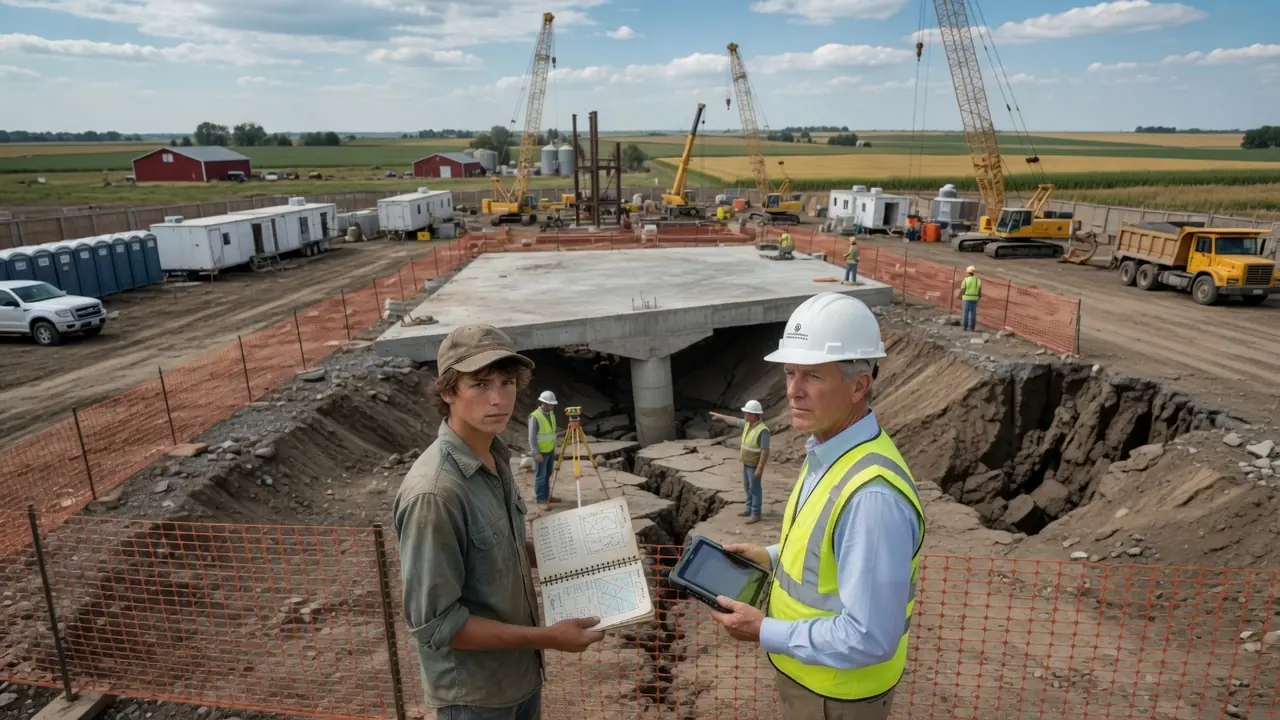
The quiet southern pasture became a maze of diesel engines, portable offices, temporary fencing, and floodlights.
Eli watched from the boundary.
He noticed problems immediately.
A loaded dump truck sank to its axles near a place he had marked in 2021.
Workers blamed recent rain.
A trench wall collapsed despite shoring.
Engineers blamed poor compaction.
Water entered a cable trench from below, although the nearest creek ran nearly half a mile away.
Pumps ran for three days.
Eli added each event to his notebook.
Then he began marking them on an aerial photograph.
Red circles for subsidence.
Blue for unexpected water.
Black lines for surface cracks.
The pattern followed a diagonal path beneath the planned turbine foundations.
It did not look random.
It looked like an underground channel.
Eli took the map to the construction office.
A security guard stopped him.
“Deliveries use the west entrance.”
“I’m here to speak with an engineer.”
“Do you have an appointment?”
“No.”
The guard looked toward the notebook in Eli’s hand.
“You the kid from the meeting?”
“Yes.”
“I heard about you.”
“Then you know why I’m here.”
The guard’s expression softened slightly.
“I know they’re busy.”
“A truck sank yesterday.”
“It’s a construction site. Trucks get stuck.”
“Not in dry ground.”
The guard called the office.
Ten minutes later, a junior engineer named Melissa Grant came outside.
She was twenty-nine, wore a white hard hat, and appeared more tired than irritated.
“What do you have?”
Eli showed her the aerial map.
Melissa studied it.
“Where did you get these locations?”
“I recorded them.”
“Over what period?”
“Seven years.”
She looked at him more carefully.
“These blue marks?”
“Places where water surfaced or vanished.”
“And this line?”
“Where I think the weak zone runs.”
Melissa glanced toward the project.
“Your line passes through four foundations.”
“Five if it bends east.”
“What are you suggesting?”
“An underground drainage channel. Maybe dissolved gypsum. Maybe an old mine. Something hollow enough to move water and let soil settle.”
Melissa did not laugh.
That was the first time anyone from Prairie Crown listened seriously.
“Do you have evidence of mining here?”
“No.”
“Historic drilling?”
“Some oil wells, mostly west.”
“Karst features?”
“Small sinkholes near the creek.”
She handed back the map.
“I’ll show this to the geotechnical lead.”
“Will he look?”
Melissa hesitated.
“I’ll show him.”
The next afternoon, two survey vehicles appeared in the southern field.
Eli felt briefly hopeful.
Then he learned they were only verifying access-road grades.
No additional subsurface testing took place.
A week later, Melissa found him beside the boundary fence.
“I showed them.”
“What did they say?”
“That the borings did not indicate significant voids.”
“Did they test my line?”
“No.”
“Why not?”
“Because changing the investigation plan costs money and delays construction.”
Eli stared toward the cranes.
“If the ground fails, that costs more.”
“I know.”
“Then why are they ignoring it?”
Melissa looked toward the portable offices.
“Because every large project develops momentum. Once enough money, schedules, and reputations depend on the plan, evidence has to become very loud before anyone changes direction.”
“How loud?”
She looked toward him.
“Usually expensive.”
The turbine foundations were enormous.
Each required a circular excavation nearly ten feet deep and more than sixty feet across.
Steel reinforcement cages filled the holes.
Hundreds of cubic yards of concrete formed the bases that would support towers rising hundreds of feet into the air.
At Foundation Seven, workers discovered one side of the excavation remained unusually wet.
They removed soft soil.
Added crushed stone.
Compacted it.
A consulting geologist approved the correction.
Eli photographed the excavation from his family’s land.
The soil layers looked wrong.
A pale band of clay dipped sharply beneath the eastern wall.
Below it lay dark soil mixed with rounded stones.
Stream material.
Not the uniform bedrock the project expected.
Eli enlarged the photograph and compared it to his grandfather’s old well records.
The weak zone appeared deeper than anyone thought.
He brought the photograph to Nathan.
His father studied it at the kitchen table.
“What am I looking at?”
“This layer.”
Eli traced it.
“It looks like an old channel filled with loose soil.”
“You can tell from a photograph?”
“I can tell it isn’t flat.”
“That’s not proof.”
“No.”
Nathan looked toward him.
“What do you want me to do?”
“Call the company.”
“I already signed the lease.”
“So?”
“So they’ll think we’re trying to stop the project after taking their money.”
“I’m not trying to stop it.”
“What are you trying to do?”
“Move five turbines.”
Nathan leaned back.
“You understand what that means?”
“Yes.”
“New roads. New cables. New permits. Months of delay.”
“Less than rebuilding them after they sink.”
Nathan looked tired.
The farm’s finances were worse than Eli knew.
The lease payment had already been used to refinance equipment loans.
If Prairie Crown declared the Hargroves uncooperative or attempted to cancel part of the agreement, Nathan feared the money might have to be returned.
He did not tell Eli that.
Instead, he said, “The engineers signed off.”
Eli closed the notebook.
“Then they can sign their names beside the crack when it opens.”
The words hurt Nathan.
Eli saw it.
But neither apologized.
Concrete for Foundation Seven was poured on a Tuesday.
More than eighty trucks arrived in a continuous line.
The pour lasted through the night.
Floodlights illuminated the field.
Workers moved across the steel cage as concrete pumps swung overhead.
Eli watched from his bedroom window until after midnight.
The next morning, he walked the boundary and noticed water rising in a shallow ditch east of the foundation.
It had not rained in six days.
He marked the location.
Two weeks later, Foundation Eight was poured.
Then Nine.
The project celebrated reaching a major milestone.
Local newspapers photographed executives beside the finished bases.
The mayor called Prairie Crown “the beginning of Red Creek’s new future.”
At the ceremony, Eli stood behind the crowd.
Lauren Price recognized him.
She approached with a smile that seemed designed for public events.
“Still taking notes?”
“Yes.”
“You’ll be able to tell your children you watched this project being built.”
“Or rebuilt.”
Her smile tightened.
“Eli, I understand you care about your family’s land.”
“I care whether those foundations stay level.”
“Our professionals have addressed the conditions.”
“Did they test the channel?”
“There is no confirmed channel.”
“That’s why you test.”
Lauren lowered her voice.
“You need to be careful about making public claims. False statements can cause real damage.”
Eli understood the warning.
“You mean to the project.”
“To the community.”
She walked away.
Samuel had been listening.
The old farmer stood beside Eli with both hands resting on a cane.
“You scared her.”
“She thinks I’m a kid.”
“No.”
Samuel looked toward the turbines.
“She thinks you might be right before she can afford for you to be.”
Foundation Seven cracked three months later.
At first, Prairie Crown kept the problem quiet.
Construction fencing was moved.
Workers covered part of the foundation with tarps.
Survey crews arrived before sunrise.
Eli saw them from the tractor while hauling hay.
He stopped beside the boundary.
Melissa walked toward him.
Her expression told him everything.
“How much?” he asked.
“Eastern side dropped twenty-two millimeters.”
“Almost an inch.”
“Yes.”
“And the others?”
“Eight is moving too.”
“What about Nine?”
“No confirmed movement.”
“Yet.”
Melissa looked toward the field.
“The geotechnical lead says settlement can occur during curing and loading preparation.”
“No.”
“Then it isn’t normal settlement.”
“I know.”
“What are they doing?”
“Installing monitoring points.”
Eli stared at her.
“You already had monitoring points.”
“More monitoring points.”
“That won’t stop it.”
“No.”
“Will they drill the line now?”
Melissa looked ashamed.
“They’re discussing it.”
Within ten days, Foundation Seven had settled more than two inches.
Foundation Eight moved one and a quarter.
A crane operator reported the access road near Foundation Nine felt uneven beneath a loaded transporter.
The project halted work in the northern section.
Rumors spread through town.
At the café, people blamed poor concrete.
At the hardware store, someone claimed environmental activists had sabotaged the foundations.
A county commissioner said delays were common in large projects.
Prairie Crown issued a statement describing “localized construction tolerances under review.”
Then a video appeared online.
It showed a steel level placed across Foundation Seven.
The bubble sat far outside the center marks.
Someone had written beneath it:
THE FARM KID WARNED THEM.
The video spread across local social media.
Reporters arrived.
Eli refused interviews.
Nathan told him that was wise.
Two days later, Prairie Crown’s chief engineer came to the Hargrove farm.
Dr. Charles Wexler was sixty-one, nationally respected, and accustomed to entering rooms where everyone listened.
He wore clean boots despite the muddy driveway.
Lauren Price came with him.
Melissa followed several steps behind.
Nathan invited them into the kitchen.
Eli placed his notebooks on the table.
All nine.
Wexler looked at the stack.
“These contain your observations?”
“Since 2017.”
“What methods did you use?”
“Measurements. Photographs. Dates. Rainfall totals. Ground changes.”
“Calibrated instruments?”
“Sometimes.”
“What kind?”
“Survey level borrowed from the school. Steel rods. Measuring tape. GPS from my phone.”
Wexler opened the first notebook.
The handwriting belonged to a nine-year-old.
Simple drawings.
Arrows.
Misspelled words.
He opened another.
The notes became more precise.
Dates.
Coordinates.
Water depths.
Crop differences.
By the seventh notebook, Eli had created tables comparing rainfall to settlement and mapped recurring depressions.
Wexler’s expression changed slowly.
“You recorded snowmelt?”
“It shows heat and moisture differences.”
“You tracked fence posts?”
“They’re fixed markers until they move.”
“And the cattle paths?”
“They avoid soft ground.”
Lauren looked impatient.
“Charles, we need useful technical data.”
Wexler raised one hand.
He opened the newest notebook.
Inside was Eli’s predicted channel.
The line crossed Foundations Seven and Eight directly.
It passed within thirty yards of Nine.
Wexler looked at Melissa.
“Have you seen this?”
“Yes.”
“When?”
“Before the foundations were poured.”
Lauren turned sharply.
“You never escalated it.”
“I sent it to the geotechnical group.”
“Through what channel?”
“Email.”
Wexler looked toward Lauren.
“We’ll retrieve it.”
Eli leaned forward.
“You have test borings that missed the weak zone because the channel is narrow and curves between them.”
Wexler studied the map.
“That is possible.”
“The impact from heavy equipment may also be pushing water through it.”
“That is less certain.”
“I know.”
Wexler’s eyes lifted.
“You distinguish observation from assumption.”
“Yes.”
“Most people don’t.”
Lauren crossed her arms.
“What exactly do you believe is beneath the site?”
Eli looked toward Samuel.
His grandfather nodded once.
“An old underground watercourse,” Eli said. “Maybe connected to a collapsed mine or dissolved gypsum beds. The surface soil bridges over it until enough weight or water changes the balance.”
Wexler asked, “Why a mine?”
Samuel answered.
“Because there was one.”
Everyone turned toward him.
Nathan stared.
“What?”
Samuel looked down at his hands.
“My grandfather told me men dug gypsum south of the creek before the First World War.”
“On our land?” Nathan asked.
“Partly.”
“Why have you never said this?”
“Because he said the entrance collapsed and the company disappeared. No map survived.”
Eli’s mind raced.
“Where was the entrance?”
Samuel pointed toward the project.
“Near the old cottonwood line.”
That line had been removed during road construction.
Wexler stood.
“We need historical records.”
“There may not be any,” Lauren said.
“There will be something,” Eli replied. “Tax rolls. rail shipments. land deeds.”
Lauren looked at him as though hearing him clearly for the first time.
The investigation began that afternoon.
Prairie Crown brought in ground-penetrating radar, electrical-resistivity imaging, and deep directional drilling.
County archives revealed references to the Red Creek Plaster Company, incorporated in 1908 and dissolved in 1916.
A fire destroyed most company records in 1923.
But railroad manifests showed shipments of raw gypsum from a loading spur near the Hargrove property.
An old insurance map identified two “subsurface extraction chambers” beneath the southern fields.
No closure documentation existed.
The mine had been forgotten.
Groundwater had not forgotten it.
Over decades, water widened fractures through the gypsum and carried fine soil into the abandoned chambers.
The original mine tunnels partially collapsed, creating a hidden network of loose fill, voids, and underground drainage routes.
The project’s test borings had landed mostly on solid pillars between the tunnels.
The data was accurate.
The interpretation was not.
The survey described the points it touched.
Eli’s notebooks described the behavior between them.
When Prairie Crown combined both, the pattern became undeniable.
Foundation Seven sat above the edge of a collapsed chamber.
Foundation Eight crossed a weakened tunnel.
Foundation Nine stood near a water-filled void.
The $200 million project had not begun sinking because the engineers knew nothing.
It began sinking because they trusted precise fragments more than incomplete evidence from someone they did not consider qualified.
Prairie Crown shut down the entire northern construction zone.
The company’s insurers arrived.
Lawyers followed.
So did national reporters.
Headlines described Eli as a teenage genius who defeated a team of engineers with a notebook.
Eli hated them.
He had not defeated anyone.
He had tried to prevent the failure.
A television crew parked beside the farm and asked him to hold the spiral notebook while standing in front of Foundation Seven.
He refused.
“They want a hero,” Nathan said.
“They want a kid pointing at a crack.”
“That may help people believe you.”
“They believe me now because it cost money.”
Nathan had no answer.
The project faced three options.
Abandon the northern section.
Stabilize the ground through expensive grouting and deep foundations.
Or relocate five turbines, reroute access roads, and redesign the cable network.
Relocation would cost tens of millions.
Ground stabilization might cost more and still carry risk.
During a public meeting, angry landowners demanded answers.
Some feared the entire project would be canceled.
Others wanted compensation.
The mayor blamed Prairie Crown.
Prairie Crown blamed incomplete historical records.
A man near the back shouted that the Hargroves had known about the mine and hidden it to secure lease money.
Nathan stood.
“That is not true.”
Samuel rose beside him.
“I knew a story.”
The room quieted.
“I did not know where the tunnels were. I did not know they remained open.”
The man shouted again.
“You still took the money.”
Eli turned.
“My father gave them every warning I could prove.”
Nathan looked at him.
He had not.
Not fully.
Eli realized it at the same moment.
The room seemed to narrow.
After the meeting, father and son stood beside the truck in freezing wind.
“You didn’t call them,” Eli said.
Nathan looked toward the parking lot.
“I spoke with the land agent.”
“When?”
“After you showed me the excavation photograph.”
“What did you say?”
“That you had concerns.”
“Did you tell him to stop construction?”
“No.”
“Did you send the notebooks?”
“No.”
“Why?”
Nathan’s face tightened.
“Because we needed the lease.”
Eli stepped back.
“You thought I was right.”
“I thought you might be.”
“And you let them pour anyway.”
“I thought the engineers would catch it if it was real.”
“I showed them.”
“You’re my son.”
The words came out wrong.
Nathan knew it immediately.
Eli’s expression hardened.
“So that made me less credible to you too.”
“No.”
“It did.”
Nathan reached toward him.
Eli moved away.
“We could lose the farm if they sue.”
“I know.”
“No, you don’t. The lease money paid the equipment debt. Without it, the bank would have taken the combine.”
“You should have told me.”
“You were sixteen.”
“I was old enough to find the problem.”
Nathan looked exhausted.
“I was trying to keep this family alive.”
Eli’s eyes filled, but his voice remained steady.
“So was I.”
He walked home alone.
For three days, Eli barely spoke to his father.
He worked.
Fed cattle.
Repaired fence.
Entered rainfall data in his notebook.
Routine gave anger somewhere to sit.
Samuel found him in the barn on the fourth evening.
“You think your father failed you.”
“He did.”
“Yes.”
Eli looked up, surprised by the agreement.
Samuel sat on an overturned bucket.
“People can love you and still fail when fear chooses for them.”
“That doesn’t fix it.”
“No.”
“Then why say it?”
“Because understanding is not forgiveness. But it keeps anger from becoming the only story.”
Eli closed the notebook.
“Why didn’t you tell us about the mine?”
Samuel stared toward the barn door.
“When I was twelve, a calf disappeared near the south field. We found it in a collapse thirty feet deep.”
Eli had never heard this.
“My father filled the hole and told everyone it was an old well.”
“Why?”
“Because the bank was considering the farm as collateral. If people believed the land was undermined, we could not borrow.”
The pattern extended across generations.
Silence.
Fear.
Short-term survival.
Samuel continued.
“Your father inherited more than soil.”
Eli looked toward him.
“So did you.”
The project’s board scheduled a closed technical meeting at Prairie Crown headquarters in Wichita.
To everyone’s surprise, Dr. Wexler asked Eli to attend.
Lauren opposed it.
“He is a minor.”
“He has the longest observational record of the site,” Wexler replied.
“He is not an engineer.”
“No. That is why his data contains things ours does not.”
Nathan drove Eli to Wichita.
They spoke little during the two-hour trip.
Inside the conference room sat geologists, structural engineers, insurers, attorneys, company executives, and state energy officials.
Eli’s notebooks had been scanned and projected onto a large screen.
A geologist presented subsurface images showing collapsed chambers beneath the northern field.
An engineer explained that Foundations Seven and Eight could not safely support turbine towers.
Foundation Nine required relocation as well.
Then Wexler turned toward Eli.
“Show us how you predicted the channel.”
Eli stood.
His hands shook slightly.
He began with water.
After heavy storms, puddles formed west of the weak zone but disappeared quickly along the diagonal line.
Snow melted earlier there.
Crops changed color in narrow bands.
Fence posts leaned toward the same corridor.
Small depressions appeared, shifted, and sometimes filled again.
The cattle changed paths before visible settlement occurred.
“Animals feel unstable footing sooner than people walking once with equipment,” Eli said.
One executive asked, “Why did the features move?”
“Because the soil above the tunnels wasn’t collapsing all at once. Fine material was washing downward. The surface sagged where support changed.”
A geologist nodded.
“Progressive internal erosion.”
Eli continued.
“The line isn’t the tunnel itself. It’s the surface expression of water moving through connected weak areas.”
Wexler asked, “Would you place any turbine foundations north of the creek?”
“Not without mapping every cavity.”
“Would you abandon the entire zone?”
“No.”
Lauren looked surprised.
Eli pointed toward higher ground east of the planned road.
“These ridges haven’t shown settlement in seven years. Drainage is consistent. Bedrock appears shallower in the well logs.”
“You are recommending relocation,” Wexler said.
“Yes.”
“Five turbines?”
“Four. Turbine Eleven can stay if its access road moves south.”
Engineers began discussing the suggestion.
The room no longer treated Eli as entertainment.
They challenged him.
Asked for evidence.
Corrected assumptions.
Eli welcomed it.
Serious questions were different from dismissal.
By the end of the meeting, the redesign team selected four new foundation locations outside the collapsed mine network.
Turbine Eleven remained but its road and cable trench shifted.
Foundation Seven and Eight would be demolished.
Nine had not yet received its tower and would be abandoned.
The cost exceeded thirty-four million dollars.
The delay reached ten months.
Prairie Crown survived.
Not everyone did.
An internal review showed Melissa had sent Eli’s map and warning to the geotechnical team.
A senior project manager marked the email “local anecdote—no action required.”
He had not forwarded it.
Lauren knew of the warning but prioritized schedule protection.
She resigned before the final report was released.
The company’s geotechnical consultant lost the contract.
Dr. Wexler publicly accepted responsibility.
At a press conference, a reporter asked whether a sixteen-year-old had outsmarted his engineering team.
Wexler shook his head.
“No.”
Cameras clicked.
“We failed to recognize useful evidence because of who carried it.”
He explained that engineering depended on sampling, models, and professional judgment.
All were necessary.
None made experts immune to blind spots.
“The boy did not possess better instruments,” Wexler said. “He possessed a longer relationship with the site.”
That sentence followed Eli for years.
Prairie Crown offered the Hargrove family a settlement.
The company would release them from liability, pay for lost use of the leased acreage, and fund stabilization of several dangerous voids near the farm.
They also offered Eli a scholarship.
He refused at first.
“It feels like payment to make the story disappear.”
Wexler visited the farm personally.
“It is not.”
“What is it?”
“An admission that knowledge has value even before institutions recognize it.”
Eli looked toward Foundation Seven, where demolition equipment had begun breaking apart the tilted concrete.
“What would I study?”
“Geology. Civil engineering. Hydrology. Whatever helps you ask better questions.”
“I already asked the right one.”
Wexler smiled.
“That is not the same as having every answer.”
Eli accepted the scholarship under one condition.
Prairie Crown would also fund a county program to map abandoned mines, wells, and subsurface hazards across the region.
The company agreed.
Nathan apologized during winter.
Not quickly.
Not in one perfect speech.
They were repairing a feed conveyor when he shut off the motor and said, “I chose the farm over your warning.”
Eli wiped grease from his hands.
“You chose the lease.”
“I told myself they were the same.”
Neither spoke for several seconds.
Nathan continued.
“I was afraid of losing what my father gave me.”
“You almost lost more.”
“I know.”
Eli looked toward him.
“Do you believe me now?”
Nathan’s face tightened.
“I believed you then.”
“That was the problem.”
“Yes.”
The honesty mattered more than an excuse.
Eli nodded once.
Forgiveness did not arrive completely that day.
But it began.
The redesigned Prairie Crown project opened two years later.
The turbines stood across the higher ridges east of the original locations.
Foundation Seven remained in the ground as a concrete ruin for several months before removal.
Eli sometimes visited the edge of the excavation.
Beneath the broken slab, engineers exposed part of the hidden collapse zone.
Loose soil disappeared into a dark opening between gypsum layers.
The void was not enormous.
That made it more unsettling.
A small hidden weakness had moved millions of dollars.
Prairie Crown built a monitoring station near the creek.
Sensors measured groundwater, soil movement, and surface elevation.
Eli helped select the locations.
Melissa became the project’s site geotechnical coordinator.
She visited the Hargrove farm frequently.
Not to praise Eli.
To compare observations.
“What are the cattle avoiding this month?” she would ask.
It became a serious technical question.
The county mapping program found fourteen undocumented wells, three abandoned mine sections, and two areas of active subsidence.
One discovery prevented a new school athletic building from being placed over a collapsed storage chamber.
Another allowed a farmer to stabilize a dangerous depression before a combine entered the field.
Eli’s notebooks were copied into the county archive.
He kept the originals.
At eighteen, he left Kansas to study geological engineering.
He returned every summer.
College challenged him in ways the project never had.
Equations did not care that he had predicted a multimillion-dollar failure.
Professors corrected him.
Laboratory results contradicted his instincts.
He learned how often observation could mislead without measurement.
He also learned how often measurement could mislead without context.
During his final year, he wrote a research paper on integrating long-term local observations into geotechnical site investigations.
The paper began with no mention of Prairie Crown.
Instead, it described a leaning fence post.
A recurring puddle.
A cow path shifting five yards uphill.
Small things.
The kind professionals rarely saw during a three-week field campaign.
Years later, Dr. Eli Hargrove returned to Red Creek as part of a state subsurface-risk initiative.
He was no longer the farm boy holding a spiral notebook.
He carried advanced instruments.
Managed drilling crews.
Reviewed models.
Signed reports.
But whenever a landowner said, “There’s something strange about that field,” Eli listened before explaining why they might be wrong.
Sometimes they were wrong.
Sometimes the strange patch was poor drainage.
Sometimes a leaning post was only rotten wood.
Local knowledge was not magic.
It required testing.
But dismissal was not testing.
One autumn afternoon, Eli stood with a group of young engineers beside the Prairie Crown turbines.
The blades turned slowly above them.
A junior engineer pointed toward the higher ridge.
“Why didn’t the original surveys find the mine?”
“They found solid ground at most boring locations.”
“So the survey was bad?”
“No.”
“The model?”
“Incomplete.”
The student looked toward the old Hargrove field.
“And you knew?”
Eli shook his head.
“I suspected.”
“But you predicted the failures.”
“I predicted where the surface was behaving differently.”
“What’s the distinction?”
“The distinction keeps you honest.”
Eli opened a weathered spiral notebook.
The cover had softened with age.
Inside were his earliest drawings.
A sinkhole shaped like a bowl.
Arrows showing water.
A badly spelled note written by a nine-year-old:
GROUND SOUNDS HOLLOW AFTER RAIN.
The young engineers smiled.
Eli did not.
“This was not proof.”
He turned to later pages filled with measurements.
“This became evidence.”
Then he pointed toward the turbines.
“The failure happened because people confused credentials with certainty.”
The wind moved through the grass.
The project that nearly collapsed had become one of the region’s strongest energy producers.
It created jobs.
Paid taxes.
Kept family farms alive through difficult seasons.
It succeeded only after the company accepted that redesign was less expensive than pride.
Nathan eventually replaced the barn roof.
The lease payments continued from relocated transmission lines and access easements.
Samuel lived long enough to see the turbines operating.
On clear evenings, he sat on the porch and watched their red lights blink across the horizon.
“Do you like them?” Eli once asked.
Samuel considered.
“I like that they stayed up.”
When Samuel died, Eli found an envelope inside the old man’s desk.
It contained a hand-drawn map based on stories passed down through the family.
The mine entrance.
The calf collapse.
Places where water once appeared.
Samuel had reconstructed it from memory after the project investigation began.
At the bottom, he had written:
THE LAND WAS ALWAYS TALKING. YOU WERE THE FIRST OF US BRAVE ENOUGH TO ANSWER OUT LOUD.
Eli framed the sentence but kept it inside the farmhouse.
He never wanted it turned into a slogan.
The truth was more complicated.
He had been observant.
He had also been stubborn.
The engineers had been dismissive.
They had also been working with incomplete records and methods that usually succeeded.
Nathan had failed to support him.
He had also been a frightened farmer trying to save land burdened by debt and secrets inherited from men before him.
Nobody in the story was entirely wise.
Nobody was entirely foolish.
That was why the failure mattered.
The foundations did not sink because experts were useless.
They sank because expertise became a wall instead of a tool.
The notebook did not save the project because a teenager possessed some mysterious connection to the earth.
It saved the project because years of patient observation contained information no short investigation could reproduce.
The first crack beneath Foundation Seven eventually disappeared when the concrete was demolished.
But Prairie Crown preserved one broken section near its visitor center.
Beside it stood a glass case containing a copy of Eli’s original map.
The display carried no headline about a boy proving engineers wrong.
Eli refused that version.
Instead, the plaque read:
GOOD ENGINEERING BEGINS WITH MEASUREMENT.
GREAT ENGINEERING ALSO ASKS WHO HAS BEEN WATCHING LONGER.
Visitors often stood there before touring the turbines.
Some focused on the cost of the failure.
Thirty-four million dollars.
Ten months of delay.
Two abandoned foundations.
Eli thought about something smaller.
The engineer at the first meeting taking his notebook, then handing it back unopened.
That moment cost nothing.
Not then.
But every expensive failure that followed began inside it.
The land had warned them through sinking tires, leaning posts, vanishing water, uneven crops, and the careful handwriting of a child growing old enough to understand the pattern.
The project did not begin failing when the concrete cracked.
It began failing the moment everyone decided the person carrying the warning could not possibly know what he was seeing.