Evelyn Blackwood had already placed the bread on the conveyor belt when she realized her hands were shaking too hard to count the coins properly. The cashier said the total once then again softer the second time as if kindness could shrink the number on the screen. At 87 years old this was what it came to, standing in a grocery store at 2:30 on a Thursday afternoon counting pennies in front of strangers who had places to be and no patience for the arithmetic of poverty. The overhead lights were too bright. They always were.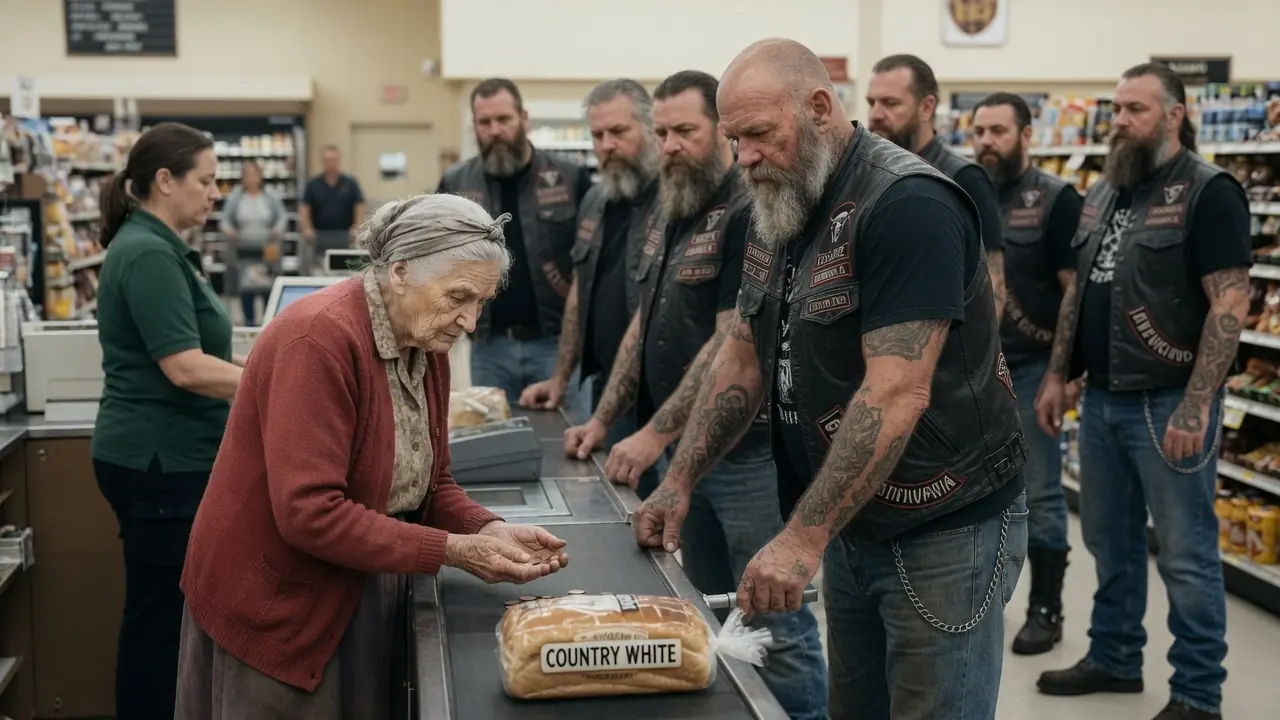
The kind of fluorescent glare that made everything look cheaper than it was, including the people under it. Winter air still clung to her coat, that particular Pennsylvania cold that worked its way through wool and settled in the joints. She opened her coin purse, the brown one with the broken clasp that Harrison had meant to fix before the stroke took him four years ago, and tipped its contents onto the counter. Two quarters, three dimes, a row of nickels that had lost their shine decades ago. Pennies flattened by years of use, their copper faces worn smooth as riverstones.
Then a folded dollar bill creased so many times it felt like fabric, then another. Her fingers moved slowly, carefully with the concentration of someone handling the last pieces of their dignity in public. The girl at the register could not have been older than 20. Freckles scattered across her cheeks like paint flecks. Tired eyes that had seen too many long shifts for someone barely out of high school. A name tag that read Lily in fading print.
She glanced once at the total, then at the bread, milk, and can of soup waiting on the belt, like evidence of a life narrowed down to its barest elements. $6.12 short. Not much. Not enough to ruin someone's day if they had a normal cushion between them and the edge. But Evelyn Blackwood had no cushion. She had not had one in longer than she cared to admit, even to herself. The number hit her like a fist to the sternum, stealing breath she could not afford to lose.
Behind her, the line shifted. A shopping cart squeaked against linoleum. Somebody sighed too loudly. The kind of theatrical exhale meant to communicate impatience without the courage of actual words. A man in a navy jacket checked his watch with the aggressive wrist movement of someone who believed his time was worth more than hers. A woman with a toddler on her hip moved her basket from one side to the other and looked toward the next register, but it was closed. The red light above it dark.
No escape route for anyone. Evelyn swallowed against the tightness in her throat. Her voice came out thin, apologetic, already defeated. Then the soup. We can take off the soup. Lily scanned it out without meeting her eyes. The total dropped. Still not enough. The gap between what Evelyn had and what she needed remained a chasm she could not cross with dignity intact.
And the milk, Evelyn said after a pause that felt too long. No, wait. Keep the milk. Take the bread. The words came out wrong. Even she heard it. Bread had been the one thing she came for. Bread and a little milk to make it last through the weekend. Maybe toast for supper. Maybe half a slice in the morning if she was careful. Lily hesitated, her hand hovering over the scanner.
Are you sure? Evelyn gave a small nod, eyes fixed on the counter. Yes, bread can wait. It was the kind of lie old people told when the truth would shame them too much to speak aloud. The kind Evelyn had been telling herself for months now, each one a little easier than the last, until lying about need became as automatic as breathing. The man behind her muttered not quietly enough. Maybe check your wallet before you hold up the line.
Evelyn flinched as if he had touched her. She turned slightly, the instinctive turn of someone about to apologize for taking up space in a world that had stopped making room for her. Her face was fine boned and deeply lined, the skin at her throat soft with age, her silver hair pinned back beneath a knit cap that had once been navy blue and had faded to something uncertain. She looked at no one directly. I'm sorry, she said again to no one and everyone. I didn't mean to.
You're fine, Lily cut in. But the damage had already been done. Everyone had heard. Everyone had seen the coins, the calculation, the surrender. Evelyn reached for the bread herself, her hand trembled as she drew it back from the belt, fingers clutching the plastic wrapper that crinkled in the silence. The cheapest loaf in the store, white sandwich bread that tasted like nothing and cost almost nothing. And still she could not afford it.
Near the front windows, a man sitting by the in-store coffee counter watched the whole thing without moving. He was impossible not to notice if you looked his way, though most people made a point not to look. Broad shoulders under a worn black leather jacket. Thick gray threaded through his dark beard. Rings on two fingers, silver worn dull. Heavy boots planted wide on the tile floor. A faded patch sewn onto his vest, though from this distance the design was unclear.
His name was Garrett Thorne, though most people who knew him called him Reaper. He was 58 years old and on first glance he looked like the kind of man polite people cross streets to avoid. He had come in for coffee, chain oil for his bike and a loaf of rye bread. He left the coffee untouched because it was not the coins that had caught his attention. It was not even the total on the screen. It was the way the old woman had tried to remove the bread before anything else, as though she had already trained herself to need less than the bare minimum.
Garrett knew that motion. He knew it too well. Years ago, his grandmother had done the same thing with eggs in a pharmacy line. She had been 75 years old, standing in front of a cashier barely older than Garrett was then, counting change that did not add up, smiling while she put the carton back in the cooler, saying she was not really hungry anyway. Three months later, Garrett had found her dead in her apartment. The heat had been off. The cabinets were empty. Her pride had stayed intact all the way to the end, and it had killed her just as surely as the cold.
He had been 15 years old, too young to understand what he was seeing, too angry to forgive himself for not seeing it sooner. He had carried that weight for 43 years, and it had not gotten lighter. It had just gotten quieter, the way old injuries do when you learn to move around them. Now watching Evelyn Blackwood put the bread back with shaking hands, Garrett felt the weight shift inside him, not lighter, heavier, because this was not his grandmother. This was someone else's grandmother, and no one was stepping in.
He stood up slowly, the stool scraped against tile. A few heads turned, but only briefly. Lily had just finished voiding the bread from the register when Garrett crossed the tiled floor and stopped beside Evelyn, keeping a respectful distance so he would not startle her. Up close, he could see how thin her wrists were inside her coat sleeves. He could see the tremor in her hands that was not entirely from the cold. Put it back on, he said.
Evelyn turned. Her eyes went first to the vest, the leather, the patch she could not quite read. Then to the tattoos peeking from his cuffs. Then to his face, which was not unkind, but was hard in the way faces get when they have seen too much, and stopped pretending otherwise. There was fear there for a second. The quick old fear of a woman alone in the world. I beg your pardon, she asked, voice barely above a whisper.
A couple of people in line looked away at once, suddenly embarrassed to be present for a private humiliation turning into a public rescue. The man with the watch said nothing now. Evelyn's face flushed a painful red. Please, she said, and the word came out broken. I can't let you do that. You can, Garrett replied. And you will. There was no hardness in his voice, but there was no room for argument either.
Lily looked between them, then quietly rescanned the bread, then the milk, then the soup. The total climbed back up the screen. Garrett added a carton of eggs with a glance down the cooler aisle, then a small pack of butter from the display by the register. Evelyn saw it and drew in a breath that sounded like drowning. No, no, I didn't ask for that. I know, Garrett said. I have enough at home.
That was another lie, and this time both of them knew it. Garrett leaned one forearm on the counter and lowered his voice. Ma'am, if you had enough at home, you wouldn't be deciding between bread and soup with a purse full of coins. The words should have sounded cruel. In his mouth, they did not. They sounded tired, honest. Tears threatened. Evelyn blinked them back, refusing to cry in public. I don't take charity, she said.
But her voice had lost its edge. Good, Garrett said. Neither do I. So, let's call it me buying groceries and you doing me the favor of not making this weird. For the first time, something very small moved at the corner of Lily's mouth. Not a smile exactly. Relief, maybe. The total printed. Garrett paid. He did not wait for change. Lily bagged the groceries quickly, carefully, as though speed might protect Evelyn from the stares that had already begun to turn guilty.
But public shame does not disappear just because the bill is covered. It lingers in the body. Evelyn's fingers still shook when she reached for the first bag. Garrett took it before she could. I've got it. You don't need to carry those, Evelyn said, but there was no strength behind the protest. I know. I live close. Then this won't take long. He picked up all three bags in one hand.
Lily slid the receipt across the counter. Evelyn did not take it. Thank you, Lily said quietly to Garrett. He gave her a short nod, then looked at Evelyn. You got a car? She almost laughed. The sound came out sharp and bitter. No. Then I'm walking you out. Her spine stiffened, old pride, refusing to die. I can walk myself. I didn't say you couldn't.
The automatic doors opened with a rush of cold. Wind pushed through the entryway and lifted the edge of Evelyn's coat. Outside the sky hung low and colorless above the parking lot, the particular gray of January in Pennsylvania, when winter had settled in for the long haul. Salt stained snow sat in gray piles along the curb. Her shoes were sensible, or had been once, but age had worn them down. One sole was thinner than the other.
Garrett noticed. He noticed everything. She stopped just outside the doors and looked at the bags in his hand. You should go back to your shopping. I'm grateful truly, but this is far enough. Garrett glanced toward the far end of the parking lot where no car waited for her. No bus idled at the curb. You walking home in this weather with three bags. I've done worse. I believe you, he said.
And that answer took something out of her because it held no pity, only recognition. A gust of wind cut across the asphalt. Evelyn shivered despite herself. Garrett looked at her face properly then. Not just old, exhausted, a person living in quiet subtraction. One comfort gone, then another until all that remained was the habit of endurance. He softened his tone. How far?
She hesitated. Seven blocks with that knee. Her eyes snapped up. My knee is none of your business. That bad, huh? Despite herself, Evelyn let out the faintest breath of a laugh. It shocked her as soon as it escaped. Garrett heard it and said nothing, but something in the air between them changed. Across the parking lot, a motorcycle stood parked near the curb. Black and chrome, road dust still on the frame.
The sight of it made Evelyn stiffen again. Oh no, she said immediately. Absolutely not. Garrett looked back at her. I wasn't putting you on the bike. Well, I should hope not. I was going to walk. That seemed to embarrass her more than the offer itself. You can't spend your afternoon walking old women home from grocery stores. Watch me.
For a long moment, she said nothing. Cars rolled past at the edge of the lot. Somewhere behind them, a shopping cart slammed into a corral. The world kept moving with its usual indifference. Then Evelyn looked down at the bread in the top bag, visible through thin plastic. Plain white sandwich bread, the cheapest kind in the store. She stared at it as if it had become evidence of a private failure she could no longer hide.
When my husband was alive, she said suddenly, voice quiet but steady. We used to buy the seeded loaf from the bakery section. He liked the crust too dark. Said bread should fight you a little. Her voice caught on the last word but did not break. Garrett said nothing. He knew enough to let the silence hold. Funny what goes first, isn't it? Evelyn continued. Not the big dreams, just small choices. Dark crust, real butter, heat after sunset.
Garrett's jaw tightened, but he kept his face neutral. My son keeps telling me to ask if I need help, she said. But he has children, a mortgage. His wife's mother is sick. Everyone is carrying something. You start thinking perhaps the kindest thing you can do is need less. The words hung in the cold air between them and Garrett understood with perfect clarity why his grandmother had died alone. And today, Evelyn said, voice dropping to something almost inaudible. I thought I had enough. I counted twice. I always count twice.
You shouldn't have to count like that for bread, Garrett said. Well, she said, drawing herself up with a flicker of pride. The world rarely asks what should be. Garrett studied her for a second longer, then shifted the bags in his hand. Seven blocks. Yes. Show me which way. She opened her mouth to refuse again, but Garrett waited, and the wind bit through her coat, and her knuckles had gone white around the strap of her purse.
Somewhere beneath the embarrassment, a more basic truth was winning. She was tired, bone tired. Finally, Evelyn nodded once sharply. Only to the corner of Mercer and Pine. We'll see, Garrett said. No, she answered, some steel returning to her voice. You'll do exactly as I say, mister. She paused, realizing she did not know his name. Thorne, he supplied. Garrett Thorne. Most people call me Reaper.
She blinked. I never told you my name. You didn't have to. The cashier did. That almost made her smile. Almost. She took one careful step off the curb and then another. Garrett fell into pace beside her, matching his stride to hers, carrying the bags as though the weight belonged to him. Evelyn walked with the stubborn, deliberate rhythm of someone who had spent a lifetime refusing to let pain set the pace. The grocery store fell behind them.
Then the pharmacy with its bright red cross glowing against gray sky. Then a laundromat with two flickering letters missing from its sign. The town looked like it had once believed in itself and then little by little stopped. Milbrook, Pennsylvania had been built around the paper mill the way towns used to be built around single industries. The mill had closed in 2015. Nearly a decade gone now, but the town still bore the marks of that loss like scars that refused to fade.
Empty storefronts with soap-painted windows. For lease signs that had been up so long the phone numbers were no longer in service. Cars hissed past on wet pavement. Wind pushed newspaper against the curb. Christmas lights still hung from porch rails in tired loops of color. Though it was well past the season, Evelyn kept one gloved hand on her purse and the other pressed lightly against her coat. Her breath came in small clouds that dissipated quickly in the wind.
You don't have to walk so slowly on my account, Evelyn said after half a block, though her breathing had already taken on the faint hitch of effort. I'm not. You are. Maybe you're just walking faster than you think. That, she said, breath thin in the air, is nonsense. Garrett glanced over at her. You always this friendly? I was once.
The answer came out so plain it nearly stopped him. She did not say it for sympathy. She said it like someone stating the weather. He looked ahead again. What changed? Evelyn let out a dry sound that might have been a laugh if it had more strength in it. Time, bills, funerals, the usual thieves. They crossed Mercer and Pine, the corner she had named as her boundary. Garrett expected her to stop there.
Instead, she kept going, slower now, favoring her left leg more openly. Pride was still present, visible in the set of her shoulders, but practicality had begun to win its small, quiet victories. The neighborhood thinned as they went. Houses stood farther apart. Some had curtains drawn tight in the middle of the afternoon. Others had porches caved in at one end, plastic taped over cracked window panes. On one lot, an old swing set leaned sideways in the dirt, the chains hanging slack.
Evelyn noticed Garrett taking it in. It used to be better. I figured there was a paper mill once, a proper one. My husband worked there 32 years. You could hear the whistle from every street in town. Life had shape to it then. And now there's a warehouse 10 miles over and a clinic that keeps cutting hours. She lifted one shoulder and people mostly drive through on their way somewhere else.
By the third block, Garrett could see the strain in her mouth. Not dramatic pain. Worse than that, familiar pain, managed pain. You got anyone checking in on you? Garrett asked. My son calls. That's not what I asked. Evelyn took a few more steps before answering. Not regularly. Garrett absorbed that in silence.
At the sixth block, she stopped at the base of a narrow street lined with bare maples and pointed with her chin. The yellow one. Garrett followed her gaze. It might once have been yellow. Now it was a tired, weather-chewed color, somewhere between smoke and old butter. The paint peeling in long strips. The front step sagged noticeably to the right. One shutter hung crooked. The porch roof had a dark water stain spreading from the corner.
A trash can lay on its side near the fence. No footprints marked the thin crust of old snow in the yard. Garrett's face changed, though only slightly. You live here? It was not a question. Evelyn noticed anyway. You make it sound surprising. He chose his words carefully. I make it sound cold. It is cold, she said flatly. That's winter.
She climbed the steps with agonizing dignity, one hand on the rail that shifted slightly under her grip. Garrett stayed half a pace behind, watching the porch dip under her weight. Evelyn opened the front door with a key attached to a faded ribbon and stepped inside. The first thing Garrett felt was the air. Not the comfortable cool of an old house in winter. A deep damp chill that lived in the walls. Inside smelled faintly of dust, mothballs, stale tea.
The entry rug was threadbare. The wallpaper at the far end of the hall had begun peeling. A bucket sat beneath a brown stain spreading across the ceiling. Water dripped into it at long intervals. Evelyn took off her gloves and tucked them into her sleeves. You can leave the bags on the table. Garrett stepped into the kitchen and stopped. There was no disaster in the theatrical sense, just absence, the kind poverty preferred when it wanted not to be seen.
The refrigerator hummed weakly. On the counter sat a loaf heel wrapped in wax paper, three tea bags drying on a saucer for reuse, and a prescription bottle with only two tablets inside. A kettle rested on the stove beside an envelope. Final notice stamped in red. Property tax amount due. The small round kitchen table was clean but scarred with decades of use. Two chairs, though only one looked regularly occupied.
A knitted blanket hung over the back of the other as if saving a place for someone who had not sat there in years. Garrett set the groceries down gently. Evelyn. She had already moved to the sink, filling it halfway with cold water to set the milk in. I know what it looks like. Do you? She turned and for the first time since the store, there was something fierce in her expression. It looks like an old house. It looks like widowhood.
It looks like a furnace that needs coaxing and a roof that needs doing. And a woman who got older while she was busy with other things. None of which is any great tragedy, Mr. Thorne. Garrett looked past her to the vent under the window, then to the thermostat on the wall. 52°. What happened to the heat? It works. It limps. It works enough.
Garrett nodded toward the prescription bottle. And that? Evelyn followed his eyes and her jaw tightened. Arthritis, blood pressure, age, a collector's set. You stretching the pills? No. He gave her a look that said he knew a lie when he heard one. Sometimes, she finally admitted, the word clipped and reluctant. Garrett rested a hand on the back of the empty chair. When's the last time you ate more than toast?
That's a rude question. When's the last time? She looked away. Yesterday. What? Oatmeal. Half a banana. Toast. Her spine stiffened. I do not starve if that's what you are imagining. Garrett did not answer. He scanned the room once more. The lamp rewired with electrical tape. The dish towel stuffed at the base of the back door to keep out drafts. The calendar from last year still hanging on the wall.
On the wall beyond the kitchen doorway hung framed photographs. Garrett moved toward them without asking permission. Evelyn opened her mouth to object, then let it close again. A younger Evelyn in a flower dress holding a pie beside a man in work boots and suspenders. A boy at 12 with a baseball glove. A wedding photograph in black and white. School photos. Christmas snapshots. People crowded around the same porch when the railing had been straight and the paint fresh.
You had a full house once, Garrett said quietly. Evelyn stayed by the sink. Most people do before they don't. He turned to another frame. Four boys on bicycles, all elbows and knees, maybe 14 or 15 years old. The photograph was old. The colors faded. The boys were shirtless, sunburned, grinning. Evelyn stood behind them with an apron on, laughing. One of the boys was holding half a loaf of bread like a trophy.
Garrett stared at it a second longer than the others. Something about the composition, the faces. You should sit down, he said. I'm in my own kitchen. That wasn't a question. Evelyn exhaled through her nose, a sound of defeat that had nothing to do with him and everything to do with the pounding in her knee. She lowered herself into the chair with slow, careful movements. Garrett took the milk from the sink and opened the refrigerator.
Anyway, the interior light flickered once. Inside was a landscape of absence. Mustard, a jar of jam with one spoonful left, half an onion wrapped in paper towel, a margarine tub filled with what looked like homemade broth, nothing else. When he shut the door, something in his face had gone very still. Evelyn saw it and looked almost ashamed. I was going back next week, she said. With what money? That is none of your business either.
Garrett leaned both palms on the table. No, it became my business the minute I watched you choose between bread and dignity in front of a room full of strangers. Evelyn's chin lifted. I kept my dignity. Yes, Garrett said. That's the problem. The sentence hit harder than accusation would have. Something flickered behind her eyes, the fear of being fully seen. You think old women should go around confessing they can't manage?
I think old women shouldn't freeze in houses with empty refrigerators because they're too proud to inconvenience people who'd sleep fine either way. Evelyn's lips parted then closed. The room held that sentence for a long moment. Finally, she said much smaller. It wasn't all at once. Garrett said nothing, just waited. The bills, I mean, it wasn't some dramatic fall. Her hands tightened in her lap.
First, it was the taxes going up. Then Harrison's medicine before he died. Then the furnace man said it would cost 3,000 to replace the whole system. Then the roof. Then prices at the store. Then winter. Things don't collapse all at once if you're careful. They just narrow. You tell yourself one less thing is manageable. Then another, then another. Her voice had flattened the way voices do when a person has rehearsed the same hard truth too many nights in a row.
I stopped buying fresh food first. That spoils and feels wasteful for one person. Then I kept the heat lower. 55 at first, then 52. Then I let the roof wait because rain is easier than contractors. Then I told my son I was tired when really I didn't want him seeing the pantry. Garrett pulled out the chair opposite her and sat. The leather of his jacket creaked softly. Why didn't you tell him?
Because he would come. Her answer was immediate. He would miss work. His wife would say she told him so. The children would hear whispering. They'd think grandma was in trouble. And then I would become a task on someone else's list. Her mouth trembled once, then steadied. I could bear being poor. I could not bear becoming the thing everyone rearranged themselves around. The bucket in the hall dripped.
Garrett looked toward the sound, then back at her. How long's it been like this? Evelyn did not ask what this meant. Since autumn properly. Since summer, if we're being honest. Garrett sat back, jaw working. Then he reached into his pocket and pulled out his phone. Evelyn's eyes narrowed. What are you doing? Calling someone? No. Um, I wasn't asking that time either.
She pushed back from the table with surprising force. Mr. Thorne, if you bring a parade of men into my house, I will send every one of you back out of it. Garrett was already dialing. It's not a parade. It had better not be. The call clicked through. Wyatt. Garrett said. So, you near the garage? A voice answered tiny and distant. Garrett listened. Glanced once at the ceiling stain, then at the thermostat.
I need a space heater, groceries, and somebody who knows roofs enough to tell me how bad one is. He paused. No, not tomorrow. Now. Evelyn stood rigid beside the table, color rising in her cheeks. You cannot just summon people. Garrett covered the phone with his hand and looked at her. Watch me. She hated that the line almost pulled another laugh from her. Garrett turned back to the call. Address is on Cedar Street. Yellow house with the bad porch.
His gaze shifted to the photograph wall. And Wyatt, call Dalton if he's around. Tell him to bring anyone who remembers the old mill families. He ended the call and immediately dialed a second number. Evelyn folded her arms. This is absurd. The second voice answered. Ruffer, older. Garrett did not waste time. Dalton got a situation. Elderly woman, house is cold, roofs leaking, pantries empty.
He listened then looked again toward the wall of photographs at the boys on bicycles. You ever know a Blackwood family on Cedar, husband worked the mill. Woman used to bake. Name's Evelyn. A pause. Garrett saw it first in the silence coming from the other end. Yeah, Garrett said more slowly now. That's what I thought, too. Evelyn frowned. Who was that?
Garrett held up a finger and crossed to the wall, phone still to his ear. He leaned closer to the photograph of the boys with bicycles. The dark-haired boy on the left looked uncannily like an older version Garrett had known in patch and leather for 20 years. You got a minute? Garrett asked. Because I think you need to come see something. He lowered the phone and reached carefully toward the frame.
Evelyn took a step forward. Please don't drop that. I won't. He lifted the picture from the wall and turned it toward the window light. The cardboard backing had warped with age. At the bottom, almost hidden by the frame edge, someone had written in blue ink. Summer of 68, Tommy Varela, Eddie Knox, Billy Mercer, Joe Hanley. Fed every Thursday by E. Blackwood because we were always hungry. Garrett stared at the names.
Billy Mercer, his father, dead 15 years now. Tommy Varela, Dalton's father. For a moment, the room seemed to tilt around that one ordinary impossible truth. Evelyn came nearer, squinting. Oh Lord, I haven't looked at that in years. Garrett looked up at her slowly. You fed them. She gave a small shrug. They were boys, always dirty, always starving. Four of them, sometimes more.
She frowned at the names again, memory stirring. Tommy Varela. That one broke my fence, hopping it. Never admitted it either. Garrett's phone buzzed in his hand. Dalton calling back. He answered without taking his eyes off Evelyn. Dalton, what is it? Came the voice on the other end. Urgent now. Garrett looked at the photograph, at the bread in the grocery bag on the table, at the woman standing in a freezing kitchen who still had no idea what she had once meant to hungry boys who had grown into hard men.
It's family, Garrett said. Evelyn looked from Garrett to the phone in his hand, then back to the photograph. Family? No, that can't be right. Garrett was already moving. He set the frame carefully on the table, then walked back into the front room. He scanned the ceiling, the sag in the porch visible through the window. He was seeing the house differently now, not as a stranger's hardship, as an unfinished sentence that had somehow reached him decades late.
Evelyn followed him more slowly, one hand pressed to the door frame. I only gave those boys sandwiches, soup sometimes, leftover pie if Harrison hadn't gotten to it first. That was all. Garrett turned. To you, maybe. A truck rumbled past outside. Somewhere in the distance, a dog barked twice and stopped. The house settled with a soft wooden complaint. Evelyn folded her arms tighter across herself.
You make it sound important. Garrett gave her a long look. You got any idea how many men remember who fed them when they were young? And nobody had anything? Evelyn opened her mouth, then closed it. Memory was moving behind her eyes now. Tommy Varela, dark hair, fast mouth, broke a tooth jumping off my porch railing because the other boys dared him to. Garrett almost smiled. Runs in the family.
Before Evelyn could ask what that meant, the low thrum of engines rolled down the street. Not one bike, not two, a cluster. The sound grew wider as it approached. Evelyn stiffened at once. Oh no, absolutely not, Mr. Thorne. Garrett looked out the front window. Too late. Three motorcycles turned onto Cedar Street and slowed in front of the house, followed by a pickup truck with ladders strapped down in the bed.
The engines cut one by one, but the sound seemed to linger in the walls. Evelyn took a full step back from the window. You called a battalion. I called help. The front gate creaked. Boots sounded on the porch. Garrett opened it without ceremony. The first man inside was huge in the way only old labor and bad weather could make someone huge. Thick through the shoulders, gray at the temples, beard cut short, denim under leather, eyes alert and steady.
He carried cold air in with him and the authority of someone used to being listened to. Behind him came a younger man hauling two cases of bottled water and another rider with a duffel over one shoulder. Reaper, the big man said. Dalton. Evelyn's gaze moved to him and something flickered there. Not recognition. Echo. Dalton Brennan removed his gloves slowly and looked from Garrett to the kitchen table where the photograph rested.
He did not speak at first. He crossed the room with deliberate steps, picked up the frame, and read the names at the bottom. No one said anything while he did. The silence became the event. Dalton's jaw shifted once. His thumb passed over the blue ink without touching the glass. When he finally looked up, his face had changed in a way Evelyn understood before she understood why. My father talked about you, he said.
Evelyn blinked. I beg your pardon. Not all the time, not in speeches, just in pieces. Dalton held the photo with both hands. Said there was a woman on Cedar with a back porch and a screen door that squeaked. Said she never asked questions when hungry boys showed up pretending they were just passing by. Said she'd act annoyed, tell them to wipe their boots then feed them anyway. Evelyn stared.
Dalton kept going, voice low and even. He said one winter he hadn't eaten since the morning before. Said you cut your own husband's loaf thinner so four boys could have enough. Said you wrapped the extra slices in wax paper and pretended you were getting rid of stale bread so they wouldn't feel ashamed taking it. Evelyn's hand rose to her throat. Oh, those boys! Dalton nodded once. Those boys!
The younger writer by the door looked between them, already understanding enough to go still. Wyatt set the duffel down without a word. Garrett watched Evelyn's face lose 20 years and gain them back in the same instant. I didn't know they remembered, she said. Dalton gave a short breath through his nose. Not quite a laugh. My father remembered everything that happened to him before he had money. He just didn't talk about all of it.
He looked around the room, the leaking ceiling, the draft moving the edge of the curtain. And if he could see this now, he'd tear half the county up getting here first. That finally broke something in Evelyn's expression. Not tears yet. Something more dangerous than tears. The fear of being fully seen. She drew herself up. That flicker of dignity returning. This is kind, but I do not need a scene.
Dalton handed the frame back to Garrett and turned fully toward her. With respect, ma'am, the scene already happened. It happened at the grocery store. It happened in this house all winter. We're just arriving late. Wyatt, reading the room, unzipped the duffel without waiting for permission. Brought canned goods, dry stuff, blankets, and a small heater. Tommy's outside checking the porch before he comes in.
Didn't want to drop through it and make a first impression. That line landed. Evelyn let out a startled, unwilling sound that could almost have been laughter. Dalton heard it and the corner of his mouth moved. Within 10 minutes, the house was no longer quiet. Tommy came in from the porch with cold red hands and announced the boards by the right rail were one hard freeze from collapse. Wyatt found two draft leaks around the back door and one around a front window.
The younger rider, Eli, was sent back to the truck for more supplies. Garrett stocked the refrigerator while Evelyn stood in the kitchen trying to protest every third item and failing because new ones kept appearing. Soup, eggs, butter, tea, chicken stock, fresh fruit, potatoes, bread, real bread from the bakery, milk, coffee, oatmeal, a rotisserie chicken still warm under foil. This is too much, Evelyn said, voice thin. It's a start, Garrett answered.
Dalton had stepped outside again. Garrett saw him through the window with his phone pressed to his ear, walking the length of the porch. When Dalton Brennan started making calls, things got bigger, not smaller. Evelyn noticed, too. What is he doing? Garrett did not lie. Making this bigger. Her head turned sharply. No. He went on unpacking groceries. Probably. No, no, no.
She moved toward the window. I will not have half this town staring at my windows because some men have confused sandwiches from 1968 with a blood debt. Garrett closed the fridge and leaned against it. You fed hungry kids. That does not entitle anyone to descend on my roof like crows. Dalton re-entered just in time to hear that. Not crows, more like skilled labor.
Evelyn put both hands on the table. Dalton Brennan, if you say one more thing that sounds like an operation, I will ask every single one of you to leave. He respected the use of his full name enough not to smile. Then I'll say it plain. He pulled out the chair across from her and sat. I called the brothers and some people who owe favors. That porch is dangerous. That roof is leaking.
Your furnace is barely breathing. You've got medicine on the table with two pills left and a thermostat set like you're trying to survive in sections. He paused. This isn't pride anymore, ma'am. This is neglect and it's ending. Evelyn drew back as if he had slapped the word across the room. I did not neglect myself. Dalton's tone softened, but not his meaning. Maybe not at first.
That was the sentence that got her. She gripped the chair back and stared at the scarred wood. Garrett saw the exact second the truth of it landed in her body. I did what I could, she said. I know, Dalton answered. No. Her eyes lifted to him, suddenly fierce. You do not know. You know a story your father carried. You know boys and sandwiches.
You do not know what it is to keep a house after everybody goes. You do not know what it is to stand in a room built for a family and hear only the boiler clicking and your own cup on the counter. You do not know what it is to choose which light stays off because no one is coming to visit anyway. No one moved. Eli lowered his eyes. Wyatt took one step back, giving the grief more air.
Garrett stayed where he was. Dalton absorbed every word without interruption. When she was finished, he nodded once. You're right. I don't know your exact version. He leaned forward. But I know what men become when one person shows them mercy at the right time. I know my father told that story when he wanted to remind us what dignity looked like. Not handouts, not pity, a door opening, and someone saying, Sit down before the soup gets cold.
Evelyn's mouth trembled. Dalton took a slow step closer. So, let me say this carefully. We are not here because you're helpless. We are here because you mattered before and you matter still. And too many people got comfortable pretending that wasn't true. Outside, another engine rolled onto Cedar Street. Then another, then two more in quick succession. The sound layered, building like weather.
Evelyn shut her eyes. Oh, dear God. The next arrivals came in waves. Two touring bikes, a trike, a work van with plumbing decals, another pickup carrying plywood, then a box truck from a local hardware store driven by a woman in a denim jacket who leaned out the window and asked if this was the Blackwood place. The street began filling with chrome, leather, utility belts, gloves. Voices carried through the walls, not loud, but purposeful.
Evelyn stood in the center of her kitchen, listening as her invisible life grew too loud to deny. How many people did you call? she asked without looking at anyone. Dalton checked his phone. Depends how fast word spreads. That's not an answer. It's the one I have. Through the front window, the neighborhood had started reacting. A curtain twitched across the street. A man on the corner slowed his dog to a stop and stared.
Two children in puffy coats came halfway down the sidewalk before their mother called them back. But nothing about the men arriving looked like trouble. One rider carried insulation foam. Another had folding saw horses. A woman with silver braids climbed off a bike and headed straight for the porch with a clipboard and a first aid bag. An older man began unloading canned goods. Like this was not a dramatic intervention, but a Saturday assignment.
Evelyn looked at Garrett. This is impossible. He followed her gaze to the street. No, just overdue. Dalton's phone buzzed again. He glanced at the screen, then at Garrett. What? Garrett asked. Dalton gave one of those grim half smiles. North Chapter picked it up, then East County, then Riverbend. Somebody posted the picture. Evelyn turned sharply. What picture?
Garrett already knew. The old photograph. Dalton held up a hand. Only the one with the boys. I'm not relaxed. No, he said, You are not. Another roar of engines rolled down Cedar Street, louder this time, thicker. Garrett went still at the window. Wyatt looked out beside him and let out a low whistle. Evelyn, despite herself, stepped closer. One line of motorcycles turned onto the block, then another behind it, then trucks mixed between them, and behind those more bikes.
The sound was too much for the small street, too much for the version of the day that had begun with an 87 year old woman counting coins for bread. The neighbors were all outside now. Someone across the street removed his cap. A little girl on a porch stopped swinging her legs and just stared. Dalton looked at Evelyn, then back at the procession filling the block. How many? Garrett asked quietly.
Dalton checked the thread one last time, then slid the phone into his pocket. Still counting. But if everybody who said they were coming actually comes, he looked toward the window as another pack of headlights swung onto Cedar Street. Could be close to 200. Evelyn made a small sound Garrett would remember for the rest of his life. Not fear, not exactly. The sound a person makes when the world returns them something they never expected to see again.
No one, she whispered, staring through the glass, has come to this house in years. The street outside filled with engines, boots, and men who had once been hungry boys in one form or another. And in the middle of her dim front room, Evelyn Blackwood stood very still as the impossible kept arriving. By the time the first 30 riders had parked, Cedar Street no longer looked like a neighborhood people forgot. It looked like the center of something alive.
Evelyn stood just inside her front door with one hand pressed to the frame. Outside, motorcycles lined both sides of the street. Pickup trucks backed in with tool boxes rattling. A flatbed rolled up with lumber. Someone unloaded ladders. Someone else was already carrying bundles of insulation toward the porch. Nobody shouted, nobody posed. They moved with focused speed.
Dalton stepped onto the porch, lifted one hand, and the block quieted. Roof first, heat second, porch stabilized before dark, food inside, plumbing and electrical. Tell me what's dangerous before you tell me what's ugly. A few dry chuckles ran through the crowd. Then everybody split with practiced instinct. Men and women were coming up Evelyn's steps now, carrying boxes, blankets, extension cords, folding tables, cleaning supplies, grocery flats, hardware, paint samples.
One older woman insisted on bringing potted herbs. Every time Evelyn opened her mouth to object, three new people passed with something else she desperately needed. The woman with silver braids entered carrying the medical bag. She had the bearing of someone used to being obeyed. No, Evelyn said immediately. Yeah, the woman answered just as quickly. Sit. I am not an invalid and I'm not arguing.
The woman set her bag down. I'm Iris Caldwell, retired trauma nurse with half a century of practice and a bad knee that can smell blood pressure problems through wallpaper. Sit down. Evelyn blinked and sat before remembering she had meant to resist. Iris nodded once. Within minutes, Evelyn had a cuff around one arm, a pulse oximeter on one finger, and an expression of dignified outrage Garrett found almost impressive. Your pressure's up, Iris said. Probably from stress.
I have nearly a hundred strangers in and around my home, Evelyn said. Closer to 150 now, Dalton said from the doorway without looking up from his phone. Evelyn closed her eyes. That does not help. Outside hammers began, boards lifted, roofers climbed. One of the plumbers shut off the back line and announced there was a slow leak under the kitchen sink. An electrician checked the fuse box and muttered something serious enough to bring Dalton over at once.
Garrett moved through it all like a hinge between worlds. He carried supplies, answered questions, kept people from crowding Evelyn too hard, and quietly removed anything that made survival look more obvious than she could bear. Empty envelopes, utility shut off warnings, a grocery notebook where every purchase had been written, then crossed down to smaller versions when she realized she could not afford the original list. He did not throw any of it away. He simply stacked it face down in a drawer.
At some point, a folding card table appeared in the kitchen and became a command station. Names were written down, tasks divided. Someone from the diner on Maine sent two trays of hot chicken and biscuits for the workers. A local pharmacist arrived with prescription forms. A hardware store owner showed up with invoices, looked at Evelyn's kitchen, then tore the papers up, and called it donated stock. The whole town had not changed, but it had turned its head.
Evelyn sat at the kitchen table wrapped in a new blanket someone had tucked around her shoulders, watching her life become visible to other people in fast, unsparing detail. It should have felt violating. Sometimes it did. But every pair of hands touching her home seemed to carry the same message. This should never have gotten this far. Iris handed her a cup of tea. Drink. Evelyn obeyed this time.
In the front room, two riders carefully moved a sagging bookshelf away from the damp wall. Garrett heard one of them whistle softly when he found mold beginning behind the paneling. Another made a note. Another called for masks. Nothing catastrophic, but enough to confirm what Evelyn had said and what she had tried not to say. The house had not failed suddenly. It had been failing politely, one quiet compromise at a time.
Near dusk, Dalton found something in the living room sideboard while helping move furniture. An old cigar tin, scratched and dented, once blue, but now mostly silver at the corners. He carried it into the kitchen. Evelyn, this yours? She glanced over. Probably. It has letters then. Yes, probably. He set it gently on the table. Inside were recipe cards, church bulletins, three rationing coupons too old to matter, and a bundle of folded paper tied with faded twine.
Evelyn saw the twine and went still. Oh. What? Garrett asked. She reached for the bundle with fingers that had begun to tremble again, though not from age this time. I haven't seen these in years. The first page she unfolded was written in a young hand. The ink slightly faded but still legible. Mrs. Blackwood, sorry about the fence. Tommy says it was Billy's idea, but it wasn't. Thank you for the bread. I know you know we come by hungry on purpose. Please don't tell our fathers. Joe.
A laugh escaped Evelyn before the tears could stop it. Real laughter this time, surprised and aching all at once. Oh, those awful boys. Dalton leaned in. There are more. She nodded and unfolded another. Mrs. Blackwood, my dad says asking for food makes a man weak. I think he's wrong. Thank you for pretending not to hear us ask. Tommy V. Dalton read it over her shoulder and went silent.
Then Evelyn found a third page, older, thinner, in her own handwriting. She stared at it like a message from a woman she had once known. Dalton noticed. What is it? She swallowed. I wrote this for your father after he got into that fight by the mill. He came by bleeding and too proud to say he was scared. She handed it to him. Dalton took the page carefully. Tommy being hard is not the same as being strong.
Strong people know when they are hungry, when they are hurt, and when they need to sit down and let someone help them. One day you will have the chance to do for someone else what was done for you. Do not waste it trying to look tough. E. Blackwood. No one in the kitchen moved. The house was louder now than it had been in years. Boots in the hall, tools outside, low talk from the porch.
But in that moment, all of it seemed to pull back around the paper in Dalton's hand. He read it once, then again. My father kept this, he said finally, voice rougher than before. I've heard this line my whole life. He used to say it when one of us boys got stupid about pride. Never said where it came from. Evelyn stared at him. Dalton looked up from the letter and Garrett saw his eyes had gone bright in a way the man would not acknowledge if accused.
He carried your words into our house, into mine, into my sons. I thought it was something he made up after a bar fight and too much age. He let out a breath that shook once and steadied. It was you. Evelyn covered her mouth. Garrett, still standing near the sideboard where Dalton had found the tin, noticed something else. A small wooden box pushed to the back, half hidden behind old photo books.
He pulled it forward. The lid was stuck, swollen from moisture. When it finally opened, the inside was lined with faded velvet, empty, but there was a receipt tucked into the lid's groove. Garrett unfolded it carefully. Miller's Pawn and Loan, December 14th, 2023. Item: Lady's 14 karat gold wedding band engraved. Amount $340. The air in the room changed. Garrett looked at Evelyn, who had gone very still.
She knew what he held before he said anything. Her face drained of color. Evelyn, he said quietly. She stood up faster than she should have and reached for the receipt with hands that shook worse than they had at the grocery store. When she saw the date, something broke behind her eyes. I needed it for the property taxes, she whispered. They were going to, her voice failed.
She sat back down heavily, the receipt still in her hand. Harrison gave me that ring in 1957, under the oak tree by the mill. He was so nervous he dropped it twice. Dalton stood slowly. Ma'am. I thought I'd be buried with it. Evelyn's voice had gone hollow. I thought that was the one thing I'd never have to give up. But the letter came, final notice, and I kept thinking, What good is a ring if I don't have a house to wear it in?
Garrett's jaw tightened. 40 years of marriage reduced to $340. Not even enough to cover a third of what she owed. Did Warren know? Dalton asked gently. Evelyn shook her head. If he knew I'd sold my wedding ring, it would have killed him. Some things you can't tell your children. Some failures are too. She couldn't finish. The receipt slipped from her fingers onto the table.
Garrett picked it up, folded it once, and put it in his pocket. What's the pawn shop's address? Evelyn looked up, confused. What? The address, Evelyn. She told him. Garrett made a call, brief and direct to someone named Cole. When he hung up, he looked at Dalton. He's on it. Evelyn was shaking her head. You can't just buy back a ring that was sold two months ago. Garrett's expression didn't change. Watch me.
All afternoon she had been resisting the scale of what was happening outside. Resisting the trucks, the ladders, the noise, the care. But this was different. This was not the town taking pity. This was consequence. A life returning by a route she had never seen. I don't remember writing it, she whispered, looking at the letter still in Dalton's hand. You wrote it, Dalton said, and he kept it, which means it mattered more than he ever admitted.
Evelyn lowered her hand. Tears slipped free now without permission. And for once, she did not wipe them quickly away. Garrett watched her look around the kitchen. The stocked shelves, the repaired draft line, the men and women passing with tools, the loaf of real bakery bread on the counter, the old letter in Dalton's hand. And finally, she seemed to understand. Not charity, not rescue, continuity.
Iris, wise enough not to make a scene of the tears, quietly poured her more tea. Outside, somebody tested the new porch step and called out, Solid now. Inside, Evelyn laughed through tears at the same time and shook her head. I thought all those little things were gone. The people, the dinners, the boys at the back door. Harrison yelling that I fed half the county. I thought it had all disappeared.
Dalton folded the letter with enormous care. No, ma'am. It just took the long road back. Night settled over Cedar Street slowly. By 7:00, the worst of the work for the day had been done. Temporary roofing covered the leaking section. The porch stood level and solid beneath fresh boards. The drafts around the doors had been sealed. Two safe heaters warmed the downstairs rooms, raising the temperature from 52° to something a human could survive in.
Evelyn had not moved much from the table, but not because no one would let her. Because every time she stood, another impossible thing appeared. New pantry shelves leaned against the hall wall. Fresh curtains waited folded over the back of a chair. Someone had replaced her old porch light fixture with one that cast a soft amber glow. A man she had never met repaired the loose leg on Harrison's old armchair without announcing it.
A woman from the diner left two casseroles in her freezer with handwritten instructions in case the brain gets tired before the appetite does. Nothing about it felt flashy now. The day had moved beyond spectacle. It had become care. Near the front windows, Dalton crossed the room and stopped beside Evelyn's chair. He was carrying a white bakery box. Evelyn looked at it suspiciously. What now? Bread.
She stared. He set the box on the table and opened it. Inside were three loaves from the good bakery, each crust scored by hand. One plain country loaf, one dark rye. One seeded loaf baked deep brown, almost black at the edges. For a second, Evelyn did not move at all. Then she reached out and touched the seeded loaf with the back of her fingers, almost the way someone touches a photograph of a person they have lost.
That one, she said quietly. That's the one Harrison liked. Dalton nodded. Evelyn looked up at Garrett standing in the doorway and understood. You remembered. You said bread should fight you a little. Evelyn smiled then. Not the startled half smiles of the afternoon. A real one. Warm, watery, but unmistakably real. It changed her entire face. Dalton pulled out the chair opposite her and sat.
For the first time all day, he looked less like the head of an operation and more like a son sitting in someone else's kitchen trying to get a sentence right. We're putting a schedule together. Evelyn's smile faded on instinct. No. Dalton raised one hand. Hear it before you refuse. She frowned but said nothing. Groceries every Friday unless you tell us otherwise. Medicine pickup handled. Someone checks the house twice a week till the big repairs are made.
Rides to appointments if you want them. Sunday dinner is rotating. Not because you can't cook, because you shouldn't always have to. Evelyn looked between him and Garrett. This sounds an awful lot like being managed. Iris entering with her clipboard did not miss a beat. It sounds like people making sure you don't nearly freeze to death in polite silence again. Evelyn gave her a look. Iris remained completely unimpressed.
Dalton went on. We're also setting up a fund quietly. No public page, no pity campaign. Roof, furnace, taxes, medication cushion, emergency repairs. Evelyn's face tightened. Absolutely not. Garrett spoke before Dalton could. Fin, no, I mean it. Her spine stiffened. Food for the week is one thing, a heater is one thing, but money, collection funds, I will not be turned into a story people use to feel good about themselves.
Dalton nodded as if he had expected the resistance at exactly this point. Then don't think of it that way. I will think of it exactly that way. No, he said it calmly but with finality. Think of it as debt. She went still. Dalton folded his hands on the table. My father owed you. Garrett's father owed you. Half the old boys in that picture owed you. They didn't pay it because life moved fast and pride runs mean and men who grew up hungry.
He looked toward the window. We're the receipt. Evelyn shook her head at once. No one owes me for soup. Dalton's answer was immediate. No, they owe you for what the soup meant. The room held that. Iris quietly stopped writing on her clipboard. Garrett shifted his weight but did not interrupt. Dalton leaned forward slightly. You want to know why nearly 200 riders answered a message about an old woman on Cedar? Because every one of us knows some version of that story.
Somebody opened a door before we earned it. Somebody gave us food, shelter, a couch or second chance, a hand on the shoulder at the exact moment life could have broken bad in a permanent way. He glanced at the letter he had folded and set beside the bread box. My father carried your words for 40 years. Don't tell me this is charity. This is inheritance. Evelyn pressed her fingertips to her lips.
The tears came again, though now they seemed less like collapse and more like recognition finally catching up to fact. At 7:15, just before Dalton was about to gather everyone, an old woman crossed the street from three houses down. She moved slowly using a cane, her silver hair pinned under a knit scarf. Several people stepped aside to let her through. She walked straight to Evelyn, who was standing by the kitchen window.
Patricia Patterson, she said, her voice still strong despite her age. We've been neighbors for 42 years, though I don't suppose you remember me much. Evelyn squinted. Then recognition flickered. Mrs. Patterson, you used to have the garden with the yellow roses. Still do when my knees allow it. Patricia's eyes were wet. I came to tell you something. Something I should have said a long time ago, but pride is a poison, isn't it?
She reached into her coat and pulled out an envelope yellowed with age. 1974, the oil crisis. My husband had been laid off for 3 months. We had four children under 10. No food stamps back then. Not the way they are now. Just hunger and shame. Patricia's voice wavered. You showed up at my door one morning with two bags of groceries. Bread, milk, eggs, flour, canned vegetables. Told me you'd bought too much and it would spoil.
Made me promise to take it so it wouldn't go to waste. Evelyn's mouth opened slightly. The memory was there, distant and dusty. But there. You did that every week for two months, Patricia continued. Never once made me feel like charity. Always some excuse. Too much from the garden. Found it on sale. Harrison won't eat green beans anyway. She smiled through tears. You saved my children that winter, Evelyn. You literally kept them alive.
She opened the envelope and pulled out something small and gold. Evelyn's wedding ring. I was at Miller's Pawn last month looking for a watch for my grandson. Patricia said, I saw this in the case. Recognized the engraving H2E 1957. I bought it, been carrying it around, trying to find the courage to bring it back. She placed the ring in Evelyn's palm and closed her fingers around it. Some debts take 50 years to pay. This is mine.
Evelyn stared at the ring in her hand, then at Patricia, then burst into sobs. Real full body sobs that she'd been holding back all day. Patricia pulled her into an embrace. Two old women standing in a kitchen full of bikers crying together about bread and roses and the terrible mathematics of survival. Garrett turned away to give them privacy. Dalton did the same, but both men understood what they just witnessed. The circle was closing. The debt was traveling both ways.
When Evelyn finally pulled back, she slipped the ring onto her finger. It fit perfectly, the way it had for 47 years. Thank you, she whispered. Patricia smiled. Thank you for teaching me that kindness isn't weakness. I should have come sooner. At 7:30, Dalton stepped onto the porch. The work crews had pulled back from ladders and toolboxes. The street noise had softened into a waiting hush. It was not construction anymore. It was assembly.
Iris gathered the blanket around Evelyn's shoulders. Garrett brought her coat. Dalton offered his arm. This time, after only the briefest hesitation, Evelyn took it. The repaired porch felt strange beneath her feet. Firm, level, trustworthy. She stood beneath the new porch light and looked out. The whole block was full. Motorcycles in long rows, chrome catching amber light. Trucks and vans tucked between them.
Men and women standing shoulder to shoulder in leather, denim, flannel, reflective work jackets. Knit caps, gloves tucked into belts. Faces weathered, young, scarred, open, tired, alive. Neighbors now mixed among them. Someone had switched off unnecessary engines. No one shouted. They were simply there. Evelyn drew in one breath and did not seem able to let it out.
Dalton stepped down one porch step and turned to face the street. A few people bowed their heads without being asked. Some debts don't die, Dalton said, his voice carrying the block without force. They travel. A murmur moved through the riders. Not applause. Agreement. Garrett had not planned to speak, but suddenly all eyes were on him, too. He cleared his throat once. I watched her put the bread back before the milk, he said.
That told me everything I needed to know. His voice was rough, less practiced than Dalton's. My grandmother did the same thing once. Nobody stepped in. Today, I got a second chance in a different grocery line. For a moment, nothing moved. Then an older rider stepped forward and lifted a loaf wrapped in brown paper. For the pantry, Miss Evelyn. Another rider held up a bag for winter. A woman raised a casserole dish for tomorrow.
Then another voice from farther back. For Sunday. Another, younger, this time choked with emotion, but steady enough. For what you did for boys like us. The offerings did not become chaotic. They became a litany. Each object naming the same thing in a different language. You were not alone. You were not finished. Evelyn cried openly then. No hiding, no apology. Her shoulders shook once then again.
Dalton came back to the porch but did not crowd her. Garrett stood on the other side, close enough if she needed balance, far enough to preserve her dignity. When Evelyn finally found her voice, it was thin, broken but clear enough for the people nearest the porch to hear. The rest went silent until the quiet carried it farther. I thought, she said, looking out at the street. I thought I had become the sort of person people remember only after the funeral.
Her mouth trembled. This morning I thought I had enough for bread. She looked down once then back at them all, but it turns out bread was not what I was short on. No one spoke. She scanned the line of motorcycles, the faces under knit caps and helmets, the work gloves, the neighbors now standing shoulder to shoulder with bikers they had probably once judged from behind curtains. Her gaze came back to Dalton, then Garrett, then out to the whole impossible gathering.
I was short on people, she whispered. The silence that followed was the gentlest thing Garrett had ever heard. Then Dalton, voice thick now whether he liked it or not, said the one thing nobody could improve upon. Not anymore. It moved through the crowd in a hundred small ways, heads nodding, eyes dropping, hands lifting in quiet acknowledgement. One rider near the curb took off his cap. A woman in the second row wiped her cheeks and laughed at herself for doing it.
Someone near the back said, Love you, Grandma Eevee. And the line that followed was not laughter, but a deep, warm chorus of agreement that rolled up Cedar Street and into the dark. Grandma Eevee. The title hit her like a blessing she had not applied for and somehow had always wanted. She laughed through tears again, shaking her head as if it was all too much and exactly right. Nobody rushed off after that.
Some went back to measuring roof sections under work lights. Some carried in more supplies. Some shared coffee on the curb. A few neighbors crossed over properly, now introductions finally being made where assumptions had lived all afternoon. Later, much later, when the street had thinned only a little, and the house had grown warm enough that Evelyn loosened her coat indoors for the first time in months, she sat at her kitchen table with fresh bread, real butter, and a cup of tea that did not have to be reused.
Through the window, she could still see motorcycles under the street light and figures moving in familiar, unhurried patterns beyond the glass. Not leaving, just there. The next morning, three sharp knocks sounded at Evelyn's door. She opened it to find a man in a navy jacket standing on her new porch, holding flowers with the awkward grip of someone who did not often carry such things. It was the man from the grocery store, the one who had muttered about checking wallets.
Mrs. Blackwood, he said. I'm sorry. I didn't know. Evelyn looked at him, recognition dawning slowly. You're Tommy Howard. He nodded, eyes dropping. You gave me lunch money in 1970 when my father drank away his paycheck. Evelyn's face softened at once. Oh, Tommy. And yesterday I. His voice broke. I had no right. Evelyn stepped forward and before he could say more wrapped her arms around him. We all have bad days, Tommy. All of us.
He stood there on her porch crying into the shoulder of a woman who had saved his life 40 years ago and whom he had judged in a grocery store without knowing. When he finally pulled back, Evelyn took the flowers and smiled. Come by Sunday, she said. I'm told there will be dinner. Two weeks later, Evelyn's phone rang. Her son Warren. Mom, Sarah and I talked. You should move in with us. Pittsburgh's not far. The kids would love it.
Evelyn looked around her kitchen, the stocked shelves, the working heat, the calendar on the wall now from the current year with appointments written in. Friday groceries, Wednesday checkup, Sunday dinner. Through the window, she could see Garrett and Wyatt working on the fence, their breath fogging in the cold air. No, Warren, she said gently. This is where I'm needed. But mom. You can visit every Sunday if you like, but this is my home.
Three months later, Evelyn stood on her repaired porch, teaching five children how to knead dough. Garrett and Dalton were repainting the fence. Iris arrived with groceries. The refrigerator was full. The thermostat read 70°. Her blood pressure checked that morning was normal for the first time in two years. She broke off a piece of the seeded loaf, the crust dark and resistant, and handed it to the youngest child. Always knead the dough hard, she said. Good bread fights back.
The child bit into it and grinned. Evelyn looked out over Cedar Street at the bikes still parked there most weekends, at the neighbors who now waved, at the life that had returned by the long road. She thought of Harrison, of hungry boys, of the bread she had almost put back, of the man in leather who had seen what no one else had seen and refused to let her disappear. Good things, she thought, should fight you a little because easy things don't build you. Hard things make you remember who you are. And standing there on her porch, warm and fed and surrounded, Evelyn Blackwood remembered exactly who she was.