On a freezing Thanksgiving night in the Catskills Mountains, a lonely widow lights a single oil lamp in her empty home, unaware that 20 stranded bikers are fighting their way through the blizzard toward her door. When their leader knocks, begging for shelter, every instinct tells her to lock the bolt, but instead she opens the door. And that one act of kindness sets off a chain of miracles that will reunite her with the son she lost 34 years ago and change an entire community forever.
The wind came down off the Catskills like something alive and angry, howling through the pines with a voice that sounded almost human. Eleanor Hartman stood at her kitchen window, watching snow devils twist across the frozen yard. The house creaked around her, old bones settling into another long winter night. 73 years old and she'd spent the last 30 of them alone in this place.
30 years of silence, 30 years of ghosts. The table behind her was set for one. A small turkey breast barely worth roasting. Mashed potatoes going cold in their bowl. Cranberry sauce still in the can because what was the point of making it nice when nobody was coming? When nobody ever came. Thanksgiving, the cruelest holiday of them all.
She'd been a nurse once back during the tail end of Vietnam. Saw boys die on tables, held their hands when they called for their mothers in languages she didn't speak. Married Henry in 71, a good man who'd made it home from Da Nang with only scars you couldn't see. They'd had one son, Thomas, born in 73 with Henry's dark eyes and her stubborn chin.
8 years, that's all she'd gotten with him. 8 years of laughter and scraped knees and bedtime stories. The bus accident happened in November of 81. A school trip to see the covered bridges near the Vermont border. Black ice on Route 7. The bus went through a guardrail and into a ravine. 12 kids made it out screaming and bleeding. Thomas wasn't one of them.
They never found his body. The river had been running fast that year, they said. Swept everything downstream. Swept her baby away like he'd never existed. Henry lasted six more years before his heart gave out. Eleanor always suspected it was more than his heart. It was everything. The empty bedroom at the end of the hall. The silence at dinner. The way hope dies slowly, painfully, when there's nothing left to feed it.
She poured herself tea, hands shaking slightly, not from age, from the cold that never seemed to leave this house anymore. The oil furnace was running, rattling, and wheezing, but it couldn't keep up with nights like this. She'd wrapped herself in Henry's old cardigan, the one that still smelled faintly of his aftershave even after all these years. She wore it every night, pretending she wasn't completely alone.
Outside, the storm was building. The weather report had said it would be bad. Early season blizzard, possibly the worst in 20 years. Wind gusts up to 60 mph. 2 ft of snow expected. The kind of storm that killed people stupid enough to be out in it. The kind that buried everything under layers of white and cold. Eleanor had seen that kind of storm before.
The night Thomas disappeared, the snow had fallen just like this. She'd driven those mountain roads for hours, screaming his name into the wind until her voice gave out and her throat bled until the police had to physically drag her away from the search. She closed her eyes and said a small prayer. Not for herself. She'd stopped praying for herself years ago. What was the point? God had taken everything that mattered.
But she prayed for anyone out there on the roads tonight. For travelers, for the lost, for anyone who needed shelter and couldn't find it. She knew what it felt like to be lost in the cold. The house groaned again. The windows rattled in their frames, glass shaking against wood, and then something else. A sound underneath the wind. Mechanical, distant, growing.
Eleanor lifted her head. Probably nothing. Her hearing wasn't what it used to be. And on nights like this, the wind played tricks. Made you hear things that weren't there. Made you imagine headlights where there was only darkness. Made you hope when hope was the cruelest thing of all. But the sound didn't stop. It grew louder, deeper. Multiple engines, she realized. Not one vehicle, but many.
She moved to the front window, pulling aside the curtain with trembling fingers. The snow was coming down so thick she could barely see past the porch. But there was something out there. Lights moving, getting closer. Not one light, many, too many. Her heart began to pound against her ribs. She thought about the shotgun Henry had kept in the closet. She thought about locking the door, turning off the lights, pretending nobody was home.
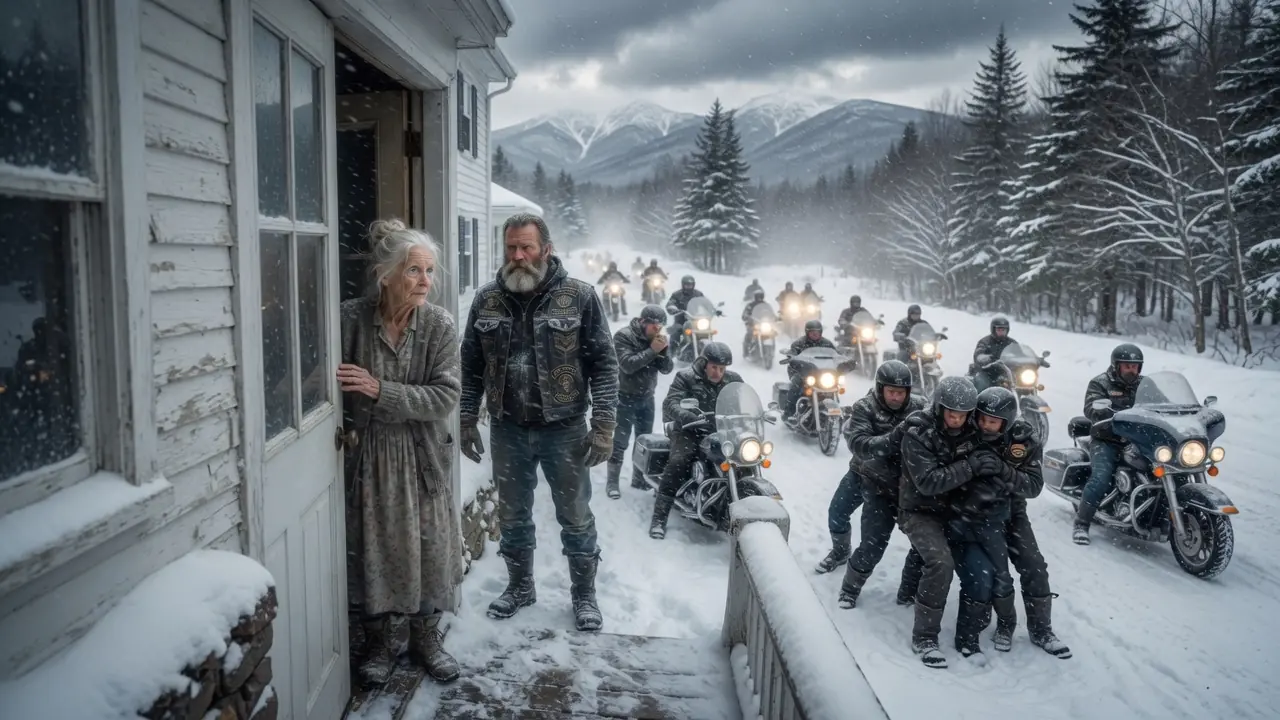
The engines grew louder, closer. The sound was deafening now, and then they appeared through the snow. Motorcycles, big ones, 20 of them, maybe more. Headlights cutting through the blizzard like search lights. They came up her long driveway in a slow procession, engines rumbling like thunder rolling across the mountain. Bikers, leather and chrome, and tattoos. The kind of men her neighbors crossed the street to avoid. The kind that made people lock their car doors.
They were stopping right in front of her house. One by one, the engines idled down but didn't cut off. Eleanor's hand went to her throat. Every instinct screamed at her to hide, to call someone, to do anything but stand here watching. One of them dismounted, walked toward her porch, boots crunching in the fresh snow. She could see him clearly now, tall, broad-shouldered, his face hidden behind a bandana and frost-covered beard. Massive, intimidating.
The knock came again, harder this time, more desperate. Please, ma'am, we don't mean any trouble. We're just. The man's voice broke off into a cough. A bad one, wet and rattling. We're just trying not to die out here. Please, she should call someone. The police, the state troopers, the neighbors. Except the phone lines were probably already down. They always went down in storms like this.
And even if they weren't, what would she say? There are bikers at my door, and I'm scared. By the time anyone got here through this weather, these men would be frozen solid in her yard, dead because she was afraid. Her mind went back to that night. The night Thomas disappeared. She'd been driving those mountain roads, desperate and terrified, searching every ditch and curve. Her car had slid off into a ravine not far from where the bus went down.
She'd thought she was going to die there, alone in the dark, while her son was out there somewhere needing her. But someone had stopped, a trucker whose name she never learned. He'd pulled her out, driven her to town, saved her life without asking for anything in return, told her that you can't turn your back on people in need. Not ever, not even when you're scared. Always open the door to those in need, Eleanor. That's what Henry used to say.
He'd seen enough death in Vietnam to know that the worst thing you could do was turn your back when someone needed help. Even if it scared you, even if every instinct said to run, especially if it scared you, he'd say. That's when it matters most. Eleanor's hand moved to the dead bolt. Her fingers trembled so badly she almost couldn't turn it, but she did. She opened the door.
Cold air hit her like a physical blow, stealing her breath. The man on her porch was massive, 6'3, maybe 6'4, with ice crusted in his beard and eyebrows. His leather jacket was covered in patches she didn't recognize. Road captain, Vermont, numbers and symbols that meant nothing to her. Behind him, the others were still mounted, engines idling, watching, waiting. 19 pairs of eyes fixed on her.
Thank you. The big man's voice was raw from the cold. Thank you so much. You have no idea. She stepped aside. Get in all of you before you freeze to death out there. He turned and waved. One by one the engines cut and suddenly the night was quieter. Just wind and the creak of leather as 20 men dismounted and trudged toward her porch. They moved slowly, stiffly like their joints had frozen in place.
They filed in like soldiers, quiet, respectful, stomping snow off their boots before crossing her threshold. They were younger than she'd expected. Most of them in their 30s or 40s. A few older gray in their beards. One kid who couldn't have been more than 25. His face pale and pinched with cold lips almost blue. The last one through pulled off his helmet. Gray beard, deep set eyes, a scar running from his temple to his jaw. Military bearing.
He met her gaze and nodded once slowly with something like respect in his eyes. Name's Jacob, ma'am. These are my brothers. He gestured to the others crowding into her small living room. We're heading down to a Thanksgiving run in Pennsylvania. Charity event. Didn't think the storm would hit this hard this fast. Weather service said it wouldn't reach us until midnight. You should have stayed off the road entirely.
Eleanor closed the door behind them, sealing out the wind. The sudden quiet was almost shocking. Yes, ma'am. You're absolutely right about that. Jacob looked around her small living room at the 20 men now crowding every available space, dripping melted snow onto her floors. We won't be any trouble. We just need to warm up. Maybe wait out the worst of it. Soon as it's safe, we'll be gone. You won't even know we were here.
Eleanor studied them. They looked rough. Tattoos snaking up necks and across knuckles. Scars, hard faces weathered by wind and sun. But their eyes told a different story. These weren't men looking for trouble. These were men who'd run into trouble and barely escaped it. Men who'd looked death in the face tonight. You'll catch pneumonia standing around in wet clothes. She pointed toward the fireplace. Dark and cold.
Get that going. Someone who knows what they're doing. Bathrooms down the hall if you need to dry off. And I need three men, strong ones, to help me get more wood from the shed out back. They moved quickly, efficiently, like a unit that had worked together before. Two of them got the fire roaring within minutes, feeding it kindling and logs from the bin beside the hearth. Three more followed her directions outside, coming back with arm loads of firewood.
The others peeled off their wet jackets and huddled near the growing flames, holding their hands out to the heat. Eleanor went to her kitchen and stared at her pitiful Thanksgiving dinner. One small turkey breast wasn't going to feed 20 men. 20 hungry half-frozen men. But she had soup, a big pot of chicken and vegetable she'd made yesterday, hoping it would last her the week. And there was bread, potatoes, some canned corn. It wasn't much, but it would be warm. It would help.
The young kid, the pale one, was standing in her kitchen doorway. Up close, he looked worse, shivering despite being inside now. His lips had a bluish tinge that worried her. His eyes were glassy, unfocused. You okay, son? Yes, ma'am. Just cold. His voice was barely above a whisper. She didn't believe him for a second, but she nodded. Sit down before you fall down.
He obeyed, sinking into one of her kitchen chairs like his strings had been cut. Eleanor started pulling out bowls, spoons, everything she had. Behind her, the house filled with voices. Low, grateful, careful. The sound of men trying not to take up too much space in a stranger's home, trying to be respectful, to not be threatening. For the first time in 30 years, her house didn't feel empty. It terrified her. And somehow, impossibly, it felt right, like the universe had sent her something she didn't know she needed.
The kitchen came alive with movement and voices. Eleanor worked the stove while the bikers crowded into every available space, leaning against counters, sitting cross-legged on the floor, perched on the radiator by the window. The soup pot bubbled and steamed, filling the house with the smell of chicken and herbs and something that felt almost like home. Ma'am, let me help with that. A younger biker, maybe 30, with a shaved head and a tattoo of a cross on his neck, stepped forward.
I used to cook in the army, did two years in a mess hall before they shipped me to Kandahar. You know your way around a kitchen. Enough to not burn soup. He grinned and she saw the gap where a front tooth should have been. Name's Marcus. She handed him the ladle. Don't let it boil over and keep stirring so it doesn't stick to the bottom. Yes, ma'am. The bread came out. Two loaves she'd baked yesterday. More out of habit than need. Not fancy, just basic white bread.
But when she set them on the table, the men looked at them like they were something precious, like they hadn't seen homemade bread in years. Jacob started slicing with her bread knife while another biker, this one older, maybe 50, with gray streaking his ponytail, found her butter dish without being asked and began spreading thick pats on each slice. Haven't had a home-cooked meal in 3 months, the older man said quietly. His voice was soft, educated, not what she'd expected from a man covered in tattoos and leather.
Been on the road since August, living off gas station food and whatever we can heat on a camping stove. What's your name? Eleanor asked, studying him. David used to teach high school English before. He trailed off, smiled sadly before life got complicated. What happened? Same thing that happens to a lot of us. Lost everything. Found the road. He didn't elaborate and she didn't push. Some wounds were too fresh to expose.
The young kid, the pale one, was still sitting at her kitchen table, watching everything with hollow eyes that seemed to look through people instead of at them. Eleanor brought him hot tea. Pressed the mug into his hands. His fingers were so cold they felt like ice. Drink that. You need to warm up from the inside out. Thank you, ma'am. His voice was barely a whisper, and this close she could hear the rattle in his chest. What's your name, son? Reed.
Something about the way he said it made her pause. There was weight in that single word. Pain hidden beneath it. She wanted to ask more, to dig deeper, but Jacob appeared at her elbow. Reed's new to the club. This is his first long ride. Jacob's voice was protective. Been with us about 6 months. Picked a hell of a night for it, Eleanor said, still watching Reed's face. Jacob's expression darkened. He needed to get away from some things, some bad situations. We all did at one point or another.
That's what the club does. Gives you a reason to keep going when you don't have one anymore. She understood that better than he knew. Sometimes running was the only option left. The only thing that kept you breathing. She'd wanted to run after Thomas died, but there had been nowhere to go. The pain followed you everywhere, settled into your bones like arthritis. You couldn't outrun it, but at least on the road you could pretend you were trying.
The soup was ready. Marcus started ladling it into bowls. She only had 12, so some men would have to wait. And Eleanor pulled out every chair she had. Still wasn't enough, so men sat on the floor holding their bowls carefully, eating slowly like they were afraid it would disappear if they rushed. The silence lasted about 30 seconds before someone spoke. This is really good, ma'am. It was one of the younger ones, Hispanic with kind eyes and a scar across his cheek.
Haven't eaten anything hot in two days. Been living on beef jerky and protein bars. Where were you headed? Eleanor asked, settling into her own chair at the head of the table. Before the storm hit. Pennsylvania, Jacob said, sitting on her couch with his bowl balanced on his knees. An annual Thanksgiving ride. We do it every year. Collect toys for kids in hospitals. Raise money for veterans hospitals. Visit nursing homes. About 200 clubs usually show up from all over the east coast.
200. Eleanor blinked trying to picture it. How many people is that? Last year, close to 5,000. The number was incomprehensible. She couldn't picture it. 5,000 bikers all in one place. It sounded terrifying and magnificent at the same time, like something out of a movie. You do this every year, she asked genuinely curious now. 15 years running. Jacob tore off a piece of bread. Chewed thoughtfully.
A lot of us are vets. Lost friends overseas. Lost ourselves for a while after we came home. Lost everything we thought we were fighting for. The ride helps, gives us purpose, reminds us we're still capable of doing good in the world. The room went quiet. Eleanor looked around at these men, these strangers who'd invaded her home, and suddenly saw them differently. Not as threats, not as criminals, as survivors, as men who'd been through hell and come out the other side, scarred, but still standing.
My husband was in Vietnam, she said softly, surprising herself. Every head turned toward her. Jacob set down his spoon, giving her his full attention. What unit? Marines. Third battalion. Fifth Marines. He was at Hue City. The words came out easier than she expected. She hadn't talked about Henry's service in years. Someone whistled low. That was rough. Real rough. Some of the worst urban combat of the whole war.
He came home. Eleanor's throat tightened, but he never really left that place, if you know what I mean. Nightmares every night for years. Couldn't handle loud noises. Couldn't be in crowds. Some days he'd just sit on the porch and stare at nothing for hours. They knew. She could see it in their faces, the nods, the way some of them looked away. The recognition of something they all carried. I was a nurse, she continued. Stationed at a field hospital in 69 and 70.
I saw boys younger than you, she gestured to Reed. Die on tables because we couldn't stop the bleeding fast enough. Boys calling for their mothers. Boys who'd never get to go home. Boys who should have been in college or working their first jobs, not bleeding out in a jungle halfway around the world. Marcus set down his bowl carefully. Thank you for your service, ma'am. Seriously, not enough people say that to the nurses. You saved a lot of lives.
It surprised her. That gratitude. She'd never thought of what she did as service. Just work. Just trying to keep people alive in an impossible situation. Just trying to do something good in the middle of all that death and chaos. We had a son, she heard herself say. The words came out before she could stop them. Pulled by the unexpected intimacy of the moment. Thomas, he'd be 38 now if he'd lived.
He used to talk about getting a motorcycle when he grew up. Wanted to ride across the country, see everything, the Grand Canyon, the Pacific Ocean, all of it. The room went completely still. Even the fire seemed to quiet. What happened to him? David asked gently, his teacher's voice soft with compassion. Bus accident. He was 8 years old. They never, she stopped, swallowed hard against the lump in her throat. They never found him. The river took him. That's what they told me.
The river was running fast, and it just took him away from me. Reed made a small sound, almost like a whimper. Eleanor looked over and saw tears tracking down his pale face. He wasn't the only one. Marcus was staring at his soup like he could see something terrible in it. Another biker, younger, with a baby face despite the beard, had his head bowed, shoulders shaking slightly. I'm sorry, Jacob said, and his voice was rough with emotion.
No parent should have to lose a child. No parent should have to go through that. No, Eleanor wiped her eyes with her sleeve, the old familiar grief rising up. No, they shouldn't. But it happens anyway, and you either keep living or you don't. I kept living because Henry needed me. And after Henry died, I kept living because because I didn't know what else to do. The moment stretched heavy and sacred.
Then someone cleared their throat and the spell broke gently. Conversation started again, quieter now, more personal. Men began sharing their own stories, their own losses, their own reasons for being on the road. The Hispanic biker was named Carlos. He'd lost his daughter to leukemia 3 years ago, 9 years old. Still rode with her photo tucked in his jacket pocket, wrapped in plastic to protect it from rain. He talked to her every day, he said. Told her about the places he saw, the people he met.
Marcus talked about his deployment to Iraq. The friends who didn't come home. The ones who came home in pieces. The guilt that ate at him every day. Survivors guilt. The therapist had called it. Why did I live when they died? What makes my life worth more than theirs? David mentioned his divorce, losing his house, his job, his pension, everything he'd spent 20 years building. The motorcycle club had saved his life when he was standing on a bridge at 2:00 in the morning, ready to jump.
A group of bikers had stopped, talked to him for 3 hours, and when the sun came up, they'd given him a choice. Jump or ride with us and see what happens. He chose to ride. Each story landed like a stone in water, ripples spreading outward, touching everyone in the room. Eleanor listened, not judging, just being present. These men had been through hell in different ways, but they'd survived. They'd found each other, made a family out of broken pieces and bad decisions and second chances.
Why do you do it? she asked Jacob. Why keep riding? Why not just settle down somewhere? Get regular jobs. He thought about it, rotating his coffee mug in his large hands. Because when you're on the road, you're free. The past can't catch you. The future hasn't happened yet. There's just you, the bike, and the next mile. It's the only peace some of us ever get. The only time our brain shuts up and lets us just exist. Eleanor understood that more than he knew.
She'd spent 30 years trying to outrun grief and failing every single time. Maybe that was the difference. These men knew grief was always going to be there, riding pillion behind them. They just refused to let it be the only thing. Refused to let it define them completely. Reed coughed. A wet rattling sound that made everyone look up sharply. You okay, kid? Marcus asked, concerned now. Yeah, just. Reed coughed again. Harder this time. His face went from pale to gray.
Eleanor was moving before she consciously decided to. She crossed to Reed in three quick steps, pressed the back of her hand to his forehead. He was burning up. Fever hot. Dangerously hot. You're sick. You're really sick. I'm fine. Another cough. This one doubling him over. His whole body convulsing. Jacob. Eleanor's voice snapped into command mode. The nurse taking over completely. He's got a fever. A bad one. Has he been sick? Couple days. Thought it was just a cold from the weather.
In this weather, riding in the cold. Eleanor shook her head, already assessing it's pneumonia or close to it. Could be bronchitis at best. The room erupted in concerned murmurs. Reed tried to wave them off, but his hands were shaking violently. I need blankets, Eleanor said firmly. All of them, and someone get more wood on that fire. We need to keep him warm and keep that fever from spiking higher. The bikers moved like a well-oiled machine.
Within minutes, Reed was wrapped in every blanket Eleanor owned, positioned close to the fireplace where the heat was strongest. Eleanor made him drink more hot tea, felt his pulse too fast, racing, listened to his breathing, too shallow, too labored. You should have said something sooner, Jacob told him. But his voice was gentle, not accusatory. Didn't want to slow anyone down, Reed mumbled through chattering teeth. Didn't want to be a burden, kid. We would have stopped. We would have gotten you to a doctor. I know. That's why I didn't say anything.
Reed's eyes fluttered closed. Always the weak link. Always the problem. Eleanor looked at this boy because that's what he was really just a boy pretending to be hard. And something twisted painfully in her chest. He reminded her of Thomas, not in looks, but in that stubborn independence. That desperate need to prove he could handle anything, could tough it out, could be strong enough. You're staying right here tonight, she said firmly, using her nurse voice. All of you, that storm isn't letting up anytime soon, and he needs rest and warmth and monitoring.
If that fever spikes higher, we'll have real problems. Nobody argued. They just nodded, accepting her authority in her own home. As the night deepened and the fire crackled and cast dancing shadows on the walls, Eleanor realized something strange. For the first time since Henry died, since Thomas died, her house felt like a home again, full of voices and warmth and life and purpose. It scared her how much she'd missed this. Scared her how easily she'd accepted these strangers. Scared her how much it was going to hurt when they left.
The fire cast dancing shadows on the walls, making everything look dreamlike and unreal. Most of the bikers had settled into whatever space they could find. Some on the couch, others on the floor with rolled up jackets as pillows, a few leaning against walls with their arms crossed. Reed was asleep near the hearth, his breathing rough but steady, his face still too pale, but not as gray as before. Eleanor sat in Henry's old chair wrapped in a quilt that smelled like mothballs and memories watching these strangers who'd become something else.
Not quite guests, not quite family, something in between, something she didn't have a word for. Tell us about him. David's voice came from the darkness near the bookshelf. He was sitting cross-legged with a cup of coffee steaming in his hands. Your son, if you want to, only if you want to. She didn't want to. Talking about Thomas hurt like pressing on a bruise that never healed, never even scabbed over. It was a wound that stayed fresh and raw no matter how many years passed.
But something about this night, the storm outside, the fire, these broken men who'd shared their own pain made her want to share it. To make Thomas real again, even just for a moment, to let him exist somewhere other than just in her head. He was stubborn, she said, her voice soft and distant. God, he was stubborn. If you told him he couldn't do something, he'd do it just to prove you wrong. Just to show you that you didn't know everything. Carlos chuckled quietly. Sounds familiar. Sounds like half the people in this room.
He loved animals. We had this old barn cat. Meanest thing you ever saw. Scratched everyone who tried to pet it. Drew blood. But Thomas would sit out there in that barn for hours just talking to it, reading books out loud. Eventually, that cat followed him everywhere like a dog. She smiled at the memory, seeing it clearly. Henry used to say Thomas could make friends with a rattlesnake if he tried hard enough. What did he look like? Marcus asked from his spot by the window.
Dark hair, brown eyes, almost black, small for his age, but wiry, fast, could climb trees that scared me to death. 50, 60 ft up like it was nothing. The doctor said he'd probably hit a growth spurt around 10 or 11. Her voice cracked slightly. The last thing I said to him that morning was, Be careful. He said, I'm always careful, Mom. And then he kissed my cheek and got on that bus. And that was it. That was the last time I saw my son alive.
The silence stretched like taffy, sticky and uncomfortable. Someone shifted position, leather creaking. The fire popped, sending sparks up the chimney. The worst part, Eleanor continued, needing to say it out loud, was not knowing. Not having a body, they found 11 bodies from that bus. 12 kids survived with broken bones and head trauma. But Thomas, nothing, not a shoe, not a piece of his backpack, not even a thread from his jacket. The river took him, they said, swept him away like garbage, but without a body, without proof, without something to bury, there was always this.
She pressed her hand to her chest over her heart. This hope that maybe they were wrong. Maybe he was out there somewhere, lost, confused, waiting for me to find him, waiting for me to be a good enough mother to track him down. That kind of hope will kill you, Jacob said quietly, knowingly. That kind of hope is worse than grief sometimes. It did kill Henry. Took 6 years, but it killed him just as surely as a bullet. Eleanor wiped her eyes with the back of her hand.
Some nights I still dream about Thomas. He's still 8 years old calling for me. I try to run to him, but I can't move fast enough. My legs don't work right. And then I wake up alone in that bed upstairs and remember all over again that he's gone. Reed stirred in his sleep, mumbling something incoherent. Eleanor stood and adjusted his blankets, checked his forehead again with practiced fingers. Still too warm, but not worse. She'd take that as a victory.
When she sat back down, Marcus was staring into his coffee like it held answers to questions he didn't know how to ask. I got a son, he said suddenly, his voice thick. Haven't seen him in 4 years. His mother won't let me near him. Got a restraining order. Says I'm dangerous. Says I'll hurt him like I hurt her. Did you? Eleanor asked directly. Hurt them? Never laid a hand on either of them? Never, Marcus looked up, eyes glittering with unshed tears.
But I did three tours, Iraq and Afghanistan. Came back different, angry all the time. Couldn't sleep. Couldn't be in crowds. Started drinking to make the noise in my head stop. One night I got drunk and put my fist through a wall. Not near them, just the wall. And she packed up and left. Filed for divorce. Took my boy. Can't blame her. I was a mess. I was dangerous. Just not in the way she thought. You could try again. Eleanor suggested gently to see him. People change. Courts understand that. Tried. Court says no. I got a record now. Bar fight. Drunk and disorderly. Resisting arrest.
System doesn't care that I'm sober now. 3 years sober. Doesn't care that I miss him so bad I can't breathe sometimes. Doesn't care that I lie awake at night wondering if he remembers me, if he hates me, if he's better off without me. He set down the cup with shaking hands. So I ride and I try to be better than I was. Try to be the kind of man who deserves a second chance. David spoke next, his teacher's voice measured and sad. I taught Romeo and Juliet for 15 years.
Every year same play, same themes, love and hate, and stupid decisions made by people who should know better. Then my wife left me for another teacher. Guy I considered a friend, guy I'd had over for dinner a hundred times. And suddenly I understood it. That kind of pain that makes you do stupid destructive things. I drove to his house with a baseball bat in my trunk. Sat outside for 3 hours in my car trying to decide if I wanted to go to prison. Trying to decide if revenge was worth throwing away everything else.
What stopped you? Carlos asked quietly. A kid rode by on a bicycle. Couldn't have been more than 10 years old. Red bike with streamers on the handlebars. Reminded me of my students, reminded me that I used to be someone who believed in second chances and redemption and all that we tell kids to give them hope. David smiled bitterly, so I threw the bat in a dumpster and kept driving. Ended up at a motorcycle dealership, bought a bike with my last paycheck. Teacher salary doesn't leave much and started riding. Been on the road ever since, 3 years now.
One by one, they shared. Carlos talked about his daughter Maria's last days, how he'd held her hand through every chemo treatment, how she'd lost her hair, but never her smile, how she died on a Tuesday morning while he was reading her favorite story, The Velveteen Rabbit, and how he'd finished reading it even after she was gone because he promised he would. A biker named Tommy mentioned his time in Afghanistan, the IED that killed three of his squad members while he walked away without a scratch. How he couldn't figure out why he deserved to live when they didn't.
Another one, older gray-haired, probably 60, talked about his brother's suicide, how he'd found the body, how he still heard the gunshot in his sleep, even though he wasn't there when it happened. Each story was a wound opened up, examined in the fire light, and carefully set down by the hearth. Not to forget, never to forget, but to share the weight so no one had to carry it alone. Eleanor listened to all of it, absorbing their pain like a sponge. These men, these rough tattooed, dangerous-looking men were just people trying to survive their own personal hells.
They'd found each other, built something like a family from the wreckage, and kept moving forward because stopping meant drowning in everything they'd lost. You know what the worst part is? Jacob said. He'd been quiet through most of the sharing, but now his voice cut through like a knife. People see us and cross the street. See the patches, the bikes, the tattoos, and assume we're criminals, drug dealers, gangsters. Nobody asks what brought us here. Nobody cares that some of us are vets, fathers, teachers, regular people who just got knocked down and haven't found a way to stand back up yet.
We're just scary, just threats, just problems to be avoided. I was scared, Eleanor admitted quietly. When you knocked on my door, I thought about not answering. I thought about hiding and pretending nobody was home. Why did you? Jacob asked genuinely curious. She thought about it, trying to find the right words. Because someone opened their door for me once when I needed it. And because my husband always said, The only thing worse than being scared is letting fear make you cruel. Letting fear make you into the kind of person who turns away when someone needs help.
Jacob nodded slowly, a small smile crossing his weathered face. Your husband was a wise man. He was. Eleanor looked around at all of them. Seeing them clearly now, he would have liked you all. He always said, The best people are the ones who've been broken and put themselves back together. The ones who know what it's like to fall and still choose to get back up. Reed coughed again, a deep rattling sound that filled the quiet room. His eyes opened briefly, unfocused and glassy with fever. Mom, he mumbled, his voice small and childlike. Mom, I'm cold. I'm so cold.
Eleanor froze. Everyone froze. The word hung in the air like smoke, impossible to ignore. Reed's eyes fluttered shut again, his breathing evening out. Just a fevered dream, just delirium. But the word hung there. Marcus cleared his throat awkwardly. Fevers making him confused, making him see things that aren't there. Yeah, Eleanor said quietly, but her hands were shaking as she pulled the blankets tighter around Reed's thin shoulders because for just a second when he'd said that word, she'd felt something she hadn't felt in 30 years. Hope. Dangerous, terrible, devastating hope.
The fire popped loudly. Outside, the wind howled like something alive and hungry. And Eleanor wondered if God was cruel enough to let her hope again, knowing what it had cost her the last time. Knowing how hope could destroy you more thoroughly than grief ever could. Reed's breathing changed around midnight. It went from rough to ragged. Each inhale a struggle against something thick and suffocating. Eleanor woke from a light doze in her chair and knew immediately something was wrong. She'd heard that sound too many times before in field hospitals, in ICU wards, lungs filling with fluid, the body fighting a battle it was starting to lose.
Jacob. She shook his shoulder hard. He came awake instantly, alert, the way soldiers did, even years after the war. Something's wrong. Reed's in trouble. Reed was convulsing, his whole body shaking violently. His lips had gone from pale to blue. Foam flecked the corners of his mouth. His eyes were rolling back, showing only whites. Jacob dropped to his knees beside Reed, hands hovering, unsure what to do. Reed, Reed, can you hear me? Come on, kid. Stay with us.
The kid's eyes rolled back further. His breathing turned to desperate gasps like drowning on dry land. Eleanor’s training kicked in. 30 years old, but still there, hardwired. Muscle memory from a thousand emergencies in Vietnam and hospitals and her own home. On his side, now he's aspirating. Roll him or he'll choke. Marcus, help roll Reed over onto his side. Fluid leaked from his mouth clear and viscous. His chest heaved, fighting for air that wouldn't come easily.
He needs a hospital, David said, his voice tight with panic. He needs real doctors, real medicine. Hospitals 40 minutes away in good weather. Eleanor pressed her fingers to Reed's neck, counting his pulse against her watch. Too fast. Racing way too fast. We'd never make it through the storm. Roads are completely blocked. We'd get stuck and he'd die in a car before we got halfway there. So, what do we do? Marcus's voice cracked with fear. We can't just watch him die.
Eleanor stood, her mind already racing through options, through her old training, through everything she'd learned in 2 years of war and 30 years of living. She ran to the bathroom, yanked open the medicine cabinet with shaking hands, antibiotics, amoxicillin left over from her own bout with bronchitis last winter. Fever reducer, aspirin. Not much, but it was something. It had to be enough. She came back crushing pills between two spoons, mixing them with water into a cloudy suspension. Hold his mouth open. Don't let him bite down.
Jacob forced Reed's jaw open while Eleanor poured the mixture in, massaging his throat until he swallowed reflexively. Reed choked, coughed, but some of it went down. It had to be enough. We need steam. Lots of it. Someone filled the bathroom sink with hot water. As hot as it'll go. Fill the tub, too. She pointed at Carlos. You more blankets. All of them. From upstairs, from closets. I don't care. We have to keep his core temperature stable or his organs will start shutting down.
They moved like a crisis response team. Years of military training kicking in for most of them. Within minutes, the bathroom was full of steam, thick and hot and humid. They carried Reed in carefully, propped him up against the wall so the moisture could reach his lungs, open them up, help him breathe. Eleanor sat beside him on the cold tile floor, one hand on his wrist, monitoring his pulse. The other on his forehead. His skin was like fire, burning her palm.
Come on, son, she whispered, her voice fierce. Stay with us. Stay with me. You don't get to die in my house. You don't get to give up now. His eyes opened, just slits, unfocused, swimming, confused, and scared. Where? He gasped, each word a battle. Where am I? You're safe. You're in my house. You're going to be okay. I promise you're going to be okay. So cold. Tears leaked from his eyes, mixing with the sweat on his face. I've been so cold for so long. All my life, just cold.
Something about the way he said it, not just physically cold, but something deeper, something so deep, made Eleanor's chest tighten painfully. She took his hand, squeezed it hard. I know, baby. I know you have, but you have to fight now. You hear me? You have to fight. I need you to fight. He stared at her and for a moment his eyes cleared slightly. He looked at her like he was seeing something he'd forgotten existed. Something he'd lost a long time ago and given up hope of finding. You look like her, he whispered, his voice barely audible over the running water. Like who, honey? The lady in the snow. The one who saved me when I was little.
His eyes started to close again. I was so little, so scared, and she picked me up and told me everything would be okay. Told me I was safe, that she had me. Eleanor's heart stopped completely. Her hand tightened on his until her knuckles went white. Reed, Reed, when was this? How old were you? But he'd slipped back under, lost to fever dreams again, his breathing still labored, but slightly better in the steam. Marcus appeared in the doorway, his face pale. How is he? His fever's breaking slowly.
Eleanor checked her watch with shaking hands. The medicine was working slowly, too. Slowly, but working. Keep the steam going and someone pray. I don't care who you pray to or what you believe. Just pray. The next two hours were the longest of Eleanor's life since the night they told her Thomas was gone. They took turns sitting with Reed, monitoring his breathing, wiping the sweat from his face with cool cloths. Jacob stayed the entire time, refusing to leave, sitting on the bathroom floor with his back against the tub.
He's like a kid brother to me, Jacob said quietly, staring at Reed's unconscious form. Found him 6 months ago, living under a bridge in Burlington, strung out on heroin, half dead, 20 lb underweight, track marks all up his arms. We got him clean, got him into treatment, got him on a bike, gave him a reason to live when he'd given up completely. What happened to his family? Eleanor asked, though part of her was afraid of the answer. He doesn't remember. Says he grew up in foster care all over New England. No memory of anything before he was 8 or 9 years old. Just fragments that don't make sense.
A woman's voice singing snow being scared, being lost, but nothing concrete. Nothing he can hold on to. Eleanor's hand shook as she pressed a cool cloth to Reed's forehead. Her mind was racing, making connections she didn't want to make, seeing patterns that couldn't possibly be real. 8 years old, snow, a woman, lost. No, it was impossible. Coincidences like that didn't happen outside of television movies. The world wasn't that small. Fate wasn't that cruel or that kind.
Reed's breathing steadied gradually. The blue faded from his lips, replaced by a healthier pink. His chest rose and fell in a more natural rhythm. Less desperate. I think he's through the worst of it, Eleanor said finally, her voice. The fever's down to 101. Still too high, but not dangerous anymore. Jacob exhaled hard, his shoulders sagging with relief. Thank God. Thank you. You saved his life. Don't thank me yet. He needs real medical care once this storm clears. Chest X-rays, real antibiotics, maybe IV fluids. We'll get him there. I promise.
But Reed was sleeping now. Really sleeping, not unconscious. And Eleanor sat there in the steam-filled bathroom, holding this stranger's hand, her mind spinning with impossible thoughts about boys and snowstorms, and mothers who never stopped searching and coincidences that might not be coincidences at all. Morning came slow and pale through the windows. The kind of light that follows a storm. Clean, washed out, everything softened by snow and new beginnings. Eleanor woke in her chair, neck stiff and aching, Henry's quilt slipping off her shoulders.
The fire had burned down to glowing embers. Around her living room, bikers were scattered like fallen dominoes, some snoring, others stirring awake with groans, rubbing their eyes and stretching cramped muscles. Reed was still asleep by the fireplace, but his color looked better, normal. His breathing was even and deep. She touched his forehead with the back of her hand, warm, but not burning. The fever had broken completely. Thank God. Thank whatever force in the universe had listened to her desperate prayers.
She stood slowly, joints protesting every movement, and shuffled to the kitchen like an old woman, which she supposed she was. Through the window, the world was white and pristine. 2 ft of snow, maybe more, transforming everything into something clean. And the motorcycle line was buried up to the handlebars. Nothing was moving anywhere. No cars, no plows, just endless white. She needed coffee before anything else. She got the pot going and started assessing her supplies with a practiced eye.
The bread was gone, most of the soup. She had eggs in the refrigerator, pancake mix in the cupboard, some bacon in the freezer that she'd been saving. Not much, but enough for one more meal. Maybe the last meal before they all went their separate ways. Morning, ma'am. She turned. Marcus stood in the doorway, hair sticking up in every direction, looking younger and more vulnerable without his hard expression. Morning. Coffee will be ready in a minute. You sleep at all?
He stepped into the kitchen, keeping his voice low. Some, not enough, maybe two hours total. Her body ached everywhere, but she'd survived worse. Much worse. Reed's doing better. Jacob told me what you did. You saved his life. No question. Marcus's voice was thick with emotion. Most people would have turned us away at the door, would have let us freeze. You didn't have to help us. You didn't have to do any of this. Eleanor shrugged, uncomfortable with praise. I was a nurse. It's what we do. It's what I was trained to do.
No. Marcus shook his head firmly. Most people would have been too scared. Would have seen the leather and the bikes and decided we weren't worth the risk. You didn't do that. You saw people who needed help and you helped. That's not training. That's character. I'm just a lonely old woman who got lucky last night. Eleanor poured two cups of coffee. Handed him one. I haven't had this many people in my house since since before everything fell apart. It felt good. Even under the circumstances, even being scared half to death, it felt good to be needed again.
He took the cup, studied her over the rim with eyes that had seen too much. You're a good person, Mrs. Hartman. A genuinely good person. World needs more of those. The world needs more people who help instead of looking away. She smiled sadly. That's all I did. The others started waking up gradually. Groans and coughs and the rustle of leather. The bathroom door opened and closed repeatedly. Someone got the fire going again, feeding it fresh logs.
Reed sat up slowly, blinking at the morning light streaming through the windows. Jacob was beside him immediately, kneeling down. Hey kid, how you feeling? Like I got hit by a truck and then the truck backed up and hit me again. Reed's voice was hoarse but stronger, more present. He looked around, saw Eleanor, and his expression softened completely. You stayed with me all night, didn't you? Someone had to make sure you kept breathing. Thank you. His eyes were shining with unshed tears.
I don't I don't remember much from last night, but thank you for everything. Eleanor waved it off, but her throat was tight with emotion she couldn't name. There was something about this boy, something familiar in the curve of his jaw, the way he tilted his head when he was thinking, the shape of his hands. Or maybe she was just a desperate old woman seeing ghosts in every young face looking for her son in strangers. She made breakfast scrambled eggs, bacon, pancakes on her old griddle that Henry had bought her 40 years ago.
The bikers ate standing up, crowded around her kitchen counter, grateful for every bite, thanking her repeatedly. Storms passed, David reported from the front window, looking out at the transformed landscape. But the roads won't be clear for hours, maybe days. We're completely snowed in. We should start digging out, Jacob said. Always practical. Get the bikes ready to roll once the plows come through. They filed outside, 20 men attacking the snow with shovels borrowed from Eleanor's shed, bare hands, pieces of plywood, anything they could find.
She watched them work through the window, this temporary family, and felt the loneliness creeping back in like cold air under a door. They'd be gone soon. The house would be empty again, just her and the ghosts and the silence. The thought made her chest ache. Reed appeared at her elbow, wrapped in a blanket like a child. He'd stayed inside, still too weak for physical work. You okay? she asked gently. Yeah, just I had these dreams last night, vivid ones, about being a kid, about snow and being lost and being terrified.
He frowned, trying to remember, trying to hold on to something that kept slipping away. And someone finding me, someone who looked exactly like you. Same eyes, same voice. Eleanor's breath caught in her throat. Reed. But then Marcus was calling from outside. His voice sharp with urgency, cutting through everything. Jacob, get out here now. Everyone stopped digging. The urgency in his voice froze them all because coming down the mountain road, engines roaring even through the deep snow was a sight that made Eleanor's heart seize in her chest.
More motorcycles, hundreds of them, maybe thousands. A black river of chrome and leather flowing toward her small house, all headed straight for her. The rumble started low, like distant thunder rolling across the mountains, or an earthquake moving slow and inexorable through the earth beneath their feet. Eleanor gripped the porch railing so hard her knuckles went white. Her teacups rattled violently on the kitchen shelves. The windows vibrated in their frames, glass humming, pictures on the walls tilted.
The 20 bikers in her yard stood frozen like statues, shovels hanging from their hands, staring down the mountain road with expressions ranging from shock to awe to something like fear. The rumble grew louder, became a roar that drowned out everything else. And then they appeared through the trees, motorcycles, a wave of them stretching back as far as Eleanor could see. Chrome and steel catching the morning sun, creating a river of light and sound that seemed endless. Hundreds, no more than hundreds. The road was packed solid with bikes moving in tight formation, engines synchronized in a thunderous chorus that shook the ground.
Jesus Christ, Marcus whispered, his voice barely audible over the roar. Eleanor couldn't breathe. Her first thought was invasion. Her second was that somehow she'd done something terribly wrong, harbored dangerous criminals, and now judgment was coming down the mountain like an avalanche. They'd take her house, arrest her, maybe worse. But Jacob wasn't afraid. He was smiling, actually smiling, with tears streaming down his weathered face. They came, he said, his voice breaking. I sent out a call last night when the phone still worked. I didn't think I didn't know if anyone would make it through the storm, but they came.
The lead bikes pulled into Eleanor's yard, not aggressively, but carefully, almost reverently, like they were approaching sacred ground. They parked in neat rows. One by one, the engines cut, and the roar faded to silence. Silence that felt heavier and more meaningful than any sound. A man dismounted from the lead bike, 70 years old, if he was a day, white beard flowing down to his chest, wearing a leather vest covered in patches from a lifetime of riding. He walked with a pronounced limp old injury, maybe from a war even older than Henry's, but his back was straight and proud.
He walked right up to Eleanor's porch and stopped at the bottom step, removed his helmet slowly, deliberately. Every single rider behind him did the same. A wave of helmets coming off, revealing faces young and old, scarred and smooth, all watching her. Mrs. Hartman, his voice was gravelly, worn smooth by decades of wind and road noise, and shouting over engines. Eleanor's mouth was dry as sand. How do you know my name? Because 34 years ago, you saved a little boy's life. The old man's eyes were steady, piercing, seeing right through her.
February of 1993 near the Vermont border. There was a bus accident. 24 kids on board. River running fast and high from snow melt. You were driving those roads looking for your son and you found a different child instead. Half frozen, confused, bleeding, injured. The world tilted sickeningly. Eleanor grabbed the railing to keep from falling. Her vision swimming. You took him to a hospital in Burlington. The old man continued, his voice gentle now. Stayed with him for 3 days until he was stable. Even though you were grieving, even though you were falling apart, the state came for him, put him in foster care because nobody could figure out who he belonged to.
He had no memory, no ID, no family claiming him. Just one thing he remembered clearly through all the trauma. A woman in a red coat who pulled him out of the snow and told him everything would be okay. Eleanor's hand went to her throat. She'd blocked out that night. Too painful, too wrapped up with losing Thomas. Too much failure and grief all tangled together. But now it came flooding back like ice water. The boy by the side of the road, stumbling through snow, hypothermic, bleeding from a head wound. She'd thought he was Thomas at first in that terrible moment of hope and desperation. But it wasn't her son, just another lost child on the worst night of her life.
I forgot about him. She whispered, shame washing over her. God forgive me. I forgot. I was so wrapped up in my own grief that I forgot that child existed. You didn't forget. The old man's voice was gentle understanding. You were drowning in your own grief. Nobody blames you for that. You just lost your son. You were barely surviving. But that boy never forgot you. Never forgot the woman who saved him. Grew up in the system. Bounced around foster homes. Seven of them. Aged out at 16, ended up on the streets.
And when he was at his lowest, at his absolute bottom, someone helped him. One of us, one of our brothers, he turned and gestured to the massive crowd behind him. A thousand faces staring back at her with expressions of respect and something like reverence. We're all someone's lost boy, ma'am. We've all been pulled out of the snow by somebody at some point. We've all been saved by someone who didn't have to care, but did anyway. And when Jacob put out the call last night, said you'd opened your door to 20 freezing strangers in the middle of a blizzard, said you'd saved Reed's life, even though you had every reason to be afraid of us.
Every chapter within 500 miles dropped what they were doing, and rode through the night to get here, to be here for this moment. Eleanor shook her head, not understanding, not able to process what he was saying. I don't understand. Who is Reed? What does this have to do with? The old man smiled, sad and sweet and full of emotion. You really don't recognize him, do you? Even after spending all night with him. Reed stepped forward slowly, still wrapped in the blanket, his face pale, but his eyes clear and focused. His hands were shaking.
The boy you saved that night, Reed said softly, his voice barely carrying. The one from the bus accident, the one you stayed with in the hospital, that was me. I was 8 years old. I'd been on a field trip. Environmental science, learning about rivers, bus went off the road. I survived somehow, but I lost everything in that water. My memory, my identity, my family, everything that made me who I was. His voice cracked like breaking glass. Except the memory of you. The woman who wouldn't let me die alone in the snow. The woman with the red coat and the kind eyes who told me I was going to be okay.
Eleanor's legs went out from under her. Jacob caught her, eased her gently into a chair someone had brought from inside. No, she breathed, her mind refusing to accept it. No, that's not. You're not. That's impossible. But even as she said it, even as she denied it, she saw it clearly. The way he held his head, the shape of his eyes, the stubborn set of his jaw, the exact way he tilted his head when confused. Thomas's eyes. Thomas's jaw. Thomas's mannerisms. My real name is Thomas Hartman, Reed said, tears streaming down his face now. And I've been trying to find my way home for 34 years.
Eleanor couldn't let go. Her hands clutched Thomas. Reed. Thomas like he might disappear into smoke if she loosened her grip even slightly. He was shaking violently in her arms. Or maybe she was shaking. Maybe both. Maybe the whole world was shaking. How? She gasped, unable to form complete thoughts. How is this possible? This doesn't happen. This doesn't happen. The old man spoke gently, climbing the porch steps slowly. May we come inside, ma'am? It's a long story. A complicated story. You'll want to sit down for all of it.
Eleanor nodded, not trusting her voice, not trusting anything except the solid weight of her son in her arms. Jacob helped her stand. Her legs were still weak, unreliable, and they moved inside together. Thomas stayed pressed against her side like a child afraid of the dark, like he'd spent his whole life afraid and was finally finding light. The house filled with bikers again. But this time, the energy was different, reverent, sacred. They packed the living room, the kitchen, spilling into the hallway and up the stairs. But it wasn't threatening. It felt like protection, like a family gathering around someone precious who'd been lost and found.
The old man sat across from Eleanor in Henry's chair. Up close, his eyes were kind beneath the weathered sun-damaged face. Eyes that had seen terrible things and chosen kindness. Anyway, my name's Robert Chen. I was president of the club from 1989 to 2005. Served in Vietnam. Same as your husband. Different unit. I'm the one who found Thomas in 2001. His voice was steady, factual, but his eyes were wet. Found him where. Eleanor's voice shook uncontrollably. Living under a bridge in Burlington. 16 years old, heroin addict, more dead than alive, weighed maybe 90 pounds, track marks covering both arms, hadn't eaten in days.
Robert's face was grave, deeply lined. The system had chewed him up and spit him out. Seven different foster homes, three group homes, physical abuse in two of them, sexual abuse in one. Aged out at 16 with nothing, no family, no support system, no money, just a head full of trauma he couldn't remember and couldn't process and no way to cope with it except drugs. Thomas, she couldn't think of him as Reed anymore, wouldn't spoke quietly, his voice small and broken. I tried to kill myself three times before Robert found me. Pills, razor blades, standing on a bridge. Figured I was trash. Figured nobody wanted me. Figured I'd been thrown away for a reason.
That's not true. Eleanor started. Her voice fierce. I know that now. I understand that now. Thomas looked at her with red-rimmed eyes, but I didn't then. All I had were these fragments in my head that didn't make sense. A woman's voice singing something. A red coat in the snow. Strong hands picking me up. Someone telling me I was safe. I was loved. I mattered. And this feeling, this terrible, desperate feeling that I'd been loved once, truly loved, but I'd lost it somehow. Lost her. And I couldn't figure out how to get back. We cleaned him up, Robert continued, his voice thick with emotion.
Got him into rehab. Paid for it ourselves. Club money, donations, whatever it took. Then treatment, real therapy with someone who understood trauma. Then when he was ready, we gave him a home, a family, because that's what we do. We're all broken pieces, Mrs. Hartman. We're all the kids nobody wanted, and we tried to help each other heal because nobody else will. Eleanor touched Thomas's face with shaking fingers, grown now, scarred, so different from the 8-year-old she remembered, the baby she'd rocked to sleep. But his eyes were the same. God help her. His eyes were exactly the same. How had she not seen it immediately?
I searched for you, she whispered, her voice breaking. For years and years, I searched. I called every hospital, every police station, every morgue in three states, every week for 10 years. They all said the same thing. No body found, no leads, no hope. I know. Robert found the records when we started looking for you. Pages and pages of calls you made. Thomas caught her hand, held it against his cheek like he used to do as a child. But I wasn't in the system as Thomas Hartman. After the accident, after the head injury, I couldn't tell them who I was. Couldn't remember my name, my address, my parents' names, nothing.
They listed me as John Doe 7 in the hospital system. When no family came forward after 3 months, they gave me a random name from a list, Reed Morrison. That's who I became in all the official records. Thomas Hartman was legally dead. Reed Morrison was born from nothing. The accident. Eleanor's medical training was kicking through the overwhelming emotion. You had head trauma, severe head trauma, traumatic brain injury, fractured skull, some permanent brain damage. His face crumpled and he looked young again, vulnerable. The memories before the accident are just gone or buried so deep I can't reach them. No matter how hard I try, I don't remember you raising me. Mom, I don't remember. Dad, I don't remember our house or my room or birthdays or any of it.
Just fragments, pieces of dreams that might not even be real. Mom, that word shattered something in Eleanor's chest. Broke open something that had been locked away for 34 years. She pulled him close again, rocking slightly, making a sound that was half sob, half laugh. It doesn't matter. It doesn't matter what you remember. You're here now. You're alive. That's all that matters. That's everything. Robert cleared his throat, giving them a moment before continuing. Two months ago, Thomas started having dreams, clear ones, vivid ones, more than fragments, about a house in the mountains. A mother who sang him to sleep. A father who taught him to fish in a stream. A dog named Sam. A tire swing. The smell of pancakes on Sunday mornings.
His therapist said, Sometimes trauma unlocks when a person feels safe enough, stable enough. Thomas has been sober three years now. Three years clean. He's stable. He's doing well. His mind was finally ready to remember. I dreamed about you every single night for 2 months, Thomas said into Eleanor's shoulder, his voice muffled. But I didn't know if you were real or if I'd made you up. My mind creating a fantasy mother to replace the emptiness. I didn't know if you were still alive. Didn't know if you'd moved away or remarried or forgotten about me or what. Didn't know anything except I had to find you. Had to know for sure. So, we started searching, Robert said. His voice full of quiet pride. Took us 8 weeks.
Finally found records of the bus accident in old newspaper archives. Found your name listed as a witness. Found this address in property records. We were planning to visit after the Thanksgiving run in Pennsylvania. But then the storm hit and Jacob's group ended up here by pure chance. Not chance, Jacob said quietly from his spot by the window. Fate or God or the universe or whatever you want to call it when something impossible becomes possible. Eleanor looked around at all these faces. These rough tattooed dangerous-looking men who'd saved her son's life raised him when she couldn't kept him alive through addiction and despair and brought him home to her who'd ridden through a blizzard just to witness this moment.
Why? She asked her voice small. Why did you do all this for him? Why did you care? Because someone did it for me once, Robert said firmly. When I came back from Vietnam, I was a mess. PTSD before they had a name for it. Drinking, fighting, destroyed my marriage, lost my kids, was living in my car when a group of bikers found me, took me in, gave me purpose, saved my life. He gestured around the room, and someone did it for him. He pointed at Marcus and him and him and him. We're all somebody's lost boy, every single one of us, and we take care of our own. When Thomas said he was looking for his mother, looking for home, we all became part of that search, because we all wished someone had looked for us that hard, wished someone had cared that much.
The room was silent except for muffled sniffles. These tough men, these survivors were crying openly now, unashamed. Carlos spoke up, his voice thick. My daughter Maria died alone in a hospital room while I was deployed overseas. I missed her last words, missed holding her hand one last time, missed everything that mattered. He wiped his eyes roughly. But today, right now, I got to see a mother and son reunited after 34 years. I got to witness a miracle that means something that heals something in me that matters. I never got to say goodbye to my brother, said the gray-haired biker, his voice breaking. Found him after he'd been dead for two days.
Never got to tell him I loved him. Never got to tell him it wasn't his fault that I didn't blame him for anything. He looked at Eleanor and Thomas with swimming eyes. But today, I watched someone get their family back. I watched love win against impossible odds. That's a gift. That's grace. That's proof that sometimes against all logic and reason, good things still happen. One by one, they shared what this moment meant to them personally. How it healed something they'd thought was broken forever. How it proved that sometimes, against all odds and all logic, love actually does win. How it gave them hope that maybe their own broken pieces could be put back together someday.
Thomas pulled back slightly, looked at Eleanor with eyes full of fear and hope. The storm outside had passed, but inside Eleanor's home, something new and unbreakable had begun. A bridge had been built across decades of loss, carried by strangers who had become family, and the light of one oil lamp on a freezing Thanksgiving night had guided a lost son home.