The boots hit the porch before anyone said a word. Marcus had broken down doors before, but nothing prepared him for the smell that rolled out, or the silence after it, or the sound buried inside that silence. A man's voice, thin, cracked, saying the same word over and over from somewhere upstairs in a darkened house on a road nobody paid attention to. Help. Just that. Just one word, repeated like a prayer that had been going on so long the person saying it had almost forgotten why. 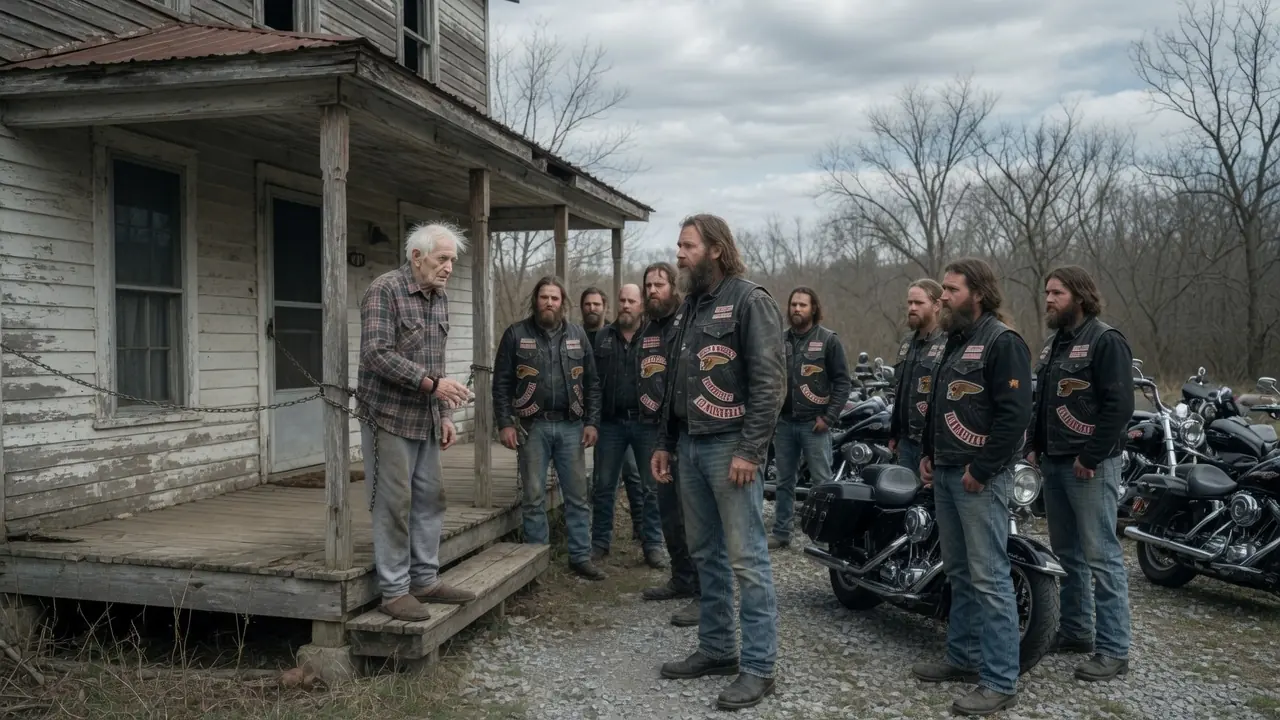
What Marcus found at the top of those stairs would change everything about the town, about justice, and about the one person nobody ever suspected. The engine of Marcus Dalton's Harley-Davidson Road King growled low and steady as he turned off Route 49 onto the cracked asphalt of Millbrook Lane. It was a Tuesday morning in late October, the kind that smelled like wood smoke and wet leaves. The sky the color of old pewter pressing down on the hills of rural Tennessee. The trees had gone mostly bare, their skeletal fingers reaching upward as if pleading with a sky that wasn't listening.
Marcus had ridden this stretch of road a hundred times. He knew every pothole, every rusted mailbox, every sagging fence line. But today felt different. Something in the air sat heavy, the way it does before a storm that doesn't come with rain. He was leading a small group, five riders total, all members of the Ironbound Brotherhood, a motorcycle club based out of Harlan County that had over the past decade quietly built a reputation not for trouble, but for showing up when nobody else would.
They delivered meals to veterans. They escorted kids with terminal illnesses to theme parks. They sat with grieving families at funerals when no one else came. The leather and chrome and noise were surface things. Underneath, these were men who had lived hard enough to understand what suffering looked like and hard enough to refuse to look away from it.
Behind Marcus rode Steve Garrett, 41, who had the easy grin of a man who'd been through enough darkness to genuinely appreciate daylight. Steve was the kind of person who noticed things, a broken taillight, a dog tied too long in a yard, a curtain that didn't move right. It was Steve who had first said something 3 weeks ago when they'd passed the old Holloway property on their regular charity run.
That house, Steve had said over the radio intercom, his voice careful and quiet, something's off about it. Marcus had looked. A two-story farmhouse set back from the road, white paint peeling like sunburned skin, the front porch sagging under years of neglect. Two cars in the gravel driveway, a newer model Honda Civic and an older pickup truck. Curtains drawn on every window despite it being midday. He'd filed it away without saying much. They had deliveries to make, but Steve mentioned it again the following week and the week after that. By the third time, Marcus trusted the instinct enough to slow down and look longer.
The property belonged to Raymond Holloway. Marcus knew the name in the vague way you know the names of people who've always been part of the landscape of a small town. Raymond had been a high school shop teacher for 32 years. He'd coached Little League one summer when Marcus was 8 years old. A quiet man, steady and decent, the kind who remembered your name even when you'd grown past the age of needing him to. His wife, Eleanor, had passed 4 years ago, cancer, swift and merciless. Since then, Raymond had lived alone. Or so people assumed.
You feel it, too? Steve said, pulling up beside him, visor up, eyes on the house. Yeah, Marcus said. He didn't try to define what it was. Some things didn't need defining. They needed acting on. He swung off the bike, his boots finding the gravel with a crunch that sounded too loud. He motioned to the others. Stay back. Stay ready. And he and Steve walked up the path toward the front door.
The porch steps groaned under their weight. A wind chime made of old keys hung beside the door, motionless in the still air. Marcus knocked. Nothing. He knocked again, harder this time. Mr. Holloway? Sir, it's Marcus Dalton. I used to play in your little league. Just checking in. A long silence. Then, from somewhere deep inside the house, faint but unmistakable, a sound that raised every hair on Marcus's arms.
It was a man's voice, thin and cracked and desperate, saying one word over and over. Help. Marcus didn't hesitate. He tried the door, locked, then moved to the side window, cupped his hands against the glass, and looked inside. The living room was dim and cluttered, furniture pushed against the walls, mail piled on the floor. And at the far end of the hallway, barely visible in the weak light filtering from upstairs, was the foot of a staircase.
And from the top of that staircase came the sound again. Help. Please. Help. Steve was already on his phone, calling 911. Marcus looked at the door, looked at Steve, and made the decision. He took one step back and drove his shoulder into the door. It gave on the second hit, the frame splintering with a crack like a gunshot. The smell that rolled out of the house hit him like a wall. Stale air, unwashed fabric, something medicinal, and something underneath that was worse. The smell of a person kept too long in one place.
Marcus moved toward the stairs. What he found at the top of them would stay with him for the rest of his life. The bedroom door was closed, but not locked. Marcus pushed it open slowly, the way you approach something you're not sure you're ready to see. The room beyond was dim, the curtains drawn tight, a single lamp on the nightstand casting a jaundiced circle of light across the floor.
It took his eyes a moment to adjust. When they did, his stomach dropped. Raymond Holloway lay on a hospital-style bed that had no business being in a private home, the kind with metal rails along the sides and a thin plastic mattress cover that crinkled with every breath. He was dressed in a faded flannel shirt and gray sweatpants, his white hair matted against the pillow, his face a geography of hollows and shadows that spoke of weeks without proper food or sunlight.
His cheeks had caved. His eyes, when they found Marcus, were the clearest thing in the room, still sharp, still present, even after whatever he had endured. And around his left wrist, attached to the metal bedrail with a short length of chain and a padlock, was the reason Marcus's hands were shaking. Sir, Marcus said, and his voice came out steadier than he felt. He crossed the room in four steps and crouched beside the bed. Sir, I'm Marcus Dalton. I'm going to get you out of here. You're safe. Help is coming.
Raymond's lips moved. His voice, when it came, was barely above a whisper, dry and cracked as old leather. Water, he said. Please. Marcus turned to find Steve already in the doorway, face pale beneath his beard, holding a water bottle he'd taken from his jacket pocket. Marcus took it, uncapped it, and helped Raymond drink. Slowly, carefully, the way you do with someone who hasn't had enough for a long time.
The old man's hand, the free one, gripped Marcus's wrist with surprising strength. She said she'd be back, Raymond said when he'd had enough to speak more clearly. She said it was for my own good, so I wouldn't fall again. Who said that, sir? Marcus asked, though something cold was already settling in his chest, narrowing the list of possible answers. Raymond closed his eyes. When he opened them, the clarity in them had sharpened into something that looked like shame. Not his own shame, something borrowed, the shame of having to say out loud what had been done to him.
Brenda, he said. My daughter. The word landed in the room like a stone dropped into still water. Marcus held Raymond's gaze and didn't flinch. How long? he asked. I don't know exactly. Raymond's voice was careful, methodical, as if he'd spent weeks organizing the facts into the order they'd need to be said. Since August, I think. After I fell in the kitchen and she came to help. She said she was moving in to take care of me.
At first, it was fine. She cooked. She cleaned a little. But then she started going through my papers, my bank papers, my pension statements. She made me sign some things, said it was just to make managing easier while I recovered. He paused and Marcus waited. Then one night she put this on. Raymond lifted his chained wrist slightly, the motion pulling at something painful. Said I'd try to get up during the night and she was afraid I'd fall again and she couldn't watch me every minute.
He let his arm rest again. But she was gone most days. Sometimes all day, coming back at night, sometimes not until morning. She'd leave a sandwich on the table there, sometimes water, sometimes not. Marcus became aware of Steve behind him and the sound of distant sirens rising from the road below. He kept his voice quiet and steady. Did she hurt you in any other way, sir?
Raymond considered the question with the gravity of a man who understood its weight. Not with her hands, he said finally. But there are more ways to hurt a person than with your hands. Marcus nodded once. He understood that better than most. By the time the first patrol car crunched up the gravel driveway, Marcus had found a blanket in the closet and draped it over Raymond's shoulders, had found the kitchen and brought back a glass of water and the remaining half of a sandwich. The only food in the refrigerator apart from a six-pack of soda and some condiments. And had sat with the old man in the yellow lamplight listening while Steve directed the arriving officers up the stairs.
Officer Doug Pierce was the first through the bedroom door. He was a broad, deliberate man in his mid-40s with the look of someone who had seen enough in 20 years on the job to be hard to surprise. But what he saw in that room surprised him. Marcus watched the officer's expression move through several stages, confusion, comprehension, anger controlled into professionalism before settling into the focused calm of someone who knows exactly what needs to happen next.
Sir, my name is Pierce. I'm going to get a paramedic up here right now. He stepped closer to the bed, looked at the chain, looked at the padlock, and pulled his radio from his belt. Dispatch, I need an ambulance priority at 4412 Millbrook Lane, and I need another unit for a possible protective custody situation. He paused. And somebody needs to find Brenda Holloway.
That last sentence changed the temperature of the room. Outside, the other bikers had gathered near their machines at the end of the driveway, watching the patrol cars and the arriving ambulance with the quiet attention of men who knew when to stay out of the way and when to stay close. They stayed close. Steve came back downstairs and stood with them, his jaw set, his eyes on the upstairs window where the pale light still burned.
Is he alive? One of the others asked. He's alive, Steve said. Talking? Sharp. He looked down at his boots for a moment. Chained to his own bed by his own daughter. Nobody said anything to that. There wasn't anything to say. The words sat in the cold October air and refused to leave.
Inside, as the paramedics worked around him, Raymond Holloway looked at Marcus and said something that Marcus would repeat many times in the months that followed when people asked him what it had been like in that room. I kept thinking someone would come, Raymond said. I never stopped thinking that. Every day, someone will come today. Someone will come.
He paused. I'm glad it was you boys. Marcus had to look away for a moment. He looked at the window, at the pale sky pressing against the curtains. Then he looked back at Raymond and said, We should have come sooner. You came, Raymond said simply. That's what matters.
Brenda Holloway was 42 years old, not 52, as some of the early rumors in Clarksville would claim, and she was found at a casino 40 minutes east of town by mid-afternoon of the same day her father was taken to Clarksville General Hospital. She was cooperative with the officers who approached her at the blackjack table, which struck everyone as either a sign of innocence or a very particular kind of arrogance. She came with them without protest, wearing a look of practiced concern that she deployed like a costume.
Marcus wasn't there for her arrest. He was at the hospital. He hadn't planned to stay. He'd given his statement to Officer Pierce, answered every question thoroughly and accurately, provided his contact information. He could have ridden back to Harlan County, filed it away as a good deed done. But he found himself in the waiting room of Clarksville General, sitting in a plastic chair beside Steve, a paper cup of bad coffee going cold in his hand, unable to make himself leave.
A social worker named Cheryl Owens found them there around 2:00 in the afternoon. She was a compact woman in her late 30s with the energy of someone permanently running behind schedule and the eyes of someone who had decided long ago that this particular job was worth it anyway. She sat down across from them with a manila folder on her knee and a directness that Marcus immediately respected.
You're the ones who found him. she said. Not a question. Yes, ma'am. Marcus said. Cheryl looked at them both for a moment, measuring something. Then she opened the folder. I want to be transparent with you because without you gentlemen, this wouldn't have happened. Raymond Holloway's situation is more complex than it appeared this morning.
She paused. Brenda Holloway has power of attorney over her father's finances. It was signed and notarized 6 weeks ago. Since then, approximately 43,000 has been withdrawn from his accounts. His pension is being direct deposited into a joint account she controls. And 3 weeks ago, she initiated paperwork to sell the Millbrook Lane property. Steve let out a slow breath. She was draining him. That's what the evidence suggests. Cheryl said carefully. But evidence and conviction are two different things. And right now, the DA's office is looking at what charges will hold.
She looked at Marcus. The chain and the conditions, those give us elder abuse, potentially unlawful restraint. The financial piece is harder. She'll claim he gave his consent. He told me she made him sign things. Marcus said. He said he didn't fully understand what they were. That's consistent with what he told the doctors this morning. Cheryl made a note. But her attorney will argue cognitive decline, that he consented without understanding, and that the restraint was a safety measure, not a punitive one.
She closed the folder. I want you to know we're taking this seriously, but I also want you to understand that the system sometimes moves slower than justice should. That sentence lodged itself in Marcus's chest like something barbed. He spent the next 3 days making phone calls. He wasn't a lawyer, and he wasn't a cop, but he was someone who, over a decade of community work, had built relationships with people who were.
He called a victim's rights attorney in Nashville who had worked pro bono cases for the brotherhood before. He called a reporter at the Knoxville Sentinel who had covered elder care stories. He called the state's adult protective services hotline and documented every exchange. Steve, meanwhile, was doing something quieter but equally important. He was talking to people in Clarksville.
The hardware store owner who said Raymond used to come in every spring for seeds, and they hadn't seen him since April. The neighbor three houses down who'd noticed the mail piling up but assumed Raymond had switched to paperless billing. The woman at the pharmacy who said Brenda had been picking up Raymond's prescriptions, including his blood pressure medication, but had let the last two refills lapse. Each of these details, individually, was ambiguous. Together, they assembled into something that looked less like caregiving and more like management. The management of a person being extracted of everything valuable before being discarded.
Raymond, meanwhile, was recovering. Slowly, but with what the nurses described as a stubbornness that was almost inspiring. He was dehydrated and malnourished with the early signs of a pressure sore on his lower back from weeks spent mostly immobile. His blood pressure was dangerously low, but his mind was clear, startlingly, almost combatively clear. When Marcus visited on the third day, Raymond was sitting up in the hospital bed eating chicken soup with the focused determination of a man reclaiming something. He looked better. Color in his face, eyes sharp.
They tell me you've been making calls, Raymond said without preamble. Some, Marcus said, pulling a chair close. You don't have to do that, Raymond said. You already did enough. With respect, sir, Marcus said, I disagree. Raymond studied him for a moment, the spoon held still over the soup. You know what the hardest part was? he said. Not the chain, not even being hungry. It was thinking that maybe I'd done something to deserve it, that maybe I was too much trouble, too much of a burden.
He set the spoon down. She told me that over and over, that I was a burden, that nobody had time for a sick old man who couldn't take care of himself. He paused. After enough weeks of that, you start to believe it. Marcus felt the anger in him like a coal, hot and steady, burning without smoke. You didn't deserve any of it, he said. Not one day of it. Raymond nodded slowly. I know that now, he said. I think I knew it before, too, but knowing something and feeling it, there's a distance between those two things. Yeah, Marcus said. There is.
Are they going to charge her? Raymond asked. They're working on it, Marcus said. The attorney I spoke with thinks the financial fraud piece is actually stronger than the abuse charge, depending on how they document the timeline, but both are being pursued. Raymond was quiet for a moment. Outside the hospital window, the Tennessee hills spread out in the gray afternoon, still and enormous. She's my daughter, he said finally, not as an excuse or a defense, but as a plain fact that contained its own kind of devastation. I keep trying to understand how a person gets there, to that place where they can do that to their own father. He shook his head. I can't get there. I can't find my way to understanding it. Maybe you don't have to, Marcus said. Raymond looked at him. No? Maybe some things don't have an explanation that makes sense. Maybe what matters now is what happens next.
The preliminary hearing was set for the second week of November, and the courtroom in the Clarksville municipal building was standing room only, which was unusual for a preliminary hearing in a county where most legal proceedings drew nobody but the principals and their immediate family. Word had gotten out, not because of any media campaign or organized effort, but because small towns carry news the way rivers carry water, quietly and in every direction at once. Marcus sat in the third row with Steve on his left and Cheryl Owens on his right. Several other Brotherhood members had ridden up from Harlan County and filled the row behind them. They wore their cuts, the leather vests with the club patch, not as a statement, but because they always did, because these were their clothes, their identity, and they had as much right to be here as anyone.
Brenda Holloway sat at the defense table in a dark blazer, her hair pulled back, her expression arranged into something between grief and indignation. Her attorney, a sharp-faced man named Gerald Fitch, who had driven up from Memphis, had spent the preceding weeks working the local press with a counter narrative that Brenda had sacrificed her own life to care for a failing father, that the restraint had been a medically necessary precaution she'd implemented in a moment of panic after Raymond's second fall, and that the financial management had been undertaken with Raymond's full understanding and explicit consent. It was a coherent story. It was also, Marcus had come to understand, almost entirely constructed.
The first witness was the attending physician from Clarksville General, a careful woman named Dr. Harris, who walked the courtroom through Raymond's condition on admission in the precise, unhurried language of someone who understood that her words were going to matter. Malnourished, dehydrated, muscle atrophy consistent with prolonged immobility, pressure sores indicating weeks spent in one position. Blood pressure medication absent from his system for at least 3 weeks. She used no inflammatory language. She didn't need to. The facts were inflammatory enough on their own.
Fitch cross-examined her with the focus of someone trying to find a crack in the wall. Could the malnutrition have been due to Raymond's own refusal to eat? Possible in theory, Dr. Harris said, but inconsistent with the pattern. Could the muscle atrophy have had other causes? Some, she acknowledged, but not to this degree over this time frame. He worked at her testimony for 20 minutes and moved it approximately nowhere.
The second witness was the notary who had witnessed Raymond's signature on the power of attorney document. Under direct examination, she confirmed the signing. Under cross-examination by the prosecution attorney, a young methodical woman named Claire Sutton, who had driven down from Nashville. The notary acknowledged that Raymond had seemed confused during the signing, had asked twice what exactly he was signing, and that Brenda had answered both times on his behalf. The notary had noted this in her personal log as unusual, but had not felt it rose to the level of requiring her to refuse the notarization.
The room was very quiet when concluded. Then Raymond Holloway took the stand. He walked to the witness box slowly with a cane he hadn't needed before August. His white hair combed carefully, his blue eyes moving across the courtroom with the calm of a man who has decided that the truth is the only thing he has left, and he intends to give it fully. He sat, adjusted the microphone, and folded his hands on the rail.
Claire Sutton walked him through it chronologically. When Brenda arrived, when the chains appeared, what she said to justify them, what she said to him on the days she was present, and what those days looked like. Raymond answered each question with the same methodical clarity he brought to 32 years of teaching, organized, specific, patient. He named dates, he named amounts. He described the specific wording Brenda had used when she told him he was a burden, when she told him he was lucky to have anyone willing to help him, when she told him that if he made trouble, she would put him in a facility where nobody would visit.
He did not cry. His voice did not waver. He was simply devastatingly precise. When Fitch rose for cross-examination, he tried three different approaches in quick succession. That Raymond's memory might be affected by his medical condition, that the dynamic between them had been loving and the restraint a misunderstood safety measure, that Raymond had been confused and had perhaps reinterpreted normal caregiving as something sinister. Raymond answered each challenge the same way, with specifics, dates, amounts, exact words. Fitch had walked in expecting to cross-examine an elderly man with compromised memory and had instead encountered someone who had spent months alone with nothing to do but remember.
After 25 minutes, Fitch sat down. He did not look satisfied. When Raymond was helped back to his seat in the gallery by a court officer, he passed close to the defense table. For one moment, he and Brenda were less than 4 feet apart and the courtroom held its breath. Raymond looked at his daughter. Brenda looked at the table. Raymond looked at her for 3 full seconds, not with hatred, not with the performance of forgiveness, but with something quieter and sadder and more honest than either. Then he moved past and found his seat.
Marcus watched all of this. He watched Brenda's attorney lean close and whisper something. He watched Brenda's carefully composed expression develop in the corner closest to her eye, the smallest possible fracture. Then she pressed her lips together and it was gone. Outside, during the recess, Steve found Marcus on the courthouse steps, both of them breathing the cold November air. What do you think? Steve asked. Marcus considered. I think the truth is loud when you let it speak long enough, he said. Steve nodded.
They stood there in the pale sunlight for a while, looking out at the quiet main street of Clarksville, Tennessee, at the hardware store and the diner and the old water tower with the town's name painted in letters that had faded to suggestion. A town where everybody knew everybody and somehow a man had been chained to a bed for months without anyone knowing. We should have come sooner. Marcus said again. The same words he'd said to Raymond the morning they found him. We came. Steve said, Exactly the way Raymond had. And then We're here now.
The judge bound the case over for trial. Brenda Holloway was charged with elder abuse, unlawful restraint, and financial exploitation of a vulnerable adult. Three counts that under Tennessee law carried the potential for significant prison time. She was released on bond with conditions that included no contact with Raymond and surrender of her passport. Gerald Fitch filed several motions in the weeks that followed, all of which were denied. The trial was set for the following spring.
Marcus drove back to Harlan County that evening with Steve and the others. The highway dark and cold. Their headlights cutting through the November night. Nobody talked much on the ride. Some things settle better in silence. But the story wasn't over. Not even close.
In the weeks that followed something happened in Clarksville that nobody had planned or orchestrated. The town which had failed Raymond Holloway in the specific way that towns sometimes failed people by assuming everything was fine by not asking by letting the curtains stay drawn began quietly and collectively to reckon with that failure. The hardware store owner started a meal delivery rotation for elderly residents living alone. The woman from the pharmacy organized a wellness check system with three other local businesses. The church on Millbrook Road created a volunteer visitor program.
None of these were grand gestures or organized campaigns. They were small, practical, local acts of people deciding that they would pay more attention. Cheryl Owens was at the center of much of it, working her usual 18-hour days with her usual running behind energy, connecting people to resources, cutting through bureaucratic delays, making sure Raymond's transition out of the hospital and into appropriate housing was handled with the care it deserved. Raymond moved into a senior living community in late November. A good one, clean and warm and full of people who had lived long enough to know that time was worth spending well.
He had his own room. He had a window that looked out at a garden. He had people who knocked on his door to ask how he was doing, and he discovered, to his own surprise, that he enjoyed the company. Marcus visited on a Saturday in early December, the first real cold of the season, making the parking lot glitter with frost. He brought a tin of cookies that one of the brotherhood wives had made, which felt inadequate and turned out to be exactly right. Raymond was in the common room playing cards with three other residents, and he looked up when Marcus came through the door with an expression of genuine pleasure that was different from the careful, managed expressions of a man who has learned not to expect too much.
Marcus, he said, come sit down. Do you play gin rummy? Not well, Marcus admitted. Good, said one of the other card players, a small woman with silver hair and sharp eyes. We need someone to lose gracefully. Raymond laughed. It was a full, unguarded laugh, the kind that belongs to people who haven't forgotten how to use it, and the sound of it moved through the warm room, and Marcus felt something in his chest loosen. Something that had been tightened since the morning they'd broken down that door and followed the sound of a voice saying help through a cold and darkened house.
They played three hands. Marcus lost all three, which delighted the table. Afterward, he and Raymond sat in two chairs by the window. The garden outside bare and frost-dusted. The afternoon light thin and silver. How are you, sir? Marcus asked. Really? Raymond considered the question seriously, the way he considered all serious questions. Better, he said. Some days are harder than others. I think about I think about what she did, and I think about Eleanor, my wife, what she would have said about all of it. She had very clear opinions about most things.
He smiled briefly, the smile holding something private. And some days I just think about what I'm going to have for dinner, and that's enough. That sounds like progress, Marcus said. The therapist tells me that's healthy. Raymond looked at him sideways. I'm seeing a therapist. Never did that in my life before. Turns out there are some things that are useful to say out loud to a person who is paid to listen without flinching. Sounds about right, Marcus said. I told her about the day you came, Raymond said. About hearing those boots on the porch, the knock on the door.
He paused. I'd given up calling out. I'd been calling, and nobody came for so long that I'd stopped. That morning I started again. Not because I thought it would work, but because I don't know. Something told me to. He looked out at the frozen garden. And then I heard the knock. Marcus didn't say anything. There wasn't anything he needed to add to that. I want to ask you something. Raymond said. Yes, sir. Why did you come that morning? What made you stop?
Marcus thought about it honestly, the way the question deserved. Steve noticed something was off. He said. Three weeks in a row he said it. I trusted his instinct. He paused. And I remembered you from Little League. You were the kind of coach who paid attention, who noticed if a kid was having a bad day. I always thought, I don't know, that kind of person deserves to have someone return the favor. Raymond was quiet for a long moment. Outside, a bird landed on the frozen bird bath in the garden and immediately left again, apparently disappointed. I wasn't a particularly good coach. Raymond said. I didn't know much about baseball. No. Marcus agreed. But you knew about kids.
Raymond looked at him and something in his expression, some last careful layer of guardedness, came down. Just briefly. Just enough. Thank you. He said simply and completely. Yes, sir. Marcus said. The trial of Brenda Holloway took place the following April. She was convicted on all three counts. The judge, in sentencing, cited the duration of the abuse, the deliberate financial exploitation of a vulnerable adult, and what she described as a fundamental betrayal of the most basic human obligation, the care owed to those who once cared for us. Brenda received six years with eligibility for parole after three. Gerald Fitch announced his intention to appeal. The appeal was later denied.
Raymond Holloway watched the verdict on the television in the common room of the senior living community surrounded by the friends he had made over the preceding months. Card partners, garden companions, people who knew his name and used it often. When the news anchor read the conviction, the room was quiet for a moment. Then the silver-haired woman who played gin rummy put her hand over Raymond's and said nothing, which was exactly the right thing.
Marcus got the call from Steve while he was working in the garage. He sat down his tools and stood there for a moment. Grease on his hands, October light coming through the door. Justice, he thought. It didn't undo anything. It didn't give back the months Raymond spent in that room or the years of trust that had been hollowed out or the particular grief of discovering that a person you loved had contained something capable of that. It didn't fix the town's long inattention or the systems that had failed to notice, but it meant something. It meant that what had been done had been seen and named and answered. It meant that Raymond Holloway, who had spent months being told he was a burden, had stood in a courtroom and spoken the truth in his own voice and the truth had been believed. That meant something. Marcus believed that down to the bone.
He wiped his hands on a shop rag and called Raymond. The phone rang twice. I heard, Raymond said when he answered. His voice was steady, quiet. I'm all right. I know you are, Marcus said. A pause, the comfortable kind. Come play cards sometime, Raymond said. You still owe us a rematch. Yes, sir, Marcus said. I do.
He hung up the phone and stood for a moment in the garage doorway, looking out at the October hills of Tennessee. The same hills he'd ridden past a hundred times, the same trees going bare, the same pewter sky. The same road, but something had changed in the shape of what he knew was possible, what one person could do to another, and what a handful of people paying attention could do in return. He went back to work. The engine wasn't going to fix itself.
But somewhere in the Tennessee hills, in a warm room with a garden view, an old man was shuffling a deck of cards and listening to the sound of other people living around him. And that, Marcus knew, was everything.