He marched back to Beatrice, grabbed her elbow with more force than necessary, and practically dragged her towards Southampton Street. He found a hackney cab, shoved a fistful of silver at the driver, and put Beatrice inside. “Take Lady Beatrice to the Fairfax townhouse,” he ordered the driver. “Theo, aren’t you coming?” Beatrice cried, clutching her fur collar.
Her mascara was running. “You left me for what? You saw a ghost.” “I have business,” he said, his voice deadly quiet. “Do not expect me for dinner.”
He slammed the carriage door. He didn’t wait to watch it pull away. He walked back to the vegetable stall. The vendor, a grizzled old man missing half his teeth, looked up warily. Theo didn’t speak.
He reached into his pocket, pulled out two gold guineas, and slammed them down on the wooden planks. The vendor stared at the coins. It was a month’s earnings. “The woman who was just here,” Theo said, his voice no longer flat. It was low, vibrating with a dangerous, desperate intensity.
“The pregnant woman in the gray dress, who is she? Where does she live?” The vendor licked his lips. “She don’t talk much, sir. Calls herself Mrs. Miller.”
“Miller? Her mother’s maiden name?” “Where?” Theo demanded. “St. Giles.”
The vendor said, pocketing the gold with lightning speed, “Seven Dials, top floor of a lodging house above the cooper’s shop on Monmouth Street. But I wouldn’t go there, sir. Not in that coat. They’ll slit your throat for the buttons.” Theo turned on his heel.
St. Giles, the worst slum in London, a labyrinth of disease, violence, and crushing poverty. And she was living there, pregnant. As he walked, his long strides eating up the pavement, the anger began to boil over. But it was not anger at Josephine. It was a vicious, blinding rage directed entirely at himself.
He had let pride dictate his life. When she handed him those annulment papers, he hadn’t fought. He had let his wounded ego tell him that if she wanted to leave, he wouldn’t beg her to stay. He had retreated into the cold, untouchable fortress of his title. He hadn’t asked questions.
He hadn’t investigated. Why had she taken no money? Why had she hidden? The memory of his mother’s smug face the day Josephine left suddenly flashed in his mind. The Dowager Duchess had been triumphant.
“A lucky escape, Theodore. The trash has taken itself out.” He stopped dead in the middle of the street, oblivious to a passing cart that nearly clipped his shoulder. His mother had orchestrated the entire thing. He knew it in his bones.
The embezzlement charges against Josie’s father, the swift, quiet dissolution of the marriage. Josephine wouldn’t have just walked away and lived in a slum by choice. She was forced. She was threatened. And she had borne the threat in silence to protect him or her family, taking his child into the gutter rather than beg for his help.
Theo looked down at his clean, perfectly manicured hands. He felt sick. He had spent the last eight months playing the victim, wrapping himself in the luxurious misery of a heartbroken duke. Meanwhile, the woman he loved was freezing, fighting for scraps to feed his unborn child. “I will burn it all down,” he whispered to the wind.
He didn’t care about the scandal. He didn’t care about Beatrice. He didn’t care if he had to drag the Dowager Duchess into the street and strip her of her allowance. He resumed walking. His pace was relentless.
He wasn’t the Duke of Westmore anymore. He was a man who had just found out he was bleeding to death, and he was walking toward the only person who could stop it. The transition from the affluent streets to the rookeries was stark. The pavement vanished, replaced by packed dirt and raw sewage. The buildings leaned over the street, blocking out the gray light.
Their windows were broken and stuffed with rags. The smell was abominable, a mix of gin, unwashed bodies, and decay. Men with hollow eyes watched him from doorways. Women with painted faces hissed at him from the shadows. Theo ignored them all.
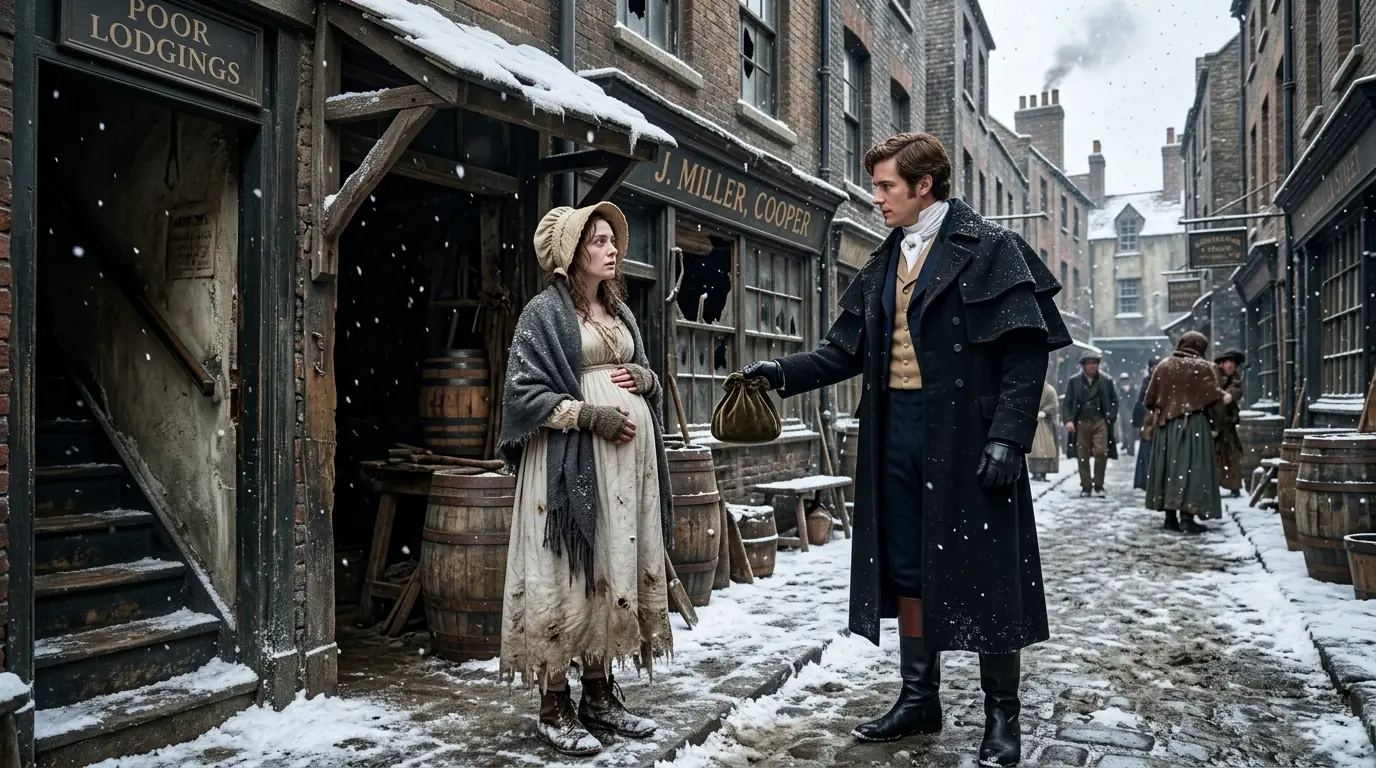
He walked with the terrifying purpose of a predator. He found Monmouth Street. He found the cooper’s shop, the sharp smell of wood shavings and tar cutting through the stench of the street. Beside it was a narrow, rotting wooden staircase leading up into the darkness. Theo didn’t hesitate.
He climbed. The stairs groaned under his weight. At the second landing, a rat scurried over his boot. He kept climbing. He reached the top floor.
There was only one door. It hung slightly off its hinges, the wood splintered. Theo stopped in front of it. His heart, dead and quiet for eight months, was hammering against his ribs with frantic, painful violence. He raised his hand.
He hesitated for a fraction of a second. What if she slammed it in his face? What if she hated him? She has every right to, he thought grimly. He knocked.
The knock echoed in the damp, freezing stairwell. It sounded too loud, too violent for the rotting wood of the door. Theo held his breath. For a long, agonizing minute, there was only silence. He raised his fist to knock again, harder this time, when he heard the faint scuff of a shoe against bare floorboards.
The door opened, not fully, just a few meager inches. Josephine stood in the crack. Up close, stripped of the market crowd, the reality of her condition hit Theo like a physical blow to the stomach. Her face, once round and full of color, was hollowed out. The cheekbones sharp beneath pale, translucent skin.
Dark, bruised circles hung heavy under her eyes. She was shivering, a violent, uncontrollable tremor that racked her entire frame. She did not look surprised to see him. She looked utterly, overwhelmingly exhausted. “Go away, Theodore,” she said.
Her voice was raspy, stripped of its usual warmth. She pushed against the door to close it. Theo reacted on pure instinct. He shoved his heavy, bespoke leather boot into the gap. The wood groaned against the leather.
“Josie, let me in.” “There is nothing for you here,” she said, leaning her weight against the door. It was a futile gesture. He was a broad-shouldered man in the prime of his life. She was a starving, pregnant woman.
But the sheer stubbornness of her effort made his chest ache. “I am not leaving this hallway until you open this door,” Theo said, his voice dropping to a low, dangerous register. “You can let me in or I can break the hinges. I do not care which.” Josephine stared at him through the gap.
Her dark eyes searched his face, looking for the anger, the coldness she had come to expect from him. But there was no coldness left. There was only a desperate, frantic terror. Slowly, she stepped back, letting the door swing open. Theo stepped over the threshold and felt his heart stop.
The room was no larger than his dressing closet at the estate. The walls were weeping with damp. There was a single, narrow bed in the corner, covered in a thin, ragged quilt. A cracked ceramic pitcher sat on a wooden crate. There was a small fireplace, but the grate was dead, filled only with a handful of cold, gray ash.
The air inside the room was colder than the street, trapping the winter chill within the brick. This was where she lived. This was where she was preparing to bring his child into the world. He turned to look at her. She stood by the window, her arms wrapped defensively around the heavy swell of her stomach.
She refused to meet his eyes. “Have you seen enough?” she asked, her voice dripping with defensive venom. “Has your curiosity been satisfied? You may return to your pristine bride now. You will want to wash your boots.”
Theo ignored the barb. He took a step toward her. “How long, Josie?” “How long what?” “How long have you lived in this squalor?” he demanded, the words tearing out of his throat.
“How long have you been starving yourself to buy bruised cabbage in the mud?” She flinched. “I am not starving. I am surviving. It is none of your concern.”
“It became my concern the moment I saw you in that square.” Theo fired back, closing the distance between them. He stopped just a foot away, towering over her. “You are pregnant.”
“Women get pregnant, Theodore. It is a biological reality. It has nothing to do with you.” “Do not lie to me.” The shout rattled the thin windowpanes.
He didn’t mean to yell, but the terror was clawing its way up his throat, choking him. “Do not stand there and tell me that child is not mine. The timeline, the last night before you left. I know it is mine, Josie. I feel it in my bones.”
Josephine lifted her chin. The defiance was back, a fragile shield over her breaking body. “The ecclesiastical court declared our marriage unconsummated. You signed the papers agreeing to that fact. Therefore, legally, this child cannot possibly be yours.”
“It is a bastard, a nobody.” The words were a direct quote. He recognized the cold, sterile phrasing of his mother’s solicitors. The realization slammed into him. “They made you say that?” Theo whispered, the anger draining away, leaving only horror.
“My mother—she threatened you?” Josie turned her face away, staring out at the gray, smog-choked sky. She didn’t speak. She didn’t have to. The rigid set of her shoulders, the way she gripped her stomach told him everything.
Theo reached out, moving slowly, deliberately. He unbuttoned his heavy wool greatcoat. He slipped it off his shoulders and stepped closer, draping the massive, fur-lined garment over her shivering frame. She stiffened, trying to pull away. “I don’t want your coat.”
“You are freezing,” he said, pulling the lapels closed around her, wrapping her in his warmth, his scent. “You are freezing, and you are exhausted, and you are going to put this coat on before I tear this building down with my bare hands.” For a moment, she fought him. Her hands pushed against his chest, but the heavy wool was too warm, and the cold had settled too deep into her bones. Her resistance crumbled.
She slumped forward slightly, the fight draining out of her. “Why are you here, Theo?” she whispered, her voice cracking. “You let me go. You didn’t even fight for me.” The accusation hit him perfectly square in the chest.