The door of the ’58 Ford F-100 groaned like an old man rising from a comfortable chair. Jedediah Harlan knew that sound better than his own heartbeat. The faded seafoam-green paint was worn through to the primer on the hood and fenders, polished smooth not by wax but by decades of sun, rain, and wind. He slammed it shut, the solid thud echoing in the cavernous quiet of the brand-new Miller and Sons John Deere dealership parking lot.
The building itself was an affront to Jed’s sensibilities. It was a massive green-and-yellow steel structure that had replaced the old cramped brick building downtown just last year. It gleamed under the 1973 spring sun, its plate-glass windows reflecting the endless Iowa sky. Lined up in perfect military rows out front were the titans of the new age: 40- and 30-series tractors with their futuristic Sound-Guard cabs, massive 700-series combines that looked like they could swallow his entire eighty-acre cornfield in a single pass. They smelled of new paint, new tires, and easy credit.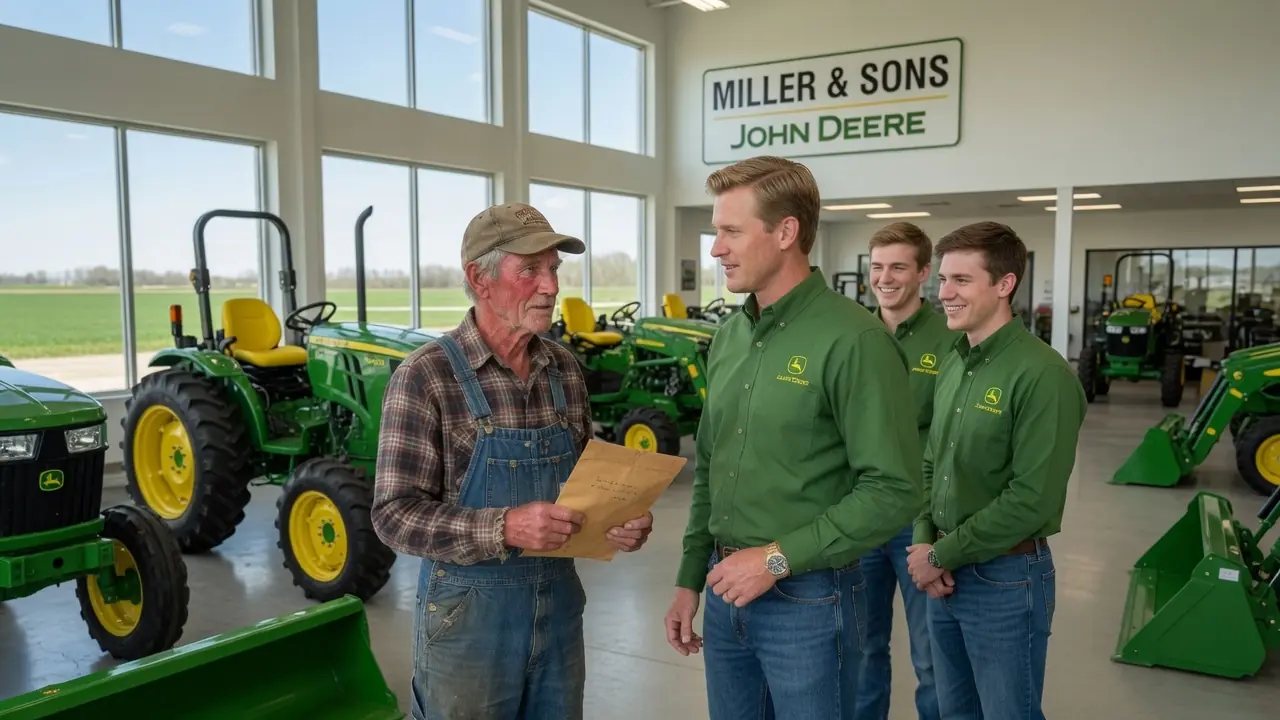
Jed’s pickup, with its one rust-rimmed wheel well and a tailgate held shut with baling wire, looked like a stray dog that had wandered into a palace.
He could feel the eyes on him before he even reached the glass door. Through the window he saw young Chad Miller and two of his salesmen, all clad in matching green shirts with the leaping deer logo over the pocket. They were leaning against a sales counter, drinking coffee from Styrofoam cups, and they weren’t even trying to hide their smirks.
Chad was the son of the original owner, a good man named Earl who had sold Jed his first two-row corn-picker parts back in the fifties. But Earl was retired now, living in Florida, and Chad ran the show. Chad had a business degree from the state university and a smile that never quite reached his eyes. He believed in leverage, expansion, and the gospel of “get big or get out.”
Jed pushed the door open. A little bell, a quaint holdover from the old shop, chimed incongruously in the vast echoing space. The smell of fresh coffee and something synthetic, like new vinyl, hit him.
“Well, well, look what the cat dragged in,” Chad said, his voice loud enough for the others to hear. He didn’t move from his spot. “Jed Harlan. Didn’t think your old Ford could make it this far out of the sticks. What’s the matter? Did the baling wire on your Farmall finally give up the ghost?”
The two salesmen chuckled. One was a kid no older than twenty. The other a man in his forties with thinning hair who should have known better.
Jed ignored the jab. His eyes scanned the showroom floor. He wasn’t looking at the tractors. He was looking at the implements. He’d spent the winter studying, reading the brochures he’d picked up at the state fair, talking to the one or two old-timers he still trusted. He knew what he wanted. He knew what they cost. And he knew what they could do that his old equipment, reliable as it was, couldn’t.
“Chad,” Jed said, his voice calm and level. It was a voice weathered by forty-five years of Iowa winters and blistering summers. A voice that didn’t waste words. “I need to look at a planter.”
Chad pushed himself off the counter, a look of theatrical surprise on his face.
“A planter, Jed? We sell planters that are wider than your barn. You’d need a real tractor to pull one, not that old 4020 you keep tinkering with. Are you sure you’re in the right place? Maybe the antique museum is what you’re looking for?”
More laughter.
Jed felt a familiar slow burn in his gut, but his face remained a mask of placid determination. He’d been underestimated his whole life. He was a small man, wiry and tough like a fence post, with hands that were more callus than skin. He wore faded denim overalls over a clean but frayed flannel shirt. To men like Chad, he looked like a relic, a failure, a man the modern world was leaving behind.
“I’m looking at the 7000 series,” Jed stated, walking past them toward the implement section. “The six-row narrow. And the 2500 moldboard plow, the five-bottom with the spring reset.”
Chad’s smirk faltered for a fraction of a second. Those were top-of-the-line items, the best, the most expensive. He quickly recovered, following Jed with the salesmen trailing behind like pilot fish.
“That’s a lot of iron, Jed,” Chad said, his tone shifting from mockery to a kind of condescending sales patter. “That’s a serious setup for a serious operation. We can get you set up with a financing plan. With corn prices like they are, the bank is handing out money. We could get you into a new 4430 and the whole package for a very reasonable payment.”
“Don’t need a tractor,” Jed said quietly, his attention focused on the machine. “The 4020 will handle it.”
The younger salesman couldn’t help himself. He snorted.
“That old thing? It doesn’t even have a cab. The hydraulics on that will scream bloody murder trying to lift this thing.”
Jed finally turned his head and looked at the three of them. His eyes were pale blue, the color of a winter sky, and they held a weight that made the young salesman take an involuntary step back.
“My 4020 was born in ’68, son. I rebuilt the engine myself two winters ago. New sleeves, pistons, bearings. I lapped the head and set the injector-pump timing to factory spec. Her hydraulics are just fine because I change the fluid and filters every spring, not just when something breaks. She’ll lift it.”
He turned back to Chad.
“There’s one more thing. You got a 24T baler in stock?”
Chad was baffled now. The 24T was a legend, but it was an old design. Simple, reliable, but small. It was the kind of baler guys were trading in, not buying new.
“A 24T? Yeah, I think we have one crated up out in the warehouse. Most guys are going for the bigger 336 now.”
“I want the 24T,” Jed said. “So the six-row 7000 planter, the five-bottom 2500 plow, and the 24T baler. What’s the cash price for all three? Out the door.”
The word “cash” hung in the air like a stunned bird.
Chad’s salesman mask slipped completely. He looked at Jed’s worn overalls, his scuffed work boots, the grease permanently etched into the lines of his knuckles. He looked back at the rusty Ford pickup in the lot. The idea of this man having the cash for one of these machines, let alone all three, was laughable.
“Cash?” Chad repeated, a genuine mocking laugh escaping his lips this time. “Jed, you’re talking about nearly fifteen thousand dollars’ worth of equipment. That’s more than your whole farm is worth on the tax books.”
Jed didn’t flinch. He just stood there waiting.
The silence stretched. The confident smirks on the salesmen’s faces returned, sure that this was the punchline to a long, strange joke.
Jed reached into the front pocket of his overalls and pulled out a thick, rumpled envelope from the Farmer’s Trust and Savings Bank. He worked his thumb under the flap and tipped it. Out onto the polished concrete floor with a soft shuffling sound tumbled bundle after bundle of hundred-dollar bills, each held together by a paper band from the bank.
The sound of their laughter died in their throats, replaced by a collective sharp intake of breath.
Jed looked down at the pile of money, then back up at Chad, his pale blue eyes holding no hint of triumph or arrogance, just a quiet, unshakable certainty.
“You were saying?”
The trip home was a slow, careful procession. Jed drove the old Ford, its V8 engine rumbling contentedly. Behind him, the young salesman who had laughed the loudest was driving Jed’s pride and joy, the ’68 John Deere 4020. And behind the 4020, hitched one behind the other like a circus train, were the new plow and the new planter. The baler would be delivered the next day.
The young man’s face was a mixture of confusion and sullen respect. He had watched dumbfounded as Jed counted out the cash while Chad Miller, his face pale, had written up the invoice, his hand shaking slightly. The dealership owner had insisted on delivering the equipment, a desperate attempt to salvage some professional dignity. Jed had simply nodded and said, “Fine, but I’m driving my tractor home. Have your boy follow me.”
Pulling into his own lane was like crossing into another world. The gravel crunched under the tires, a familiar and comforting sound. The lane was lined with ancient oak trees planted by his grandfather. His house was a simple white two-story farmhouse, tidy and well-kept. The barns were painted a traditional red with white trim, their roofs straight and sound. Nothing was shiny or new, but everything was cared for. It was a farm built on sweat, not credit.
The young salesman unhitched the implements in the farmyard, the clank of steel echoing in the quiet afternoon. He wouldn’t meet Jed’s eye.
“I’ll have the baler out to you tomorrow morning,” he mumbled, climbing into the dealership pickup he’d followed them in.
“Appreciate it,” Jed said, and that was all.
He watched the truck disappear down the lane, kicking up a cloud of dust. He was alone now with his old tractor and his new iron.
He walked a slow circle around the planter first. It was a beautiful piece of engineering. He knelt, examining the parallel linkages that allowed each row unit to float independently, ensuring consistent seed depth over uneven ground. His old four-row International planter was a rigid beast. If one row went over a rock, the other three lifted out of the ground. This new design would mean a more uniform stand of corn, and a uniform stand meant a better yield. He saw the finger-pickup seed meters, a revolutionary concept that promised one seed at a time. No doubles, no skips. That alone was worth a fortune in saved seed and increased population.
Next, the plow—a five-bottom 2500. It was a monster. He ran his hand over the thick main beam. The genius was in the spring-reset mechanism on each shank. His old plow had simple shear bolts. Hit a big rock and bang, the bolt would snap. You’d have to stop, get out the wrenches, find the spare bolt, and wrestle the heavy shank back into position, all while wasting precious daylight. With this new plow, if a bottom hit a rock, the spring would allow it to trip back and up, clearing the obstacle, and then automatically reset itself. He could plow right through the rock-strewn south forty without stopping once.
He backed the 4020 up to the plow first. The three-point hitch arms of the tractor looked dwarfed by the massive headstock of the plow. This was the first test. Chad and his boys thought his old tractor couldn’t handle it.
Jed climbed into the worn seat, the cracked vinyl familiar beneath him. He pushed the throttle forward and the six-cylinder diesel engine settled into a deep, throaty rumble. It was a sound of pure, unadulterated power. He eased the rock-shaft lever back. The hydraulic pump whined, the pitch changing as it took the strain. For a moment, the front wheels of the 4020 seemed to get light. Then, with a groan of protesting steel, the massive plow lifted smoothly off the ground.
Jed smiled. He knew his machine.
But it wasn’t perfect.
The planter used the newer universal quick-hitch system, and his 4020 had the older-style three-point. They wouldn’t connect. A man like Chad Miller would have told him he needed a new tractor. A man like Jed Harlan saw it as a problem to be solved with steel and a welder.
He spent the rest of the afternoon in his workshop. It was a place of organized chaos, where every tool had a home worn from years of use. The air smelled of cold steel, cutting oil, and the faint sharp scent of the arc welder. He took measurements, drew a rough sketch on a dusty workbench with a piece of chalk, and fired up the cutting torch. The hiss and pop of the flame filled the shed as he cut thick plates of half-inch steel. He ground the edges smooth, the shower of sparks illuminating the focused intensity on his face. He tacked the pieces together, checked the fit, then laid down thick, clean beads with his old Lincoln arc welder. The bright actinic light of the arc was the only thing in the world for those moments, a miniature sun under his control.
He was building an adapter, a bridge between the old and the new.
By the time the sun was setting, casting long shadows across the yard, he was bolting his homemade, freshly painted John Deere-green adapter onto the planter. He backed the 4020 up again, and this time the hitch arms slid into place and the pins dropped home with a satisfying click. He lifted it. The old tractor grunted, but it held the weight.
That night, the talk at the coffee shop in town was all about Jed Harlan. Chad Miller, his pride wounded, was holding court.
“Craziest thing I’ve ever seen,” he told the assembled farmers who were nursing their coffees after a long day in the field. “Old man Harlan comes in looking like he just crawled out from under a rock and peels off fifteen grand in cash. Cash. For equipment his tractor can barely lift, let alone pull.”
A farmer named Bill Henderson, who had just traded for a new 4630 on a five-year note, shook his head.
“He’s a fool. Why not use that money as a down payment? He could have leveraged that into a whole new line of equipment, a new tractor, a bigger planter. He could double his acreage.”
“Exactly,” Chad exclaimed, slapping the counter. “That’s what I told him. The banks are begging to lend us money. Land is cheap. Corn is four dollars a bushel. This is the time to expand, to modernize. But he’s stuck in the past. Putting that precision planter behind that open-station relic. It’s like putting airplane wings on a donkey. The power just ain’t there.”
The men laughed and nodded in agreement. They were all riding the same wave. The 1970s were a boom time for American agriculture. After the great grain robbery of 1972, when the Soviet Union bought massive quantities of American grain, prices shot to the moon and stayed there. Secretary of Agriculture Earl Butz was telling them to plant fence row to fence row. The message from the banks, the government, and the equipment dealers was unanimous: Borrow. Expand. Produce. Debt was not a liability. It was a tool, a sign of ambition.
Jed Harlan, in their eyes, had no ambition. He was content with his three hundred acres, land his father had paid off during the Depression by being just as frugal. They saw his cash purchase not as a sign of discipline, but as a sign of fear. He was a man too scared to take a risk, a man who would be left in the dust.
The story of him welding a homemade adapter was the final proof. He was a tinkerer, a shade-tree mechanic, playing with new toys he didn’t understand while they were businessmen managing assets and cash flow.
They laughed at him, but underneath the laughter was a nervous energy. Jed’s quiet, debt-free existence was a silent rebuke to the path they had all chosen, and it made them uncomfortable.
The next few years seemed to prove Chad Miller and the others right. The boom roared on. Inflation was high, but land values and commodity prices were rising even faster. Every farmer who had borrowed heavily in ’73 saw his net worth explode on paper. Bill Henderson bought another quarter section of land in ’75, the price per acre double what it had been five years earlier, but the bank didn’t hesitate to give him the loan. He tore out the old farmhouse and bulldozed the windbreak to make one giant, efficient field.
Chad Miller’s dealership became a regional powerhouse. He sold dozens of the new 8000-series four-wheel-drive tractors, machines that cost more than Jed’s entire farm. He drove a new Lincoln Continental every year and built a sprawling ranch-style house on a hill overlooking the town. When he saw Jed at the grain elevator, he’d greet him with a pitying smile.
“Still running that old 4020, Jed?” he’d ask loud enough for others to hear. “I’ve got a 4440 on the lot with your name on it. Air conditioning, a tape deck. You owe it to yourself to farm in comfort.”
Jed would just nod.
“The 4020 is doing just fine, Chad. No payments.”
And it was true. The new plow allowed him to get his fall tillage done in half the time, saving fuel and wear on the engine. The planter was a marvel. His corn emerged in perfect picket-fence rows, every plant the same height, all competing equally for sun and water. His yields climbed by twenty bushels an acre, then thirty. The 24T baler was slow, but it made tight, dense bales of hay and straw that were easy to handle and stacked perfectly in the barn.
While his neighbors were spending their windfall profits on new pickups, bigger tractors, and family vacations to Disney World, Jed was reinvesting in his farm—but in his own way. He used the extra income to systematically improve his land. He laid thousands of feet of drainage tile in the low spots, paying a local contractor in cash. He built new fences, solid and straight, with osage-orange posts that would outlast him. He poured a concrete floor in his machine shed and wired it with proper lighting, creating a workshop that was the envy of many, though few would admit it.
He paid off the last small mortgage on his farm in the fall of 1976. He drove to the bank, handed the teller the final payment, and walked out with the deed in his hand. There was no celebration, no fanfare. He just went home, put the document in the old safe behind his father’s desk, and went out to grease the combine for the soybean harvest.
To the outside world, nothing had changed. He still drove the ’58 Ford. He still wore faded overalls. He still farmed with a fifteen-year-old tractor. He was, by the standards of the late 1970s, a man standing still, a failure in a world that only rewarded forward motion.
But Jed saw things differently. He saw the rising interest rates in the financial pages of the Wall Street Journal he read every week. He listened to the old men at the feed store who remembered the 1920s, how a boom just like this one had ended in a catastrophic bust. He saw the frantic look in the eyes of some of his neighbors—men who were farming a thousand acres but couldn’t sleep at night, their fortunes tied to the whims of the markets and the mood of their loan officer.
One crisp autumn evening in 1979, Jed stood at the edge of his machine shed. The harvest was done. His corn cribs were full, the golden ears piled high. His bins were full of soybeans. All of it was his. Not his and the bank’s. His.
The 4020 was parked inside, its engine ticking as it cooled. The new planter and plow were cleaned, greased, and stored for the winter, still looking almost new. He looked out across his fields, dark and resting under a blanket of chopped stalks. A cold front was moving in. The wind had a sharp, biting edge to it, carrying the scent of snow and change. In the distance he could see the yard lights of Bill Henderson’s massive farmstead, a brilliant island of light in the sea of darkness. It looked prosperous, powerful.
But Jed knew Bill had just bought another new, bigger combine, and the interest rate on the loan was a staggering fourteen percent.
He felt a deep, unsettling chill that had nothing to do with the wind. The party had been going on for almost a decade, and the music was louder than ever. But Jed could hear something else—a low, discordant note beneath the celebration. He felt like a man standing on a beach, watching his neighbors build beautiful sand castles ever closer to the water, laughing at him for building his small stone hut high up on the rocks. They couldn’t see it yet, but he could. The tide was turning, and the storm that was coming was going to wash everything away.
The first sign of trouble arrived not as a clap of thunder, but as a whisper on the radio.
It was the summer of 1980. Jed was in the cab of his old Chevy C60 grain truck, waiting in a long, slow line at the co-op elevator when the news came on. President Carter, in response to the Soviet invasion of Afghanistan, had announced a grain embargo.
The man in the truck ahead of Jed slammed his fist against his steering wheel. The sound a dull thud in the humid air.
The market, which had been the foundation of their prosperity, had just been kicked out from under them.
That summer, the sky turned against them, too. The rains stopped in June. By July, the corn leaves were curling up during the day, a thirsty, desperate gesture. The heat was a physical weight shimmering off the fields and the asphalt. Jed watched his neighbors’ massive four-wheel-drive tractors pulling equally massive field cultivators, trying to conserve what little moisture was left in the ground. The dust they raised was biblical, a brown haze that hung over the county for weeks.
Jed’s corn suffered like everyone else’s, but his deep, well-tilled soil, enriched by years of manure from his small herd of cattle, held the moisture better. His yields would be down, but he would have a crop.
The real crisis was playing out in the machine sheds and farmhouses of men like Bill Henderson.
One sweltering August afternoon, Jed was cultivating his soybeans with the 4020—the open station allowing him to feel the breeze he was making—when he saw Bill’s new combine, a John Deere 7720, stopped dead in the middle of a field. It was a magnificent machine with an air-conditioned cab and a price tag that could have bought Jed’s entire farm twice over.
Bill climbed down, a frantic figure in the heat, and stared up at the silent engine.
Jed finished his row and drove over.
Bill was on his CB radio, his voice tight with panic.
“I’m telling you, Chad, it’s the sensor on the main hydrostat. The whole damn dashboard is dead. I’ve got a hundred and sixty acres of beans to cut before they shatter, and this thing is a twenty-ton paperweight.”
There was a crackle from the radio. Chad Miller’s voice sounded strained, a world away from the confident salesman of years past.
“I’m telling you, Bill, the part is on back order. The whole system is electronic. There’s a circuit board in there, and they’re having trouble with them. It could be two weeks.”
“Two weeks?” Bill’s voice cracked. “In two weeks my beans will be on the ground. I’ve got a payment on this thing due next month that would choke a horse.”
Jed listened, saying nothing. He knew the guts of his own combine, an older John Deere 95. It was a machine of belts, chains, and bearings. If it broke, he could fix it with a wrench and a welder. Bill’s new machine was a marvel of productivity when it ran. But when it broke, it was a hostage to a supply chain and a specialized knowledge he didn’t possess.
Bill ended up hiring a custom cutter at a ruinous price to save what he could of his crop. The brand-new combine sat in the field like a monument to progress—silent and useless.
A few weeks later, Jed needed a hydraulic filter. He drove the old Ford pickup to the dealership. The place felt different. The rows of new equipment gleamed just as brightly, but now they seemed menacing—a vast inventory of unsellable, depreciating assets.
Inside, the air was thick with tension. Two farmers were arguing with Chad in his glass-walled office. The young salesman who had once mocked Jed was sitting at his desk, staring blankly at a pile of paperwork, his face pale.
Chad saw Jed and came out, forcing a smile that was more of a grimace.
“Jed. What can I do for you?”
“Just need a filter for the 4020,” Jed said.
“Sure, sure,” Chad said, waving the parts man over. He looked tired, the skin around his eyes puffy. “Heard you got your beans out.”
“Got them out,” Jed confirmed.
“That’s good. That’s good,” Chad said, his eyes darting around the empty showroom. “Some guys are having a tough time. Weather, the embargo… and these interest rates are just… they’re just killing us.”
The prime interest rate, the number that governed all their operating loans, had been creeping up for months. Now it was a monster devouring equity, erasing profits, and turning the tool of debt into a weapon of self-destruction. Chad’s empire, built on the assumption of cheap money and endless growth, was beginning to crack. The farmers he had encouraged to get big or get out were now trapped. Their cash flow choked off, their assets depreciating, their debt multiplying with every tick of the clock.
Jed paid for his filter with a twenty-dollar bill, got his change, and walked out into the sunlight, feeling a profound sense of sorrow. The laughter had stopped. The reckoning had begun.
By the winter of 1981, the whispers of trouble had become a roar. The Federal Reserve, in a desperate war against inflation, had pushed interest rates to an unthinkable twenty-one percent. It was a death sentence for the leveraged farmer. Operating loans became impossible to service. Land values, which had been the collateral for a decade of expansion, collapsed. Men who were millionaires on paper in 1979 found themselves insolvent in 1982.
The coffee-shop talk was no longer about yields and new tractors. It was about auctions and foreclosures. The names were of friends and neighbors—good men who had worked hard and played by the new rules, only to have the rules change on them overnight. The green-and-white signs started appearing on fence posts. Stark announcements of a family’s ruin, tacked up by the very banks that had so eagerly loaned them the money.
Bill Henderson was one of the first to go under. His auction was on a cold, blustery Saturday in March. The entire community was there, not out of morbid curiosity, but out of a shared sense of dread and a need to bear witness. The auctioneer’s rhythmic chant echoed across the yard, a somber litany of a life’s work being sold off piece by piece.
Jed stood at the back of the crowd, his hands in his pockets, his face grim. He watched as Bill’s equipment, much of it less than five years old, was sold for pennies on the dollar. The magnificent 7720 combine, the one that had sat broken in the field, went for less than half of what Bill still owed on it. He saw Bill’s wife trying to comfort their teenage daughter, who was crying silently, her face buried in her mother’s coat. Bill himself stood by the machine shed, his shoulders slumped, his face a gray mask of shock and shame. He looked like a man who had been in a terrible accident and was still trying to understand what had happened.
The final, most brutal part of the auction was the land itself. The quarter section Bill had bought in ’75, the one he had paid top dollar for, was sold back to the bank for a fraction of its former value. The dream of expansion, of getting big, had ended here in a muddy farmyard, with the cold wind whipping the auctioneer’s words away.
Chad Miller’s downfall was slower, but just as complete. His dealership, once a bustling hub of commerce, became a ghost town. The unsold inventory was a millstone around his neck, financed at the same ruinous interest rates that were bankrupting his customers. The bank that had financed his grand expansion called his note.
One morning, the town awoke to see a large sign posted in front of the massive steel building: Property of Farmer’s Trust and Savings Bank. No Trespassing.
Chad lost it all—the business, the new Lincoln, the sprawling house on the hill.
Jed saw him a few months later gassing up a rusty ten-year-old sedan at the town service station. He had lost weight, and his hair was threaded with gray. He looked older, smaller, a man hollowed out by failure. He saw Jed, and for a moment his eyes filled with the old resentment, but it was quickly replaced by a profound weariness.
He gave a short, bitter nod and drove away.
Through it all, Jed endured. His lack of debt was his shield. The low commodity prices hurt, but they didn’t break him. He didn’t need to earn enough to satisfy a loan officer. He only needed to earn enough to feed his family and buy fuel and seed for the next year. His old skills, once seen as quaint, were now the tools of survival. When a bearing went out on his corn picker, he didn’t call a dealer. He pressed a new one in himself using the old hydraulic press in his shop. When the engine on the Ford pickup started to burn oil, he pulled it, honed the cylinders, and put in new rings and bearings.
Over a long winter weekend, his farm became an island of stability in a sea of chaos. He had corn in his cribs and beans in his bins, all owned free and clear. He could afford to wait for the price to inch up a few cents before selling, a luxury his debt-ridden neighbors didn’t have. He wasn’t getting rich, but he was holding on. He was solvent. In the farm crisis of the 1980s, that was the only victory that mattered.
He had built his house upon the rock, and while the rains descended, and the floods came, and the winds blew and beat upon that house, it did not fall.
The auction for the contents of Miller and Sons was held on a gray day in the spring of 1984. The cavernous showroom of the dealership was filled with bidders, mostly other dealers and liquidators from out of state, vultures picking at the carcass of a failed business. The rows of brand-new tractors and combines were gone, repossessed by John Deere. What remained were the tools, the parts inventory, and the office furniture.
Jed was there, standing quietly near the back. He wasn’t interested in the shelves of new parts or the fancy desks. He waited patiently.
Late in the afternoon, the auctioneer moved to a dusty pile of items that had been brought over from the old downtown building when Chad had built his new palace. It was a collection of relics: an old anvil, a forge, a heavy-duty drill press, and a massive fifty-ton hydraulic press. Its frame was made of thick I-beams. Its paint was faded and chipped. It was the press that Chad’s father, Earl, had used for decades to straighten bent axles and press in stubborn bearings. Jed had seen him use it a hundred times.
The auctioneer started the bidding.
“All right, folks. What am I bid for this old press? Heavy as sin, but they don’t make ’em like this anymore. Who’ll give me fifty?”
A scrap dealer raised his hand.
“Fifty? I got fifty. Who’ll give seventy-five?”
Jed raised his hand.
“A hundred.”
The scrap dealer went to a hundred and fifty. Jed went to two hundred. They went back and forth, the scrap dealer shaking his head in disbelief that anyone would want the old relic for anything other than its weight in steel.
Finally, at three hundred and fifty dollars, the scrap dealer dropped out.
“Sold!” the auctioneer cried, pointing at Jed, the man in the overalls.
Jed paid the clerk in cash and arranged for a neighbor with a rollback truck to help him move it the next day.
As he was leaving, he saw Chad Miller standing by the service-bay doors, watching the dismemberment of his life’s work. He looked like a ghost at his own funeral.
Jed walked over.
“Chad,” he said, his voice quiet.
Chad turned, his eyes hollow.
“Come to gloat, Jed? Come to see the man who laughed at your old tractor get what he deserved?”
“No,” Jed said simply. “I came to buy your father’s press.”
Chad looked at him, confusion warring with bitterness in his eyes.
“My father’s press? Why in God’s name would you want that old thing?”
“Because it’s a good tool,” Jed said. “It was built to last. It was paid for a long time ago. Your father built his whole business with tools like that. Honest tools. He never tried to be bigger than he was. He was a good mechanic who sold good equipment to his neighbors. That was enough for him.”
The words hung in the air between them. They weren’t an accusation, just a statement of fact, but they landed with the weight of a judgment.
Chad’s face crumpled. The bravado, the arrogance, the bitterness—it all fell away, leaving behind a broken man.
“He told me not to,” Chad whispered, his voice thick with emotion. “When the banker came around in ’72 with the plans for this place, my dad told me not to do it. He said, ‘Son, you don’t build a business on borrowed money. You build it on a good name and a handshake.’ I thought he was an old fool. I thought he didn’t understand the new way of doing things.”
He let out a dry, ragged sob.
“God, he was right. He was right about everything.”
Jed stood there for a long moment. Then he reached into his pocket and pulled out his worn leather wallet. He took out two hundred-dollar bills and held them out to Chad.
“What’s this for?” Chad asked, his voice choked.
“For the press?” Jed said. “The auction money goes to the bank. This is for you.”
Chad stared at the money, then at Jed’s weathered face. He shook his head.
“I can’t take your money, Jed.”
“It’s not a handout,” Jed said, his voice firm but not unkind. “It’s a down payment. You’re going to help me set up that press in my shop. It’s a two-man job. After that, I’ve got a stack of cultivator shanks that need straightening. I’ll pay you a fair wage. It’s honest work, Chad.”
Tears welled in Chad Miller’s eyes. For the first time in years, someone was looking at him not as a failure, not as a fool, but as a man who still had skills, who could still do honest work.
He slowly reached out and took the money.
“Thank you, Jed,” he whispered. “Thank you.”
The years that followed were quiet and healing. The farm crisis slowly loosened its grip on the heartland. Prices stabilized. Interest rates fell. The land began to breathe again. Many farms were gone forever, consolidated into larger corporate operations. But a core of survivors remained—men like Jed, who had weathered the storm through caution and skill.
The community’s perspective had shifted. The laughter was long gone, replaced by a deep, quiet respect. Jed’s frugality was no longer seen as a lack of ambition, but as wisdom. His old, well-maintained equipment was no longer a sign of being behind the times, but a symbol of independence.
Younger farmers, starting out on the wreckage of their fathers’ dreams, would stop by his workshop. They didn’t ask for financial advice. They came to learn how to weld a clean bead, how to time a diesel engine, how to make a necessary part instead of buying it. Jed never lectured. He just showed them, sharing the knowledge that had been passed down to him—the gospel of self-reliance.
By 1989, Jed was nearing seventy, but he was still as wiry and tough as an old fence post. His grandson David was sixteen, with his grandfather’s pale blue eyes and a boundless curiosity for the machinery that was his heritage.
One Saturday afternoon they were in the workshop giving the 4020 its annual tune-up. The big hydraulic press—Earl Miller’s old press—stood against one wall, its metal gleaming with use.
“Grandpa,” David said, wiping grease from his hands with a rag. “I saw the new John Deere tractors at the state fair—the 8000 series. They’ve got computers in them, full power-shift transmissions, GPS. They’re amazing.”
Jed finished tightening an injector line and looked at the boy. He saw the gleam in his eye, the same gleam that had been in the eyes of a generation of farmers who had believed technology and credit were the keys to the kingdom.
He walked over to the tractor and laid a hand on the warm green hood of the 4020. The paint was faded, worn thin on the edges from twenty years of work, but the steel beneath was sound.
“It is amazing what they can do now,” Jed said, his voice a low rumble. “But you have to understand something, David. There’s a difference between a tool and a master. This tractor,” he patted the fender, “is a tool. We own it. It does what we ask, and when it breaks, we fix it. It doesn’t ask for a payment every month. It doesn’t own a piece of our crop before it’s even planted. Those new machines—they’re wonderful tools, but they can become your master real quick. The minute you sign that bank note, the machine owns you. It tells you how many acres you have to plant, what price you have to get, how many hours you have to work just to feed it. And if you have one bad year—one drought, one embargo—the master can take everything.”
He looked out the big open door of the machine shed across the fields that his father had paid for with cash in 1938, that he had protected with that same discipline. The land was green and vibrant, resting, waiting for spring.
“This land,” he said, his voice softening. “This farm. It’s not about getting big. It’s about staying. It’s about passing something whole and healthy to the next person in line—your father, and someday you. Never borrow money for something that rusts, rots, or depreciates. You build your foundation on the land, not on the equipment. The land is patient. It’ll be here long after all this iron has turned to dust.”
David looked from his grandfather’s earnest face to the old tractor, and for the first time he didn’t just see an obsolete machine. He saw a symbol of freedom. He saw the wisdom in the faded paint and the simple, rugged design. He saw the story of survival, of a quiet, unshakable faith in a different way of farming, a different way of living.
Jed smiled—a rare, full smile that lit up his weathered face.
“Now hand me that 9/16 wrench. Let’s finish this up. We’ve got fences to check before sundown.”