"Don't move. Follow me. " The boy's voice was barely louder than a whisper, but something in it made Richard Callaway stop in the middle of his own driveway. He had been walking toward the silver town car waiting at the gate, briefcase in one hand, phone in the other. His mind already 3 hours ahead in a boardroom across the city.
Now he was standing perfectly still on the polished stone path, looking down at a small boy in a faded blue shirt who had appeared from behind the rose hedges like he had been waiting there for hours. "What did you say? " Richard asked. He recognized the boy, or at least he thought he did. The housekeeper's son, maybe 10 years old.
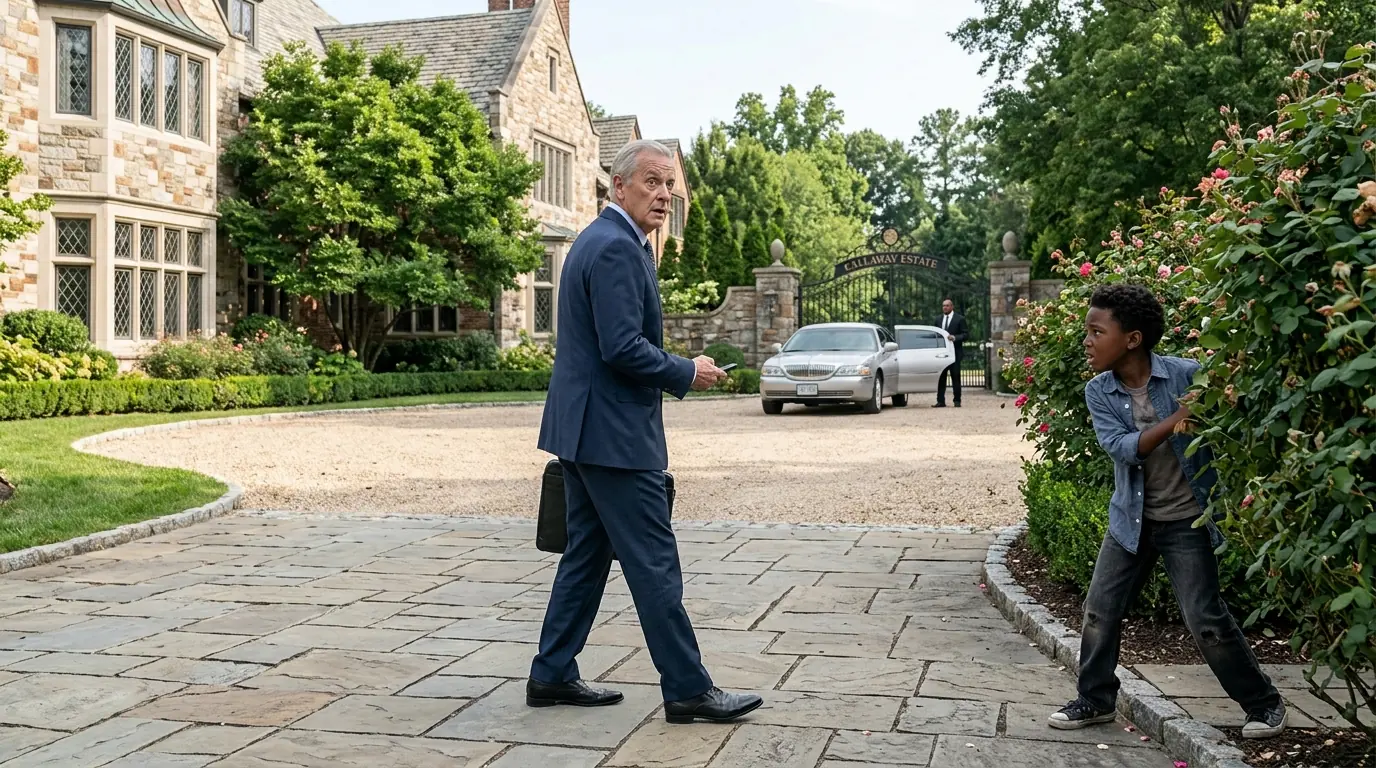
He had seen him a few times helping his mother carry laundry baskets across the back lawn, but he could not remember ever speaking to him directly. "Don't move. " The boy repeated, even quieter this time. "Please, sir, follow me. Don't let the man at the gate see you.
" Richard glanced toward the gate. His driver was standing beside the town car, holding the rear door open, looking down at his phone. Nothing seemed wrong. Nothing seemed out of place. The morning was bright.
The sky was clean. The engine of the car was humming softly the way it always did when his driver had been waiting for more than 2 minutes. "Son, I'm late for a meeting. " Richard said, trying to keep his voice patient. "Whatever this is, can we talk about it tonight?
" The boy did not let go of his sleeve. His fingers were small, but his grip was firm, and his eyes were not the eyes of a child playing a game. They were the eyes of someone who had not slept the night before. "If you go to that car," the boy whispered, "you won't come back. I heard them say it last night in the kitchen.
Please, sir. " Richard felt something cold pass through him, but he pushed it away. He had built his entire life on logic, on numbers, on the discipline of not reacting to surprises. He was the founder of one of the largest private logistics firms on the East Coast. He did not change his schedule because a child told him to.
But something about the way the boy was holding his sleeve made him look once more at the car at the gate. And this time he looked carefully. The car was the same model, the same color, the same plate as far as he could tell from this distance. The driver was the same height, the same build, wearing the same dark jacket. Everything was as it should be, except for one thing.
His regular driver, a man named Anthony who had worked for him for almost 4 years, always wore a small silver ring on his left thumb, a gift from his late father. Anthony was not a man who took the ring off, not even when he washed dishes or worked on his car. Richard had once teased him about it at a Christmas party, and Anthony had told him the story behind it, and Richard had felt slightly embarrassed for joking. The man at the gate was not wearing a ring. "How do you know what you heard?
" Richard asked quietly, his eyes still on the driver. "How do you know it was about me? " "Because they said your name," the boy whispered. "Mr. Callaway, they said it three times, and they said your wife paid them already, half last week, half when it was done.
" Richard's chest did not move for a long moment. He felt his lungs stop and then start again slowly, the way they always did when he received very bad news in a meeting and could not let anyone see it. "Walk with me," he said quietly, "slowly, toward the side of the house. Don't run. Don't look at the gate.
" The boy nodded once and let go of his sleeve. The two of them walked together across the stone path, past the fountain that Richard had paid more for than most people pay for a car, past the marble bench where his wife sometimes drank her morning coffee, and around the corner of the house where a tall row of cypress trees blocked the view from the gate. When they were behind the trees, Richard knelt down so his eyes were level with the boy's. "What's your name? " he asked.
"Elijah, sir. " "Elijah. " Richard nodded slowly, as if locking the name into a place inside his head where important things were kept. "Tell me everything, slowly. Don't skip anything.
Start from last night. " Elijah took a deep breath. His shoulders were trembling slightly, but his voice stayed steady. "My mom was making tea in the kitchen," he said. "It was late.
I was supposed to be sleeping, but I came down because I forgot my book. " The lights in the kitchen were off, but I could hear voices on the back patio. Two people, a woman and a man. The man was not from the house. I had never heard his voice before, and the woman was Mrs.
Callaway. Richard kept his face very still. "She said," Elijah continued, "everything is ready for the morning. She said the driver had been replaced. " "She said her husband would be in the car at 8:30, and that he would not notice because he never notices anything in the morning because he is always reading his phone.
" Elijah paused, and his eyes filled with something that looked older than 10 years. "And then she said, sir, that after today she would finally be free. " Richard Callaway stayed very still behind the cypress trees, listening to his own heartbeat in his ears, and felt the entire shape of his life shifting underneath him like a floor that had just stopped being solid. For a long moment, Richard Callaway did not speak. He stayed crouched behind the cypress trees, one hand resting on the cold stone of the garden wall, the other still holding his briefcase as if it were the only thing connecting him to the world he had walked out of 3 minutes earlier.
The sound of the town car's engine drifted softly from the gate, patient, mechanical, indifferent. "Elijah," he said quietly, "do you have anything else? Anything you can show me? A note, a picture, anything? " The boy hesitated.
He looked down at his shoes for a second, then reached into the front pocket of his shirt and pulled out a small black object. It was an old phone, the kind that had been new maybe 6 years ago with a cracked screen held together by clear tape along the corner. "My mom gave me this one when she got her new one," Elijah said. "It still records sound. I was scared, so I pressed the button.
I held it near the door. " Richard took the phone carefully, the way a man might handle a piece of glass that had been pulled out of a wound. He looked at the screen. There was a single audio file saved from the night before, 11 minutes and 42 seconds long. "You recorded it," Richard said.
"I didn't know what else to do, sir. I thought if I told my mom she would say I was dreaming. I thought if I told nobody then nobody would believe me later. " Richard nodded slowly. He pressed play.
The first thing he heard was the sound of dishes settling in a sink and then almost immediately the soft sliding noise of the patio door. Then his wife's voice, calm and warm in the way she always spoke at dinner parties, saying something he could not quite make out at first. He raised the volume. "Has to look ordinary. He has to walk to the car himself.
If anything is forced, if anything looks wrong, the police will find it within a day. He has to get in willingly. " Then a man's voice, deeper, slower, careful in the way a person sounds when they are reading from a list they have memorized. "He will. 8:30 is his window.
He never varies. He walks out, he opens his email, he gets in the car. The new driver knows the route. There's a place outside Hartwick where the road bends along the reservoir. The car will stop there.
The rest happens after. " A pause. A small sound that might have been ice in a glass. "And the policy? " the man asked.
"It pays out after 7 months. " his wife answered. "Accidental death double indemnity. The lawyers have already reviewed it. There is no contest because there is no other beneficiary.
I am the only one. The house, the company shares, everything moves through the trust to me. The board cannot stop it. They tried to put protections in 2 years ago but he signed them away during the merger. " He never read the third page.
Richard closed his eyes. He remembered that day. He remembered signing a stack of documents at a hotel desk in Boston while a junior lawyer pointed at the lines. He remembered being told that the third page was administrative language, standard, nothing to worry about. He remembered feeling tired and not asking.