I was never a daughter. I was just a risk, a liability—an error margin dirtying this family’s legacy. “Clean this body up before the rug gets a blood stain.” Those were the words my biological mother spat while casually smoothing a crease on her designer Chanel dress. Down at her feet, I was slumped on the marble floor, blood leaking from the corner of my mouth because of the poisoned glass of Opus One red wine she had just forced me to drink.
My father sat there silently sipping the rest of his glass, and my brother took a half step back just so my foaming mouth wouldn’t splatter onto his expensive leather loafers. They had just killed me with their own hands simply to clear the way for a $5 billion family weapons contract. They thought a rejected daughter would die quietly like a stray dog. But they had no idea what the military had forged me into. Cold—that was the first thing: deep, bone-leaching cold pulling the heat right out of my spine.
I was lying flat on packed dirt. My stomach spasmed violently, a hard, ugly knot trying to turn itself inside out. The nausea was blinding. I didn’t thrash. I didn’t scream.
Panic is a luxury you lose on day one of basic training. Total darkness. It smelled like rotting cedar and wet mold. I was in the wine cellar, an old sublevel under the guest house that had not been used since the ’80s. I forced my right hand to move heavily, as though dragging it through wet cement.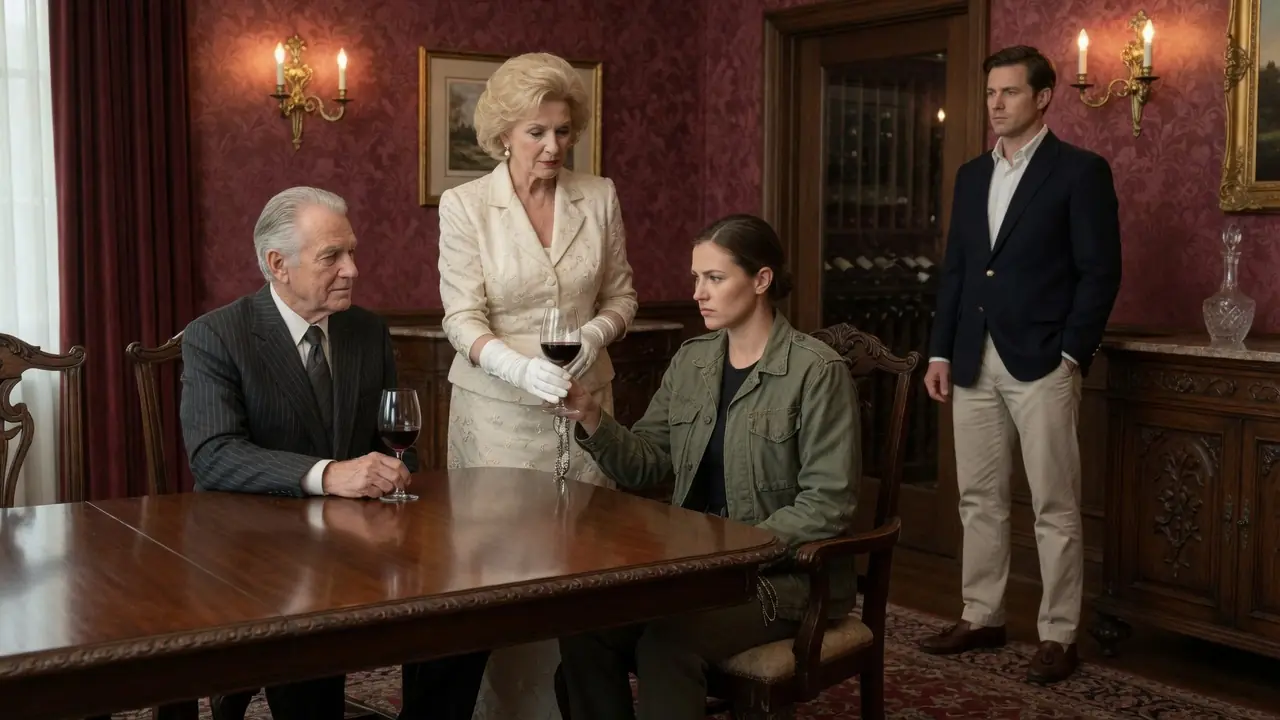
I pressed my index and middle fingers hard against my carotid artery. One, two, three. My heart rate was slow and steady, but barely detectable. My mouth tasted like battery acid and old pennies. It coated the roof of my mouth thick and bitter.
It wasn’t cyanide. Cyanide would have dropped me at the dinner table. No, this was a slow-burn synthetic—a tailored cocktail designed to mimic massive heart failure. Clean, unquestionable for the coroner. I swallowed the bile rising in my throat.
I forced my brain to boot up, shutting down the pain receptors. Breathe in, hold, breathe out, assess the perimeter. I shifted my weight, dragging my hands over my own body. The physical damage was one thing. What they did next was the real insult.
My combat jacket gone, my tactical boots stripped off. I was in bare feet on the freezing dirt. I patted my pockets. Phone, leather wallet, military ID, all gone. They didn’t just dump me, they erased me.
Stripped my identity off my back like skinning a dead animal on the side of the highway. A flash of memory cut through the pounding headache. Victoria, my mother, standing over me in the dining room. She was wearing pristine white silk gloves. I remembered the cold, detached look in her eyes as she reached down to unlace my boots while the poison paralyzed my nervous system.
In the army, getting stripped of your rank is the ultimate disgrace. A court-martial, a punishment for treason. In the Pool household, it was just standard waste disposal. Over in Kabul, men I had known for barely 3 months threw their own bodies over mine to shield me from shrapnel. Here in Atherton, California, my own mother poured venom into a $500 glass of wine and watched me choke on it.
The family dinner table was a hell of a lot more dangerous than a trench in a war zone. I rolled onto my hands and knees. The ground was freezing. I started sweeping the dirt floor in the pitch black, my bare palms brushing over loose rocks, dead spiders, and shattered glass. Then my fingers caught on something.
Thin, flat, metallic. I picked it up, running my thumb over the edge, a bobby pin. My lips pulled back in a hard, humorless smile in the dark. When they dragged my dead weight down the concrete stairs, they grabbed me by the hair. Victoria must have dropped it.
This was the absolute blind spot of the country club elite. They were so used to paying a cleaning crew to scrub their messes that they had no idea how to get their own hands dirty. They were sloppy, careless. They looked at me with such total disgust that they didn’t even bother to zip tie my wrists. They figured a dying dog wouldn’t bite back.
They miscalculated badly. I gripped the bobby pin with both hands, snapped off the plastic tip, bent the metal straight. I dragged myself toward the wall, feeling along the damp brick until my hand hit the cold steel of the heavy service door, locked from the outside. A standard pin tumbler deadbolt. I didn’t have my kit, no tension wrench, no picks, just a single piece of cheap metal and a pair of hands that used to defuse IEDs on dirt roads in the Middle East.
I slid the bent pin into the keyway, pushed it up against the top pins. Focus. Ignore the stomach cramps. Ignore the freezing cold seeping into my bare feet. Apply pressure.
Shift the angle. Click. That was pin one. Rotate the wrist. Find the binding pin.
Click. Pin two. I could feel the cylinder giving way a millimeter at a time. Sweat stung my eyes mixing with the dried blood on my face. Click.
One last push against the final tumbler. Clack. The sound was sharp and clean. The deadbolt slid back. The mechanism disengaged.
I shoved the heavy steel door outward. It groaned on rusted hinges flying open. A sharp blast of Northern California night wind slammed into my face. It was biting cold, carrying the scent of pine needles and damp asphalt. It was the smell of oxygen, the smell of staying alive.
I stepped over the threshold into the pitch black of the driveway, the gravel digging into my bare soles. The house was dead quiet behind me. They had the drop on me. They had the poison, but they didn’t pull the trigger when they had the chance. That was their death sentence.
I kept to the shadows of the Atherton tree lines, my bare feet completely numb against the freezing asphalt. The poison was still sitting heavy in my gut, fighting my metabolism, but I had adrenaline now. Cold, hard adrenaline. Half a mile down the road, sat the local country club. The parking lot was mostly empty at this hour, save for a few vehicles left overnight by members too drunk to drive.
I spotted a black SUV parked under a broken street lamp. Perfect. I picked up a jagged piece of landscaping rock. I didn’t hesitate. I drove the rock through the driver’s side window.
Glass shattered, raining down on the leather seat with a loud, messy crash. I reached through the jagged hole, popped the lock, and climbed in. I ignored the glass biting into my thighs. I ducked under the steering wheel, grabbing the cheap plastic housing of the steering column. I yanked hard.
I threw it in gear and stomped the gas. The SUV tore out of the lot tires, spitting gravel, merging onto Interstate 280. I pushed the needle to 80, 90. The freezing wind screamed through the broken window, whipping my hair across my face. Staring at the glowing dashboard, a ghost from the past slammed into me.
I was 14 again, standing in the pristine foyer of our mansion, holding a cheap plastic trophy. First place in the state science fair. My hands were stained with black machine grease from building the robotics project. Victoria had walked in smelling of expensive perfume and gin. She didn’t look at the trophy.
She looked at my hands. Her palm cracked across my jaw, a sharp, stinging slap that rattled my teeth. Look at you. She had sneered her voice dripping with disgust. You look like a mechanic.
Hide that piece of junk and get out of sight. The caterers are arriving for Harrison’s party. Harrison, my older brother, the golden boy. They threw a 100 person bash because he made the varsity lacrosse team even though he spent the entire season riding the bench. My trophy was kicked into a dark closet.
I gripped the steering wheel harder, my knuckles turning white. The speedometer crept up to 100. I blasted through a red light at an empty intersection, the red glare washing over the windshield. Red lights. Another memory hit, hitting me harder than the cold wind.
I was 15, standing on the side of a dark road in Woodside. Flashing red and blue police lights painted the trees. The stench of cheap vodka and burnt rubber filled the air. Harrison’s brand new BMW was wrapped around an oak tree. The front end was crushed like a beer can.
Harrison was puking in the bushes, too drunk to stand. My father, Richard, pulled up in his Mercedes. He didn’t ask if we were hurt. He walked straight to me, grabbed my wrist, and squeezed. I felt the bones grinding together.
You were driving. Richard hissed through his teeth. His grip tight enough to bruise bone. You tell the cops you took his keys. Harrison needs Stanford.
His record stays clean. You take the fall. I looked at my father. I looked at the weak, pathetic boy vomiting in the dirt. And I shook my head.
No. Richard’s face went dead. In that exact second, I stopped being his child. I became a liability, a piece of trash stinking up his balance sheet. I slammed the brakes as the SUV took the San Jose exit.
The heavy tires squeealled against the pavement, throwing me forward against the seat belt. 16 years old, standing in the kitchen. Harrison had stolen my history essay, submitted it as his own, and got caught. When Richard confronted him, Harrison pointed a shaking finger at me and said, "I framed him." Victoria didn’t ask for proof. She marched into the home office, rummaged through her filing cabinet, and pulled out my birth certificate.
She walked right up to my face. I could see the broken blood vessels in her eyes. She grabbed the heavy paper and ripped it right down the middle. Rip. That sound echoed over the hum of the SUV’s engine.
I wish you were never born, she had whispered. She didn’t just want me gone. She wanted to erase the fact that I had ever existed. Today down in that wine cellar, she finally tried to finish the job. I pulled the stolen SUV into the lot of a seedy motel off Monterey Road.
The neon sign buzzed. Half the letters burned out. It smelled like cheap bleach and old cigarettes. I killed the engine. The sudden silence in the car was deafening.
I leaned my head against the cold leather of the steering wheel. One last memory bubbled up, cutting through the anger. The night they threw me out. 16 years old, carrying a single duffel bag, walking out the heavy iron gates into the freezing winter air. Mrs. Higgins, our old housekeeper, had chased after me.
Her knees were bad, her breath fogging in the cold. She grabbed my arm. Her hands were wrinkled rough from years of scrubbing the Pool family’s floors. She shoved a wad of crumpled $1 bills and a foil wrapped bread roll deep into my coat pocket. She didn’t say a word.
She just squeezed my hand. It was the only actual warmth I’d felt in 16 years of living in that mausoleum. I lifted my head off the wheel. The blood on my chin had dried into a stiff, itchy crust. I wiped my mouth with the back of my hand, smearing the dark red stain across my knuckles.
I reached into the center console, ignoring the stolen loose change, and grabbed the keys. Family was a myth. Blood was a scam, but loyalty. That was something you earned in the mud. I stepped out of the car, the freezing concrete biting into my bare feet, and walked toward the pay phone glowing at the edge of the lot.
It was time to call the only real family I had left. The poison was fighting me. My vision blurred around the edges, a heavy gray fog threatening to drag me back into the dark. I pushed through the door of room 12. The air inside the cheap motel room was thick, reeking of stale cigarette smoke and industrial pine cleaner.
I did not bother turning on the lights. I stumbled straight into the cramped bathroom, dropping to my knees. The floor tiles were cracked, sucking the remaining heat right out of my bare feet. I gripped the edges of the yellowed porcelain bowl. The metal bolts anchoring it to the floor were rusted brown.
I leaned over, shoved two fingers deep down my throat, and pressed hard against the base of my tongue. My stomach violently rebelled. The contraction of my abdominal muscles felt like a serrated blade twisting under my ribs. I gagged, forcing the rest of the poisoned Opus One back up. It burned like battery acid coming out, splashing violently against the ceramic.
I stayed hovered over the bowl, coughing until my lungs burned and nothing but empty, dry heaves racked my chest. I spat a thick wad of bitter saliva. Flushed, watched the dark toxic water swirl down the drain. I slumped back against the peeling floral wallpaper, my chest heaving. I dragged the back of my hand across my mouth, wiping away a smear of bile and blood.
The harsh smell of bleach in this cheap bathroom dragged me backward. 10 years backward, 16 years old, Los Angeles. I was pushing a filthy mop across the floor of a Chevron gas station bathroom off Interstate 5. My ribs were pressing sharply against my skin. I had not eaten a real meal in 3 days. I was surviving on half-eaten stale hot dog buns I dug out of the dumpster out back.
I remembered walking out to the cash register to ring out the mop head. The overhead TV was playing the local evening news. There was Victoria, my mother. She was wearing a custom silk gown that cost more than that gas station gross in a year. She stood on a brightly lit stage bathed in camera flashes, handing a giant oversized check to a charity director.
The bright graphic at the bottom of the screen read, "Pool Defense CEO’s wife pledges $2 million to homeless youth." I stood there gripping a wooden mop handle coated in strangers’ grime, watching my own mother smile for the press. Her bleached teeth gleamed. Her botoxed forehead was flawless. She had thrown her actual daughter onto the street to freeze in the winter, but she was perfectly happy to buy the public title of a savior.
The hypocrisy was a physical weight. It crushed the breath right out of my lungs. That was the exact moment the last fragile piece of the scared little girl inside me died. I did not cry. Crying was a useless bodily function.
Instead, I found a military recruiting office. I traded the garbage cans for a uniform. I remembered the freezing red clay of Fort Jackson during basic training. A drill sergeant with a vein bulging in his neck kicked my boots out from under me. I hit the ground hard.
My lips split. Blood filled my mouth. He shoved my face into the freezing mud, screaming in my ear, telling me I was nothing. A maggot. a waste of space. Other recruits broke.
They sobbed. They quit. I just stared back at him. I wanted to laugh. He thought he was being cruel.
He was an amateur. He had never sat across a dining table from Richard Pool. When my face was shoved into the mud, I did not feel the dirt. I felt the sterile temperature controlled water of the Pool family swimming pool. I felt the heavy suffocating weight of my family’s disgust.
The military did not break me. You cannot break something that has already been smashed to dust by its own bloodline. The army just took the shattered pieces of Elsie Pool and threw them into a furnace. They burned away the desperate need for a mother’s approval. They hammered the remaining iron into a weapon.
A tactical intelligence asset. I pulled myself off the bathroom floor. The cold air raised goosebumps on my arms. I walked over to the cheap laminate dresser in the main room. Sitting on top was a plastic prepaid phone.
I had bought it 10 minutes ago from the night clerk behind a bulletproof glass window across the street, paying with the crumpled $20 bills I found shoved in the center console of the stolen SUV. I popped the cheap plastic back off, snapped the untraceable SIM card into the slot, booted it up. The screen glowed with a harsh blue light, casting deep shadows across the dried blood still caked on my jawline. I punched in a 12-digit number. It was a sequence that did not exist in any public directory.
No phone book, no government database. It was a direct line to a ghost server in Langley. I pressed the cheap plastic to my ear. Ring ring. The dial tone was sharp digital.
It scraped against my eardrum like a rusted nail. Then a click. Dead air. No automated greeting. No operator.
Report. A voice rumbled. It was deep and gravelly, like heavy machinery idling in the dark. Major Elias, my commanding officer, my handler. The closest thing to a father I’d ever known.
I did not shake. My voice did not crack. The military had drilled the panic out of me a long time ago. Phantom, I said. My voice was a dry, ugly rasp.
Status compromised. I ingested a tailored toxin. Slow acting. Managed to purge the majority of the agent. Identify the hostile actors.
I looked at my own reflection in the cracked mirror above the motel sink. Pale skin, dead eyes. Biological family, I said. The words tasted worse than the poison. They staged an overdose, left me in the sublevel cellar to rot.
There was no gasp on the other end of the line. No useless questions, no fake sympathy. Elias did not ask me if I was joking. He did not ask me how my parents could do such a thing. Pity was for civilians.
Requesting burn protocol, I said flatly. Silence hung on the line for exactly 2 seconds. Protocol authenticated, Elias said. The sound of heavy keys clacking on a mechanical keyboard echoed through the receiver. They missed their window, Sergeant.
I am routing untraceable cash and a new identity package to a dropbox in San Francisco. Coordinates will follow. I closed my eyes. The tight, painful knot in my chest finally loosened just a fraction of an inch. Copy that, I said.
Elsie, Elias said. The rigid military formality dropped for half a second. His voice was a heavy anchoring weight in the freezing room. Hold the line. You are not alone.
The line went dead. I lowered the phone. For the first time tonight, the tight muscles in my jaw relaxed. My family had just signed their own death warrants. They just did not know it yet.
The fog rolling off the San Francisco Bay felt like a wet, heavy towel against my face. I walked out of the transit station carrying a cheap canvas duffel bag. Inside was the emergency drop package Elias had routed from Langley, stacked $100 bills, a clean driver’s license, a new Social Security number. I rode the private elevator to the 42nd floor of a financial district high-rise. The doors parted.
The lobby was all polished steel, frosted glass, and the smell of expensive espresso. Maya Patel did not stand up when I walked into her corner office. She was a corporate litigator, a shark wrapped in a $3,000 Tom Ford suit. She looked at the dark purple bruises blooming along my jawline. She did not offer a hug.
She did not ask how I felt or offer me a glass of water. "They think you are dead," Maya said. Her voice was flat as she filed the edge off a fingernail with an emery board. We are not going to play the emotion card today, Elsie. That game is useless against sociopaths.
We are going to hit the only thing they actually worship. She dropped a heavy file on her glass desk. The slap of paper echoed in the quiet room. Money. Maya led me into a sterile temperature-controlled conference room.
Two paralegals were hammering away on mechanical keyboards. Clack clack clack. The sound was sharp like small arms fire echoing inside a concrete bunker. A massive monitor lit up the far wall. The harsh white glare burned my retinas.
"Look at the dates," Maya said, pointing a laser pen at the screen. It was the Pool family trust fund ledger. My name was at the bottom. Or it used to be. A heavy black digital line struck through my designated shares dated exactly 3 weeks ago.
One-third of the massive family assets transferred directly to Harrison. I stared at the authorization document. There it was. Victoria’s looping elegant signature. The black ink felt like a physical knife twisting in my gut.
Why 3 weeks ago? I asked. Maya pressed a button. A new document flashed on the screen. It bore a United States Department of Defense seal.
Pool Defense is finalizing a $5 billion weapons contract with the Pentagon. Maya said clause 4, section B. The military requires absolute stability in corporate leadership. No internal lawsuits, no disputed shares among primary family stakeholders. You have always been the wild card, the runaway soldier who would not play the corporate country club game.
I felt the blood drain out of my face, leaving my skin cold. They didn’t poison me because they hated me. Hate requires passion. This was a balance sheet. My mother and father looked at a $5 billion government contract, looked at their own flesh and blood, and did the math.
My life was just a rounding error in a federal weapons deal. I bled in the dirt of Afghanistan to protect this country. My father sold missiles to this country, took the taxpayer cash, and used it to buy my murder. The heavy oak door swung open. Silas Cole walked in.
He was an ex-investigator for the National Transportation Safety Board. Heavyset and wearing a wrinkled shirt. He smelled like stale black coffee and cheap drugstore aftershave. Silas did not say hello. He slapped a thick manila folder down on the glass table.
Local police found a burned-out SUV at the bottom of a ravine off Highway 1. Silas grunted, pulling out a chair. They are going to rule it a tragic accident. The narrative is that you drove off the cliff in a manic episode. He slid an 8-by-10 glossy photograph across the glass.
Look at the airbag module. Silas pointed a thick calloused finger at the charred steering column. Deployed remotely. No impact trigger and the blood smeared on the driver’s seat. He let out a harsh rasping laugh.
I ran a backdoor favor with a buddy at the county lab. It is poor scene pig blood bought from a local butcher shop. Silas pulled out a grainier photograph, a still frame from a traffic camera 2 miles from the cliff edge. The timestamp was 2 in the morning. The resolution was terrible, but the silhouette was undeniable.
A tall, slouched man standing by the open driver door holding a heavy rag. Harrison, my golden brother. He did not have the guts to look me in the eye when Victoria poured the poison into my glass, but he was perfectly willing to wipe down the steering wheel with pig blood and stage my corpse. He was the janitor for my execution. I reached for a paper cup of black coffee sitting on the edge of the table.
The liquid was lukewarm, bitter. My burner phone vibrated in my pocket, a heavy aggressive buzz against my thigh. I stepped away from the table, turning my back to the lawyers, and pressed the cheap plastic speaker to my ear. Speak, I said. Elsie.
Elias’s voice was a low, dangerous growl over the encrypted line. We have a massive breach. My spine locked straight. Report: Langley Internal Servers. Your active duty alibi file.
Someone just initiated a remote wipe sequence. They are erasing your military deployment record to match the timeline of the fake car crash in California. The air in the room stopped moving. Origin point, I asked. Pool Defense corporate servers, Elias said.
The disgust in his voice was palpable, heavy as lead. Your father bought someone inside the agency. He is paying them to erase your service. I stared blindly out the floor-to-ceiling window at the San Francisco skyline. They took my childhood.
They took my name. They tried to take my life. I accepted all of that as the cost of being born into a snake pit. But the army was mine. The military was my sanctuary.
It was the only place I ever earned respect with my own two hands. It was the only place that judged me by my sweat and my blood, not my last name. And Richard Pool thought he could just slide a check under a table and burn my sanctuary to the ground. The paper coffee cup in my right hand crumpled. Hot, dark liquid exploded over my knuckles, dripping down onto the pristine hardwood floor in slow, heavy drops.
I did not feel the heat. I did not feel anything except cold absolute clarity. The limit was gone. The civilian rules of engagement were officially suspended. I dropped the crushed paper cup into the metal trash can.
Elias, I said, my voice dropping to a dead mechanical whisper. Give me a target. Maya Patel did not flinch. She looked at the ruined paper cup, then up at my face. Silas Cole stopped chewing his gum.
The air in the room went completely still. Richard Pool did not just steal my trust fund. He did not just try to poison me in a dirty wine cellar. He reached his manicured hands into the Pentagon and paid someone to erase my service. My blood in the sand of Kabul, my sweat, my honor.
He bought it and deleted it like a typo. Civilian law was no longer sufficient. You do not fight a cancer with a lawsuit. You cut it out with a knife. I wiped my wet hand on the thigh of my jeans.
I looked directly at Maya. Keep digging into the trust fund fraud, I said. My voice was completely hollow. Lock down the assets. The corporate side is yours, Maya raised an eyebrow.
And the military cover up. The treason, I said, turning toward the heavy glass door is mine. I left the financial district. I took the cash from Elias and bought a used matte black Ford F-150 from a cash-only lot in Oakland. I drove south, checking into a windowless motel room off Interstate 880.
The place smelled like industrial bleach and burnt coffee. It was perfect. I dropped a heavy military-grade laptop onto the cheap laminate desk. Elias had packed it in the drop bag. Encrypted hard drive, satellite uplink.
I booted it up, the cooling fan whirring and releasing out the smell of warm dust and ozone. I went to work. My fingers hammered the keys. Clack, clack, clack. I traced the digital footprint of the remote wipe command that hit the Langley servers.
The IP address bounced through three proxy servers in Eastern Europe before I caught the slip. The backdoor was opened from a local terminal, Santa Clara, California. The archive division of Pool Defense. My father did not hack the CIA himself. He used a corporate rat inside his own building to execute the script.
I pulled the employee manifest for the archive sublevel. I filtered the list by security clearance. Seven names. I scanned their backgrounds looking for the weak link. I found her in 3 minutes.
Clara Jenkins, data archivist. I stared at her employee badge photo on the glaring screen. I knew that last name. Clara was the daughter of William Jenkins. 10 years ago, William was a senior engineer for Pool Defense. He found a critical guidance flaw in a ballistic missile prototype.
Richard Pool told him to bury the report to save the contract. William refused. Within 48 hours, the company lawyers destroyed William with fake embezzlement charges, bankrupting his family. The pressure broke him. William Jenkins put a 12-gauge shotgun in his mouth and pulled the trigger.
Richard sent a cheap floral arrangement to the funeral. Clara did not work for my father out of loyalty. She worked there to get close to the monster who killed her dad. She was a sleeper agent waiting for a match to strike. I opened an untraceable encrypted messaging protocol.
I typed a single line of text and sent it directly to Clara’s personal terminal. I know the truth about your father. Send me the black ledger. We burned them down. I hit send.
I walked over to the cheap coffee maker in the corner. The glass pot was stained brown. The liquid inside smelled like burnt rubber. I poured a mug and drank it black. It tasted like ash.
I sat on the edge of the sagging mattress and stared at the laptop screen. Two hours passed. The neon sign outside flickered, buzzing like a dying insect. Ding. The notification sound cut through the silence.
A secure file transfer window popped open on the screen. 5 GB of data. Clara Jenkins had pulled the pin on the grenade. I downloaded the file and cracked the folder. It was a digital slaughterhouse. Thousands of offshore banking statements, shell companies in the Cayman Islands.
I scrolled down. I found a $50,000 wire transfer routed to a Las Vegas police captain dated the exact same night Harrison crashed his BMW hush money. I scrolled further. I found it. a $2 million wire transfer sent to an LLC owned by a deputy director of Army intelligence. The payment was processed 12 hours ago.
That was the price tag on my military record. That was the cost of a daughter. The cancer of the Pool family was laid bare on the glowing screen. I pulled my burner phone from my pocket. I dialed the ghost number.
Elias picked up on the first ring. Phantom, I said. The anger in my chest had condensed into a block of solid ice. I have the ledger. Now I need a ghost.
Name the target. Elias rumbled. Arthur Pendleton. Arthur was Richard’s former lead auditor. He managed the dark money for a decade. 5 years ago.
The official record stated Arthur died in a horrific car fire on Highway 101. But I remembered reading the coroner’s report. The dental records were only a 60% match. Richard needed to tie up loose ends. So, he killed a homeless man, shoved the body into Arthur’s car, and burned it.
Arthur Pendleton was alive. He was the only man who could verify the ledger in a federal court. "Hold," Elias said. The sound of rapid typing echoed over the secure line. Pendleton dropped off the grid completely, but a Social Security number attached to his deceased mother just paid property taxes on a hunting cabin.
Deschutes National Forest, Bend, Oregon. Elias read off the latitude and longitude coordinates. I wrote them on a torn piece of paper. Copy, I said. Elsie.
Elias warned. If Arthur is out there, he is a cornered animal. He will be armed. So am I, I replied. I hung up the phone.
I snapped the laptop shut and shoved it into the canvas duffel bag. I walked out into the freezing parking lot. The gravel crunched under the thick rubber soles of my tactical boots. I threw the bag into the passenger seat of the F-150. I walked around to the front of the truck.
I slammed the heavy steel hood down to make sure the latch was secure. Bang. The sound echoed in the empty lot. I reached under my jacket. I pulled the black Glock 19 from the waistband holster.
The metal was freezing cold against my skin. I pressed the magazine release. The heavy clip slid out into my palm. A full load of 15 hollow-point rounds. I slammed the magazine back into the grip.
I grabbed the serrated slide and racked it backward. Clack clack. A live round chambered. I shoved the gun back into the holster, feeling the cold steel press hard against my ribs. I climbed into the driver’s seat, twisted the key, and threw the truck into drive.
I turned the headlights on, cutting a blinding white path through the dark. I pointed the truck north. I was going hunting. I killed the engine of the Ford. 2 miles down a forgotten logging road. Deschutes National Forest at midnight was a black void.
The Oregon fog was thick, hanging in the cold air like dirty wet cotton. It coated the nylon of my tactical jacket and left a freezing layer of moisture on my skin. I did not use a flashlight. My eyes adjusted to the ambient light of a half moon bleeding through the heavy timber canopy. I moved through the dense brush.
I placed the outside edge of my boot down first, rolling my weight to the instep. It is an old infantry trick. Dead silence. The cabin appeared out of the mist. Rotted wood.
A sagging roof. It looked like a corpse decaying in the woods. I crouched behind a massive Douglas fir scanning the perimeter. Arthur Pendleton was a paranoid man. He had strung rusted barbed wire between the tree trunks shin high in the tall grass.
A makeshift trip wire system attached to empty soup cans and broken glass. I bypassed the front door entirely. I grabbed a low hanging branch and swung my body weight onto the slick moss-covered shingles of the roof. I crawled slowly toward the stone chimney. It was cold to the touch.
No fire. I slipped my boots into the wide flue, braced my back against the soot-covered brick, and lowered myself down. I dropped onto the hearth of the kitchen without making a single sound. The floorboards groaned out in the hallway. Clack!
Clack! It was the heavy, unmistakable sound of a 12-gauge shotgun chambering a live round. A shadow burst from the back room. Arthur Pendleton. He looked like a feral animal, matted gray hair, sunken cheeks, wild and desperate eyes.
He swung the long barrel of a Remington 870 directly at the center of my chest. He hesitated for a fraction of a second. I did not. I stepped inside the arc of the weapon. I kicked upward the steel toe of my boot, slamming hard into the underside of the barrel, driving the muzzle toward the ceiling.
The gun discharged. The blast was deafening in the small enclosed space, blowing a massive hole through the wooden rafters. Hot wood splinters rained down on our shoulders. I grabbed the searing hot barrel of the shotgun with my left hand, twisted it violently clockwise to snap his wrist, and drove my right forearm straight into his throat. I slammed him face down onto the rough wood of the kitchen table.
I pinned his arm flat against his spine until the shoulder joint popped. "Arthur Pendleton," I hissed. My voice was a dead flat calm over his panicked gasping. "I am Elsie Pool. My father just poured synthetic poison down my throat and left me in a basement to rot.
The enemy of my enemy is my friend. Drop the gun.” Arthur stopped struggling. The adrenaline and the fight completely drained out of his emaciated body, his fingers uncurled. The heavy shotgun hit the wooden floor with a dull thud.
I released the pressure on his neck and took a step back. Arthur slumped against the kitchen table, massaging his bruised throat. He looked up at my face, searching for the family resemblance. He saw the coldness in my eyes. He nodded slowly.
“Five years,” Arthur whispered. His voice was a dry, ugly croak. It sounded like a man who had not spoken out loud to another human being in a decade. “I have been dead for five years.” He walked over to the cracked glass of the window, staring out into the black fog.
I was Richard Pool’s lead auditor, Arthur said. I found the dark money. I found the offshore bribes to the Pentagon officials. I told him I was taking the ledger to the federal authorities. That same night, his corporate security team ran my sedan off the road.
Arthur turned around. His eyes were completely hollow. I survived the crash and crawled deep into the drainage ditch, but they did not leave the scene. They pulled a homeless man out of the trunk of their company car. a drifter they picked up off the streets of San Francisco. They shoved him into the driver’s seat of my wrecked car while he was still breathing and then they poured gasoline over the hood and dropped a match.
I felt a cold, hard sensation creep up the back of my neck. Richard Pool did not just view his own bloodline as a financial liability. He viewed the American working class as disposable garbage. He bought a human being off the street just to burn him alive and close a loophole in a corporate ledger. If I did not possess the combat training of a military intelligence asset, that would have been me in the wine cellar.
Just another nameless corpse buried under the crushing weight of elite greed. You have lived like a rat in the dark long enough, I said. I will give you your name back, but you have to give me your silver bullet. Arthur looked at me for a long time. He walked over to the far corner of the kitchen and knelt on the dirty floor.
He wedged his bleeding fingers into a gap between the rotting pine boards and pulled one up. He reached into the dirt and pulled out a small package wrapped in heavy plastic. He peeled the layers back. Inside was an old digital voice recorder. The plastic casing was scratched and faded.
Arthur walked back and set the digital recorder on the table between us. I kept a wire running in the executive boardroom for a month before I ran. Arthur said, "This is the audio from the night before they staged the crash." He pressed his thumb down on the play button. A harsh digital static hiss filled the room.
Then a voice cut through the white noise. It was crisp, arrogant, dripping with absolute untouchable superiority. "Arthur knows too much," Victoria Pool said. Her voice echoed off the damp walls of the cabin. Clean him up.
Draw the funds from account number four. I do not want any loose ends. I stared at the small black device. My biological mother ordering a brutal murder like she was ordering a dry martini at the country club. The corner of my mouth pulled up into a slow, sharp smirk.
The bomb was armed. It was time to blow up the castle. I drove back down the coast through the night. The digital clock on the dash of the Ford F-150 read 2 in the morning when I pulled into the underground parking garage of a long-term stay hotel in downtown San Francisco. I hauled the heavy canvas duffel bag up to the 9th floor, room 914.
I locked the deadbolt, slid the security chain into place. I did not turn on the overhead lights, only the small desk lamp in the corner. I walked over to the large corkboard hanging above the desk. I opened the duffel bag and pulled out the stacks of printed documents Maya had prepared. Bank statements, wire transfer receipts, police reports from the fake crash.
I took a heavy-duty staple gun and drove a steel staple through a printed photograph of Harrison’s face, pinning it to the top left corner of the board. Clack. I pinned a copy of the $50,000 check written to the Las Vegas police captain right next to it. Clack. I took a spool of red thread and stretched it tight between the two staples.
Next was Victoria. I pinned a high-resolution photo of her smiling at a charity gala to the center of the board. Right below it, I stapled a transcript of the audio file I pulled from Arthur’s digital recorder. Clack. I stretched the red thread down.
Finally, Richard. I pinned his corporate headshot to the top right. I stapled the 5 GB black ledger of offshore accounts and the IP trace of the Langley server hack underneath him. Clack. Clack.
I stepped back. The red thread crisscrossed the corkboard like a massive spiderweb. The trap was set. Every lie, every bribe, every drop of blood, it all connected. I picked up the burner phone and dialed Maya Patel.
She answered on the second ring. "Is the bait in the water?" I asked. The Wall Street Journal picked up the anonymous tip an hour ago. Maya’s voice was crisp.
All business. The headline drops in the morning edition. Massive irregularities discovered in Pool family trust ahead of five billion dollar Pentagon deal. The financial reporters are already circling. They smell blood in the water.
Elsie. By 8:00 in the morning, the steps of the San Mateo Superior Court are going to be a media circus. I looked at the web of red thread on the wall. Good, I said. Rich people do not fear prison.
They fear public humiliation. See you at 9, Maya said and hung up. I placed the phone down on the desk. It vibrated almost immediately, the encrypted line. Report, Elias said.
His voice was a low rumble through the cheap speaker. The board is set, I replied. The hearing is at 9, but Richard hacked the Langley servers. He deleted my active duty alibi. When I walk into that courtroom, his lawyers are going to claim I was the one driving that SUV off the cliff.
They will say I faked my own death to extort the family. Let them try, Elias said. I could hear a dark, cold amusement in his voice. Richard Pool might have enough cash to buy a backdoor into a virtual server, but he cannot burn physical paper inside the Pentagon. I just dispatched an Army liaison officer from the Presidio.
He will be walking into that courtroom at 9:00 sharp. The tight knot of tension at the base of my neck finally released. "What is he carrying?" I asked. "A hard copy dossier with a red wax seal," Elias said.
"Declassifying a portion of your current assignment, proving you were under federal orders on the night of the crash. You are bulletproof sergeant." I closed my eyes, letting out a slow, controlled breath. "Understood," I said. "Thank you, Phantom.
Finish the mission, Elsie." The line went dead. I looked at the digital clock on the microwave. 5 in the morning. I walked over to the small kitchenette and started the cheap coffee maker. It hissed and sputtered, filling the room with the smell of dark roast.
I poured a heavy ceramic mug full and drank it black. It was bitter and burned the back of my throat. I pulled a small ironing board out of the closet and set it up next to the window. Outside, the thick San Francisco fog was rolling over the street lights, turning the city into a cold, gray blur. I plugged in the iron.
It hissed, spitting a cloud of hot steam into the air. I laid a crisp white button-down shirt flat on the board. I pressed the hot iron down, sliding it firmly across the fabric. I flattened every single crease. I did not rush.
I ironed that shirt with the same mechanical precision I used to clean my service rifle in the desert. I slipped the white shirt on, buttoning it all the way to the collar. I pulled a sharp tailored black suit jacket over my shoulders. The heavy fabric hid the dark purple bruises still covering my ribs and collarbone from the poison. I looked at myself in the full-length mirror on the closet door.
I was not wearing combat fatigues. I did not have a Kevlar vest or a sidearm, but I was going to war. And the bitter irony was not lost on me. I spent my entire adult life training to fight foreign enemies in the dirt. But the most dangerous combat zone I would ever step into was a polished mahogany courtroom, fighting my own mother and father.
I walked over to the desk. I pulled the pins out of the corkboard one by one. I stacked the documents, the ledger, and the audio transcript in a neat pile. I placed them inside a heavy black leather briefcase. I closed the lid.
Clack. The brass lock snapped shut with a heavy final sound. I picked up the burner phone. I typed a short text message to Maya. Target locked.
I grabbed the handle of the briefcase and walked out the door. The San Mateo Superior Court smelled of floor wax and stale sweat. Outside the heavy oak doors, the media vultures were pressed against the glass panels. Camera flashes popped like firecrackers. Inside department 42, the Pool family sat in the front row.
They looked like American royalty holding court. Victoria wore a sterile white Chanel suit. There was not a single wrinkle on the expensive fabric. Richard sat with his legs crossed, checking his heavy gold Rolex. He looked entirely bored.
Harrison stared at his expensive leather shoes, his knee bouncing up and down in a nervous, pathetic twitch. Victor Blackwood, their $2,000 an hour defense attorney, stood at the wooden podium. He adjusted his silk tie and puffed out his chest. Your honor, this entire proceeding is a pathetic extortion attempt. Blackwood projected his voice to the packed gallery.
Elsie Pool is a deeply unstable woman. She staged a vehicle accident, faked her own death, and is now trying to hold this respectable family hostage for financial gain. The heavy oak doors at the back of the courtroom swung open. I walked down the center aisle. I did not blink.
I kept my spine completely straight, rolling my weight from heel to toe in a silent tactical glide. My tailored black suit hid the dark purple bruises on my ribs, but my jaw was set like a steel trap. Richard looked up. The boredom vanished from his eyes. It was replaced by a sharp, sudden flash of panic.
Victoria gripped the edge of the wooden bench. They looked at me and I remembered the smell of rotting cedar. I remembered the taste of synthetic poison in the dark. They were not sorry they tried to kill me. They were just furious that I was still breathing and ruining their morning.
I took my seat next to Maya Patel. She did not even look at me. She stood up, grabbed her yellow legal pad, and stepped forward. “The defense claims my client fled in a manic episode,” Maya said. Her voice cut through the room like a scalpel, slicing through dead tissue.
They claim she drove a vehicle off a cliff in a remote area of Highway 1. Let us look at the federal facts. Maya nodded to the bailiff. The side door of the courtroom opened. A man in a pristine green United States Army dress uniform stepped into the room.
He walked with absolute precision carrying a heavy manila folder sealed with red wax. He approached the judge’s bench and set the file down with a loud slap. Major Davis, United States Army, the officer said, his deep voice carried all the way to the back row. I am submitting declassified federal documents. On the night of the alleged vehicle crash, Sergeant Elsie Pool was operating under a classified national security directive.
She was nowhere near that cliff. The courtroom erupted. Reporters started shouting. Victor Blackwood opened his mouth, but no sound came out. the fake pig blood, the remotely deployed airbag. The entire narrative shattered into a million pieces right there on the floor.
Harrison slumped down in his chair, looking like he wanted to vomit. Maya did not let the chaos settle. She pressed a single button on her laptop. The digital audio file we pulled from the Oregon cabin patched directly into the courtroom speaker system. A harsh static hiss filled the heavy oak room.
Then a voice cut through the white noise. Cold, arrogant, unmistakable. Arthur knows too much, Victoria Pool said. Her voice echoed off the high ceiling. Clean him up.
Draw the funds from account number four. I do not want any loose ends. The audio looped once, then silence. Every camera lens in the gallery snapped toward Victoria. The camera flashes fired in a blinding strobe effect.
The thick layer of expensive foundation on her face could not hide the absolute terror bleeding through her skin. She looked like a cornered rat trapped in a bright light. Richard Pool grabbed the heavy wooden armrest of his chair. His knuckles turned pure white. He squeezed the wood so hard I could see a drop of blood form under his thumbnail.
The trap had closed. He knew it. Your honor, Maya said her voice dropping to a dangerous whisper. That audio was recorded 5 years ago, the exact night Arthur Pendleton supposedly burned to death in a tragic car accident. The main double doors at the back of the gallery pushed open one last time.
The room went dead silent. Arthur Pendleton walked down the center aisle. He was wearing a cheap oversized suit, but his eyes were locked directly on Richard. A man recognized by the state of California as a burned corpse standing in the middle of a federal courtroom, breathing and blinking. Arthur stopped right behind the defense table.
He looked down at Richard. Hello, boss. Arthur croaked his voice rough and dry. Long time no see. The judge slammed the wooden gavel down hard.
Bang bang. The sound cracked like a rifle shot. Bailiff, the judge shouted over the screaming reporters. Take Richard and Victoria Pool into custody immediately. I am issuing federal warrants for conspiracy fraud and attempted murder.
Two armed deputies moved forward. Heavy steel handcuffs rattled. Richard Pool stood up. His face went entirely gray the color of wet cement. A thick sheen of cold sweat broke out across his forehead.
He reached for his chest, his fingers clawing desperately at the expensive silk tie around his neck. He gasped for air, his eyes rolling back in his head. He hit the floor like a sack of dead weight. Victoria screamed. It was an ugly guttural sound.
It was the sound of a queen losing her crown, her money, and her kingdom in 5 seconds. I did not smile. I did not laugh. I felt a cold, ruthless satisfaction settled deep in my bones. I stood up, buttoned my black suit jacket, and turned my back on them.
I walked down the center aisle, pushed through the heavy oak doors, and stepped out into the cold air. The federal holding facility in San Francisco smelled exactly like every other prison on Earth. A sharp chemical cocktail of industrial disinfectant masking the sour stench of stale sweat and dried urine. I sat down on a hard plastic chair inside the visitors booth. A thick pane of bulletproof plexiglass separated me from the inmate side.
The heavy steel door buzzed loudly, echoing down the concrete block hallway. A guard escorted Harrison into the booth. My brother looked like a ghost wrapped in a cheap orange jumpsuit. His expensive haircut was gone, replaced by a brutal, uneven buzz cut. The deep tan he got from playing tennis at the country club had completely faded into a sickly gray pallor.
His hands were shaking violently as he picked up the heavy black plastic receiver. I picked up my side of the phone. The line crackled with static. "Elsie," Harrison croaked. Tears immediately spilled over his lower eyelids, tracking down his hollow cheeks.
"Please, you have to tell the lawyers to cut a deal. I cannot survive in here. The food is rotten. The guards hate me. Please, Elsie, I am sorry."
I did not blink. I stared right through the dirty plexiglass, looking at the golden boy, the favorite son, the chosen heir to a $5 billion empire. Without his trust fund, without Richard’s expensive lawyers to clean up his messes, Harrison was just a weak, pathetic shell. "You are not sorry," I said. My voice was completely flat, devoid of any anger or pity.
"You are not sorry that you wiped down a steering wheel with pig blood. You are not sorry that you left me in a basement to die. You are only sorry that you got caught." Harrison sobbed, pressing his greasy forehead against the glass. "Enjoy the next 25 years, Harrison."
I said, "Be good." I hung up the heavy receiver. I did not wait for the guard to take him away. I stood up, turned my back, and walked out. My next stop was a high-security nursing facility in Marin County.
The floors were covered in cheap, sterile linoleum. I could hear the high-pitched squeak of rubber wheelchair tires echoing down the long, brightly lit corridors. Richard Pool was sitting alone in a small private room overlooking a concrete parking lot. The massive stroke he suffered in the courtroom had destroyed the left hemisphere of his brain. The right side of his face sagged heavily.
His right arm lay uselessly and awkwardly in his lap. He was not wearing a $2,000 tailored suit. He was wearing a faded standard-issue hospital gown and a thin fleece blanket draped over his legs. He did not look like a CEO. He looked like an old broken man waiting to die.
I walked into the room. I did not speak. I pulled a heavy metal object out of my jacket pocket and placed it on the glass table next to his wheelchair. Clack. It was his old brass Zippo lighter, the one he used to flip open and closed during board meetings when he was about to fire someone.
Richard’s left eye tracked the movement. He stared at the lighter. Then he slowly raised his head and looked at me. His eyes were completely hollow. There was no rage left, no power, just an empty, terrifying silence.
“You chose to be a CEO instead of a father,” I said, my voice barely above a whisper. "Now you get to chew on this empty balance sheet for the rest of your life." I turned around and walked out. I did not look back. My final stop was the Atherton estate.
The federal court had frozen the family assets, but Victoria was allowed to stay under strict house arrest while she awaited trial. I pushed open the heavy mahogany front door. The air inside the house was stale. The pristine sterile perfection of the pool mansion was completely gone. Dust coated the expensive furniture.
The smell of cheap gin and unwashed laundry hung heavy in the air. Victoria burst out of the formal dining room. She looked insane. Her expensive blonde hair was matted and wild. She was wearing a silk robe that was stained with spilled liquor.
She held a heavy crystal tumbler in her right hand. When she saw me standing in the foyer, her eyes widened in absolute fury. “You!” she screamed, her voice cracking. “You are a curse. You ruined this family.
You destroyed everything we built." She cocked her arm back and threw the heavy crystal glass directly at my head. I did not flinch. I simply shifted my weight to the left. The glass sailed past my ear and smashed against the marble wall.
Shards of expensive crystal exploded across the hardwood floor, ringing out like broken wind chimes. A classic narcissist. She was staring down the barrel of a federal prison sentence. And she was still blaming the victim. She would never take accountability.
She would go to her grave believing she was the martyr. I stepped forward, crushing the broken glass under the thick rubber soles of my tactical boots. I stopped two feet away from her. I looked directly into her bloodshot eyes. I am not a curse, I said.
My voice was a cold, razor-sharp edge. I am the consequence. Victoria’s breath hitched in her throat. She took a half step backward. You taught me that emotion is a weakness.
I continued staring her down. You taught me that only the strong survive. You taught me to crush anything that gets in my way. I reached into my pocket and pulled out the heavy brass ring of house keys. I learned the lesson, Mrs.
Pool. I dropped the keys. They hit the expensive Persian rug with a dull, heavy thud. I turned my back on her. I walked out the front door, stepping onto the cold granite porch.
Come back here. Victoria shrieked from inside the foyer. You ungrateful little brat. Come back here. I grabbed the heavy brass handle of the front door.
I pulled it shut. Slam. The sound cut her voice off instantly. The thick oak sealed the noise inside, leaving nothing but the sound of the California wind blowing through the trees. The toxic umbilical cord was officially severed.
I walked down the driveway and for the first time in my life, I felt completely free. Six months later, Alexandria, Virginia. The small diner smelled like burned bacon and old grease. Rain hammered against the foggy glass of the front window. I sat in a cracked vinyl booth across from Elias.
He was drinking black coffee out of a heavy ceramic mug. He looked exactly the same, solid, unmovable. I reached into the inner pocket of my jacket. I pulled out my United States Army identification card. I placed it flat on the scratched Formica table.
I pushed it across the center line. Elias looked at the card. He did not say a word. He reached into his coat and pulled out a small blue booklet, a United States passport, a clean name, a clean slate. He slid it across the table.
The Pool family assets were completely liquidated by the federal government, Elias said. His voice was a low rumble over the sound of the rain. Richard is in a secure medical ward. Victoria took a plea deal for 20 years to avoid a public trial. Harrison is in general population.
I did not smile. I just nodded. You killed the monsters, Elsie. Elias said. He picked up my military ID and slipped it into his pocket.
The war is over. Now go learn how to serve yourself. I picked up the passport. I stood up, gave my commanding officer one last nod, and walked out into the rain. I was officially a civilian.
The silence was the hardest part. When you spend your entire life surviving combat zones, first in a toxic mansion, then in the desert, quiet feels like an ambush. You keep waiting for the next attack. I bought a small one-room wooden cabin off a dirt road in rural Maine. The nearest neighbor was 3 miles away.
The property backed up to a massive frozen lake. I learned how to chop my own firewood. I swung the heavy steel axe down on the pine logs. Crack. The sound echoed through the frozen trees.
The brutal physical labor grounded me. It kept the memories of the wine cellar pushed down deep in the dirt. The smell of fresh pine sap and wood smoke replaced the stench of cordite and hospital bleach. One month in, I drove my beat up Ford truck to a local animal shelter. I walked past a dozen cages until I saw him.
A golden retriever mix, malnourished, abandoned. He had a dark scar across his snout, but his eyes were soft. He pressed his cold, wet nose against the chain-link fence. I signed the papers and put him in the passenger seat. I named him Higgins after the old housekeeper who shoved a piece of bread and a few dollar bills into my coat pocket when I had nothing.
The only piece of pure decency from my childhood. Now he was sleeping on a braided rug in front of my wood stove. Winter set in hard. I walked out to the metal mailbox at the end of the dirt road. The hinges squeaked.
Inside was a small padded envelope. No return address, just a Washington, D. C. postmark. I took it inside. I sat at the wooden kitchen table and tore the thick paper open.
A heavy brass object slid out, hitting the wood with a dull thud. Clack. It was Richard Pool’s old Zippo lighter. There was a small piece of paper folded at the bottom of the envelope. Elias’s handwriting was sharp and rigid.
Your legacy is what you survive. I picked up the cold brass lighter. I held it in my palm. The metal was heavy. It held the weight of a billion-dollar defense company.
It held the weight of a father who tried to erase his own daughter for a government contract. My thumb rested on the lid. I could spark it. I could strike the flint and watch the flame burn. But I did not.
I did not need to burn anything down anymore. The fire was out. I opened a small wooden box sitting on the desk. I placed the lighter inside. I closed the lid.
I locked the small brass clasp and shoved the box deep into the bottom drawer. The past was locked away. I woke up the next morning before sunrise. I poured a mug of black coffee and walked out onto the front porch. The air was freezing, biting at my cheeks.
Higgins followed me out, his tail wagging a slow, lazy rhythm. He pressed his warm flank against my leg. I reached down and buried my fingers in his thick golden fur. I looked out at the frozen lake.
The sun broke over the tree line, casting a blinding, brilliant white light across the ice. Richard and Victoria Pool thought I was a liability. They poured poison down my throat and locked me in the dark. They thought they could bury me under the dirt of that wine cellar and walk away clean.
But they made one massive miscalculation. They tried to bury me. They did not know I was a seed. Now that seed had broken through the ice.