1. Never remove your clothes to prove your love.
This is one of the strongest messages in the list, and modern psychology strongly supports it.
Love should never have to be proven through sexual activity. If someone genuinely cares about you, they will not pressure, manipulate, or guilt you into doing something that makes you uncomfortable.
Relationship experts recognize emotional pressure as a form of coercion. Statements like "If you really loved me, you would…" or "Everyone else does it" are attempts to create guilt rather than build trust.
Healthy love respects your choices, your comfort, and your timing.
A caring partner understands that consent is freely given—not negotiated, demanded, or earned.
The healthiest message is simple: You never have to sacrifice your boundaries to prove your love.
2. Going on dates is okay, but before marriage, never go to bed.
This statement reflects a personal, cultural, or religious belief rather than a universal psychological rule.
Scientific research does not show that sex before marriage is automatically harmful or that waiting until marriage guarantees a successful relationship.
Instead, healthy relationships are associated with qualities such as:
-
Mutual consent
-
Emotional maturity
-
Honest communication
-
Shared expectations
-
Respect for personal values
-
Responsible sexual health
People have different beliefs about intimacy, and those beliefs deserve respect.
What matters most is that both partners freely choose what aligns with their values without pressure from each other or from society.
The healthiest relationships are built on intentional choices—not on fear, guilt, or obligation.
3. Get a boy who can buy sanitary pads for you, not condoms.
The comparison itself is misleading, but the underlying message is meaningful.
A caring partner pays attention to your everyday well-being.
They are willing to pick up sanitary pads, medicine, groceries, or anything else you need when you're not feeling well.
At the same time, buying condoms is also a responsible behavior. Condoms help prevent sexually transmitted infections and unintended pregnancies and reflect concern for the health of both partners.
Rather than choosing one over the other, emotional maturity is shown by someone who cares about your overall health and well-being while also taking sexual health seriously.
A loving partner is present for both ordinary needs and important responsibilities.
4. Get a boy who can take you to his home, not to hotels.
This advice is intended to encourage choosing someone who is proud to include you in their life.
However, where two people spend time together does not automatically reveal the quality of their relationship.
Living situations, family circumstances, finances, privacy, and cultural expectations vary greatly.
A healthier question is whether someone is transparent about your relationship.
Do they introduce you to the important people in their life?
Do they include you in future plans?
Do they treat you as someone they're proud to be with rather than someone they keep hidden?
Healthy commitment is demonstrated through honesty, consistency, and inclusion—not simply by location.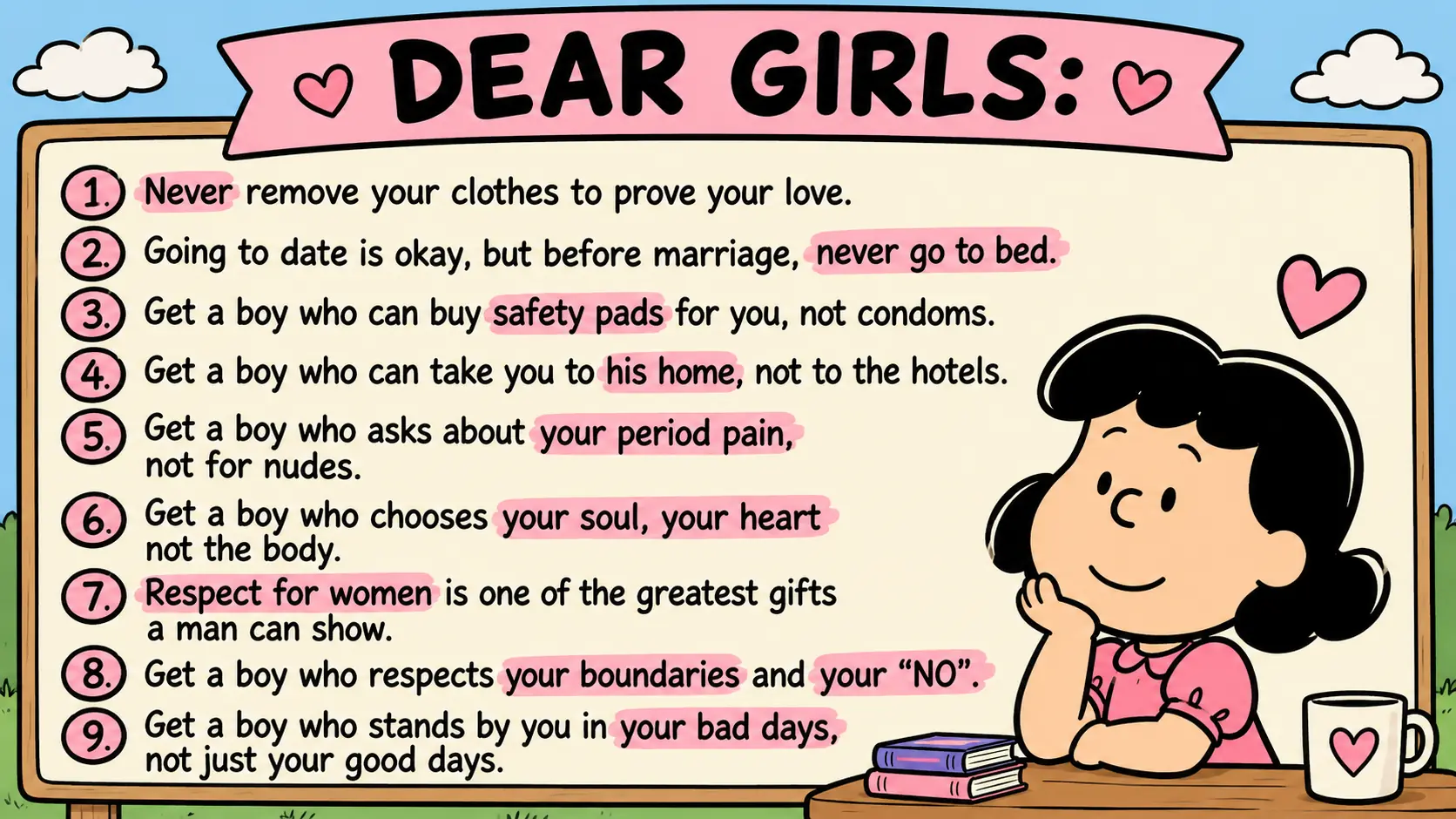
5. Get a boy who asks about your period pain, not for nudes.
This advice reflects an important psychological principle: empathy.
Empathy is one of the strongest predictors of healthy relationships.
A caring partner notices when you're uncomfortable, asks how you're feeling, and wants to help without expecting anything in return.
Likewise, they respect your digital boundaries.
No one should ever pressure you into sending intimate photos or videos.
Respect exists both offline and online.
Someone who values your comfort more than their own desires is demonstrating emotional maturity.
6. Get a boy who chooses your soul, your heart—not your body.
Physical attraction is a natural part of romantic relationships.
However, research consistently shows that long-term relationship satisfaction depends much more on qualities such as:
-
Kindness
-
Trust
-
Emotional support
-
Communication
-
Shared values
-
Reliability
-
Mutual respect
Appearance naturally changes over time.
Character often determines whether a relationship grows stronger or falls apart.
The healthiest relationships appreciate physical attraction while placing equal—or greater—value on emotional connection.
A lasting partnership begins with seeing the whole person.
7. Respect for women is one of the greatest gifts a man can show.
Healthy relationships cannot exist without respect.
Respect means far more than polite words.
It includes:
-
Listening without interrupting.
-
Supporting each other's goals.
-
Respecting opinions, even during disagreement.
-
Speaking without humiliation or insults.
-
Treating one another as equals.
-
Solving conflicts without intimidation or control.
Mutual respect creates emotional safety.
Without respect, trust eventually begins to disappear.
Whether in dating or marriage, genuine love always includes respect.
8. Get a boy who respects your boundaries and your "No."
Perhaps no relationship skill is more important than respecting boundaries.
Healthy boundaries protect emotional, physical, and psychological well-being.
A respectful partner accepts "no" without:
-
Arguing
-
Guilt-tripping
-
Manipulating
-
Becoming angry
-
Repeatedly asking until you give in
Consent is not something given once.
It should exist every time, in every situation.
The healthiest relationships allow both people to feel safe expressing their needs without fear of punishment or rejection.
Someone who consistently ignores your boundaries is showing a serious warning sign.
9. Get a boy who stands by you in your bad days, not just your good days.
Anyone can be present during celebrations.
Character is revealed during hardship.
Research on long-term relationships consistently finds that emotional support during stressful periods strengthens trust, resilience, and relationship satisfaction.
A healthy partner remains supportive during:
-
Illness
-
Failure
-
Financial difficulties
-
Family problems
-
Grief
-
Emotional struggles
Real love is measured not by how someone behaves when life is easy, but by how they respond when life becomes difficult.
Consistency creates security.
Reliability builds trust.
Support strengthens love.
The bigger relationship lesson
Although this advice was written specifically for girls, its core message applies to everyone.
Healthy relationships are not about proving your worth, changing yourself to keep someone's attention, or meeting someone else's expectations at the expense of your own well-being.
Instead, they are built on everyday habits of kindness, honesty, empathy, accountability, and mutual respect.
When evaluating a relationship, it can be helpful to ask yourself:
-
Do I feel emotionally safe with this person?
-
Can I express my thoughts without fear?
-
Are my boundaries respected?
-
Do they support me during difficult times?
-
Do our actions consistently match our words?
-
Do I feel valued for who I am, not just for what I can give?
Love is not something that should leave you feeling anxious, pressured, or constantly trying to earn acceptance.
The healthiest relationships allow both people to grow without sacrificing their identity, dignity, or peace of mind.
In the end, the strongest foundation for lasting love is not appearance, gifts, or grand promises—it is two people who consistently choose respect, trust, compassion, and genuine care for one another, every single day.