She can't hear you screaming," someone shouted from the crowd. "She can't hear anything. She's deaf. " But Emma Brooks was already inside the burning truck.
Nobody told her to stop. Nobody could. She felt the explosion in her chest before it happened. A deep bone rattling pressure that most people would have run from.
Emma ran toward it. The drive back from Phoenix had taken Emma Brooks 3 hours longer than it should have. She hadn't planned on stopping at the rest area outside Flagstaff, but her hands were shaking too badly to keep them steady on the wheel, and she knew better than to push it. Shaking hands meant she was running on empty, not the gas kind, the kind that lived somewhere behind your sternum and had no name in any language hearing or otherwise. She pulled off the highway, cut the engine, and in the silence that had been her whole life.
22 years of silence. She'd been born with it, the doctors told her parents. Not deaf from birth exactly, but close enough that the difference didn't matter. By the time she was three, the world of sound was already something that happened to other people. She'd learned to read lips the way other kids learned to read books early, stubbornly, and out of pure necessity.
She'd learned sign language from a school district that barely funded the program. She'd learned to watch hands and faces and the way light changed on a person's expression when their mood shifted before their words caught up. What she hadn't learned, not in 22 years, was how to ask for help without feeling like she was handing someone a reason to pity her. The manila folder on the passenger seat held the answer to a question she'd been trying not to ask herself for 3 months. She didn't need to open it.
She already had every number memorized. $178,000. That was what the specialist in Phoenix had quoted her. Not a hospital bill she hadn't had the surgery yet. That was the estimate.
The presurgical consultation fee alone had cost her $400 she'd put on a credit card she was still paying down from the last time she tried to navigate a medical system that treated deaf patients like translation problems rather than human beings. The specialist to Dr. Hargrove had been kind enough, efficient, professional. He'd explained her condition in careful, clearly enunciated words because someone on his staff had thought to flag that she read lips, which was more than most offices did. The condition had a name.
It was long and clinical, and she'd looked it up so many times the Wikipedia page had stopped feeling scary and started feeling like an old enemy she'd made peace with. What it meant stripped of the medical language was this. The part of her brain that managed balance and spatial orientation was deteriorating. Had been deteriorating since she was 19 would continue deteriorating until either she had the reconstructive procedure or she didn't. If she didn't within 2 to 3 years she would lose the ability to walk unassisted.
She would lose the ability to drive. She would lose the careful, hard-won independence she had spent her entire adult life building out of stubbornness and spite and the deep, furious love she had for her own freedom. She had $4,200 in her savings account. She'd spent 6 weeks applying for grants. Four of them had rejected her outright.
Two were still pending, which meant that they were almost certainly going to reject her, too, just slowly. The nonprofit her physical therapist had recommended required proof of income below a certain threshold. In Emma's income, freelance graphic design contract work, occasional tutoring for younger deaf kids in the county fluctuated enough that she'd come in $2,000 over the cutoff in one of the quarterly assessments. $2,000. She'd almost laughed when she read that letter.
She had not laughed. She'd driven to Phoenix because a patient advocacy group had told her about a state program that was supposedly expanding its coverage for neurological procedures. The meeting had been held in a conference room on the seventh floor of a building that smelled like recycled air and bureaucratic caution. There had been 11 other people in the room. A woman with a child in a wheelchair, a veteran with one arm, a man who kept touching his throat in a way that suggested recent surgery.
Emma had watched all of them and thought, "We are the people who fall through the cracks and the cracks keep getting wider. " The program representative had explained clearly and not unkindly that the expansion had been delayed pending legislative review, possibly until the next fiscal year, possibly longer. Emma had thanked him, gathered her folder, and walked back to her car. She had cried for exactly 11 minutes in the parking structure before deciding that was enough. And then she had driven north toward home, which was how she came to be, sitting at a rest area outside Flagstaff with shaking hands and a heart that felt like it had been rung out and left on a wire.
She gave herself 5 minutes. That was the rule she'd made for herself at some point in her teens. Some version of the rule, 5 minutes to feel whatever you need to feel and then you pick it back up and you move. She didn't remember where the rule had come from. Maybe nowhere.
Maybe she'd invented it out of necessity the same way she'd invented most of the coping mechanism she ran on. 5 minutes. She checked the time on her phone. It was 4:17 in the afternoon. She pulled back onto the highway at 4:22.
The road through the mountains north of Flagstaff was the kind of road that didn't forgive inattention. It moved. It curved in ways that seemed reasonable until they weren't. Until you were suddenly aware that there was a guardrail between you and a drop that a person wouldn't walk away from. Emma had driven it dozens of times and she knew its rhythms, knew where the road surfaced poorly and where it smoothed out.
Knew the stretch near mile marker 34, where the wind came through a gap in the ridge line and pushed against the driver's side like a slow insistent hand. She felt the world through her body when she drove. That was something hearing people didn't understand and mostly didn't think to ask about. She felt the road through the seat in the steering wheel. She felt changes in grade through the pressure in her inner ear.
She felt the wind as vibration and resistance. She had been told by people who meant it as a compliment and didn't understand why it landed differently that she was an excellent driver. She was an excellent driver because she had learned to pay attention to everything the car was telling her, everything the road was telling her, everything she could see. She saw the smoke before she saw the accident. It rose above the tree line on the far side of a long curve, dark and rolling and wrong.
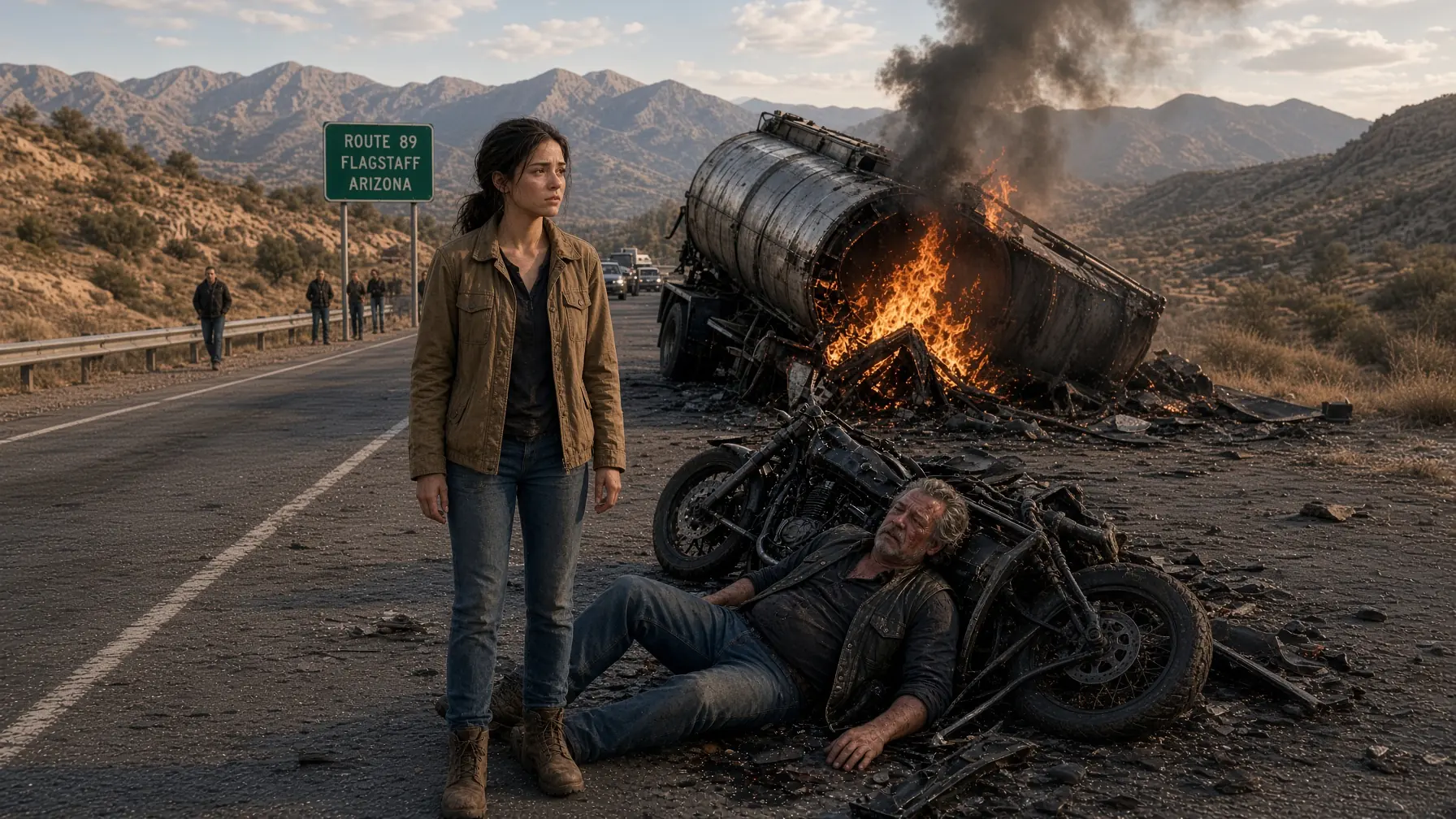
The kind of smoke that wasn't from a campfire or a controlled burn. Her foot came off the accelerator before her conscious mind had fully processed what she was seeing. By the time she came around the curb and saw what was in the road, she'd already slowed to less than 30 miles an hour. The fuel truck was on its side. That was the first thing that registered the sheer scale of it.
The massive tanker lying across both lanes with its cab crumpled against the guardrail and something that was already burning at the rear. Low orange flames that were doing what fire does, which is grow. A motorcycle was visible at the near end of the scene, or what remained of one, the frame bent and scattered across the asphalt in a way that told a story Emma didn't want to finish reading. Three other vehicles had stopped at a distance. She could see people outside their cars, hands raised to mouths.
One man with a phone pressed to his ear. Emma pulled to the shoulder and was out of her car before the engine was fully off. She felt the heat before she was close enough to see the flames clearly. That was how fire worked. When it was this size, it announced itself physically, a pressure against the skin, a change in the air.
She could feel the vibrations of it through the ground, low and rolling, not like sound, but like the memory of sound translated into something a body could receive through its feet and hands. She moved toward it. Later, the people who'd stood at the side of the road and watched would have a hard time explaining why they hadn't done the same. Some of them would say they'd been frozen. Some would say they didn't think anyone could still be alive in there.
Some would say they didn't want to get too close before the fire departments arrived. These were reasonable explanations. They were also, every one of them, explanations that a 22-year-old deaf woman with shaking hands had not given herself. Emma had not decided to be brave. She had simply looked at the overturned truck and thought there could be someone in there.
And that thought had moved her legs before anything else could intervene. The man standing furthest forward, a heavyset guy in a flannel shirt who'd gotten maybe 20 feet closer than everyone else, saw her coming and stepped into her path. She watched his mouth. He was saying something emphatic and frightened. She shook her head once and kept walking.
He grabbed her arm. She stopped, looked at his face. He was saying it again, whatever it was, and this time she caught enough of it. You can't go in there. It's going to blow.
She looked at the burning truck. She looked back at him. "Is there someone inside? " she asked. Her voice was her own train since childhood.
Not perfect, but functional. She'd worked with speech therapists long enough to know how to form words, even when she couldn't monitor herself by sound. She watched his face for the answer. He pointed, not toward the truck cab, but toward the far side of the wreckage. She turned and looked and saw what he was pointing at.
A shape on the ground half concealed by a section of the truck's undercarriage that had sheared off in the impact. A person, a large person, face down, not moving. Emma felt something settle in her chest. Not calm. Exactly.
Clarity. She pulled her arm free and went. The heat was extraordinary. She'd never been close to a fire like this. Nobody she knew had outside of firefighters.
And what she hadn't understood, what she couldn't have understood from news footage or photographs was how physical it was, how it pushed, how it made her face feel tight and wrong, how it dried the inside of her nose and made her eyes want to close. She moved with her arm up, using the sleeve of her jacket as a partial shield, following the pull of what she needed to do rather than any thought she could have articulated. The man on the ground was enormous. She could see that as she got closer, broad shoulders, heavy build, wearing a leather vest over a long sleeve shirt, one arm bent at an angle that made her stomach tighten. He was breathing.
She could see the expansion and contraction of his rib cage. That was something. That was the thing that mattered. She grabbed his shoulders and pulled. He didn't move.
She repositioned, got lower, tried to use her legs rather than her back. He shifted slightly, maybe 2 inches, and then her foot found the edge of the crumpled undercarriage section, and she understood the problem. His leg was pinned. Not deeply, not in the way that would require hydraulic equipment to fix, but pinned well enough that her strength alone wasn't going to accomplish it. She looked around.
Fire does something strange to time. It speeds it up and slows it down simultaneously. She was aware of every second passing and simultaneously aware that she couldn't afford to track them. To her left, a metal bar lay on the asphalt maybe 4 feet long, a piece of the motorcycle's frame, or possibly something that had come off the truck. She grabbed it.
The physics were not complicated. She'd taken one semester of college physics before the cost of attendance had made the decision for her her. And even without that, she understood levers from 22 years of being a person who had to solve physical problems creatively. She worked the bar under the crumpled metal. She pushed the section lifted.
Not much. Maybe 4 inches, maybe five. It was enough. She dropped the bar. It felt it ring through the ground and grabbed the man's shoulders again and pulled with everything she had.
He moved slowly then faster than she was pulling him across the asphalt with the kind of desperate ungraceful momentum that happens when adrenaline overrides awareness of your own limitations. She didn't feel the burns on her forearms forming. She didn't feel the moment when her knee hit the guardrail. She felt only the resistance of his weight and the heat at her back and the vibration through the ground that was getting worse building towards something she understood with her body. Even if she couldn't hear it building.
She got him 20 feet, then 30. Then her legs gave out and she sat down hard on the asphalt and the world did something strange. It pulsed a deep single throbb of pressure that she felt in her chest and her sinuses and the soles of her feet simultaneously. The truck had exploded. The shock wave hit her from behind and knocked her sideways onto the road.
She was aware of heat of brightness through her closed eyelids, of a ringing in her head that she couldn't actually hear, but that her brain insisted was happening. She was aware of not being on fire, which she took as a positive development. She lay on her side for a moment, maybe 2 seconds, maybe 20, and then she pushed herself up and looked at the man she'd pulled from the wreckage. He was still breathing. His eyes were open now, half open, and he was looking at her with an expression she didn't have a word for, dazed and present simultaneously, like a man trying to decide if he was awake or somewhere else.
His mouth moved. She watched it. The words were unclear. His lips weren't forming cleanly, either from the shock or the position of his head. But she caught one thing, one word.
Who? She pressed her hand to the ground to steady herself. Her arms were burning in a way that was starting to move from background noise to something requiring attention. Her vision was doing something at the edges that she didn't like. "Emma," she said.
"My name is Emma. " She watched his face. He blinked once slowly like a man filing something away in a drawer he intended to open later. Then Emma Brooks lay back on the Arizona asphalt and let the world go gray. She came back to sound, or rather to the absence of it, which for Emma was its own specific kind of awareness.
The awareness that the world around her was doing things she couldn't access. She came back to light through her eyelids and the texture of something below her that was not pavement. A surface that moved slightly when she shifted her weight. A gurney. She opened her eyes.
A face above her, young female wearing the uniform of a paramedic mouth, moving in careful practice shapes. Emma watched and assembled. ""Can you hear me? Can you tell me your name? "" "Emma," she said.
Her voice felt distant from her. "I'm deaf," I read lips. The paramedic's expression didn't change the way people's usually did. No flash of uncertainty, no recalibration, just a small nod. And then she moved closer and spoke more deliberately.
"You have burns on your forearms and hands. We think you may have a concussion. We're taking you to Flagstaff Medical. " Emma nodded. She turned her head, looking for the man she'd pulled out of the wreckage.
There were multiple vehicles now. She could count five emergency units from where she was and people moving in organized ways that controlled flow of professional response. She couldn't see him. She grabbed the paramedic's wrist, not hard, but firmly. She waited until the woman looked at her.
The man, she said, "Is he alive? " The paramedic hesitated for one second, the kind of hesitation that Emma had learned to read like a dialect, and then her expression settled into something that was carefully professional, but carried something underneath it. Something like, "The news is not the worst possible news. He's being transported," she mouthed. "We're doing everything we can.
" Emma released her wrist. She lay back and looked at the sky which was going orange at the edge with the late afternoon and felt the world moving through the wheels of the gurney in gentle vibrations and thought, "Hope he makes it. I don't know who he is. I hope he makes it. " didn't.
The emergency room at Flagstaff Medical was organized chaos, which Emma navigated the way she navigated most institutional environments carefully with heightened attention to everything she could see and with the steady low-grade work of making herself understood to people who hadn't expected to communicate with her today. The triage nurse was excellent. She found a whiteboard within 2 minutes of Emma arriving and used it without being asked, which put her in the top 10% of medical staff Emma had dealt with in her lifetime. The attending physician was adequate. The resident who came to assess her concussion was nervous in a way that translated into overexplanation, which was fine.
Emma had seen worse. Her forearms had second-degree burns in three distinct patches, the largest of which ran from her left wrist to the inside of her elbow. They were serious enough to require proper wound care and dressing not serious enough to threaten her long-term function if she took care of them. Her right knee had a bruise that was already spectacular in color and would be worse tomorrow. The concussion was per the resident's careful whiteboard notation, moderate with recommended observation overnight.
She was placed in a room. She was given something for pain that made the edges of the world soft without making them disappear. She was given ice for her knee and a phone charger someone dug up from a supply closet because her phone had died somewhere in the process of being transported. She texted her roommate in hospital. Flagstaff burns concussion.
I'm fine. Don't panic. And then sat with the phone in her bandaged hands and looked at the wall. She didn't know why she was crying until she was already doing it. Not sobbing.
She never sobbed if she could help it. Another rule from somewhere in her past. Just the quiet kind. The kind that happened when the adrenaline went away and the body remembered what it had spent the last 2 hours not feeling. Her arms hurt.
Her knee hurt. Her head hurt in a way that was different from regular headaches, slower and more pervasive, like a weather system moving through. She thought about the manila folder on the passenger seat of her car, which was presumably still parked on the shoulder of Route 89 or had been towed by now. She thought about the number, $178,000. She thought about the look on the program representative's face when he'd explained that the expansion had been delayed.
She thought about the man on the asphalt, the half-open eyes, the three letters she'd read on his lips. Who? She didn't know who he was. She'd saved someone without knowing who they were, which was the only way you could actually save someone without the math of whether they deserved it, without the calculation of what you'd get back. She'd learned that somewhere, or maybe she'd always known it, the way you know some things without being taught, a nurse appeared in the doorway.
Older woman, efficient, bearing the kind of nurse who had been doing this long enough that nothing surprised her. She was holding a small paper bag. She crossed to Emma's bedside, set the bag down, and then held up one finger. Wait, she left. She came back 40 seconds later with a notepad and a pen.
She wrote, "The man you pulled from the truck. He's in surgery. The doctors say if you hadn't gotten him out when you did, the outcome would have been very different. " I thought you should know. Emma read it twice.
Then she looked up at the nurse. The nurse's expression was not sentimental. She was not a sentimental woman, Emma could tell. But there was something in her face that wasn't clinical either. Something direct and human and certain.
Emma said, ""Thank you for telling me. "" The nurse nodded. She tore the sheet off the notepad and left it on the bedside table as if it was information Emma might want to reference later. Then she picked up her notepad, checked something on Emma's chart, and walked out. Emma picked up the paper and held it for a long time.
The man was in surgery. The doctors said the outcome would have been different. She had done a thing and the thing had mattered. She folded the paper carefully and set it beside her phone. Outside the window, the Arizona sky had gone from orange to the deep saturated purple that happened here in the high desert just before dark.
A color that felt almost artificial until you lived in it long enough to accept it as real. She was going to have to figure out how to get her car back. She was going to have to call the grant programs in the morning and check whether there had been any updates. She was going to have to keep going because that was what you did. But tonight she let herself hold the paper that a nurse had taken 40 seconds to find and give to her.
Tonight she let herself feel the fact that it had mattered. It had been enough for now. It had been exactly enough. She didn't sleep well. Concussions rarely permitted it.
And the nursing staff came in every two hours with the practiced gentle efficiency of people who had learned to do their jobs without waking patients all the way up, which never quite worked because the attempt itself was a form of waking. Emma experienced it differently than hearing patients. The light changes the shift in air pressure as the door opened, the vibration of footsteps. She drifted in the spaces between. At some point in the middle of the night, she checked her phone.
2:47 a.m. She became aware that someone was in the hallway outside her room. Not a nurse, the footstep pattern was different, heavier, more than one person. She sat up carefully, which cost her a sharp reminder from her knee and a slower protest from her head. Through the small rectangular window in her door, she could see figures, multiple figures, large ones, at this hour in a hospital hallway.
That should have been alarming. What was strange, what she couldn't have fully explained was that it wasn't. Whatever they were doing, they were being careful about it. Methodical. One of them positioned himself near the elevator, one near the stairwell door, one directly across from her room.
They weren't behaving like threats. They were behaving like people who had been given instructions about how to stand. She could see enough of the nearest one to observe black leather vest. Heavybuild arms that had the texture of geography lines and images visible even from this distance. She lay back down.
She thought about the man she'd pulled from the wreckage, the leather vest he'd been wearing, the patch on the back that she hadn't been close enough to read clearly. She thought about the car that had been visible for a moment through the passenger window of the fuel truck just before she'd committed fully to running toward the wreckage. A dark sedan moving fast, moving wrong, moving in the direction of away when everything else was stopping. She hadn't thought about that car until just now. It had been filed in the part of her brain that was storing things for later processing.
The way her brain always handled excess input and now it surfaced. A car moving away from an accident, moving fast. She looked at the ceiling of her hospital room in the low nighttime light and thought about what that meant and felt something settle in her chest that wasn't quite fear and wasn't quite calm. It was the feeling she got when something had weight that she hadn't yet finished measuring. Outside in the hallway, the large men in leather vest stood their careful watch.
Emma closed her eyes and thought, "I don't know what I walked into. " She thought I saved a man, and I don't know who he was. She thought, "But there is something about those men in the hallway. Something in the way they're standing. Something in the deliberate patience of it that says they know exactly what they owe.
" She turned onto her side, and the bandages on her forearms reminded her of the fire. And the fire reminded her of the ground beneath her feet. On that mountain rush stood the vibration of catastrophe translated into something her body could receive and act on. She had walked into the fire because there was someone inside. Whatever came next, that part was finished.
She had done the thing. The rest was someone else's chapter. She was discharged at 11:00 the next morning. The paperwork took 40 minutes, which was faster than she'd expected. And the nurse who processed it, a different one from the night before, younger, with careful handwriting, wrote everything down without being asked.
Emma had learned to notice that the people who reached for a pen without prompting, who understood instinctively that the accommodation wasn't a burden, but a basic courtesy. She noticed them the way you notice a light in a window when you've been walking in the dark for a while. Her roommate Diane had driven up from Sedona that morning. Emma had told her not to. Diane had come anyway, which was one of the reasons Emma had chosen her as a roommate 3 years ago when the alternative was a Craigslist stranger with questionable references.
Diane was 47, a retired school teacher who did pottery on weekends and had a talent for showing up without making the showing up feel like an intrusion. She was waiting in the lobby when Emma came through with her discharge papers and her bandaged arms and her knee that had turned a color overnight that didn't exist in any normal palette. Diane took one look at her, stood up, and did not say anything dramatic. She put her arm around Emma's shoulders and walked her to the car. In the car, she handed Emma her phone.
She'd written out the message already. Your car was towed to a lot on Route 66. I called. It's fine. I'll take you when you're ready.
Emma read it and nodded. She looked out the window. Then she looked back at Diane and said, ""There were men outside my room last night. Big men, leather vests. "" Diane's expression shifted through several things in quick succession.
She reached for her phone and typed, ""What do you mean outside your room? "" Standing in the hallway, three of them, "Not nurses, not doctors. They were watching like they were keeping something out. " Diane stared at her. Then she looked at the road, then back at Emma with the expression of a woman who had a number of follow-up questions and was trying to decide which one to lead with.
She typed, ""Did anyone from the hospital say anything about them? "" No one said anything about anything. Diane drove in silence for a moment. Then "Emma, do you know who the man was? The one you pulled out of the truck?
" Emma hadn't let herself think about that question in any direct way. She'd circled it the way you circle something that has a weight you're not certain you can hold. She shook her head. "No," she said. "I don't know who he is.