“Daddy, please help her.”
Seven-year-old Emma Cole’s cry cut across the shopping-center parking lot.
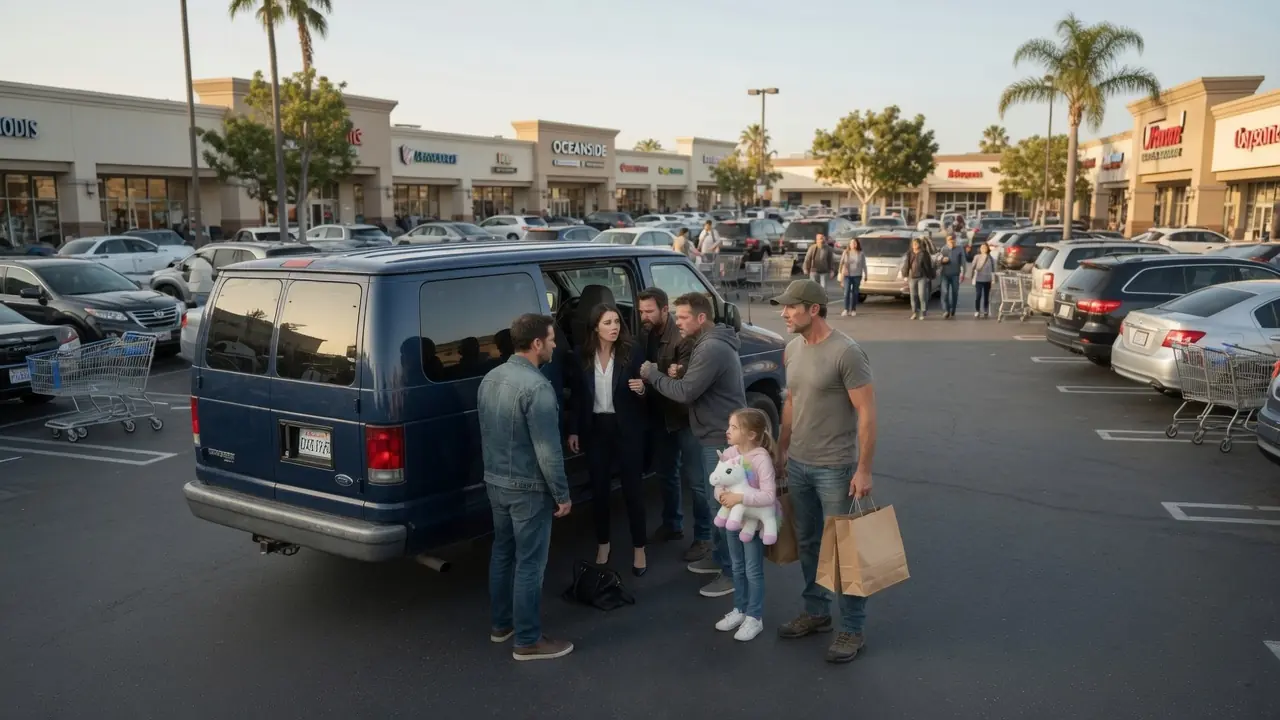
Marcus turned and saw three men forcing a young woman toward the open side door of a dark blue van.
Every instinct he had developed as a father told him to take Emma, get behind cover, and wait for the police.
Every instinct he had developed during fifteen years in the Navy told him the woman did not have six minutes.
Then one of the men pressed a knife against her ribs.
Marcus made his choice.
Less than a minute later, all three attackers were on the pavement.
The following morning, a Navy admiral arrived at Marcus’s home.
Only then did Marcus learn that the woman he had saved was not a random victim—and the three men were connected to something far larger than an attempted kidnapping in a parking lot.
Oceanside, California, sat along the coast twenty miles north of San Diego.
To tourists, it was surf shops, beaches, and sunsets over the Pacific.
To military families, veterans, mechanics, contractors, and service workers, it was a working city shaped by nearby Camp Pendleton and the thousands of people who passed through its gates.
Marcus Cole understood both sides of the city.
He had spent twelve years with SEAL Team Five before a training accident destroyed his left knee and ended his career.
The Navy gave him a medical retirement, a monthly disability payment, a formal handshake, and a sentence he came to hate.
Thank you for your service.
Then the institution that had defined his adult life continued without him.
Marcus was thirty-nine, five feet eleven, and still built like the middleweight fighter he had once been. His dark hair remained cut short, though gray had begun appearing near his temples. Old scars crossed his forearms and one shoulder.
He rarely discussed their origins.
Three years after leaving the Navy, he worked as an independent security consultant. Most assignments involved corporate offices, warehouses, or executives worried about theft.
It paid the bills.
It did not give him purpose.
His daughter did.
Emma had been six months old when Marcus’s wife died after complications from an undiagnosed heart condition.
Marcus had faced gunfire, explosions, and nights in places that did not officially exist.
Nothing frightened him like raising a child alone.
He learned to braid hair by watching online videos.
He packed lunches.
Attended parent-teacher conferences.
Memorized medication dosages and every name in Emma’s favorite animated films.
He arranged his work around school schedules whenever possible.
Emma never doubted that she came first.
Marcus sometimes doubted everything else.
That Tuesday afternoon, he and Emma left the Target store carrying two shopping bags and a stuffed unicorn she had persuaded him to buy.
The October sun remained warm despite the late hour. Heat rose from the asphalt, and the air carried traces of ocean salt, exhaust, and hot pavement.
Emma skipped beside him.
“Can we get ice cream?”
“We need to get home.”
“Small ice cream.”
“You have homework.”
“I can do homework while eating ice cream.”
“That is not how multiplication works.”
“It might help.”
Marcus smiled despite himself.
“We’ll see.”
They had crossed less than half the parking lot when Marcus heard a woman shout.
The sound ended abruptly.
His body stopped before he consciously understood why.
Across the lot, partially hidden between two large sport-utility vehicles, stood a dark blue panel van.
Three men surrounded a woman in her mid-twenties.
She wore black slacks, a white blouse, and a navy jacket. One man held her arm. Another blocked her path. The third stood near the driver’s door, scanning the lot.
The side door of the van was open.
Marcus’s mind processed the scene instantly.
Three suspects.
One victim.
Vehicle prepared for rapid departure.
Lookout positioned to detect interference.
This was not an argument.
It was an abduction.
Marcus placed the shopping bags on the ground and removed his phone.
“Stay beside me,” he told Emma.
He called emergency services.
“911. What is your emergency?”
“I’m at the Oceanside Gateway Shopping Center. Southeast parking area near the Target entrance. Three males are attempting to force a woman into a dark blue panel van.”
The dispatcher began asking for descriptions.
Marcus supplied them while reading the license plate.
Then Emma screamed.
“Daddy, he has a knife!”
One of the men had unfolded a short blade.
He pressed it against the woman’s side.
Her body went rigid.
The dispatcher heard Emma.
“Sir, officers are responding. Do not approach.”
“How long?”
Six minutes.
The woman would be inside the van in less than thirty seconds.
Marcus looked down at Emma.
Her face had gone pale. She held the stuffed unicorn against her chest with both arms.
This was no longer a military operation.
He had no team.
No weapon.
No body armor.
Most importantly, his daughter stood beside him.
He knew the correct civilian decision.
Move Emma to safety.
Remain on the line.
Observe.
Let police respond.
Then the man with the knife pulled the woman closer to the van.
Emma looked up at Marcus with tears in her eyes.
“Please help her.”
Her faith in him felt heavier than any command he had received in uniform.
Marcus lowered himself until they were eye level.
“Listen carefully.”
He pointed toward a woman loading groceries into a nearby car.
“Run to that lady. Tell her your father needs help. Stay with her until a police officer comes.”
Emma’s lip trembled.
“Are you coming back?”
“Yes.”
It was a promise he had no right to make.
He made it anyway.
“Go.”
Emma ran.
Marcus placed the phone on the asphalt, still connected to the dispatcher.
Then he walked toward the van.
He did not sprint.
Running would draw attention too soon.
He moved between parked vehicles, using them to conceal his approach.
His breathing slowed.
The noise of the parking lot seemed to narrow into separate details.
A shopping cart rattling.
The van’s engine running.
The woman’s uneven breathing.
A gull crying above the buildings.
The lookout saw him first.
He was stocky, perhaps forty, wearing a denim jacket.
“Hey,” the man called. “You lost?”
Marcus kept moving.
The lookout’s right hand drifted toward his waistband.
Marcus closed the final distance before the man could pull whatever he carried.
He trapped the wrist, drove one short palm strike beneath the man’s chin, and redirected his body into the side of the van.
The man collapsed.
The second attacker released the woman and charged.
He swung hard and wide.
Marcus moved outside the punch, caught the arm, and swept the man’s leg from beneath him.
The attacker hit the asphalt on his back.
Marcus controlled the fall enough to avoid cracking his skull, then drove a forearm across the man’s upper chest until the resistance stopped.
The knife-wielding attacker shoved the woman aside.
She fell near the rear tire.
He turned toward Marcus with the blade held low.
“You made a bad choice.”
Marcus watched the weapon.
The man lunged.
Marcus shifted away from the point, captured the attacker’s wrist with both hands, and twisted until the knife fell.
The attacker tried to strike with his free hand.
Marcus drove an elbow into the side of his face.
The man staggered.
Marcus swept his legs and forced him against the van, controlling him until his body went limp.
The entire confrontation lasted less than twenty seconds.
Marcus stood among the three fallen men.
His breathing remained controlled.
His hands did not.
They began trembling as the surge of adrenaline faded.
He turned toward the woman.
She had pushed herself into a seated position, staring at him.
“Are you injured?”
She shook her head.
“Stay there. Police are coming.”
Marcus walked back toward Emma.
The woman with the groceries had pulled the child behind her car.
Emma broke free the moment she saw him.
She ran across the lot and struck his body with enough force to make him step backward.
“Daddy!”
Marcus dropped to one knee and wrapped both arms around her.
“I’m here.”
She sobbed into his shoulder.
“You said you would come back.”
“I know.”
Behind them, sirens approached.
The police investigation lasted nearly two hours.
Officers secured the van and recovered a handgun from the lookout’s waistband. The knife remained beneath the rear bumper where it had fallen.
Several shoppers had recorded parts of the incident.
The woman Marcus saved identified herself as Lieutenant Sarah Brennan, a naval intelligence officer stationed in San Diego.
She had bruises on one arm but no serious injuries.
The attackers were transported to a hospital under guard.
One had a broken nose.
Another had a fractured wrist.
All three regained consciousness.
Marcus sat in the back of a patrol vehicle with Emma asleep across his lap. An officer had brought her a blanket and a carton of chocolate milk.
Sergeant Luis Rodriguez, a veteran detective with tired eyes and a graying mustache, stood outside the open door.
“You’ve had training.”
Marcus looked at him.
“Navy.”
Rodriguez glanced toward the three ambulances.
“What kind of Navy?”
Marcus did not answer.
The detective gave a faint nod.
“Understood.”
He looked toward Emma.
“You know that could have ended badly.”
“Yes.”
“Three men. One armed with a knife, another with a pistol. Your daughter nearby.”
“I know.”
Rodriguez studied him.
“You saved the woman.”
Marcus rested one hand on Emma’s back.
“I also taught my daughter that her father might disappear while she watched.”
“You taught her something else.”
“What?”
“That someone being in danger matters.”
Marcus looked away.
“That lesson is not worth leaving her without a father.”
“No.”
Rodriguez’s voice softened.
“But neither would ignoring that woman have been easy to explain.”
Marcus did not respond.
By the time police released them, the sun had set.
He carried Emma to his truck and secured her in the booster seat.
During the drive home, she remained quiet.
At a red light, she finally spoke.
“Were those bad men?”
“Yes.”
“Were you scared?”
Marcus considered lying.
“Yes.”
Emma looked surprised.
“But you fought them.”
“Being scared does not stop your body from moving.”
“Were you scared for the lady?”
“I was scared for you.”
She tightened her arms around the stuffed unicorn.
“I told you to help.”
“I know.”
“Was that wrong?”
Marcus looked at her in the mirror.
“No.”
He paused.
“But you should never believe helping means you have to run toward every danger.”
“Then why did you?”
He had no simple answer.
“Because sometimes there is no safe choice.”
At home, he made grilled cheese sandwiches neither of them finished.
Emma asked whether the woman was all right.
Whether the men would escape.
Whether Marcus had done the same kind of fighting in the Navy.
He answered what he could.
After putting her to bed, Marcus remained beside her until she fell asleep.
Then he sat alone in the living room.
The encounter replayed in his mind.
He saw every possible failure.
The hidden pistol clearing the waistband.
The knife slipping through his control.
A fourth attacker inside the van.
Emma leaving the woman and running toward him.
He had succeeded.
That did not mean the decision had been wise.
At eight thirty the following morning, three firm knocks sounded at the front door.
Marcus had just placed pancakes in front of Emma.
He checked through the peephole.
A man in Navy service dress blues stood on the porch.
Two silver stars marked each shoulder.
Marcus opened the door.
The officer was in his late fifties, tall and fit, with iron-gray hair and a chest filled with ribbons.
His name tag read:
BRENNAN.
Marcus understood immediately.
“Admiral.”
“Chief Petty Officer Cole.”
“I’m retired, sir.”
“So am I expected to call you Mr. Cole?”
“Marcus works.”
The admiral’s expression softened slightly.
“May I come in?”
Marcus stepped aside.
Rear Admiral Thomas Brennan entered and surveyed the modest room.
Emma’s drawings covered the refrigerator.
A basket of unfolded laundry sat near the couch.
Framed photographs on the mantel showed Marcus in uniform beside men whose faces carried the distance of deployments.
Emma peeked from the kitchen.
“Daddy, who is that?”
“Admiral Brennan.”
“Is he the man with the stars?”
“Yes.”
She looked at the admiral.
“Are they real?”
Brennan almost smiled.
“They are.”
“Do they come off?”
“Emma, finish breakfast.”
She disappeared into the kitchen.
The admiral turned toward Marcus.
“The woman you saved yesterday is my daughter.”
“I assumed.”
“She is alive because you intervened.”
“I’m glad she’s safe.”
Brennan looked at him for a long moment.
“I reviewed your record.”
Marcus’s shoulders tightened.
“SEAL Team Five. Twelve years. Three combat deployments. Navy Cross, two Silver Stars, Purple Heart. Medically retired after a training injury.”
“You came here to recite my file?”
“No.”
“Then why are you here?”
Brennan removed a card from inside his jacket.
“Those three men were not random criminals.”
Marcus accepted the card without looking at it.
“They belong to a trafficking network operating across Southern California.”
The words changed the room.
Brennan continued.
“The group recruits, coerces, and abducts women. Some are moved across the border. Others are transported through ports using falsified documents.”
“How many?”
“We have confirmed seven missing victims.”
“Confirmed?”
“We believe there are more.”
Marcus thought of the van.
“What did Sarah have to do with them?”
“She was assigned to an intelligence-support team assisting NCIS and federal investigators.”
“Yes.”
“Then yesterday was retaliation.”
“Partly.”
Brennan walked toward the window.
“They intended to take her alive. We believe they wanted information about the task force and access to secure files.”
Marcus felt cold despite the morning sunlight.
“The men are talking?”
“One is.”
“Why?”
“He understands that attempted kidnapping of a federal officer, weapons charges, and trafficking conspiracy could keep him in prison for the rest of his life.”
Brennan faced Marcus.
“Your intervention gave us three living suspects, a vehicle, communications devices, and evidence linking them to several properties.”
Marcus looked toward the kitchen.
Emma was humming softly.
“You came to thank me.”
“That is one reason.”
“What is the other?”
The admiral handed him the card.
“I want to offer you work.”
Marcus did not examine it.
“No.”
“You haven’t heard the offer.”
“I have a daughter.”
“I know.”
“I left the Navy for a reason.”
“You were medically retired.”
“My reason remains.”
Brennan sat on the edge of the couch.
“This is not active duty. It would be short-term contract work supporting an interagency task force.”
“I’m done kicking doors.”
“That is not what we need.”
“What do you need?”
“Operational assessment. Protective planning. Surveillance support. Someone who understands how organized groups move people, secure locations, and detect pursuit.”
Marcus shook his head.
“You have federal agents.”
“We do.”
“Then use them.”
“This network has survived because several members are former military contractors and private-security employees. They recognize standard law-enforcement methods.”
“And they wouldn’t recognize me?”
“You have been out for three years. You already work in private security circles.”
Marcus stared at the card.
“Why would I bring more danger near Emma?”
Brennan’s jaw tightened.
“Because danger may already know your name.”
Silence filled the living room.
Marcus looked up slowly.
“What does that mean?”
“The lookout’s phone contained a message sent after your intervention.”
Brennan’s voice became careful.
“The sender requested your vehicle registration and home address.”
Marcus stepped toward him.
“You came here knowing that?”
“The message was intercepted before the information was delivered.”
“Before?”
“Yes.”
“Are you certain?”
“No intelligence officer should promise certainty.”
Marcus’s hands clenched.
“Then get out.”
Brennan stood.
“I am not threatening you.”
“You told me people who traffic women may come after my child, then offered me a contract.”
“I told you because hiding it would leave you unprepared.”
Marcus moved closer.
“If anything happens to Emma—”
“We have surveillance on the house and school.”
“You put agents near my daughter without asking?”
“We placed protection after learning the network had requested your information.”
Marcus turned toward the kitchen.
The ordinary sound of Emma’s fork touching a plate felt suddenly fragile.
Brennan lowered his voice.
“The fastest way to protect her is to dismantle the organization.”
“And you think I can do that?”
“I think you can help.”
Marcus faced him again.
“How long?”
“Six months at most.”
“Terms?”
“Consulting contract. Flexible scheduling. Full protective support for you and Emma. Compensation appropriate to the risk.”
“I don’t care about the money.”
“You will if the work prevents you from accepting other contracts.”
Marcus looked at the card.
“Why me?”
Brennan’s answer came without hesitation.
“Because you saw an armed abduction while holding your daughter’s hand, and you still understood exactly what was happening.”
“That should be the reason not to hire me.”
“You did not lose control.”
“I put three men in the hospital.”
“You used only enough force to stop them.”
Marcus looked toward the photograph of his former team.
“I need time.”
“You have until tomorrow.”
Brennan moved toward the door.
Then he removed a folded note from his pocket.
“Sarah asked me to give you this.”
After he left, Marcus opened it.
Mr. Cole,
Thank you for saving my life.
I remember the knife, the van door, and the moment I realized no one around us could see what was happening.
Then you appeared.
My father told me you have a daughter. I am sorry she had to witness what happened, but I hope she understands that her words helped save me.
I will never forget either of you.
Sarah Brennan
Marcus folded the note.
Emma stood in the hallway.
“Is she okay?”
“Yes.”
“Did she write that?”
He nodded.
Emma walked closer.
“Was the star man angry?”
“No.”
“What did he want?”
Marcus looked at the business card.
“To ask for help.”
“Will you help?”
The question felt too familiar.
“I don’t know.”
That evening, Marcus called Jake Martinez, his former teammate.
Jake answered from Virginia.
“I heard you turned a shopping trip into a three-man takedown.”
“The SEAL community needs fewer gossip networks.”
“You okay?”
“Yes.”
“Emma?”
“Scared.”
Jake became quiet.
Marcus explained the admiral’s visit.
When he finished, Jake exhaled.
“You already know what you’re going to do.”
“No.”
“You called me because you want someone to tell you not to.”
Marcus stared into the dark backyard.
“I have Emma.”
“You had Emma yesterday.”
“That was different.”
“You stepped into their world. They may not care whether you sign a contract.”
“So I should make myself a bigger target?”
“You should help remove the target.”
Marcus rubbed his left knee.
Pain still appeared during cold mornings or after long periods standing.
“I’m not who I was.”
“Good.”
Jake’s voice softened.
“The man you were did not have Emma.”
“Exactly.”
“The man you are understands what failure costs.”
Marcus did not sleep.
The following morning, he called Admiral Brennan.
“I’ll do it.”
The admiral remained silent.
“Six months,” Marcus continued. “No extensions without my agreement. Emma receives protection that does not interfere with her school or frighten her.”
“Agreed.”
“If anything happens to me, a trust is established for her.”
“Already prepared.”
Marcus closed his eyes.
“And I am not leaving the country.”
“You won’t.”
“One more condition.”
“Name it.”
“I work with Sarah.”
Brennan paused.
“She is currently on administrative leave.”
“She knows the investigation, and the attackers targeted her. She will understand their mistakes better than anyone.”
“I’ll discuss it with her.”
“No Sarah, no contract.”
The admiral gave a faint sound that might have been approval.
“Welcome aboard, Chief.”
Marcus joined the task force three days later.
The operation was run jointly by NCIS, the FBI, Homeland Security Investigations, and local departments.
He entered expecting professional coordination.
He found territorial disputes, duplicated reports, and agencies guarding information as though credit mattered more than victims.
Sarah returned after two weeks.
She was twenty-seven, disciplined, and quieter than she had been before the attempted kidnapping.
The first time she saw Marcus inside the secure operations center, she stopped.
“You accepted.”
“For six months.”
“My father convinced you?”
“The men requesting my home address convinced me.”
Her expression changed.
“I’m sorry.”
“You didn’t send them.”
“They came because of my work.”
“They came because criminals believed fear would stop you.”
Sarah looked toward the evidence boards.
“It almost did.”
Marcus did not offer empty reassurance.
“Then we make sure it fails.”
The captured suspects revealed a warehouse near the port, two safe houses, and a private transportation company used to move victims.
But the leaders remained unidentified.
Marcus studied the network differently from the investigators.
He examined delivery schedules.
Vehicle maintenance records.
Security contracts.
Properties with unexplained construction work.
He noticed that several suspected sites used the same private fire-inspection company.
The owner was a former military contractor named Victor Dane.
Dane had worked in logistics overseas and understood how to move people through controlled spaces without attracting attention.
The inspection company gave him legal access to warehouses, hotels, and apartment complexes.
It also allowed him to identify isolated employees and residents.
Sarah reviewed financial records.
Payments from shell companies connected Dane to the transportation firm and several suspected kidnappers.
The task force obtained warrants.
Their first raid found an empty warehouse.
Marcus examined the space afterward.
“They knew we were coming.”
A federal supervisor disagreed.
“We moved within two hours of authorization.”
“Someone warned them before authorization.”
The room became tense.
“You think we have a leak?”
“I think seven women disappeared while four agencies investigated the same group.”
Sarah looked toward him.
“What would you do?”
“Limit the next operation to people whose presence is essential.”
“And the paperwork?”
“Prepare parallel plans. Nobody knows which location is real until departure.”
The strategy worked.
Three weeks later, the task force raided a rural property east of San Diego.
They rescued two women from a concealed basement.
Both were dehydrated, frightened, and alive.
One identified Dane.
The other revealed that a police officer supplied information about patrol patterns.
The leak was not inside the federal task force.
It was a detective assigned to a neighboring city.
He had warned Dane about searches and missing-person reports.
His arrest led investigators to another location near the border.
Marcus participated only in the planning, but he waited in the command vehicle as agents entered.
Five women were rescued.
One had been missing for eleven months.
The operation should have ended there.
It did not.
Dane escaped.
Evidence suggested he had learned Marcus’s identity and recognized his role in the investigation.
Protection around Emma increased.
Marcus told her there were police nearby because his work involved dangerous people.
She listened quietly.
“Are they the men from the parking lot?”
“Some of their friends.”
“Are you going to fight them?”
“I’m helping police find them.”
“Will you come home?”
Marcus sat beside her on the bed.
“That is always the plan.”
“That’s not a promise.”
She remembered.
He looked at her.
“No.”
Emma took his hand.
“Then promise you’ll be careful.”
“I promise.”
Victor Dane made his final move five months into the investigation.
He sent Marcus a photograph.
Emma stood outside her school holding her backpack.
The image had been taken that morning.
Beneath it was a message.
WALK AWAY.
Marcus felt something cold settle inside him.
Not panic.
Something worse.
The old operational calm.
The task force traced the message through several relays but found no location.
Marcus studied the photograph.
A delivery truck reflected in a nearby window.
A partial company logo appeared on its side.
The truck belonged to a linen service supplying hotels, hospitals, and naval facilities.
Sarah searched the company’s routes.
One vehicle had been reported stolen two days earlier.
Traffic cameras showed it traveling toward an abandoned coastal resort north of the city.
The task force prepared a raid.
Marcus was ordered to remain at command.
He refused.
Sarah confronted him.
“You cannot enter emotionally compromised.”
“He photographed my daughter.”
“That is exactly why.”
Marcus stared at the resort plans.
“He wants me there.”
“Then don’t give him what he wants.”
“He may have hostages.”
“So let the assault team handle it.”
Marcus looked at her.
“You were the victim in that parking lot. Would you have waited outside if your father was inside?”
Sarah did not answer.
The raid began before dawn.
Marcus remained with the command unit but moved forward when agents discovered a concealed service tunnel not shown on the plans.
Dane escaped through it with one hostage.
Marcus recognized the tunnel’s direction from the slope of the property.
It emerged near the coastal cliffs.
He and Sarah reached the exit with two agents.
Dane stood near the edge holding a young woman with a knife against her throat.
He recognized Marcus.
“You should have walked away in the parking lot.”
Marcus stopped.
“You already tried that line.”
“You destroyed everything.”
“You built it on stolen lives.”
Dane pressed the blade closer.
“You think you’re a hero because your child asked you to help?”
“No.”
Marcus kept his hands visible.
“I think you’re afraid because she was right.”
Dane’s attention shifted for half a second.
The hostage drove her heel backward into his shin.
Marcus moved.
Agents rushed from both sides.
Dane released the woman and reached for a handgun.
Sarah fired first.
The bullet struck his shoulder.
Marcus tackled him before he could lift the weapon.
Dane fought desperately.
Marcus pinned his arm and held him against the ground until agents secured the handcuffs.
The entire operation lasted less than nine minutes.
The investigation lasted another year.
Seventeen suspects were convicted.
Nine victims were rescued alive.
Evidence recovered from Dane’s files helped identify trafficking routes in three states.
The corrupt detective received a federal sentence.
The captured attackers from the parking lot cooperated in exchange for reduced charges.
Marcus’s name never appeared in official press releases.
He requested anonymity.
Sarah returned to active intelligence work.
Her father retired the following year.
On Marcus’s final day with the task force, Admiral Brennan called him into his office.
“You exceeded every expectation.”
Marcus sat opposite the desk.
“I did what the contract required.”
“You saved lives.”
“The teams executing the warrants saved them.”
“You found the pattern.”
Marcus looked toward the admiral’s photographs of ships, commands, and ceremonies.
“What happens now?”
“That depends on you.”
“My contract is finished.”
“I know.”
Brennan leaned back.
“You could remain as a consultant.”
“No.”
The answer came easily.
The admiral nodded.
“What will you do?”
Marcus had spent months considering it.
“There are veterans leaving service with skills they don’t know how to translate.”
Brennan listened.
“Some end up chasing money through dangerous contracts. Others feel useless because civilian employers don’t understand what they can do.”
“What are you proposing?”
“A training program.”
Marcus leaned forward.
“Protective services, emergency planning, disaster response, missing-person support. Civilian work with standards and oversight.”
“Purpose without sending them back to war.”
“Yes.”
Brennan smiled.
“That sounds more difficult than hunting traffickers.”
“It probably is.”
“Do you need funding?”
“I’ll need introductions.”
“You have them.”
Marcus stood.
The admiral extended his hand.
Marcus shook it.
“Thank you, Chief.”
“For what?”
“For refusing to walk away.”
Marcus looked toward the door.
“My daughter made that decision.”
The program opened eight months later.
It was called Second Watch.
The first class included twelve veterans.
A former Marine trained in emergency medicine.
An Army logistics specialist.
A Navy intelligence analyst.
A helicopter crew chief.
Two former military police officers.
Marcus required every participant to complete training in de-escalation, trauma-informed protection, and civilian law.
He reminded them that skill without restraint was only another danger.
Second Watch helped hospitals improve security.
Protected domestic-violence shelters.
Assisted police during searches for missing children.
Provided employment to veterans who believed their usefulness had ended with their uniforms.
Sarah occasionally taught intelligence-awareness courses.
Emma grew accustomed to seeing her at their dinner table.
Admiral Brennan attended the first graduation and pretended not to become emotional.
Years later, Emma asked Marcus about the parking lot.
She was sixteen by then.
They sat outside the Second Watch training center while a new class completed emergency drills.
“Did you know you could beat all three men?”
“No.”
“But you did.”
“That does not mean I knew.”
“Would you make the same choice now?”
Marcus looked at her.
The honest answer remained complicated.
“I would move you to safety sooner.”
“That isn’t what I asked.”
He smiled faintly.
“You sound like your mother.”
“I never met her long enough to remember.”
“No.”
“But you carry some of her questions.”
Emma waited.
Marcus looked toward the training field.
“I would help the woman.”
“Even knowing everything that came afterward?”
“Yes.”
“Why?”
“Because the worst consequences came from the men who chose to take her.”
He turned toward his daughter.
“Helping did not create the danger. It revealed it.”
Emma considered that.
“You were scared.”
“Terrified.”
“You didn’t look scared.”
“That is not the same as courage.”
“What is?”
Marcus thought of the woman beside the van.
The knife.
His daughter clutching a stuffed unicorn.
The admiral at his front door.
The victims rescued from locked rooms.
“Courage is deciding fear does not get the only vote.”
The parking-lot video continued circulating online for years.
Most versions showed only Marcus dropping the three attackers.
People praised his speed.
His training.
His strength.
They called him a retired warrior, a hero, and a one-man rescue team.
Marcus disliked all of those descriptions.
The most important moment happened before any punch was thrown.
It was not the instant he saw the knife.
It was not the moment he moved toward the van.
It was when a frightened seven-year-old looked at a woman surrounded by strangers and understood something adults often trained themselves to ignore.
Someone needed help.
Emma did not know the victim was a naval officer.
She did not know an admiral would arrive the next morning.
She knew nothing about trafficking networks, federal investigations, or the lives that would later be saved.
She saw only a woman in danger.
“Daddy, please help her.”
Marcus had spent years believing purpose belonged to uniforms, missions, and orders.
That afternoon, it arrived in a child’s trembling voice.
He learned that service did not always end when the military took back the uniform.
Sometimes it changed shape.
Sometimes it looked like a father carrying shopping bags across a parking lot.
Sometimes it meant training other veterans to protect people without losing themselves.
And sometimes the mission began because a little girl refused to look away.