Cowboy accepted an Apache slave as payment. Didn't know he's taking care of the chief's daughter.
The desert wind came like a furnace breath, dragging red dust across the dying sun. At the edge of his land, Nash Carter hauled a bucket from the well, sweat and silence running down his back. That was when he heard them, three riders, their laughter sharp as broken glass.
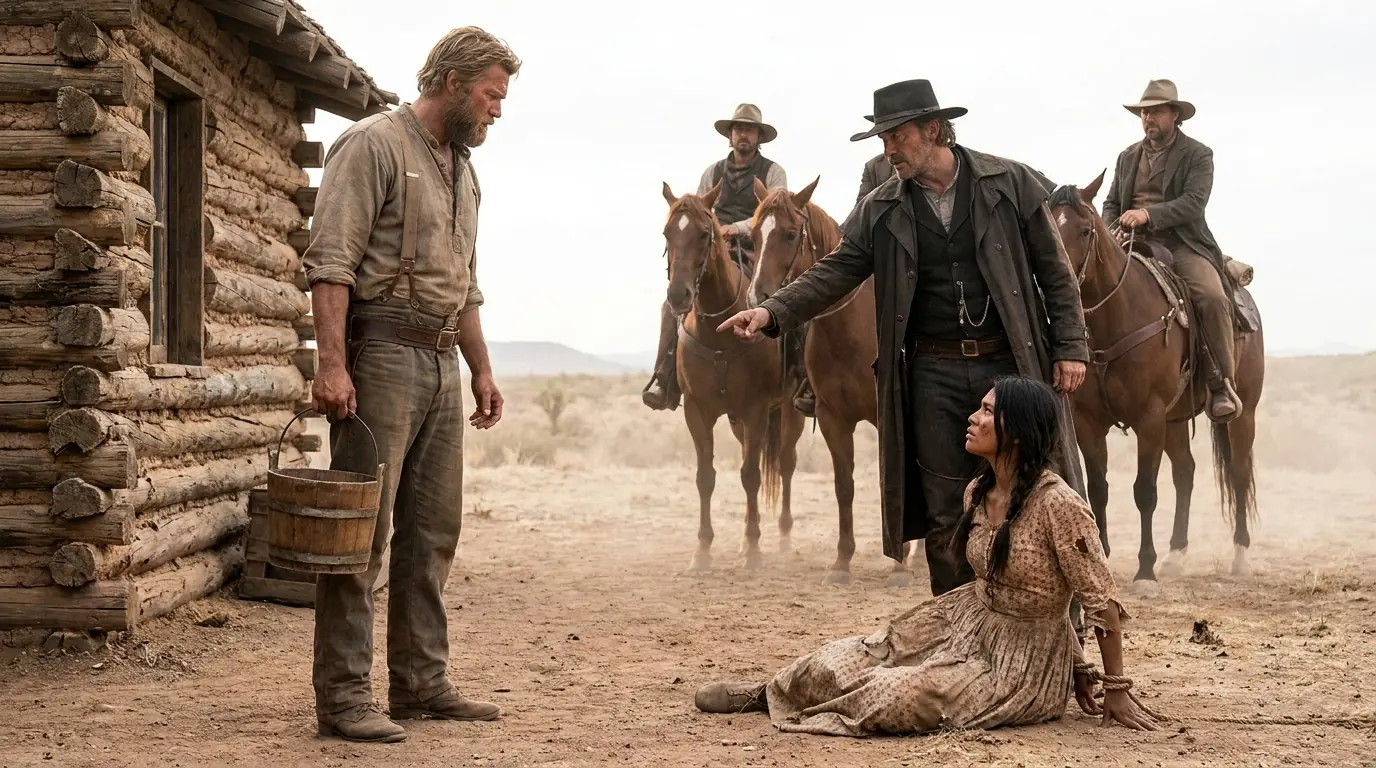
They reined in, the horses panting, heat shimmering off their coats. Hank Crow, Silas Dunn, Charlie Pemberton, men he once guided through Apache country. Crow grinned. Carter, remember that horse we owed you? We brought payment.
He yanked a shape from his saddle, a woman, wrists bound, hair matted with dust and blood. She fell hard to the ground. Debt settled, Crow spat, spurring away.
Nash didn't move for a long time. Then he cut the ropes. Her eyes, black as obsidian, met his, not afraid, only burning. Don't touch me, she rasped.
He said quietly, You'll die out here.
The San Simon Valley, midsummer of 1879, lay still beneath a sun that burned the world bone dry. The air shimmered above the cracked earth, where tufts of brittle grass clung to life among the yucca and mesquite. Even the wind carried no mercy, only dust, salt, and the faint metallic taste of heat.
Nash Carter's cabin crouched against a low mesa, a single room shelter built from hand-hewn logs and rock dragged from the canyon wall. The roof sagged where last winter's storm had chewed through it, and the well out front coughed more dust than water. Yet it was his, the only thing he hadn't lost when his brother died.
He moved with the silence of a man long used to being alone. His shoulders were thick, his beard sun-faded, and in his gray eyes there was the weary calm of someone who had seen too much. Once, he had served the cavalry as a scout and guide, tracing Apache trails through lands that didn't belong to him.
The memory of his brother's death in one of those skirmishes had never left. It sat behind his ribs like an unburied stone. So he'd left the army, left people, and come here where guilt had room to breathe.
Now, as the woman lay motionless in the dirt outside his cabin, that stillness broke. Nash knelt beside her, cutting through the rawhide binding her wrists. Beneath the grime, her skin was bronzed by sun and wind, marked with faint scars that told of a hard life.
Her hair, thick and black, clung to her neck in tangles. When he lifted her slightly to give water, she shuddered but didn't flinch. Her lips were cracked, yet when she spoke, the words came sharp. Don't pity me.
I don't, he said. Just trying to keep you alive.
She looked away toward the mesas, where the last light bled over the horizon. Something proud lived in that gaze, a defiance that refused to die even when her body trembled.
He carried her inside, laid her on the narrow bed once belonging to his brother. The small room smelled of dry pine and smoke. He tore a strip from his shirt to bandage her wrists, then left a tin cup of water on the stool.
Before he stepped out, he asked quietly, What's your name? For a moment she didn't answer. Then, in a low, rasping voice, Kaya.
He nodded once. Nash.
Outside, the desert turned black. Coyotes called from the flats, and a warm wind rattled the shutters. Inside, the firelight trembled over two people who didn't yet know that the night had bound their fates tighter than any rope.
The night deepened, heavy with the scent of dust and smoke. Inside the cabin, Nash Carter sat beside the hearth, feeding the fire one dry stick at a time. The flames hissed, throwing restless shadows along the log walls.
On the bed, Kaya stirred, her breathing ragged from fever. Every few moments, she murmured something in a language he didn't understand, soft, rhythmic, like a prayer whispered into wind.
When she woke, her eyes were unfocused, then sharpened on him like the edge of a blade. You still here.
Fire needs tending, he said simply.
She pushed herself upright with effort, the blanket slipping from her shoulders. You're guarding me.
He looked into the fire. I'm making sure you don't wander off and die on my doorstep.
Her mouth tightened. If I did, that wouldn't be your burden.
I've carried heavier ones. His tone was dry, but something behind it hinted at truth.
Kaya turned her gaze toward the flames. You speak like a man who's been left alone too long.
Nash didn't answer. The fire cracked between them.
After a moment, he reached for the kettle, poured a little hot water into the tin cup, and handed it to her. She hesitated before taking it, eyes never leaving his. Her hands were small but calloused, wrists bruised deep purple.
She sipped slowly, wincing when the heat met her cracked lips.
He stilled. Was.
Then you know what they do to my people.
Nash looked at her, really looked. The fire caught the hard shine in her eyes, the thin scar along her temple, the stubborn line of her jaw.
I know what men do to other men when someone tells them it's for peace, he said.
That silenced her. She turned away, drawing the blanket closer.
Outside, the coyotes cried again, long, mournful notes swallowed by the open night.
After a while, she spoke quietly. The men who brought me here, you know them.
He nodded. Rode with them once, before I learned the kind of debts they like to collect.
She studied him, her expression unreadable. Why help me? Then you owe them nothing.
Maybe I owe myself something, he said.
For a heartbeat, the air between them shifted, not soft, but aware. The flickering firelight painted his face in amber, catching the hollow shadows beneath his eyes.
Kaya watched the way he looked at the flame, not her, as if afraid of what he might find there.
She set the cup down. Don't think saving me will wash whatever ghost you carry. I'm not that foolish.
He stood, pulling his coat from the chair. Get some sleep. The desert doesn't forgive the weak.
She lay back, eyes tracing the low ceiling. But before he reached the door, her voice came again, quieter, almost gentle.
In my tongue, there's a word, Ashe. It means thank you, but it's said only when you mean it with your life.
He paused. Then I'll remember it.
Nash stepped out into the open night. The stars hung low over the mesa, fierce and cold. He could still hear her breathing behind the thin wall, could still feel the echo of her words in the dark.
For the first time in years, he realized he wasn't alone, and that unsettled him more than the silence ever had.
Days stretched long under the desert sun, each one quiet, each one edged with slow feet, unspoken change.
Kaya healed quickly, too quickly, Nash thought. Her spirit refused stillness. Once strong enough to walk, she began tending to the cabin as if she had always belonged there, sweeping sand from the corners, patching torn curtains with thread she found in his old army kit, drawing water from the stubborn well with a grunt of defiance.
Nash pretended not to notice. He fixed the corral fence, sharpened his axe, mended his saddle strap, anything to keep his hands busy while his mind circled around the stranger who now shared his silence.
At first, she spoke little. When she did, it was often sharp, as if words were arrows she couldn't blunt.
But sometimes, when the wind shifted and the light softened, she would hum low, melodic sounds that drifted through the dry air like forgotten prayers.
One evening, Nash returned from the canyon carrying a stack of mesquite wood. Kaya knelt by the doorway, rinsing a strip of cloth in a tin basin. Her sleeves were rolled to the elbow, and the sun painted copper along her arms.
As she reached up to wring the fabric, the motion revealed a narrow leather cord at her neck, a dark thong carved with the shape of a double-headed thunderbird.
He paused. That symbol, he'd seen it before, inked on maps, marked dangerous territory. It was said to belong to a high family among the Apache.
He looked away before she noticed his stare.
That night, she caught him watching. You think you know what that means?
I know enough to stay out of trouble, he said.
Kaya's lips curved faintly, though not in amusement. Trouble finds men who hide from it.
He met her gaze. You speak from experience.
She didn't answer. The silence between them wasn't cold this time, just full, like rain before it falls.
A week later, Kaya approached him with her hair braided neatly and a steady look in her eyes. I'm coming with you, she said.
Where?
To Dry Hollow. You need salt.
I need to breathe air that's not your roof.
Nash frowned. That town's not kind to your people.
She shrugged. If the world calls me a slave, then I'll walk into it on my own feet.
Something in that defiance tugged at him, not pity, not admiration exactly, but the memory of courage he'd once known in himself.
He exhaled, long and low. Fine. But you stay close.
The ride took half the day. The valley unfolded before them, a land of pale stone and burnt red mesas.
When they reached the outskirts of Dry Hollow, the street froze. Miners, drifters, and storekeepers turned to stare. A white man and an Apache woman riding side by side, it was a sight that bent the rules of the frontier.
Kaya sat straight in the saddle, chin high. Nash saw her hands tighten on the reins, but said nothing.
They tied their horses outside Able Moore's General Store. The bell above the door clanged as they entered.
Moore, a heavy man with greasy hair, looked up from behind the counter. His smirk came slow. Well, I'll be damned. Carter, you bringing her in to sell?
The room went still.
Nash's voice came calm, but cold. I came for salt and cartridges, not talk.
Moore spat tobacco into a can. Could have fooled me.
Kaya said nothing, her gaze fixed somewhere over the man's shoulder.
Nash set his coin pouch on the counter. Just bag what I asked for.
Before Moore could move, the door creaked again. Boots struck the floorboards with a sharp rhythm of authority.
A young officer stepped inside, uniform pressed, silver insignia gleaming. Lieutenant Marshall Keen, U.S. Cavalry, he announced, by order of Fort Bowie. Any native found outside reservation bounds is to be detained.
Kaya's fingers closed around the edge of the table.
Easy, Nash said softly, without looking at her.
Keen's eyes slid toward Nash, recognition flickering. Carter, you're the scout who quit the service, aren't you? Interesting company you keep.
Nash's tone stayed even. She's under my care.
That so? Keen stepped closer. Then you're obstructing military law.
His hand brushed the holster at his side.
A faint click broke the silence, the metallic whisper of a Colt's hammer being drawn back.
Try, Nash said quietly. His revolver was already leveled, steady as the horizon.
The store seemed to shrink around the sound of breathing.
For a long second, no one moved.
Then a quavering voice broke in, Old Harlan Webb, the saddlemaker, standing by the doorway. That's Nash Carter, Lieutenant, the man who guided your regiment through San Pedro Canyon two summers back.
Keen's smile thinned, his pride wounded. Then he should know better than to defy his own uniform.
He backed away a step, eyes hard. I'll remember this, Carter.
He turned on his heel and left. The bell above the door jingled, a sound absurdly gentle in the tense quiet.
Kaya exhaled slowly, shoulders still rigid. You shouldn't have done that.
Too late, he said, holstering his gun.
Outside, the street had already begun to whisper. Faces followed them as they mounted up, suspicion, curiosity, fear.
By the time they reached the open plains again, the sun was low. Dust swirled behind their horses, glowing copper in the light.
Kaya finally spoke. Now they'll come for you.
They always do, Nash said, eyes on the horizon. The trick is being ready before they ride.
She looked at him for a long moment, the wind tangling her hair, then said softly, You sound like a man who's tired of surviving.
Maybe I am.
And for the first time, she didn't argue.
The wind came first, low and distant, a dull moan sliding over the mesas. By the time Nash Carter stepped outside the cabin, the light had turned the color of copper ash.
The horizon swelled with a wall of dust, curling and boiling like smoke from some buried fire. He knew that sound, the voice of the desert when it meant to swallow everything.
Inside, Kaya stood by the window, her braid unbound, the double-headed thunderbird glinting at her throat.
It's a sandstorm, she said quietly.
More than that, Nash replied, squinting toward the dark edge. Storms riding horses.
And indeed, beneath the roar, came the rhythm of hooves, faint at first, then pounding, a formation, soldiers.
They came hard out of the west, Lieutenant Keen at the front, six cavalrymen at his back. Their faces were wrapped in scarves, rifles slung low. The desert light burned white across their buttons.
Stay inside, Nash said.
Kaya reached for his arm. You can't fight them.
I'm not planning to. He checked his rifle, chambered one round, then another. But I won't hand you over, either.
He met her gaze, dark eyes filled with fear that refused to show itself. For a brief, dangerous second, he saw more than defiance in them. He saw trust.
When the first shots cracked through the dust, Nash grabbed her hand. This way.
They ran out the back, bent low against the screaming wind. Sand bit their skin like glass. The air was thick with it, choking, blinding.
Nash half dragged her toward the narrow canyon cleft behind the ridge, a place he knew from years ago, a wound in the land too tight for horses.
Keen's voice rang somewhere behind them, faint, but furious. Find them, inside the canyon.
The storm howled like a living thing. Dust clouded the air into a yellow haze.
Nash pulled Kaya into a hollow between rocks. She coughed, covering her mouth with her sleeve.
We'll wait it out, he said.
Blood streaked the side of her arm, a grazing wound, fresh. He tore a strip from his shirt and pressed it against the cut.
You're hurt.
I've been hurt before. Her breath came shallow. Why, Nash, why risk this?
He tied the bandage tight. Because I couldn't save the last one.
Her eyes narrowed. The last what?
My brother, he said, voice roughened by the storm. He died because I obeyed orders instead of heart. He trusted me to see the truth before it was too late.
Silence. Only wind.
Kaya's voice softened. And now?
Now I listen to the right thing, even if it kills me.
For a long moment, she looked at him, really looked, as though the storm itself had peeled both of them raw.
Then she reached out, touched his hand lightly where the skin was torn from the rope of his rifle.
You carry ghosts, she whispered, but they've carried you too far from life.
The wind roared louder, drowning her words.
He leaned close, hearing only fragments. You deserve to live.
Something broke in him then, a dam built from guilt and years of solitude. He brushed his thumb against her cheek, wiping grit from her skin.
She didn't pull away.
Outside, thunder rolled through the dust like distant artillery. The canyon flickered with brief flashes of lightning, dry fire leaping from rock to rock.
When the noise finally eased, the air heavy and still, Nash peered out. The soldiers were gone. Only the storm's tail dragged across the plain, leaving the world washed in a dim red haze.
He turned back to Kaya. She sat beside the wall of stone, her eyes closed, lips moving in a slow chant.
What are you saying?
It's a song, she murmured, opening her eyes. For the young dead, to tell the wind not to take them too soon.
Her voice was hoarse, but steady. The melody rose and fell like the breathing of the earth itself.
Nash listened, something tight inside him loosening with every note.
When she finished, he said softly, You sing like you believe someone still listens.
I do, she answered. The land listens when men don't.
He nodded, glancing toward the fading storm. Then maybe tonight it heard both of us.
They stayed hidden until the stars returned. The desert was quiet again, as if nothing had happened.
Nash helped her to her feet, and together they walked back toward the cabin through the wreckage of sand and broken branches.
The roof had half collapsed, the door swinging loose. He fixed what he could, and by the time the fire was lit again, both of them were too tired for words.
Kaya sat near the flames, her bandaged shoulder bare.
When you looked at me out there, she said quietly, I saw a man who'd stopped running.
He met her eyes across the glow. Maybe because I finally found something worth standing still for.
Her breath caught, barely audible.
For a moment, the world shrank to the space between them, the low crackle of fire, the faint scent of sage in her hair, the tremor of something neither dared to name.
Then she looked away, whispering, Don't say things that can't live outside these walls.
Maybe that's the only place they ever could.
The fire popped, sending sparks into the dark.
Outside, the wind had calmed, and the stars blinked away above the valley, cold, endless, mercifully silent.
The storm passed, but its echo lingered in the torn roof, in the broken corral gate, in the silence that followed too quickly after violence.
For three days, the wind stayed quiet, as if the valley itself was listening.
Kaya slept through the first day, fevered and restless. Nash kept the fire low, changing the cloth on her shoulder, forcing her to drink when she stirred.
He'd done this before, long ago, tending to a dying brother whose blood couldn't be stopped. But this time was different. This time, the one he guarded still had fight in her eyes.
By the second morning, she was awake, weak, but steady. She watched him while he sharpened his knife near the door.
You didn't have to stay, she said.
He didn't look up. I didn't know where else to go.
She smiled faintly, tracing the edge of her bandage. You sound like a man who lives by accident.
He glanced at her then, meeting the weight of her gaze. Maybe I do.
That evening, they sat outside by the small fire pit. The desert was cool now, the kind of quiet that made a man hear things inside himself.
Kaya stared into the flames, her expression distant.
When I was a child, she began softly, my father taught me the word Dasaan. It means leader, but it isn't just a title. It means the one who walks in front of danger so others can live.
Nash turned to her slowly. Dasaan, your father's name.
She nodded. He was the head of our people. He fought when they tried to move us north. When I was captured, I thought he was dead.
Her eyes glistened in the firelight, not from tears, but from memory. If he still lives, he'll come for me.
Nash leaned forward, elbows on his knees. And if he doesn't?
Then I'll walk back alone.
There was no fear in her voice, only certainty.
He felt something twist inside him, a strange ache that wasn't quite admiration or sorrow, but both.
The third day dawned blood red.
At first, Nash thought it was just the sunrise burning against the mesa, until he saw three riders crest the ridge.
He stood, hand near his rifle.
Kaya rose, too, eyes narrowing. They're not soldiers, she whispered.
The men rode slow and straight, wrapped in dark blankets that shimmered with silver thread. At their head sat Yoska, an elder with long gray braids and the calm of stone.
When they halted, he dismounted and spoke in a voice that rolled like deep water. We come for the daughter of Chief Dasaan.
Kaya's breath caught. Yoska, she said, stepping forward, disbelief breaking into joy. You're alive.
The old man's eyes softened. You as well, Ta, child of thunder.
Nash stayed still, his fingers tense on the rifle strap.
Yoska turned toward him. You are the white man who cut her bonds?
I am.
You harmed her?
No.
Yoska nodded once. Then part of your soul belongs to her now. To save a life is to tie breath to breath. Among our people, that debt cannot be broken.
Nash met his gaze evenly. Then I'll carry it.
The old man studied him for a long moment, then said quietly, Not all men of your kind would.
Before they could speak further, a faint tremor ran through the ground, hoofbeats again.
Nash's jaw tightened. They came back.
Over the ridge, the glint of metal flashed, Lieutenant Keen and his riders, six soldiers cutting through the valley dust.
Get behind me, Nash said.
Yoska raised a hand. No. Let us see how far courage rides in that man's heart.
Keen's horse slid to a halt twenty paces away. His voice rang sharp. Step aside, Carter. The woman comes with us.
Nash didn't move. You'll have to drag her over me.
Keen sneered. You think a few savages and an ex-scout can stop the U.S. cavalry?
Yoska said something in Apache, a word like thunder breaking.
From the cliffs above, three warriors rose into view, bows drawn, arrowheads glinting in the sun.
One shaft hissed through the air and struck the sand an inch from Keen's boot.
The lieutenant's horse reared, nearly throwing him.
Another arrow sliced the feather off his hat.
The soldiers hesitated, their nerve faltering.
Nash's voice was calm, but iron hard. Next one won't miss.
Keen glared, face white beneath the dust. You're a fool, Carter. You've chosen the wrong side.
Maybe, Nash said, lowering his rifle just enough to make the choice final. But it's the only side I can live with.
Keen's mouth twisted. He yanked his reins and wheeled his horse. Let's go.
They rode off into the glare, swallowed by distance.
Silence fell again, heavy and clean.
Yoska turned to Nash, his voice solemn. You have chosen well, even if the world will hate you for it.
I'm used to that, Nash replied.
The old man smiled faintly. Then may the land remember your name.
He looked to Kaya. Your father still lives. He waits at the San Pedro, too weak to travel. Come home, child.
Kaya's eyes filled with a light that was half relief, half sorrow.
She looked toward Nash, who stood with the rifle at his side, wind tugging at his hair.
When the sun touches that ridge, Yoska said, we leave.
Kaya nodded slowly. Then I'll be ready.
Yoska and his men rode off toward the canyon mouth, leaving the two of them alone again.
The valley glowed orange with dusk.
Nash stared into the fading light, then said, almost to himself, Guess that's how it ends.
Kaya stepped closer. For me?
Maybe. Not for you.
He turned. You're free now.
Her lips curved in a sad smile. Freedom isn't a place, Nash. It's a wound that keeps healing.
They stood there, the wind between them like breath held too long.
When she finally turned to go inside, she said softly, Sleep easy tonight. The desert knows who its friends are.
And for the first time in years, Nash believed it might be true.
Morning broke in silence, a pale, washed-out light spilling over the San Simon Valley, painting the land in colors of bone and ember.
The storm had scoured everything clean. Even the air smelled new.
Nash Carter woke before dawn, as he always did. He stepped outside, the ground cool beneath his boots, and watched the horizon breathe open.
The world felt too still, the kind of stillness that comes before goodbye.
Inside, Kaya was already awake, packing a small leather satchel. Her movements were quiet, deliberate, as though she feared the noise of leaving might make her heart falter.
When she saw him in the doorway, she paused. Yoska will be here soon, she said.
He nodded. I figured.
Neither spoke for a while. The only sound was the kettle hissing over the fire, and the far cry of a hawk circling somewhere beyond the mesa.
Finally, Nash said, Your father's lucky. He's got a daughter who'd cross hell to find him.
She smiled faintly. You make it sound brave.
It is.
Kaya's eyes softened. Then what about you, Nash Carter? Will you keep living like the land owes you forgiveness?
He didn't answer. The truth was too heavy for words.
She stepped closer, the scent of sage clinging to her skin. Maybe the land forgave you already, she whispered. You just haven't learned to forgive yourself.
He almost smiled. You think that's easy?
No, she said gently, but easy isn't what makes it worth doing.
The rhythmic drumming of hooves came from the valley floor. Yoska and his riders were returning, dark shapes against the light.
Kaya turned toward the door. When the sun touches that fence, she said quietly, I'll go.
Nash nodded again.
He wanted to speak, to say stay, to ask her what would happen if she didn't, but his voice betrayed him.
So, instead, he went to the old table by the wall, the one that still held the marks of his brother's knife.
He reached into the drawer and drew out a folded square of faded cloth, a blue neckerchief, once belonging to the brother whose death had carved the silence inside him.
He placed it beside her satchel. Take this. It might keep the dust off your throat.
Kaya looked at it, then at him. I think it belongs here.
She set something down beside it, the leather cord, the Thunderbird charm gleaming faintly in the morning light.
My father carved it for me, she said. You saved his blood. Now, it should remind you that not everything you touch ends in loss.
Nash swallowed, eyes fixed on the charm. You sure?
She nodded. Among my people, giving away a symbol means you trust the spirit it carries. I trust you.
For a moment, he couldn't speak. His chest ached with a feeling too tangled to name.
Outside, Yoska called her name, low, patient, final.
Kaya slung the satchel over her shoulder and stepped to the doorway.
She looked back once more, sunlight tracing her outline in gold.
If I don't return, remember this. Some debts are not meant to be paid. They're meant to be lived.
He managed a rough smile. I'll keep the account open.
Her eyes shimmered, not with tears, but with something steadier, the kind of strength born from pain.
Goodbye, Nash Carter.
Safe trail, Kaya.
She turned and walked toward the waiting riders.
The Thunderbird charm caught the light one last time before she disappeared into the red dust of the valley.
When they were gone, Nash stood in the doorway for a long while, the silence pressing close around him.
Then he looked down at the table, at the two relics lying side by side, the blue neckerchief of his brother and the Thunderbird cord of the Apache woman.
One from blood, one from mercy. Both proof that life still found ways to give back.
He lifted the charm and tied it to the wooden post beside the window, where the wind could move it freely.
The carved wings caught the morning light, casting a small shadow that trembled like flight.
Outside, the valley shimmered under the sun. The ground that had cracked from drought now showed faint veins of green, tiny shoots pushing through the dust, fragile yet alive.
Nash crouched, brushing his fingers against them.
Well, he murmured, looks like even this desert gets second chances.
The wind stirred, warm and steady, carrying the faintest echo of a voice, a woman's voice, singing somewhere far away, a song about freedom and the wind's forgiveness.
He smiled, for real this time, not the tired smile of a man surviving, but the quiet one of a man beginning again.
And when he turned toward the mesa, the sun was already climbing, bright, merciless, and full of promise.