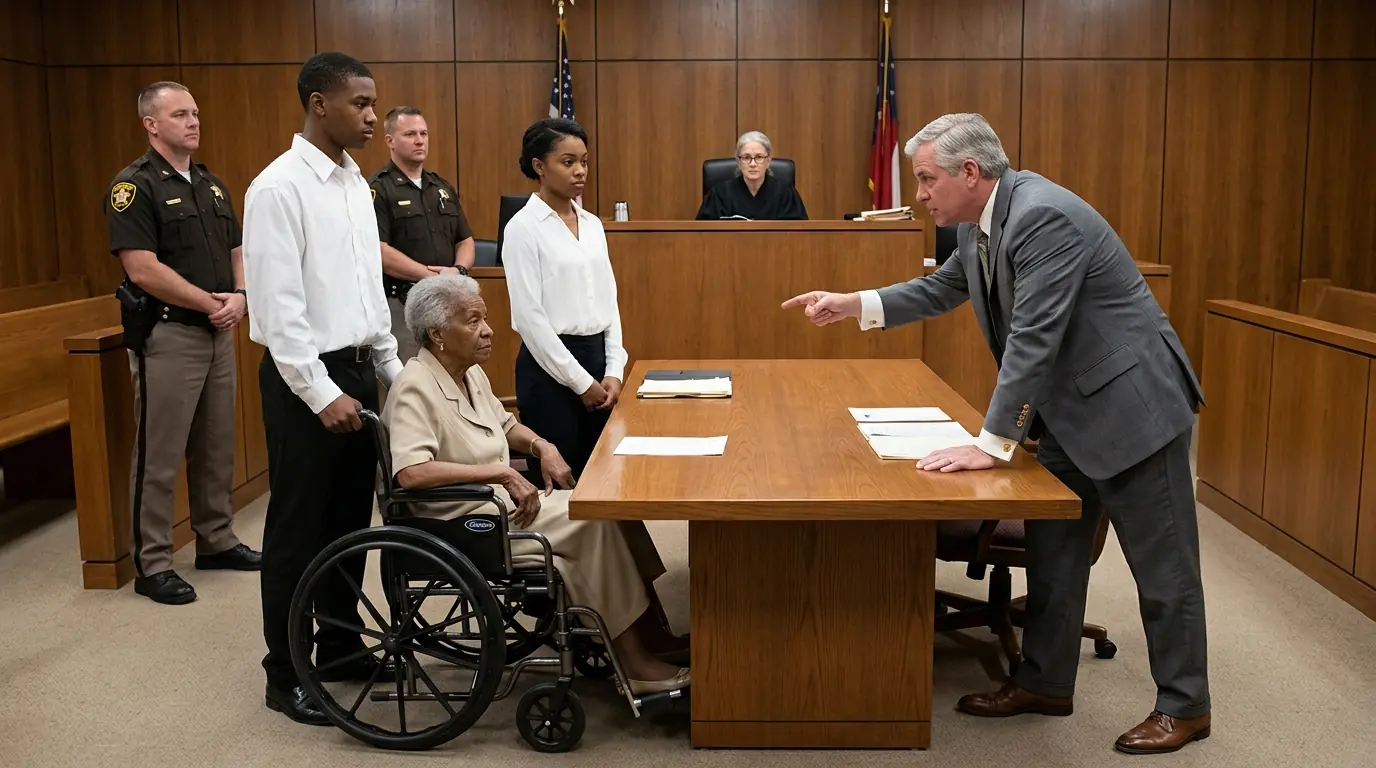
Get these black kids out of my courtroom. Your honor, this is a courthouse, not a daycare. Wesley Lewis stood still, 18 years old, white shirt, hands steady. We're here to represent our grandmother, sir. Gerald turned slowly, looked Wesley up and down like something stuck.
Represent? You can barely represent yourselves in decent clothing. The courtroom laughed, everyone, even the bailiff smirked. Willa picked up the papers Gerald had knocked off their table. Wesley didn't move, didn't blink.
Their grandmother watched from her wheelchair, silent, her paralyzed right hand resting where it always rests. Nobody in that room knew it yet, but those scattered papers held one question that would end Gerald Haynes's career before lunch. Colton Springs, Georgia, a small town where everybody knows your name, and your skin color decides how they say it. Cedar Hill sits on the east side of town, 2.4 acres of red Georgia clay, old oak trees, and a white clappered house with a porch swing that hasn't stopped creaking in 40 years. Dorothea Lewis bought that land with her husband in 1962, back when a black couple buying property in Colton Springs meant signing papers in a back room while white folks used the front door.
Her husband worked three jobs to make the payments. He never missed one. Three generations grew up on that porch. Dorothea raised her daughter there. Her daughter raised twins there.
And when a car accident took the twins' parents 12 years ago, Dorothea raised Wesley and Willa there, too. She was 63 then, already tired, already grieving. She raised them anyway. Dorothea taught elementary school for 38 years in Colton Springs. Every black child in town passed through her classroom at some point.
She taught them to read. She taught them to speak up. And every single one of them called her Miss Dot. In 2019, a stroke took the use of her right hand completely, permanently. She learned to write with her left hand at 70 years old.
Her signature changed, shaky now, tilted left, nothing like before. But she still made breakfast every morning for Wesley and Willa. Still sat on that porch swing. Still told them the same thing their grandfather used to say. This land is paid for.
This land is ours. Don't you ever let nobody take it with a pen. Wesley was the quiet one. The kind of quiet that makes people nervous because they can't figure out what you're thinking. He started reading law books at the public library when he was 14.
Not for school. Not for a grade. Because one day he watched a landlord threaten Miss Alma down the street with an eviction notice. And nobody could tell him whether it was legal or not. So he decided he would know.
By 18, Wesley had read more Georgia property code than most first-year law students. He kept a brown leather notebook. His grandmother gave it to him on his 16th birthday. Every page filled with case notes, statutes, questions. Willa was different.
Willa was sharp the way a blade is sharp. Fast, precise, and impossible to ignore once she moved. She had a photographic memory. Read a page once, remembered the whole thing. While Wesley studied the law, Willa studied the system.
County records, public filings, online databases. She could find a document the state forgot it had. Together, they were something nobody in Colton Springs expected. But Colton Springs wasn't paying attention to Wesley and Willa Lewis. Colton Springs was paying attention to Brent Calloway.