By the time Deputy Wade Crowley pushed through the front door of the Iron Mule, Ray Garrett had already decided he wanted one beer, ten quiet minutes, and nothing else from the night. The old bar sat off a two-lane eastern Kentucky highway where the mountains seemed to lean close to the asphalt, and by eight o'clock the October dark had swallowed everything beyond the neon beer signs in the windows.
Inside, the place smelled of wood smoke, engine oil, wet leather, and the faint sour trace of beer that had seeped into the floorboards over fifteen hard years. Ray sat at the far end of the counter in a faded denim cut worn nearly gray, one hand around a longneck bottle, the other resting beside a set of Harley keys polished smooth by decades of use.
Outside, his 1976 Shovelhead cooled under a yellow parking-lot light. The black paint had been rubbed dull on the tank where his knees had gripped it for more than twenty years, the chrome was freckled with age, and the seat carried so many repairs that no two rows of stitching matched. Nothing about the motorcycle suggested money, but the engine idled cleaner than machines half its age because Ray had rebuilt it more times than he could count.
He had spent most of his life with grease beneath his fingernails and the sound of old V-twins in his ears, and at fifty-six he had stopped caring whether strangers understood the difference between worn-out and well-kept.
The Iron Mule's jukebox was playing low enough for conversation when Crowley entered with Deputy Tom Beech at his shoulder. Crowley was thirty-eight, broad through the chest, wearing the easy confidence of a man who had been protected by the same county name for most of his adult life. His uncle was the sheriff, and people along that stretch of highway had learned that Crowley treated the badge less like a duty than a family inheritance.
Beech, seven years younger, followed half a pace behind him and watched the room with the nervous alertness of someone who had not yet decided what kind of deputy he intended to become.
Crowley stopped just inside the doorway and breathed through his nose as if the bar itself had offended him. “Smells like motor oil and unemployment,” he said. A few men at the pool table looked over, then looked away, and Frank Dwyer continued wiping a glass behind the counter as though no one had spoken. Ray lifted his beer, drank once, and kept his eyes on the old television above the backbar, where a baseball highlight reel flickered without sound.
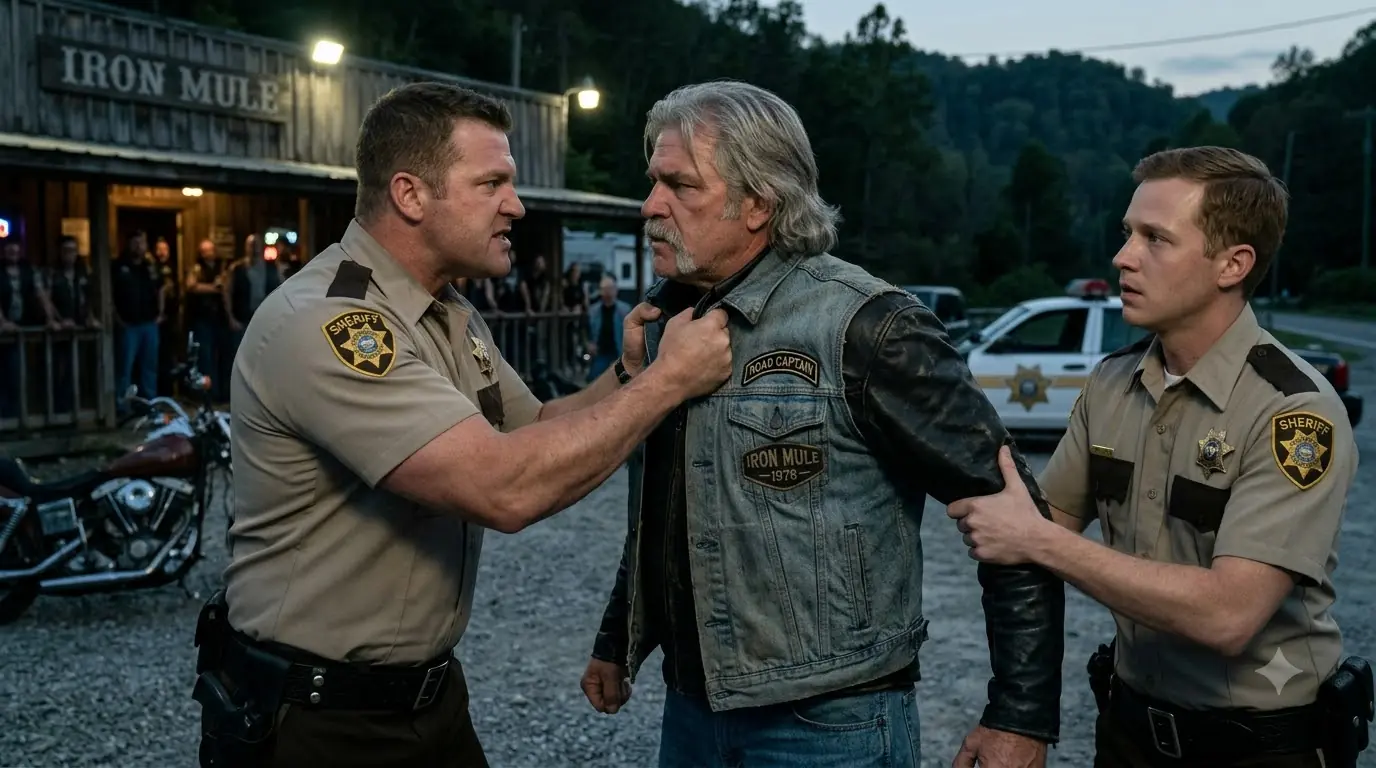
Crowley noticed that indifference and immediately disliked it. His gaze moved over leather jackets, patched denim, engineer boots, motorcycle keys, and the framed photographs that covered almost every wall. Then he saw the faded lettering on Ray's vest. ROAD CAPTAIN sat above an older patch that read IRON MULE — 1978, the thread sun-bleached and frayed around the edges.
“Road Captain?” Crowley asked, stepping closer. Ray finally turned his head. “Used to be.” Crowley smiled without humor. “Used to matter too?” Ray studied him for a moment, his gray hair brushing the collar of his black leather jacket, thick moustache unmoving. “Depends who's asking.”