"Move, you crooked judge. This courtroom isn't your church, and that bench doesn't make you better than us. " Officer Travis Cole's fingers bit into Judge Margaret Bennett's shoulder hard enough to twist her sideways as Officer Nolan Pierce clamped down on the other, hauling her up from the bench in front of her own packed courtroom. The cuffs clicked once, sharp and metallic, while Cole leaned close, his breath hot with coffee and contempt. "Let's see how much attitude you have without your little wooden hammer," he said, loud enough for every lawyer, clerk, and defendant to hear. Margaret's black robe bunched under their fists, her face calm even as the warrant Pierce waved shook with his own excitement.
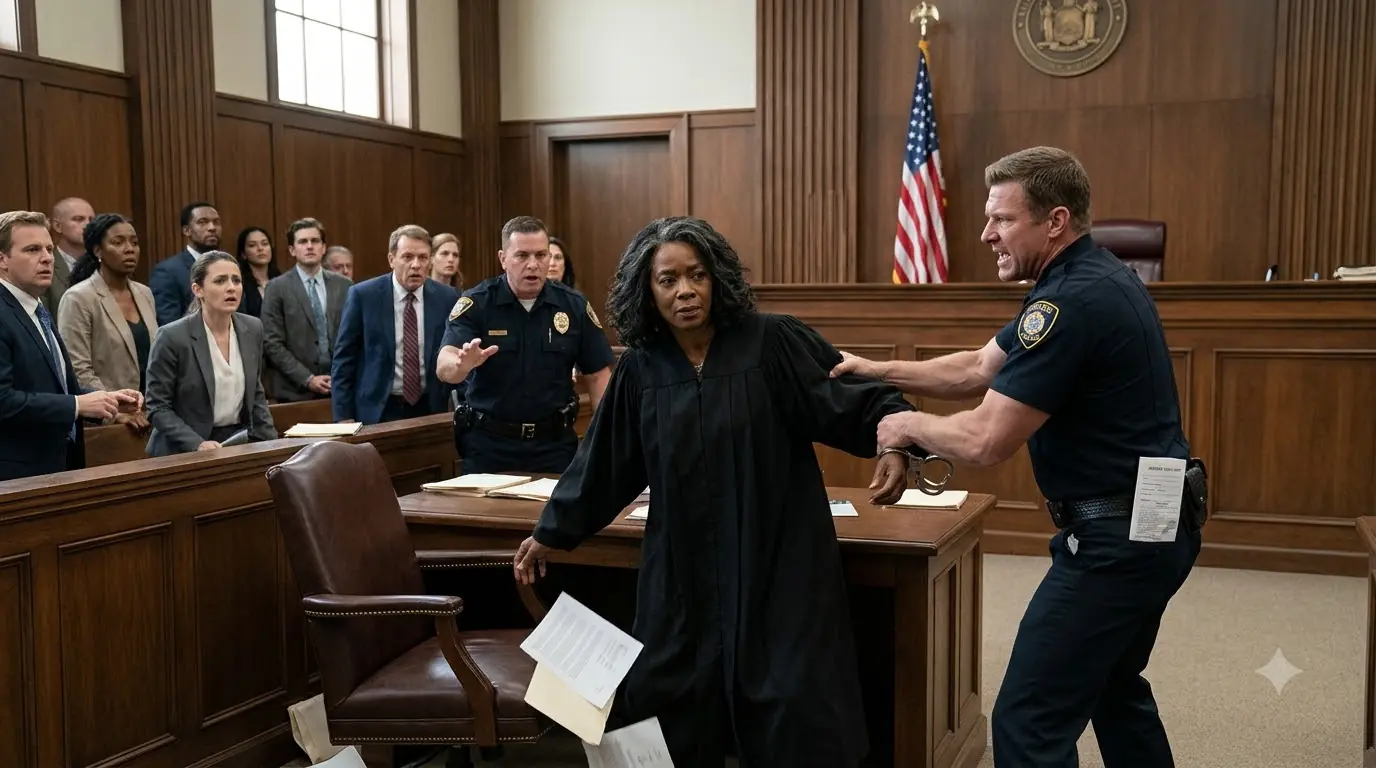
Around her, no one moved. Even the bailiff looked terrified to breathe. They thought they were parading a disgraced nobody out of court, never realizing they were laying hands on the one person who could bury them both.
Long before the day two police officers forced their way into her courtroom, Judge Margaret Bennett had learned that the law was often tested in quiet rooms rather than dramatic ones. She had grown up in a narrow brick house near the east end of Bellwether, a manufacturing city where factory whistles once regulated entire neighborhoods. Her father repaired railroad signals and her mother supervised the night shift at a county nursing home. They did not speak about justice as a noble abstraction. They spoke about it when a landlord refused to repair a furnace or when a worker lost a paycheck because his supervisor had decided not to listen.
Margaret remembered one winter when her father arrived home with an injured hand and a letter explaining that the company had found his accident preventable. He was offered enough money to replace two weeks of wages if he would sign a release. Her mother read the letter three times and called a legal-aid office before anyone signed anything. The lawyer who helped them was young, exhausted, and working from a room above a grocery store. He found an inspection report the railroad had not disclosed, and the report changed the settlement. Margaret was eleven when she learned that a piece of paper could be more powerful than an important person's certainty, but only if somebody insisted on reading it.
She eventually went to law school in Ohio and returned to Bellwether rather than accept a position at a larger firm. As a public defender, she spent mornings in crowded arraignment rooms and evenings explaining to frightened families that the first court appearance did not decide a person's whole future. She saw guilty defendants who needed fair hearings and innocent defendants who had already lost their jobs because nobody had distinguished accusation from proof. She also met police officers who worked patiently to protect people and understood that reliable investigations made convictions stronger. The distinction mattered to her long before she put on a robe.