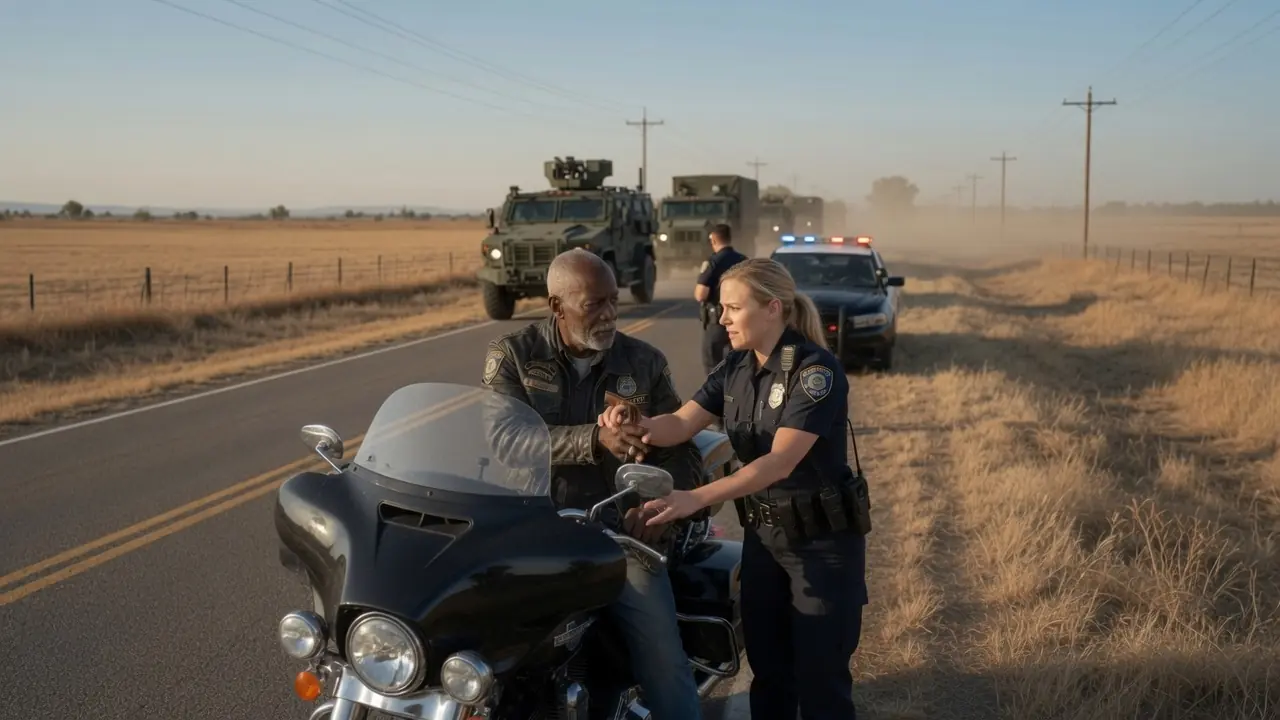
The first military vehicle appeared over the hill eight minutes after Officer Cole Mercer placed James Harris beside the guardrail.
It was a dark green Humvee with a small command flag mounted near the front. Behind it came two more Humvees, a troop carrier, and a black government SUV moving in tight formation along the state highway.
Cole stopped smiling.
His partner, Officer Daniel Ruiz, looked away from the elderly motorcyclist and stared at the approaching vehicles.
The convoy slowed.
Not gradually.
Every vehicle reduced speed at nearly the same moment, as if one command had passed through the entire line.
The lead Humvee activated its hazard lights.
Then the convoy turned toward the traffic stop.
Cole glanced at James.
The eighty-two-year-old man remained beside his motorcycle with both hands visible. His gray beard moved slightly in the highway wind, and his faded leather vest hung loosely over a clean denim shirt.
He did not look surprised.
That frightened Cole more than the convoy itself.
“Are they here for you?” he asked.
James looked toward the vehicles.
“I expect they were wondering why I was late.”
The black SUV stopped directly behind the patrol car.
A colonel stepped out first.
Then a brigadier general.
Cole’s hand dropped away from the citation book.
The general saw James standing near the guardrail.
His entire expression changed.
He moved quickly across the shoulder, stopped in front of the elderly man, and raised a formal salute.
“Sergeant Major Harris.”
James returned the salute slowly.
“General.”
The officers stood frozen.
The soldiers climbing from the other vehicles did not speak. Some of them recognized James immediately. Others noticed the old motorcycle and the name painted carefully on its fuel tank.
The general lowered his hand.
“Why are you standing on the side of the road?”
James looked toward Cole.
“The officer is still deciding.”
Eleven minutes earlier, the highway had been almost empty.
James Harris rode north beneath a pale September sky, keeping the old motorcycle at a steady fifty-two miles per hour.
The machine was a restored 1957 Harley-Davidson FLH, black with worn chrome and a deep engine note that sounded more like distant thunder than noise. James had owned it for forty-six years.
He had replaced the transmission twice.
Rebuilt the carburetor himself.
Repainted the fuel tank only once, after a storm damaged the shed where he kept it.
A small metal emblem was mounted beneath the handlebars.
It carried the insignia of the 1st Cavalry Division.
James wore no helmet because state law did not require one for riders his age, though a black half-shell was strapped to the rear seat. He preferred the wind against his face on quiet roads.
That morning, he had left his farmhouse before sunrise.
A pressed Army dress uniform hung inside a garment bag secured to the support vehicle traveling with the convoy farther south.
James could have ridden inside the government SUV.
The general’s staff had offered.
James declined.
He wanted to arrive on the motorcycle.
The dedication ceremony would begin at ten.
A new rehabilitation and training center at Fort Redstone was being named in his honor. It would serve wounded soldiers, military working-dog handlers, and veterans recovering from traumatic injuries.
James had argued against putting his name on it.
The committee had ignored him.
At 8:41, Officer Cole Mercer saw the motorcycle traveling ahead of the patrol car.
Cole was twenty-eight and had worked highway patrol for three years. He was energetic, confident, and increasingly convinced that confidence was the same thing as judgment.
His partner, Daniel Ruiz, had served almost nineteen years.
Daniel noticed the motorcycle.
He saw an elderly rider moving below the speed limit and maintaining a straight line.
Then he looked back at the report on the patrol computer.
Cole continued watching.
“Old guy on a bike like that.”
Daniel looked up.
“What about him?”
“Could be stolen.”
“Why?”
“That machine is worth money.”
“So?”
Cole accelerated slightly.
“You don’t see many eighty-year-olds riding collector Harleys.”
Daniel studied James.
“He looks like he’s been riding longer than you’ve been alive.”
Cole ignored the comment.
The motorcycle’s rear plate was clean and properly displayed. A veteran designation appeared in the corner.
Cole ran the registration.
The system returned:
1957 HARLEY-DAVIDSON
REGISTERED OWNER: JAMES EVERETT HARRIS
STATUS: VALID
No theft report.
No insurance issue.
No warrant.
Daniel saw the result.
“It’s registered.”
Cole continued following.
“Could be borrowed.”
“Borrowing a motorcycle isn’t illegal.”
“He touched the center line back there.”
Daniel turned toward him.
“No, he didn’t.”
“Close enough.”
Cole activated the lights.
James saw the patrol car in his mirror.
He signaled, slowed, and moved onto the shoulder beside an abandoned fruit stand.
Then he turned off the engine and placed both hands on the handlebars.
Daniel noticed the smoothness of every movement.
The old man had not hesitated.
He knew how to handle a traffic stop.
Cole stepped from the patrol car before Daniel finished unfastening his seat belt.
He approached with a slight smile.
“Nice ride.”
James looked toward him.
“Thank you.”
“You had to steal it.”
The old man’s expression did not change.
“No, Officer.”
“Mind telling me who it really belongs to?”
“It belongs to me.”
Cole looked at the worn boots, gray beard, and old leather vest.
“Sure it does.”
“The registration is in the left saddlebag.”
“License first.”
James reached slowly toward his vest.
“I’m removing my wallet.”
Cole rested one hand near his holster.
“Slowly.”
James gave him the license.
Cole read the name.
James Everett Harris.
Age eighty-two.
The address matched the registered owner.
Cole looked at the photograph.
Then at James.
“This license is current.”
“Yes.”
“That surprises me.”
James waited.
Cole walked toward the rear of the motorcycle and examined the plate.
Daniel joined him.
“Registration matches,” Daniel said quietly.
Cole opened the left saddlebag without asking.
James turned his head.
“I didn’t consent to a search.”
“I’m looking for the registration.”
“You asked where it was.”
Cole removed the document.
The registration matched the license.
The vehicle identification number matched the motorcycle.
Every fact confirmed James’s explanation.
Cole’s smile faded slightly.
Then he saw the patches on the leather vest.
One read:
U.S. ARMY RETIRED
Another carried the rank insignia of a command sergeant major.
A small cloth tab beneath it displayed the word RANGER.
Cole looked back at James.
“You military?”
“Retired Army.”
“What did you do?”
“A little of everything.”
Cole held up the registration.
“Step off the bike.”
Daniel glanced toward him.
“Why?”
Cole answered without looking at his partner.
“I need to verify the VIN.”
“It’s visible on the frame.”
“Then he can stand aside while I check it.”
James dismounted carefully.
His left knee did not bend easily, but he refused to use the motorcycle for support longer than necessary.
He stood beside the road.
Cole pointed toward the guardrail.
“Over there.”
James walked to it.
Daniel remained near the motorcycle.
“Cole, the number matches.”
“I haven’t checked it.”
“I checked it.”
Cole crouched beside the frame.
The number was old but readable.
It matched the registration exactly.
Still, he continued examining the motorcycle.
“What are you looking for?” Daniel asked.
“Altered plate. Ground serial. Something.”
“There is nothing.”
Cole opened the second saddlebag.
Inside was a folded rain jacket, a basic tool kit, and a polished wooden box.
James’s voice became firmer.
“Do not open that.”
Cole looked at him.
“What’s inside?”
“Personal property.”
“That answer makes me curious.”
“Curiosity is not probable cause.”
Daniel looked toward James.
The old man’s tone was calm, but it carried the authority of someone accustomed to being obeyed without shouting.
Cole removed the wooden box.
James stepped away from the guardrail.
“Put it back.”
Cole placed one hand on his Taser.
“Stay where you are.”
Daniel moved between them slightly.
“James, remain there for a moment.”
James looked at Daniel.
The use of his first name surprised him.
Not because it was disrespectful.
Because Daniel had spoken it with unease.
Cole opened the box.
Inside lay a folded American flag, several military ribbons, a silver identification bracelet, and a sealed envelope.
A medal rested beneath the flag.
Cole lifted it.
Daniel recognized the blue ribbon immediately.
“Put that down.”
Cole looked at him.
“What?”
“That’s the Distinguished Service Cross.”
James said nothing.
Cole examined the medal.
“You can buy replicas online.”
Daniel stared at him.
“The registration matches. The ID matches. Put his property back.”
Cole’s face hardened.
“He could be impersonating a veteran.”
James’s eyes changed.
Until that moment, he had responded with patience.
Now he looked at Cole with something colder than anger.
“You stopped me for allegedly touching a line.”
Cole remained silent.
“Then you accused me of stealing my own motorcycle.”
James pointed toward the wooden box.
“Now you are searching for a new offense because the first accusation failed.”
Cole replaced the medal carelessly.
The metal struck the side of the box.
James flinched.
Daniel noticed.
“What is the bracelet?” he asked.
James looked toward him.
“It belonged to a soldier who died before we could bring him home.”
Daniel lowered his eyes.
Cole closed the box.
“Why are you carrying medals on a motorcycle?”
“I’m attending a ceremony.”
“What ceremony?”
“At Fort Redstone.”
Cole laughed.
“That base is forty miles north.”
“Yes.”
“What kind of ceremony?”
James looked at his watch.
“One that will begin late if you continue.”
Cole walked closer.
“Is that supposed to intimidate me?”
“No.”
“You think being an old veteran puts you above the law?”
James studied him.
“No one is above the law.”
“Good.”
Cole removed his citation book.
“Then you won’t mind waiting while we verify everything.”
Daniel walked toward the patrol car.
“What are you doing?” Cole asked.
“Calling dispatch.”
“For what?”
“To verify him.”
Cole gave a dismissive shrug.
James remained near the guardrail while Daniel contacted the communications center.
“Confirm military status if available for James Everett Harris.”
The dispatcher paused.
Then came the sound of typing.
“Stand by.”
Cole began writing a citation for unsafe lane movement.
Daniel looked toward him.
“You’re citing him?”
“I saw the violation.”
“No, you didn’t.”
Cole lowered the book.
“You calling me a liar?”
“I’m saying the dash camera will show what happened.”
Cole glanced at the patrol car.
The forward camera was recording.
His expression tightened.
The dispatcher returned.
“Unit Twelve, be advised. The subject’s file carries a federal ceremonial-security notification.”
Daniel straightened.
“Repeat.”
“James Everett Harris is expected at Fort Redstone this morning. Military liaison has requested immediate notification if delayed.”
Cole stopped writing.
Daniel looked toward James.
The old man remained motionless.
“What kind of notification?” Daniel asked.
“Stand by for command contact.”
Cole took the radio.
“This is Officer Mercer. Is the subject under any restriction?”
“Negative.”
“Any warrant?”
“Negative.”
“Any reason we should detain?”
“Negative. Command contact is calling now.”
Cole returned the radio.
Daniel’s department phone rang almost immediately.
He answered.
“Officer Ruiz.”
A male voice spoke with controlled urgency.
“This is Colonel Andrew McKenna, Fort Redstone operations. Is Sergeant Major Harris safe?”
Daniel looked toward James.
“Yes.”
“Has he been injured?”
“No.”
“Why is he detained?”
Daniel hesitated.
“Traffic investigation.”
“What violation?”
Cole moved closer, trying to hear.
Daniel looked at the empty highway.
“That is still being determined.”
The colonel became silent.
“Our convoy is seven miles south of your position. We are on the way.”
Daniel lowered the phone.
“You called a military convoy here?” Cole asked.
“No. They were already coming.”
James heard the exchange.
He looked toward the road and sighed.
“I told them not to make a spectacle.”
Daniel approached him.
“Sergeant Major, are you carrying military identification?”
“Yes.”
“Why didn’t you show us?”
“You asked for my driver’s license.”
“You could have explained.”
“I did.”
James looked toward Cole.
“He decided the explanation was impossible.”
Cole’s face reddened.
“You could have said who you were.”
James remained calm.
“I said my name.”
The distant rumble arrived less than a minute later.
The convoy appeared over the hill.
Now, beside the traffic stop, Brigadier General Rebecca Shaw lowered her salute and looked at the open saddlebags.
The wooden medal box sat on the motorcycle seat.
Her expression darkened.
“Who opened that?”
Cole answered.
“I conducted a lawful vehicle investigation.”
General Shaw looked toward Daniel.
“Was the motorcycle reported stolen?”
“No, General.”
“Was there contraband?”
“No.”
“Did the registration match?”
“Yes.”
“Then what is the investigation?”
Cole spoke.
“He crossed the center line.”
James glanced toward the highway.
There was no painted center line on that section of road.
Construction crews had removed it two days earlier while resurfacing the pavement.
General Shaw looked down.
Then toward Cole.
“What line?”
Daniel closed his eyes briefly.
Cole stared at the dark strip of fresh asphalt.
“It was there farther back.”
“The patrol camera will show it,” Daniel said.
Cole turned sharply.
General Shaw looked toward James.
“Were you searched?”
“The motorcycle was.”
“Were you threatened?”
James considered the question.
“He placed his hand near the Taser when I asked him not to open the box.”
The general’s jaw tightened.
Cole stepped forward.
“General, with respect, this is a civilian traffic matter.”
“You are correct.”
The answer surprised him.
General Shaw turned toward the patrol officers.
“This is not military jurisdiction. I will not tell you how to perform your duties.”
She pointed toward James.
“But he was expected to lead a convoy onto Fort Redstone twenty minutes ago. Your department will receive a complete request for all reports and video connected to this stop.”
Cole looked toward the soldiers.
Several stood near the vehicles.
One of them carried a ceremonial flag.
Another held a framed photograph covered in protective cloth.
Cole noticed the words printed on the frame’s label.
COMMAND SERGEANT MAJOR JAMES E. HARRIS
CENTER FOR RECOVERY AND RESILIENCE
His face changed.
General Shaw continued.
“Sergeant Major Harris served thirty-four years.”
James looked uncomfortable.
The general ignored him.
“He completed three tours in Vietnam, later served as an instructor, and built one of the Army’s first formal programs for helping combat veterans return to duty after severe trauma.”
Cole looked toward the Distinguished Service Cross inside the box.
General Shaw saw him.
“That medal is not a replica.”
The highway seemed quieter.
“During an ambush in 1969, Sergeant Harris crossed open ground six times under machine-gun fire to recover wounded soldiers.”
James spoke softly.
“Five.”
General Shaw looked at him.
“You went back for Lieutenant Mercer.”
Cole’s head lifted.
The name struck something inside him.
“What did you say?”
James looked toward the young officer.
“Lieutenant Thomas Mercer.”
Cole’s expression emptied.
“My grandfather was Thomas Mercer.”
The general looked between them.
James studied Cole more closely.
“What was your father’s name?”
“David.”
James became still.
He knew the family.
Not well.
But enough.
Thomas Mercer had been twenty-four during the ambush. A round entered below his collarbone and collapsed his lung. He lost consciousness inside a field of burning grass while the unit withdrew toward cover.
James returned alone.
He dragged Thomas nearly seventy yards while bullets struck the ground around them.
Thomas survived.
He returned home, married, raised three children, and died many years later surrounded by family.
One of those children was David Mercer.
Cole’s father.
Cole stared at James.
“My grandfather told us someone carried him.”
James looked toward the open road.
“A lot of men carried one another that day.”
“He said a sergeant named Harris came back for him.”
James nodded once.
Cole took a step backward.
The citation book slipped from his hand.
No one spoke.
He looked toward the wooden box.
The silver bracelet belonged to Lieutenant Thomas Mercer.
His name was engraved on the metal.
James had carried it since Thomas gave it to him at a reunion forty years earlier.
“Why do you have his bracelet?” Cole asked.
“He asked me to keep it.”
“My grandfather survived.”
“Yes.”
“Then why—”
“He had another made after the war.”
James walked toward the motorcycle and lifted the bracelet.
“Your grandfather gave me this one because I carried his name in my pocket for three days while we waited to learn whether he would live.”
Cole stared at the engraving.
James held it out.
“Would you like to see it?”
Cole did not move.
Shame had replaced every trace of confidence.
“You saved my grandfather.”
James closed his fingers around the bracelet.
“I helped him get home.”
Cole looked at the old man’s face.
Then at the motorcycle he had accused him of stealing.
The medal he called fake.
The belongings he searched without permission.
“I didn’t know.”
James looked at him for a long moment.
“No.”
Cole swallowed.
“If I had known—”
James raised one hand.
“Do not finish that sentence.”
Cole stopped.
James returned the bracelet to the box.
“You are about to say you would have treated me differently.”
The young officer looked down.
“That should trouble you more than anything else that happened here.”
General Shaw remained silent.
Daniel watched James carefully.
The elderly veteran closed the box and secured it inside the saddlebag.
“I should not need to have saved your grandfather before you believe my registration.”
Cole’s face reddened with humiliation.
“I made a mistake.”
“You made several.”
“I’m sorry.”
James fastened the leather strap.
“An apology is the beginning of accountability. It is not the end.”
Daniel stepped toward him.
“Sergeant Major, I owe you an apology too.”
James looked at him.
“You did not begin the stop.”
“I let it continue.”
Daniel’s voice was quiet.
“I knew the registration matched. I knew there was no line violation. I waited until the situation became embarrassing instead of stopping it when it became wrong.”
James nodded slowly.
“That is honest.”
“It doesn’t excuse it.”
“No.”
Daniel accepted the answer.
A state patrol supervisor arrived several minutes later after dispatch alerted command staff.
Captain Elaine Foster reviewed the scene.
She ordered Cole to surrender his citation book and body camera. Then she secured the patrol-car footage before speaking privately with James.
“I understand you have a ceremony.”
“Yes.”
“I won’t delay you further.”
“I want the video preserved.”
“It will be.”
“All of it.”
“Yes.”
James looked toward Daniel.
“Including the moments when someone had the opportunity to intervene.”
Daniel lowered his eyes.
Captain Foster nodded.
James mounted the Harley.
General Shaw returned to the SUV.
The soldiers climbed into their vehicles.
Cole remained beside the patrol car.
Before starting the motorcycle, James looked toward him.
“What was your grandfather like after the war?”
Cole lifted his head.
“Quiet.”
James smiled faintly.
“He was loud before it.”
Cole almost smiled.
The expression disappeared.
“He never talked much about Vietnam.”
“Most of us didn’t.”
James placed both hands on the handlebars.
“He was a good man.”
“Did he ever talk about me?”
James considered the question.
“He spoke about his family.”
Cole’s eyes filled.
“He was proud of all of you.”
James started the engine.
The Harley’s deep rumble moved across the highway.
He pulled onto the road.
The military convoy followed behind him.
Not because James held active rank.
Not because the Army needed his protection.
Because hundreds of soldiers at Fort Redstone were waiting for an old man on a motorcycle to lead them toward a building created from lessons he had spent a lifetime learning.
Officer Cole Mercer remained on administrative leave while the department reviewed the stop.
The dash camera showed James maintaining his lane.
There had been no traffic violation.
Cole’s report draft included claims that the motorcycle appeared suspicious and the rider behaved evasively.
The audio showed James answering every question.
Investigators reopened nine previous complaints involving Cole.
Three drivers alleged he had extended stops after learning his original suspicion was wrong.
One was a teenager driving his mother’s luxury SUV.
Another was a mechanic transporting a restored sports car.
A third was an elderly veteran whose military plate Cole described as possibly fraudulent.
None of the complaints had been sustained.
Captain Foster ordered a broader review.
Daniel provided a complete statement.
He did not minimize his role.
That decision cost him a temporary suspension but prevented the investigation from becoming another protected narrative.
Cole faced termination.
James did not request it.
He did not request leniency either.
When asked what outcome he wanted, he answered carefully.
“I want the department to determine whether he can learn to carry authority without needing people to fear him.”
The final decision removed Cole from patrol for one year.
He lost seniority and completed extensive retraining in constitutional law, bias recognition, report integrity, and intervention.
He also spent six months assigned to the veterans’ transportation office, helping elderly and disabled former service members reach hospitals, benefits hearings, and rehabilitation appointments.
At first, Cole believed the assignment was punishment.
Then he met men and women whose lives did not resemble their medals.
A decorated Marine who could not remember his own address.
An Army nurse who panicked whenever someone stood behind her.
A former pilot who lived in a one-room apartment after losing his savings to medical debt.
An infantry veteran who wore stained overalls and walked with a grocery cart because his truck no longer ran.
Cole learned how little appearance revealed.
He visited his grandmother and asked for the old family photographs.
She brought out a metal box from a closet.
Inside was a faded picture of Thomas Mercer standing beside James Harris at an Army reunion.
Thomas was younger than Cole had ever known him.
James stood beside him with one hand on his shoulder.
On the back, Thomas had written:
The man who came back when he didn’t have to.
Cole sat at the kitchen table for a long time.
His grandmother watched him.
“Why are you asking about James?”
Cole told her.
He did not soften the story.
He described the stop.
The accusations.
The search.
The medal.
The convoy.
When he finished, his grandmother’s face showed pain rather than anger.
“Your grandfather would have been ashamed.”
“I know.”
“He also would have told you to do better instead of sitting here feeling sorry for yourself.”
Cole looked at the photograph.
“I don’t know how.”
“Start with the next person you meet.”
One year after the highway stop, James returned to Fort Redstone for an anniversary ceremony at the rehabilitation center.
He arrived on the same motorcycle.
This time, Officer Cole Mercer waited near the gate.
He was back in uniform but had not yet returned to independent patrol.
James stopped beside him.
Cole removed his hat.
“Sergeant Major.”
“Officer.”
“I didn’t know whether you’d speak to me.”
“You are standing here.”
Cole nodded.
“I completed the assignment.”
“I heard.”
“I’m returning to patrol next month.”
James looked toward the center.
“Are you ready?”
Cole could have answered yes.
Instead, he said, “I’m more aware of how unready I was.”
James nodded.
“That is a better answer.”
Cole reached into his pocket and removed a small envelope.
Inside was a copy of the photograph from his grandmother’s box.
James studied it.
Thomas Mercer smiled beneath a canvas cap.
James looked younger, straighter, and less tired.
“I thought you might want it.”
James held the picture carefully.
“I do.”
Cole hesitated.
“My grandfather wrote something on the back.”
James turned it over.
He read the words.
His eyes remained on them for several seconds.
Then he placed the photograph inside his vest.
“Thank you.”
Cole looked toward the old motorcycle.
“I was wrong about everything that morning.”
“Not everything.”
Cole waited.
“You said it was a nice ride.”
The officer laughed once.
It was the first time James had heard him do so without contempt.
James started the engine.
Before leaving, he looked toward Cole.
“Remember something.”
“Yes, Sergeant Major?”
“The people you stop will not always have a convoy coming behind them.”
Cole’s expression became serious.
“They may not have a general who knows their name.”
James continued.
“They may not have medals in a box or family history connected to yours.”
He looked directly at the younger man.
“The law still belongs to them.”
Cole nodded.
“I understand.”
James watched him for a moment.
“Make sure you do.”
Then he rode through the gate.
Years later, the department used footage from the stop during training.
The video always ended before the military convoy arrived.
Recruits watched Cole accuse James of stealing the motorcycle.
They watched the registration match.
They watched him open the saddlebags and question the medal.
Then the instructor stopped the recording.
The recruits were not told James’s rank.
They did not know about Vietnam.
They did not know he had saved Thomas Mercer.
They did not know a rehabilitation center carried his name.
The instructor asked only one question.
“What should the officers do now?”
The answer was simple.
Return the documents.
Close the saddlebag.
Apologize.
End the stop.
The convoy did not make James innocent.
The general’s salute did not create his dignity.
Saving Cole’s grandfather did not earn him the right to be treated lawfully.
Those things only revealed how wrong the officers had already been.
On a quiet highway, two officers stopped an elderly man riding an old motorcycle.
They believed they had found someone suspicious.
Then the military vehicles appeared.
But the lesson was never that they had stopped the wrong old man.
The lesson was that no man should need an Army convoy approaching over the hill before an officer decides to see him clearly.