The first officer laughed when he saw the motorcycle.
It was an old machine, older than either patrolman standing beside it, with faded olive paint, scarred leather saddlebags, and an engine that sounded less like modern machinery than distant artillery.
Its rider looked even older.
James Harris was eighty-two years old, with a gray beard, narrow shoulders, and weathered hands resting calmly on the handlebars. He wore dark jeans, brown riding boots, and a leather vest polished smooth by decades of wind and rain.
He had not been speeding.
He had not crossed the center line.
He had not ignored a traffic signal or frightened another driver.
He had simply been riding west along State Highway 18 when the patrol cruiser appeared behind him and activated its lights.
James eased onto the shoulder, shut off the engine, and waited.
The younger officer approached first.
His name was Travis Boyd, twenty-six years old and less than three years out of the academy. He wore mirrored sunglasses and carried himself with the exaggerated confidence of someone who believed authority became more convincing when performed loudly.
“License and registration,” Boyd said. “Off the bike. Now.”
James removed his gloves slowly.
“Is there a problem, Officer?”
“You heard me.”
James looked toward the cruiser.
A second officer remained near the passenger door. He was older, perhaps forty, with the tired posture of a man who had spent too many years cleaning up other people’s poor decisions.
His name was Sergeant Daniel Ruiz.
Ruiz watched as James placed both feet on the pavement.
“Keep your hands where I can see them,” Boyd ordered.
James stepped away from the motorcycle.
His movements were careful, not fearful. Age had stiffened his left knee, and a long scar beneath his jeans pulled whenever he put weight on it.
Boyd noticed the limp and smirked.
“Long night?”
“Long life.”
Boyd held out his hand.
James reached toward the inside of his vest.
The officer immediately placed one hand on his holster.
“Stop.”
James froze.
“My wallet is in this pocket.”
“Use two fingers.”
James did as instructed and handed over a worn brown wallet.
Boyd removed the driver’s license.
“James Franklin Harris.”
“Yes.”
“Eighty-two?”
“That is what the card says.”
Boyd looked toward the motorcycle.
“Registration.”
“In the left saddlebag.”
“Open it.”
James turned.
“Slowly,” Boyd warned.
The old man released the leather buckle and removed a plastic envelope containing the registration, proof of insurance, and maintenance receipts.
Everything was current.
Boyd appeared disappointed.
“Where are you going?”
“To Fort Kendrick.”
The answer made Ruiz look up.
Fort Kendrick stood twenty miles west, beyond the low hills visible in the distance. The installation was home to the Army’s 14th Sustainment Command and a large military transportation school.
Boyd looked at James’s leather vest.
There were no military patches on it.
No unit insignia.
No veteran slogans.
Only a small brass pin shaped like a compass.
“What business do you have at the base?”
“I was invited.”
“To do what?”
“Attend a ceremony.”
Boyd glanced at the faded motorcycle.
“They know you’re coming on that?”
James looked at the machine.
“They should.”
A large transport truck thundered past, shaking the shoulder.
Boyd stepped closer to the motorcycle and examined the frame.
The old bike was unusual.
It resembled a 1940s military Harley-Davidson, though several parts had been replaced over the years. Faded numbers remained visible beneath the paint on the fuel tank.
“Where did you get this?”
“Government auction.”
“When?”
“1959.”
Boyd laughed again.
“You expect me to believe you’ve had this thing since 1959?”
“I did not ask you to believe it.”
The younger officer’s expression hardened.
“You have an attitude.”
“No.”
“You’re being smart.”
“I answered your question.”
Sergeant Ruiz left the cruiser and approached.
“Boyd, what was the reason for the stop?”
Boyd did not turn.
“Plate looked obscured.”
Ruiz glanced at the rear plate.
It was dusty but clearly readable.
“Dispatch report it stolen?”
“Not yet.”
“Not yet?”
Boyd removed his radio.
“Run the plate and license.”
James folded his hands in front of him.
Ruiz studied the old man.
Most people became nervous during traffic stops. They talked too much, moved too quickly, or stared at the officers with obvious fear.
James did none of those things.
He stood beside the motorcycle with the patience of someone who had waited through far more dangerous situations.
Ruiz noticed the scars on his hands.
One curved from the base of James’s thumb to the wrist. Another crossed two knuckles. A small portion of his left index finger was missing.
“You work on motorcycles?” Ruiz asked.
“Among other things.”
“What did you do before retirement?”
James looked toward the hills.
“Transportation.”
Boyd overheard.
“Truck driver?”
“Sometimes.”
The radio crackled.
“Unit Twelve, plate returns valid to James Franklin Harris. No wants. No warrants. Motorcycle registered and insured.”
Boyd pressed the microphone.
“Any stolen-vehicle reports matching an old military-style motorcycle?”
“Negative.”
The dispatcher paused.
“Sergeant Ruiz, confirm subject’s middle name.”
“Franklin.”
Another silence followed.
“Stand by.”
Ruiz frowned.
Boyd looked pleased again.
“Maybe we found something.”
James glanced at the dashboard clock inside the cruiser.
“What time is it?”
Boyd tilted his head.
“Why?”
“I am expected at ten.”
“You’ll get there when we’re finished.”
James looked west.
The ceremony would begin in thirty-two minutes.
He had left home before sunrise to give himself more than enough time. He had stopped once at a diner for coffee and once beside a cemetery where his wife was buried.
He had not expected two officers to hold him on a highway shoulder because one of them disliked the appearance of his motorcycle.
Boyd walked around the bike.
“What is in the saddlebags?”
“Tools, rain gear, and a folded uniform.”
The officer stopped.
“What kind of uniform?”
“Army dress uniform.”
“You said you were a truck driver.”
“I said I worked in transportation.”
“Open the other bag.”
James did not move.
“You already have my identification, registration, and insurance. You have confirmed there are no warrants. Am I free to leave?”
Boyd’s face tightened.
“I’m still investigating.”
“What crime?”
“Possible possession of stolen government property.”
Ruiz looked at him.
“Based on what?”
“The markings.”
“The motorcycle is registered to him.”
“That doesn’t prove the frame wasn’t stolen.”
James let out a slow breath.
“That motorcycle was released through a federal surplus auction sixty-five years ago.”
“Do you have the receipt?”
“In my files at home.”
“Convenient.”
Ruiz stepped between them slightly.
“Boyd, we need an articulable reason to extend the stop.”
“I have one.”
“No, you have a suspicion you created after the plate came back clean.”
Boyd removed his sunglasses.
“You taking his side?”
“I’m asking why we’re still here.”
Before Boyd could respond, the dispatcher returned.
“Unit Twelve, use caution with the identification return.”
Both officers listened.
“Subject name produces a protected federal record. No criminal alert. Confirmation request sent to Fort Kendrick Provost Marshal’s Office.”
Boyd smiled triumphantly.
“Protected record. I knew it.”
Ruiz did not share his excitement.
Protected records often belonged to judges, federal officials, undercover officers, witnesses, or military personnel whose information required special handling.
James remained silent.
Boyd pointed toward the second saddlebag.
“Open it.”
“No.”
Boyd stepped closer.
“That was not a request.”
James met his eyes.
“You do not have consent to search my property.”
“You think you know procedure?”
“I know enough.”
Boyd reached for the leather buckle.
James placed one hand on the saddlebag.
Not aggressively.
Only to prevent the officer from opening it.
Boyd grabbed his wrist.
“Get your hand off.”
Ruiz moved immediately.
“Travis.”
“He interfered with the search.”
“There is no lawful search.”
Boyd twisted James’s arm.
The old man’s face tightened from pain, but he did not struggle.
“You want to be arrested?” Boyd asked.
“No.”
“Then stop resisting.”
“I am standing still.”
Ruiz pulled Boyd’s hand away.
“That’s enough.”
The two officers faced each other.
For a moment, the traffic stop became something more dangerous than a misunderstanding. It became a decision about whether one officer would protect another officer’s pride or protect the law.
Boyd pointed at James.
“He put his hand between me and possible evidence.”
“He denied consent.”
“He touched my arm.”
“You grabbed him first.”
Boyd lowered his voice.
“You’re making me look weak.”
“No,” Ruiz said. “You’re doing that yourself.”
James massaged his wrist.
His watch showed twenty-six minutes until the ceremony.
In the distance, beyond the western ridge, came a faint rumble.
At first, it sounded like thunder.
But the sky was clear.
The vibration grew steadily, becoming deeper and more mechanical.
Boyd looked toward the highway.
“What is that?”
James picked up his gloves from the motorcycle seat.
“My schedule catching up with me.”
Twenty miles away, Fort Kendrick had begun preparing before dawn.
Soldiers polished vehicles.
Flags were raised.
A brass ensemble rehearsed beneath a temporary canopy while mechanics checked the alignment of a restored military transport truck positioned near the parade field.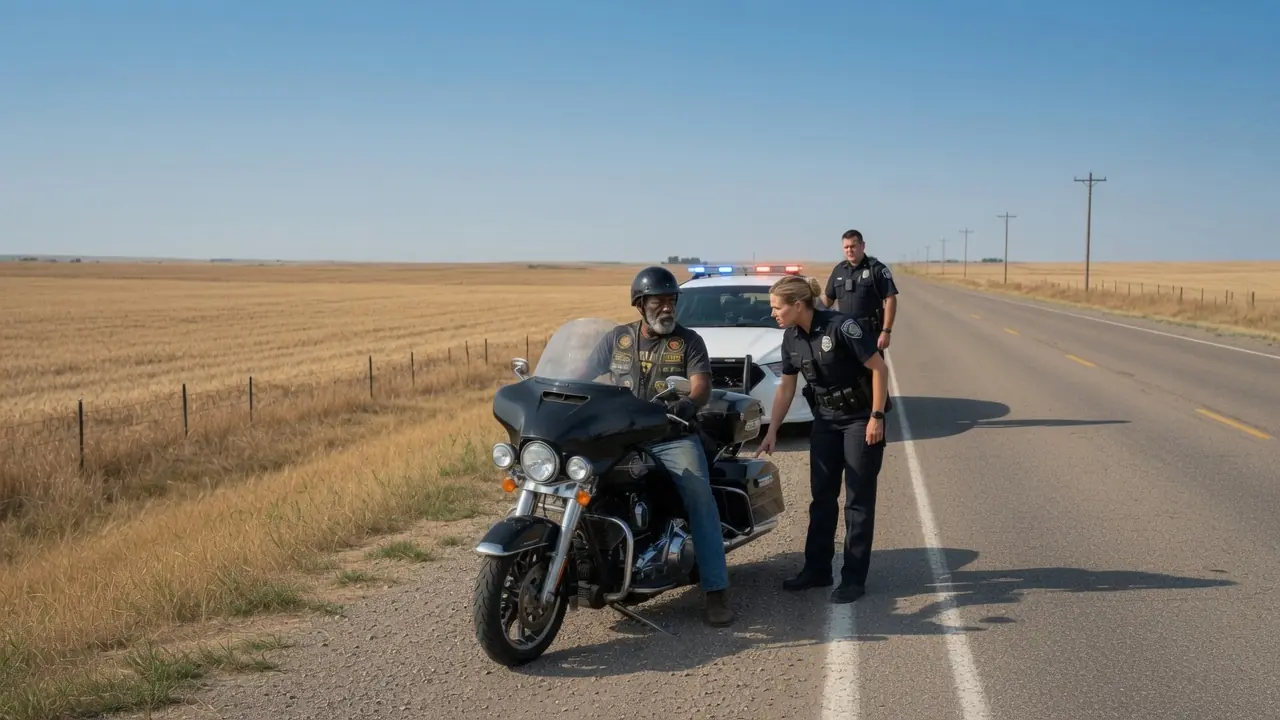
At the headquarters building, Brigadier General Rebecca Lawson looked at her watch for the third time.
“Where is he?”
A captain standing beside her checked his phone.
“Mr. Harris left his home at six fifteen. He should have arrived twenty minutes ago.”
“Did he accept the escort?”
“He declined it.”
Lawson almost smiled.
“Of course he did.”
A young major approached.
“General, the highway patrol contacted the provost marshal regarding a protected identification record.”
“Name?”
“James Franklin Harris.”
Lawson’s expression changed.
“What happened?”
“Two county officers stopped him east of the base. The dispatcher requested identity confirmation.”
“Why was he stopped?”
“We don’t know.”
Lawson turned toward her chief of staff.
“Move the convoy.”
“The ceremony convoy?”
“All of it.”
“General, that is forty vehicles.”
“He is the reason those vehicles are assembled.”
Within four minutes, the gates of Fort Kendrick opened.
Two military police motorcycles moved onto the highway.
Behind them came armored utility vehicles, transport trucks, heavy wreckers, fuel carriers, and restored vehicles from several eras of Army service.
At the center of the convoy rolled a carefully preserved olive-drab cargo truck from the Vietnam War.
Painted on its door was a small white compass.
The same compass James wore on his vest.
Officer Boyd watched the approaching convoy with growing confusion.
Military police motorcycles appeared first, blue lights flashing.
Then came two dark command vehicles, followed by trucks stretching back around the curve.
The highway patrol had already begun blocking traffic at the nearest intersection.
Boyd took a step toward his cruiser.
“Did they close the road for an exercise?”
Ruiz watched the lead vehicle slow.
“I don’t think this is an exercise.”
The first command SUV stopped on the shoulder.
A uniformed military police captain stepped out and approached.
Boyd straightened.
“This is an active county investigation.”
The captain looked at James.
“Mr. Harris, are you injured?”
“No.”
“Were you detained?”
“Temporarily.”
Boyd moved between them.
“Who are you?”
“Captain Laura Mitchell, Fort Kendrick Military Police.”
“This man is being investigated for possible stolen government property.”
Mitchell looked at the motorcycle.
Then at Boyd.
“That vehicle is not stolen.”
“How do you know?”
“Because the Department of the Army invited it to today’s ceremony.”
The second command vehicle stopped.
Brigadier General Lawson stepped out wearing her dress uniform.
Ruiz recognized the rank immediately and stood straighter.
Boyd appeared uncertain whether to salute.
Lawson walked past both officers and stopped before James.
“Sir.”
James frowned.
“You did not need to bring the entire command.”
“You were late.”
“I encountered paperwork.”
Lawson looked at the red mark forming around his wrist.
“What happened?”
James glanced toward Boyd.
“A disagreement concerning ownership and consent.”
The general turned toward Ruiz.
“Sergeant?”
Ruiz answered honestly.
“Officer Boyd initiated the stop because he believed the rear plate was obscured. The plate returned valid. He then extended the stop based on the motorcycle’s military appearance.”
“And placed hands on Mr. Harris?”
“Yes, ma’am.”
Boyd stepped forward.
“He refused a lawful inspection.”
James spoke calmly.
“I refused a warrantless search.”
Lawson looked at Boyd.
“Do you know who you stopped?”
Boyd folded his arms.
“I know his name. That doesn’t make him exempt from traffic laws.”
“No,” James said. “It does not.”
The old man looked at Lawson.
“And I would prefer we not suggest otherwise.”
The general nodded.
Then she faced the officers again.
“James Harris is today’s guest of honor at Fort Kendrick.”
Boyd glanced at the convoy.
“For what?”
Lawson pointed toward the olive-drab truck approaching behind them.
“Fifty-three years ago, then-Captain Harris commanded the 407th Transportation Company in Vietnam.”
James looked uncomfortable.
“General.”
She continued.
“His convoy was ambushed outside An Khê while carrying medical supplies and ammunition to an isolated American position.”
Boyd’s arms slowly fell to his sides.
“Enemy fire destroyed the lead vehicle and blocked the road. Captain Harris moved forward under fire, connected a disabled tractor to the wreckage, and cleared the route.”
Lawson looked toward James.
“He was wounded twice.”
Ruiz glanced at the old man’s left leg.
Lawson continued.
“After clearing the road, he discovered three trucks and seventeen soldiers were missing. He turned the surviving convoy around and went back.”
The traffic stop had become silent.
Even the engines of the arriving military vehicles seemed muted by the weight of the story.
“He recovered every surviving soldier,” Lawson said. “Then he drove the final medical truck through the night after its driver was killed.”
Boyd looked at James’s faded motorcycle.
“What does that have to do with the bike?”
James answered this time.
“The Army auctioned it after the war.”
Lawson smiled faintly.
“He used a motorcycle just like this one to carry dispatches during the early part of his service. When he found this machine at a surplus auction, he restored it with parts from several others.”
The convoy stopped completely.
Dozens of soldiers stepped from the vehicles.
Some were young.
Others wore rows of ribbons and badges.
At the center of them stood six elderly men in matching blue blazers.
James recognized them immediately.
The surviving members of the 407th.
One used a cane.
Another sat in a wheelchair.
All wore the white compass emblem.
The man in the wheelchair called from the roadside.
“Captain, you planning to keep us waiting all morning?”
James smiled for the first time since the stop began.
“You could have started without me, Walter.”
“Not after fifty-three years.”
Brigadier General Lawson turned back to Boyd.
“The Army is dedicating its new convoy-training center in Mr. Harris’s name.”
Boyd swallowed.
“I didn’t know.”
James looked at him.
“That is not the problem.”
The officer’s face tightened.
“What is?”
“You believed you did not need to know.”
Sergeant Ruiz asked James to step aside while he reviewed the stop with Captain Mitchell.
Boyd stood near the cruiser, suddenly aware that dozens of soldiers were watching him.
He looked much younger than he had fifteen minutes earlier.
James could have demanded his badge.
He could have called reporters.
He could have used the general, military police, and entire convoy as a wall of authority against the man who had embarrassed him.
Instead, he approached Boyd alone.
The officer stood rigid.
“I was doing my job.”
James looked at him.
“Were you?”
“The plate was dirty.”
“It was readable.”
“The motorcycle had military markings.”
“It was lawfully registered.”
“You would not let me search the bag.”
“You had no legal basis to search it.”
Boyd glanced toward the soldiers.
“You made me look like an idiot.”
“No.”
James’s voice remained quiet.
“You decided an old man on an old motorcycle must be suspicious. Every answer I gave became another reason to distrust me.”
“You could have told me who you were.”
“I did tell you.”
“You said transportation.”
“That was my profession.”
“You know what I mean.”
“You wanted a title important enough to make you respectful.”
Boyd looked away.
James continued.
“That is a dangerous habit for a police officer.”
“I treat everyone the same.”
“No, you don’t.”
Boyd’s eyes returned to him.
“You laughed before you asked my name.”
The officer said nothing.
“You decided the motorcycle was ridiculous. You decided my clothing meant I did not belong on the road. You decided asking for the legal basis of a search was resistance.”
James looked toward Ruiz.
“Your sergeant questioned you. Instead of reconsidering, you became angrier because you thought correction made you appear weak.”
Boyd’s jaw tightened.
“What do you want me to say?”
“The truth would be a useful beginning.”
For several seconds, only the idling engines filled the silence.
Finally, Boyd spoke.
“I thought you were some old biker looking for trouble.”
“Why?”
“The motorcycle. The vest.”
“And?”
Boyd looked at the scars on James’s hands.
“I don’t know.”
“Yes, you do.”
The officer’s shoulders lowered.
“Because I thought you were nobody.”
James nodded once.
“There it is.”
Boyd looked toward the military convoy.
“I’m sorry.”
“Are you?”
“Yes.”
“Or are you sorry because these vehicles arrived?”
Boyd did not answer.
James placed one glove on the motorcycle seat.
“An apology offered only after discovering someone’s importance is not respect. It is self-preservation.”
The words struck harder than anger would have.
Boyd stared at the pavement.
“What happens now?”
“That depends on your department.”
“You could ask the general to have me fired.”
“I could ask.”
James looked toward the convoy.
“But authority is not a toy you use because someone bruised your pride.”
He turned back to Boyd.
“Your body camera will show what happened. Your sergeant will report it. Then your supervisors will decide whether you can learn from correction.”
James placed his helmet on his head.
“But understand this: the next elderly rider you stop may not have a military convoy behind him.”
Sergeant Ruiz completed the roadside report before allowing Boyd to drive away.
He recorded that the plate was legible, the registration was valid, no traffic citation had been issued, and the detention had been prolonged without sufficient evidence of another offense.
He also documented Boyd’s attempt to search the saddlebag and the physical contact with James.
Boyd was ordered to return to the station.
Ruiz remained behind.
“I should have stopped him sooner,” he told James.
“You stopped him.”
“After he grabbed you.”
“Yes.”
“That was too late.”
James studied the sergeant.
“Too late for a perfect response.”
Ruiz looked toward the red mark on James’s wrist.
“Still late.”
James nodded.
“Then remember the feeling.”
Ruiz extended his hand.
“I’m sorry, sir.”
James shook it.
“That apology I believe.”
The military police reopened the highway.
General Lawson approached James’s motorcycle.
“Will it make it to the base?”
“It has made it farther than most people expected.”
“That describes the rider too.”
James mounted the bike.
The surviving members of the 407th waited beside the restored cargo truck.
Walter raised one hand from his wheelchair.
“You leading us in?”
James started the engine.
The old motorcycle shook beneath him, its deep uneven rhythm cutting through the sound of modern military vehicles.
“Wouldn’t have it any other way.”
The convoy entered Fort Kendrick twenty minutes late.
Thousands of soldiers and family members stood around the new training complex.
A large sign beside the entrance remained covered by a canvas sheet.
James parked the motorcycle near the stage.
He disliked ceremonies.
During his Army career, he avoided photographers whenever possible and claimed medals interfered with useful work.
Age had not changed him.
Brigadier General Lawson introduced the surviving members of the 407th first.
Each received a standing ovation.
Then she invited James forward.
He walked slowly because of his damaged knee.
The crowd saw the limp.
They did not see the night in 1971 when a young captain crawled beneath burning vehicles to attach a recovery chain.
They did not see him carrying Private Raymond Collins across his shoulders while bullets struck the road.
They did not see the three days James remained awake after the ambush because no other officer knew the mountain route.
Those memories belonged to the men on the stage.
Lawson pulled the canvas away.
The sign read:
JAMES F. HARRIS CONVOY LEADERSHIP AND SURVIVAL CENTER
Beneath it was the white compass emblem.
James looked at the name for a long moment.
Then he stepped to the microphone.
The prepared speech inside his jacket remained folded.
He looked at the young soldiers.
“This morning, I was stopped by a police officer who made several assumptions about me.”
General Lawson shifted slightly, concerned about where he was going.
James continued.
“He saw my age, my clothes, and my motorcycle. From those things, he decided he understood my character.”
The crowd became quiet.
“Then this convoy arrived, and suddenly the same facts looked different.”
He glanced toward the military vehicles.
“But nothing about me changed when those engines appeared.”
James rested both hands on the podium.
“I was not more innocent because a general knew my name. I was not more deserving of respect because soldiers came looking for me.”
Several officers standing near the stage listened closely.
James continued.
“The lesson is not that you should treat an old man carefully because he may once have commanded troops.”
His gaze moved across the audience.
“The lesson is that dignity cannot depend on whether someone has a title you recognize.”
Behind him, Walter Collins nodded from his wheelchair.
James looked toward the training vehicles.
“Convoys work because every driver matters. The first truck matters. The last truck matters. The mechanic matters. The medic matters. The private nobody remembers matters.”
His voice grew stronger.
“If you begin deciding who deserves protection based on rank, appearance, wealth, age, or usefulness, then you are no longer leading a convoy.”
He paused.
“You are only protecting yourself.”
No one applauded immediately.
The words settled over the crowd.
Then Walter began clapping.
The other veterans joined.
Within seconds, the entire training ground rose.
James stepped away from the microphone before the applause finished.
He returned to his motorcycle.
That was where he felt most comfortable.
Officer Boyd’s body-camera footage confirmed Sergeant Ruiz’s report.
The department placed Boyd on administrative duty pending review. He was required to complete additional constitutional-policing and de-escalation training.
The investigation also examined several of his earlier stops.
In two cases, supervisors found that Boyd had extended detentions after drivers questioned him, describing their confusion as suspicious behavior.
No one had previously connected the reports.
James’s complaint forced the department to look.
Boyd was not sent to prison.
He was not dramatically handcuffed in front of his colleagues.
Real accountability came more slowly.
A formal reprimand entered his permanent file.
His field responsibilities were restricted.
He lost consideration for a special traffic unit he had hoped to join.
Most importantly, he was assigned to ride with Sergeant Ruiz for six months.
Ruiz did not make those months comfortable.
Every stop began with the same question.
“What specific law did you observe being violated?”
If Boyd could not answer clearly, they did not initiate contact.
If a driver asked why they had been stopped, Boyd had to explain before demanding additional compliance.
If his tone became condescending, Ruiz corrected him immediately.
At first, Boyd believed the sergeant was humiliating him.
Later, he began to understand that correction before harm was a form of protection.
Three months after the motorcycle stop, they saw an old pickup parked beside a closed warehouse at night.
Boyd slowed the cruiser.
“Suspicious vehicle.”
“What is suspicious?” Ruiz asked.
“Closed business. Late hour.”
“Any alarm?”
“No.”
“Sign prohibiting parking?”
Boyd looked.
“No.”
“Observed crime?”
“No.”
The old Boyd would have activated the lights.
The new one continued past.
A mile later, dispatch reported that the truck belonged to the warehouse owner, who had returned to repair a broken water line.
Boyd said nothing.
Ruiz glanced at him.
“What did you learn?”
“That not knowing why someone is there is not the same as knowing they shouldn’t be.”
Ruiz nodded.
It was a beginning.
Months later, James received a letter at his farmhouse.
The return address belonged to Officer Travis Boyd.
James placed it on the kitchen table and left it unopened for two days.
When he finally read it, the letter contained no excuses.
Boyd admitted that he had laughed because the motorcycle looked old and the rider looked harmless.
He admitted that James’s questions had made him angry because he believed obedience mattered more than understanding.
He wrote about the other reports reviewed after the incident.
Then he described a recent stop involving a teenage rider on a damaged motorcycle.
The boy had no registration card because he had purchased the bike that afternoon. Instead of assuming theft, Boyd contacted the seller and confirmed the transaction.
The teenager went home with a warning about the broken taillight.
Boyd ended the letter with one sentence:
The convoy did not teach me who you were. It showed me how wrong I had been before I knew.
James folded the letter and placed it inside the left saddlebag.
Beside the Army uniform.
Beside old maps.
Beside a photograph of the 407th Transportation Company taken in 1971.
He did not write back immediately.
When he did, his reply was brief.
Officer Boyd,
A mistake becomes character only when a man protects it from correction.
Keep learning.
James F. Harris
James continued riding for two more years.
His doctor repeatedly suggested that eighty-four was an appropriate age to consider a smaller motorcycle.
James repeatedly suggested that his doctor mind his own profession.
Every spring, he rode to Fort Kendrick.
Sometimes soldiers recognized him.
Often they did not.
He preferred the latter.
He would park near the training center and watch young convoy commanders practice recovery operations, route changes, and casualty evacuations.
The motorcycle became familiar around the base.
Cadets called it the Old Compass.
On James’s final visit, a private approached him near the fuel point.
“Sir, is it true this bike was in Vietnam?”
“No.”
The private looked disappointed.
“It is the same model?”
“Close.”
“Did you really go back into an ambush for your men?”
James tightened one saddlebag strap.
“There was nowhere else useful to go.”
The private considered that.
“What made you do it?”
James looked toward a convoy preparing to leave the training yard.
The lead vehicle waited.
The rear vehicle signaled ready.
Every driver depended on the others.
“You do not leave people behind simply because the road becomes dangerous.”
The private nodded.
James added:
“And you do not decide someone matters only after discovering who they are.”
He started the motorcycle.
The engine coughed, shook, and settled into its familiar rhythm.
As he rode toward the gate, the young private saluted.
James returned the gesture.
Not because of rank.
Because respect, when offered honestly, deserved to be returned.
Years later, the old motorcycle stood inside the entrance of the Harris Convoy Leadership Center.
James had donated it before his death under one condition.
It could not be polished until every scar disappeared.
The faded paint remained.
So did the worn saddlebags, the cracked seat, and the place where Officer Boyd had rested one hand while questioning whether the machine belonged to James.
Beside it stood a small plaque.
It did not list James’s medals.
It did not describe the ambush or the soldiers he saved.
The inscription contained only words from his dedication speech:
NOTHING ABOUT A PERSON CHANGES WHEN POWERFUL PEOPLE ARRIVE TO CONFIRM HIS WORTH.
Every new class read the sentence before beginning convoy training.
Some understood immediately.
Others needed time.
That was true of most important lessons.
On the morning of the traffic stop, Officer Travis Boyd believed he had pulled over an insignificant old man riding a suspicious motorcycle.
Then a military convoy appeared over the ridge.
Its arrival did not transform James Harris into someone worthy of patience, dignity, or lawful treatment.
It revealed that he had deserved those things before the first engine was heard.
The convoy did not change who stood beside the highway.
It only forced everyone else to see him.