Olivia Foster arrived at the Ridgemont County Sheriff’s Department at 7:43 on a gray Monday morning. She parked in the public lot, not the staff lot, and walked through the glass front doors like any civilian coming in with a complaint. She wore a plain navy blazer, a white blouse, dark trousers, and low black shoes. In her left hand, she carried a leather portfolio that held the letter no one inside that building had seen yet.
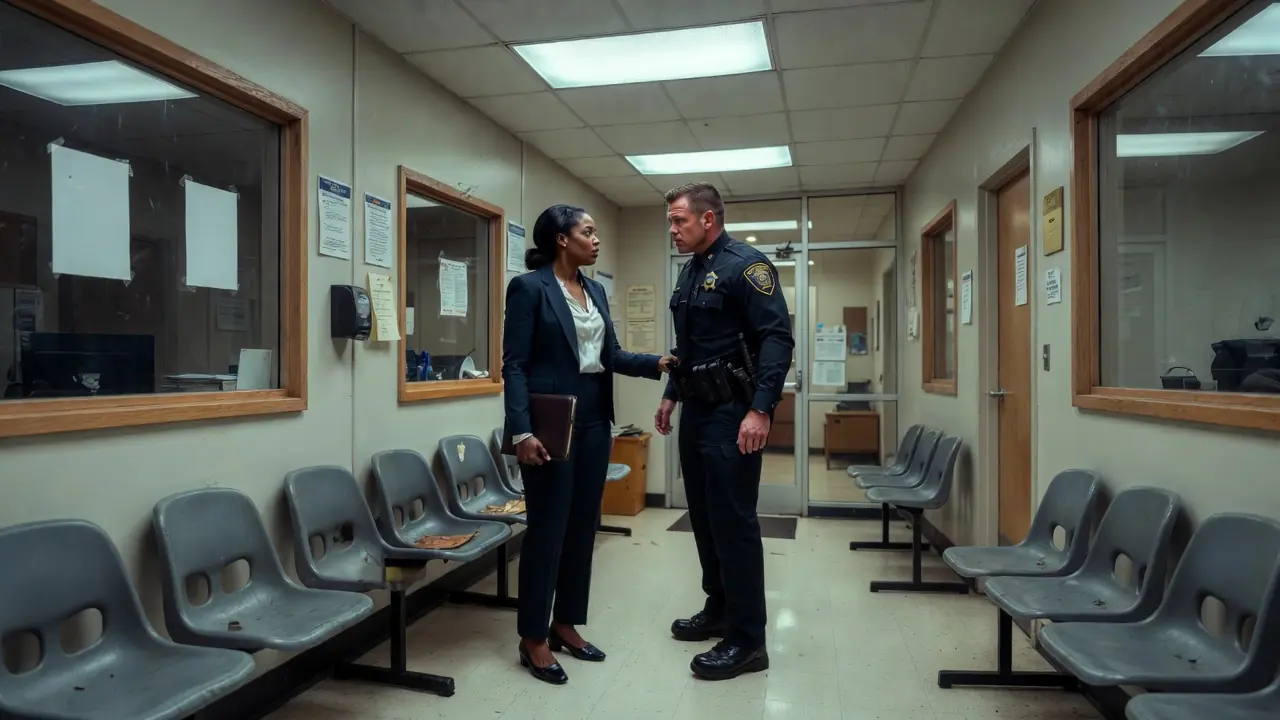
The lobby looked exactly the way she expected it to look. Scuffed linoleum floors. Buzzing fluorescent lights. A bulletproof reception window with a clerk sitting behind it, barely looking up. A row of cracked plastic chairs ran along one wall, and faded county notices curled at the edges on a corkboard near the entrance.
Olivia had been in law enforcement for eighteen years. She had worked narcotics, internal affairs, and community policing across two states. She had a master’s degree in criminal justice from Howard University and a reputation for finding rot where other people only saw routine. She was not lost, confused, or wandering. She was exactly where she was supposed to be.
But that morning, no one in the lobby knew that. That was intentional. Mayor Patricia Coleman had hired Olivia as the new captain of the Ridgemont County Sheriff’s Department, but the announcement was still confidential. The mayor wanted Olivia to walk in without a title first. She wanted her to see how the department treated people when they did not know power was watching.
Ridgemont County had been in trouble for years. Civilian complaints were rising. Use-of-force reviews were a mess. A state audit had flagged patterns that community leaders had been shouting about long before anyone in government admitted they existed. The previous captain had retired early, leaving behind a department that smiled for cameras and bled trust in private.
Olivia had accepted the job because she knew departments like this could not be fixed from press conferences. They had to be opened up from the inside. She also knew that the first few minutes inside a building often told more than any official report. A lobby was never just a lobby. It was where a department showed the public who mattered.
She took three steps toward the reception window before the staff entrance opened behind her. Two officers came through, laughing about something from the parking lot. The first was Derek Sullivan, a forty-four-year-old white deputy with a broad muscular build, short sandy hair, hard blue eyes, and the kind of swagger that made his uniform look less like public service and more like ownership. Behind him was Officer Craig Benson, younger, quieter, and used to following Sullivan’s lead.
Sullivan noticed Olivia immediately. He stopped walking, coffee cup still in one hand. His eyes moved over her face, her blazer, her portfolio, and her shoes. He did not ask if she needed help. He did not ask whether she had an appointment. He simply saw a Black woman in plain clothes standing in the middle of his lobby and decided she did not belong.
“You need to turn around,” Sullivan said. His voice was flat and hard. Olivia turned to face him, calm and steady. “Good morning,” she said. “I have a meeting here.” Benson smirked behind Sullivan’s shoulder, already entertained by a scene that had not yet fully begun.
“A meeting?” Sullivan repeated, letting the word stretch with mockery. “In this building?” Olivia held his gaze. “Yes.” Sullivan stepped closer, close enough that the space between them became less like a conversation and more like a warning. “This station isn’t a place for people who wander in looking for trouble.”
Olivia did not step back. “I have every right to be here.” That sentence changed the temperature in the room. Sullivan was used to people shrinking when he leaned into them. He was used to frightened apologies, lowered eyes, and quick exits. Olivia gave him none of that.
Behind the reception window, the clerk froze. Her name was Carol, and she had worked that desk for nine years. She had seen Sullivan talk to people this way before, though usually not this openly, not this early in the morning, not in front of someone who stood so still. Carol’s hand hovered near the phone, then dropped. She looked down at her desk as if paperwork could make her invisible.
On the waiting bench, a civilian named Denise Harper sat holding a small folder of papers. She had come to file a noise complaint about a neighbor, but now her attention was locked on the scene near the reception window. Slowly, carefully, she slipped her phone from her purse and placed it on her lap. She did not raise it high. She only pressed record.
Sullivan moved closer to Olivia and pointed one finger near her shoulder. “You don’t give orders here,” he said. “You wait outside until someone decides you matter.” Olivia’s expression remained composed, but her eyes sharpened. “Take a step back, officer.” Benson gave a short laugh under his breath. Sullivan’s face hardened.
Instead of stepping back, Sullivan grabbed the edge of Olivia’s blazer sleeve and yanked her half a step toward the glass doors. It was not a brutal strike, but it was forceful, humiliating, and deliberate. Olivia pulled her arm free at once. “Take your hand off me,” she said, her voice still controlled. Sullivan’s jaw tightened, because her calm made his anger look smaller.
He stepped into her space again and shoved her backward with one firm hand against her upper arm. Olivia caught herself against the edge of a waiting-room chair, her portfolio slipping slightly in her grip. The chair scraped loudly across the linoleum. The sound seemed to cut through the lobby. For one second, everyone stopped breathing.
Olivia straightened slowly. Her face showed no fear. No panic. No pleading. Only focus. She looked at Sullivan the way an investigator looks at a man who has just created evidence without realizing it.
Sullivan leaned toward her with a cold, contemptuous stare. “You should learn when to walk out quietly,” he said. “People who don’t belong here usually make things worse for themselves.” It was not the ugliest thing he could have said, but everyone understood the meaning underneath it. He wanted her to feel small. He wanted her to feel outside the building before he ever opened the door.
Olivia said nothing for three seconds. She simply held his gaze. Then she looked at Benson, at Carol behind the glass, at the waiting bench, at the camera in the upper corner of the lobby, and back at Sullivan. She was recording it all in her mind: time, position, witnesses, body language, words, escalation. This was no longer her first day. This was her first case.
Sullivan thought her silence meant defeat. He lifted his coffee and took a slow sip, satisfied. “That’s what I thought,” he muttered. Olivia adjusted her portfolio, turned without another word, and walked toward the glass doors. She did not hurry. She did not stumble. She left the station the way she entered it, with her spine straight.
The moment she stepped outside, Sullivan turned to Benson and laughed. “Let’s go,” he said, as if nothing had happened. Benson followed him through the staff door into the bullpen. Carol finally exhaled behind the reception window. Denise Harper looked down at her phone, stopped the recording, and stared at the file as if she were holding something dangerous.
From Sullivan’s point of view, the incident was over. A woman had come in, challenged him, and left. He did not file a report. He did not tell a supervisor in any official way. He entered the bullpen and turned the story into a joke before the coffee in his cup had gone cold.
“Some woman wandered in acting like she owned the place,” he told three officers near the desks. “Had to show her the door.” Benson added, “She had attitude too.” The room laughed easily, comfortably, the way rooms laugh when cruelty has been normalized. One person did not laugh. Officer Tanya Williams sat at her desk, eyes lowered, jaw tight.
Tanya had been with the department six years. She knew Sullivan’s reputation. She knew Benson followed him like a shadow, and she knew Sergeant Nathan Moore protected them both whenever complaints appeared. Tanya had learned that speaking up in Ridgemont did not make a person brave in the eyes of leadership. It made them inconvenient. And inconvenient officers lost shifts, assignments, and support.
But that morning felt different. Tanya could not explain why. Maybe it was the way Sullivan spoke too loudly, too proudly. Maybe it was the way Benson laughed a little too hard. Maybe it was the way no report appeared in the system after something clearly happened in the lobby. Whatever it was, something inside her refused to settle.
Outside, Olivia sat in her car in the public lot. Both hands rested on the steering wheel. She looked at herself in the rearview mirror. Her sleeve was wrinkled where Sullivan had grabbed it, and the back of her arm ached where he had shoved her. The contact had not seriously hurt her, but that was not the point. The point was authority being used to humiliate, intimidate, and erase.
She took photographs of her sleeve, her arm, and the slight red mark where his fingers had gripped the fabric. Then she opened her portfolio and pulled out a pen. On a clean sheet of paper, she wrote the time: 7:43 a.m. She wrote the description of the lobby, the officer’s name from his uniform, the presence of Benson, the clerk, and the civilian on the bench. She wrote every word she remembered.
Her handwriting stayed even. Clinical. Precise. Internal affairs work had taught her that emotion could come later. Documentation came first. She had taken statements from victims who shook while telling the truth. Now she was writing her own statement with the discipline she had once asked of others.
When she finished, she picked up her phone and called Mayor Patricia Coleman. The mayor answered on the second ring. Olivia said only six words. “Patricia, I’ve seen enough.” The mayor went silent for a breath. Then she asked, “How bad?” Olivia looked through the windshield at the station. “Bad enough to move up the announcement.”
The mayor wanted to act immediately. Olivia stopped her. “Not yet,” she said. “If we move emotionally, they call it politics. If we move by evidence, they have nowhere to hide.” Patricia Coleman understood. She had hired Olivia for exactly that kind of discipline. By the end of the call, the plan changed. The announcement would happen the next morning at 8:00 sharp.
Olivia did not go home because home was not in Ridgemont yet. She returned to her hotel room and turned it into a command post. She photographed her arm again under better lighting. She typed a formal incident memo from her handwritten notes. She saved everything twice and sent a copy to a secure account. Then she opened the appointment letter signed by the mayor and read the first line one more time.
Captain Olivia Foster. Effective immediately upon public announcement. She folded the letter and placed it back into the portfolio. Then she called her teenage daughter. Her daughter answered sleepily and immediately heard something in her mother’s voice. “Mom, did something happen?” Olivia paused. “Something happened,” she said. “But tomorrow something bigger is going to happen.”
At 6:00 the next morning, every inbox inside the Ridgemont County Sheriff’s Department received an email from the mayor’s office. Mandatory all-hands assembly. 0800 hours. No exceptions. Sullivan read it in the locker room and shrugged. “Probably another diversity lecture,” he said to Benson. Benson laughed, but his laugh was thinner than usual.
Sergeant Nathan Moore read the same email in his office and did not laugh. He was fifty-six, with thinning gray hair, wire-framed glasses, and twenty years of experience surviving department politics. He had supervised Sullivan for years. Every complaint against Sullivan had crossed Moore’s desk. Every one had vanished under words like unfounded, insufficient evidence, and no further action.
Moore did not know what the assembly was about, but something in his stomach tightened. The mayor did not usually call mandatory meetings directly. Not without warning. He looked at the email again, then at the closed door of his office. For the first time in a long while, Nathan Moore wondered whether something had slipped beyond his control.
At 8:00, the briefing room was full. Sixty officers, detectives, clerks, and staff sat in metal chairs under harsh fluorescent lights. The room smelled like burnt coffee and dry erase markers. Conversations bounced against the cinderblock walls. Most people looked bored. A few looked irritated.
Sullivan sat in the third row with Benson beside him. He leaned back with arms crossed, still comfortable in his own importance. Moore stood near the back wall instead of sitting, his eyes fixed on the side door. Tanya Williams sat alone on the far side of the room. Her phone was in her pocket, holding a screenshot she had taken the night before: the lobby incident log, completely empty.
Mayor Coleman entered first. She wore a dark suit, carried a folder, and did not smile. Two aides followed her, but she walked straight to the podium without greeting anyone. The conversations died row by row. Sullivan muttered something to Benson, but even he quieted when the mayor looked over the room.
“Thank you for being here,” Coleman said. “I’ll keep this brief.” Her voice was steady, official, and cold enough to make people sit straighter. “As you know, this department has been without permanent leadership since Captain Ellis retired. That ends today.” A few officers shifted in their seats.
Coleman continued. “After a national search, I have selected a new captain for this department. This individual brings eighteen years of law enforcement experience across two states, including internal affairs, narcotics, and community-centered policing.” Sullivan looked down at his phone, already bored. Benson nudged him when the mayor’s tone sharpened. “This department has lost public trust. The person I’ve chosen was selected because she has the independence and backbone to rebuild it.”
The word backbone hung in the room. Moore’s jaw tightened. Tanya sat up slightly. Coleman looked at the side door and said, “Please welcome your new captain, Olivia Foster.” The door opened.
Olivia walked in wearing a full dress uniform. Her captain’s bars caught the light. Her badge was polished, her nameplate read Foster, and her posture was straight enough to make the entire room go still. She carried the same leather portfolio in her left hand. Yesterday it had looked like a civilian’s folder. Today it looked like authority.
Sullivan saw her when she reached the center aisle. At first, recognition came slowly. A face. A shape. A memory from the lobby. Then it hit him all at once. His hands gripped the armrests. The color drained from his face. Benson saw it too, and the smirk disappeared from his mouth.
That was her. The woman from the lobby. The woman Sullivan had grabbed, shoved, mocked, and pushed toward the door. She was walking toward the podium in a captain’s uniform, introduced by the mayor as the new commanding officer. Sullivan stopped breathing for a moment. Benson stared at the floor.
Olivia reached the podium and nodded once to the mayor. Then she faced the room. Sixty people looked back at her. Some were curious. Some were confused. A few had already understood enough to feel fear. Olivia did not smile.
“I’m not here to make friends,” she said. “I’m here because this department has lost the trust of the people it is supposed to protect.” The room stayed silent. “My job is to rebuild that trust from the inside out.” She paused, letting the sentence settle. Then she added, “I have already seen how some of you operate when you think no one important is watching.”
She did not look at Sullivan. She did not have to. The sentence found him anyway. His throat moved as he swallowed. Moore remained against the back wall, but the stillness in his face had changed. Yesterday’s silence had returned with a uniform and a title.
“Starting today,” Olivia continued, “every complaint will be reviewed. Every use-of-force incident will be documented. Every civilian interaction in this building will reflect the standards of this badge.” She tapped her chest once. “I expect professionalism. I expect accountability. I expect it immediately.” No one applauded when she finished. The silence was too heavy for applause.
After the assembly, officers left in clusters. Sullivan found Benson in the hallway and grabbed his sleeve. His voice was low and cracked. “That was her.” Benson looked at him. “I know.” Sullivan’s eyes darted toward Moore’s office. “We need to talk to Moore. Now.” Benson did not answer, because there was nothing useful left to say.
Olivia’s first official act as captain was not a tour or a meet-and-greet. It was a preservation order. Within one hour, she placed a department-wide hold on all security footage from the previous seventy-two hours. Every camera, every hallway, every lobby angle, every second. No overrides. No deletions. No exceptions.
She knew the system ran on a forty-eight-hour loop. She had read the technical manual before she ever arrived. That meant the lobby footage was already on a countdown. Moore received the preservation order before lunch and walked into Olivia’s office with controlled concern. “Captain, is this necessary?” he asked. Olivia looked up. “Yes.”
“With respect,” Moore said, “we’ve never done a blanket hold like this. It may raise questions.” Olivia closed the folder in front of her. “Is there a reason you would prefer the footage not be preserved?” Moore’s mouth opened, then closed. For three seconds, silence answered for him. Then he turned and left.
The next morning, James Caldwell arrived from the state capital. He was an internal affairs investigator with twenty-two years of experience and no loyalty to Ridgemont County. Olivia had worked with him once on a corruption case and trusted him to follow evidence wherever it led. They met in her office with the door closed. She handed him the portfolio containing her notes, photos, and timeline.
Caldwell read everything without interruption. When he finished, he looked at her carefully. “You’re the complainant and a witness,” he said. “You cannot be involved in the investigation.” Olivia nodded. “That’s why you’re here.” She told him he would report his findings to her and the mayor at the same time. She would not sit in on interviews, influence witnesses, or review partial conclusions.
Caldwell began with the lobby footage. The camera had no audio, but it showed enough. Sullivan approaching. Sullivan closing the distance. The sleeve grab. The shove. Olivia catching herself against the chair. Olivia leaving. Sullivan and Benson walking away like nothing important had happened.
Then Caldwell found Denise Harper. Her phone recording had audio. It captured Sullivan’s opening demand, the mocking remarks, Olivia’s calm responses, the physical contact, and the silence afterward. It also captured tone, which mattered more than Sullivan would ever admit. Denise handed over the video willingly. “I didn’t know if anyone would care,” she said. Caldwell answered, “I care. That’s why I’m here.”
Tanya Williams came forward next. She requested a private interview and sat across from Caldwell with her hands folded. “I’ve been here six years,” she said. “I’ve seen Sullivan do versions of this before.” She described prior incidents, the way complaints disappeared, the way Moore protected certain officers, and the way people learned to stay quiet. Then she showed Caldwell the screenshot of the empty incident log.
“Why now?” Caldwell asked. Tanya did not hesitate. “Because someone finally walked into this building who might do something about it.” Her statement became part of the file. It changed the investigation from a single incident into a pattern. Caldwell knew the difference. One incident could be minimized. A pattern could not.
Sullivan came in for his interview with the union representative. He began with a rehearsed statement. He claimed Olivia was unidentified, refused to leave, and had been guided toward the exit with minimum necessary contact. Caldwell let him talk. Then he played the lobby footage. Sullivan watched with a stiff face. “That’s what I said,” he muttered. “Minimum necessary.”
Then Caldwell played Denise Harper’s recording. The room changed. Sullivan heard his own voice, his own contempt, his own words stripped of excuse. His hands tightened on the table. His union representative leaned toward him and whispered urgently. Caldwell paused the recording and asked, “Would you like to revise your statement?” Sullivan said nothing.
Benson’s interview was different. Without Sullivan in the room, he looked smaller. He started with the same script, then began to crumble as Caldwell laid out the footage and witness statements. “You were three feet away,” Caldwell said. “You saw the contact. You heard the words. You did nothing.” Benson asked for a break. When he returned, he admitted the obvious. “I should have stopped him,” he said.
Moore’s records completed the picture. Every complaint against Sullivan over several years had gone through Moore’s desk. Every one had been closed quickly, with minimal documentation and no meaningful follow-up. Caldwell also found something worse: a late-night text from Moore to the outgoing captain, telling him not to rush in the next morning. The outgoing captain was the only person inside the department who knew Olivia was arriving.
Maybe Moore knew exactly who she was. Maybe he only wanted the lobby clear of oversight. Either way, the message looked like interference, and the timing made it impossible to ignore. Caldwell’s report sustained findings against Sullivan, Benson, and Moore. Sullivan for excessive force, discriminatory conduct, and failure to report. Benson for failure to intervene. Moore for supervisory misconduct, complaint suppression, and interference with operations.
The disciplinary hearing happened nine days after the lobby incident. No cameras, no press, no audience. Just a closed room on the second floor with Olivia at the head of the table, Mayor Coleman beside her, and Caldwell’s report open in front of them. Sullivan entered in uniform, though it would be the last time he wore it in that building. His face was blank, but his eyes had lost their arrogance.
Caldwell presented the findings. The footage played one last time. Sullivan’s attorney asked for suspension, counseling, and a chance at rehabilitation. Olivia listened without expression. When the attorney finished, she spoke. “Officer Sullivan, based on the sustained findings, you are terminated effective immediately.”
Sullivan sat motionless. Olivia continued. His file would be sent to the state licensing board and the district attorney for further review. He unclipped his badge, placed it on the table, and walked out without looking at her. Moore came next. He was stripped of rank, suspended without pay, and every complaint he had supervised in the past five years was reopened for independent review.
Benson was last. His cooperation spared him termination, but not discipline. Olivia suspended him without pay for sixty days, ordered retraining, and placed him under two years of supervised probation. Then she said what mattered most. “You had a choice in that lobby. You saw what was happening. You could have stopped it. You didn’t.”
Benson looked down. “I’m sorry, Captain,” he said, voice cracking. Olivia nodded once. That was all. The hearing ended, but the work had just begun.
Within two weeks, Olivia launched a full reform package. Public-area body cameras were installed. Use-of-force documentation had to be filed within one hour of any physical contact. Civilian complaints went to an independent review board, not a sergeant’s desk. Bias training moved outside the department, led by external facilitators who did not owe favors to anyone in the room.
Some officers resented her. Some transferred out. Some stayed quiet and waited to see whether she would last. But others began to change because the rules finally meant something. Tanya Williams was promoted to sergeant and tasked with helping rebuild internal reporting culture. Denise Harper received a formal letter of apology and thanks from the department. She pinned it to her refrigerator.
Six months later, the Ridgemont County Sheriff’s Department still looked like the same building from outside. Same glass doors. Same worn floors. Same fluorescent lights. But inside, the lobby felt different. There was a civilian liaison desk near the entrance, a posted code of conduct on the wall, and a visible complaint box that actually got checked. Officers greeted people when they walked in.
One evening, Olivia stood near the reception window after most of the building had emptied. She looked at the waiting chair where she had caught herself that first morning. She looked at the spot where Sullivan had blocked her path. She felt no triumph. What she felt was quieter than that. Proof.
The worst minute of her first day had become the first evidence of everything that needed to change. She had walked in as a civilian and been treated like a problem. She returned as captain and made sure the truth could no longer be buried. Then she stepped through the same front doors, this time on her own terms, and walked into the evening air.
The department was not fixed in one day. No broken culture ever is. But a door had opened. Tanya had walked through it. Denise had walked through it. Others would follow because courage, once visible, becomes harder to ignore.
Olivia Foster had not come to Ridgemont County to be liked. She came to make the badge mean what it was supposed to mean. And every officer who watched her work learned the same lesson Derek Sullivan learned too late. Power does not belong to the loudest person in the lobby. It belongs to the person still standing when the truth arrives.